lock JEEP PATRIOT 2007 1.G Owner's Manual
[x] Cancel search | Manufacturer: JEEP, Model Year: 2007, Model line: PATRIOT, Model: JEEP PATRIOT 2007 1.GPages: 440, PDF Size: 7.26 MB
Page 33 of 440
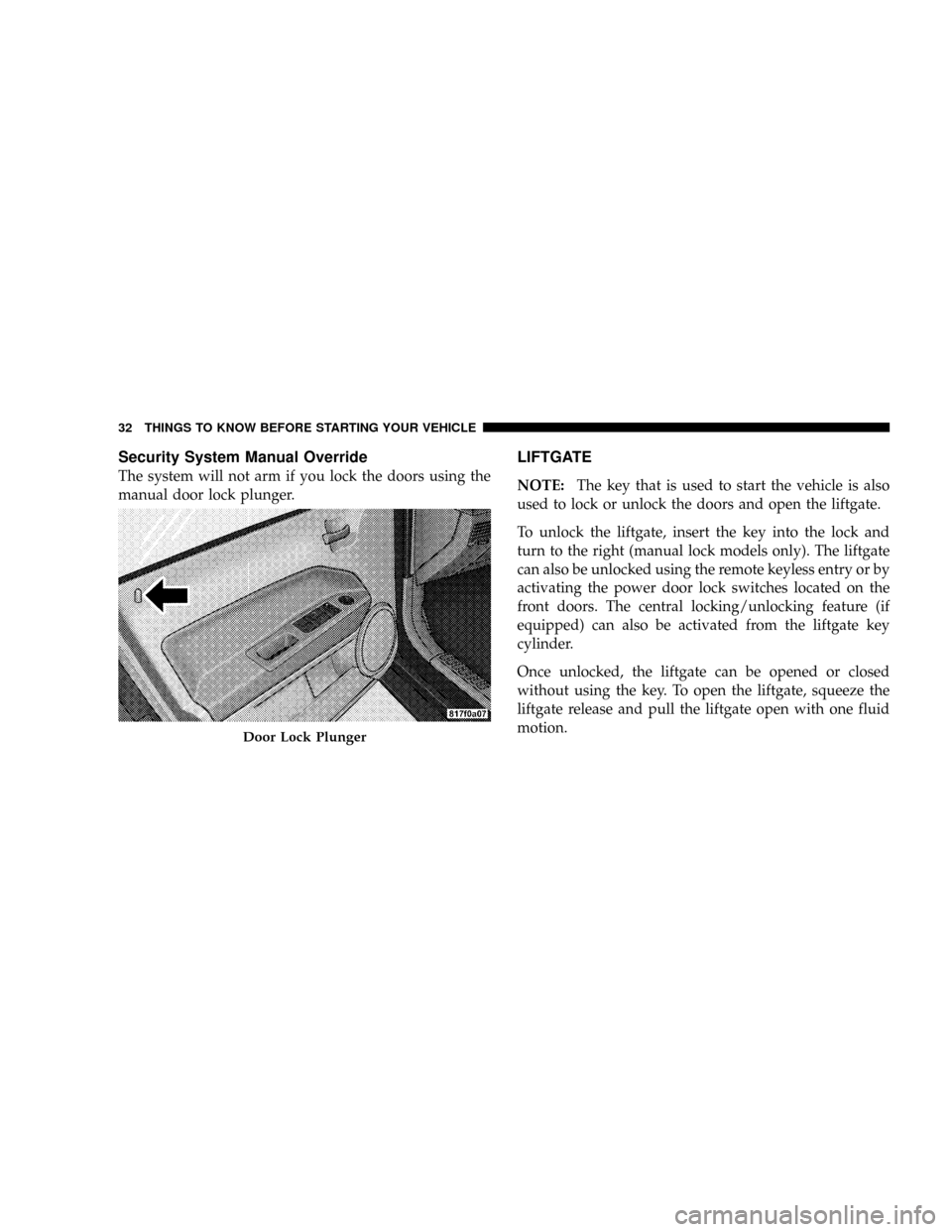
Security System Manual Override
The system will not arm if you lock the doors using the
manual door lock plunger.
LIFTGATE
NOTE:The key that is used to start the vehicle is also
used to lock or unlock the doors and open the liftgate.
To unlock the liftgate, insert the key into the lock and
turn to the right (manual lock models only). The liftgate
can also be unlocked using the remote keyless entry or by
activating the power door lock switches located on the
front doors. The central locking/unlocking feature (if
equipped) can also be activated from the liftgate key
cylinder.
Once unlocked, the liftgate can be opened or closed
without using the key. To open the liftgate, squeeze the
liftgate release and pull the liftgate open with one fluid
motion.
Door Lock Plunger
32 THINGS TO KNOW BEFORE STARTING YOUR VEHICLE
Page 34 of 440
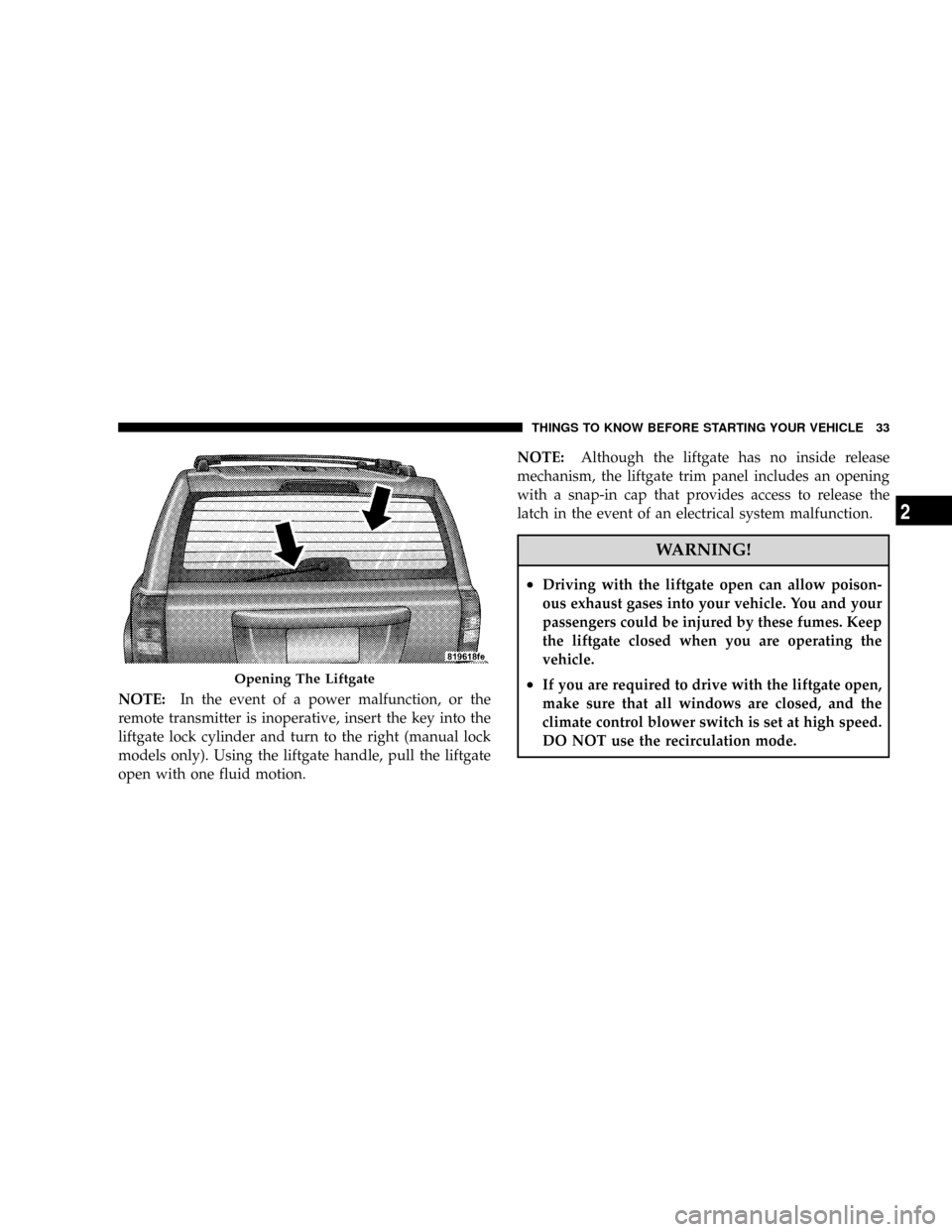
NOTE:In the event of a power malfunction, or the
remote transmitter is inoperative, insert the key into the
liftgate lock cylinder and turn to the right (manual lock
models only). Using the liftgate handle, pull the liftgate
open with one fluid motion.NOTE:Although the liftgate has no inside release
mechanism, the liftgate trim panel includes an opening
with a snap-in cap that provides access to release the
latch in the event of an electrical system malfunction.
WARNING!
²Driving with the liftgate open can allow poison-
ous exhaust gases into your vehicle. You and your
passengers could be injured by these fumes. Keep
the liftgate closed when you are operating the
vehicle.
²If you are required to drive with the liftgate open,
make sure that all windows are closed, and the
climate control blower switch is set at high speed.
DO NOT use the recirculation mode.Opening The Liftgate
THINGS TO KNOW BEFORE STARTING YOUR VEHICLE 33
2
Page 37 of 440
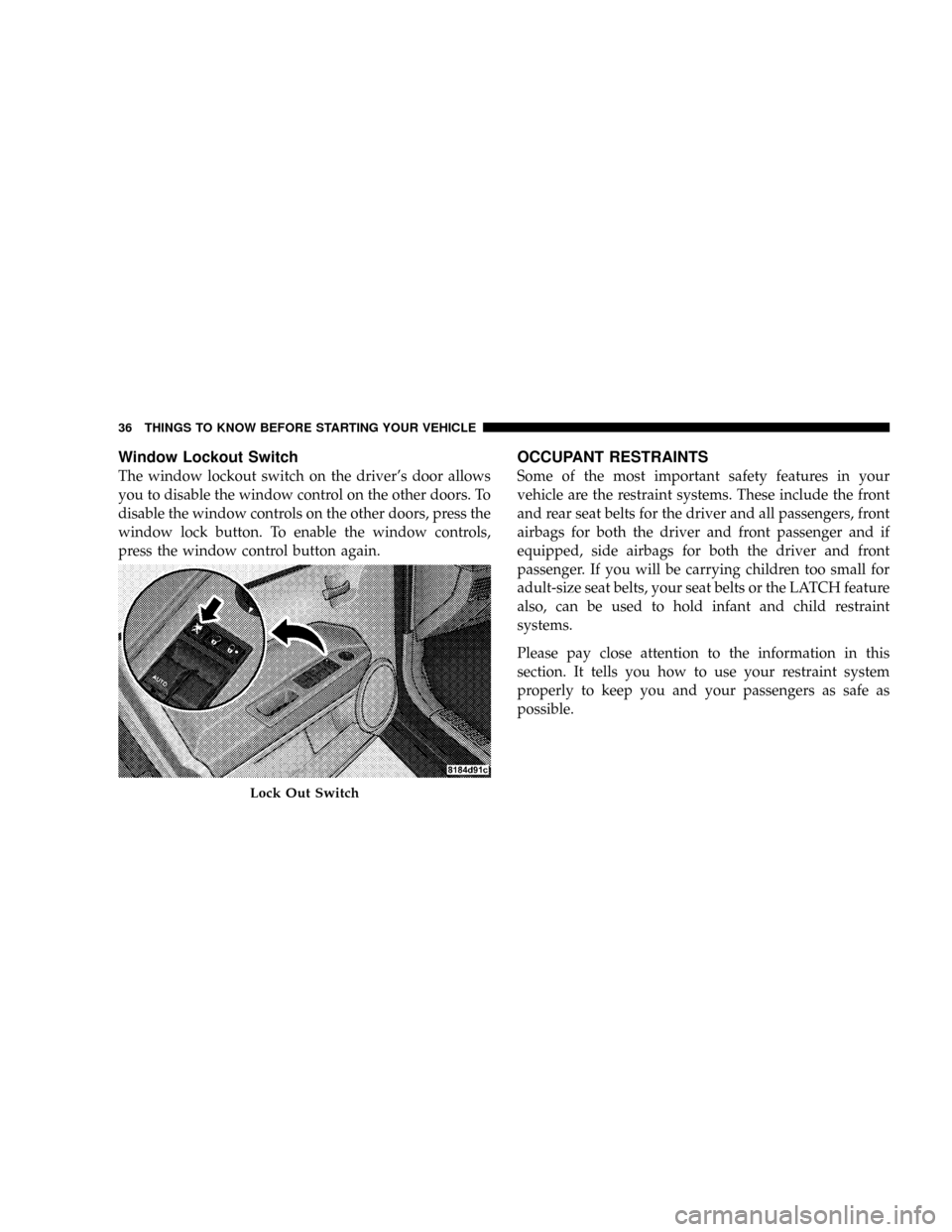
Window Lockout Switch
The window lockout switch on the driver's door allows
you to disable the window control on the other doors. To
disable the window controls on the other doors, press the
window lock button. To enable the window controls,
press the window control button again.
OCCUPANT RESTRAINTS
Some of the most important safety features in your
vehicle are the restraint systems. These include the front
and rear seat belts for the driver and all passengers, front
airbags for both the driver and front passenger and if
equipped, side airbags for both the driver and front
passenger. If you will be carrying children too small for
adult-size seat belts, your seat belts or the LATCH feature
also, can be used to hold infant and child restraint
systems.
Please pay close attention to the information in this
section. It tells you how to use your restraint system
properly to keep you and your passengers as safe as
possible.
Lock Out Switch
36 THINGS TO KNOW BEFORE STARTING YOUR VEHICLE
Page 38 of 440
WARNING!
In a collision, you and your passengers can suffer
much greater injuries if you are not properly buckled
up. You can strike the interior of your vehicle or other
passengers, or you can be thrown out of the vehicle.
Always be sure you and others in your vehicle are
buckled up properly.
Buckle up even though you are an excellent driver, even
on short trips. Someone on the road may be a poor driver
and cause a collision that includes you. This can happen
far away from home or on your own street.
Research has shown that seat belts save lives, and they
can reduce the seriousness of injuries in a collision. Someof the worst injuries happen when people are thrown
from the vehicle. Seat belts reduce the possibility of
ejection and the risk of injury caused by striking the
inside of the vehicle.Everyonein a motor vehicle should
be belted at all times.
Lap/Shoulder Belts
All the seats in your vehicle are equipped with Lap/
Shoulder Belts.
The belt webbing retractor is designed to lock during
very sudden stops or collisions. This feature allows the
shoulder part of the belt to move freely with you under
normal conditions. But in a collision, the belt will lock
and reduce the risk of your striking the inside of the
vehicle or being thrown out.
THINGS TO KNOW BEFORE STARTING YOUR VEHICLE 37
2
Page 44 of 440
As a guide, if you are shorter than average, you will
prefer a lower position, and if you are taller than average,
you'll prefer a higher position. When you release the
anchorage, try to move it up or down to make sure that
it is locked in position.
Second Row Center Lap/Shoulder Belt Operating
Instructions
The second row center lap/shoulder belt features a three
point seat belt with a mini latch and buckle, which allows
the shoulder belt to detach from the lower anchor when
the seat is folded. The mini buckle and shoulder belt can
then be stored out of the way in the right side trim panel
for added convenience.
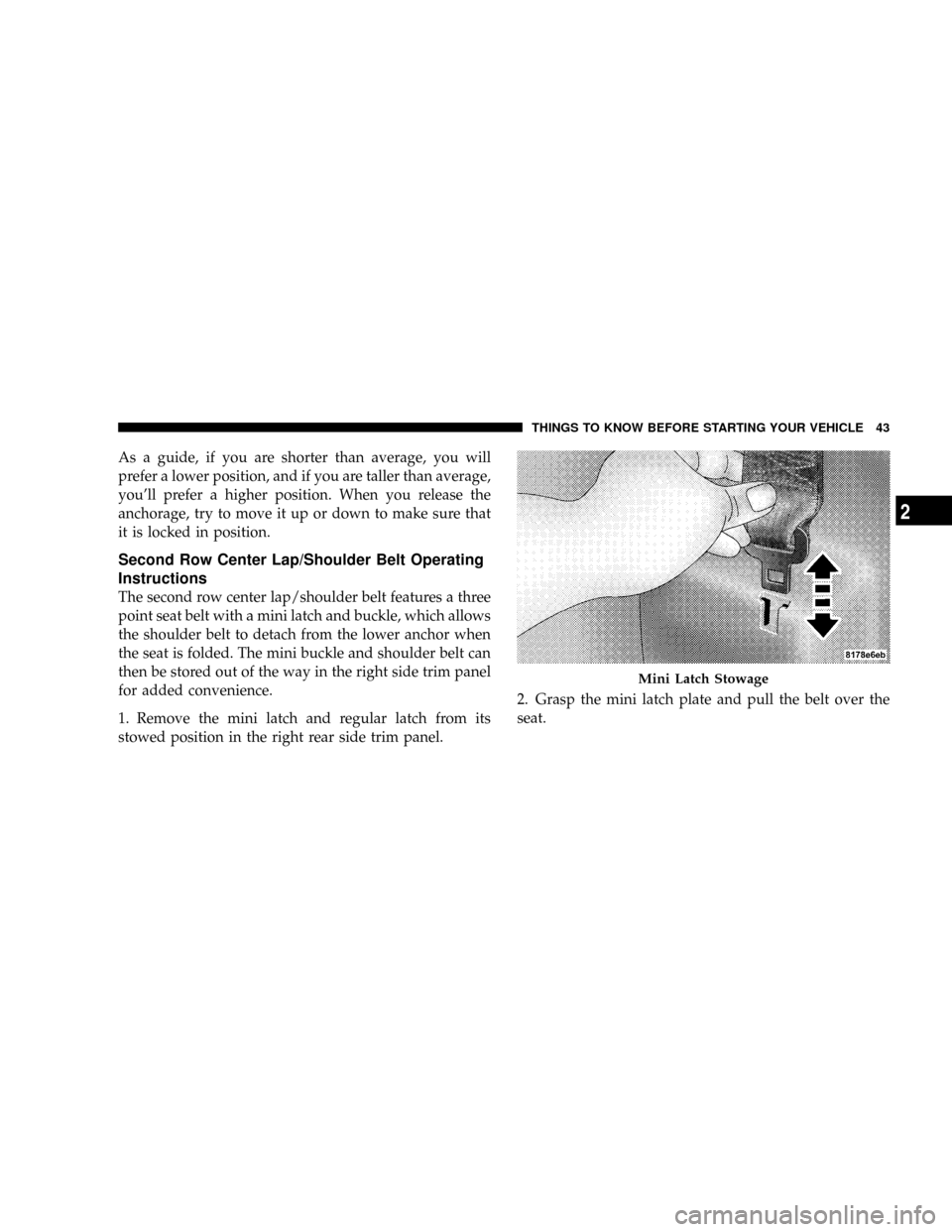
1. Remove the mini latch and regular latch from its
stowed position in the right rear side trim panel.2. Grasp the mini latch plate and pull the belt over the
seat.
Mini Latch Stowage
THINGS TO KNOW BEFORE STARTING YOUR VEHICLE 43
2
Page 48 of 440
items. After a collision that is severe enough to deploy
the airbags and pretensioners, both must be replaced.
Enhanced Driver Seat Belt Reminder System
(BeltAlert)
If the driver's seat belt has not been buckled within 60
seconds of starting the vehicle and if the vehicle speed is
greater than 5 mph (8 km/h), the Enhanced Warning
System (BeltAlert) will alert the driver to buckle their seat
belt. The driver should also instruct all other occupants to
buckle their seat belts. Once the warning is triggered, the
Enhanced Warning System (BeltAlert) will continue to
chime and flash the Seat Belt Warning Light for 96
seconds or until the driver's seat belt is buckled. The
Enhanced Warning System (BeltAlert) will be reactivated
if the driver's seat belt is unbuckled for more than 10
seconds and the vehicle speed is greater than 5 mph (8
km/h).The Enhanced Warning System (BeltAlert) can be en-
abled or disabled by your authorized dealer or by
following these steps:
NOTE:The following steps must occur within the first
60 seconds of the ignition switch being turned to the ON
or START position. DaimlerChrysler does not recom-
mend deactivating the Enhanced Warning System
(BeltAlert).
1. Turn the ignition switch to the LOCK position and
buckle the driver's seat belt.
2. Turn the ignition switch to the ON position and wait
for the Seat Belt Warning Light to turn off.
3. Within 60 seconds of turning the ignition switch to the
ON position, unbuckle and then re-buckle the driver's
seat belt at least three times within 10 seconds, ending
with the seat belt buckled.
THINGS TO KNOW BEFORE STARTING YOUR VEHICLE 47
2
Page 49 of 440
NOTE:Watch for the Seat Belt Warning Light to turn on
while unbuckling and off while re-buckling the seat belt.
It may be necessary to retract the seat belt.
4. Turn the ignition switch to the LOCK position. A
single chime will sound to signify that you have success-
fully completed the programming.
The Enhanced Warning System (BeltAlert) can be reacti-
vated by repeating this procedure.
NOTE:Although the Enhanced Warning System
(BeltAlert) has been deactivated, the Seat Belt Warning
Light will continue to illuminate while the driver's seat
belt remains unbuckled.
Seat Belt Extender
If a seat belt is too short, even when fully extended, and
when the adjustable upper shoulder belt anchorage (if soequipped) is in its lowest position, your dealer can
provide you with a seat belt extender. This extender
should be used only if the existing belt is not long
enough. When it is not required, remove the extender,
and store it.
WARNING!
Using a seat belt extender when not needed can
increase the risk of injury in a collision. Only use
when the seat belt is not long enough when it is worn
low and snug, and in the recommended seating
positions. Remove and store the extender when not
needed.
48 THINGS TO KNOW BEFORE STARTING YOUR VEHICLE
Page 52 of 440
WARNING!
²Do not put anything on or around the front airbag covers or
attempt to manually open them. You may damage the airbags
and you could be injured because the airbags are no longer
functional. These protective covers for the airbag cushions
are designed to open only when the airbags are inflating.
²If your vehicle is equipped with side curtain airbags, do not
stack luggage or other cargo up high enough to block the
location of the side curtain airbag. The area where the side
curtain airbag is located should remain free from any ob-
structions.
²If your vehicle is equipped with side curtain airbags, do not
have any accessory items installed which will alter the roof,
including adding a sunroof to your vehicle. Do not add roof
racks that require permanent attachments (bolts or screws)
for installation on the vehicle roof. Do not drill into the roof
of the vehicle for any reason.
²Do not drill, cut or tamper with the knee bolster in any way.
²Do not mount any accessories to the knee bolster such as
alarm lights, stereos, citizens band radios etc.
NOTE:Do not use a clothing bar mounted to the coat
hooks in this vehicle. A clothing bar will impede the
proper performance of the curtain airbags.
Along with the seat belts, front airbags work with the
instrument panel knee bolsters to provide improved
protection for the driver and front passenger. Side Cur-
tain Airbags also work with seat belts to improve occu-
pant protection.
The seat belts are designed to protect you in many types
of collisions. The front airbags deploy in moderate to
severe frontal collisions.
If your vehicle is so equipped, the Side Curtain Airbag on
the crash side of the vehicle is triggered in moderate to
severe side collisions. However, even in collisions where
the airbags deploy, you need the seat belts to keep you in
the correct position for the airbags to protect you prop-
erly.
THINGS TO KNOW BEFORE STARTING YOUR VEHICLE 51
2
Page 55 of 440
²Front Acceleration Sensors
²Driver and Front Passenger Seat Belt Pretensioners
How The Airbag System Works
²
TheOccupant Restraint Controller (ORC)determines
if a frontal collision is severe enough to require the
airbags to inflate. The front airbag inflators are de-
signed to provide different rates of airbag inflation
from direction provided by the ORC. This ORC will
detect roll over.
²The ORC also monitors the readiness of the electronic
parts of the system whenever the ignition switch is in
the START or ON positions. These include all of the
items listed above except the knee bolster, the instru-
ment panel, and the steering wheel and column. If the
key is in the LOCK position, in the ACC position, or
not in the ignition, the airbags are not on and will not
inflate.
²The ORC also turns on the Airbag Warning
Light in the instrument panel for 6 to 8
seconds as a self-check when the ignition is
first turned on. After the self-check, the
Airbag Warning Light will turn off. If the ORC detects
a malfunction in any part of the system, it turns on the
Airbag Warning Light either momentarily or continu-
ously. A single chime will sound if the light comes on
again after initial start up.
WARNING!
Ignoring the AIRBAG Warning Light in your instru-
ment panel could mean you won't have the airbags to
protect you in a collision. If the light does not come
on, stays on after you start the vehicle, or if it comes
on as you drive, have the airbag system checked right
away.
54 THINGS TO KNOW BEFORE STARTING YOUR VEHICLE
Page 58 of 440
WARNING!
Deployed airbags can't protect you in another colli-
sion. Have the airbags replaced by an authorized
dealer as soon as possible.
Enhanced Accident Response System
In the event of an impact that causes airbag deployment,
with the vehicle stopped, and the vehicle communication
network intact, and the power intact, the Enhanced Acci-
dent Response System performs the following functions:
²Cuts off fuel to the engine.
²Flashes hazard lights.
²Turns on the interior lamps which remain on as long as
the battery has power or until the ignition key is
removed.
²Unlocks the doors automatically
Maintaining Your Airbag System
WARNING!
²Modifications to any part of the airbag system
could cause it to fail when you need it. You could
be injured because the airbags are not there to
protect you. Do not modify the components or
wiring, including adding any kind of badges or
stickers to the steering wheel hub trim cover or the
upper passenger side of the instrument panel. Do
not modify the front bumper, vehicle body struc-
ture, or frame.
²You need proper knee impact protection in a
collision. Do not mount or locate any aftermarket
equipment on or behind the knee impact bolster.
²It is dangerous to try to repair any part of the
airbag system yourself. Be sure to tell anyone who
works on your vehicle that it has airbags.
THINGS TO KNOW BEFORE STARTING YOUR VEHICLE 57
2