warning light JEEP PATRIOT 2007 1.G Owner's Guide
[x] Cancel search | Manufacturer: JEEP, Model Year: 2007, Model line: PATRIOT, Model: JEEP PATRIOT 2007 1.GPages: 440, PDF Size: 7.26 MB
Page 275 of 440
WARNING!
²Anti-lock system (ABS) cannot prevent the natural
laws of physics from acting on the vehicle, nor can
it increase braking or steering efficiency beyond
that afforded by the condition of the vehicle
brakes and tires or the traction afforded.
²The ABS cannot prevent accidents, including
those resulting from excessive speed in turns,
following another vehicle too closely, or hydro-
planing. Only a safe, attentive, and skillful driver
can prevent accidents.
²The capabilities of an ABS equipped vehicle must
never be exploited in a reckless or dangerous
manner which could jeopardize the user's safety
or the safety of others.The ABS light monitors the Anti-Lock Brake
System. The light will come on when the
ignition switch is turned to the ON position
and may stay on for as long as four seconds.
If the ABS light remains on or comes on while driving, it
indicates that the Anti-Lock portion of the brake system
is not functioning and that service is required. However,
the conventional brake system will continue to operate
normally if the BRAKE warning light is not on.
If the ABS light is on, the brake system should be serviced
as soon as possible to restore the benefits of Anti-Lock
brakes. If the ABS light does not come on when the
Ignition switch is turned to the ON position, have the
bulb repaired as soon as possible.
If both the Brake Warning Light and the ABS Light
remain on, the Anti-Lock brakes (ABS) and Electronic
Brake Force Distribution (EBD) systems are not function-
ing. Immediate repair to the ABS system is required.
274 STARTING AND OPERATING
Page 276 of 440
When the vehicle is driven over 7 mph (11 km/h), you
may also hear a slight clicking sound as well as some
related motor noises. These noises are the system per-
forming its self check cycle to ensure that the ABS system
is working properly. This self check occurs each time the
vehicle is started and accelerated past 7 mph (11 km/h).
ABS is activated during braking under certain road or
stopping conditions. ABS-inducing conditions can in-
clude ice, snow, gravel, bumps, railroad tracks, loose
debris, or panic stops.
You also may experience the following when the brake
system goes into Anti-lock:
²The ABS motor running (it may continue to run for a
short time after the stop),
²the clicking sound of solenoid valves,
²brake pedal pulsations,
²and a slight drop or fall away of the brake pedal at the
end of the stop.
These are all normal characteristics of ABS.
WARNING!
The Anti-Lock Brake System contains sophisticated
electronic equipment that may be susceptible to
interference caused by improperly installed or high
output radio transmitting equipment. This interfer-
ence can cause possible loss of anti-lock braking
capability. Installation of such equipment should be
performed by qualified professionals.
All vehicle wheels and tires must be the same size and
type and tires must be properly inflated to produce
accurate signals for the computer.
STARTING AND OPERATING 275
5
Page 293 of 440
These indicators are molded into the bottom of the tread
grooves. They will appear as bands when the tread depth
becomes 1/16 inch (2 mm). When the tread is worn to the
tread wear indicators, the tire should be replaced.
Many states have laws requiring tire replacement at this
point.
Life of Tire
The service life of a tire is dependent upon varying
factors including but not limited to:
²Driving style
²Tire pressure
²Distance driven
WARNING!
Tires and spare tire should be replaced after six years,
regardless of the remaining tread. Failure to follow
this warning can result in sudden tire failure. You
could lose control and have an accident resulting in
serious injury or death.
Keep dismounted tires in a cool, dry place with as little
exposure to light as possible. Protect tires from contact
with oil, grease, and gasoline.
Replacement Tires
The tires on your new vehicle provide a balance of many
characteristics. They should be inspected regularly for
wear and correct cold tire inflation pressure. The manu-
facturer strongly recommends that you use tires equiva-
lent to the originals in size, quality and performance
when replacement is needed (refer to the paragraph on
292 STARTING AND OPERATING
Page 296 of 440
based on cold inflation tire pressure. This is defined as
the tire pressure after a vehicle has not been driven for
more than 3 hours - and in outside ambient tempera-
ture. Refer to the ªTires ± General Informationº in this
section for information on how to properly inflate the
vehicle's tires. The tire pressure will also increase as
the vehicle is driven - this is normal and there should
be no adjustment for this increased pressure.
²The TPM System will warn the driver of a low tire
pressure if the tire pressure falls below the low pres-
sure warning threshold for any reason, including low
temperature effects.
²The TPM System will continue to warn the driver of
low tire pressure as long as the condition exists, and
will not turn off until the tire pressure is at or above
recommended cold placard pressure. Once the low tire
pressure warning has been illuminated, the tire pres-
sure must be increased to the recommended coldplacard pressure in order for the TPM warning lamp to
be turned off. The system will automatically update
and the TPM warning lamp will extinguish once the
updated tire pressures have been received. The vehicle
may need to be driven for up to 10 minutes above 15
mph (25 km/h) to receive this information.
For example, your vehicle may have a recommended
cold (parked for more than 3 hours) placard of 35 ÉF (241
kPa). If the ambient temperature is 68 ÉF (20 ÉC) and the
measured tire pressure is 30 psi (207 kPa), a temperature
drop to 20 ÉF (-7 ÉC) will decrease the tire pressure to
approximately 26 psi (179 kPa). This tire pressure is
sufficiently low enough to turn ON the ªTire Pressure
Monitoring Lightº. Driving the vehicle may cause the tire
pressure to rise to approximately 30 psi (207 kPa), but the
ªTire Pressure Monitoring Lightº will still be ON. In this
situation, the ªTire Pressure Monitoring Lightº will turn
OFF only after the tires have been inflated to the vehicle's
recommended cold placard pressure value.
STARTING AND OPERATING 295
5
Page 297 of 440
Premium System ± If Equipped
The Tire Pressure Monitor System (TPMS) uses wireless
technology with wheel rim mounted electronic sensors to
monitor tire pressure levels. Sensors, mounted to each
wheel as part of the valve stem, transmit tire pressure
readings to the Receiver Module.
NOTE:It is particularly important, for you to check the
tire pressure in all of your tires regularly and to maintain
the proper pressure.
The TPMS consists of the following components:
²Receiver Module
²4 Tire Pressure Monitoring Sensors
²3 Trigger Modules (mounted in three of the four wheel
wells)
²Various Tire Pressure Monitoring System Messages,
which display in the Electronic Vehicle Information
Center (EVIC)
²Yellow Tire Pressure Monitoring Telltale Light
Tire Pressure Monitoring Low Pressure Warnings
The Tire Pressure Monitoring Telltale Lamp will illumi-
nate in the instrument cluster, and an audible chime will
be activated when one or more of the four active road tire
pressures are low. The audible chime will sound once
every ignition cycle for each condition that it detects. In
addition, the Electronic Vehicle Information Center
(EVIC) will display a graphic of the pressure value(s)
with the low tire(s) flashing.
296 STARTING AND OPERATING
Page 309 of 440
NOTE:When the fuel nozzle ªclicksº or shuts off, the
fuel tank is full.
WARNING!
²Never have any smoking materials lit in or near
the vehicle when the gas cap is removed or the
tank filled.
²Never add fuel when the engine is running. This is
in violation of most state and federal fire regula-
tions and will cause the malfunction indicator
light to turn on.
NOTE:Tighten the gas cap about 1/4 turn until you
hear one click. This is an indication that cap is properly
tightened.If the gas cap is not tighten properly, the Malfunction
Indicator Light will come on. Be sure the gas cap is
tightened every time the vehicle is refueled.
WARNING!
A fire may result if gasoline is pumped into a
portable container that is inside of a vehicle. You
could be burned. Always place gas containers on the
ground while filling.
Loose Fuel Filler Cap Message
If the vehicle diagnostic system determines that the fuel
filler cap is loose or improperly installed, a ªGASCAPº
message will be displayed in the Odometer/Trip Odom-
eter in the instrument cluster. Refer to ªInstrument
Cluster Descriptionº in Section 4 of this manual. Tighten
the fuel filler cap properly and press the odometer/trip
odometer reset button to turn the message off. If the
308 STARTING AND OPERATING
Page 313 of 440
WARNING!
An improperly adjusted Weight Distributing Hitch
system may reduce handling, stability, braking per-
formance, and could result in an accident.
Weight Distributing Systems may not be compatible
with Surge Brake Couplers. Consult with your hitch
and trailer manufacturer or a reputable Recreational
Vehicle dealer for additional information.
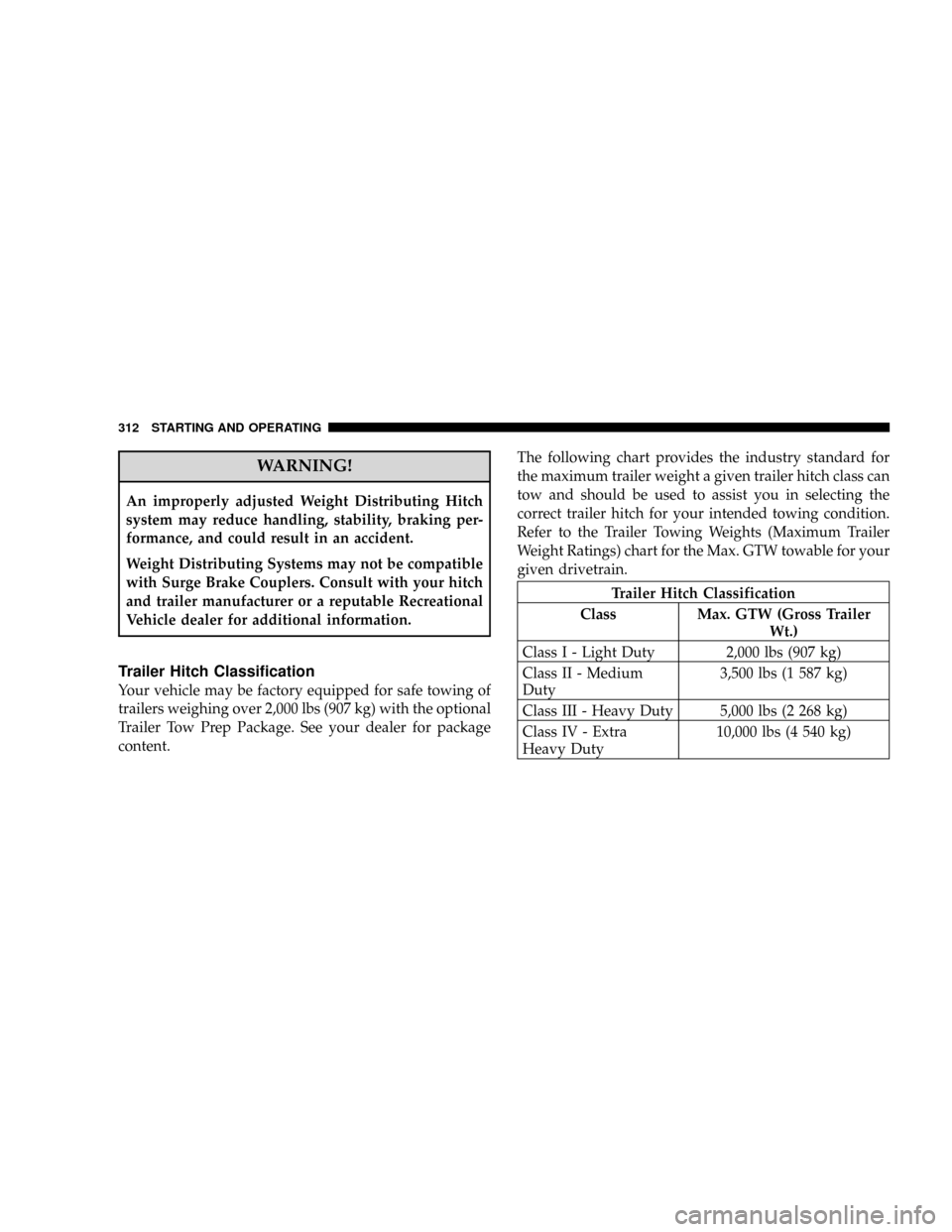
Trailer Hitch Classification
Your vehicle may be factory equipped for safe towing of
trailers weighing over 2,000 lbs (907 kg) with the optional
Trailer Tow Prep Package. See your dealer for package
content.The following chart provides the industry standard for
the maximum trailer weight a given trailer hitch class can
tow and should be used to assist you in selecting the
correct trailer hitch for your intended towing condition.
Refer to the Trailer Towing Weights (Maximum Trailer
Weight Ratings) chart for the Max. GTW towable for your
given drivetrain.
Trailer Hitch Classification
Class Max. GTW (Gross Trailer
Wt.)
Class I - Light Duty 2,000 lbs (907 kg)
Class II - Medium
Duty3,500 lbs (1 587 kg)
Class III - Heavy Duty 5,000 lbs (2 268 kg)
Class IV - Extra
Heavy Duty10,000 lbs (4 540 kg)
312 STARTING AND OPERATING
Page 320 of 440
WARNING!
Do not connect trailer brakes to your vehicle's hy-
draulic brake lines. It can overload your brake sys-
tem and cause it to fail. You might not have brakes
when you need them and could have an accident.
Towing any trailer will increase your stopping dis-
tance. When towing you should allow for additional
space between your vehicle and the vehicle in front
of you. Failure to do so could result in an accident.
Towing Requirements Ð Trailer Lights & Wiring
Whenever you pull a trailer, regardless of the trailer size,
stop lights and turn signals on the trailer are required for
motoring safety.The Trailer Tow Package may includea4and7pin
wiring harness. Use a factory approved trailer harness
and connector.
NOTE:Do not cut or splice wiring into the vehicles
wiring harness.
STARTING AND OPERATING 319
5
Page 327 of 440
WARNING!
A hot engine cooling system is dangerous. You or
others could be badly burned by steam or boiling
coolant. You may want to call a service center if your
vehicle overheats. If you decide to look under the
hood yourself, refer to Section 7, Maintenance, of this
manual. Follow the warnings under the Cooling
System Pressure Cap paragraph.
AUTOMATIC TRANSAXLE OVERHEATING
During sustained high speed driving or trailer towing up
long grades on hot days, the automatic transaxle oil may
become too hot.
If this happens, the transmission overheat in-
dicator light will come on, and the vehicle will
slow slightly until the automatic transaxle
cools down enough to allow a return to therequested speed. If the high speed is maintained, the
overheating will reoccur, as before, in a cyclic fashion.
JACKING AND TIRE CHANGING
WARNING!
²Being under a jacked-up vehicle is dangerous. The
vehicle could slip off the jack and fall on you. You
could be crushed. Never put any part of your body
under a vehicle that is on a jack. Never start or run
the engine while the vehicle is on a jack. If you
need to get under a raised vehicle, take it to a
service center where it can be raised on a lift.
²The jack is designed to use as a tool for changing
tires only. The jack should not be used to lift the
vehicle for service purposes. The vehicle should
be jacked on a firm level surface only. Avoid ice or
slippery areas.
326 WHAT TO DO IN EMERGENCIES
Page 330 of 440
3. There are two front jacking locations and two rear
jacking locations on each side of the body. The front
locations are outlined by two triangular cutouts, the rear
ones by two rectangular cutouts. For vehicles equipped
with plastic trim, the plastic has been cut away to expose
the jacking locations in the body.
Do not raise the vehicle until you are sure the jack is
securely engaged.
4. Turn the jack screw to the left until the jack can be
placed under the jacking location. Once the jack is
positioned, turn the jack screw to the right until the jack
head is properly engaged with the lift area closest to the
wheel to be changed. Do not raise the vehicle until you
are sure the jack is securely engaged.WARNING!
Raising the vehicle higher than necessary can make
the vehicle less stable. It could slip off the jack and
hurt someone near it. Raise the vehicle only enough
to remove the tire.
5. Raise the vehicle by turning the jack screw to the right,
using the swivel wrench. Raise the vehicle only until the
tire just clears the surface and enough clearance is
obtained to install the spare tire. Minimum tire lift
provides maximum stability.
6. Remove the wheel nuts and pull the wheel off the hub.
Install the spare wheel and wheel nuts with the cone
shaped end of the nuts toward the wheel. Lightly tighten
the nuts. To avoid the risk of forcing the vehicle off the
jack, do not tighten the nuts fully until the vehicle has
been lowered.
WHAT TO DO IN EMERGENCIES 329
6