window JEEP PATRIOT 2007 1.G Owners Manual
[x] Cancel search | Manufacturer: JEEP, Model Year: 2007, Model line: PATRIOT, Model: JEEP PATRIOT 2007 1.GPages: 440, PDF Size: 7.26 MB
Page 11 of 440
NªChild-Protectionº Door Lock System (Rear Doors)
Ð If Equipped........................23
mRemote Keyless Entry Ð If Equipped.........24
NTo Unlock The Doors And Liftgate..........25
NTo Lock The Doors And Liftgate............26
NUsing The Panic Alarm:..................26
NTo Turn Off ªFlash Lights With Lockº........27
NProgramming Additional Transmitters........27
NGeneral Information....................29
NBattery Replacement....................29
mSecurity Alarm System Ð If Equipped.........30
NTo Set The Alarm......................31
NTo Disarm The System...................31NSecurity System Manual Override...........32
mLiftgate...............................32
mPower Windows........................34
NPower Window Switches.................34
NAuto Down..........................35
NWindow Lockout Switch.................36
mOccupant Restraints......................36
NLap/Shoulder Belts.....................37
NAdjustable Upper Shoulder Belt Anchorage....42
NSecond Row Center Lap/Shoulder Belt Operating
Instructions..........................43
NSeat Belt Pretensioners...................46
NEnhanced Driver Seat Belt Reminder System
(BeltAlert)...........................47
10 THINGS TO KNOW BEFORE STARTING YOUR VEHICLE
Page 14 of 440
NOTE:If you try to remove the key before you place the
lever in PARK, the key may become trapped temporarily
in the ignition cylinder. If this occurs, rotate the key to the
right slightly, then remove the key as described. If a
malfunction occurs, the system will trap the key in the
ignition cylinder to warn you that this safety feature is
inoperable. The engine can be started and stopped but
the key cannot be removed until you obtain service.
WARNING!
Never leave children alone in a vehicle. Leaving
children in a vehicle unattended is dangerous for a
number of reasons. A child or others could be seri-
ously or fatally injured. Don't leave the keys in the
ignition. A child could operate power windows,
other controls, or move the vehicle.
CAUTION!
An unlocked car is an invitation to thieves. Always
remove key from the ignition and lock all doors
when leaving the vehicle unattended.
Manual TransaxleÐIf Equipped
Turn the ignition switch to the ACC position, push the
key and cylinder inward, rotate the key to the LOCK
position, and remove the key.
Locking Doors With The Key
You can insert the key with either side up. To lock the
door, turn the key rearward, to unlock the door, turn the
key forward. See Section 7 of this manual for door lock
lubrication.
THINGS TO KNOW BEFORE STARTING YOUR VEHICLE 13
2
Page 25 of 440

WARNING!
Avoid trapping anyone in a vehicle in a collision.
Remember that the rear doors can only be opened
from the outside when the child protection locks are
engaged.
NOTE:For emergency exit with the system engaged,
move the lock plunger up (unlocked position), roll down
window and open the door with the outside door handle.
REMOTE KEYLESS ENTRY Ð IF EQUIPPED
This system allows you to lock or unlock the doors and
liftgate or activate the panic alarm from distances a
maximum of 66 feet (20 meters) using a hand held radio
transmitter. The transmitter need not be pointed at the
vehicle to activate the system.
Three Button Transmitter
24 THINGS TO KNOW BEFORE STARTING YOUR VEHICLE
Page 34 of 440
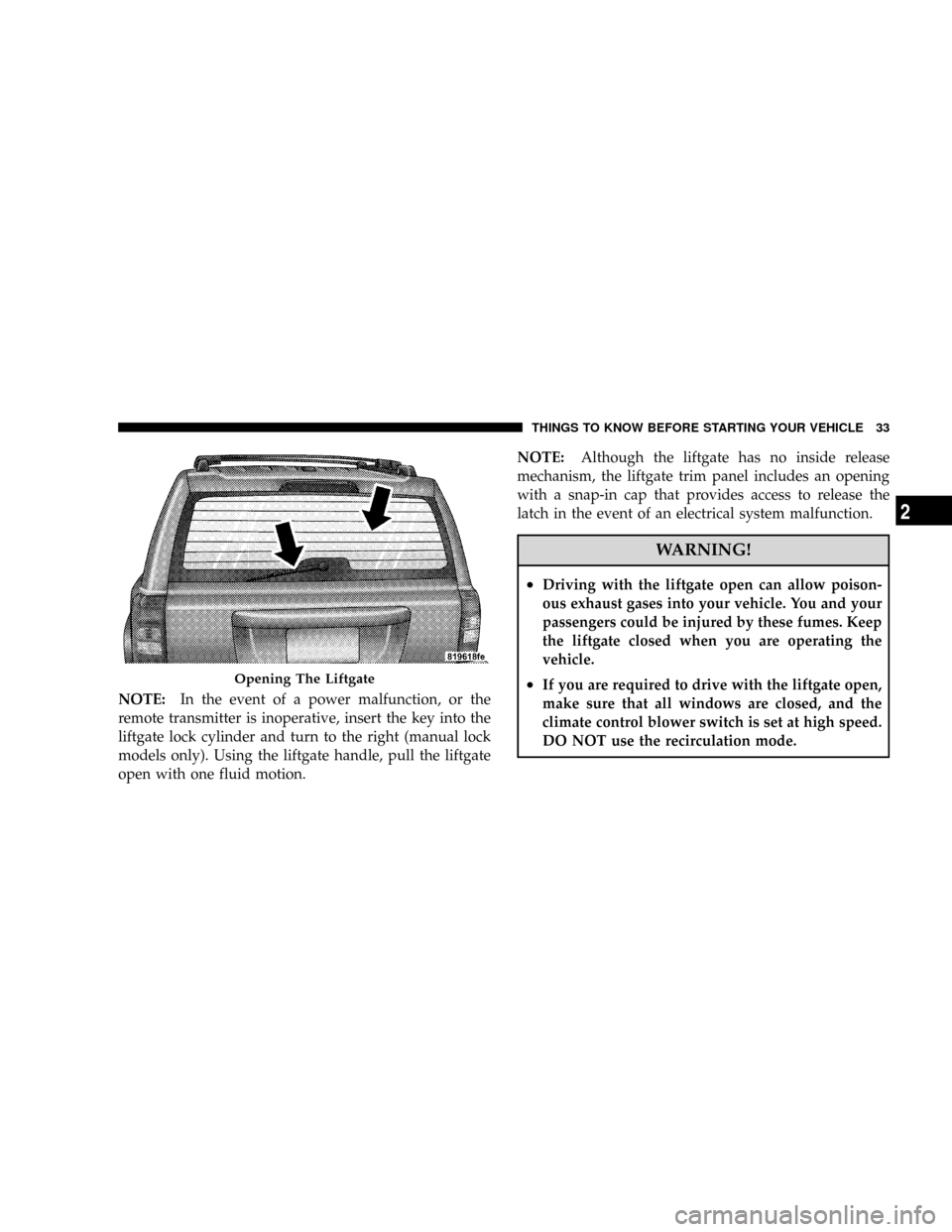
NOTE:In the event of a power malfunction, or the
remote transmitter is inoperative, insert the key into the
liftgate lock cylinder and turn to the right (manual lock
models only). Using the liftgate handle, pull the liftgate
open with one fluid motion.NOTE:Although the liftgate has no inside release
mechanism, the liftgate trim panel includes an opening
with a snap-in cap that provides access to release the
latch in the event of an electrical system malfunction.
WARNING!
²Driving with the liftgate open can allow poison-
ous exhaust gases into your vehicle. You and your
passengers could be injured by these fumes. Keep
the liftgate closed when you are operating the
vehicle.
²If you are required to drive with the liftgate open,
make sure that all windows are closed, and the
climate control blower switch is set at high speed.
DO NOT use the recirculation mode.Opening The Liftgate
THINGS TO KNOW BEFORE STARTING YOUR VEHICLE 33
2
Page 35 of 440

Gas props support the liftgate in the open position.
However, because the gas pressure drops with tempera-
ture, it may be necessary to assist the props when
opening the liftgate in cold weather.POWER WINDOWS
Power Window Switches
Power Window Switch Location
34 THINGS TO KNOW BEFORE STARTING YOUR VEHICLE
Page 36 of 440

The control on the left front door has up-down switches
that give you finger tip control of all four power win-
dows. There is a single opening and closing switch on thepassenger doors for passenger window control. The
windows will operate only when the ignition switch is
turned to the ON position and for 45 seconds after the
ignition is turned OFF or the driver's door is opened.
This feature can be turned off by your authorized dealer.
Auto Down
The driver's window switch has an Auto Down feature.
Push the window switch past the first detent, release, and
the window will go down automatically. To cancel the
Auto Down movement, operate the switch in either the
up or down direction and release the switch.
Power Window Switches
THINGS TO KNOW BEFORE STARTING YOUR VEHICLE 35
2
Page 37 of 440
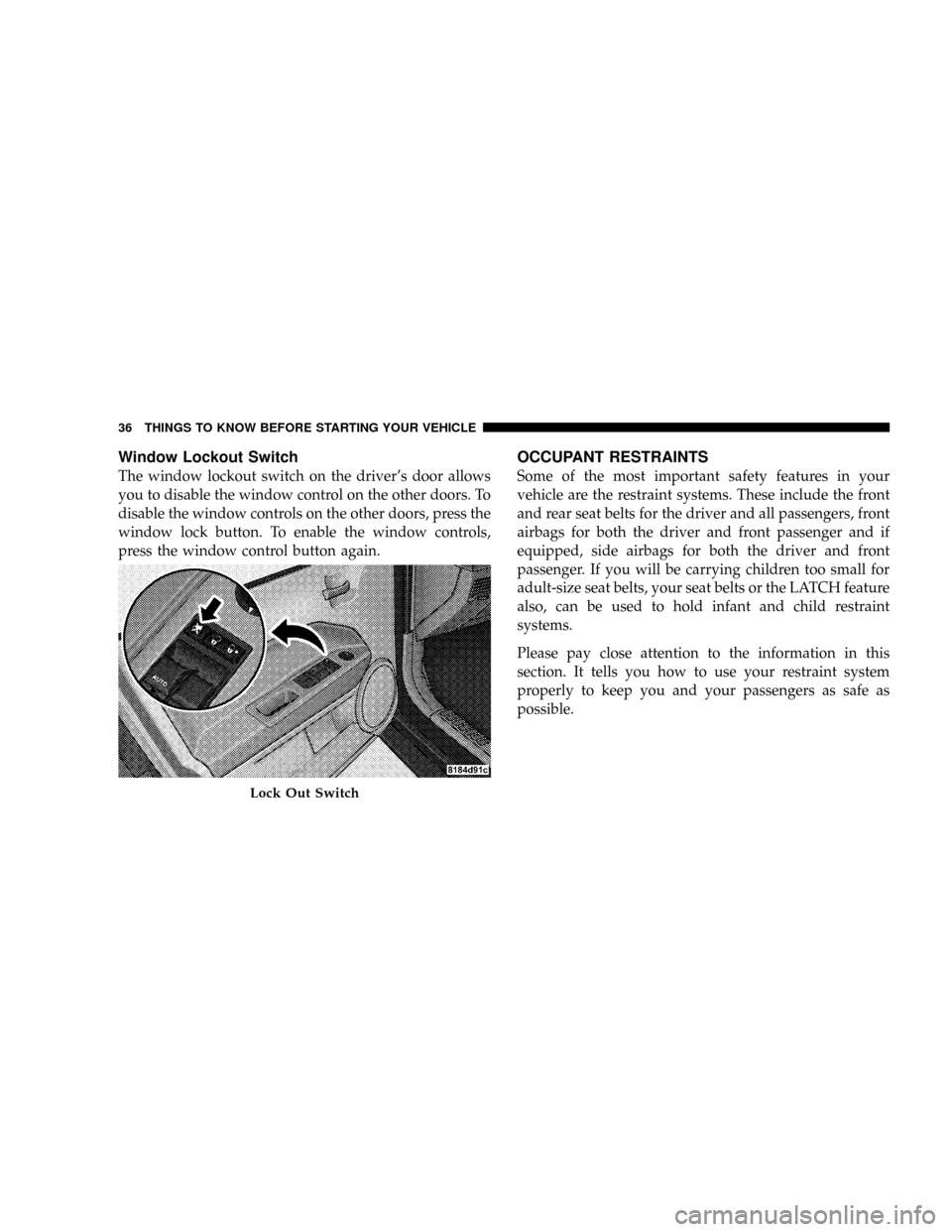
Window Lockout Switch
The window lockout switch on the driver's door allows
you to disable the window control on the other doors. To
disable the window controls on the other doors, press the
window lock button. To enable the window controls,
press the window control button again.
OCCUPANT RESTRAINTS
Some of the most important safety features in your
vehicle are the restraint systems. These include the front
and rear seat belts for the driver and all passengers, front
airbags for both the driver and front passenger and if
equipped, side airbags for both the driver and front
passenger. If you will be carrying children too small for
adult-size seat belts, your seat belts or the LATCH feature
also, can be used to hold infant and child restraint
systems.
Please pay close attention to the information in this
section. It tells you how to use your restraint system
properly to keep you and your passengers as safe as
possible.
Lock Out Switch
36 THINGS TO KNOW BEFORE STARTING YOUR VEHICLE
Page 51 of 440

NOTE:The front airbags are certified to the Federal
regulations that allow less forceful deployment.
The front airbags have a multistage inflator design. This
may allow the airbag to have different rates of inflation
that are based on collision severity.
This vehicle may also be equipped with side curtain
airbags to protect the driver and passengers sitting next
to a window. If the vehicle is equipped with side curtain
airbags, they are located above the side windows. Their
covers are also labeled SRS AIRBAG.
NOTE:Airbag covers may not be obvious in the interior
trim; but they will open to allow airbag deployment.
Side Curtain Airbag Location
50 THINGS TO KNOW BEFORE STARTING YOUR VEHICLE
Page 54 of 440
WARNING!
²Relying on the airbags alone could lead to more
severe injuries in a collision. The airbags work
with your seat belt to restrain you properly. In
some collisions, the airbags won't deploy at all.
Always wear your seat belts even though you have
airbags.
²Being too close to the steering wheel or instrument
panel during airbag deployment could cause seri-
ous injury. Airbags need room to inflate. Sit back,
comfortably extending your arms to reach the
steering wheel or instrument panel.
²If the vehicle has side curtain airbags, they also
need room to inflate. Do not lean against the door
or window. Sit upright in the center of the seat.
Air Bag System Components
The airbag system consists of the following:
²Occupant Restraint Controller (ORC)
²Side Remote Acceleration Sensors (if equipped)
²Airbag Warning Light
²Driver Airbag
²Front Passenger Airbag
²Supplemental Side Curtain Airbags above Side Win-
dows (if equipped)
²Steering Wheel and Column
²Instrument Panel
²Interconnecting Wiring
²Seatbelt Reminder Light
²Knee Impact Bolsters
THINGS TO KNOW BEFORE STARTING YOUR VEHICLE 53
2
Page 56 of 440
²TheDriver and Front Passenger Airbag/Inflator
Unitsare located in the center of the steering wheel
and the passenger side of the instrument panel. When
the ORC detects a collision requiring the airbags, it
signals the inflator units. A large quantity of nontoxic
gas is generated to inflate the front airbags. Different
airbag inflation rates may be possible based on colli-
sion severity. The steering wheel hub trim cover, and
the upper passenger side of the instrument panel
separate and fold out of the way, as the bags inflate to
their full size. The bags fully inflate in about 50 - 70
milliseconds. This is about half of the time that it takes
to blink your eyes. The bags then quickly deflate while
helping to restrain the driver and front passenger. The
driver's front airbag gas is vented through vent holes
in the sides of the airbag. The passenger's front airbag
gas is vented through vent holes in the sides of the
airbag. In this way, the airbags do not interfere with
your control of the vehicle.²TheSide Impact SRS Side Curtain Airbagare de-
signed to activate only in certain side collisions. When
the ORC (with side impact option) detects a collision
requiring the side curtain airbag to inflate, it signals
the inflators on the crash side of the vehicle. A quantity
of nontoxic gas is generated to inflate the side curtain
airbag. The inflating side curtain airbag pushes the
outside edge of the headliner out of the way and
covers the window. The airbag inflates in about 30
milliseconds (about one quarter of the time that it
takes to blink your eyes) with enough force to injure
you if you are not belted and seated properly, or if
items are positioned in the area where the side curtain
airbag inflates. This especially applies to children. The
side curtain airbag is only about 3-1/2 inches (9 cm)
thick when it is inflated.
²TheKnee Impact Bolstershelp protect the knees of
the driver and the front passenger, and position every-
one for the best interaction with the front airbag.
THINGS TO KNOW BEFORE STARTING YOUR VEHICLE 55
2