light JEEP PATRIOT 2007 1.G Repair Manual
[x] Cancel search | Manufacturer: JEEP, Model Year: 2007, Model line: PATRIOT, Model: JEEP PATRIOT 2007 1.GPages: 440, PDF Size: 7.26 MB
Page 245 of 440
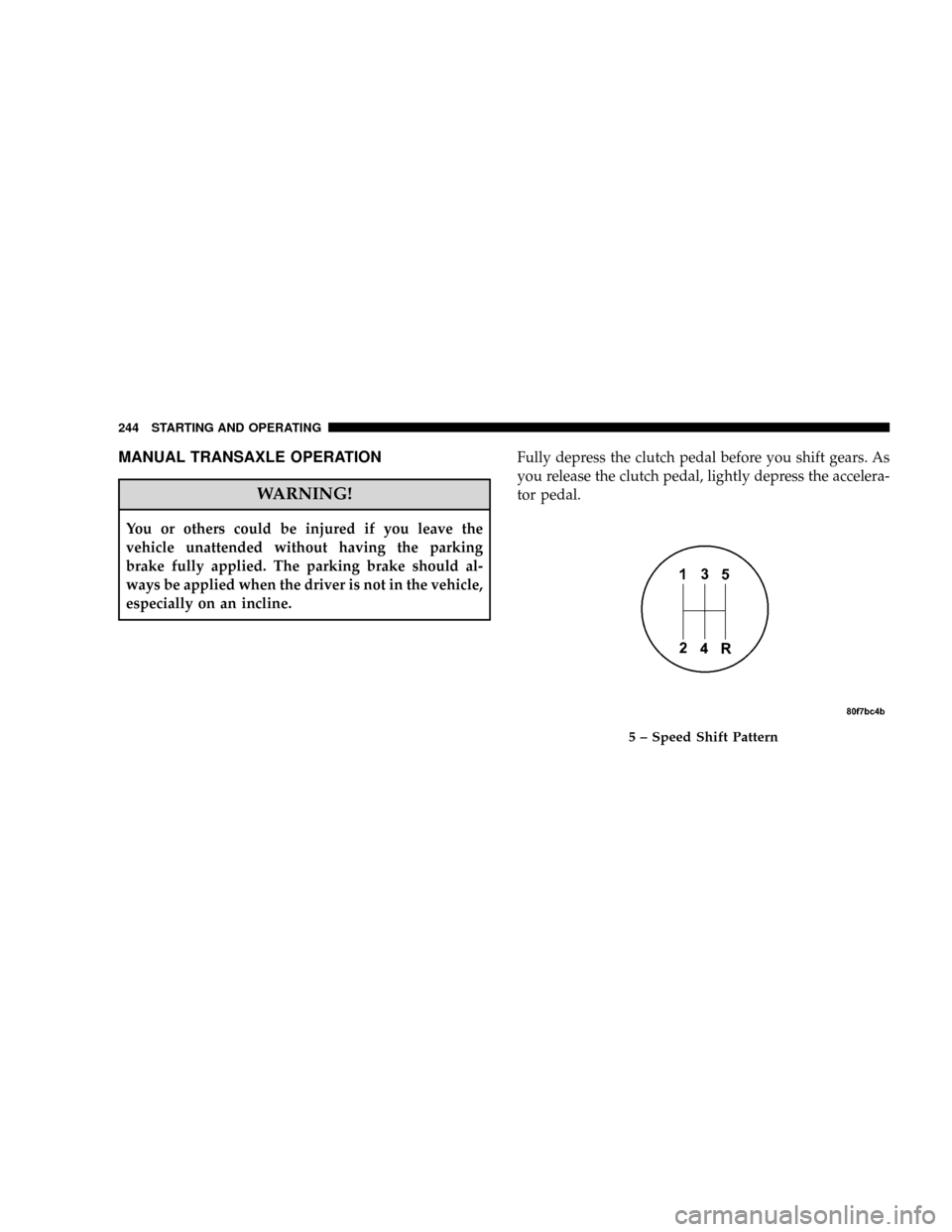
MANUAL TRANSAXLE OPERATION
WARNING!
You or others could be injured if you leave the
vehicle unattended without having the parking
brake fully applied. The parking brake should al-
ways be applied when the driver is not in the vehicle,
especially on an incline.Fully depress the clutch pedal before you shift gears. As
you release the clutch pedal, lightly depress the accelera-
tor pedal.
5 ± Speed Shift Pattern
244 STARTING AND OPERATING
Page 246 of 440
Use each gear in numerical order - do not skip a gear. Be
sure the transaxle is in FIRST gear, (not THIRD), when
starting from a standing position. Damage to the clutch
can result from starting in THIRD.
For most city driving you will find it easier to use only
the lower gears. For steady highway driving with light
accelerations, 5th gear is recommended.
Never drive with your foot resting on the clutch pedal, or
try to hold the vehicle on a hill with the clutch pedal
partially engaged. This will cause abnormal wear on the
clutch.
Never shift into REVERSE until the vehicle has come to a
complete stop.
NOTE:During cold weather, until the transaxle lubri-
cant is warm, you may experience slightly higher shift
efforts. This is normal and not harmful to the transaxle.Recommended Shift Speeds
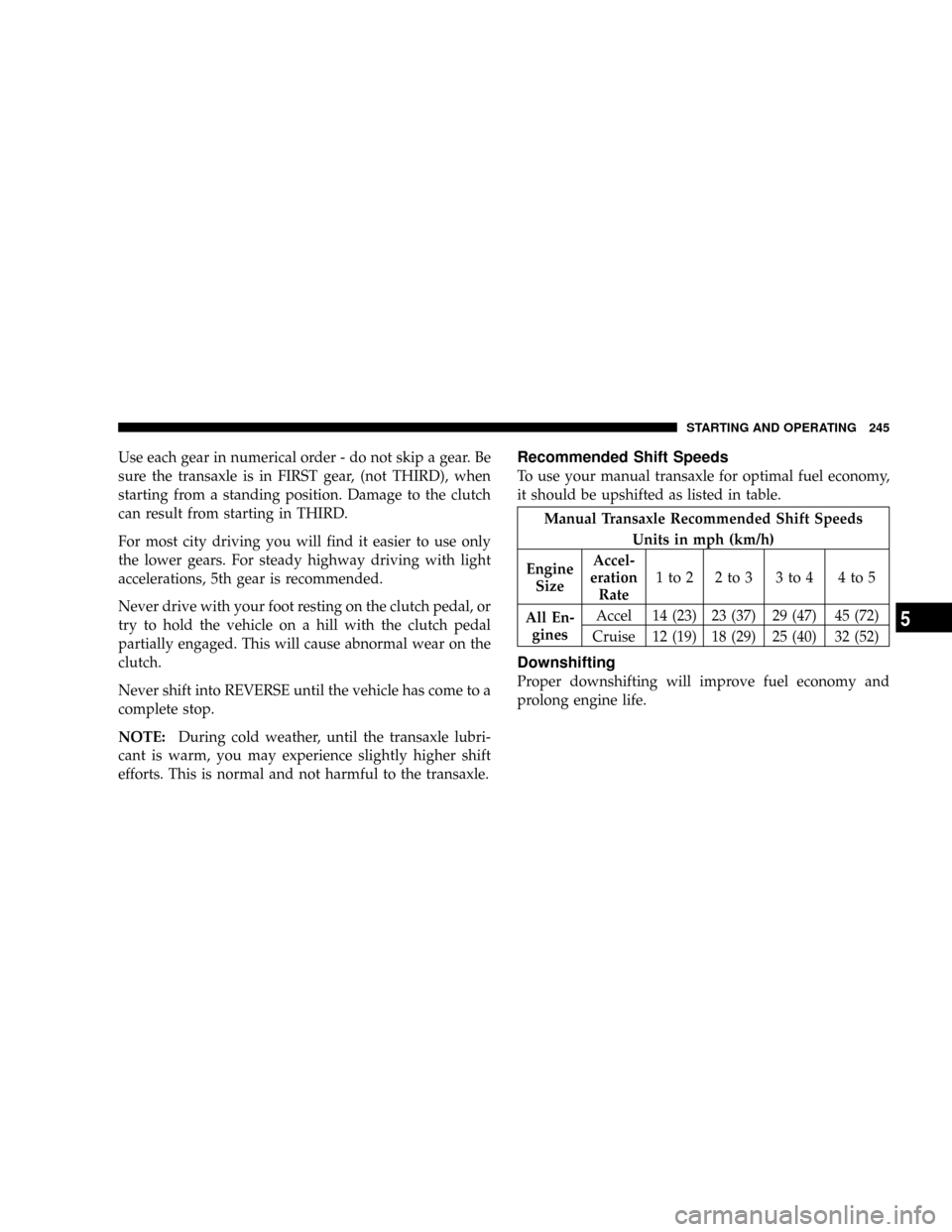
To use your manual transaxle for optimal fuel economy,
it should be upshifted as listed in table.
Manual Transaxle Recommended Shift Speeds
Units in mph (km/h)
Engine
SizeAccel-
eration
Rate1to2 2to3 3to4 4to5
All En-
ginesAccel 14 (23) 23 (37) 29 (47) 45 (72)
Cruise 12 (19) 18 (29) 25 (40) 32 (52)
Downshifting
Proper downshifting will improve fuel economy and
prolong engine life.
STARTING AND OPERATING 245
5
Page 248 of 440
traction surfaces, activate the 4WD Lock switch by pull-
ing up once and releasing. This locks the center coupling
allowing more torque to be sent to the rear wheels. The
amber94WD9light will come on in the cluster. This can be
done on the fly, at any vehicle speed. To deactivate,
simply pull on the switch one more time. The cluster light
will then go out.
NOTE:Refer to ºESP (Electronic Stability Program) in
the ªElectronic Brake Control Systemº section of this
manual for additional information.
PATRIOT FREEDOM DRIVE II ± SAFE OFF-ROAD
DRIVING
Off-Road Driving Tips and Vehicle Characteristics
The Patriot with the Freedom Drive II Off-Road package
has excellent on and off-road capabilities. These off-road
capabilities will allow you to explore those wilderness
trails where few travel, providing a source of exciting andsatisfying recreation. Before you venture out you should
contact your local governmental agency to determine
what are the designated off-road vehicle (ORV) trails or
recreation areas. You should always tread lightly and
only use established roads, trails or ORV recreational
areas. The National Forest Service, Bureau of Land Man-
agement or local Department of Natural Resources are a
wealth of information and usually have maps with
marked trails.
NOTE: For optimum off-road performance, premium
fuel is recommended. However, your vehicle is
equipped with an active spark knock system and can
adjust the engine calibration for varying range of fuel
octane levels.The Patriot's Freedom Drive II Off-Road Package
The Jeep Patriot with the Freedom Drive II has excellent
capability on and off-road.
STARTING AND OPERATING 247
5
Page 249 of 440
The package includes:
²2.4L DOHC 16-Valve I4 (172 bhp @ 6000 rpm, 165 lb-ft
@ 4400 rpm)
²Second generation continuously variable transaxle
(CVT2L) with 19:1 crawl ratio
²Tow Hooks: 2 front and 1 rear
²Front engine and transaxle skid plate
²Fuel tank skid plate
²Air filtration system
²Unique springs for a 1 inch of increased ride height
²Fog lamps
²Seat height adjust
²Three-mode Electronic Stability Program (ESP)
²Hill-descent control
²Unique off-road engine calibration for optimum off-
road performance with premium fuel
²Off-road Brake Traction Control
²Unique off-road Anti-lock brake calibration
²Heavy duty cooling package (Eng/larger CVT oil
cooler, High capacity cooling fans)
²Heavy duty alternator
²Improved body sealing and high located drivetrain
component vents
²Reinforced rear lateral links
Freedom Drive II 4WD System Operation
Under normal driving conditions, the vehicle operates in
the active four wheel drive mode. Pulling up on the 4WD
lock lever activates the 4WD system and lights the amber
4WD cluster light. This commands a higher torque to the
rear wheels, for improved traction capability on slippery
248 STARTING AND OPERATING
Page 250 of 440
roads. The active four wheel drive mode has the same
functionality with the Freedom Drive I system. Shifting
the transaxle gear select lever into Low Off-Road mode
with the 4WD lock lever active, lights the amber off-road
and 4WD cluster lights. This off-road mode gives the
combined benefits of a 19:1 crawl ratio, hill descent
braking, optimum off-road performance with premium
fuel, and off-road brake traction control for improved
traction capability off-road. In low, the transaxle (CVT2L)
initially maintains the 19:1 crawl ratio before changing
ratio. This low ratio is ideal for crawling over obstacles.
Freedom Drive II ± Off-Road Features
The following are key off-road features which are active
when the system has the 4WD lock lever engaged and is
in the Low Off-Road mode.
²Hill descent Braking± Hill descent braking uses the
vehicle braking system to provide a controlled descent
down varying grades. This feature is only active whenthe system has the 4WD lock lever engaged and is in
the Low Off-Road mode or reverse. Hill descent
braking can be turned off by turning off ESP. The hill
decent control speed varies between 4-6 mph (6 -10
km/h) forward, 3 mph (5 km/h) reverse.
²Off-Road Brake Traction Control± When conditions
warrant, the vehicle braking system transfers torque
from side to side. It does not control throttle input
unlike normal traction control which is active in
normal drive mode.
²19.1 Crawl Ratio± When the system has the 4WD lock
lever engaged and is in the Low Off-Road mode, the
CVT2L initially maintains the 19:1 crawl ratio before
changing ratio. This low ratio is ideal for crawling over
obstacles.
²4WD Lock Mode± Four wheel drive lock mode
commands a higher torque to the rear wheels, for
STARTING AND OPERATING 249
5
Page 255 of 440
The Basics of Off-Road Driving
You will encounter many types of terrain driving off-
road. You should be familiar with the terrain and area
before proceeding. There are many types of surface
conditions: hard packed dirt, gravel, rocks, grass, sand,
mud, snow and ice. Every surface has a different effect on
your vehicle's steering, handling and traction. Control-
ling your vehicle is one of the keys to successful off-road
driving, so always keep a firm grip on the steering wheel
and maintain a good driving posture. Avoid sudden
accelerations, turns or braking. In most cases there are no
road signs, posted speed limits or signal lights. Therefore
you will need to use your own good judgment on what is
safe and what isn't. When on a trail you should always be
looking ahead for surface obstacles and changes in
terrain. The key is to plan your future driving route while
remembering what you are currently driving over.CAUTION!
Never park your vehicle over dry grass or other
combustible materials. The heat from your vehicle
exhaust system could cause a fire.
WARNING!
Always wear your seat belt and firmly tie down
cargo. Unsecured cargo can become projectiles in an
off-road situation.
When To Use Low (L Off-Road) with the 4WD
Lock Lever Engaged
When To Use Low (L Off-Road) with the 4WD Lock
Lever Engaged When driving off-road, shift into low (L
Off-Road) and activate the 4WD Lock. This will provide
254 STARTING AND OPERATING
Page 256 of 440
additional traction and activates the numerous off-road
features to improve handling and control on slippery or
difficult terrain. Due to the sustained lower gearing, low
(L Off-Road) with 4WD Lock engaged will allow the
engine to operate in a higher power range. This will
allow you to cross over obstacles and descend hills, with
improved control and less effort.
Simultaneous Brake And Throttle Operation
Many off-road driving conditions require the simulta-
neous use of the brake and throttle (two footed driving).
When climbing rocks, logs, or other stepped objects,
using light brake pressure with light throttle will keep the
vehicle from jerking or lurching. This technique is also
used when you need to stop and restart a vehicle on a
steep incline.
Driving in Snow, Mud and Sand
There is a drastic reduction in traction when driving in
snow, mud or sand. The vehicle will be less responsive to
steering, acceleration and braking inputs. Therefore you
should accelerate slowly, leave greater stopping distances
and avoid abrupt vehicle maneuvers. You want to keep a
slow constant steady pace. The key is to maintain the
vehicle's momentum.
²Snow± In heavy snow or for additional control and
traction at slower speeds, activate the 4WD Lock and
shift the transmission to a low (L Off-Road) if neces-
sary. Don't shift to a lower gear than necessary to
maintain headway. Over-revving the engine can spin
the wheels and traction will be lost. If you start to slow
to a stop, try turning your steering wheel no more than
a 1/4; turn quickly back and forth, while still applying
throttle. This will allow the tires to get a fresh9bite9
and help maintain your momentum.
STARTING AND OPERATING 255
5
Page 258 of 440
on pavement or other hard surfaces. Be sure you have
a way to air the tires back up prior to reducing the
pressure.
CAUTION!
Reduced tire pressures may cause tire unseating and
total loss of air pressure. To reduce the risk of tire
unseating, while at a reduced tire pressure, reduce
your speed and avoid sharp turns or abrupt
maneuvers.
Crossing Obstacles (Rocks And Other High
Points)
While driving off road, you will encounter many types of
terrain. These varying types of terrain bring different
types of obstacles. Before proceeding review the path
ahead to determine the correct approach and your ability
to safely recover the vehicle if something goes wrong.Keeping a firm grip on the steering wheel, bring the
vehicle to a complete stop and then inch the vehicle
forward until it makes contact with the object. Apply the
throttle lightly while holding a light brake pressure and
ease the vehicle up and over the object.
WARNING!
Crossing obstacles can cause abrupt steering system
loading which could cause you to loose control of
your vehicle.
Using A Spotter
There are many times where it is hard to see the obstacle
or determine the correct path. Determining the correct
path can be extremely difficult when you are confronting
many obstacles. In these cases have someone guide you
over, through, or around the obstacle. Have the person
STARTING AND OPERATING 257
5
Page 260 of 440
dirt to fill the rut ahead of the turnout you just created.
You should now be able to drive out following the trench
you just created at a 45-degree angle.
WARNING!
There is an increased risk of roll over when crossing
an obstacle, at any angle, with steep sides.
Crossing Logs
To cross a log, approach it at a slight angle (approxi-
mately 10 to 15 degrees). This allows one front tire to be
on top of the log while the other just starts to climb the
log. While climbing the log, modulate your brake and
accelerator to avoid spinning the log out from under your
tires. Then ease the vehicle off the log using your brakes.
CAUTION!
Do not attempted to cross a log with a greater
diameter than the running ground clearance or the
vehicle will become high centered.
Getting High Centered
If you get hung up or high centered on an object, get out
of the vehicle and try to determine what the vehicle is
hung up on, where it is contacting the underbody and
what is the best direction to recover the vehicle. Depend-
ing on what you are in contact with, jack the vehicle up
and place a few rocks under the tires so the weight is off
of the high point when you let the vehicle down. You can
also try rocking the vehicle or winching the vehicle off
the object.
STARTING AND OPERATING 259
5
Page 261 of 440
CAUTION!
Winching or rocking the vehicle off hard objects
increases the risk of underbody damage.
Hill Climbing
Hill climbing requires good judgment and a good under-
standing of your abilities and your vehicle's limitations.
Hills can cause serious problems. Some are just too steep
to climb and should not be attempted. You should always
feel confident with the vehicle and your abilities. You
should always climb hills straight up and down. Never
attempt to climb a hill on an angle.
²Before Climbing A Steep Hill± As you approach a
hill consider its grade or steepness. Determine if it is
too steep. Look to see what the traction is on the hill
side trail. Is the trail straight up and down? What is on
top and the other side? Are there ruts, rocks, branchesor other obstacles on the path? Can you safely recover
the vehicle if something goes wrong? If everything
looks good and you feel confident, then you should
use low (L Off-Road) with the 4WD Lock engaged and
proceed with caution maintaining your momentum as
you climb the hill
²Driving Up Hill± Once you have determined your
ability to proceed and have shifted into the appropri-
ate gear, line your vehicle up for the straightest
possible run. Accelerate with an easy constant throttle
and apply more power as you start up the hill. Do not
race forward into a steep grade, the abrupt change of
grade could cause you to lose control. If the front end
begins to bounce, ease off the throttle slightly to bring
all four tires back on the ground. As you approach the
crest of the hill ease off the throttle and slowly proceed
over the top. If the wheels start to slip as you approach
the crest of a hill, ease off the accelerator and maintain
headway by turning the steering wheel no more than
260 STARTING AND OPERATING