check engine JEEP PATRIOT 2009 1.G Owner's Manual
[x] Cancel search | Manufacturer: JEEP, Model Year: 2009, Model line: PATRIOT, Model: JEEP PATRIOT 2009 1.GPages: 457, PDF Size: 12.48 MB
Page 381 of 457
WARNING! (Continued)
•You or others can be badly burned by hot coolant
or steam from your radiator. If you see or hear
steam coming from under the hood, do not open
the hood until the radiator has had time to cool.
Never try to open a cooling system pressure cap
when the radiator is hot.
Coolant Checks
Check engine coolant (antifreeze) protection every
12 months (before the onset of freezing weather, where
applicable). If the engine coolant (antifreeze) is dirty or
rusty in appearance, the system should be drained,
flushed and refilled with fresh engine coolant (anti-
freeze). Check the front of the A/C condenser for any
accumulation of bugs, leaves, etc. If dirty, clean by gently
spraying water from a garden hose vertically down the
face of the condenser.Check the coolant recovery bottle tubing for brittle rub-
ber, cracking, tears, cuts and tightness of the connection
at the bottle and radiator. Inspect the entire system for
leaks.
Cooling System — Drain, Flush And Refill
Refer to the “Maintenance Schedule” in Section 8 for
proper maintenance intervals.
If the engine coolant (antifreeze) is dirty or contains a
considerable amount of sediment, clean and flush with a
reliable cooling system cleaner. Follow with a thorough
rinsing to remove all deposits and chemicals. Properly
dispose of old engine coolant (antifreeze).
Selection Of Coolant
Refer to “Fluids, Lubricants, and Genuine Parts” in this
section for the correct fluid type.
MAINTAINING YOUR VEHICLE 379
7
Page 384 of 457
WARNING! (Continued)
•Do not use a pressure cap other than the one
specified for your vehicle. Personal injury or en-
gine damage may result.
Disposal Of Used Engine Coolant
Used ethylene glycol-based engine coolant (antifreeze) is
a regulated substance requiring proper disposal. Check
with your local authorities to determine the disposal
rules for your community. To prevent ingestion by ani-
mals or children do not store ethylene glycol-based
engine coolant (antifreeze) in open containers or allow it
to remain in puddles on the ground. If ingested by a
child, contact a physician immediately. Clean up any
ground spills immediately.
Coolant Level
The coolant bottle provides a quick visual method for
determining that the coolant level is adequate. With the
engine idling and warm to normal operating tempera-
ture, the level of the engine coolant (antifreeze) in the
bottle should be between the “ADD” and “FULL” lines
shown on the bottle.
The radiator normally remains completely full, so there is
no need to remove the radiator cap unless checking for
the coolant freeze point or replacing the engine coolant
(antifreeze). Advise your service attendant of this. As
long as the engine operating temperature is satisfactory,
the coolant bottle need only be checked once a month.
When additional engine coolant (antifreeze) is needed to
maintain the proper level, it should be added to the
coolant bottle. Do not overfill.
382 MAINTAINING YOUR VEHICLE
Page 385 of 457
Points to Remember
NOTE:When the vehicle is stopped after a few miles/
kilometers of operation, you may observe vapor coming
from the front of the engine compartment. This is nor-
mally a result of moisture from rain, snow, or high
humidity accumulating on the radiator and being vapor-
ized when the thermostat opens, allowing hot engine
coolant (antifreeze) to enter the radiator.
If an examination of your engine compartment shows no
evidence of radiator or hose leaks, the vehicle may be
safely driven. The vapor will soon dissipate.
•Do not overfill the coolant recovery bottle.
•Check the coolant freeze point in the radiator and in
the coolant recovery bottle. If engine coolant (anti-
freeze) needs to be added, the contents of the coolant
recovery bottle must also be protected against freez-
ing.
•If frequent engine coolant (antifreeze) additions are
required, or if the level in the coolant recovery bottle
does not drop when the engine cools, the cooling
system should be pressure tested for leaks.
•Maintain engine coolant (antifreeze) concentration at
50% HOAT engine coolant (antifreeze) (minimum)
and distilled water for proper corrosion protection of
your engine which contains aluminum components.
•Make sure that the radiator and coolant recovery
bottle overflow hoses are not kinked or obstructed.
•Keep the front of the radiator clean. If your vehicle is
equipped with air conditioning, keep the front of the
condenser clean also.
•Do not change the thermostat for Summer or Winter
operation. If replacement is ever necessary, install ONLY
the correct type thermostat. Other designs may result in
unsatisfactory engine coolant (antifreeze) performance,
poor gas mileage, and increased emissions.
MAINTAINING YOUR VEHICLE 383
7
Page 388 of 457
Automatic Transaxle (CVT)
Selection Of Lubricant
It is important that the proper lubricant is used in the
transaxle to assure optimum transaxle performance. Use
only the manufacturer’s recommended transmission
fluid which has been formulated with special metal to
metal friction coefficient additives to provide the proper
steel belt traction on the drive and driven pulleys. Refer
to “Fluids, Lubricants, and Genuine Parts” in this section
for the correct fluid type.
CAUTION!
Using a transmission fluid other than the manufac-
turer’s recommended fluid will cause belt slip and
result in a complete transmission failure! Refer to
“Fluids, Lubricants, and Genuine Parts” in this sec-
tion for the correct fluid type.
Fluid Level Check
The fluid level in the automatic transaxle should be
checked only by a trained technician.
Fluid And Filter Changes
Refer to the “Maintenance Schedule” in Section 8 for the
correct maintenance interval.
Special Additives
Do not add any materials (other than leak detection dyes)
to Continuously Variable Transaxle (CVT) Fluid
(CVTF+4). CVTF+4 is an engineered product and its
performance may be impaired by supplemental
additives.
Manual Transaxle
Lubricant Selection
Use only the manufacturers recommended transmission
fluid. Refer to “Fluids, Lubricants, and Genuine Parts” in
this section for the correct fluid type.
386 MAINTAINING YOUR VEHICLE
Page 411 of 457
NOTE:
•The oil change indicator message will not monitor the
time since the last oil change. Change your vehicle’s
oil if it has been six months since your last oil change
and even if the oil change indicator message is NOT
illuminated.
•Change your engine oil more often if you drive your
vehicle off-road for an extended period of time.
•Under no circumstances should oil change intervals
exceed 6,000 miles (10 000 km) or six months, which-
ever comes first.
Your authorized dealer will reset the oil change indicator
message after completing the scheduled oil change. If this
scheduled oil change is performed by someone other
than your authorized dealer, the message can be reset by
referring to the steps described under “Oil Change
Required” in “Use Factory Settings” of the EVIC sectionin this manual or under “Odometer/Trip Odometer” in
the Instrument Cluster Descriptions section of this
manual.
At Each Stop for Fuel
•Check the engine oil level about five minutes after a
fully warmed engine is shut off. Checking the oil level
while the vehicle is on level ground will improve the
accuracy of the oil level reading. Add oil only when
the level is at or below the ADD or MIN mark.
•Check the windshield washer solvent and add if
required.
MAINTENANCE SCHEDULES 409
8
M
A
I
N
T
E
N
A
N
C
E
S
C
H
E
D
U
L
E
S
Page 412 of 457
Once a Month
•Check the tire pressure and look for unusual wear or
damage.
•Inspect the battery and clean and tighten the terminals
as required.
•Check the fluid levels of coolant reservoir, brake
master cylinder, power steering and transmission and
add as needed.
•Check all lights and other electrical items for correct
operation.At Each Oil Change
•Change the engine oil filter.
•Inspect the brake hoses and lines.
•Check the manual transmission fluid level.
CAUTION!
Failure to perform the required maintenance items
may result in damage to the vehicle.
Required Maintenance Intervals
Refer to the Maintenance Schedules on the following
pages for the required maintenance intervals.
410 MAINTENANCE SCHEDULES
8
M
A
I
N
T
E
N
A
N
C
E
S
C
H
E
D
U
L
E
S
Page 438 of 457
ABS (Anti-Lock Brake System).............. 290
Adding Engine Coolant (Antifreeze).......... 380
Adding Fuel........................... 332
Adding Washer Fluid..................... 376
Additives, Fuel......................... 331
Air Cleaner, Engine (Engine Air Cleaner Filter) . . . 372
Air Conditioner Maintenance............... 374
Air Conditioning, Operating Tips............ 248
Air Conditioning Refrigerant.............374,375
Air Conditioning System.................. 374
Air Pressure, Tires....................... 310
Airbag................................ 48
Airbag Deployment.....................53,55
Airbag Light.....................54,57,70,168
Airbag Maintenance....................... 57
Airbag, Side............................ 55
Airbag, Window (Side Curtain).............49,55
Alarm Light........................... 172
Alarm System (Security Alarm)............... 19Alterations/Modifications, Vehicle............. 8
Antenna, Satellite Radio................... 236
Antifreeze (Engine Coolant)...........379,404,405
Capacities........................... 404
Disposal............................ 382
Anti-Lock Brake System (ABS).............. 290
Anti-Lock Warning Light.................. 169
Anti-Theft Security Alarm (Theft Alarm)........ 19
Appearance Care........................ 388
Assistance Towing........................ 95
Automatic Dimming Mirror................. 76
Automatic Door Locks...................28,29
Automatic Transaxle...........12,256,260,352,386
Fluid Level Check..................... 386
Interlock System....................... 262
Overheating.......................... 352
Selection Of Lubricant................... 386
Shifting............................. 262
Special Additives...................... 386
436 INDEX
Page 440 of 457
Chains, Tire............................ 318
Changing A Flat Tire..................... 352
Chart, Tire Sizing........................ 302
Check Engine Light
(Malfunction Indicator Light)............... 367
Child Restraint.......................... 60
Child Restraint Tether Anchors............... 64
Child Restraint with Automatic Belts........... 63
Child Safety Locks........................ 31
Child Seat.............................. 66
Clean Air Gasoline....................... 329
Cleaning
Wheels............................. 390
Climate Control......................... 242
Clock.....................189,192,206,209,219
Clutch............................... 384
Clutch Fluid........................... 384
Coin Holder........................... 153
Compact Disc (CD) Maintenance............. 241Compact Spare Tire...................... 312
Compass Variance....................... 186
Connector
UCI ................................ 229
Universal Consumer Interface (UCI)......... 229
Console.............................. 153
Contract, Service........................ 429
Coolant (Antifreeze)...................404,405
Cooling System......................... 378
Adding Coolant (Antifreeze).............. 380
Coolant Level......................379,382
Disposal of Used Coolant................ 382
Drain, Flush, and Refill.................. 379
Inspection........................... 382
Points to Remember.................381,383
Pressure Cap......................... 381
Selection of Coolant (Antifreeze)........... 379
Corrosion Protection..................... 388
Cruise Light........................... 173
438 INDEX
Page 442 of 457
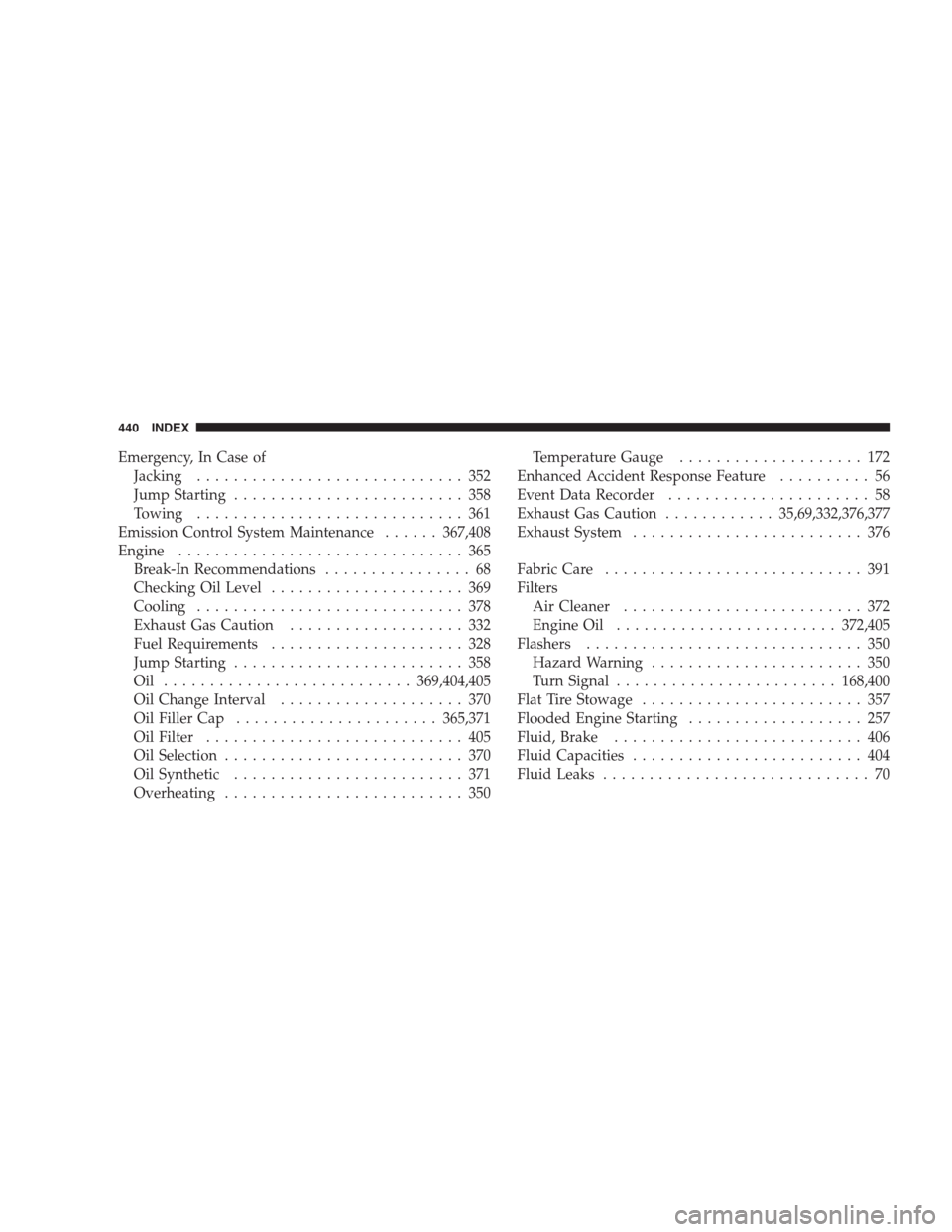
Emergency, In Case of
Jacking............................. 352
Jump Starting......................... 358
Towing............................. 361
Emission Control System Maintenance......367,408
Engine............................... 365
Break-In Recommendations................ 68
Checking Oil Level..................... 369
Cooling............................. 378
Exhaust Gas Caution................... 332
Fuel Requirements..................... 328
Jump Starting......................... 358
Oil ...........................369,404,405
Oil Change Interval.................... 370
Oil Filler Cap......................365,371
Oil Filter............................ 405
Oil Selection.......................... 370
Oil Synthetic......................... 371
Overheating.......................... 350Temperature Gauge.................... 172
Enhanced Accident Response Feature.......... 56
Event Data Recorder...................... 58
Exhaust Gas Caution............35,69,332,376,377
Exhaust System......................... 376
Fabric Care............................ 391
Filters
Air Cleaner.......................... 372
Engine Oil........................372,405
Flashers.............................. 350
Hazard Warning....................... 350
Turn Signal........................168,400
Flat Tire Stowage........................ 357
Flooded Engine Starting................... 257
Fluid, Brake........................... 406
Fluid Capacities......................... 404
Fluid Leaks............................. 70
440 INDEX
Page 446 of 457
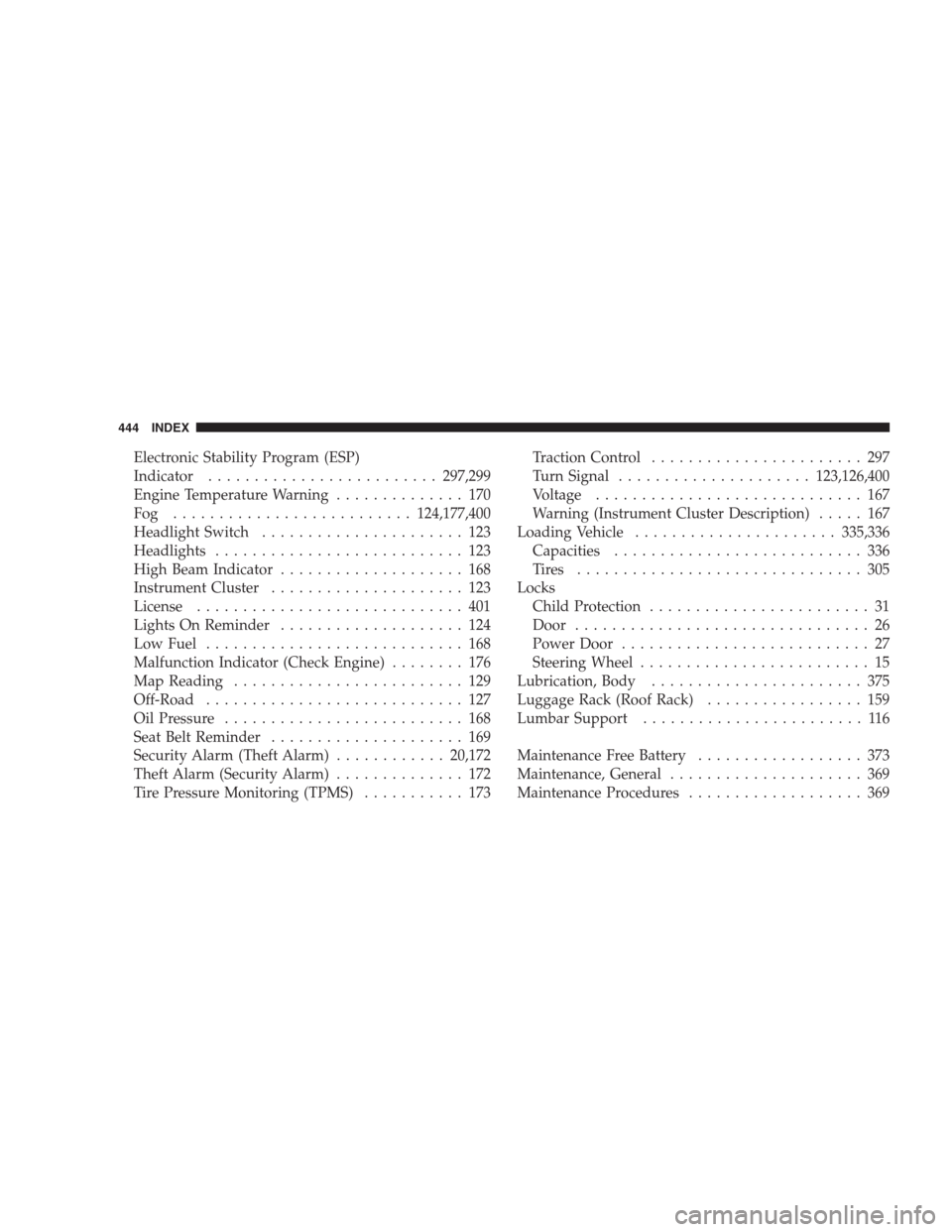
Electronic Stability Program (ESP)
Indicator.........................297,299
Engine Temperature Warning.............. 170
Fog ..........................124,177,400
Headlight Switch...................... 123
Headlights........................... 123
High Beam Indicator.................... 168
Instrument Cluster..................... 123
License............................. 401
Lights On Reminder.................... 124
Low Fuel............................ 168
Malfunction Indicator (Check Engine)........ 176
Map Reading......................... 129
Off-Road............................ 127
Oil Pressure.......................... 168
Seat Belt Reminder..................... 169
Security Alarm (Theft Alarm)............20,172
Theft Alarm (Security Alarm).............. 172
Tire Pressure Monitoring (TPMS)........... 173Traction Control....................... 297
Turn Signal.....................123,126,400
Voltage............................. 167
Warning (Instrument Cluster Description)..... 167
Loading Vehicle......................335,336
Capacities........................... 336
Tires ............................... 305
Locks
Child Protection........................ 31
Door................................ 26
Power Door........................... 27
Steering Wheel......................... 15
Lubrication, Body....................... 375
Luggage Rack (Roof Rack)................. 159
Lumbar Support........................ 116
Maintenance Free Battery.................. 373
Maintenance, General..................... 369
Maintenance Procedures................... 369
444 INDEX