brake JEEP PATRIOT 2019 Owner handbook (in English)
[x] Cancel search | Manufacturer: JEEP, Model Year: 2019, Model line: PATRIOT, Model: JEEP PATRIOT 2019Pages: 332, PDF Size: 1.99 MB
Page 129 of 332
WARNING!
Driving a vehicle with the red brake light on is
dangerous. Part of the brake system may
have failed. It will take longer to stop the
vehicle. You could have a collision. Have the
vehicle checked immediately.
Vehicles equipped with the Anti-Lock Brake
System (ABS) are also equipped with ElectronicBrake Force Distribution (EBD). In the event of
an EBD failure, the Brake Warning Light will turn
on along with the ABS Light. Immediate repair
to the ABS system is required.
Operation of the Brake Warning Light can be
checked by turning the ignition switch from the
OFF position to the ON/RUN position. The light
should illuminate for approximately two sec-
onds. The light should then turn off unless the
parking brake is applied or a brake fault isdetected. If the light does not illuminate, have
the light inspected by an authorized dealer.
The light also will turn on when the parking
brake is applied with the ignition switch in the
ON/RUN position.
NOTE:
This light shows only that the parking brake
is applied. It does not show the degree of
brake application.
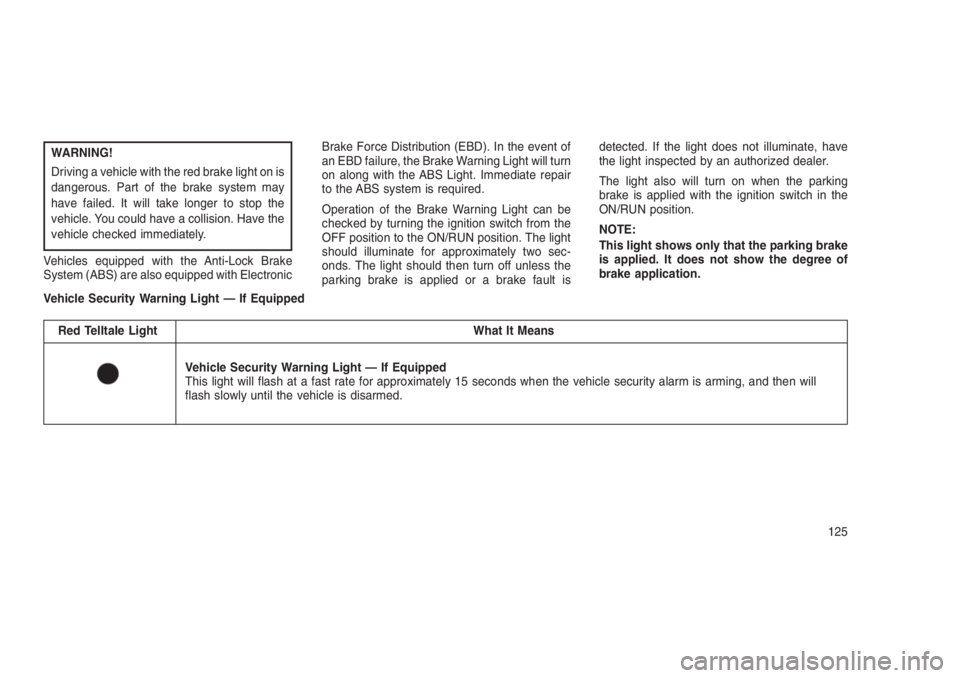
Vehicle Security Warning Light — If Equipped
Red Telltale Light What It Means
Vehicle Security Warning Light — If Equipped
This light will flash at a fast rate for approximately 15 seconds when the vehicle security alarm is arming, and then will
flash slowly until the vehicle is disarmed.
125
Page 137 of 332
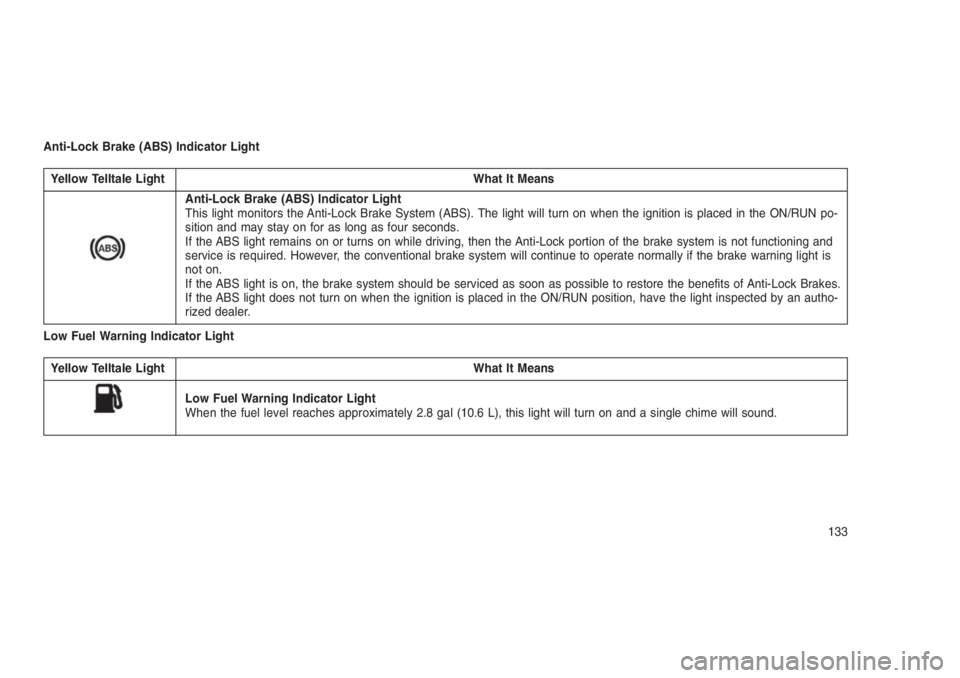
Anti-Lock Brake (ABS) Indicator Light
Yellow Telltale Light What It Means
Anti-Lock Brake (ABS) Indicator Light
This light monitors the Anti-Lock Brake System (ABS). The light will turn on when the ignition is placed in the ON/RUN po-
sition and may stay on for as long as four seconds.
If the ABS light remains on or turns on while driving, then the Anti-Lock portion of the brake system is not functioning and
service is required. However, the conventional brake system will continue to operate normally if the brake warning light is
not on.
If the ABS light is on, the brake system should be serviced as soon as possible to restore the benefits of Anti-Lock Brakes.
If the ABS light does not turn on when the ignition is placed in the ON/RUN position, have the light inspected by an autho-
rized dealer.
Low Fuel Warning Indicator Light
Yellow Telltale Light What It Means
Low Fuel Warning Indicator Light
When the fuel level reaches approximately 2.8 gal (10.6 L), this light will turn on and a single chime will sound.
133
Page 147 of 332
Illuminated Approach
When this feature is selected, the headlights will
activate and remain on for up to 90 seconds
when the doors are unlocked using the RKE
Key Fob. Push and hold theRIGHT
arrow
button when in this display until “OFF,” “30 sec,”
“60 sec,” or “90 sec.” appears to make your
selection.
Hill Start Assist (HSA) — If Equipped
When “On” is selected, the HSA system is
active. Refer to “Electronic Brake Control Sys-
tem” in “Starting And Operating” for system
function and operating information. To make
your selection, push and release theRIGHT
arrow button until “On” or “Off” appears.
Display Units In
The EVIC, odometer, and Uconnect GPS sys-
tem units can be changed between US and
Metric.
Push and hold theRIGHT
arrow button
when in this display until “US” or “METRIC”
appears to make your selection.
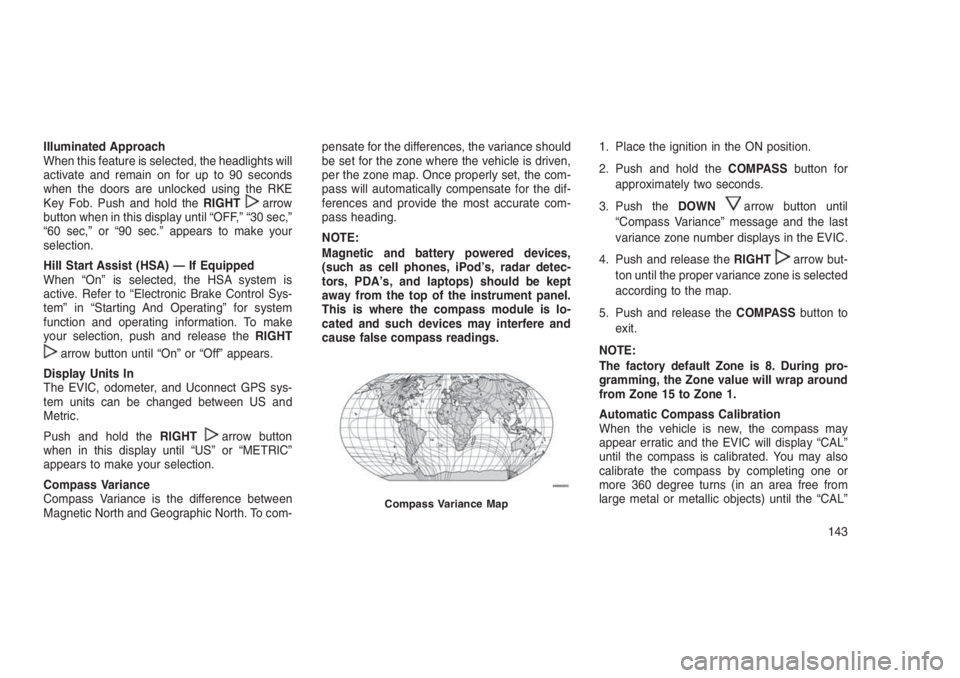
Compass Variance
Compass Variance is the difference between
Magnetic North and Geographic North. To com-pensate for the differences, the variance should
be set for the zone where the vehicle is driven,
per the zone map. Once properly set, the com-
pass will automatically compensate for the dif-
ferences and provide the most accurate com-
pass heading.
NOTE:
Magnetic and battery powered devices,
(such as cell phones, iPod’s, radar detec-
tors, PDA’s, and laptops) should be kept
away from the top of the instrument panel.
This is where the compass module is lo-
cated and such devices may interfere and
cause false compass readings.1. Place the ignition in the ON position.
2. Push and hold theCOMPASSbutton for
approximately two seconds.
3. Push theDOWN
arrow button until
“Compass Variance” message and the last
variance zone number displays in the EVIC.
4. Push and release theRIGHT
arrow but-
ton until the proper variance zone is selected
according to the map.
5. Push and release theCOMPASSbutton to
exit.
NOTE:
The factory default Zone is 8. During pro-
gramming, the Zone value will wrap around
from Zone 15 to Zone 1.
Automatic Compass Calibration
When the vehicle is new, the compass may
appear erratic and the EVIC will display “CAL”
until the compass is calibrated. You may also
calibrate the compass by completing one or
more 360 degree turns (in an area free from
large metal or metallic objects) until the “CAL”
Compass Variance Map
143
Page 165 of 332
5
STARTING AND OPERATING
•STARTING PROCEDURES . . . . . . . . . . . . . . . . . . . . . . .165•Manual Transmission — If Equipped................165
•Automatic Transmission — If Equipped..............165
•Normal Starting.............................165
•Extreme Cold Weather (below −20°F or −29°C)...........166
•If Engine Fails To Start........................166
•After Starting..............................166
•MANUAL TRANSMISSION — IF EQUIPPED . . . . . . . . . . . . .166•Five-Speed Manual Transmission..................166
•Recommended Shift Speeds.....................167
•Downshifting..............................168
•AUTOMATIC TRANSMISSION — IF EQUIPPED . . . . . . . . . . .168•Key Ignition Park Interlock......................169
•Brake/Transmission Shift Interlock System............169
•Six-Speed Automatic Transmission — If Equipped........169
•Continuously Variable Automatic Transmission (CVT) — If
Equipped.................................173
•AUTOSTICK................................176•AutoStick (Six-Speed Automatic Transmission) — If Equipped .176
161
Page 166 of 332
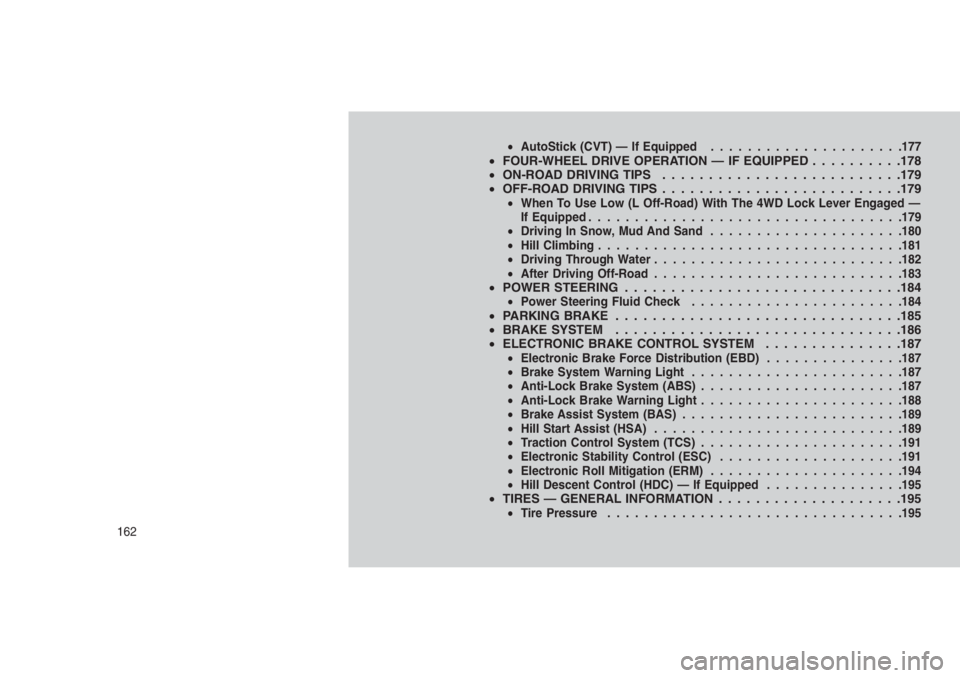
•AutoStick (CVT) — If Equipped.....................177•FOUR-WHEEL DRIVE OPERATION — IF EQUIPPED . . . . . . . . . .178
•ON-ROAD DRIVING TIPS . . . . . . . . . . . . . . . . . .........179
•OFF-ROAD DRIVING TIPS..........................179
•When To Use Low (L Off-Road) With The 4WD Lock Lever Engaged —
If Equipped..................................179
•Driving In Snow, Mud And Sand.....................180
•Hill Climbing.................................181
•Driving Through Water...........................182
•After Driving Off-Road...........................183
•POWER STEERING . . . . . . . . . .....................184•Power Steering Fluid Check.......................184•PARKING BRAKE . ..............................185
•BRAKE SYSTEM . . . . . . . . . . . . . . . . . ..............186
•ELECTRONIC BRAKE CONTROL SYSTEM . . . . . . . . . ......187
•Electronic Brake Force Distribution (EBD)...............187
•Brake System Warning Light.......................187
•Anti-Lock Brake System (ABS)......................187
•Anti-Lock Brake Warning Light......................188
•Brake Assist System (BAS)........................189
•Hill Start Assist (HSA)...........................189
•Traction Control System (TCS)......................191
•Electronic Stability Control (ESC)....................191
•Electronic Roll Mitigation (ERM).....................194
•Hill Descent Control (HDC) — If Equipped...............195
•TIRES — GENERAL INFORMATION . . . . . . . . . . . . . . . . . . . .195•Tire Pressure................................195
162
Page 169 of 332
STARTING PROCEDURES
Before starting your vehicle, adjust your seat,
adjust both inside and outside mirrors, and
fasten your seat belts.
WARNING!
•When leaving the vehicle, always remove
the Key Fob from the ignition and lock your
vehicle.
•Never leave children alone in a vehicle, or
with access to an unlocked vehicle. Allow-
ing children to be in a vehicle unattended
is dangerous for a number of reasons. A
child or others could be seriously or fatally
injured. Children should be warned not to
touch the parking brake, brake pedal or the
transmission gear selector.
•Do not leave the key fob in or near the
vehicle, or in a location accessible to chil-
dren. A child could operate power win-
dows, other controls, or move the vehicle.
(Continued)
WARNING!(Continued)
•Do not leave children or animals inside
parked vehicles in hot weather. Interior
heat build-up may cause serious injury or
death.
Manual Transmission — If EquippedBefore starting the engine fully apply the park-
ing brake, press the clutch pedal to the floor and
place the gear selector in NEUTRAL.
NOTE:
The engine will not start unless the clutch
pedal is pressed to the floor.
Automatic Transmission — If
Equipped
The gear selector must be in the PARK or
NEUTRAL position before you can start the
engine. Press the brake pedal before shifting to
any driving gear.
NOTE:
You must press the brake pedal before shift-
ing out of PARK.Tip Start
Do notpress the accelerator. Turn the ignition
switch to the START position and release it as
soon as the starter engages. The starter motor
will continue to run, and it will disengage auto-
matically when the engine is running. If the
engine fails to start, the starter will disengage
automatically in 10 seconds. If this occurs, turn
the ignition switch to the LOCK position, wait 10
to 15 seconds, then repeat the “Normal Start-
ing” procedure.
NOTE:
Normal starting of either a cold or a warm
engine is obtained without pumping or
pressing the accelerator pedal.
Normal StartingNormal starting of either a cold or a warm
engine does not require pumping or pressing
the accelerator pedal. Simply turn the ignition
switch to the START position and release when
the engine starts. If the engine fails to start
within 15 seconds, turn the ignition switch to the
OFF position, wait 10 to 15 seconds, then
repeat the “Normal Starting” procedure.
165
Page 170 of 332
WARNING!
Do not attempt to push or tow your vehicle to
get it started. Vehicles equipped with an
automatic transmission cannot be started
this way. Unburned fuel could enter the cata-
lytic converter and once the engine has
started, ignite and damage the converter and
vehicle. If the vehicle has a discharged bat-
tery, booster cables may be used to obtain a
start from another vehicle. This type of start
can be dangerous if done improperly, so
follow the procedure carefully. Refer to
“Jump-Starting” in “What To Do In Emergen-
cies” for further information.
Extreme Cold Weather (below −20°F
or −29°C)
To ensure reliable starting at these tempera-
tures, use of an externally powered electric
engine block heater (available from your autho-
rized dealer) is recommended.
If Engine Fails To StartIf the engine fails to start after you have followed
the “Normal Starting” procedure, it may be
flooded. Push the accelerator pedal all the way
to the floor and hold it there. Crank the engine
for no more than 15 seconds. This should clear
any excess fuel in case the engine is flooded.
Leave the ignition key in the ON position, re-
lease the accelerator pedal and repeat the
“Normal Starting” procedure.
WARNING!
Never pour fuel or other flammable liquid into
the throttle body air inlet opening in an
attempt to start the vehicle. This could result
in flash fire causing serious personal injury.
CAUTION!
To prevent damage to the starter, do not
crank the engine for more than 15 seconds
at a time. Wait 10 to 15 seconds before trying
again.
After StartingThe idle speed will automatically decrease as
the engine warms up.
MANUAL TRANSMISSION — IF
EQUIPPED
Five-Speed Manual Transmission
WARNING!
You or others could be injured if you leave
the vehicle unattended without having the
parking brake fully applied. The parking
brake should always be applied when the
driver is not in the vehicle, especially on an
incline.
Fully press the clutch pedal before you shift
gears. As you release the clutch pedal, lightly
press the accelerator pedal.
166
Page 172 of 332
DownshiftingProper downshifting will improve fuel economy
and prolong engine life.
CAUTION!
If you skip a gear while downshifting or
downshift at too high of a vehicle speed,
these conditions may cause the engine to
overspeed if too low of a gear is selected and
the clutch pedal is released. Damage to the
clutch and the transmission can result from
skipping a gear while downshifting or down-
shifting at too high of a vehicle speed even if
the clutch pedal is held pressed (i.e., not
released).
To maintain a safe speed and prolong brake life,
shift down to second or first gear when de-
scending a steep grade.
When turning a corner or driving up a steep
grade, downshift early so that the engine will not
be overburdened.
AUTOMATIC TRANSMISSION
— IF EQUIPPED
CAUTION!
Damage to the transmission may occur if
the following precautions are not observed:
•Shift into or out of PARK or REVERSE only
after the vehicle has come to a complete
stop.
•Do not shift between PARK, REVERSE,
NEUTRAL, or DRIVE when the engine is
above idle speed.
•Before shifting into any gear, make sure
your foot is firmly pressing the brake pedal.
NOTE:
You must press and hold the brake pedal
while shifting out of PARK.
WARNING!
•It is dangerous to shift out of PARK or
NEUTRAL if the engine speed is higher
than idle speed. If your foot is not firmly
pressing the brake pedal, the vehicle could
accelerate quickly forward or in reverse.
You could lose control of the vehicle and
hit someone or something. Only shift into
gear when the engine is idling normally
and your foot is firmly pressing the brake
pedal.
•Unintended movement of a vehicle could
injure those in or near the vehicle. As with
all vehicles, you should never exit a ve-
hicle while the engine is running. Before
exiting a vehicle, always shift the transmis-
sion into PARK, apply the parking brake,
turn the engine OFF, and remove the igni-
tion key. Once the key is removed, the
transmission is locked in PARK, securing
the vehicle against unwanted movement.
(Continued)
168
Page 173 of 332
WARNING!(Continued)
•When leaving the vehicle, always remove
the ignition key from the vehicle and lock
the vehicle.
•Never leave children alone in a vehicle, or
with access to an unlocked vehicle. Allow-
ing children to be in a vehicle unattended
is dangerous for a number of reasons. A
child or others could be seriously or fatally
injured. Children should be warned not to
touch the parking brake, brake pedal or the
transmission gear selector.
•Do not leave the ignition key in or near the
vehicle (or in a location accessible to chil-
dren). A child could operate power win-
dows, other controls, or move the vehicle.
Key Ignition Park InterlockThis vehicle is equipped with a Key Ignition Park
Interlock which requires the transmission to be
in PARK before the ignition switch can be turned
to the LOCK/OFF (key removal) position. The
key can only be removed from the ignition whenthe ignition is in the LOCK/OFF position, and
once removed the transmission is locked in
PARK.
NOTE:
If a malfunction occurs, the system will trap
the key in the ignition switch to warn you
that this safety feature is inoperable. The
engine can be started and stopped but the
key cannot be removed until you obtain
service.
Brake/Transmission Shift Interlock
System
This vehicle is equipped with a Brake Transmis-
sion Shift Interlock system (BTSI) that holds the
gear selector in PARK unless the brakes are
applied. To shift the transmission out of PARK,
the ignition switch must be turned to the ON/
RUN position (engine running or not) and the
brake pedal must be pressed.
Six-Speed Automatic Transmission
— If Equipped
The transmission gear position display (located
in the instrument cluster) indicates the transmis-
sion gear range. You must press the brakepedal to move the gear selector out of PARK
(refer to “Brake/Transmission Shift Interlock
System” in this section). To drive, move the gear
selector from PARK or NEUTRAL to the DRIVE
position.
The electronically-controlled transmission pro-
vides a precise shift schedule. The transmission
electronics are self-calibrating; therefore, the
first few shifts on a new vehicle may be some-
what abrupt. This is a normal condition, and
precision shifts will develop within a few hun-
dred miles (kilometers).
Only shift from DRIVE to PARK or REVERSE
when the accelerator pedal is released and the
vehicle is stopped. Be sure to keep your foot on
the brake pedal when shifting between these
gears.
The transmission gear selector has only PARK,
REVERSE, NEUTRAL, and DRIVE shift posi-
tions. Manual shifts can be made using the
AutoStick shift control (refer to “AutoStick” in
this section). Moving the gear selector to the left
or right (-/+) while in the DRIVE position will
169
Page 174 of 332
manually select the transmission gear, and will
display the current gear in the instrument clus-
ter as 1, 2, 3, etc.
Gear Ranges
DO NOT race the engine when shifting from
PARK or NEUTRAL into another gear range.
NOTE:
After selecting any gear range, wait a mo-
ment to allow the selected gear to engage
before accelerating. This is especially im-
portant when the engine is cold.
PARK (P)
This range supplements the parking brake by
locking the transmission. The engine can be
started in this range. Never attempt to use
PARK while the vehicle is in motion. Apply the
parking brake when leaving the vehicle in this
range.
When parking on a level surface, you may shift
the transmission into PARK first, and then apply
the parking brake.
When parking on a hill, apply the parking brake
before shifting the transmission to PARK, oth-
erwise the load on the transmission lockingmechanism may make it difficult to move the
gear selector out of PARK. As an added precau-
tion, turn the front wheels toward the curb on a
downhill grade and away from the curb on an
uphill grade.
WARNING!
•Never use the PARK position as a substi-
tute for the parking brake. Always apply
the parking brake fully when parked to
guard against vehicle movement and pos-
sible injury or damage.
•Your vehicle could move and injure you
and others if it is not in PARK. Check by
trying to move the gear selector out of
PARK with the brake pedal released. Make
sure the transmission is in PARK before
leaving the vehicle.
(Continued)
WARNING!(Continued)
•It is dangerous to shift out of PARK or
NEUTRAL if the engine speed is higher
than idle speed. If your foot is not firmly
pressing the brake pedal, the vehicle could
accelerate quickly forward or in reverse.
You could lose control of the vehicle and
hit someone or something. Only shift into
gear when the engine is idling normally
and your foot is firmly pressing the brake
pedal.
•Unintended movement of a vehicle could
injure those in or near the vehicle. As with
all vehicles, you should never exit a ve-
hicle while the engine is running. Before
exiting a vehicle, always shift the transmis-
sion into PARK, apply the parking brake,
turn the engine OFF, and remove the igni-
tion key. Once the key is removed, the
transmission is locked in PARK, securing
the vehicle against unwanted movement.
(Continued)
170