brake JEEP PATRIOT 2019 Owner handbook (in English)
[x] Cancel search | Manufacturer: JEEP, Model Year: 2019, Model line: PATRIOT, Model: JEEP PATRIOT 2019Pages: 332, PDF Size: 1.99 MB
Page 257 of 332
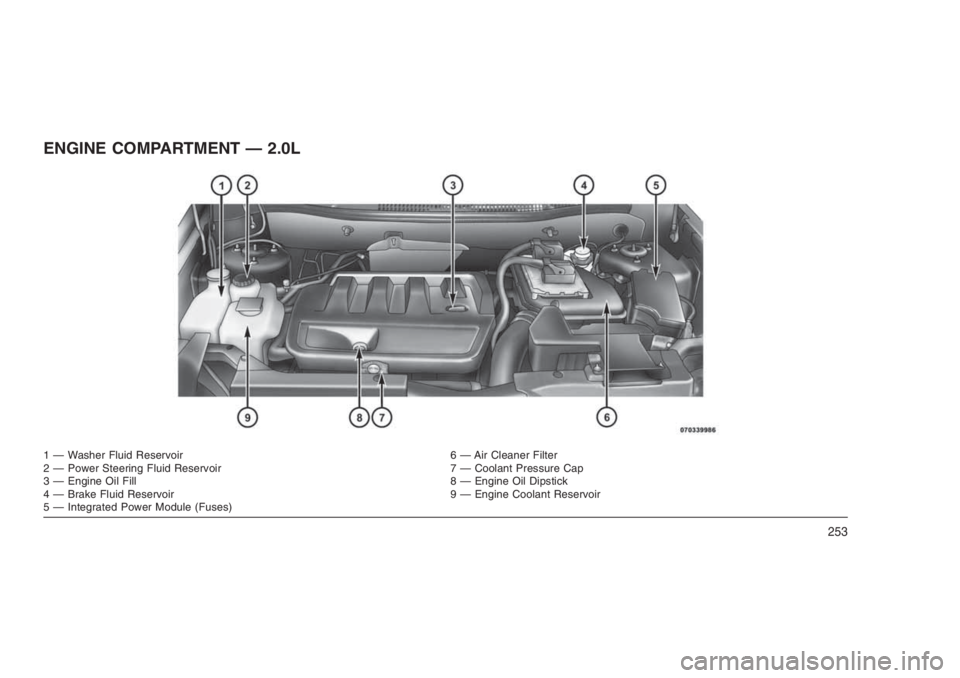
ENGINE COMPARTMENT — 2.0L
1 — Washer Fluid Reservoir 6 — Air Cleaner Filter
2 — Power Steering Fluid Reservoir 7 — Coolant Pressure Cap
3 — Engine Oil Fill 8 — Engine Oil Dipstick
4 — Brake Fluid Reservoir 9 — Engine Coolant Reservoir
5 — Integrated Power Module (Fuses)
253
Page 258 of 332
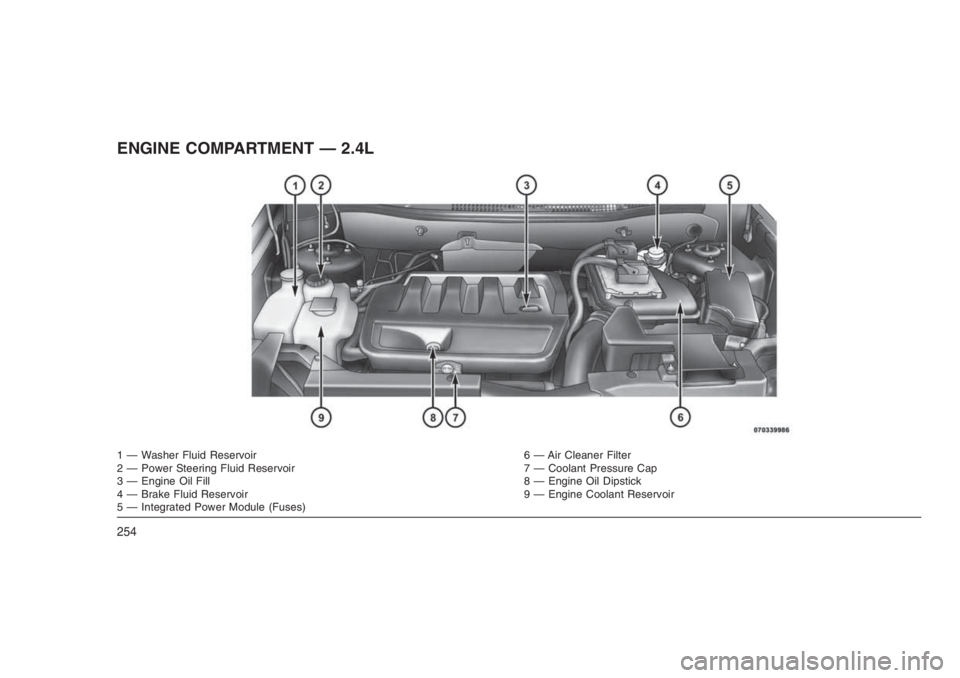
ENGINE COMPARTMENT — 2.4L
1 — Washer Fluid Reservoir 6 — Air Cleaner Filter
2 — Power Steering Fluid Reservoir 7 — Coolant Pressure Cap
3 — Engine Oil Fill 8 — Engine Oil Dipstick
4 — Brake Fluid Reservoir 9 — Engine Coolant Reservoir
5 — Integrated Power Module (Fuses)
254
Page 270 of 332
•If frequent engine coolant (antifreeze) addi-
tions are required, the cooling system should
be pressure tested for leaks.
•Maintain engine coolant (antifreeze) concen-
tration at a minimum of 50% OAT coolant
(conforming to MS.90032) and distilled water
for proper corrosion protection of your engine
which contains aluminum components.
•Make sure that the coolant expansion bottle
overflow hoses are not kinked or obstructed.
•Keep the front of the radiator clean. If your
vehicle is equipped with air conditioning,
keep the front of the condenser clean.
•Do not change the thermostat for Summer or
Winter operation. If replacement is ever nec-
essary, install ONLY the correct type thermo-
stat. Other designs may result in unsatisfac-
tory engine coolant (antifreeze) performance,
poor gas mileage, and increased emissions.
Brake SystemIn order to assure brake system performance,
all brake system components should be in-spected periodically. Refer to the “Maintenance
Schedule” for the proper maintenance intervals.
WARNING!
Riding the brakes can lead to brake failure
and possibly a collision. Driving with your
foot resting or riding on the brake pedal can
result in abnormally high brake tempera-
tures, excessive lining wear, and possible
brake damage. You would not have your full
braking capacity in an emergency.
Brake Master Cylinder
The fluid level in the master cylinder should be
checked when performing under hood services,
or immediately if the brake system warning light
is on.
Be sure to clean the top of the master cylinder
area before removing the cap. If necessary, add
fluid to bring the fluid level up to the require-
ments described on the brake fluid reservoir.
Fluid level can be expected to fall as the brake
pads wear. The brake fluid level should be
checked when the pads are replaced. However,low fluid level may be caused by a leak and a
checkup may be needed.
NOTE:
If your vehicle is equipped with a manual
transmission, the brake fluid reservoir sup-
plies fluid to both the brake system and the
clutch release system. The two systems are
separated in the reservoir, and a leak in one
system will not affect the other system. The
manual transmission clutch release system
should not require fluid replacement during
the life of the vehicle. If the brake fluid
reservoir is low and the brake system does
not indicate any leaks or other problems, it
may be a result of a leak in the hydraulic
clutch release system. See your local autho-
rized dealer for service.
Use only manufacturer’s recommended brake
fluid. Refer to “Fluids, Lubricants, And Genuine
Parts” in “Maintaining Your Vehicle” for further
information.
266
Page 271 of 332
WARNING!
•Use only manufacturer’s recommended
brake fluid. Refer to “Fluids, Lubricants,
And Genuine Parts” in “Maintaining Your
Vehicle” for further information. Using the
wrong type of brake fluid can severely
damage your brake system and/or impair
its performance. The proper type of brake
fluid for your vehicle is also identified on
the original factory installed hydraulic mas-
ter cylinder reservoir.
•To avoid contamination from foreign matter
or moisture, use only new brake fluid or
fluid that has been in a tightly closed
container. Keep the master cylinder reser-
voir cap secured at all times. Brake fluid in
a open container absorbs moisture from
the air resulting in a lower boiling point.
This may cause it to boil unexpectedly
during hard or prolonged braking, resulting
in sudden brake failure. This could result in
a collision.
(Continued)
WARNING!(Continued)
•Overfilling the brake fluid reservoir can
result in spilling brake fluid on hot engine
parts, causing the brake fluid to catch fire.
Brake fluid can also damage painted and
vinyl surfaces, care should be taken to
avoid its contact with these surfaces.
•Do not allow petroleum based fluid to
contaminate the brake fluid. Brake seal
components could be damaged, causing
partial or complete brake failure. This
could result in a collision.
CAUTION!
Use of improper brake fluids will affect over-
all clutch system performance. Improper
brake fluids may damage the clutch system
resulting in loss of clutch function and the
ability to shift the transmission.
Automatic Transmission (6-Speed)
— If Equipped
Selection Of Lubricant — 6-Speed
Transmission
It is important to use the proper transmission
fluid to ensure optimum transmission perfor-
mance and life. Use only the manufacturer’s
specified transmission fluid. Refer to “Fluids,
Lubricants, and Genuine Parts” in this section
for fluid specifications. It is important to maintain
the transmission fluid at the correct level using
the recommended fluid.
No chemical flushes should be used in any
transmission; only the approved lubricant
should be used.
CAUTION!
Using a transmission fluid other than the
manufacturer’s recommended fluid may
cause deterioration in transmission shift
quality and/or torque converter shudder. Re-
fer to “Fluids, Lubricants, And Genuine
Parts” in this section for fluid specifications.
267
Page 276 of 332
paired as soon as possible. The cost of such
repairs is considered the responsibility of the
owner.
•If you carry special cargo such as chemicals,
fertilizers, de-icer salt, etc., be sure that such
materials are well packaged and sealed.
•If a lot of driving is done on gravel roads,
consider mud or stone shields behind each
wheel.
•Use MOPAR Touch Up Paint on scratches as
soon as possible. Your authorized dealer has
touch up paint to match the color of your
vehicle.
Wheel And Wheel Trim Care
•All wheels and wheel trim, especially alumi-
num and chrome plated wheels, should be
cleaned regularly with a mild soap and water
to prevent corrosion.
•To remove heavy soil and/or excessive brake
dust, use MOPAR Wheel Cleaner.NOTE:
If your vehicle is equipped with Dark Vapor
or Black Satin Chrome wheels DO NOT USE
wheel cleaners, abrasives or polishing com-
pounds. They will permanently damage this
finish and such damage is not covered by
the New Vehicle Limited Warranty. USE
ONLY MILD SOAP AND WATER WITH A
SOFT CLOTH. Used on a regular basis this is
all that is required to maintain this finish.
CAUTION!
Do not use scouring pads, steel wool, a
bristle brush, or metal polishes. Do not use
oven cleaner. These products may damage
the wheel’s protective finish. Avoid automatic
car washes that use acidic solutions or harsh
brushes that may damage the wheel’s pro-
tective finish. Only MOPAR Wheel Cleaner
or equivalent is recommended.Stain Repel Fabric Cleaning Procedure —
If Equipped
Stain Repel seats may be cleaned in the follow-
ing manner:
•Remove as much of the stain as possible by
blotting with a clean, dry towel.
•Blot any remaining stain with a clean, damp
towel.
•For tough stains, apply MOPAR Total Clean,
or a mild soap solution to a clean, damp cloth
and remove stain. Use a fresh, damp towel to
remove soap residue.
•For grease stains, apply MOPAR Multi-
Purpose Cleaner to a clean, damp cloth and
remove stain. Use a fresh, damp towel to
remove soap residue.
•Do not use any harsh solvents or any other
form of protectants on Stain Repel products.
Interior Care
Use MOPAR Total Clean to clean fabric uphol-
stery and carpeting.
272
Page 279 of 332
WARNING!(Continued)
•Before replacing a fuse, make sure that the
ignition is off and that all the other services
are switched off and/or disengaged.
•If the replaced fuse blows again, contact
an authorized dealer.
•If a general protection fuse for safety sys-
tems (air bag system, braking system),
power unit systems (engine system, gear-
box system) or steering system blows,
contact an authorized dealer.
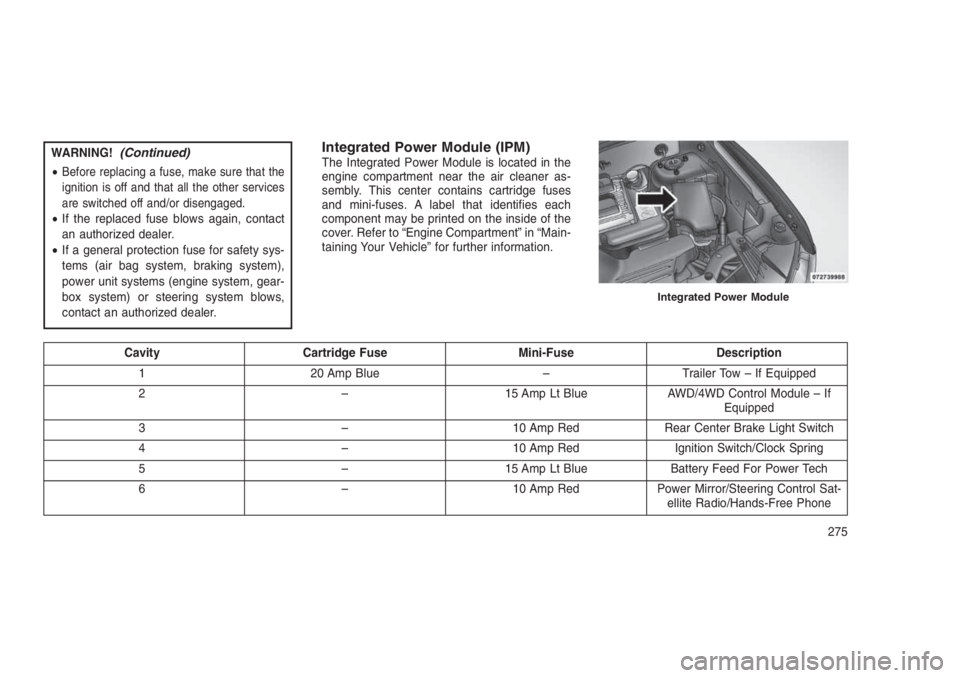
Integrated Power Module (IPM)The Integrated Power Module is located in the
engine compartment near the air cleaner as-
sembly. This center contains cartridge fuses
and mini-fuses. A label that identifies each
component may be printed on the inside of the
cover. Refer to “Engine Compartment” in “Main-
taining Your Vehicle” for further information.
Cavity Cartridge Fuse Mini-Fuse Description
1 20 Amp Blue – Trailer Tow – If Equipped
2 – 15 Amp Lt Blue AWD/4WD Control Module – If
Equipped
3 – 10 Amp Red Rear Center Brake Light Switch
4 – 10 Amp Red Ignition Switch/Clock Spring
5 – 15 Amp Lt Blue Battery Feed For Power Tech
6 – 10 Amp Red Power Mirror/Steering Control Sat-
ellite Radio/Hands-Free Phone
Integrated Power Module
275
Page 282 of 332
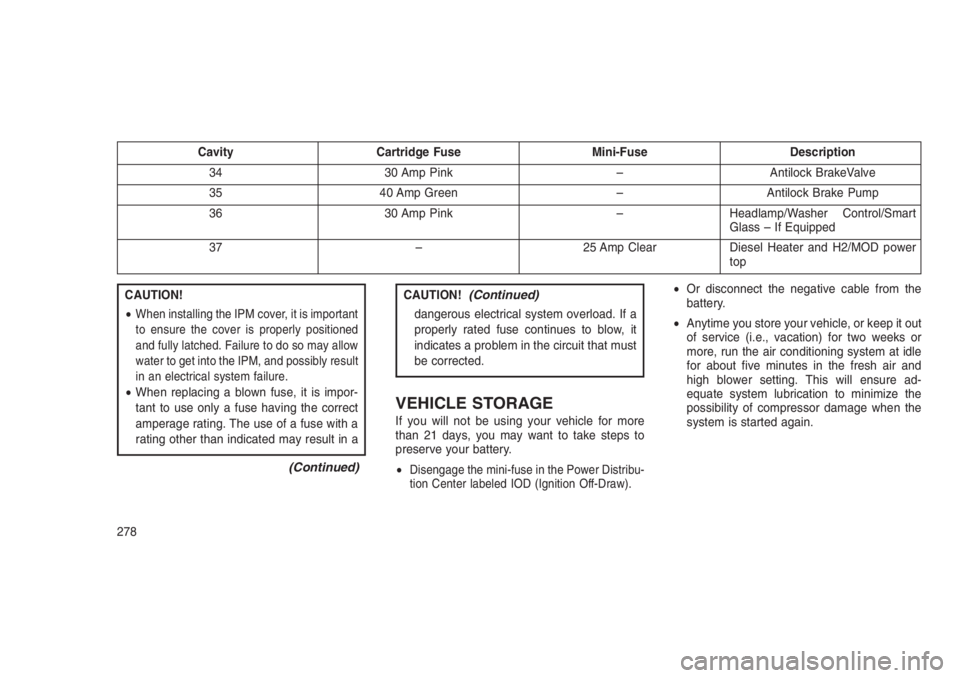
Cavity Cartridge Fuse Mini-Fuse Description
34 30 Amp Pink – Antilock BrakeValve
35 40 Amp Green – Antilock Brake Pump
36 30 Amp Pink – Headlamp/Washer Control/Smart
Glass – If Equipped
37 – 25 Amp Clear Diesel Heater and H2/MOD power
top
CAUTION!
•
When installing the IPM cover, it is important
to ensure the cover is properly positioned
and fully latched. Failure to do so may allow
water to get into the IPM, and possibly result
in an electrical system failure.
•When replacing a blown fuse, it is impor-
tant to use only a fuse having the correct
amperage rating. The use of a fuse with a
rating other than indicated may result in a
(Continued)
CAUTION!(Continued)
dangerous electrical system overload. If a
properly rated fuse continues to blow, it
indicates a problem in the circuit that must
be corrected.
VEHICLE STORAGE
If you will not be using your vehicle for more
than 21 days, you may want to take steps to
preserve your battery.
•
Disengage the mini-fuse in the Power Distribu-
tion Center labeled IOD (Ignition Off-Draw).
•Or disconnect the negative cable from the
battery.
•Anytime you store your vehicle, or keep it out
of service (i.e., vacation) for two weeks or
more, run the air conditioning system at idle
for about five minutes in the fresh air and
high blower setting. This will ensure ad-
equate system lubrication to minimize the
possibility of compressor damage when the
system is started again.
278
Page 286 of 332
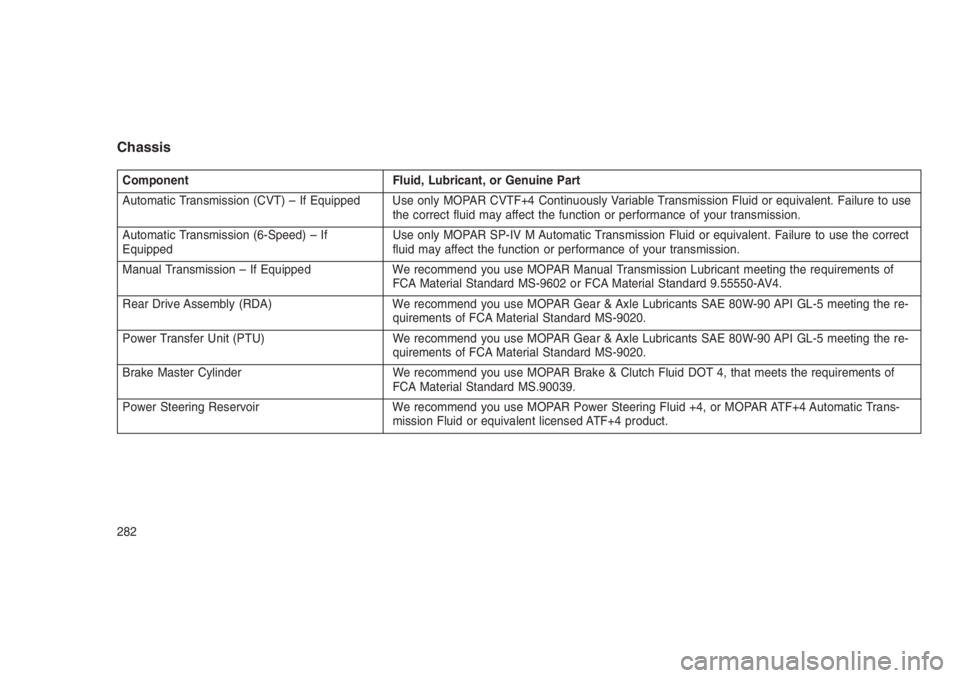
Chassis
Component Fluid, Lubricant, or Genuine Part
Automatic Transmission (CVT) – If Equipped Use only MOPAR CVTF+4 Continuously Variable Transmission Fluid or equivalent. Failure to use
the correct fluid may affect the function or performance of your transmission.
Automatic Transmission (6-Speed) – If
EquippedUse only MOPAR SP-IV M Automatic Transmission Fluid or equivalent. Failure to use the correct
fluid may affect the function or performance of your transmission.
Manual Transmission – If Equipped We recommend you use MOPAR Manual Transmission Lubricant meeting the requirements of
FCA Material Standard MS-9602 or FCA Material Standard 9.55550-AV4.
Rear Drive Assembly (RDA) We recommend you use MOPAR Gear & Axle Lubricants SAE 80W-90 API GL-5 meeting the re-
quirements of FCA Material Standard MS-9020.
Power Transfer Unit (PTU) We recommend you use MOPAR Gear & Axle Lubricants SAE 80W-90 API GL-5 meeting the re-
quirements of FCA Material Standard MS-9020.
Brake Master Cylinder We recommend you use MOPAR Brake & Clutch Fluid DOT 4, that meets the requirements of
FCA Material Standard MS.90039.
Power Steering Reservoir We recommend you use MOPAR Power Steering Fluid +4, or MOPAR ATF+4 Automatic Trans-
mission Fluid or equivalent licensed ATF+4 product.
282
Page 288 of 332
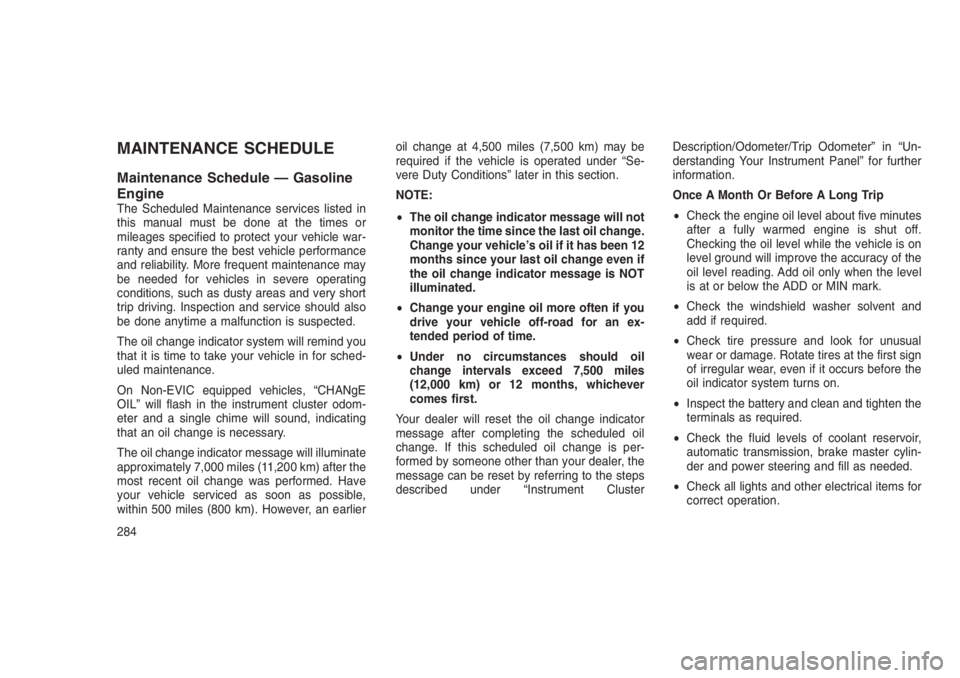
MAINTENANCE SCHEDULE
Maintenance Schedule — Gasoline
Engine
The Scheduled Maintenance services listed in
this manual must be done at the times or
mileages specified to protect your vehicle war-
ranty and ensure the best vehicle performance
and reliability. More frequent maintenance may
be needed for vehicles in severe operating
conditions, such as dusty areas and very short
trip driving. Inspection and service should also
be done anytime a malfunction is suspected.
The oil change indicator system will remind you
that it is time to take your vehicle in for sched-
uled maintenance.
On Non-EVIC equipped vehicles, “CHANgE
OIL” will flash in the instrument cluster odom-
eter and a single chime will sound, indicating
that an oil change is necessary.
The oil change indicator message will illuminate
approximately 7,000 miles (11,200 km) after the
most recent oil change was performed. Have
your vehicle serviced as soon as possible,
within 500 miles (800 km). However, an earlieroil change at 4,500 miles (7,500 km) may be
required if the vehicle is operated under “Se-
vere Duty Conditions” later in this section.
NOTE:
•The oil change indicator message will not
monitor the time since the last oil change.
Change your vehicle’s oil if it has been 12
months since your last oil change even if
the oil change indicator message is NOT
illuminated.
•Change your engine oil more often if you
drive your vehicle off-road for an ex-
tended period of time.
•Under no circumstances should oil
change intervals exceed 7,500 miles
(12,000 km) or 12 months, whichever
comes first.
Your dealer will reset the oil change indicator
message after completing the scheduled oil
change. If this scheduled oil change is per-
formed by someone other than your dealer, the
message can be reset by referring to the steps
described under “Instrument ClusterDescription/Odometer/Trip Odometer” in “Un-
derstanding Your Instrument Panel” for further
information.
Once A Month Or Before A Long Trip
•Check the engine oil level about five minutes
after a fully warmed engine is shut off.
Checking the oil level while the vehicle is on
level ground will improve the accuracy of the
oil level reading. Add oil only when the level
is at or below the ADD or MIN mark.
•Check the windshield washer solvent and
add if required.
•Check tire pressure and look for unusual
wear or damage. Rotate tires at the first sign
of irregular wear, even if it occurs before the
oil indicator system turns on.
•Inspect the battery and clean and tighten the
terminals as required.
•Check the fluid levels of coolant reservoir,
automatic transmission, brake master cylin-
der and power steering and fill as needed.
•Check all lights and other electrical items for
correct operation.
284
Page 289 of 332
At Each Oil Change
•Change the engine oil filter.
•Inspect the brake hoses and lines.CAUTION!
Failure to perform the required maintenance
items may result in damage to the vehicle.Required Maintenance Intervals
Refer to the Maintenance Schedules on the
following pages for the required maintenance
intervals.
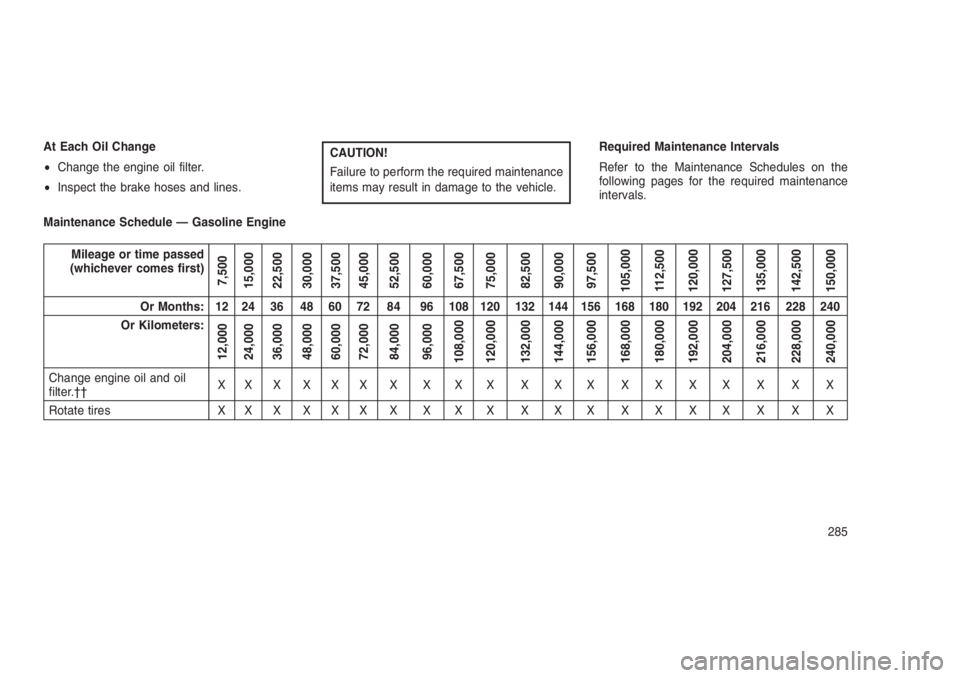
Maintenance Schedule — Gasoline Engine
Mileage or time passed
(whichever comes first)
7,500
15,000
22,500
30,000
37,500
45,000
52,500
60,000
67,500
75,000
82,500
90,000
97,500
105,000
112,500
120,000
127,500
135,000
142,500
150,000
Or Months: 12 24 36 48 60 72 84 96 108 120 132 144 156 168 180 192 204 216 228 240
Or Kilometers:
12,000
24,000
36,000
48,000
60,000
72,000
84,000
96,000
108,000
120,000
132,000
144,000
156,000
168,000
180,000
192,000
204,000
216,000
228,000
240,000
Change engine oil and oil
filter.††XXXXXXXXXX XXXXXXXX XX
Rotate tires X X X X X X X X X X X X X X X X X X X X
285