door lock JEEP PATRIOT 2019 Owner handbook (in English)
[x] Cancel search | Manufacturer: JEEP, Model Year: 2019, Model line: PATRIOT, Model: JEEP PATRIOT 2019Pages: 332, PDF Size: 1.99 MB
Page 193 of 332
Brake Assist System (BAS)The BAS is designed to optimize the vehicle’s
braking capability during emergency braking
maneuvers. The system detects an emergency
braking situation by sensing the rate and
amount of brake application and then applies
optimum pressure to the brakes. This can help
reduce braking distances. The BAS comple-
ments the anti-lock brake system (ABS). Apply-
ing the brakes very quickly results in the best
BAS assistance. To receive the benefit of the
system, you must apply continuous braking
pressure during the stopping sequence, (do not
“pump” the brakes). Do not reduce brake pedal
pressure unless braking is no longer desired.
Once the brake pedal is released, the BAS is
deactivated.
WARNING!
The Brake Assist System (BAS) cannot pre-
vent the natural laws of physics from acting
on the vehicle, nor can it increase the trac-
tion afforded by prevailing road conditions.
(Continued)
WARNING!(Continued)
BAS cannot prevent collisions, including
those resulting from excessive speed in
turns, driving on very slippery surfaces, or
hydroplaning. The capabilities of a BAS-
equipped vehicle must never be exploited in
a reckless or dangerous manner, which
could jeopardize the user’s safety or the
safety of others.
Hill Start Assist (HSA)The HSA system is designed to mitigate roll
back from a complete stop while on an incline. If
the driver releases the brake while stopped on
an incline, HSA will continue to hold the brake
pressure for a short period. If the driver does not
apply the throttle before this time expires, the
system will release brake pressure and the
vehicle will roll down the hill as normal.
The following conditions must be met in order
for HSA to activate:
•The feature must be enabled.
•The vehicle must be stopped.•Park brake must be off.
•Driver door must be closed.
•The vehicle must be on a sufficient grade.
•The gear selection must match vehicle uphill
direction (i.e., vehicle facing uphill is in for-
ward gear; vehicle backing uphill is in RE-
VERSE gear).
•HSA will work in REVERSE gear and all
forward gears. The system will not activate if
the transmission is in PARK or NEUTRAL.
For vehicles equipped with a manual trans-
mission, if the clutch is pressed, HSA will
remain active.
WARNING!
There may be situations where the Hill Start
Assist (HSA) will not activate and slight roll-
ing may occur, such as on minor hills or with
a loaded vehicle, or while pulling a trailer.
HSA is not a substitute for active driving
involvement. It is always the driver’s respon-
sibility to be attentive to distance to other
(Continued)
189
Page 216 of 332
WARNING!(Continued)
•Guard against carbon monoxide with
proper maintenance. Have the exhaust
system inspected every time the vehicle is
raised. Have any abnormal conditions re-
paired promptly. Until repaired, drive with
all side windows fully open.
•Keep the liftgate closed when driving your
vehicle to prevent carbon monoxide and
other poisonous exhaust gases from en-
tering the vehicle.
ADDING FUEL
Locking Fuel Filler Cap (Gas Cap)The locking gas cap is inside the fuel filler door,
on the left side of the vehicle. If the gas cap is
lost or damaged, be sure the replacement cap
is for use with this vehicle.
1. Turn off the engine.2. Insert the ignition key into the fuel cap and
turn the key one-quarter turn to the right,
then rotate the fuel cap to the left to remove.
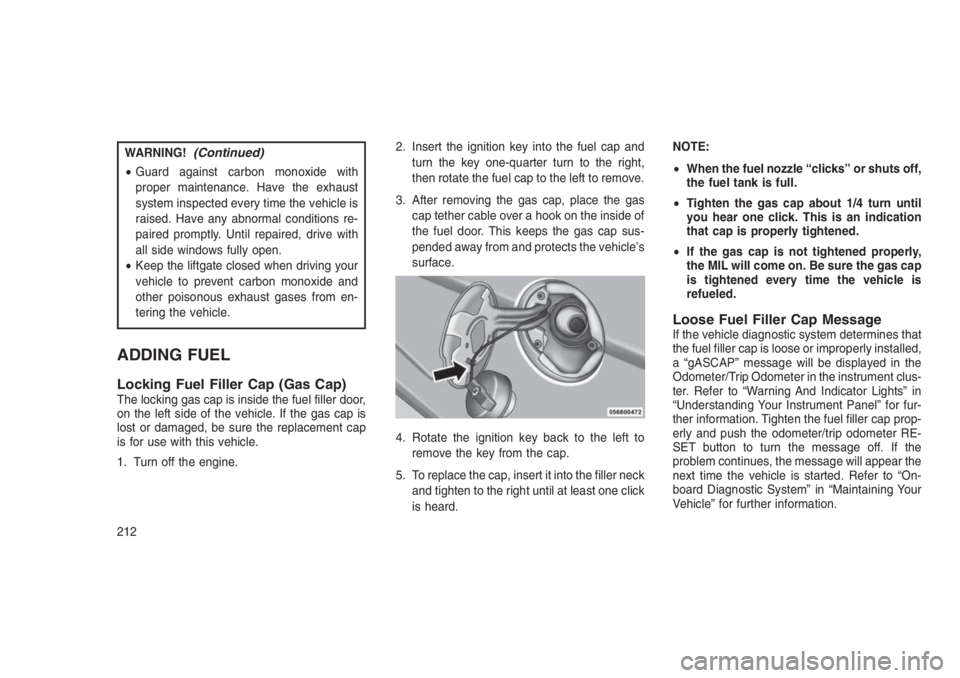
3. After removing the gas cap, place the gas
cap tether cable over a hook on the inside of
the fuel door. This keeps the gas cap sus-
pended away from and protects the vehicle’s
surface.
4. Rotate the ignition key back to the left to
remove the key from the cap.
5. To replace the cap, insert it into the filler neck
and tighten to the right until at least one click
is heard.NOTE:
•When the fuel nozzle “clicks” or shuts off,
the fuel tank is full.
•Tighten the gas cap about 1/4 turn until
you hear one click. This is an indication
that cap is properly tightened.
•If the gas cap is not tightened properly,
the MIL will come on. Be sure the gas cap
is tightened every time the vehicle is
refueled.
Loose Fuel Filler Cap MessageIf the vehicle diagnostic system determines that
the fuel filler cap is loose or improperly installed,
a “gASCAP” message will be displayed in the
Odometer/Trip Odometer in the instrument clus-
ter. Refer to “Warning And Indicator Lights” in
“Understanding Your Instrument Panel” for fur-
ther information. Tighten the fuel filler cap prop-
erly and push the odometer/trip odometer RE-
SET button to turn the message off. If the
problem continues, the message will appear the
next time the vehicle is started. Refer to “On-
board Diagnostic System” in “Maintaining Your
Vehicle” for further information.
212
Page 244 of 332
If tire pressure is less than 19 psi (1.3 Bar):
The tire is too badly damaged. Do not attempt to
drive the vehicle further. Call for assistance.
If the tire pressure is 19 psi (1.3 Bar) or
higher:
1. Push the Power Button (4) to turn on Tire
Service Kit and inflate the tire to the pressure
indicated on the tire and loading information
label on the driver-side door opening.
NOTE:
If the tire becomes over-inflated, push the
Deflation Button to reduce the tire pressure
to the recommended inflation pressure be-
fore continuing.
2. Disconnect the Tire Service Kit from the
valve stem, reinstall the cap on the valve
stem and unplug from 12 Volt outlet.
3. Place the Tire Service Kit in its proper stor-
age area in the vehicle.
4. Have the tire inspected and repaired or
replaced at the earliest opportunity at an
authorized dealer or tire service center.5. Remove the Speed Limit sticker from the
instrument panel after the tire has been
repaired.
6. Replace the Sealant Bottle (1) and Sealant
Hose (6) assembly at your authorized dealer
as soon as possible. Refer to (F) “Sealant
Bottle and Hose Replacement”.
NOTE:
When having the tire serviced, advise the
authorized dealer or service center that the
tire has been sealed using the Tire Service
Kit.
(F) Sealant Bottle And Hose Replacement:
1. Uncoil the Sealant Hose (6) (clear in color).
2. Locate the round Sealant Bottle release but-
ton in the recessed area under the sealant
bottle.
3. Push the Sealant Bottle release button. The
Sealant Bottle (1) will pop up. Remove the
bottle and dispose of it accordingly.4. Clean any remaining sealant from the Tire
Service Kit housing.
5. Position the new Sealant Bottle (1) in the
housing so that the Sealant Hose (6) aligns
with the hose slot in the front of the housing.
Push the bottle into the housing. An audible
click will be heard indicating the bottle is
locked into place.
6. Verify that the cap is installed on the fitting at
the end of the Sealant Hose (6) and return
the hose to its storage area (located on the
bottom of the air pump).
7. Return the Tire Service Kit to its storage
location in the vehicle.
240
Page 265 of 332
CAUTION!
The A/C air filter is identified with an arrow to
indicate airflow direction through the filter.
Failure to properly install the filter will result
in the need to replace it more often.
7. Rotate the glove compartment door back
into position.
Body LubricationLocks and all body pivot points, including such
items as seat tracks, door hinge pivot points
and rollers, liftgate, tailgate, decklid, sliding
doors and hood hinges, should be lubricated
periodically with a lithium based grease, such
as MOPAR Spray White Lube to assure quiet,
easy operation and to protect against rust and
wear. Prior to the application of any lubricant,
the parts concerned should be wiped clean to
remove dust and grit; after lubricating excess oil
and grease should be removed. Particular at-
tention should also be given to hood latching
components to ensure proper function. When
performing other underhood services, the hoodlatch, release mechanism and safety catch
should be cleaned and lubricated.
The external lock cylinders should be lubricated
twice a year, preferably in the Fall and Spring.
Apply a small amount of a high quality lubricant,
such as MOPAR Lock Cylinder Lubricant di-
rectly into the lock cylinder.
Windshield Wiper BladesClean the rubber edges of the wiper blades and
the windshield periodically with a sponge or soft
cloth and a mild nonabrasive cleaner. This will
remove accumulations of salt or road film.
Operation of the wipers on dry glass for long
periods may cause deterioration of the wiper
blades. Always use washer fluid when using the
wipers to remove salt or dirt from a dry wind-
shield.
Avoid using the wiper blades to remove frost or
ice from the windshield. Keep the blade rubber
out of contact with petroleum products such as
engine oil, gasoline, etc.NOTE:
Life expectancy of wiper blades varies de-
pending on geographical area and fre-
quency of use. Poor performance of blades
may be present with chattering, marks, wa-
ter lines or wet spots. If any of these condi-
tions are present, clean the wiper blades or
replace as necessary.Adding Washer FluidThe washer fluid reservoir is located in the
engine compartment, and the fluid level should
be checked at regular intervals. Fill the reservoir
with windshield washer solvent only (not radia-
tor antifreeze).
When refilling the washer fluid reservoir, take
some washer fluid and apply it to a cloth or
towel and wipe clean the wiper blades, this will
help blade performance. To prevent freeze-up
of your windshield washer system in cold
weather, select a solution or mixture that meets
or exceeds the temperature range of your cli-
mate. This rating information can be found on
most washer fluid containers.
261
Page 322 of 332
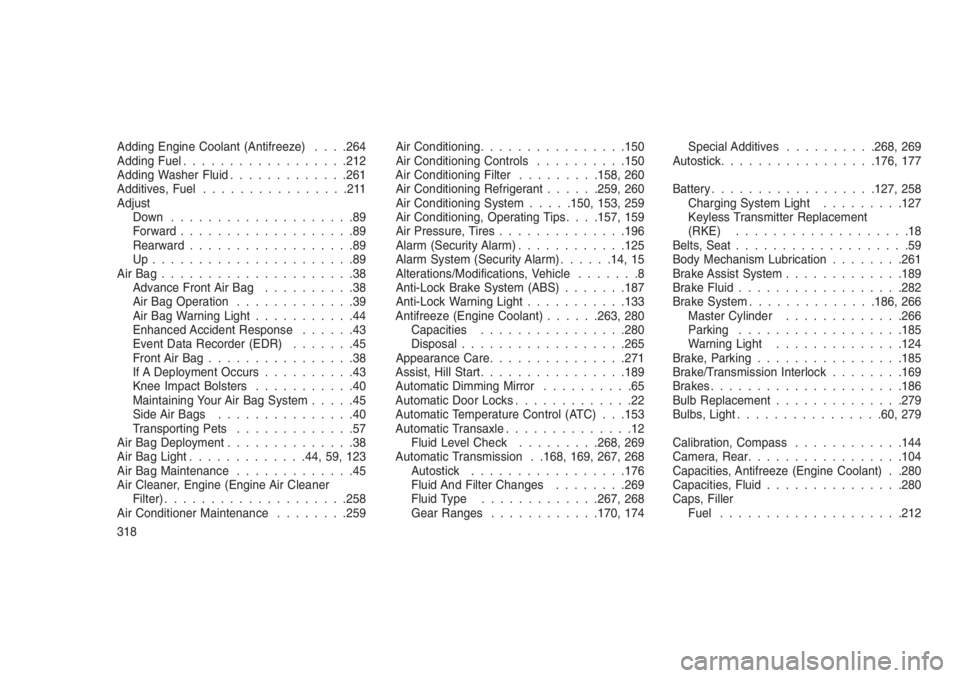
Adding Engine Coolant (Antifreeze). . . .264
Adding Fuel..................212
Adding Washer Fluid.............261
Additives, Fuel................211
Adjust
Down....................89
Forward...................89
Rearward..................89
Up......................89
AirBag.....................38
Advance Front Air Bag..........38
Air Bag Operation.............39
Air Bag Warning Light...........44
Enhanced Accident Response......43
Event Data Recorder (EDR).......45
Front Air Bag................38
If A Deployment Occurs..........43
Knee Impact Bolsters...........40
Maintaining Your Air Bag System.....45
Side Air Bags...............40
Transporting Pets.............57
Air Bag Deployment..............38
Air Bag Light.............44, 59, 123
Air Bag Maintenance.............45
Air Cleaner, Engine (Engine Air Cleaner
Filter)....................258
Air Conditioner Maintenance........259Air Conditioning................150
Air Conditioning Controls..........150
Air Conditioning Filter.........158, 260
Air Conditioning Refrigerant......259, 260
Air Conditioning System.....150, 153, 259
Air Conditioning, Operating Tips. . . .157, 159
Air Pressure, Tires..............196
Alarm (Security Alarm)............125
Alarm System (Security Alarm)......14, 15
Alterations/Modifications, Vehicle.......8
Anti-Lock Brake System (ABS).......187
Anti-Lock Warning Light...........133
Antifreeze (Engine Coolant)......263, 280
Capacities................280
Disposal..................265
Appearance Care...............271
Assist, Hill Start................189
Automatic Dimming Mirror..........65
Automatic Door Locks.............22
Automatic Temperature Control (ATC) . . .153
Automatic Transaxle..............12
Fluid Level Check.........268, 269
Automatic Transmission . .168, 169, 267, 268
Autostick.................176
Fluid And Filter Changes........269
Fluid Type.............267, 268
Gear Ranges............170, 174Special Additives..........268, 269
Autostick.................176, 177
Battery..................127, 258
Charging System Light.........127
Keyless Transmitter Replacement
(RKE)...................18
Belts, Seat...................59
Body Mechanism Lubrication........261
Brake Assist System.............189
Brake Fluid..................282
Brake System..............186, 266
Master Cylinder.............266
Parking..................185
Warning Light..............124
Brake, Parking................185
Brake/Transmission Interlock........169
Brakes.....................186
Bulb Replacement..............279
Bulbs, Light................60, 279
Calibration, Compass............144
Camera, Rear.................104
Capacities, Antifreeze (Engine Coolant) . .280
Capacities, Fluid...............280
Caps, Filler
Fuel....................212
318
Page 323 of 332
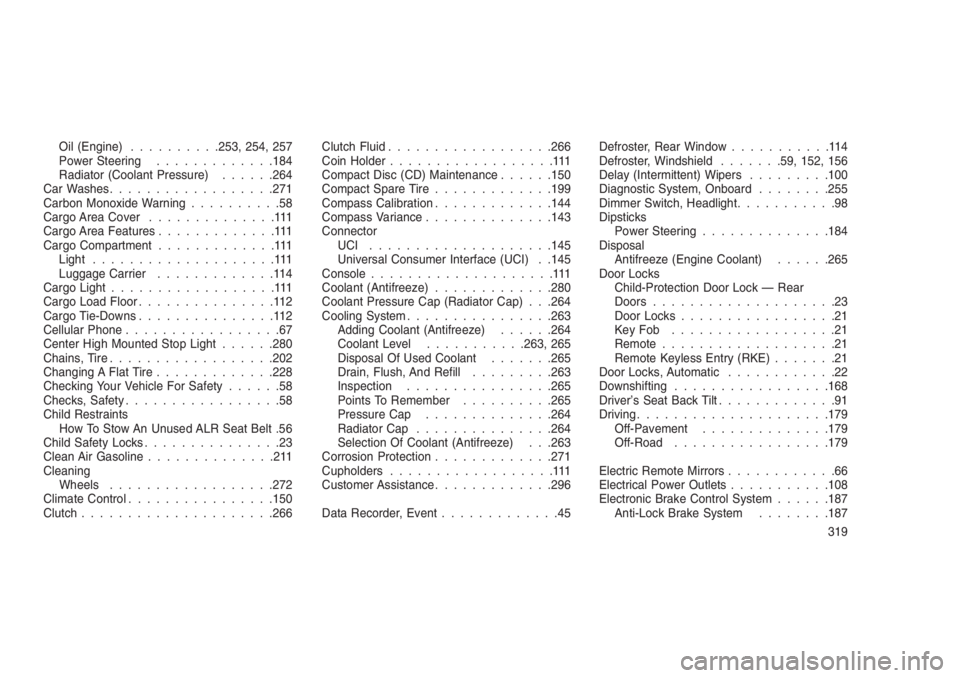
Oil (Engine)..........253, 254, 257
Power Steering.............184
Radiator (Coolant Pressure)......264
Car Washes..................271
Carbon Monoxide Warning..........58
Cargo Area Cover..............111
Cargo Area Features.............111
Cargo Compartment.............111
Light....................111
Luggage Carrier.............114
Cargo Light..................111
Cargo Load Floor...............112
Cargo Tie-Downs...............112
Cellular Phone.................67
Center High Mounted Stop Light......280
Chains, Tire..................202
Changing A Flat Tire.............228
Checking Your Vehicle For Safety......58
Checks, Safety.................58
Child Restraints
How To Stow An Unused ALR Seat Belt .56
Child Safety Locks...............23
Clean Air Gasoline..............211
Cleaning
Wheels..................272
Climate Control................150
Clutch.....................266Clutch Fluid..................266
Coin Holder..................111
Compact Disc (CD) Maintenance......150
Compact Spare Tire.............199
Compass Calibration.............144
Compass Variance..............143
Connector
UCI ....................145
Universal Consumer Interface (UCI) . .145
Console....................111
Coolant (Antifreeze).............280
Coolant Pressure Cap (Radiator Cap) . . .264
Cooling System................263
Adding Coolant (Antifreeze)......264
Coolant Level...........263, 265
Disposal Of Used Coolant.......265
Drain, Flush, And Refill
.........263
Inspection................265
Points To Remember..........265
Pressure Cap..............264
Radiator Cap...............264
Selection Of Coolant (Antifreeze) . . .263
Corrosion Protection.............271
Cupholders..................111
Customer Assistance.............296
Data Recorder, Event.............45Defroster, Rear Window...........114
Defroster, Windshield.......59, 152, 156
Delay (Intermittent) Wipers.........100
Diagnostic System, Onboard........255
Dimmer Switch, Headlight...........98
Dipsticks
Power Steering..............184
Disposal
Antifreeze (Engine Coolant)......265
Door Locks
Child-Protection Door Lock — Rear
Doors....................23
Door Locks.................21
KeyFob ..................21
Remote...................21
Remote Keyless Entry (RKE).......21
Door Locks, Automatic............22
Downshifting.................168
Driver’s Seat Back Tilt.............91
Driving.....................179
Off-Pavement..............179
Off-Road.................179
Electric Remote Mirrors............66
Electrical Power Outlets...........108
Electronic Brake Control System......187
Anti-Lock Brake System........187
319
Page 326 of 332
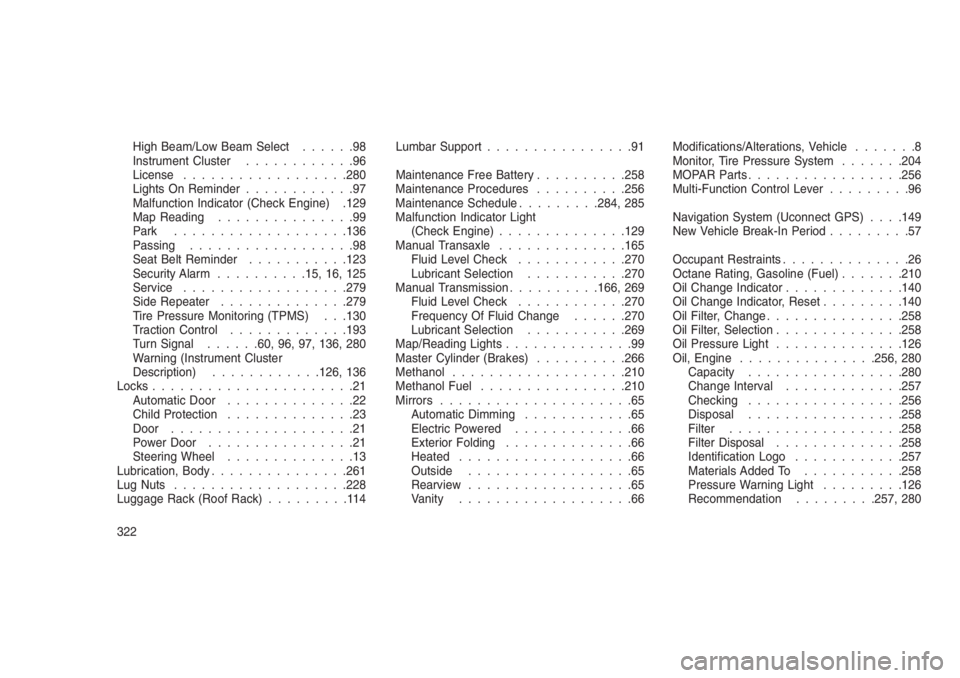
High Beam/Low Beam Select......98
Instrument Cluster............96
License..................280
Lights On Reminder............97
Malfunction Indicator (Check Engine) .129
Map Reading...............99
Park...................136
Passing..................98
Seat Belt Reminder...........123
Security Alarm..........15, 16, 125
Service..................279
Side Repeater..............279
Tire Pressure Monitoring (TPMS) . . .130
Traction Control.............193
Turn Signal......60, 96, 97, 136, 280
Warning (Instrument Cluster
Description)............126, 136
Locks......................21
Automatic Door..............22
Child Protection..............23
Door....................21
Power Door................21
Steering Wheel..............13
Lubrication, Body...............261
Lug Nuts...................228
Luggage Rack (Roof Rack).........114Lumbar Support................91
Maintenance Free Battery..........258
Maintenance Procedures..........256
Maintenance Schedule.........284, 285
Malfunction Indicator Light
(Check Engine)..............129
Manual Transaxle..............165
Fluid Level Check............270
Lubricant Selection...........270
Manual Transmission..........166, 269
Fluid Level Check............270
Frequency Of Fluid Change......270
Lubricant Selection...........269
Map/Reading Lights..............99
Master Cylinder (Brakes)..........266
Methanol..................
.210
Methanol Fuel................210
Mirrors.....................65
Automatic Dimming............65
Electric Powered.............66
Exterior Folding..............66
Heated...................66
Outside..................65
Rearview..................65
Vanity...................66Modifications/Alterations, Vehicle.......8
Monitor, Tire Pressure System.......204
MOPAR Parts.................256
Multi-Function Control Lever.........96
Navigation System (Uconnect GPS). . . .149
New Vehicle Break-In Period.........57
Occupant Restraints..............26
Octane Rating, Gasoline (Fuel).......210
Oil Change Indicator.............140
Oil Change Indicator, Reset.........140
Oil Filter, Change...............258
Oil Filter, Selection..............258
Oil Pressure Light..............126
Oil, Engine...............256, 280
Capacity.................280
Change Interval.............257
Checking.................256
Disposal.................258
Filter...................258
Filter Disposal..............258
Identification Logo............257
Materials Added To...........258
Pressure Warning Light.........126
Recommendation.........257, 280
322
Page 327 of 332
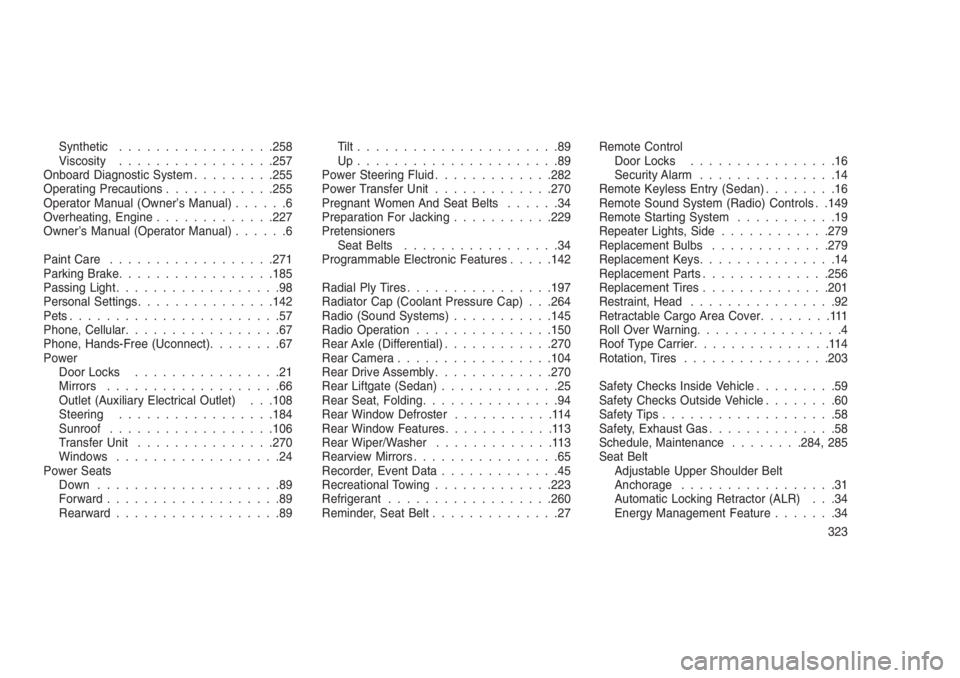
Synthetic.................258
Viscosity.................257
Onboard Diagnostic System.........255
Operating Precautions............255
Operator Manual (Owner’s Manual)......6
Overheating, Engine.............227
Owner’s Manual (Operator Manual)......6
Paint Care..................271
Parking Brake.................185
Passing Light..................98
Personal Settings...............142
Pets.......................57
Phone, Cellular.................67
Phone, Hands-Free (Uconnect)........67
Power
Door Locks................21
Mirrors...................66
Outlet (Auxiliary Electrical Outlet) . . .108
Steering.................184
Sunroof..................106
Transfer Unit...............270
Windows..................24
Power Seats
Down....................89
Forward...................89
Rearward..................89Tilt......................89
Up......................89
Power Steering Fluid.............282
Power Transfer Unit.............270
Pregnant Women And Seat Belts......34
Preparation For Jacking...........229
Pretensioners
Seat Belts.................34
Programmable Electronic Features.....142
Radial Ply Tires................197
Radiator Cap (Coolant Pressure Cap) . . .264
Radio (Sound Systems)...........145
Radio Operation...............150
Rear Axle (Differential)............270
Rear Camera.................104
Rear Drive Assembly.............270
Rear Liftgate (Sedan).............25
Rear Seat, Folding...............94
Rear Window Defroster...........114
Rear Window Features............113
Rear Wiper/Washer.............113
Rearview Mirrors................65
Recorder, Event Data.............45
Recreational Towing.............223
Refrigerant..................260
Reminder, Seat Belt..............27Remote Control
Door Locks................16
Security Alarm...............14
Remote Keyless Entry (Sedan)........16
Remote Sound System (Radio) Controls . .149
Remote Starting System...........19
Repeater Lights, Side............279
Replacement Bulbs.............279
Replacement Keys...............14
Replacement Parts..............256
Replacement Tires..............201
Restraint, Head................92
Retractable Cargo Area Cover........111
Roll Over Warning................4
Roof Type Carrier...............114
Rotation, Tires................203
Safety Checks Inside Vehicle.........59
Safety Checks Outside Vehicle........60
Safety Tips...................58
Safety, Exhaust Gas..............58
Schedule, Maintenance........284, 285
Seat Belt
Adjustable Upper Shoulder Belt
Anchorage.................31
Automatic Locking Retractor (ALR) . . .34
Energy Management Feature.......34
323