oil JEEP PATRIOT 2021 Owner handbook (in English)
[x] Cancel search | Manufacturer: JEEP, Model Year: 2021, Model line: PATRIOT, Model: JEEP PATRIOT 2021Pages: 332, PDF Size: 1.99 MB
Page 139 of 332
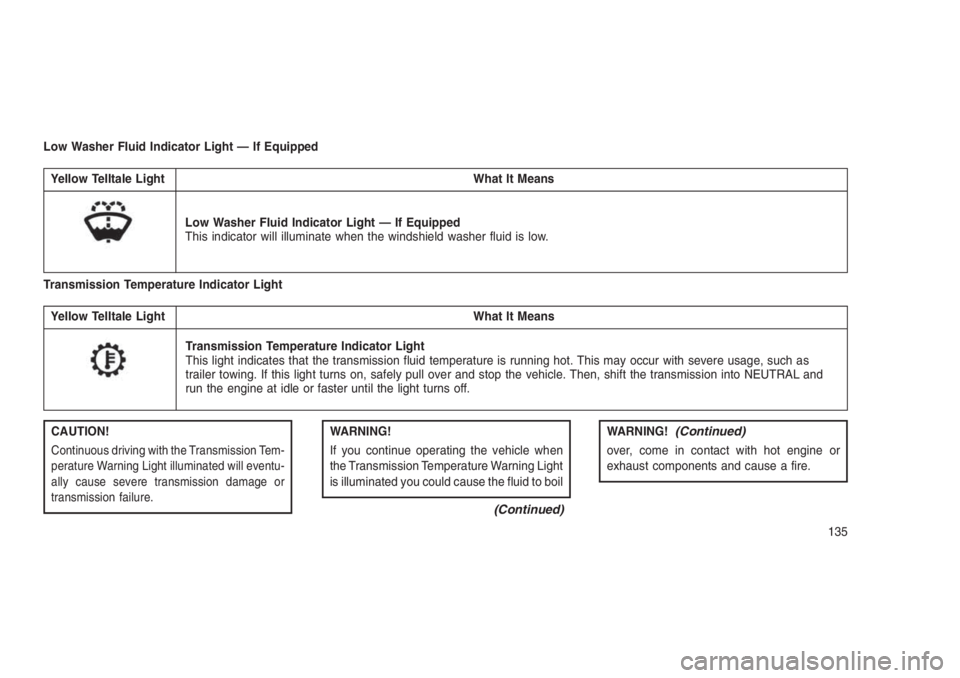
Low Washer Fluid Indicator Light — If Equipped
Yellow Telltale Light What It Means
Low Washer Fluid Indicator Light — If Equipped
This indicator will illuminate when the windshield washer fluid is low.
Transmission Temperature Indicator Light
Yellow Telltale Light What It Means
Transmission Temperature Indicator Light
This light indicates that the transmission fluid temperature is running hot. This may occur with severe usage, such as
trailer towing. If this light turns on, safely pull over and stop the vehicle. Then, shift the transmission into NEUTRAL and
run the engine at idle or faster until the light turns off.
CAUTION!
Continuous driving with the Transmission Tem-
perature Warning Light illuminated will eventu-
ally cause severe transmission damage or
transmission failure.
WARNING!
If you continue operating the vehicle when
the Transmission Temperature Warning Light
is illuminated you could cause the fluid to boil
(Continued)
WARNING!(Continued)
over, come in contact with hot engine or
exhaust components and cause a fire.
135
Page 143 of 332
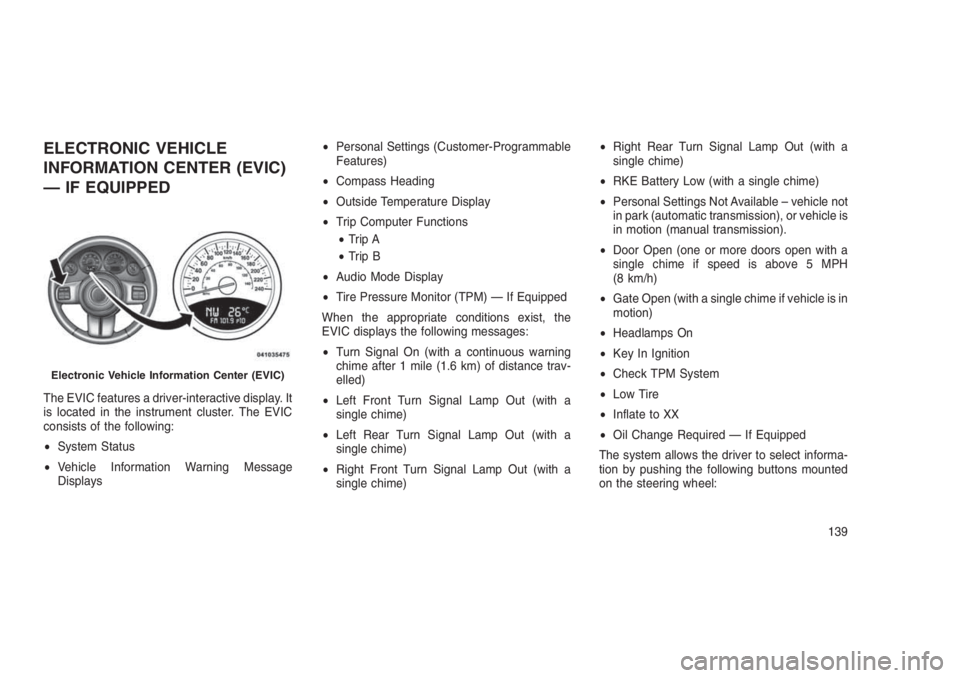
ELECTRONIC VEHICLE
INFORMATION CENTER (EVIC)
— IF EQUIPPED
The EVIC features a driver-interactive display. It
is located in the instrument cluster. The EVIC
consists of the following:
•System Status
•Vehicle Information Warning Message
Displays•Personal Settings (Customer-Programmable
Features)
•Compass Heading
•Outside Temperature Display
•Trip Computer Functions
•Trip A
•Trip B
•Audio Mode Display
•Tire Pressure Monitor (TPM) — If Equipped
When the appropriate conditions exist, the
EVIC displays the following messages:
•Turn Signal On (with a continuous warning
chime after 1 mile (1.6 km) of distance trav-
elled)
•Left Front Turn Signal Lamp Out (with a
single chime)
•Left Rear Turn Signal Lamp Out (with a
single chime)
•Right Front Turn Signal Lamp Out (with a
single chime)•Right Rear Turn Signal Lamp Out (with a
single chime)
•RKE Battery Low (with a single chime)
•Personal Settings Not Available – vehicle not
in park (automatic transmission), or vehicle is
in motion (manual transmission).
•Door Open (one or more doors open with a
single chime if speed is above 5 MPH
(8 km/h)
•Gate Open (with a single chime if vehicle is in
motion)
•Headlamps On
•Key In Ignition
•Check TPM System
•Low Tire
•Inflate to XX
•Oil Change Required — If Equipped
The system allows the driver to select informa-
tion by pushing the following buttons mounted
on the steering wheel:
Electronic Vehicle Information Center (EVIC)
139
Page 144 of 332
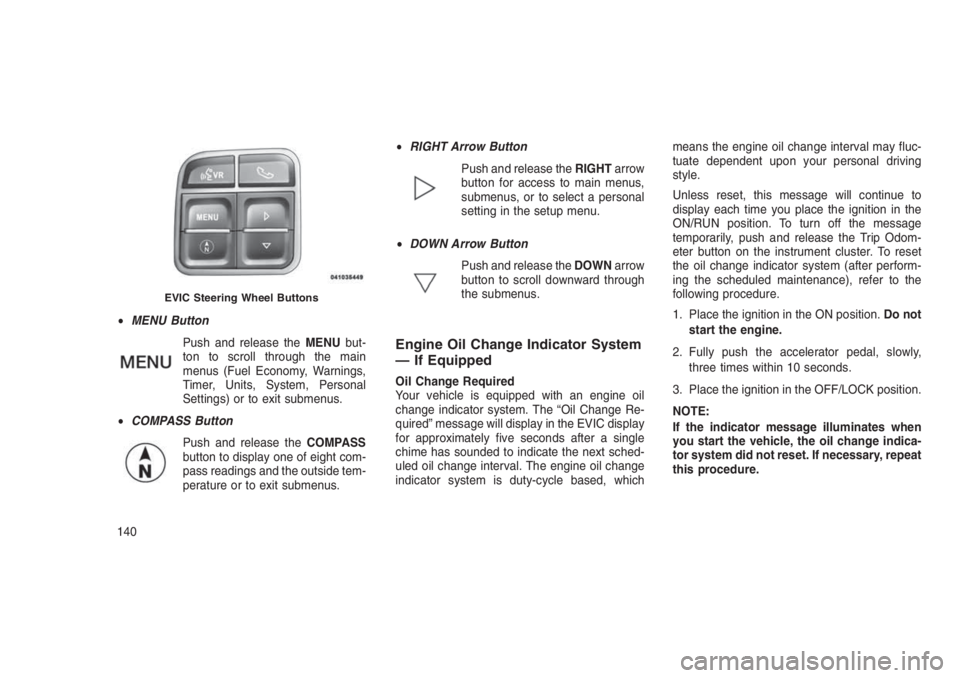
•MENU Button
Push and release theMENUbut-
ton to scroll through the main
menus (Fuel Economy, Warnings,
Timer, Units, System, Personal
Settings) or to exit submenus.
•COMPASS Button
Push and release theCOMPASS
button to display one of eight com-
pass readings and the outside tem-
perature or to exit submenus.•RIGHT Arrow Button
Push and release theRIGHTarrow
button for access to main menus,
submenus, or to select a personal
setting in the setup menu.
•DOWN Arrow Button
Push and release theDOWNarrow
button to scroll downward through
the submenus.
Engine Oil Change Indicator System
— If Equipped
Oil Change Required
Your vehicle is equipped with an engine oil
change indicator system. The “Oil Change Re-
quired” message will display in the EVIC display
for approximately five seconds after a single
chime has sounded to indicate the next sched-
uled oil change interval. The engine oil change
indicator system is duty-cycle based, whichmeans the engine oil change interval may fluc-
tuate dependent upon your personal driving
style.
Unless reset, this message will continue to
display each time you place the ignition in the
ON/RUN position. To turn off the message
temporarily, push and release the Trip Odom-
eter button on the instrument cluster. To reset
the oil change indicator system (after perform-
ing the scheduled maintenance), refer to the
following procedure.
1. Place the ignition in the ON position.Do not
start the engine.
2. Fully push the accelerator pedal, slowly,
three times within 10 seconds.
3. Place the ignition in the OFF/LOCK position.
NOTE:
If the indicator message illuminates when
you start the vehicle, the oil change indica-
tor system did not reset. If necessary, repeat
this procedure.
EVIC Steering Wheel Buttons
140
Page 180 of 332
CAUTION!(Continued)
NEUTRAL can cause severe transmission
damage. Refer to “Recreational Towing” in
“Starting And Operating” and “Towing A Dis-
abled Vehicle” in “What To Do In Emergen-
cies” for further information.
DRIVE (D)
This range should be used for most city and
highway driving. It provides the best fuel
economy. The DRIVE position provides opti-
mum driving characteristics under all normal
operating conditions.
When frequent transmission shifting occurs
(such as when operating the vehicle under
heavy loading conditions, in hilly terrain, travel-
ing into strong head winds, or while towing
heavy trailers), use the AutoStick shift control (if
equipped, refer to"AutoStick (CVT)"in this
section for further information) to select a lower
gear ratio. Under these conditions, using a
lower gear ratio will improve performance and
extend transmission life by reducing excessive
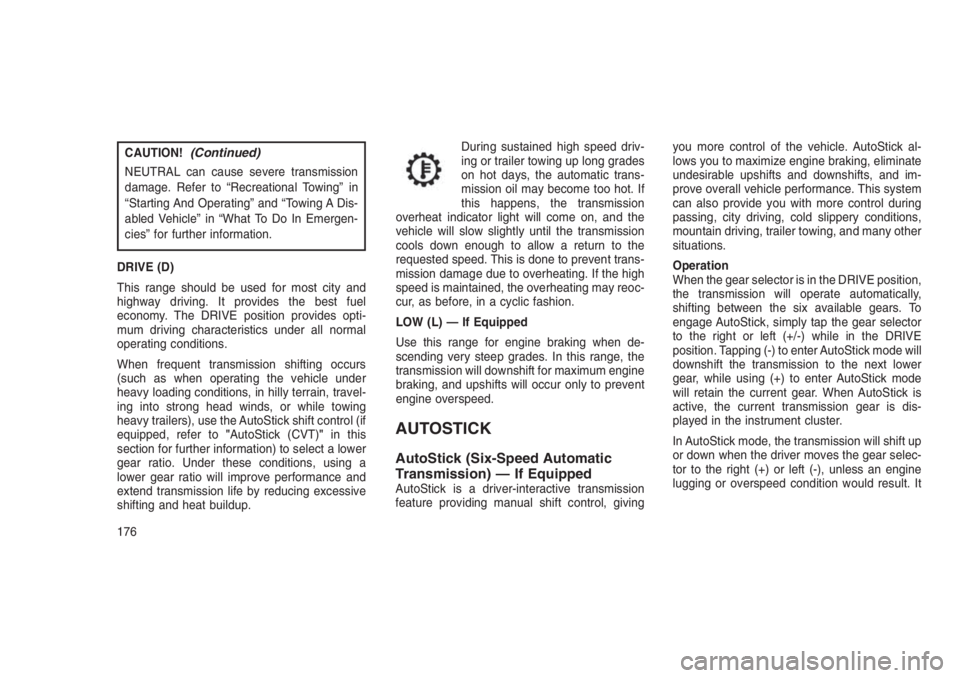
shifting and heat buildup.During sustained high speed driv-
ing or trailer towing up long grades
on hot days, the automatic trans-
mission oil may become too hot. If
this happens, the transmission
overheat indicator light will come on, and the
vehicle will slow slightly until the transmission
cools down enough to allow a return to the
requested speed. This is done to prevent trans-
mission damage due to overheating. If the high
speed is maintained, the overheating may reoc-
cur, as before, in a cyclic fashion.
LOW (L) — If Equipped
Use this range for engine braking when de-
scending very steep grades. In this range, the
transmission will downshift for maximum engine
braking, and upshifts will occur only to prevent
engine overspeed.
AUTOSTICK
AutoStick (Six-Speed Automatic
Transmission) — If Equipped
AutoStick is a driver-interactive transmission
feature providing manual shift control, givingyou more control of the vehicle. AutoStick al-
lows you to maximize engine braking, eliminate
undesirable upshifts and downshifts, and im-
prove overall vehicle performance. This system
can also provide you with more control during
passing, city driving, cold slippery conditions,
mountain driving, trailer towing, and many other
situations.
Operation
When the gear selector is in the DRIVE position,
the transmission will operate automatically,
shifting between the six available gears. To
engage AutoStick, simply tap the gear selector
to the right or left (+/-) while in the DRIVE
position. Tapping (-) to enter AutoStick mode will
downshift the transmission to the next lower
gear, while using (+) to enter AutoStick mode
will retain the current gear. When AutoStick is
active, the current transmission gear is dis-
played in the instrument cluster.
In AutoStick mode, the transmission will shift up
or down when the driver moves the gear selec-
tor to the right (+) or left (-), unless an engine
lugging or overspeed condition would result. It
176
Page 186 of 332
WARNING!
Do not descend a steep grade in NEUTRAL.
Use vehicle brakes in conjunction with en-
gine braking. Descending a grade too fast
could cause you to lose control and be
seriously injured or killed.
Driving Across An Incline
If at all possible avoid driving across an incline.
If it is necessary, know your vehicle’s abilities.
Driving across an incline places more weight on
the down-hill wheels, which increases the pos-
sibilities of a down-hill slide or rollover. Make
sure the surface has good traction with firm and
stable soils. If possible transverse the incline at
an angle heading slightly up or down.
WARNING!
Driving across an incline increases the risk of
a rollover, which may result in severe injury.
If You Stall Or Begin To Lose Headway
If you stall or begin to lose headway while
climbing a steep hill, allow your vehicle to cometo a stop and immediately apply the brake.
Restart the engine and shift to REVERSE. Back
slowly down the hill allowing engine and hill
descent braking to control the descent and
apply your brakes if necessary, but do not allow
the tires to lock.
WARNING!
If the engine stalls or you lose headway or
cannot make it to the top of a steep hill or
grade, never attempt to turn around. To do so
may result in tipping and rolling the vehicle,
which may result in severe injury. Always
back carefully straight down a hill in RE-
VERSE gear. Never back down a hill in
NEUTRAL using only the vehicle brakes.
Never drive diagonally across a hill, always
drive straight up or down.
Driving Through WaterExtreme care should be taken crossing any
type of water. Water crossings should be
avoided if possible, and only be attempted
when necessary in a safe responsible manner.You should only drive through areas which are
designated and approved. You should tread
lightly and avoid damage to the environment.
You should know your vehicles abilities and be
able to recover it if something goes wrong. You
should never stop or shut a vehicle off when
crossing deep water unless you ingested water
into the engine air intake. If the engine stalls, do
not attempt to restart it. Determine if it has
ingested water first. The key to any crossing is
low and slow. You want to use low (L Off-Road
[if equipped] ) with the 4WD LOCK engaged
and proceed very slowly with a constant slow
speed (3-5 mph [5–8 km/h] maximum) and light
throttle. Keep the vehicle moving; do not try to
accelerate through the crossing. After crossing
any water higher than the bottom of the axle
differentials, you should inspect all of the ve-
hicle fluids for signs of water ingestion.
CAUTION!
Water ingestion into the transaxle, transfer
case, engine or vehicle interior can occur if
you drive too fast or through too deep of
(Continued)
182
Page 205 of 332
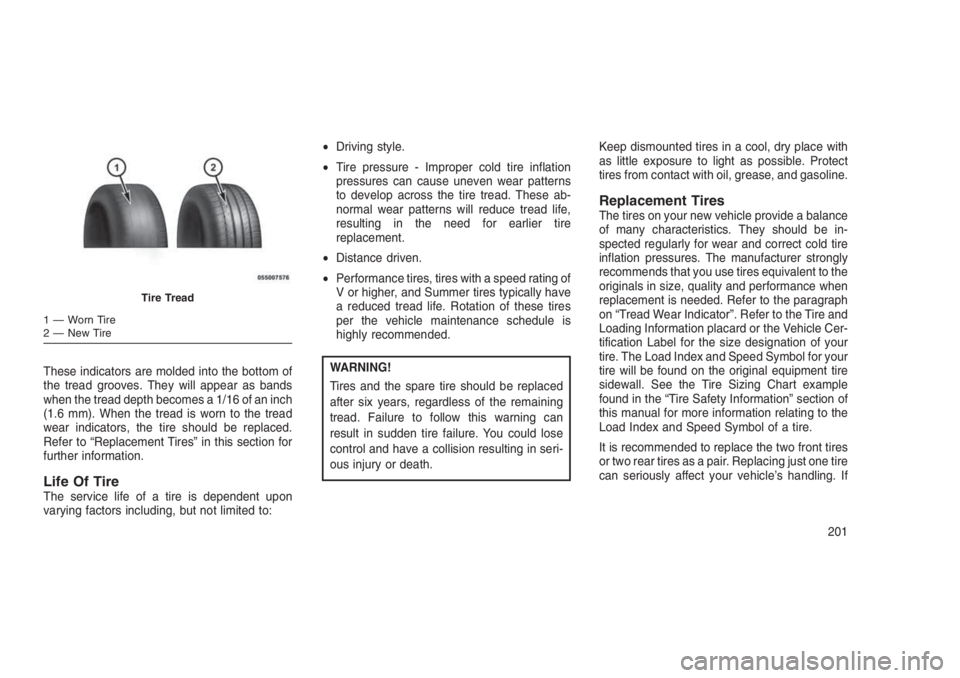
These indicators are molded into the bottom of
the tread grooves. They will appear as bands
when the tread depth becomes a 1/16 of an inch
(1.6 mm). When the tread is worn to the tread
wear indicators, the tire should be replaced.
Refer to “Replacement Tires” in this section for
further information.
Life Of TireThe service life of a tire is dependent upon
varying factors including, but not limited to:•Driving style.
•Tire pressure - Improper cold tire inflation
pressures can cause uneven wear patterns
to develop across the tire tread. These ab-
normal wear patterns will reduce tread life,
resulting in the need for earlier tire
replacement.
•Distance driven.
•Performance tires, tires with a speed rating of
V or higher, and Summer tires typically have
a reduced tread life. Rotation of these tires
per the vehicle maintenance schedule is
highly recommended.
WARNING!
Tires and the spare tire should be replaced
after six years, regardless of the remaining
tread. Failure to follow this warning can
result in sudden tire failure. You could lose
control and have a collision resulting in seri-
ous injury or death.Keep dismounted tires in a cool, dry place with
as little exposure to light as possible. Protect
tires from contact with oil, grease, and gasoline.
Replacement TiresThe tires on your new vehicle provide a balance
of many characteristics. They should be in-
spected regularly for wear and correct cold tire
inflation pressures. The manufacturer strongly
recommends that you use tires equivalent to the
originals in size, quality and performance when
replacement is needed. Refer to the paragraph
on “Tread Wear Indicator”. Refer to the Tire and
Loading Information placard or the Vehicle Cer-
tification Label for the size designation of your
tire. The Load Index and Speed Symbol for your
tire will be found on the original equipment tire
sidewall. See the Tire Sizing Chart example
found in the “Tire Safety Information” section of
this manual for more information relating to the
Load Index and Speed Symbol of a tire.
It is recommended to replace the two front tires
or two rear tires as a pair. Replacing just one tire
can seriously affect your vehicle’s handling. If
Tire Tread
1 — Worn Tire
2 — New Tire
201
Page 232 of 332
WHEEL AND TIRE TORQUE
SPECIFICATIONS
Proper lug nut/bolt torque is very important to
ensure that the wheel is properly mounted to
the vehicle. Any time a wheel has been re-
moved and reinstalled on the vehicle the lug
nuts/bolts should be torqued using a properly
calibrated torque wrench.
Torque Specifications
Lug Nut/Bolt Torque **Lug
Nut/
Bolt
SizeLug
Nut/
Bolt
Socket
Size
100 Ft-Lbs (135 N·m)M12 x
1.519 mm
**Use only your Authorized Dealer recom-
mended lug nuts/bolts and clean or remove any
dirt or oil before tightening.
Inspect the wheel mounting surface prior to
mounting the tire and remove any corrosion or
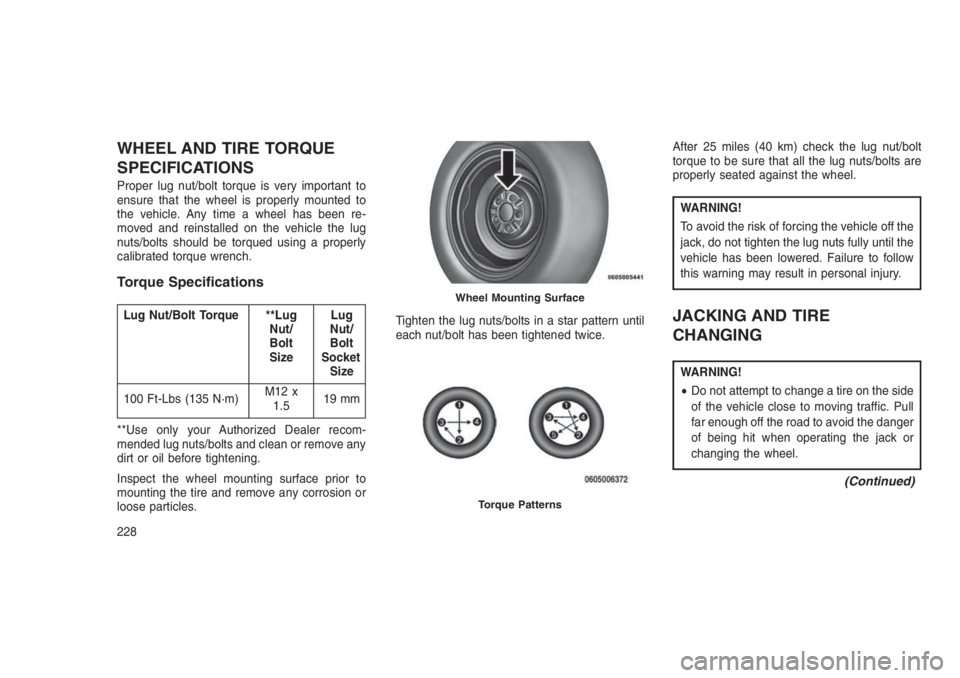
loose particles.Tighten the lug nuts/bolts in a star pattern until
each nut/bolt has been tightened twice.After 25 miles (40 km) check the lug nut/bolt
torque to be sure that all the lug nuts/bolts are
properly seated against the wheel.
WARNING!
To avoid the risk of forcing the vehicle off the
jack, do not tighten the lug nuts fully until the
vehicle has been lowered. Failure to follow
this warning may result in personal injury.
JACKING AND TIRE
CHANGING
WARNING!
•Do not attempt to change a tire on the side
of the vehicle close to moving traffic. Pull
far enough off the road to avoid the danger
of being hit when operating the jack or
changing the wheel.
(Continued)
Wheel Mounting Surface
Torque Patterns
228
Page 241 of 332
WARNING!(Continued)
•Keep Tire Service Kit away from open
flames or heat source.
•A loose Tire Service Kit thrown forward in a
collision or hard stop could endanger the
occupants of the vehicle. Always stow the
Tire Service Kit in the place provided.
Failure to follow these warnings can result
in injuries that are serious or fatal to you,
your passengers, and others around you.
•Take care not to allow the contents of Tire
Service Kit to come in contact with hair,
eyes, or clothing. Tire Service Kit sealant is
harmful if inhaled, swallowed, or absorbed
through the skin. It causes skin, eye, and
respiratory irritation. Flush immediately
with plenty of water if there is any contact
with eyes or skin. Change clothing as soon
as possible, if there is any contact with
clothing.
(Continued)
WARNING!(Continued)
•Tire Service Kit Sealant solution contains
latex. In case of an allergic reaction or
rash, consult a physician immediately.
Keep Tire Service Kit out of reach of
children. If swallowed, rinse mouth imme-
diately with plenty of water and drink plenty
of water. Do not induce vomiting! Consult a
physician immediately.
Sealing A Tire With Tire Service Kit
(A) Whenever You Stop To Use Tire Service
Kit:
1. Pull over to a safe location and turn on the
vehicle’s Hazard Warning flashers.
2. Verify that the valve stem (on the wheel with
the deflated tire) is in a position that is near
to the ground. This will allow the Tire Service
Kit Hoses (6) and (7) to reach the valve stem
and keep the Tire Service Kit flat on the
ground. This will provide the best positioning
of the kit when injecting the sealant into thedeflated tire and running the air pump. Move
the vehicle as necessary to place the valve
stem in this position before proceeding.
3. Place the transmission in PARK (auto trans-
mission) or in Gear (manual transmission)
and place the ignition in the OFF position.
4. Set the parking brake.
(B) Setting Up To Use Tire Service Kit:
1. Push in the Mode Select Knob (5) and turn to
the Sealant Mode position.
2. Uncoil the Sealant Hose (6) and then re-
move the cap from the fitting at the end of the
hose.
3. Place the Tire Service Kit flat on the ground
next to the deflated tire.
4. Remove the cap from the valve stem and
then screw the fitting at the end of the
Sealant Hose (6) onto the valve stem.
5. Uncoil the Power Plug (8) and insert the plug
into the vehicle’s 12 Volt power outlet.
237
Page 243 of 332
NOTE:
If the tire becomes over-inflated, push the
Deflation Button to reduce the tire pressure
to the recommended inflation pressure be-
fore continuing.
If the tire inflates to the recommended pres-
sure or is at least 26 psi (1.8 Bar) pressure
within 15 minutes:
1. Push the Power Button (4) to turn off the Tire
Service Kit.
2. Remove the Speed Limit sticker from the top
of the Sealant Bottle (1) and place the sticker
on the instrument panel.
3. Immediately disconnect the Sealant Hose
(6) from the valve stem, reinstall the cap on
the fitting at the end of the hose, and place
the Tire Service Kit in the vehicle storage
location. Quickly proceed to (D) “Drive Ve-
hicle.”CAUTION!
•The metal end fitting from Power Plug (8)
may get hot after use, so it should be
handled carefully.
•Failure to reinstall the cap on the fitting at
the end of the Sealant Hose (6) can result
in sealant contacting your skin, clothing,
and the vehicle’s interior. It can also result
in sealant contacting internal Tire Service
Kit components which may cause perma-
nent damage to the kit.
(D) Drive Vehicle:
Immediately after injecting sealant and inflating
the tire, drive the vehicle 5 miles (8 km) or 10
minutes to ensure distribution of the Tire Ser-
vice Kit Sealant within the tire. Do not exceed
55 mph (90 km/h).
WARNING!
Tire Service Kit is not a permanent flat tire
repair. Have the tire inspected and repaired
(Continued)
WARNING!(Continued)
or replaced after using Tire Service Kit. Do
not exceed 55 mph (90 km/h) until the tire is
repaired or replaced. Failure to follow this
warning can result in injuries that are serious
or fatal to you, your passengers, and others
around you.
(E) After Driving:
Pull over to a safe location. Refer to “Whenever
You Stop to Use Tire Service Kit” before con-
tinuing.
1. Push in the Mode Select Knob (5) and turn to
the Air Mode position.
2. Uncoil the power plug and insert the plug
into the vehicle’s 12 Volt power outlet.
3. Uncoil the Air Pump Hose (7) (black in color)
and screw the fitting at the end of hose (7)
onto the valve stem.
4. Check the pressure in the tire by reading the
Pressure Gauge (3).
239
Page 244 of 332
If tire pressure is less than 19 psi (1.3 Bar):
The tire is too badly damaged. Do not attempt to
drive the vehicle further. Call for assistance.
If the tire pressure is 19 psi (1.3 Bar) or
higher:
1. Push the Power Button (4) to turn on Tire
Service Kit and inflate the tire to the pressure
indicated on the tire and loading information
label on the driver-side door opening.
NOTE:
If the tire becomes over-inflated, push the
Deflation Button to reduce the tire pressure
to the recommended inflation pressure be-
fore continuing.
2. Disconnect the Tire Service Kit from the
valve stem, reinstall the cap on the valve
stem and unplug from 12 Volt outlet.
3. Place the Tire Service Kit in its proper stor-
age area in the vehicle.
4. Have the tire inspected and repaired or
replaced at the earliest opportunity at an
authorized dealer or tire service center.5. Remove the Speed Limit sticker from the
instrument panel after the tire has been
repaired.
6. Replace the Sealant Bottle (1) and Sealant
Hose (6) assembly at your authorized dealer
as soon as possible. Refer to (F) “Sealant
Bottle and Hose Replacement”.
NOTE:
When having the tire serviced, advise the
authorized dealer or service center that the
tire has been sealed using the Tire Service
Kit.
(F) Sealant Bottle And Hose Replacement:
1. Uncoil the Sealant Hose (6) (clear in color).
2. Locate the round Sealant Bottle release but-
ton in the recessed area under the sealant
bottle.
3. Push the Sealant Bottle release button. The
Sealant Bottle (1) will pop up. Remove the
bottle and dispose of it accordingly.4. Clean any remaining sealant from the Tire
Service Kit housing.
5. Position the new Sealant Bottle (1) in the
housing so that the Sealant Hose (6) aligns
with the hose slot in the front of the housing.
Push the bottle into the housing. An audible
click will be heard indicating the bottle is
locked into place.
6. Verify that the cap is installed on the fitting at
the end of the Sealant Hose (6) and return
the hose to its storage area (located on the
bottom of the air pump).
7. Return the Tire Service Kit to its storage
location in the vehicle.
240