warning JEEP PATRIOT 2021 Owner handbook (in English)
[x] Cancel search | Manufacturer: JEEP, Model Year: 2021, Model line: PATRIOT, Model: JEEP PATRIOT 2021Pages: 332, PDF Size: 1.99 MB
Page 52 of 332
child’s head and does not induce stress on the
neck in the event of sudden decelerations or a
crash.
The rear-facing child restraint is restrained by
the vehicle’s seat belts, as shown in fig. A. The
child seat restrains the child with its own har-
ness.
WARNING!
•Never place a rear-facing child restraint in
front of an air bag. A deploying passenger
Advanced Front Air Bag can cause death
or serious injury to a child 12 years or
younger, including a child in a rear-facing
child restraint.
•Only use a rear-facing child restraint in a
vehicle with a rear seat.Group 1
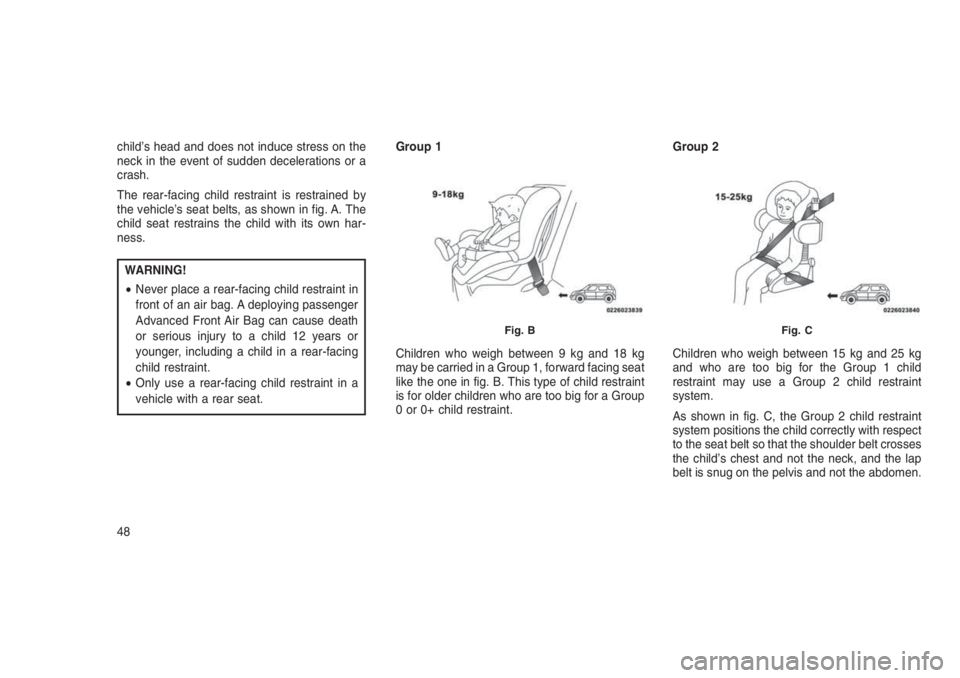
Children who weigh between 9 kg and 18 kg
may be carried in a Group 1, forward facing seat
like the one in fig. B. This type of child restraint
is for older children who are too big for a Group
0 or 0+ child restraint.Group 2
Children who weigh between 15 kg and 25 kg
and who are too big for the Group 1 child
restraint may use a Group 2 child restraint
system.
As shown in fig. C, the Group 2 child restraint
system positions the child correctly with respect
to the seat belt so that the shoulder belt crosses
the child’s chest and not the neck, and the lap
belt is snug on the pelvis and not the abdomen.
Fig. BFig. C
48
Page 53 of 332
Group 3
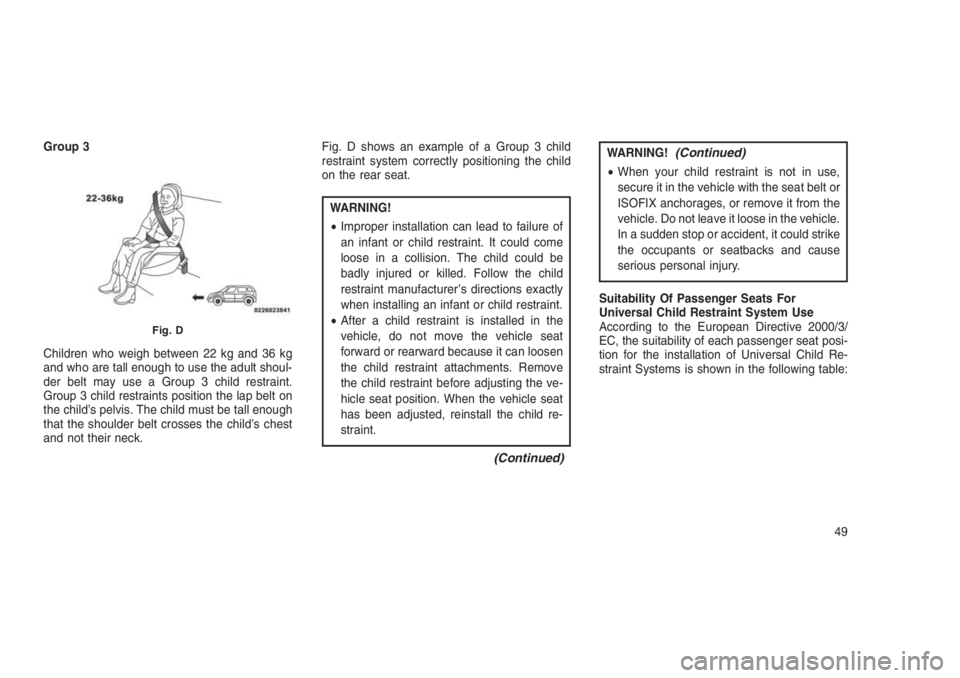
Children who weigh between 22 kg and 36 kg
and who are tall enough to use the adult shoul-
der belt may use a Group 3 child restraint.
Group 3 child restraints position the lap belt on
the child’s pelvis. The child must be tall enough
that the shoulder belt crosses the child’s chest
and not their neck.Fig. D shows an example of a Group 3 child
restraint system correctly positioning the child
on the rear seat.
WARNING!
•Improper installation can lead to failure of
an infant or child restraint. It could come
loose in a collision. The child could be
badly injured or killed. Follow the child
restraint manufacturer’s directions exactly
when installing an infant or child restraint.
•After a child restraint is installed in the
vehicle, do not move the vehicle seat
forward or rearward because it can loosen
the child restraint attachments. Remove
the child restraint before adjusting the ve-
hicle seat position. When the vehicle seat
has been adjusted, reinstall the child re-
straint.
(Continued)
WARNING!(Continued)
•When your child restraint is not in use,
secure it in the vehicle with the seat belt or
ISOFIX anchorages, or remove it from the
vehicle. Do not leave it loose in the vehicle.
In a sudden stop or accident, it could strike
the occupants or seatbacks and cause
serious personal injury.
Suitability Of Passenger Seats For
Universal Child Restraint System Use
According to the European Directive 2000/3/
EC, the suitability of each passenger seat posi-
tion for the installation of Universal Child Re-
straint Systems is shown in the following table:
Fig. D
49
Page 55 of 332
WARNING!
Never allow a child to put the shoulder belt
under an arm or behind their back. In a
crash, the shoulder belt will not protect a
child properly, which may result in serious
injury or death. A child must always wear
both the lap and shoulder portions of the seat
belt correctly.
ISOFIX Restraint SystemYour vehicle is equipped with the child restraint
anchorage system called ISOFIX. This system
allows ISOFIX equipped child seats to be in-
stalled without using the vehicle’s seat belts.
The ISOFIX system has two lower anchorages
located at the back of the seat cushion where it
meets the seatback and a top tether anchorage
located behind the seating position.
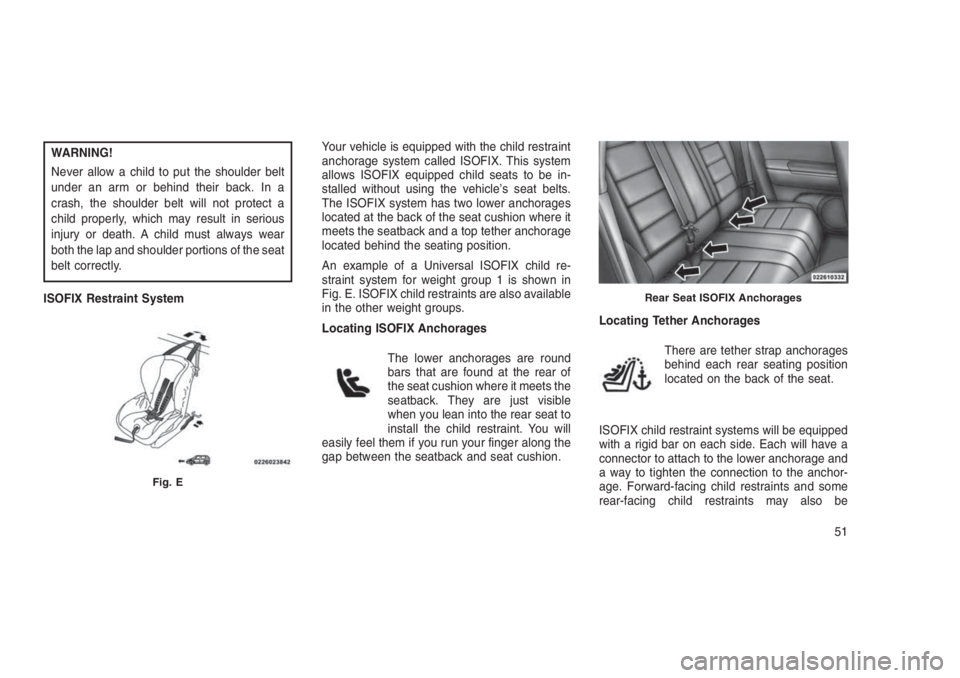
An example of a Universal ISOFIX child re-
straint system for weight group 1 is shown in
Fig. E. ISOFIX child restraints are also available
in the other weight groups.
Locating ISOFIX Anchorages
The lower anchorages are round
bars that are found at the rear of
the seat cushion where it meets the
seatback. They are just visible
when you lean into the rear seat to
install the child restraint. You will
easily feel them if you run your finger along the
gap between the seatback and seat cushion.Locating Tether Anchorages
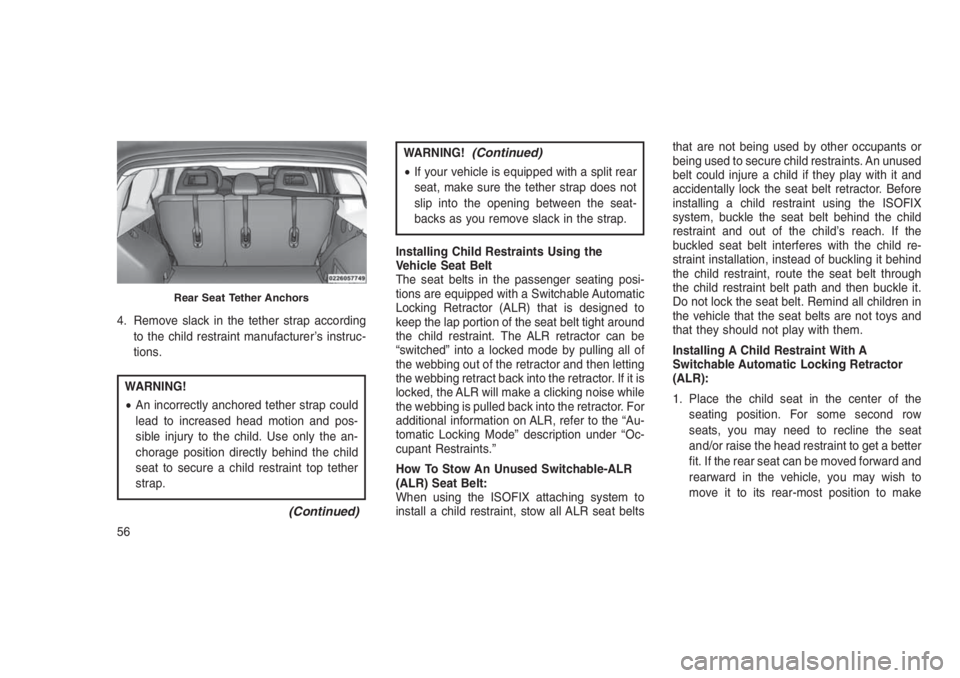
There are tether strap anchorages
behind each rear seating position
located on the back of the seat.
ISOFIX child restraint systems will be equipped
with a rigid bar on each side. Each will have a
connector to attach to the lower anchorage and
a way to tighten the connection to the anchor-
age. Forward-facing child restraints and some
rear-facing child restraints may also be
Fig. E
Rear Seat ISOFIX Anchorages
51
Page 56 of 332
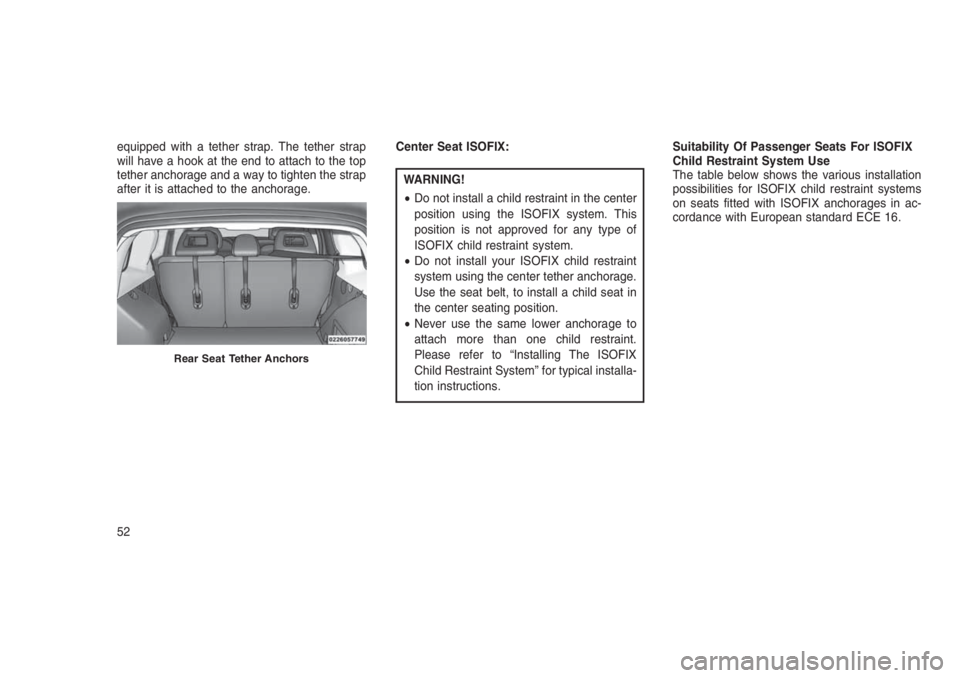
equipped with a tether strap. The tether strap
will have a hook at the end to attach to the top
tether anchorage and a way to tighten the strap
after it is attached to the anchorage.Center Seat ISOFIX:
WARNING!
•Do not install a child restraint in the center
position using the ISOFIX system. This
position is not approved for any type of
ISOFIX child restraint system.
•Do not install your ISOFIX child restraint
system using the center tether anchorage.
Use the seat belt, to install a child seat in
the center seating position.
•Never use the same lower anchorage to
attach more than one child restraint.
Please refer to “Installing The ISOFIX
Child Restraint System” for typical installa-
tion instructions.Suitability Of Passenger Seats For ISOFIX
Child Restraint System Use
The table below shows the various installation
possibilities for ISOFIX child restraint systems
on seats fitted with ISOFIX anchorages in ac-
cordance with European standard ECE 16.
Rear Seat Tether Anchors
52
Page 59 of 332
4. If the child restraint has a tether strap, con-
nect it to the top tether anchorage. See the
section “Installing Child Restraints Using the
Top Tether Anchorage” for directions to at-
tach a tether anchor.
5.
Tighten all of the straps as you push the child
restraint rearward and downward into the seat.
Remove slack in the straps according to the
child restraint manufacturer’s instructions.
6. Test that the child restraint is installed tightly
by pulling back and forth on the child seat at
the belt path. It should not move more than
25 mm in any direction.
WARNING!
•Improper installation of a child restraint to
the ISOFIX anchorages can lead to failure
of the restraint. The child could be badly
injured or killed. Follow the child restraint
manufacturer’s directions exactly when in-
stalling an infant or child restraint.
(Continued)
WARNING!(Continued)
•Child restraint anchorages are designed to
withstand only those loads imposed by
correctly-fitted child restraints. Under no
circumstances are they to be used for
adult seat belts, harnesses, or for attach-
ing other items or equipment to the ve-
hicle.
•Install the child restraint system when the
vehicle is stationary. The ISOFIX child
restraint system is correctly fixed to the
brackets when you hear the click.
Installing Child Restraints Using The Top
Tether Anchorage:
1. Look behind the seating position where you
plan to install the child restraint to find the
tether anchorage. You may need to move
the seat forward to provide better access to
the tether anchorage. If there is no top tether
anchorage for that seating position, move
the child restraint to another position in the
vehicle if one is available.2. Route the tether strap to provide the most
direct path for the strap between the anchor
and the child seat. If your vehicle is equipped
with adjustable rear head restraints, raise
the head restraint, and where possible, route
the tether strap under the head restraint and
between the two posts. If not possible, lower
the head restraint and pass the tether strap
around the outboard side of the head re-
straint.
3. Attach the tether strap hook of the child
restraint to the top tether anchorage as
shown in the diagram.
55
Page 60 of 332
4. Remove slack in the tether strap according
to the child restraint manufacturer’s instruc-
tions.
WARNING!
•An incorrectly anchored tether strap could
lead to increased head motion and pos-
sible injury to the child. Use only the an-
chorage position directly behind the child
seat to secure a child restraint top tether
strap.
(Continued)
WARNING!(Continued)
•If your vehicle is equipped with a split rear
seat, make sure the tether strap does not
slip into the opening between the seat-
backs as you remove slack in the strap.
Installing Child Restraints Using the
Vehicle Seat Belt
The seat belts in the passenger seating posi-
tions are equipped with a Switchable Automatic
Locking Retractor (ALR) that is designed to
keep the lap portion of the seat belt tight around
the child restraint. The ALR retractor can be
“switched” into a locked mode by pulling all of
the webbing out of the retractor and then letting
the webbing retract back into the retractor. If it is
locked, the ALR will make a clicking noise while
the webbing is pulled back into the retractor. For
additional information on ALR, refer to the “Au-
tomatic Locking Mode” description under “Oc-
cupant Restraints.”
How To Stow An Unused Switchable-ALR
(ALR) Seat Belt:
When using the ISOFIX attaching system to
install a child restraint, stow all ALR seat beltsthat are not being used by other occupants or
being used to secure child restraints. An unused
belt could injure a child if they play with it and
accidentally lock the seat belt retractor. Before
installing a child restraint using the ISOFIX
system, buckle the seat belt behind the child
restraint and out of the child’s reach. If the
buckled seat belt interferes with the child re-
straint installation, instead of buckling it behind
the child restraint, route the seat belt through
the child restraint belt path and then buckle it.
Do not lock the seat belt. Remind all children in
the vehicle that the seat belts are not toys and
that they should not play with them.
Installing A Child Restraint With A
Switchable Automatic Locking Retractor
(ALR):
1. Place the child seat in the center of the
seating position. For some second row
seats, you may need to recline the seat
and/or raise the head restraint to get a better
fit. If the rear seat can be moved forward and
rearward in the vehicle, you may wish to
move it to its rear-most position to make
Rear Seat Tether Anchors
56
Page 62 of 332
CAUTION!
Never use Non-Detergent Oil or Straight Min-
eral Oil in the engine or damage may result.
NOTE:
A new engine may consume some oil during
its first few thousand miles (kilometers) of
operation. This should be considered a nor-
mal part of the break-in and not interpreted
as a problem.
SAFETY TIPS
Transporting PassengersNEVER TRANSPORT PASSENGERS IN THE
CARGO AREA.
WARNING!
•Do not leave children or animals inside
parked vehicles in hot weather. Interior
heat build-up may cause serious injury or
death.
(Continued)
WARNING!(Continued)
•It is extremely dangerous to ride in a cargo
area, inside or outside of a vehicle. In a
collision, people riding in these areas are
more likely to be seriously injured or killed.
•Do not allow people to ride in any area of
your vehicle that is not equipped with seats
and seat belts.
•Be sure everyone in your vehicle is in a
seat and using a seat belt properly.
Exhaust Gas
WARNING!
Exhaust gases can injure or kill. They con-
tain carbon monoxide (CO), which is color-
less and odorless. Breathing it can make you
unconscious and can eventually poison you.
To avoid breathing (CO), follow these safety
tips:
(Continued)
WARNING!(Continued)
•Do not run the engine in a closed garage
or in confined areas any longer than
needed to move your vehicle in or out of
the area.
•If you are required to drive with the trunk/
liftgate/rear doors open, make sure that all
windows are closed and the climate con-
trol BLOWER switch is set at high speed.
DO NOT use the recirculation mode.
•If it is necessary to sit in a parked vehicle
with the engine running, adjust your heat-
ing or cooling controls to force outside air
into the vehicle. Set the blower at high
speed.
The best protection against carbon monoxide
entry into the vehicle body is a properly main-
tained engine exhaust system.
Whenever a change is noticed in the sound of
the exhaust system, when exhaust fumes can
be detected inside the vehicle, or when the
underside or rear of the vehicle is damaged,
have a competent mechanic inspect the com-
58
Page 63 of 332
plete exhaust system and adjacent body areas
for broken, damaged, deteriorated, or misposi-
tioned parts. Open seams or loose connections
could permit exhaust fumes to seep into the
passenger compartment. In addition, inspect
the exhaust system each time the vehicle is
raised for lubrication or oil change. Replace as
required.
Safety Checks You Should Make
Inside The Vehicle
Seat Belts
Inspect the seat belt system periodically, check-
ing for cuts, frays, and loose parts. Damaged
parts must be replaced immediately. Do not
disassemble or modify the system.
Front seat belt assemblies must be replaced
after a collision. Rear seat belt assemblies must
be replaced after a collision if they have been
damaged (i.e., bent retractor, torn webbing,
etc.). If there is any question regarding seat belt
or retractor condition, replace the seat belt.
Air Bag Warning Light
The Air Bag warning light
will turn on for four
to eight seconds as a bulb check when theignition is first placed in the ON/RUN position. If
the light is either not on during starting, stays
on, or turns on while driving, have the system
inspected at an authorized dealer as soon as
possible. This light will illuminate with a single
chime when a fault with the Air Bag Warning
Light has been detected, it will stay on until the
fault is cleared. If the light comes on intermit-
tently or remains on while driving, have an
authorized dealer service the vehicle immedi-
ately. Refer to “Occupant Restraints” for further
information.
Defroster
Check operation by selecting the defrost mode
and place the blower control on high speed. You
should be able to feel the air directed against
the windshield. See your authorized dealer for
service if your defroster is inoperable.
Floor Mat Safety Information
Always use floor mats designed to fit the foot-
well of your vehicle. Use only floor mats that
leave the pedal area unobstructed and that are
firmly secured so that they cannot slip out of
position and interfere with the pedals or impair
safe operation of your vehicle in other ways.
WARNING!
Pedals that cannot move freely can cause
loss of vehicle control and increase the risk
of serious personal injury.
•Always make sure that floor mats are
properly attached to the floor mat fasten-
ers.
•Never place or install floor mats or other
floor coverings in the vehicle that cannot
be properly secured to prevent them from
moving and interfering with the pedals or
the ability to control the vehicle.
•Never put floor mats or other floor cover-
ings on top of already installed floor mats.
Additional floor mats and other coverings
will reduce the size of the pedal area and
interfere with the pedals.
•Check mounting of mats on a regular
basis. Always properly reinstall and secure
floor mats that have been removed for
cleaning.
(Continued)
59
Page 64 of 332
WARNING!(Continued)
•Always make sure that objects cannot fall
into the driver footwell while the vehicle is
moving. Objects can become trapped un-
der the brake pedal and accelerator pedal
causing a loss of vehicle control.
•If required, mounting posts must be prop-
erly installed, if not equipped from the
factory.
Failure to properly follow floor mat installa-
tion or mounting can cause interference with
the brake pedal and accelerator pedal opera-
tion causing loss of control of the vehicle.
Periodic Safety Checks You Should
Make Outside The Vehicle
Tires
Examine tires for excessive tread wear and
uneven wear patterns. Check for stones, nails,
glass, or other objects lodged in the tread or
sidewall. Inspect the tread for cuts and cracks.
Inspect sidewalls for cuts, cracks, and bulges.
Check the wheel nuts for tightness. Check the
tires (including spare) for proper cold inflation
pressure.
Lights
Have someone observe the operation of brake
lights and exterior lights while you work the
controls. Check turn signal and high beam
indicator lights on the instrument panel.Door Latches
Check for proper closing, latching, and locking.
Fluid Leaks
Check area under vehicle after overnight park-
ing for fuel, engine coolant, oil, or other fluid
leaks. Also, if gasoline fumes are detected or if
fuel, power steering fluid (if equipped), or brake
fluid leaks are suspected. The cause should be
located and corrected immediately.
60
Page 69 of 332
MIRRORS
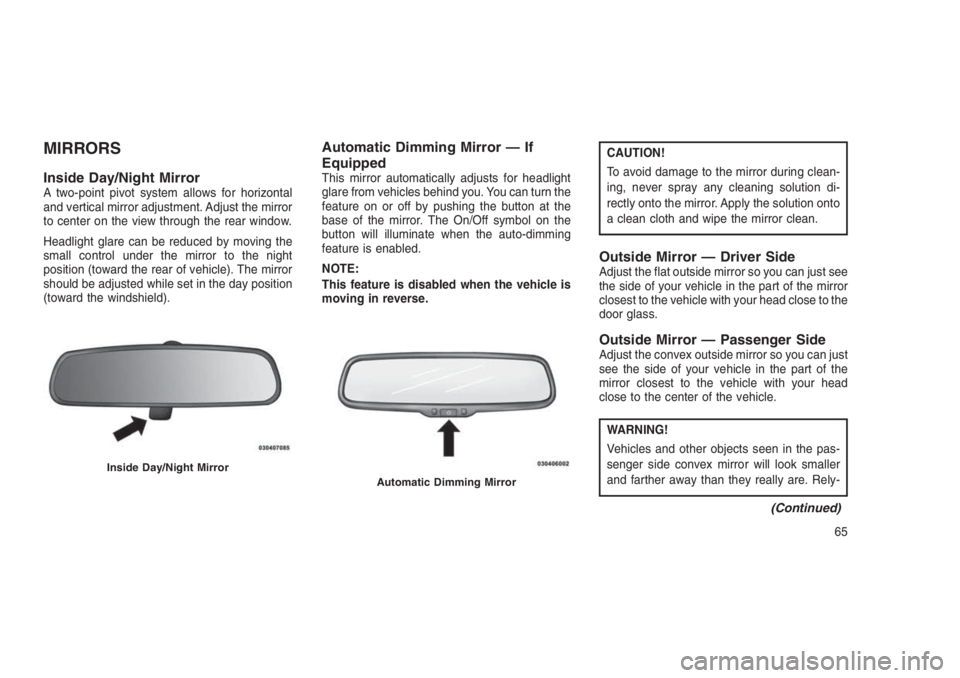
Inside Day/Night MirrorA two-point pivot system allows for horizontal
and vertical mirror adjustment. Adjust the mirror
to center on the view through the rear window.
Headlight glare can be reduced by moving the
small control under the mirror to the night
position (toward the rear of vehicle). The mirror
should be adjusted while set in the day position
(toward the windshield).
Automatic Dimming Mirror — If
Equipped
This mirror automatically adjusts for headlight
glare from vehicles behind you. You can turn the
feature on or off by pushing the button at the
base of the mirror. The On/Off symbol on the
button will illuminate when the auto-dimming
feature is enabled.
NOTE:
This feature is disabled when the vehicle is
moving in reverse.
CAUTION!
To avoid damage to the mirror during clean-
ing, never spray any cleaning solution di-
rectly onto the mirror. Apply the solution onto
a clean cloth and wipe the mirror clean.
Outside Mirror — Driver SideAdjust the flat outside mirror so you can just see
the side of your vehicle in the part of the mirror
closest to the vehicle with your head close to the
door glass.
Outside Mirror — Passenger SideAdjust the convex outside mirror so you can just
see the side of your vehicle in the part of the
mirror closest to the vehicle with your head
close to the center of the vehicle.
WARNING!
Vehicles and other objects seen in the pas-
senger side convex mirror will look smaller
and farther away than they really are. Rely-
(Continued)
Inside Day/Night MirrorAutomatic Dimming Mirror
65