climate control JEEP RENEGADE 2014 1.G Owners Manual
[x] Cancel search | Manufacturer: JEEP, Model Year: 2014, Model line: RENEGADE, Model: JEEP RENEGADE 2014 1.GPages: 212, PDF Size: 17.48 MB
Page 8 of 212
GETTING TO KNOW YOUR CAR
In-depth knowledge of your new vehicle
starts here.
The booklet that you are reading simply
and directly explains how it is made
and how it works.
That’s why we advise you to read it
seated comfortably on board, so that
you can see immediately what is
described here for yourself.THE KEYS....................................... 7
IGNITION DEVICE ........................... 8
SENTRY KEY® ............................... 10
ALARM ........................................... 11
DOORS ........................................... 11
SEATS ............................................ 14
HEAD RESTRAINTS ........................ 16
STEERING WHEEL ......................... 17
REAR VIEW MIRRORS .................... 18
EXTERIOR LIGHTS ......................... 19
INTERIOR LIGHTS .......................... 21
WINDSCREEN/REAR WINDOW
WIPER ............................................ 22
CLIMATE CONTROL ...................... 24
ELECTRIC WINDOWS .................... 28
ELECTRIC SUN ROOF .................... 29
MYSKY SUN ROOF ........................ 31
BONNET ......................................... 33
LUGGAGE COMPARTMENT ........... 34
6
GETTING TO KNOW YOUR CAR
Page 26 of 212
CLIMATE CONTROL
2).
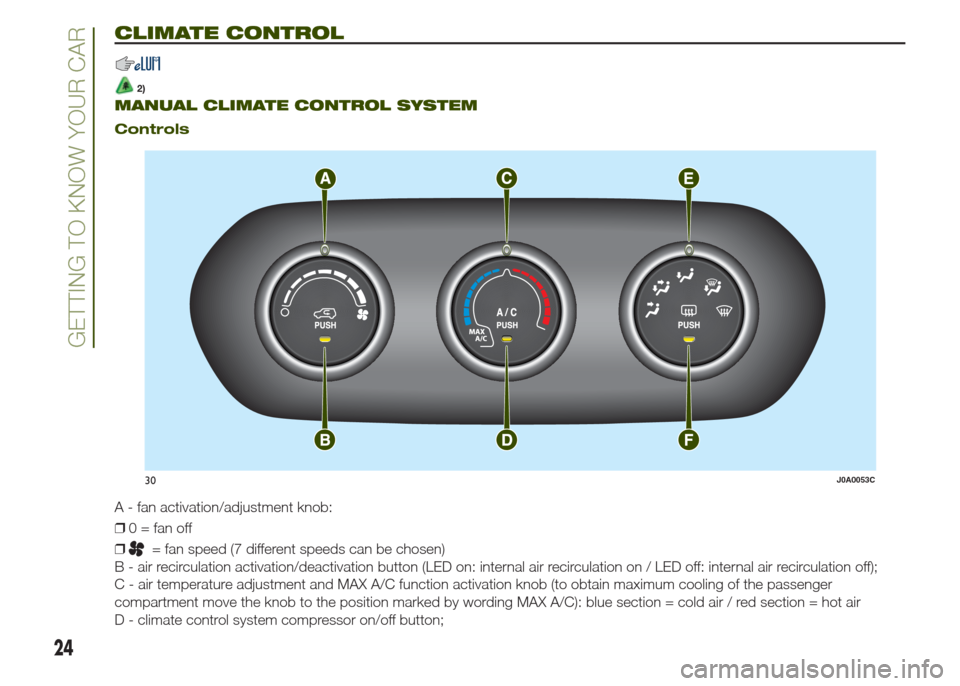
MANUAL CLIMATE CONTROL SYSTEM
Controls
A - fan activation/adjustment knob:
❒0 = fan off
❒
= fan speed (7 different speeds can be chosen)
B - air recirculation activation/deactivation button (LED on: internal air recirculation on / LED off: internal air recirculation off);
C - air temperature adjustment and MAX A/C function activation knob (to obtain maximum cooling of the passenger
compartment move the knob to the position marked by wording MAX A/C): blue section = cold air / red section = hot air
D - climate control system compressor on/off button;
30J0A0053C
24
GETTING TO KNOW YOUR CAR
Page 28 of 212
AUTOMATIC DUAL ZONE CLIMATE CONTROL SYSTEM
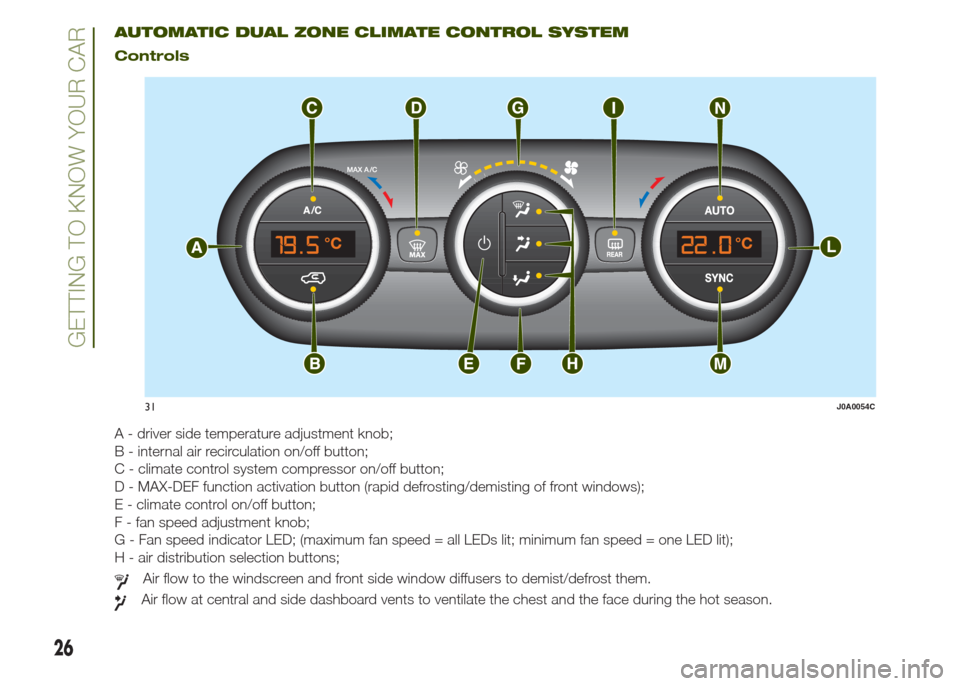
Controls
A - driver side temperature adjustment knob;
B - internal air recirculation on/off button;
C - climate control system compressor on/off button;
D - MAX-DEF function activation button (rapid defrosting/demisting of front windows);
E - climate control on/off button;
F - fan speed adjustment knob;
G - Fan speed indicator LED; (maximum fan speed = all LEDs lit; minimum fan speed = one LED lit);
H - air distribution selection buttons;
Air flow to the windscreen and front side window diffusers to demist/defrost them.
Air flow at central and side dashboard vents to ventilate the chest and the face during the hot season.
31J0A0054C
26
GETTING TO KNOW YOUR CAR
Page 29 of 212
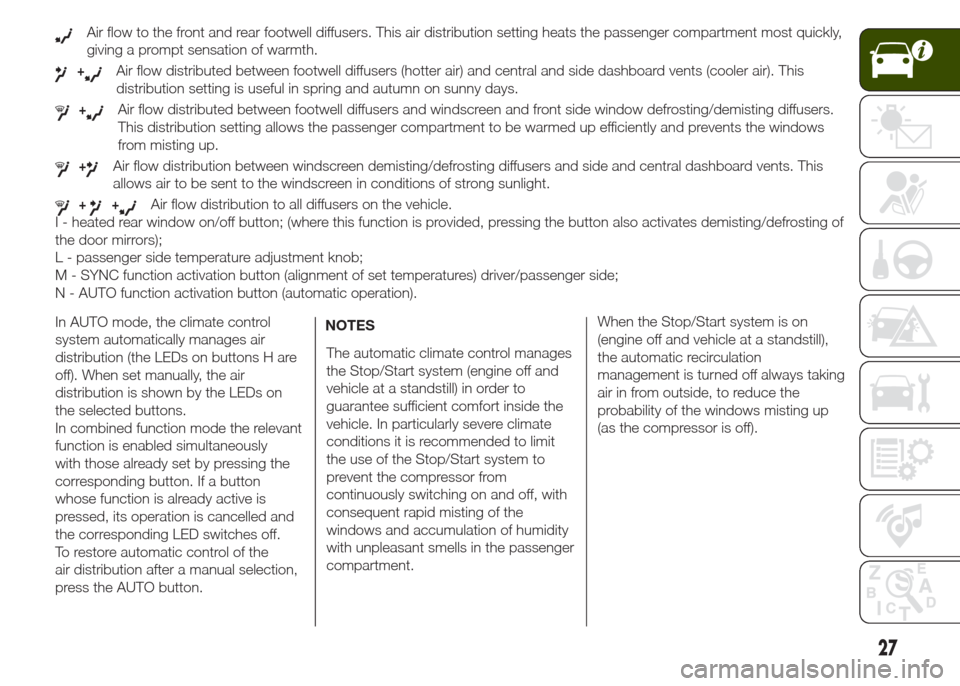
Air flow to the front and rear footwell diffusers. This air distribution setting heats the passenger compartment most quickly,
giving a prompt sensation of warmth.
+Air flow distributed between footwell diffusers (hotter air) and central and side dashboard vents (cooler air). This
distribution setting is useful in spring and autumn on sunny days.
+Air flow distributed between footwell diffusers and windscreen and front side window defrosting/demisting diffusers.
This distribution setting allows the passenger compartment to be warmed up efficiently and prevents the windows
from misting up.
+Air flow distribution between windscreen demisting/defrosting diffusers and side and central dashboard vents. This
allows air to be sent to the windscreen in conditions of strong sunlight.
++Air flow distribution to all diffusers on the vehicle.
I - heated rear window on/off button; (where this function is provided, pressing the button also activates demisting/defrosting of
the door mirrors);
L - passenger side temperature adjustment knob;
M - SYNC function activation button (alignment of set temperatures) driver/passenger side;
N - AUTO function activation button (automatic operation).
In AUTO mode, the climate control
system automatically manages air
distribution (the LEDs on buttons H are
off). When set manually, the air
distribution is shown by the LEDs on
the selected buttons.
In combined function mode the relevant
function is enabled simultaneously
with those already set by pressing the
corresponding button. If a button
whose function is already active is
pressed, its operation is cancelled and
the corresponding LED switches off.
To restore automatic control of the
air distribution after a manual selection,
press the AUTO button.NOTES
The automatic climate control manages
the Stop/Start system (engine off and
vehicle at a standstill) in order to
guarantee sufficient comfort inside the
vehicle. In particularly severe climate
conditions it is recommended to limit
the use of the Stop/Start system to
prevent the compressor from
continuously switching on and off, with
consequent rapid misting of the
windows and accumulation of humidity
with unpleasant smells in the passenger
compartment.When the Stop/Start system is on
(engine off and vehicle at a standstill),
the automatic recirculation
management is turned off always taking
air in from outside, to reduce the
probability of the windows misting up
(as the compressor is off).
27
Page 109 of 212
122)Before opening the bonnet, make
sure that the vehicle is switched off and
that the ignition device is in the STOP
position. Follow the indications on the plate
underneath the bonnet. We recommend
that you remove the key from the ignition if
other people remain in the vehicle. The
vehicle should always be left after the key
has been removed or turned to the STOP
position. During refuelling, make sure
that the engine is off (ignition device in the
STOP position).
WARNING
39)If climate comfort is to be favoured, the
Stop/Start system can be deactivated,
for a continuous operation of the climate
control system.
SPEED LIMITER
DESCRIPTION
This device allows the speed of the
vehicle to be limited to values which
can be set by the driver.
The maximum speed can be set both
with vehicle stationary and in motion.
The minimum speed that can be set is
30 km/h.
When the device is active, the vehicle
speed depends on the pressure at
the accelerator pedal, until the set
speed limit is reached.
ACTIVATING THE DEVICE
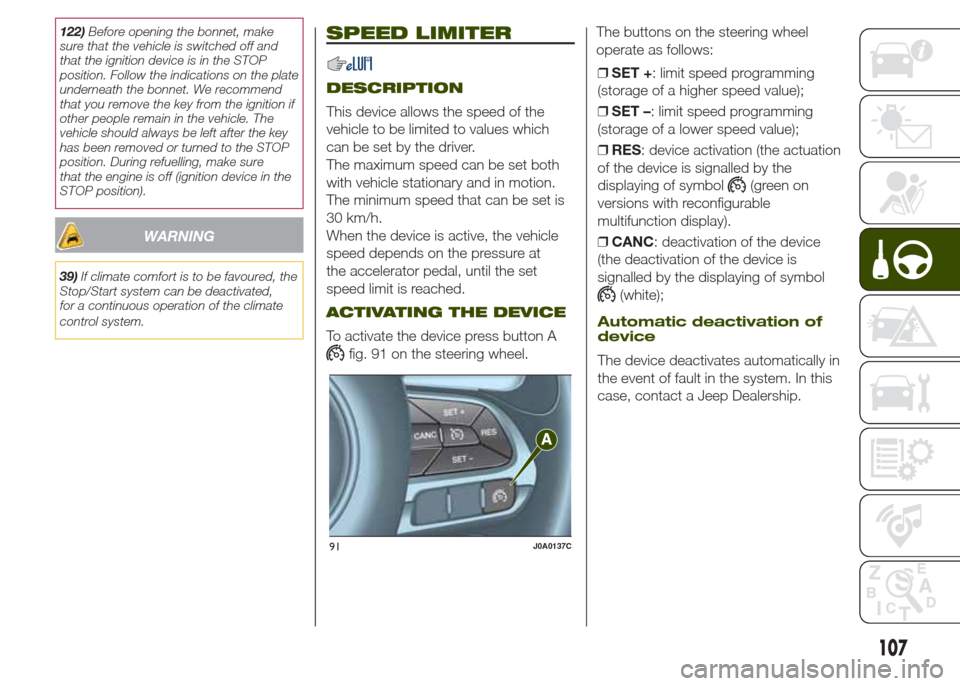
To activate the device press button A
fig. 91 on the steering wheel.The buttons on the steering wheel
operate as follows:
❒SET +: limit speed programming
(storage of a higher speed value);
❒SET –: limit speed programming
(storage of a lower speed value);
❒RES: device activation (the actuation
of the device is signalled by the
displaying of symbol
(green on
versions with reconfigurable
multifunction display).
❒CANC: deactivation of the device
(the deactivation of the device is
signalled by the displaying of symbol
(white);
Automatic deactivation of
device
The device deactivates automatically in
the event of fault in the system. In this
case, contact a Jeep Dealership.
91J0A0137C
107
Page 135 of 212
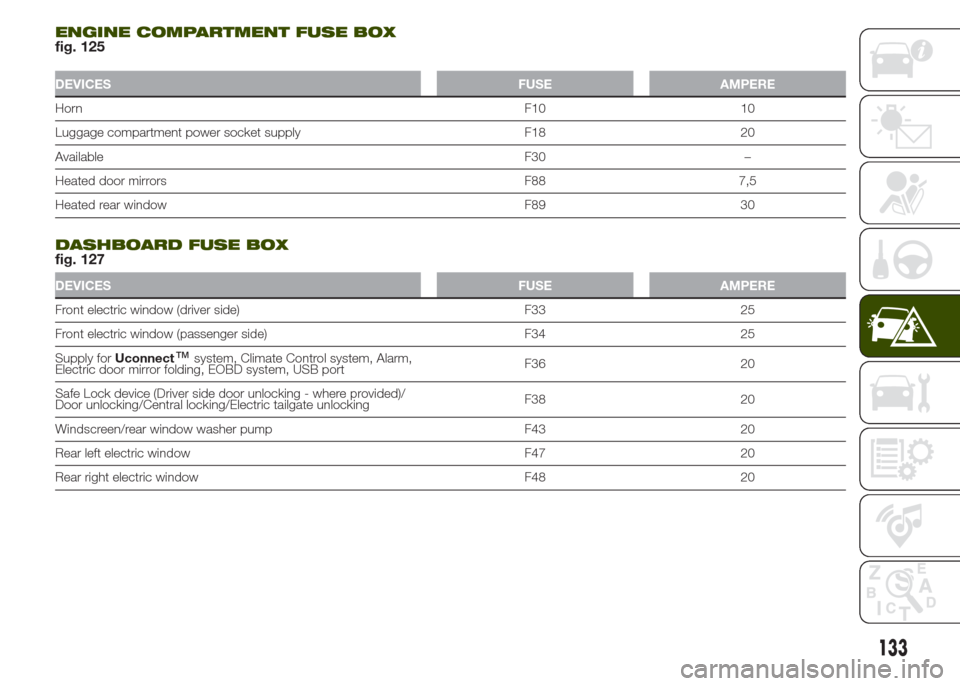
ENGINE COMPARTMENT FUSE BOXfig. 125
DEVICES FUSE AMPERE
HornF10 10
Luggage compartment power socket supply F18 20
AvailableF30 –
Heated door mirrors F88 7,5
Heated rear window F89 30
.
DASHBOARD FUSE BOXfig. 127
DEVICES FUSE AMPERE
Front electric window (driver side) F33 25
Front electric window (passenger side) F34 25
Supply forUconnect
™system, Climate Control system, Alarm,
Electric door mirror folding, EOBD system, USB portF36 20
Safe Lock device (Driver side door unlocking - where provided)/
Door unlocking/Central locking/Electric tailgate unlockingF38 20
Windscreen/rear window washer pump F43 20
Rear left electric window F47 20
Rear right electric window F48 20
133
Page 145 of 212
FUEL CUT-OFF
SYSTEM
This intervenes in the case of an impact
causing:
❒the interruption of the fuel supply with
the engine consequently cutting out;
❒the automatic unlocking of the doors;
❒turning on of the lights inside the
vehicle;
❒deactivation of climate control system
ventilation;
❒switching on of the hazard warning
lights (to deactivate the lights press the
button on the dashboard).
On some versions, the intervention of
the system is indicated by a message
shown on the display. In the same way,
a dedicated message on the display
warns the driver if system operation is
compromised.
IMPORTANT Carefully check the vehicle
for fuel leaks, for instance in the engine
compartment, under the vehicle or
near the tank area. After a collision,
bring the ignition device to STOP to
prevent the battery from running down.
To restore correct operation of the
vehicle, carry out the following
procedure (this procedure must be
started and completed within less than
one minute):❒move the ignition device to MAR;
❒turn on the direction indicators on the
right, then on the left, then again on
the right and again on the left;
❒now deactivate the direction
indicators on the left;
❒bring the ignition device to STOP;
❒move the ignition device to MAR.
160)
WARNING
160)If, after an impact, you smell fuel or
notice leaks from the fuel system, do
not reactivate the system to avoid the risk
of fire.
AUTOMATIC
TRANSMISSION
GEAR LEVER
UNLOCKING
In the event of a fault, to move the gear
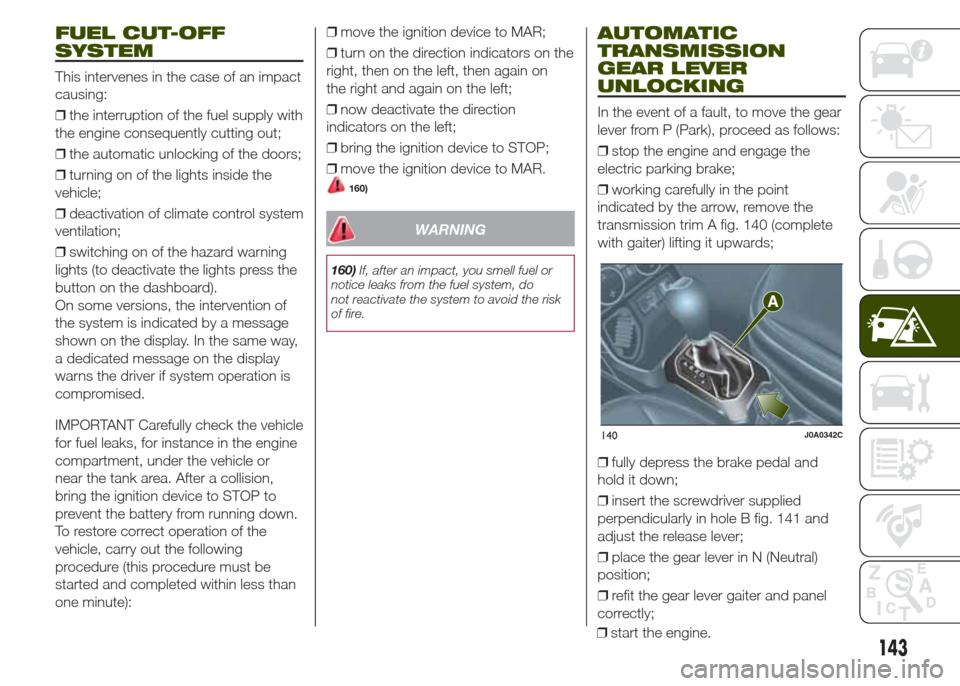
lever from P (Park), proceed as follows:
❒stop the engine and engage the
electric parking brake;
❒working carefully in the point
indicated by the arrow, remove the
transmission trim A fig. 140 (complete
with gaiter) lifting it upwards;
❒fully depress the brake pedal and
hold it down;
❒insert the screwdriver supplied
perpendicularly in hole B fig. 141 and
adjust the release lever;
❒place the gear lever in N (Neutral)
position;
❒refit the gear lever gaiter and panel
correctly;
140J0A0342C
143
❒start the engine.
Page 160 of 212
ENGINE OIL
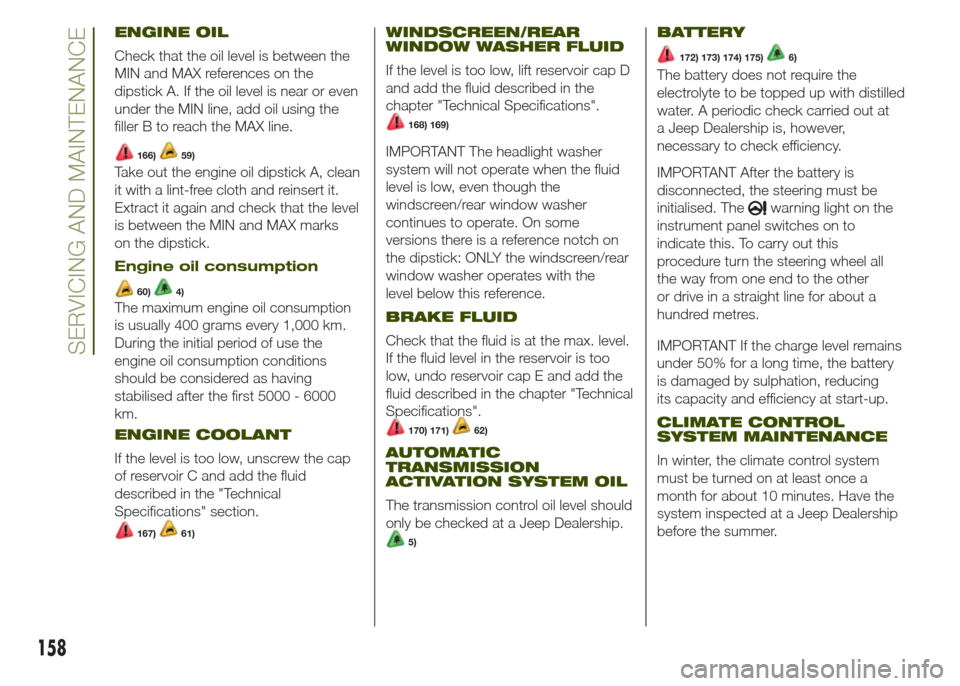
Check that the oil level is between the
MIN and MAX references on the
dipstick A. If the oil level is near or even
under the MIN line, add oil using the
filler B to reach the MAX line.
166)59)
Take out the engine oil dipstick A, clean
it with a lint-free cloth and reinsert it.
Extract it again and check that the level
is between the MIN and MAX marks
on the dipstick.
Engine oil consumption
60)4)
The maximum engine oil consumption
is usually 400 grams every 1,000 km.
During the initial period of use the
engine oil consumption conditions
should be considered as having
stabilised after the first 5000 - 6000
km.
ENGINE COOLANT
If the level is too low, unscrew the cap
of reservoir C and add the fluid
described in the "Technical
Specifications" section.
167)61)
WINDSCREEN/REAR
WINDOW WASHER FLUID
If the level is too low, lift reservoir cap D
and add the fluid described in the
chapter "Technical Specifications".
168) 169)
IMPORTANT The headlight washer
system will not operate when the fluid
level is low, even though the
windscreen/rear window washer
continues to operate. On some
versions there is a reference notch on
the dipstick: ONLY the windscreen/rear
window washer operates with the
level below this reference.
BRAKE FLUID
Check that the fluid is at the max. level.
If the fluid level in the reservoir is too
low, undo reservoir cap E and add the
fluid described in the chapter "Technical
Specifications".
170) 171)62)
AUTOMATIC
TRANSMISSION
ACTIVATION SYSTEM OIL
The transmission control oil level should
only be checked at a Jeep Dealership.
5)
BATTERY
172) 173) 174) 175)6)
The battery does not require the
electrolyte to be topped up with distilled
water. A periodic check carried out at
a Jeep Dealership is, however,
necessary to check efficiency.
IMPORTANT After the battery is
disconnected, the steering must be
initialised. The
warning light on the
instrument panel switches on to
indicate this. To carry out this
procedure turn the steering wheel all
the way from one end to the other
or drive in a straight line for about a
hundred metres.
IMPORTANT If the charge level remains
under 50% for a long time, the battery
is damaged by sulphation, reducing
its capacity and efficiency at start-up.
CLIMATE CONTROL
SYSTEM MAINTENANCE
In winter, the climate control system
must be turned on at least once a
month for about 10 minutes. Have the
system inspected at a Jeep Dealership
before the summer.
158
SERVICING AND MAINTENANCE
Page 164 of 212
IMPORTANT In versions with a sun
roof, make sure that the sun roof is
closed before operating the window
washer jets.
Rear window washer
The rear window washer jets are fixed.
The nozzle holder is located above
the rear window.
WARNING
176)The air intake system (air cleaner,
rubber hoses, etc.) can be a protection in
the case of blowbacks from the engine.
DO NOT REMOVE this system unless you
need to carry out repair or servicing
operations. Before starting the engine
make sure the system is not dismantled:
failure to comply with this precaution
may cause serious injuries.
177)Exhaust emissions are very
dangerous and may be fatal. They contain
carbon monoxide, a colourless and
odourless gas which, if inhaled, may cause
fainting and poisoning.
178)The exhaust system can reach high
temperatures and cause a fire if the vehicle
is parked on flammable material. Dry grass
or leaves can also catch fire if they come
into contact with the exhaust system.
Do not park or use the vehicle in a place in
which the exhaust system might come
into contact with flammable material.
WARNING
64)Incorrect maintenance of the vehicle or
failure to carry out operations or repairs
(when necessary) may lead to more
expensive repairs, damage to other
components or a negative impact on the
vehicle performance. Have any operating
faults immediately checked by a Jeep
Dealership.
65)The vehicle is equipped with fluids
optimised for protecting its performance
and duration, and to extend servicing
intervals. Do not use chemicals for washing
these components since they may
damage the engine, the gearbox or the
climate control system. This damage is not
covered by the vehicle’s warranty. If, due
to malfunction of a component, washing is
needed, only use the fluid specific for
that procedure.
66)An excessive or insufficient amount of
oil in the block is extremely harmful for
the engine. Make sure it is always at an
adequate level.
67)Always require the use of only
compressor coolants and lubricants
approved and suitable for the specific air
conditioning system fitted on the vehicle.
Some non-approved coolants are
flammable and may explode, with the risk
of injuries. The use of non-approved
coolants or lubricants may adversely affect
system efficiency, leading to expensive
repairs.68)The air conditioning system contains
high-pressure coolant: to prevent damage
to people or the system, any topping-up
with fuel or repairs that involves
disconnection of the pipes must be carried
out by a Jeep Dealership.
69)Vehicles equipped with a catalytic
converter must be exclusively supplied with
unleaded petrol. Leaded petrol would
permanently damage the catalytic
converter and eliminate its ability to reduce
polluting emissions, seriously
compromising the engine performance,
which would be irreparably damaged. If the
engine does not work correctly, especially
if it starts irregularly or if there is a reduction
of its performance, immediately go to a
Jeep Dealership. Prolonged and faulty
operation of the engine may cause
overheating of the converter and, as a
consequence, possible damage to the
converter and the vehicle.
70)Using a gearbox fluid different from that
approved may compromise gearshifting
quality and/or cause vibration of the
gearbox itself.
71)It is recommended to have the vehicle
serviced by a Jeep Dealership. When
carrying out normal periodic operations
and small servicing interventions personally
on the vehicle, it is recommended to use
suitable equipment, original spare parts
and the necessary fluids. Do not carry out
any interventions if you don't have the
necessary experience.
162
SERVICING AND MAINTENANCE
Page 179 of 212
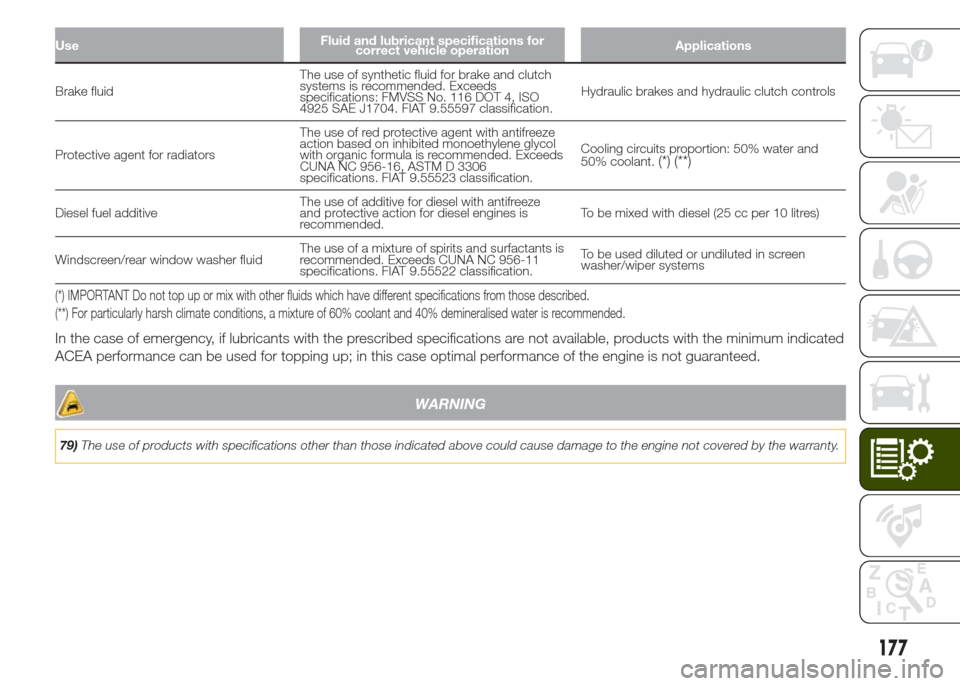
UseFluid and lubricant specifications for
correct vehicle operationApplications
Brake fluidThe use of synthetic fluid for brake and clutch
systems is recommended. Exceeds
specifications: FMVSS No. 116 DOT 4, ISO
4925 SAE J1704. FIAT 9.55597 classification.Hydraulic brakes and hydraulic clutch controls
Protective agent for radiatorsThe use of red protective agent with antifreeze
action based on inhibited monoethylene glycol
with organic formula is recommended. Exceeds
CUNA NC 956-16, ASTM D 3306
specifications. FIAT 9.55523 classification.Cooling circuits proportion: 50% water and
50% coolant.
(*) (**)
Diesel fuel additiveThe use of additive for diesel with antifreeze
and protective action for diesel engines is
recommended.To be mixed with diesel (25 cc per 10 litres)
Windscreen/rear window washer fluidThe use of a mixture of spirits and surfactants is
recommended. Exceeds CUNA NC 956-11
specifications. FIAT 9.55522 classification.To be used diluted or undiluted in screen
washer/wiper systems
(*) IMPORTANT Do not top up or mix with other fluids which have different specifications from those described.
(**) For particularly harsh climate conditions, a mixture of 60% coolant and 40% demineralised water is recommended.
In the case of emergency, if lubricants with the prescribed specifications are not available, products with the minimum indicated
ACEA performance can be used for topping up; in this case optimal performance of the engine is not guaranteed.
WARNING
79)The use of products with specifications other than those indicated above could cause damage to the engine not covered by the warranty.
177