ABS JEEP RENEGADE 2018 Owner handbook (in English)
[x] Cancel search | Manufacturer: JEEP, Model Year: 2018, Model line: RENEGADE, Model: JEEP RENEGADE 2018Pages: 356, PDF Size: 6.11 MB
Page 8 of 356
USE OF THE OWNER HANDBOOK
OPERATING INSTRUCTIONS
Each time direction instructions (left/right or forwards/backwards) about the vehicle are given, these must be intended as regarding
an occupant in the driver's seat. Special cases not complying with this rule will be properly specified in the text.
The figures in the Owner Handbook are provided by way of example only: this might imply that some details of the image do not
correspond to the actual arrangement of your vehicle.
In addition, the Handbook has been conceived considering vehicles with steering wheel on the left side; it is therefore possible that
on vehicles with steering wheel on the right side, the position or construction of some controls is not exactly mirror-like with respect
to the figure.
To identify the chapter with the information needed you can consult the index at the end of this Owner Handbook.
Chapters can be rapidly identified with dedicated graphic tabs, at the side of each odd page. A few pages further there is a key for
getting to know the chapter order and the relevant symbols in the tabs. There is anyway a textual indication of the current chapter at
the side of each even page.
Page 20 of 356
MAR: driving position. All electrical
devices are available. This state can be
entered by pressing the ignition device
button once, without pressing the brake
pedal (versions with automatic
transmission) or the clutch pedal
(versions with manual gearbox);
AVV: engine starting.
Starting the engine (with electronic key
battery flat): in this case, rest the rounded
edge of the electronic key (the side
opposite the metal insert) on the ignition
device and press the button using the
electronic key.
Stopping the engine (with electronic key
battery flat): to switch off the engine in
this situation, hold down the ignition
device button for a while or press it
3 times in a row within a few seconds.
NOTE The ignition device does NOT
activate if the electronic key is inside the
boot and this is open.
NOTE With the ignition device at MAR, if
30 minutes pass with the vehicle
stationary (versions with manual gearbox)
or with the gear lever at P (Park)
(versions with automatic transmission)
and the engine off, the ignition device
will automatically move to the STOP
position.
NOTE If the device does switch off the
car, refer to the “Display” paragraph in
the “Knowing the instrument panel”chapter, where available, and contact the
Jeep Dealership as soon as possible.
For more information on the engine
start-up, see the description in the
"Starting the engine" paragraph, in the
"Starting and driving" chapter.STEERING LOCK
Activation
Versions with mechanical key: with the
device in the STOP position, remove the
key and turn the wheel until it locks.
WARNING Locking the steering wheel
can only be done after removing the
starter key if the key has been turned in
the starter from the position MAR to
STOP.
Versions with electronic key: the steering
lock is inserted into the driver's door with
the starter device button in the STOP
position and the speed is less than
3km/h.
Deactivation
Versions with mechanical key: move the
wheel lightly, turn the key to MAR
position.
Versions with electronic key: the steering
lock is removed when the starter button
is pressed and the electronic key is
recognised.
WARNING On automatic transmissionversions, to remove the key smoothly, we
advise you to position the gear shift to P,
release the brake in safe conditions and
then turn off the engine.
4) 5)
WARNING
2)If the ignition device has been
tampered with (e.g. an attempted theft),
have it checked over by a Jeep Dealership
before driving again.
3)Always take the key with you when you
leave your vehicle to prevent someone
from accidentally operating the controls.
Remember to engage the electric parking
brake. Never leave children unattended in
the vehicle.
4)It is absolutely forbidden to carry out
any after-market operation involving
steering system or steering column
modifications (e.g. installation of
anti-theft device) that could adversely
affect performance, invalidate the
warranty, cause serious safety problems
and also result in the car not meeting
type-approval requirements.
18
GETTING TO KNOW YOUR CAR
Page 31 of 356
IMPORTANT If this function is
activated with engine off the battery
may run down.
Auto On Comfort (where provided)
The electric heated steering wheel is
switched on automatically whenever the
engine is started and the outside
temperature is lower than 4.4°C. This
functionality can be enabled or disabled
from theUconnect™system Menu.
WARNING
16)All adjustments must be carried out
only with the car stationary and engine
off.
17)It is absolutely forbidden to carry out
any after-market operation involving
steering system or steering column
modifications (e.g. installation of
anti-theft device) that could adversely
affect performance and safety, invalidate
the warranty and also result in the car not
meeting type-approval requirements.
REAR VIEW MIRRORS
INTERIOR MIRROR
The mirror is fitted with a safety device
that causes its release in the event of a
violent impact with the passenger.
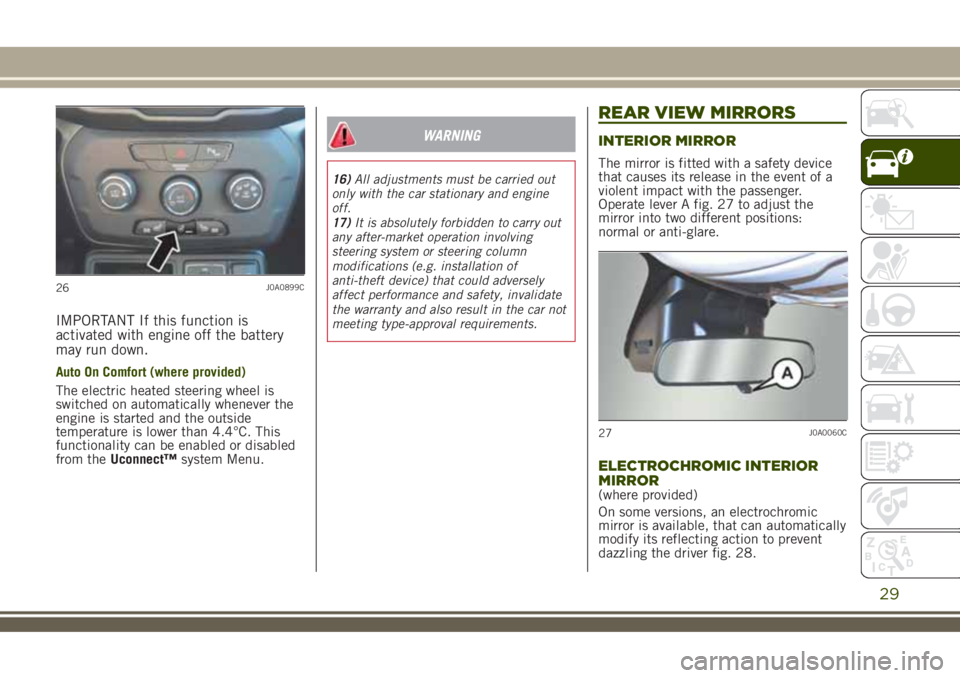
Operate lever A fig. 27 to adjust the
mirror into two different positions:
normal or anti-glare.
ELECTROCHROMIC INTERIOR
MIRROR
(where provided)
On some versions, an electrochromic
mirror is available, that can automatically
modify its reflecting action to prevent
dazzling the driver fig. 28.
26J0A0899C
27J0A0060C
29
Page 60 of 356
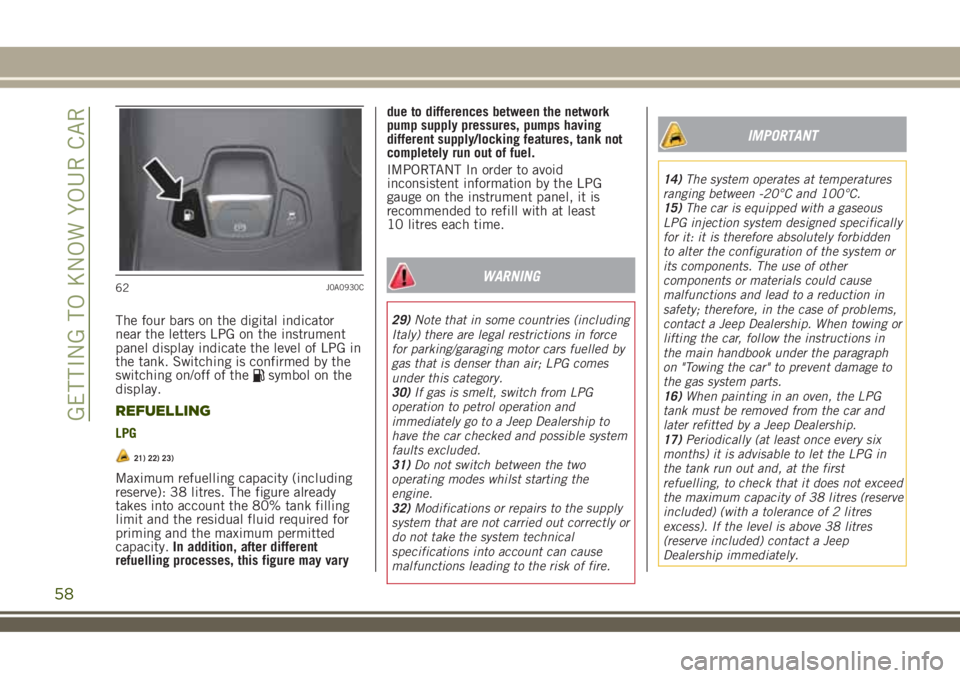
The four bars on the digital indicator
near the letters LPG on the instrument
panel display indicate the level of LPG in
the tank. Switching is confirmed by the
switching on/off of the
symbol on the
display.
REFUELLING
LPG
21) 22) 23)
Maximum refuelling capacity (including
reserve): 38 litres. The figure already
takes into account the 80% tank filling
limit and the residual fluid required for
priming and the maximum permitted
capacity.In addition, after different
refuelling processes, this figure may varydue to differences between the network
pump supply pressures, pumps having
different supply/locking features, tank not
completely run out of fuel.
IMPORTANT In order to avoid
inconsistent information by the LPG
gauge on the instrument panel, it is
recommended to refill with at least
10 litres each time.
WARNING
29)Note that in some countries (including
Italy) there are legal restrictions in force
for parking/garaging motor cars fuelled by
gas that is denser than air; LPG comes
under this category.
30)If gas is smelt, switch from LPG
operation to petrol operation and
immediately go to a Jeep Dealership to
have the car checked and possible system
faults excluded.
31)Do not switch between the two
operating modes whilst starting the
engine.
32)Modifications or repairs to the supply
system that are not carried out correctly or
do not take the system technical
specifications into account can cause
malfunctions leading to the risk of fire.
IMPORTANT
14)The system operates at temperatures
ranging between -20°C and 100°C.
15)The car is equipped with a gaseous
LPG injection system designed specifically
for it: it is therefore absolutely forbidden
to alter the configuration of the system or
its components. The use of other
components or materials could cause
malfunctions and lead to a reduction in
safety; therefore, in the case of problems,
contact a Jeep Dealership. When towing or
lifting the car, follow the instructions in
the main handbook under the paragraph
on "Towing the car" to prevent damage to
the gas system parts.
16)When painting in an oven, the LPG
tank must be removed from the car and
later refitted by a Jeep Dealership.
17)Periodically (at least once every six
months) it is advisable to let the LPG in
the tank run out and, at the first
refuelling, to check that it does not exceed
the maximum capacity of 38 litres (reserve
included) (with a tolerance of 2 litres
excess). If the level is above 38 litres
(reserve included) contact a Jeep
Dealership immediately.
62J0A0930C
58
GETTING TO KNOW YOUR CAR
Page 77 of 356
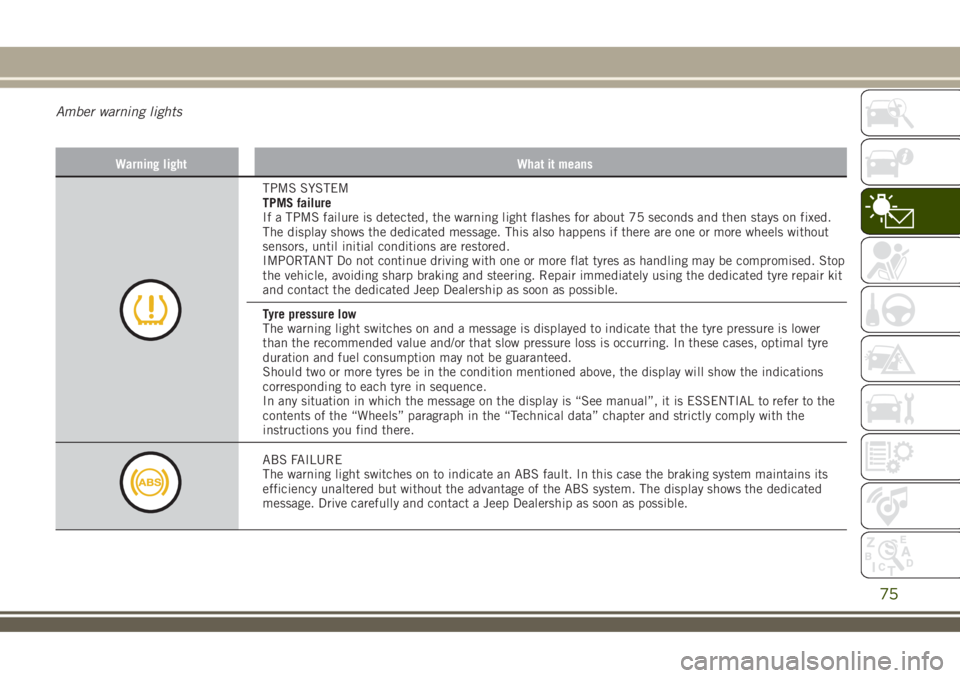
Amber warning lights
Warning light What it means
TPMS SYSTEM
TPMS failure
If a TPMS failure is detected, the warning light flashes for about 75 seconds and then stays on fixed.
The display shows the dedicated message. This also happens if there are one or more wheels without
sensors, until initial conditions are restored.
IMPORTANT Do not continue driving with one or more flat tyres as handling may be compromised. Stop
the vehicle, avoiding sharp braking and steering. Repair immediately using the dedicated tyre repair kit
and contact the dedicated Jeep Dealership as soon as possible.
Tyre pressure low
The warning light switches on and a message is displayed to indicate that the tyre pressure is lower
than the recommended value and/or that slow pressure loss is occurring. In these cases, optimal tyre
duration and fuel consumption may not be guaranteed.
Should two or more tyres be in the condition mentioned above, the display will show the indications
corresponding to each tyre in sequence.
In any situation in which the message on the display is “See manual”, it is ESSENTIAL to refer to the
contents of the “Wheels” paragraph in the “Technical data” chapter and strictly comply with the
instructions you find there.
ABS FAILURE
The warning light switches on to indicate an ABS fault. In this case the braking system maintains its
efficiency unaltered but without the advantage of the ABS system. The display shows the dedicated
message. Drive carefully and contact a Jeep Dealership as soon as possible.
75
Page 104 of 356
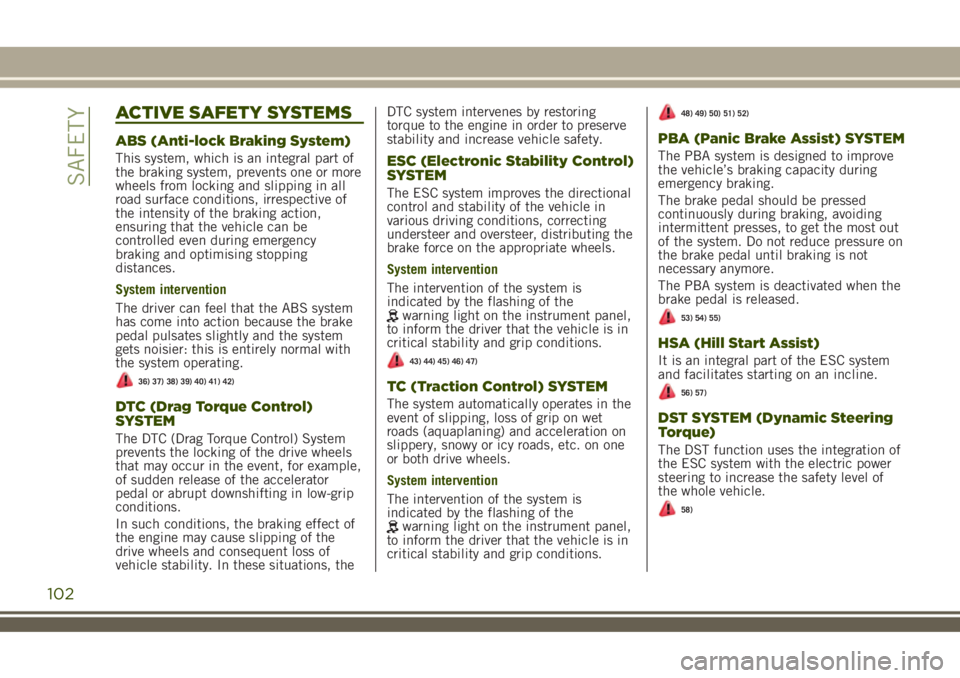
ACTIVE SAFETY SYSTEMS
ABS (Anti-lock Braking System)
This system, which is an integral part of
the braking system, prevents one or more
wheels from locking and slipping in all
road surface conditions, irrespective of
the intensity of the braking action,
ensuring that the vehicle can be
controlled even during emergency
braking and optimising stopping
distances.
System intervention
The driver can feel that the ABS system
has come into action because the brake
pedal pulsates slightly and the system
gets noisier: this is entirely normal with
the system operating.
36) 37) 38) 39) 40) 41) 42)
DTC (Drag Torque Control)
SYSTEM
The DTC (Drag Torque Control) System
prevents the locking of the drive wheels
that may occur in the event, for example,
of sudden release of the accelerator
pedal or abrupt downshifting in low-grip
conditions.
In such conditions, the braking effect of
the engine may cause slipping of the
drive wheels and consequent loss of
vehicle stability. In these situations, theDTC system intervenes by restoring
torque to the engine in order to preserve
stability and increase vehicle safety.
ESC (Electronic Stability Control)
SYSTEM
The ESC system improves the directional
control and stability of the vehicle in
various driving conditions, correcting
understeer and oversteer, distributing the
brake force on the appropriate wheels.
System intervention
The intervention of the system is
indicated by the flashing of the
warning light on the instrument panel,
to inform the driver that the vehicle is in
critical stability and grip conditions.
43) 44) 45) 46) 47)
TC (Traction Control) SYSTEM
The system automatically operates in the
event of slipping, loss of grip on wet
roads (aquaplaning) and acceleration on
slippery, snowy or icy roads, etc. on one
or both drive wheels.
System intervention
The intervention of the system is
indicated by the flashing of the
warning light on the instrument panel,
to inform the driver that the vehicle is in
critical stability and grip conditions.
48) 49) 50) 51) 52)
PBA (Panic Brake Assist) SYSTEM
The PBA system is designed to improve
the vehicle’s braking capacity during
emergency braking.
The brake pedal should be pressed
continuously during braking, avoiding
intermittent presses, to get the most out
of the system. Do not reduce pressure on
the brake pedal until braking is not
necessary anymore.
The PBA system is deactivated when the
brake pedal is released.
53) 54) 55)
HSA (Hill Start Assist)
It is an integral part of the ESC system
and facilitates starting on an incline.
56) 57)
DST SYSTEM (Dynamic Steering
Torque)
The DST function uses the integration of
the ESC system with the electric power
steering to increase the safety level of
the whole vehicle.
58)
102
SAFETY
Page 107 of 356
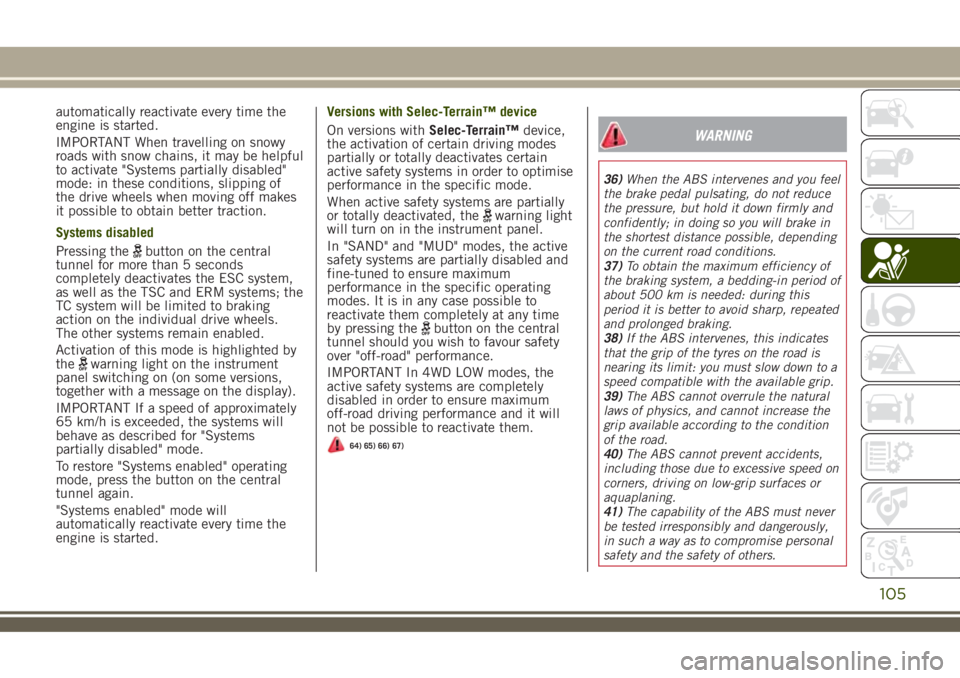
automatically reactivate every time the
engine is started.
IMPORTANT When travelling on snowy
roads with snow chains, it may be helpful
to activate "Systems partially disabled"
mode: in these conditions, slipping of
the drive wheels when moving off makes
it possible to obtain better traction.
Systems disabled
Pressing the
button on the central
tunnel for more than 5 seconds
completely deactivates the ESC system,
as well as the TSC and ERM systems; the
TC system will be limited to braking
action on the individual drive wheels.
The other systems remain enabled.
Activation of this mode is highlighted by
the
warning light on the instrument
panel switching on (on some versions,
together with a message on the display).
IMPORTANT If a speed of approximately
65 km/h is exceeded, the systems will
behave as described for "Systems
partially disabled" mode.
To restore "Systems enabled" operating
mode, press the button on the central
tunnel again.
"Systems enabled" mode will
automatically reactivate every time the
engine is started.Versions with Selec-Terrain™ device
On versions withSelec-Terrain™device,
the activation of certain driving modes
partially or totally deactivates certain
active safety systems in order to optimise
performance in the specific mode.
When active safety systems are partially
or totally deactivated, the
warning light
will turn on in the instrument panel.
In "SAND" and "MUD" modes, the active
safety systems are partially disabled and
fine-tuned to ensure maximum
performance in the specific operating
modes. It is in any case possible to
reactivate them completely at any time
by pressing the
button on the central
tunnel should you wish to favour safety
over "off-road" performance.
IMPORTANT In 4WD LOW modes, the
active safety systems are completely
disabled in order to ensure maximum
off-road driving performance and it will
not be possible to reactivate them.
64) 65) 66) 67)
WARNING
36)When the ABS intervenes and you feel
the brake pedal pulsating, do not reduce
the pressure, but hold it down firmly and
confidently; in doing so you will brake in
the shortest distance possible, depending
on the current road conditions.
37)To obtain the maximum efficiency of
the braking system, a bedding-in period of
about 500 km is needed: during this
period it is better to avoid sharp, repeated
and prolonged braking.
38)If the ABS intervenes, this indicates
that the grip of the tyres on the road is
nearing its limit: you must slow down to a
speed compatible with the available grip.
39)The ABS cannot overrule the natural
laws of physics, and cannot increase the
grip available according to the condition
of the road.
40)The ABS cannot prevent accidents,
including those due to excessive speed on
corners, driving on low-grip surfaces or
aquaplaning.
41)The capability of the ABS must never
be tested irresponsibly and dangerously,
in such a way as to compromise personal
safety and the safety of others.
105
Page 108 of 356
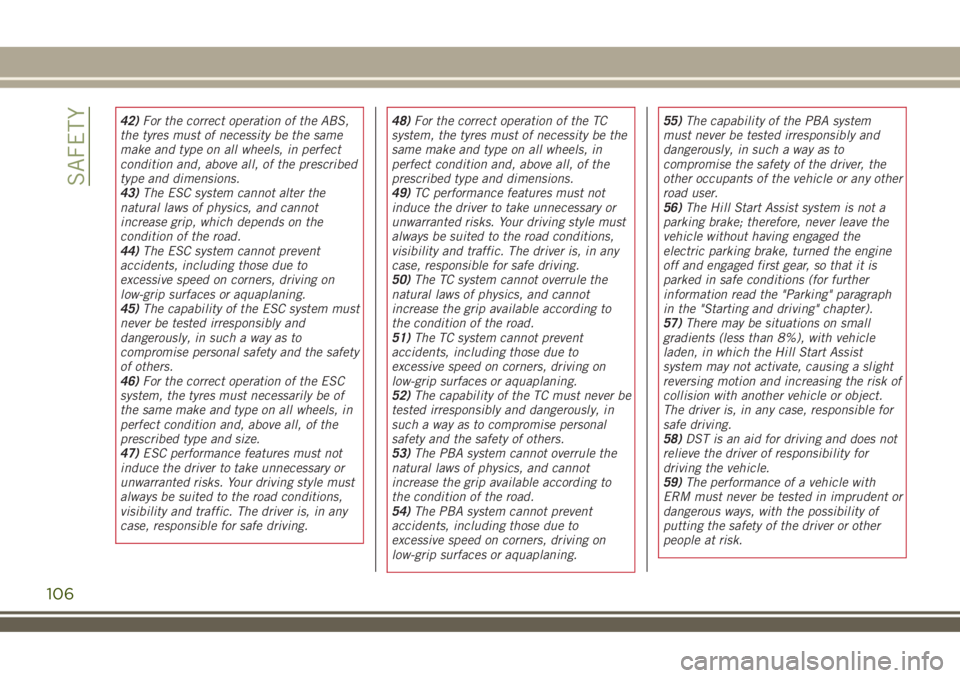
42)For the correct operation of the ABS,
the tyres must of necessity be the same
make and type on all wheels, in perfect
condition and, above all, of the prescribed
type and dimensions.
43)The ESC system cannot alter the
natural laws of physics, and cannot
increase grip, which depends on the
condition of the road.
44)The ESC system cannot prevent
accidents, including those due to
excessive speed on corners, driving on
low-grip surfaces or aquaplaning.
45)The capability of the ESC system must
never be tested irresponsibly and
dangerously, in such a way as to
compromise personal safety and the safety
of others.
46)For the correct operation of the ESC
system, the tyres must necessarily be of
the same make and type on all wheels, in
perfect condition and, above all, of the
prescribed type and size.
47)ESC performance features must not
induce the driver to take unnecessary or
unwarranted risks. Your driving style must
always be suited to the road conditions,
visibility and traffic. The driver is, in any
case, responsible for safe driving.48)For the correct operation of the TC
system, the tyres must of necessity be the
same make and type on all wheels, in
perfect condition and, above all, of the
prescribed type and dimensions.
49)TC performance features must not
induce the driver to take unnecessary or
unwarranted risks. Your driving style must
always be suited to the road conditions,
visibility and traffic. The driver is, in any
case, responsible for safe driving.
50)The TC system cannot overrule the
natural laws of physics, and cannot
increase the grip available according to
the condition of the road.
51)The TC system cannot prevent
accidents, including those due to
excessive speed on corners, driving on
low-grip surfaces or aquaplaning.
52)The capability of the TC must never be
tested irresponsibly and dangerously, in
such a way as to compromise personal
safety and the safety of others.
53)The PBA system cannot overrule the
natural laws of physics, and cannot
increase the grip available according to
the condition of the road.
54)The PBA system cannot prevent
accidents, including those due to
excessive speed on corners, driving on
low-grip surfaces or aquaplaning.55)The capability of the PBA system
must never be tested irresponsibly and
dangerously, in such a way as to
compromise the safety of the driver, the
other occupants of the vehicle or any other
road user.
56)The Hill Start Assist system is not a
parking brake; therefore, never leave the
vehicle without having engaged the
electric parking brake, turned the engine
off and engaged first gear, so that it is
parked in safe conditions (for further
information read the "Parking" paragraph
in the "Starting and driving" chapter).
57)There may be situations on small
gradients (less than 8%), with vehicle
laden, in which the Hill Start Assist
system may not activate, causing a slight
reversing motion and increasing the risk of
collision with another vehicle or object.
The driver is, in any case, responsible for
safe driving.
58)DST is an aid for driving and does not
relieve the driver of responsibility for
driving the vehicle.
59)The performance of a vehicle with
ERM must never be tested in imprudent or
dangerous ways, with the possibility of
putting the safety of the driver or other
people at risk.
106
SAFETY
Page 116 of 356
72)If the car must be placed on a roller
bench for maintenance interventions or if
it is washed in an automatic roller washing
tunnel with an obstacle in the front part
(e.g. another car, a wall or another
obstacle), the system may detect its
presence and activate. In this case the
system must be deactivated through the
settings of theUconnect™system.
73)The presence of the TPMS does not
permit the driver to neglect regular checks
of the tyre pressure, including for the
spare wheel, and correct maintenance: the
system is not used to signal a possible
fault to a tyre.
74)Tyre pressure must be checked with
tyres rested and cold. Should it become
necessary for whatever reason to check
pressure with warm tyres, do not reduce
pressure even though it is higher than the
prescribed value. Repeat the check when
the tyres are cold.
75)Should one or more wheels be fitted
without sensors (e.g. if the spare wheel is
fitted), the system will no longer be
available for the replaced wheel and a
warning message will be shown on the
display, until the wheels with sensors are
fitted again.76)The TPMS cannot indicate sudden
tyre pressure drops (e.g. if a tyre bursts).
In this case, stop the vehicle, braking with
caution and avoiding abrupt steering.
77)Replacing standard tyres with winter
tyres and vice versa requires TPMS system
adjustment that must only be performed
by Jeep Dealerships.
78)Changes in outside temperature may
cause tyre pressures to vary. The system
may temporarily indicate insufficient
pressure. In this case, check the tyre
pressure when cold and, if necessary,
restore the inflation values.
79)When a tyre is removed, it is advisable
to replace the rubber valve seal as well:
contact a Jeep Dealership. The
fitting/removal of the tyres and/or rims
require special care. To avoid damaging or
fitting the sensors incorrectly, tyre and/or
rim fitting/removal operations should only
be carried out by specialised staff.
Contact a Jeep Dealership.
IMPORTANT
33)The system may have limited or absent
operation due to weather conditions such
as: heavy rain, hail, thick fog, heavy snow.34)The section of the bumper before the
sensor must not be covered with
adhesives, auxiliary headlights or any other
object.
35)System intervention might be
unexpected or delayed when other vehicles
transport loads projecting from the side,
above or from the rear, with respect to the
normal size of the vehicle.
36)Operation can be adversely affected by
any structural change made to the vehicle,
such as a modification to the front
geometry, tyre change, or a heavier load
than the standard load of the vehicle.
37)Incorrect repairs made on the front
part of the vehicle (e.g. bumper, chassis)
may alter the position of the radar sensor,
and adversely affect its operation. Go to a
Jeep Dealership for any operation of this
type.
38)Do not tamper with nor carry out any
intervention on the radar sensor or on the
camera on the windscreen. In the event of
a sensor failure, contact a Jeep
Dealership.
39)When towing a trailer (with modules
installed after purchasing the vehicle), a
vehicle or during loading manoeuvres on a
vehicle transporter (or in vehicle for
transport), the system must be deactivated
via theUconnect™system.
114
SAFETY
Page 149 of 356
Cars equipped with electronic key (Keyless
Enter-N-Go):at a car speed over 8 km/h
(5 mph) it is possible to switch the
engine off, also with automatic
transmission lever in a position other
than P (Parking). To switch off the engine
in this situation, hold down the ignition
device button for a while or press it
3 times in a row within a few seconds. In
this case the engine will stop and the
ignition device will switch to MAR.
WARNING
116)It is dangerous to run the engine in
enclosed areas. The engine takes in
oxygen and releases carbon dioxide,
carbon monoxide and other toxic gases.
117)The brake servo is not active until
the engine is started, so you would need
to apply much more force than usual to
the brake pedal.
118)Do not start the engine by pushing,
towing or driving downhill. These
manoeuvres may damage the catalytic
converter.
IMPORTANT
44)We recommend that during the initial
period, or during the first 1600 km
(1000 miles), you do not drive to full car
performance (e.g. excessive acceleration,
long journeys at top speed, sharp braking,
etc.).
45)When the engine is switched off never
leave the ignition device in the MAR
position to prevent useless current
absorption from draining the battery.
46)A quick burst on the accelerator before
turning off the engine serves absolutely no
practical purpose; it wastes fuel and is
damaging for the engine.
47)Warning light
will flash after
starting or during prolonged cranking to
indicate a fault with the glow plug heating
system. If the engine starts, the vehicle
can be regularly used, but a Jeep
Dealership must be contacted as soon as
possible.
PARKING THE VEHICLE
Always remove the ignition key when
leaving the car.
When parking and leaving the car,
proceed as follows:
engage a gear (1st gear if facing uphill
or reverse if facing downhill) and leave
the wheels turned;
stop the engine and engage the
handbrake.
Block the wheels with a wedge or a stone
if the car is parked on a steep slope.
On versions equipped with automatic
transmission or dual clutch automatic
transmission, wait for the letter P to be
displayed before releasing the brake
pedal.
IMPORTANT NEVER leave the car with
the gearbox in neutral (or, on versions
equipped with automatic transmission
or dual clutch automatic transmission,
before putting the shift lever in the P
position).
147