air condition JEEP RENEGADE 2018 Owner handbook (in English)
[x] Cancel search | Manufacturer: JEEP, Model Year: 2018, Model line: RENEGADE, Model: JEEP RENEGADE 2018Pages: 356, PDF Size: 6.11 MB
Page 42 of 356
IMPORTANT Do not apply stickers to the inside of the heated rear window over the heating filaments, to avoid damage that
might cause them to stop working properly.
IMPORTANT Internal air recirculation makes it possible to reach the required ("heating" or "cooling") conditions more quickly
depending on the mode selected. Do not use the air recirculation function on rainy/cold days as it would considerably
increase the possibility of the windows misting inside.
40
GETTING TO KNOW YOUR CAR
Page 43 of 356
Additional heater(where provided)
The additional heater ensures more rapid
passenger compartment heating.
It activates in cold weather conditions, if
the following conditions occur:
outside temperature low;engine coolant temperature low;engine on;fan speed set at least to first speed;air temperature knob turned
completely clockwise to red section.
The heater is switched off when at least
one of the conditions above is no longer
verified.
NOTE The power of the electric heater is
modulated according to the battery
voltage.
41
Page 46 of 356
Description
Controls
A - climate control system on/off button;
B - climate control compressor on/off
button;
C - required temperature increase button
(drivers side);
D - required temperature increase button
(passengers side);
E - rapid window defrosting/de-misting
on/off button (MAX-DEF operation);
F - AUTO function activation button
(automatic operation);
G - heated rear windscreen on/off button;
H - required temperature decrease button
(passengers side);
I - air distribution selection buttons;
L - required temperature decrease button
(drivers side);
M - internal air recirculation on/off
button;
N - maximum cooling on/off button (MAX
A/C operation);
O - fan speed adjustment knob;
P - fan speed decrease button;
Q - fan speed increase button;R - air distribution buttons
(dashboard/dashboard + feet/feet/
windscreen + feet/windscreen);
S - align passenger to driver temperature
button.
Operation
The automatic dual zone climate control
system regulates the air temperatures in
the passenger compartment in two zones:
driver side and passenger side.
The system maintains comfort inside the
passenger compartment and
compensates for possible variations in
outside weather conditions.
The automatically controlled parameters
and functions are:
air temperature at the driver/front
passenger side vents;
air distribution at the driver/front
passenger side vents;
fan speed (continuous variation of the
air flow);
compressor engagement (for
cooling/dehumidifying the air);
air recirculation.
All these functions can be adjusted
manually by operating the system and
selecting one or more functions and
modifying their parameters.
The temperature of the air sent is always
automatically controlled according to the
temperature set on the display (exceptfor when the system is off or in certain
conditions when the compressor is not
running).
Notes
Do not apply stickers to the inside of the
heated rear window over the heating
filaments, to avoid damage that might
cause them to stop working properly.
Internal air recirculation makes it
possible to reach the required ("heating"
or "cooling") conditions more quickly
depending on the mode selected. Do not
use the air recirculation function on
rainy/cold days as it would considerably
increase the possibility of the windows
misting inside.
The dual zone automatic climate control
manages the Stop&Start system (engine
off and car at a standstill) in order to
guarantee sufficient comfort inside the
car.
With Stop&Start function on (engine off
and car stopped), the flow is reduced as
much as possible, to keep the
compartment comfort conditions for
longer.
44
GETTING TO KNOW YOUR CAR
Page 77 of 356
Amber warning lights
Warning light What it means
TPMS SYSTEM
TPMS failure
If a TPMS failure is detected, the warning light flashes for about 75 seconds and then stays on fixed.
The display shows the dedicated message. This also happens if there are one or more wheels without
sensors, until initial conditions are restored.
IMPORTANT Do not continue driving with one or more flat tyres as handling may be compromised. Stop
the vehicle, avoiding sharp braking and steering. Repair immediately using the dedicated tyre repair kit
and contact the dedicated Jeep Dealership as soon as possible.
Tyre pressure low
The warning light switches on and a message is displayed to indicate that the tyre pressure is lower
than the recommended value and/or that slow pressure loss is occurring. In these cases, optimal tyre
duration and fuel consumption may not be guaranteed.
Should two or more tyres be in the condition mentioned above, the display will show the indications
corresponding to each tyre in sequence.
In any situation in which the message on the display is “See manual”, it is ESSENTIAL to refer to the
contents of the “Wheels” paragraph in the “Technical data” chapter and strictly comply with the
instructions you find there.
ABS FAILURE
The warning light switches on to indicate an ABS fault. In this case the braking system maintains its
efficiency unaltered but without the advantage of the ABS system. The display shows the dedicated
message. Drive carefully and contact a Jeep Dealership as soon as possible.
75
Page 115 of 356
sealants may damage the Tyre Pressure
Monitoring System sensor. If
aftermarket tyre sealant has been
used, it is recommended to go to a
Jeep Dealership to have the sensors
checked. After checking or adjusting
the tyre pressure, always refit the valve
cap to prevent humidity and dirt from
entering. They could damage the Tyre
Pressure Monitoring System sensor.
NOTE Some external factors (e.g.
external temperature, etc...) could affect
the information reported on the
instrument panel by the TPMS.
The tyre inflation pressure and the “low
pressure” reporting threshold could
change depending on the environmental
conditions.
TPMS check message
If a system failure is present, the
warning light flashes for about
75 seconds and then stays on solid. An
acoustic signal is also emitted.
TPMS deactivation
The TPMS can be deactivated by
replacing the wheels equipped with
TPMS with others that are not (e.g. when
replacing the wheel assemblies in
winter), if the country of purchase allows
it. Then drive the vehicle for at least
20 minutes at a speed higher than about25 km/h. The TPMS will emit an
acoustic warning, the
warning light
will flash for about 75 seconds, then will
stay on constantly and the instrument
panel will display the "Tyre pressure not
available" message with some dashes (–
–) instead of the pressure values.
The next time the engine is started, the
system will not emit any acoustic signal
and the display will not show the
message "Tyre pressure not available",
but the dashes (– –) will be still
displayed instead of the pressure value.
Operating example
Supposing that the prescribed cold
inflation pressure (i.e. vehicle stationary
for at least 3 hours) is 2.3 bar, if the
ambient temperature is 20°C and the
detected tyre pressure is 1.95 bar, a
temperature reduction of −7°C results in
a decrease in tyre pressure, bringing it to
approximately 1.65 bar. This pressure is
sufficiently low to activate the
warning
light.
Heating of tyres due to driving the
vehicle may increase tyre pressure up to
approximately 1.95 bar, but the
warning light will stay on. In this
situation, the warning light will switch off
only after the tyres are inflated to the
prescribed cold pressure value for the
car.
WARNING
68)The system is an aid for vehicle
driving, it DOES NOT warn the driver
about incoming vehicles outside of the
detection areas. The driver must always
maintain a sufficient level of attention to
the traffic and road conditions and for
controlling the trajectory of the vehicle.
69)The system is an aid for the driver,
who must always pay full attention while
driving. The responsibility always rests
with the driver, who must take into
account the traffic conditions in order to
drive in complete safety. The driver must
always maintain a safe distance from the
vehicle in front.
70)If the driver depresses the brake pedal
fully or carries out a fast steering during
system operation, the automatic braking
function may stop (e.g. to allow a possible
manoeuvre to avoid the obstacle).
71)The system intervenes on vehicles
travelling in the same lane. People,
animals and things (e.g. pushchairs) are
not taken into consideration.
113
Page 116 of 356
72)If the car must be placed on a roller
bench for maintenance interventions or if
it is washed in an automatic roller washing
tunnel with an obstacle in the front part
(e.g. another car, a wall or another
obstacle), the system may detect its
presence and activate. In this case the
system must be deactivated through the
settings of theUconnect™system.
73)The presence of the TPMS does not
permit the driver to neglect regular checks
of the tyre pressure, including for the
spare wheel, and correct maintenance: the
system is not used to signal a possible
fault to a tyre.
74)Tyre pressure must be checked with
tyres rested and cold. Should it become
necessary for whatever reason to check
pressure with warm tyres, do not reduce
pressure even though it is higher than the
prescribed value. Repeat the check when
the tyres are cold.
75)Should one or more wheels be fitted
without sensors (e.g. if the spare wheel is
fitted), the system will no longer be
available for the replaced wheel and a
warning message will be shown on the
display, until the wheels with sensors are
fitted again.76)The TPMS cannot indicate sudden
tyre pressure drops (e.g. if a tyre bursts).
In this case, stop the vehicle, braking with
caution and avoiding abrupt steering.
77)Replacing standard tyres with winter
tyres and vice versa requires TPMS system
adjustment that must only be performed
by Jeep Dealerships.
78)Changes in outside temperature may
cause tyre pressures to vary. The system
may temporarily indicate insufficient
pressure. In this case, check the tyre
pressure when cold and, if necessary,
restore the inflation values.
79)When a tyre is removed, it is advisable
to replace the rubber valve seal as well:
contact a Jeep Dealership. The
fitting/removal of the tyres and/or rims
require special care. To avoid damaging or
fitting the sensors incorrectly, tyre and/or
rim fitting/removal operations should only
be carried out by specialised staff.
Contact a Jeep Dealership.
IMPORTANT
33)The system may have limited or absent
operation due to weather conditions such
as: heavy rain, hail, thick fog, heavy snow.34)The section of the bumper before the
sensor must not be covered with
adhesives, auxiliary headlights or any other
object.
35)System intervention might be
unexpected or delayed when other vehicles
transport loads projecting from the side,
above or from the rear, with respect to the
normal size of the vehicle.
36)Operation can be adversely affected by
any structural change made to the vehicle,
such as a modification to the front
geometry, tyre change, or a heavier load
than the standard load of the vehicle.
37)Incorrect repairs made on the front
part of the vehicle (e.g. bumper, chassis)
may alter the position of the radar sensor,
and adversely affect its operation. Go to a
Jeep Dealership for any operation of this
type.
38)Do not tamper with nor carry out any
intervention on the radar sensor or on the
camera on the windscreen. In the event of
a sensor failure, contact a Jeep
Dealership.
39)When towing a trailer (with modules
installed after purchasing the vehicle), a
vehicle or during loading manoeuvres on a
vehicle transporter (or in vehicle for
transport), the system must be deactivated
via theUconnect™system.
114
SAFETY
Page 140 of 356
and may come into contact with the bag
while it is still inflating. The protection
offered by the bag is compromised in
these circumstances.
The front airbags may not activate in the
case of a frontal impact against highly
deformable objects not involving the
front surface of the car (e.g. wing
collision against guard rail) or in the case
of the car wedging under other cars or
protective barriers (e.g. under trucks or
guard rails).
Failure to activate in the conditions
described above is due to the fact that
they may not provide any additional
protection compared with seat belts, so
their activation would be inappropriate.
In these cases, non-deployment does not
indicate a system malfunction.Driver's side front airbag
101) 102)
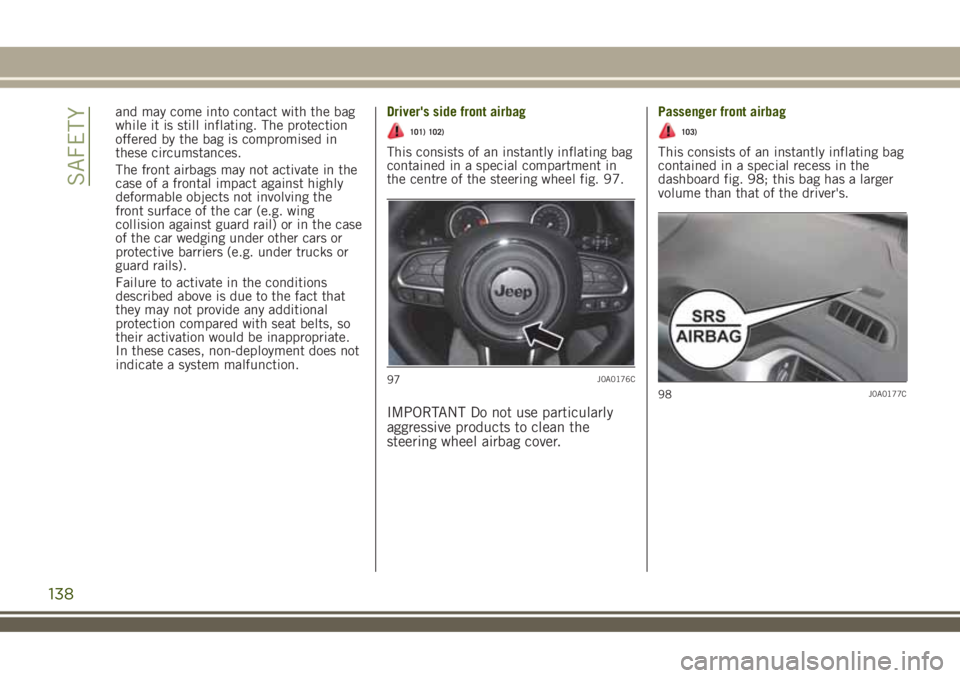
This consists of an instantly inflating bag
contained in a special compartment in
the centre of the steering wheel fig. 97.
IMPORTANT Do not use particularly
aggressive products to clean the
steering wheel airbag cover.
Passenger front airbag
103)
This consists of an instantly inflating bag
contained in a special recess in the
dashboard fig. 98; this bag has a larger
volume than that of the driver's.
97J0A0176C
98J0A0177C
138
SAFETY
Page 141 of 356
Passenger's front airbag and child restraint
systems
Rearward facing child restraint systems
mustNEVERbe fitted on the front seat
with an active passenger side airbag
since in the event of an impact the
airbag activation may cause fatal injuries
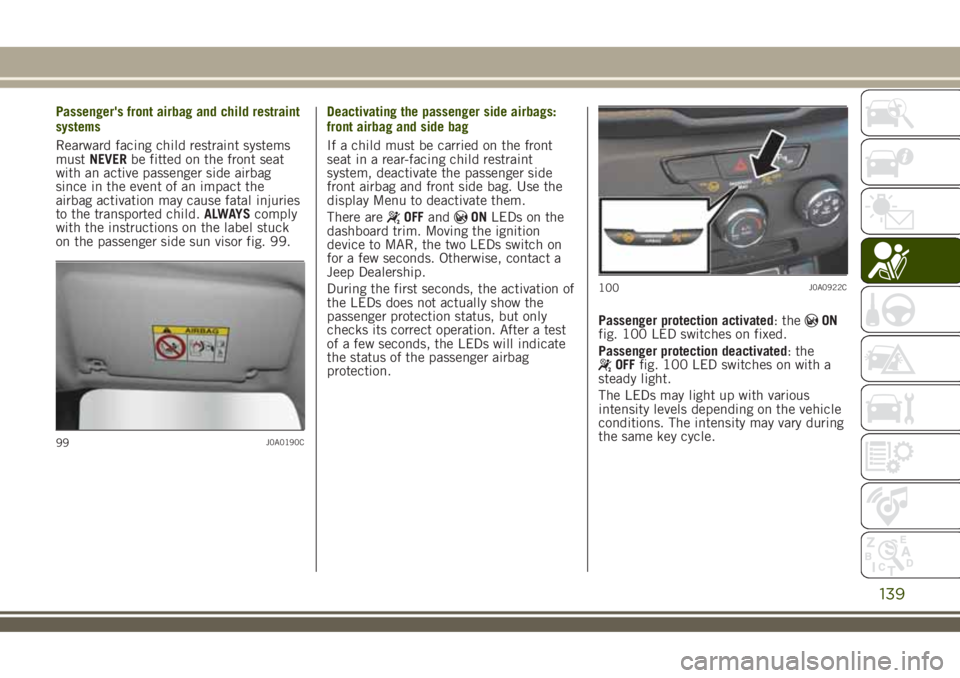
to the transported child.ALWAYScomply
with the instructions on the label stuck
on the passenger side sun visor fig. 99.Deactivating the passenger side airbags:
front airbag and side bag
If a child must be carried on the front
seat in a rear-facing child restraint
system, deactivate the passenger side
front airbag and front side bag. Use the
display Menu to deactivate them.
There are
OFFandONLEDs on the
dashboard trim. Moving the ignition
device to MAR, the two LEDs switch on
for a few seconds. Otherwise, contact a
Jeep Dealership.
During the first seconds, the activation of
the LEDs does not actually show the
passenger protection status, but only
checks its correct operation. After a test
of a few seconds, the LEDs will indicate
the status of the passenger airbag
protection.Passenger protection activated: the
ON
fig. 100 LED switches on fixed.
Passenger protection deactivated: the
OFFfig. 100 LED switches on with a
steady light.
The LEDs may light up with various
intensity levels depending on the vehicle
conditions. The intensity may vary during
the same key cycle.
99J0A0190C
100J0A0922C
139
Page 169 of 356
the device keeps working if the radar
sensor is obstructed.
Before returning to the previously set
speed, bring the speed close to that
value, then press the RES button and
release it.
WARNING
134)Pay the utmost attention while
driving at all times and be always ready to
press the brakes if needed.
135)The system is an aid for the driver,
who must always pay full attention while
driving. The responsibility always rests
with the driver, who must take into
account the traffic conditions in order to
drive in complete safety. The driver must
always maintain a safe distance from the
vehicle in front.
136)The device is not activated in
presence of pedestrians, oncoming
vehicles in the opposite direction of travel
or moving in the crosswise direction and
stationary objects (e.g. a vehicle standing
in a queue or a broken down vehicle).
137)The device cannot take account of
road, traffic and weather conditions, and
conditions of poor visibility (e.g. fog).138)The device does not always fully
recognise complex driving conditions that
could cause it to determine the safe
distance to be held incorrectly or not at
all.
139)The device cannot apply the
maximum braking force: the car will not
be stopped completely.IMPORTANT
54)The system may have limited or absent
operation due to weather conditions such
as: heavy rain, hail, thick fog, heavy snow.
55)The section of the bumper before the
sensor must not be covered with
adhesives, auxiliary headlights or any other
object.
56)Operation can be adversely affected by
any structural change made to the vehicle,
such as a modification to the front
geometry, tyre change, or a heavier load
than the standard load of the vehicle.
57)Incorrect repairs made on the front
part of the vehicle (e.g. bumper, chassis)
may alter the position of the radar sensor,
and adversely affect its operation. Go to a
Jeep Dealership for any operation of this
type.58)Do not tamper with nor carry out any
intervention on the radar sensor or on the
camera on the windscreen. In the event of
a sensor failure, contact a Jeep
Dealership.
59)Do not wash with high-pressure jets in
the bumper lower area: in particular do not
operate on the system's electrical
connector.
60)Be careful in the case of repairs and
new paintings in the area around the
sensor (panel covering the sensor on the
left side of the bumper). In the event of a
frontal impact the sensor may
automatically deactivate and display a
warning to indicate that the sensor needs
to be repaired. Even without a malfunction
warning, deactivate the system operation if
you think that the position of the radar
sensor has changed (e.g. due to low-speed
frontal impact as during parking
manoeuvres). In these cases, go to a Jeep
Dealership to have the radar sensor
realigned or replaced.
167
Page 176 of 356
uneven road surface or obstacles
before the wheels, affect vehicle's
movements, thus preventing it from
following the correct path.
IMPORTANT Manoeuvring is
deactivated if, after about 3 minutes,
parking has not been completed.
End of manoeuvre
The semi-automatic manoeuvre ends
when the display shows the message of
completed manoeuvre.
At the end of the manoeuvre, the driver
resumes control of the car and, if
necessary, has to complete parking
manually.
IMPORTANT INFORMATIONIf the sensors undergo impact which
alters their position, the system operation
could deteriorate considerably.
The system reaches top performance
after the vehicle has covered about
50 km (system "self-calibration").
If the sensors are dirty, covered by
snow, ice or mud or are repainted vs. the
original conditions, the system operation
could result strongly degraded. It is
extremely important that the sensors are
always clean in order for the system to
operate correctly. During cleaning make
sure not to scratch or damage them;
avoid using dry or rough cloths. Thesensors should be washed using clean
water with the addition of car shampoo if
necessary. In washing stations, clean the
sensors quickly, keeping the steam
jet/high pressure washing nozzles at least
10 cm away from the sensors.
Ultrasonic sound sources (e.g.
pneumatic brakes of trucks or air drills)
nearby could negatively influence the
sensor performance.
Sensors may detect a non-existent
obstacle (echo noise) due to mechanical
noises, for example while washing the
vehicle, in the case of rain, strong wind,
hail.
The sensors may not detect objects of
a particular shape or made from
particular materials (very thin poles,
trailer beams, panels, nets, bushes,
anti-parking posts, pavements, rubbish
bins, motor vehicles, etc.). Always take
great care to check that the vehicle and
its path are actually compatible with the
parking place identified by the system.
The use of (one or more) tyres or
wheels of a different size to those at the
time of vehicle purchase could affect the
operation of the system.
If a trailer (with correctly engaged
socket) is present, the system will be
automatically disabled.
In "Search in progress" mode, the
system could incorrectly identify a
parking place to carry out the manoeuvre(e.g. by a junction, driveways, roads
crossing the direction of travel, etc.).
In the case of parking manoeuvres on
roads on a gradient, the performance of
the system could be inferior and it may
deactivate.
If a parking manoeuvre is being
carried out between two parked vehicles
alongside the pavement, the system may
cause the vehicle to mount the
pavement.
Some manoeuvres at very tight bends
might be impossible to be carried out.
Take great care to ensure that
conditions do not change during the
parking manoeuvre (e.g. if there are
persons and/or animals in the parking
place, moving vehicles, etc.) and
intervene immediately if necessary.
During parking manoeuvres, pay
attention to cars approaching from the
opposite direction. Always comply with
the prescriptions of the Highway Code.
IMPORTANT Correct system operation
is not guaranteed if snow chains or the
space-saver wheel are fitted.
IMPORTANT The function only informs
the driver about the last appropriate
parking place (parallel or
perpendicular) detected by the parking
sensors.
174
STARTING AND DRIVING