steering JEEP RENEGADE 2023 Manual PDF
[x] Cancel search | Manufacturer: JEEP, Model Year: 2023, Model line: RENEGADE, Model: JEEP RENEGADE 2023Pages: 364, PDF Size: 18.65 MB
Page 306 of 364
304 SERVICING AND MAINTENANCE
The fuses protect electrical systems against
excessive current.
When a device does not work, you must check the
electr
ical circuit inside the fuse for a break/melt.
Also please be aware that using power outlets for
extend
ed periods of time with the engine off may
result in vehicle battery discharge.
Blade Fuses
Access To The Fuses
The fuses are grouped into four controllers located
in the engine compartment, under the instrument
panel and on the inside of the left side cargo trim
panel.If the replaced fuse blows again, contact an
authorized dealer.
If a general protection fuse for safety systems
(air bag system, braking system), power unit
systems (engine system, gearbox system) or
steering system blows, contact an authorized
dealer.
WARNING!
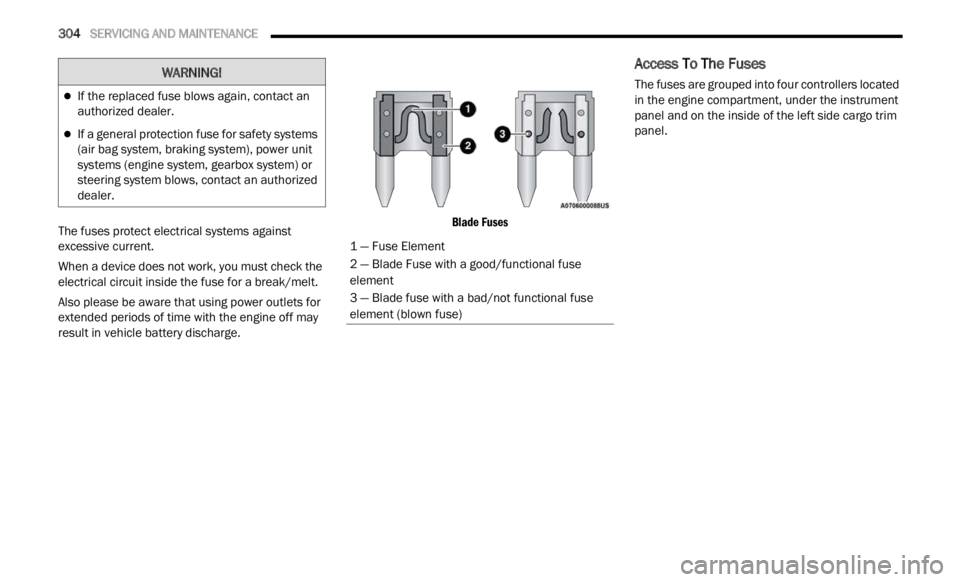
1 — Fuse Element
2 — Blade Fuse with a good/functional fuse
element
3 — Blade fuse with a bad/not functional fuse
element (blown fuse)
Page 308 of 364
306 SERVICING AND MAINTENANCE
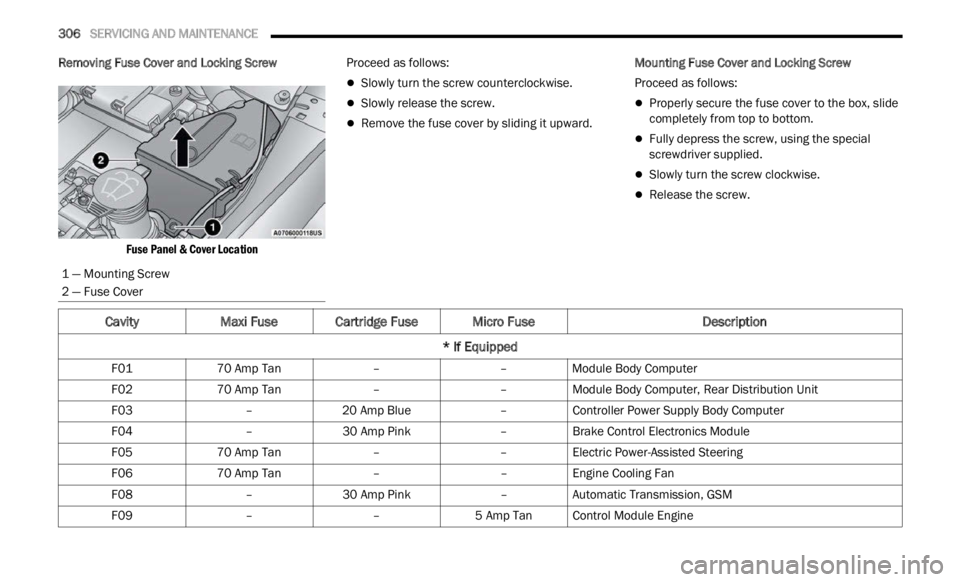
Removing Fuse Cover and Locking Screw
Fuse Panel & Cover Location
Proceed as follows:
Slowly turn the screw counterclockwise.
Slowly release the screw.
Remove the fuse cover by sliding it upward.
Mounting Fuse Cover and Locking Screw
Proceed as follows:
Properly secure the fuse cover to the box, slide
completely from top to bottom.
Fully depress the screw, using the special
screwdriver supplied.
Slowly turn the screw clockwise.
Release the screw.
1 — Mounting Screw
2 — Fuse Cover
CavityMaxi Fuse Cartridge Fuse Micro Fuse Description
* If Equipped
F01 70 Amp Tan ––Module Body Computer
F02 70 Amp Tan ––Module Body Computer, Rear Distribution Unit
F03 –20 Amp Blue –Controller Power Supply Body Computer
F04 –30 Amp Pink –Brake Control Electronics Module
F05 70 Amp Tan ––Electric Power-Assisted Steering
F06 70 Amp Tan ––Engine Cooling Fan
F08 –30 Amp Pink –Automatic Transmission, GSM
F09 ––5 Amp TanControl Module Engine
Page 310 of 364
308 SERVICING AND MAINTENANCE
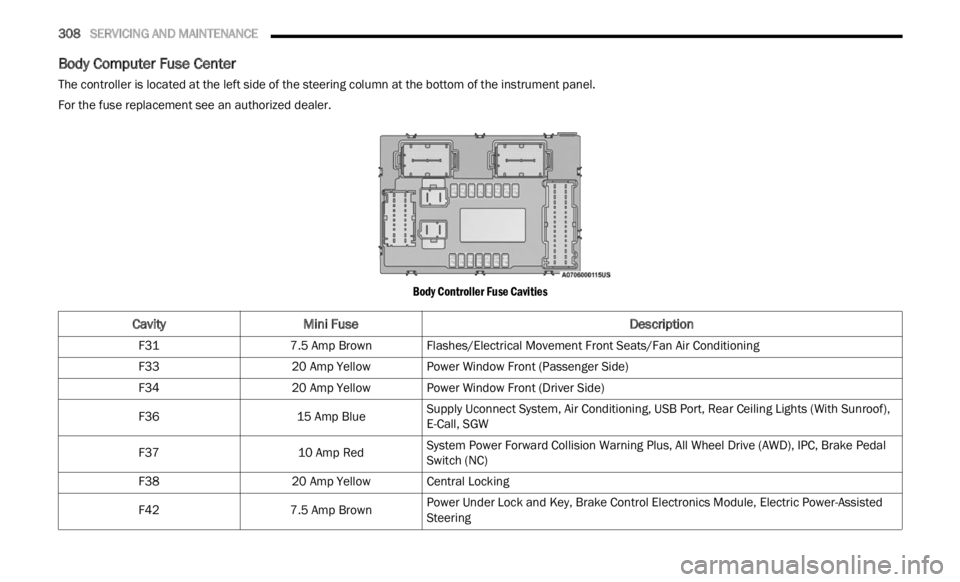
Body Computer Fuse Center
The controller is located at the left side of the steering column at the bottom of the instrument panel.
For the fuse replacement see an authorized dealer.
Body Controller Fuse Cavities
CavityMini Fuse Description
F317.5 Amp BrownFlashes/Electrical Movement Front Seats/Fan Air Conditioning
F33 20 Amp YellowPower Window Front (Passenger Side)
F34 20 Amp YellowPower Window Front (Driver Side)
F36 15 Amp BlueSupply Uconnect System, Air Conditioning, USB Port, Rear Ceiling Lights (With Sunroof),
E-Call
, SGW
F37 10 Amp RedSystem Power Forward Collision Warning Plus, All Wheel Drive (AWD), IPC, Brake Pedal
Switc
h
(NC)
F38 20 Amp YellowCentral Locking
F42 7.5 Amp BrownPower Under Lock and Key, Brake Control Electronics Module, Electric Power-Assisted
Steer
i
ng
Page 331 of 364
SERVICING AND MAINTENANCE 329
(Continued)
TIRES — GENERAL INFORMATION
Tire Pressure
Proper tire inflation pressure is essential to the
safe and satisfactory operation of your vehicle.
Four primary areas are affected by improper tire
pressure:
Safety
Fuel Economy
Tread Wear
Ride Comfort And Vehicle Stability
Safety Both underinflation and overinflation affect the
stabil
ity of the vehicle and can produce a feeling of
sluggish response or over responsiveness in the
steering.
NOTE:
Unequal tire pressures from side to side may
cause erratic and unpredictable steering
response.
Unequal tire pressure from side to side may
cause the vehicle to drift left or right.
Fuel Economy
Underinflated tires will increase tire rolling
resis t
ance resulting in higher fuel consumption. Tread Wear
Improper cold tire inflation pressures can cause
a
bnorm a
l wear patterns and reduced tread life,
resulting in the need for earlier tire replacement.
Ride Comfort And Vehicle Stability
Proper tire inflation contributes to a comfortable
ride.
Overinflation produces a jarring and
uncomfortable ride.
Tire Inflation Pressures
The proper cold tire inflation pressure is listed on
the driver's side B-pillar or rear edge of the driver's
side door.
At least once a month:
Check and adjust tire pressure with a good
quality pocket-type pressure gauge. Do not
make a visual judgment when determining
proper inflation. Tires may look properly inflated
even when they are under-inflated.
Inspect tires for signs of tire wear or visible
damage.
WARNING!
Improperly inflated tires are dangerous and
can cause collisions.
Underinflation increases tire flexing and can
result in overheating and tire failure.
Overinflation reduces a tire's ability to cushion
shock. Objects on the road and chuckholes
can cause damage that result in tire failure.
Overinflated or underinflated tires can affect
vehicle handling and can fail suddenly,
resulting in loss of vehicle control.
Unequal tire pressures can cause steering
problems. You could lose control of your
vehicle.
Unequal tire pressures from one side of the
vehicle to the other can cause the vehicle to
drift to the right or left.
Always drive with each tire inflated to the
recommended cold tire inflation pressure.
WARNING!
CAUTION!
After inspecting or adjusting the tire pressure,
always reinstall the valve stem cap. This will
prevent moisture and dirt from entering the
valve stem, which could damage the valve stem.
8
Page 334 of 364
332 SERVICING AND MAINTENANCE
Keep dismounted tires in a cool, dry place with as
little exposure to light as possible. Protect tires
from contact with oil, grease, and gasoline.
Replacement Tires
The tires on your new vehicle provide a balance of
many characteristics. They should be inspected
regularly for wear and correct cold tire inflation
pressures. The manufacturer strongly
recommends that you use tires equivalent to the
originals in size, quality and performance when
replacement is needed
Ú page 331. Refer to the
Tire and Loading Information placard or the
Vehic l
e Certification Label for the size designation
of your tire. The Load Index and Speed Symbol for
your tire will be found on the original equipment
tire sidewall.
See the Tire Sizing Chart example for more
inform a
tion relating to the Load Index and Speed
Symbol of a tire Ú page 323.
It is recommended to replace the two front tires or
two re a
r tires as a pair. Replacing just one tire can
seriously affect your vehicle’s handling. If you ever
replace a wheel, make sure that the wheel’s
specifications match those of the original wheels.
It is recommended you contact an authorized tire
deale r
or original equipment dealer with any
questions you may have on tire specifications or capability. Failure to use equivalent replacement
tires may adversely affect the safety, handling, and
ride of your vehicle.
TIRE TYPES
All Season Tires — If Equipped
All Season tires provide traction for all seasons
(Spring, Summer, Autumn, and Winter). Traction
levels may vary between different all season tires.
All season tires can be identified by the M+S, M&S,
M/S or MS designation on the tire sidewall. Use all
season tires only in sets of four; failure to do so
may adversely affect the safety and handling of
your vehicle.
Summer Or Three Season Tires —
If Equipped
Summer tires provide traction in both wet and dry
conditions, and are not intended to be driven in
snow or on ice. If your vehicle is equipped with
Summer tires, be aware these tires are not
designed for Winter or cold driving conditions.
Install Winter tires on your vehicle when ambient
temperatures are less than 40°F (5°C) or if roads
are covered with ice or snow. For more
information, contact an authorized dealer.
WARNING!
Do not use a tire, wheel size, load rating, or
speed rating other than that specified for your
vehicle. Some combinations of unapproved
tires and wheels may change suspension
dimensions and performance characteristics,
resulting in changes to steering, handling, and
braking of your vehicle. This can cause unpre -
dictable handling and stress to steering and
suspe n
sion components. You could lose
control and have a collision resulting in
serious injury or death. Use only the tire and
wheel sizes with load ratings approved for
your vehicle.
Never use a tire with a smaller load index or
capacity, other than what was originally
equipped on your vehicle. Using a tire with a
smaller load index could result in tire over -
loading and failure. You could lose control and
h ave a
collision.
Failure to equip your vehicle with tires having
adequate speed capability can result in
sudden tire failure and loss of vehicle control.
CAUTION!
Replacing original tires with tires of a different
size may result in false speedometer and
odometer readings.
Page 338 of 364
336 SERVICING AND MAINTENANCE
(Continued)
TIRE ROTATION RECOMMENDATIONS
The tires on the front and rear of your vehicle
operate at different loads and perform different
steering, handling, and braking functions. For
these reasons, they wear at unequal rates.
These effects can be reduced by timely rotation of
tires.
The benefits of rotation are especially
worthwhile with aggressive tread designs such as
those on On/Off Road type tires. Rotation will
increase tread life, help to maintain mud, snow,
and wet traction levels, and contribute to a
smooth, quiet ride.
For the proper maintenance intervals Ú page 287.
The reasons for any rapid or unusual wear should
b e cor r
ected prior to rotation being performed.
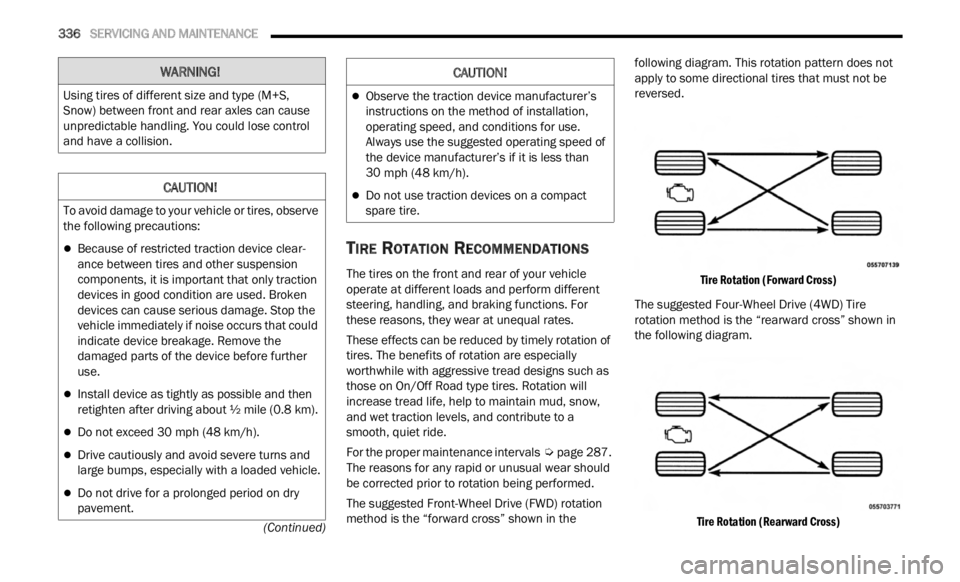
The suggested Front-Wheel Drive (FWD) rotation
method
is the “forward cross” shown in the following diagram. This rotation pattern does not
apply to some directional tires that must not be
reversed.
Tire Rotation (Forward Cross)
The suggested Four-Wheel Drive (4WD) Tire
rotati on
method is the “rearward cross” shown in
the following diagram.
Tire Rotation (Rearward Cross)
WARNING!
Using tires of different size and type (M+S,
Snow) between front and rear axles can cause
unpredictable handling. You could lose control
and have a collision.
CAUTION!
To avoid damage to your vehicle or tires, observe
the following precautions:
Because of restricted traction device clear -
ance between tires and other suspension
compone n
ts, it is important that only traction
devices in good condition are used. Broken
devices can cause serious damage. Stop the
vehicle immediately if noise occurs that could
indicate device breakage. Remove the
damaged parts of the device before further
use.
Install device as tightly as possible and then
retighten after driving about ½ mile (0.8 km).
Do not exceed 30 mph (48 km/h).
Drive cautiously and avoid severe turns and
large bumps, especially with a loaded vehicle.
Do not drive for a prolonged period on dry
pavement.
Observe the traction device manufacturer’s
instructions on the method of installation,
operating speed, and conditions for use.
Always use the suggested operating speed of
the device manufacturer’s if it is less than
30
mph (48 km/h).
Do not use traction devices on a compact
spare tire.
CAUTION!
Page 360 of 364

358
Seats...............................................................26Adjustment...........................................26, 27Head Restraints..........................................31Heated........................................................30Rear Folding................................................26Reclining.....................................................27Seatback Release.......................................27Tilting...................................................26, 27Security Alarm..........................................20, 72Arm The System..........................................20Disarm The System.....................................21Selection Of Coolant (Antifreeze)...................345Send & Go...........................................211, 216Service Assistance.........................................346Service Contract............................................347Service Manuals............................................348Settings, Audio..............................................160Shift Lever Override.......................................281Shoulder Belts...............................................241Side View Mirror Adjustment...........................35Signals, Turn....................................39, 76, 267Sirius Satellite Radio.....................................155Favorites...................................................158Replay.......................................................156SiriusXM Traffic.........................................201SiriusXM Travel Link..................................201Traffic & Weather......................................158
SiriusXM Satellite Radio
Browse in SXM.........................................158Favorites...................................................158Replay......................................................156Traffic and Weather..................................158Smart Watch.................................................215Snow Chains (Tire Chains)............................335Snow Tires....................................................333SOS Call...............................................205, 215Spare Tires..........................................333, 334SpecificationsFuel (Gasoline).........................................345Oil.............................................................345Speed Control (Cruise Control)........................95Starting............................................................80Button.........................................................17Cold Weather...............................................81Engine Fails To Start....................................80Remote........................................................18Starting And Operating.....................................80Starting Procedures.........................................80SteeringTilt Column..................................................26Wheel, Heated.............................................26Wheel, Tilt....................................................26Steering Wheel Audio Controls.....................150Steering Wheel Mounted Sound System......150
Stolen Vehicle Assistance....................212, 217Storage, Vehicle...............................................47Store Radio Presets......................................160Stuck, Freeing...............................................282Sun Roof...................................................54, 56Opening.......................................................55Supplemental Restraint System – Air Bag....247Sway Control, Trailer............................124, 227Symbol Glossary...............................................10Synthetic Engine Oil......................................295System, Remote Starting.................................18
T
Telescoping Steering Column...........................26Temperature Control, Automatic (ATC).............47Tilt Steering Column.........................................26Time DelayHeadlight.....................................................38Tip Start...........................................................80Tire And Loading Information Placard...........326Tire Markings................................................322Tire Safety Information..................................322Tire Service Kit..............................................276