fuel pump JEEP RENEGADE 2023 Owners Manual
[x] Cancel search | Manufacturer: JEEP, Model Year: 2023, Model line: RENEGADE, Model: JEEP RENEGADE 2023Pages: 364, PDF Size: 18.65 MB
Page 66 of 364
64 GETTING TO KNOW YOUR INSTRUMENT PANEL
INSTRUMENT CLUSTER DESCRIPTIONS
1. Tachometer
Indicates the engine speed in revolutions
per minute (RPM x 1000).
2. Instrument Cluster Display
The instrument cluster display features a
driver interactive display Ú page 64.
3. Speedometer
Indicates vehicle speed.
4. T emperature Gauge
The temperature gauge shows engine
coolant temperature. Any reading within the
normal range indicates that the engine
cooling system is operating satisfactorily.
The gauge will likely indicate a higher
temperature when driving in hot weather or
up mountain grades. It should not be
allowed to exceed the upper limits of the
normal operating range. 5. Fuel Gauge
The fuel gauge shows the level of fuel in the
fuel tank when the ignition is in the ON/RUN
position.
The fuel pump symbol points to the
side of the vehicle where the fuel
d oor
is
located.
INSTRUMENT CLUSTER DISPLAY
Your vehicle is equipped with an instrument cluster
display, which offers useful information to the
driver. With the ignition in the OFF position,
opening/closing of a door will activate the display
for viewing, and display the total miles, or
kilometers, in the odometer. Your instrument
cluster display is designed to display important
information about your vehicle’s systems and
features. Using a driver interactive display located on the instrument panel, your instrument cluster
display can show you how systems are working and
give you warnings when they aren’t. The steering
wheel mounted controls allow you to scroll through
and enter the main menus and submenus. You can
access the specific information you want and
make selections and adjustments.
INSTRUMENT CLUSTER DISPLAY
L
OCATION AND CONTROLS
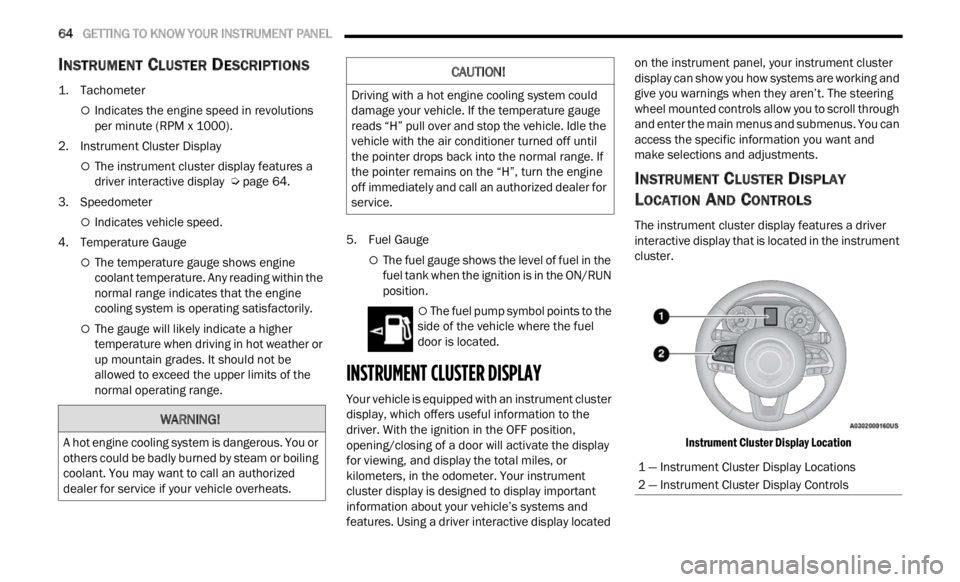
The instrument cluster display features a driver
interactive display that is located in the instrument
cluster.
Instrument Cluster Display Location
WARNING!
A hot engine cooling system is dangerous. You or
others could be badly burned by steam or boiling
coolant. You may want to call an authorized
dealer for service if your vehicle overheats.
CAUTION!
Driving with a hot engine cooling system could
damage your vehicle. If the temperature gauge
reads “H” pull over and stop the vehicle. Idle the
vehicle with the air conditioner turned off until
the pointer drops back into the normal range. If
the pointer remains on the “H”, turn the engine
off immediately and call an authorized dealer for
service.
1 — Instrument Cluster Display Locations
2 — Instrument Cluster Display Controls
Page 82 of 364
80
(Continued)
STARTING AND OPERATING
STARTING THE ENGINE
Before starting your vehicle, adjust your seat,
adjust the inside and outside mirrors, fasten your
seat belt, and if present, instruct all other
occupants to buckle their seat belts.
Start the engine with the gear selector in the
NEUTRA
L or PARK position. Apply the brake before
shifting to any driving range. Normal Starting
NOTE:
Normal starting of either a cold or warm engine is
obtain e
d without pumping or pressing the accel -
erator pedal.
Proceed as follows:
1. S et the Electric Park Brake (EPB) and put the
gear s
elector in the PARK or NEUTRAL
position.
2. Press on the brake pedal, without pressing the acce l
erator.
3. Press the START/STOP ignition button and relea
se it as soon as the engine is started.
4. If the engine does not start, place the ignition in th
e OFF position and wait 10-15 seconds
before attempting to restart the engine.
TIP START FEATURE
Do not press the accelerator. Press briefly the
START/STOP ignition button and release it. The
starter motor will continue to run but will
automatically disengage when the engine is
running.
IF ENGINE FAILS TO START
If the engine fails to start after you have followed
the “Normal Starting” procedure, and has not
experienced an extended park condition as
identified in “Extended Park Starting” procedure
below, it may be flooded. Push the accelerator
pedal all the way to the floor and hold it there.
Crank the engine for no more than 10 seconds.
This should clear any excess fuel in case the
engine is flooded. Leave the ignition in the RUN
position, release the accelerator pedal and repeat
the “Normal Starting” procedure.
WARNING!
Never leave children alone in a vehicle, or with
access to an unlocked vehicle.
Allowing children to be in a vehicle unattended
is dangerous for a number of reasons. A child
or others could be seriously or fatally injured.
Children should be warned not to touch the
parking brake, brake pedal or the gear
selector.
Do not leave the key fob in or near the vehicle
(or in a location accessible to children), and do
not leave the ignition in the ON or RUN posi -
tion. A child could operate power windows,
other c
ontrols, or move the vehicle.
WARNING!
Never pour fuel or other flammable liquid into
the throttle body air inlet opening in an attempt
to start the vehicle. This could result in flash fire
causing serious personal injury.
WARNING!
Never pour fuel or other flammable liquid into
the throttle body air inlet opening in an
attempt to start the vehicle. This could result
in flash fire causing serious personal injury.
Page 124 of 364
122 STARTING AND OPERATING
REFUELING THE VEHICLE
The Capless Fuel system uses a flapper placed at
the filler pipe of the fuel tank; it opens and closes
automatically upon insertion/extraction of the fuel
nozzle.
The Capless Fuel system is designed so that it
preven
ts the filling of an incorrect type of fuel.
Opening The Door
For filling, proceed as follows:
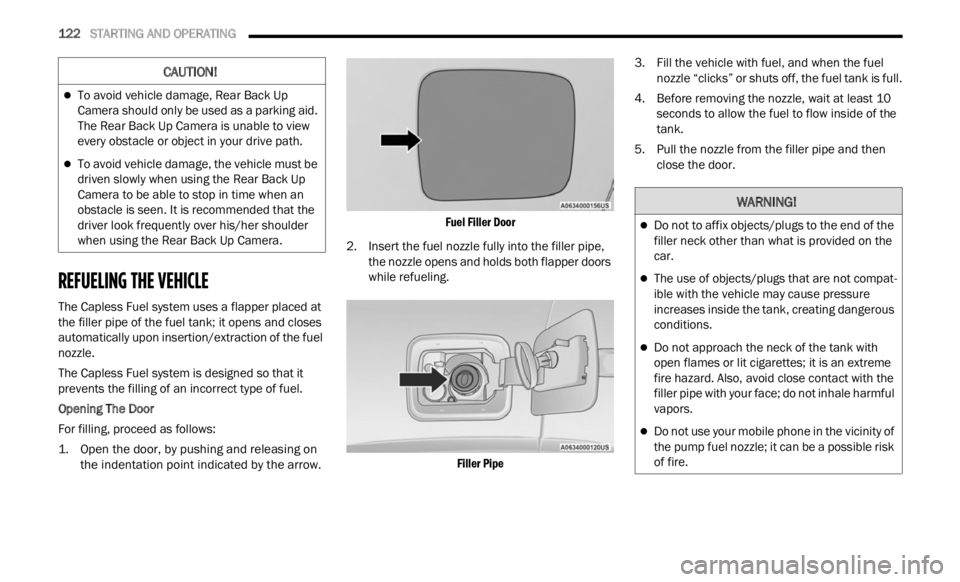
1. O pen the door, by pushing and releasing on
the in
dentation point indicated by the arrow.
Fuel Filler Door
2. Insert the fuel nozzle fully into the filler pipe, the n
ozzle opens and holds both flapper doors
while refueling.
Filler Pipe
3. Fill the vehicle with fuel, and when the fuel
nozzle
“clicks” or shuts off, the fuel tank is full.
4. Before removing the nozzle, wait at least 10 second
s to allow the fuel to flow inside of the
tank.
5. Pull the nozzle from the filler pipe and then close
the door.
CAUTION!
To avoid vehicle damage, Rear Back Up
Camera should only be used as a parking aid.
The Rear Back Up Camera is unable to view
every obstacle or object in your drive path.
To avoid vehicle damage, the vehicle must be
driven slowly when using the Rear Back Up
Camera to be able to stop in time when an
obstacle is seen. It is recommended that the
driver look frequently over his/her shoulder
when using the Rear Back Up Camera.
WARNING!
Do not to affix objects/plugs to the end of the
filler neck other than what is provided on the
car.
The use of objects/plugs that are not compat -
ible with the vehicle may cause pressure
i n c
re
a
ses inside the tank, creating dangerous
conditions.
Do not approach the neck of the tank with
open flames or lit cigarettes; it is an extreme
fire hazard. Also, avoid close contact with the
filler pipe with your face; do not inhale harmful
vapors.
Do not use your mobile phone in the vicinity of
the pump fuel nozzle; it can be a possible risk
of fire.
Page 254 of 364

252 SAFETY
If A Deployment Occurs
The front air bags are designed to deflate
immediately after deployment.
NOTE:
Front and/or side air bags will not deploy in all colli -
sions. This does not mean something is wrong with
t he a i
r bag system.
If you do have a collision which deploys the air
bags,
any or all of the following may occur:
The air bag material may sometimes cause
abrasions and/or skin reddening to the occu -
pants as the air bags deploy and unfold. The
abrasi
ons are similar to friction rope burns or
those you might get sliding along a carpet or
gymnasium floor. They are not caused by
contact with chemicals. They are not permanent
and normally heal quickly. However, if you
haven’t healed significantly within a few days, or
if you have any blistering, see your doctor imme -
diately.
As the air bags deflate, you may see some
smoke-like particles. The particles are a normal
by-product of the process that generates the
non-toxic gas used for air bag inflation. These
airborne particles may irritate the skin, eyes,
nose, or throat. If you have skin or eye irritation,
rinse the area with cool water. For nose or throat
irritation, move to fresh air. If the irritation
continues, see your doctor. If these particles settle on your clothing, follow the garment
manufacturer’s instructions for cleaning.
Do not drive your vehicle after the air bags have
deploy e
d. If you are involved in another collision,
the air bags will not be in place to protect you.
NOTE:
Air bag covers may not be obvious in the interior
trim, but they will open during air bag deploy -
ment.
After any collision, the vehicle should be taken
to an authorized dealer immediately.
Enhanced Accident Response System
In the event of an impact, if the communication
network remains intact, and the power remains
intact, depending on the nature of the event, the
Occupant Restraint Controller (ORC) will determine
whether to have the Enhanced Accident Response
System perform the following functions:
Cut off fuel to the engine (if equipped)
Cut off battery power to the electric motor (if
equipped)
Flash hazard lights as long as the battery has
power
Turn on the interior lights, which remain on as
long as the battery has power or for 15 minutes
f r
om
t h
e intervention of the Enhanced Accident
Response System
Unlock the power door locks
Your vehicle may also be designed to perform any
of the s
e other functions in response to the
Enhanced Accident Response System:
Turn off the Fuel Filter Heater, Turn off the HVAC
Blower Motor, Close the HVAC Circulation Door
Cut off battery power to the:
Engine
Electric Motor (if equipped)
Electric power steering
Brake booster
Electric park brake
Automatic transmission gear selector
Horn
Front wiper
Headlamp washer pump (if equipped)
WARNING!
Deployed air bags and seat belt pretensioners
cannot protect you in another collision. Have the
air bags, seat belt pretensioners, and the seat
belt retractor assemblies replaced by an autho -
rized dealer immediately. Also, have the Occu -
pant Restraint Controller System serviced as well.
Page 283 of 364

IN CASE OF EMERGENCY 281
5. Remove funnel from filler pipe, clean off prior
to putting back in the spare tire storage area.
IF YOUR ENGINE OVERHEATS
If the vehicle is overheating, it will need to be
serviced by an authorized dealer.
In any of the following situations, you can reduce
the pot
ential for overheating your engine by taking
the appropriate action.
On the highways — slow down.
In city traffic — while stopped, put transmission
in NEUTRAL (N), but do not increase engine idle
speed.
NOTE:
There are steps that you can take to slow down an
impen d
ing overheat condition:
If your Air Conditioner (A/C) is on, turn it off. The
A/C system adds heat to the engine cooling
system and turning the A/C off can help remove
this heat.
You can also turn the temperature control to
maximum heat, the mode control to floor and
the blower control to high. This allows the heater
core to act as a supplement to the radiator and
aids in removing heat from the engine cooling
system.
GEAR SELECTOR OVERRIDE
If a malfunction occurs and the gear selector
cannot be moved out of the PARK position, follow
the steps below:
NOTE:
A depleted battery will prevent the Electric Park
Brake
to be applied.
1. Turn the engine OFF.
2. App
ly the Electric Park Brake.
WARNING!
Never have any smoking materials lit in or
near the vehicle when the fuel door is open or
the tank is being filled.
Never add fuel when the engine is running.
This is in violation of most state and federal
fire regulations and may cause the Malfunc -
tion Indicator Light to turn on.
A fire may result if fuel is pumped into a
portable container that is inside of a vehicle.
You could be burned. Always place fuel
containers on the ground while filling.
CAUTION!
Driving with a hot cooling system could damage
your vehicle. If the temperature gauge reads
“H”, pull over and stop the vehicle. Idle the vehi -
cle with the air conditioner turned off until the
pointe r
drops back into the normal range. If the
pointer remains on the “H” and you hear contin -
uous chimes, turn the engine off immediately
and c a
ll for service.
WARNING!
You or others can be badly burned by hot engine
coolant (antifreeze) or steam from your radiator.
If you see or hear steam coming from under the
hood, do not open the hood until the radiator
has had time to cool. Never try to open a cooling
system pressure cap when the radiator or cool -
ant bottle is hot.
7
Page 309 of 364

SERVICING AND MAINTENANCE 307
F10 ––15 Amp Blue Horn
F11 ––5 Amp TanSupply Secondary Loads
F14 ––15 Amp Blue WCAC Pump/Active Grille Shutters
F15 40 Amp Orange ––Brake Control Module Pump
F16 ––5 Amp TanEngine Control Module Power, Automatic Transmission
F17 ––30 Amp Green Supply Primary Loads
F18 ––5 Amp TanIntelligent Battery Sensor
F19 ––7.5 Amp Brown Air Conditioner 1.3L Compressor
F20 ––5 Amp TanElectronic Power Four-Wheel Drive
F21 ––15 Amp Blue Fuel Pump
F22 ––10 Amp Red Power Control Module Engine
F23 ––30 Amp Green Heated Windshield *
F24 ––15 Amp Blue Electronic Unit Supply Automatic Transmission
F82 –20 Amp Yellow –Power Control Module Engine
F83 –40 Amp Green –Air Conditioning Fan
F84 ––30 Amp Green Power Supply All Wheel Drive
F87 ––5 Amp TanGear Selector Automatic Transmission
F88 ––7.5 Amp Brown Heated Outside Mirrors
F89 –30 Amp Green –Heated Rear Window
Cavity Maxi Fuse Cartridge Fuse Micro Fuse Description
* If Equipped
8
Page 344 of 364
342 TECHNICAL SPECIFICATIONS
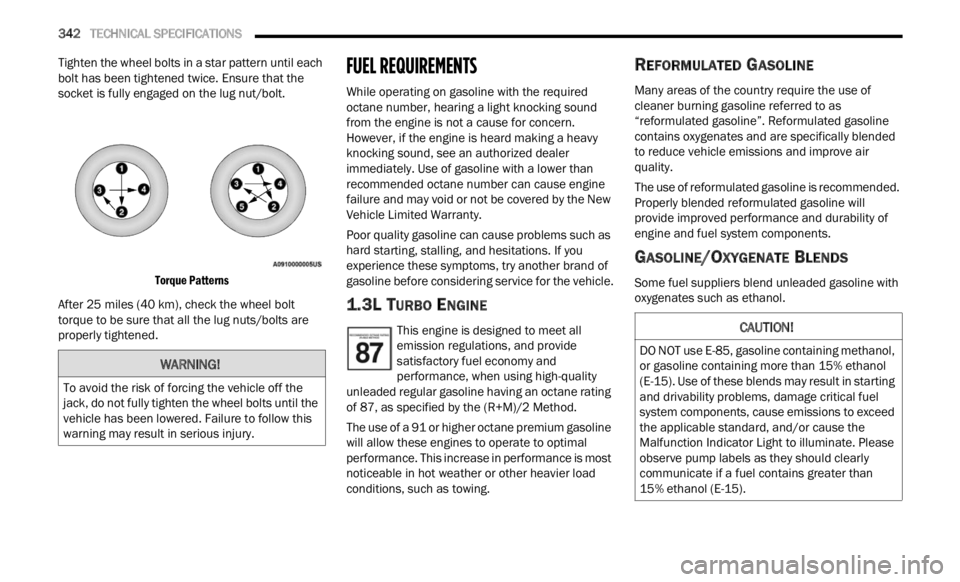
Tighten the wheel bolts in a star pattern until each
bolt has been tightened twice. Ensure that the
socket is fully engaged on the lug nut/bolt.
Torque Patterns
After 25 miles (40 km), check the wheel bolt
torque
to be sure that all the lug nuts/bolts are
properly tightened.
FUEL REQUIREMENTS
While operating on gasoline with the required
octane number, hearing a light knocking sound
from the engine is not a cause for concern.
However, if the engine is heard making a heavy
knocking sound, see an authorized dealer
immediately. Use of gasoline with a lower than
recommended octane number can cause engine
failure and may void or not be covered by the New
Vehicle Limited Warranty.
Poor quality gasoline can cause problems such as
hard s
tarting, stalling, and hesitations. If you
experience these symptoms, try another brand of
gasoline before considering service for the vehicle.
1.3L TURBO ENGINE
This engine is designed to meet all
emission regulations, and provide
s a t
is
f
actory fuel economy and
performance, when using high-quality
unleaded regular gasoline having an octane rating
of 87, as specified by the (R+M)/2 Method.
The use of a 91 or higher octane premium gasoline
will a
llow these engines to operate to optimal
performance. This increase in performance is most
noticeable in hot weather or other heavier load
conditions, such as towing.
REFORMULATED GASOLINE
Many areas of the country require the use of
cleaner burning gasoline referred to as
“reformulated gasoline”. Reformulated gasoline
contains oxygenates and are specifically blended
to reduce vehicle emissions and improve air
quality.
The use of reformulated gasoline is recommended.
Proper l
y blended reformulated gasoline will
provide improved performance and durability of
engine and fuel system components.
GASOLINE/OXYGENATE BLENDS
Some fuel suppliers blend unleaded gasoline with
oxygenates such as ethanol.
WARNING!
To avoid the risk of forcing the vehicle off the
jack, do not fully tighten the wheel bolts until the
vehicle has been lowered. Failure to follow this
warning may result in serious injury.
CAUTION!
DO NOT use E-85, gasoline containing methanol,
or gasoline containing more than 15% ethanol
(E-15). Use of these blends may result in starting
and drivability problems, damage critical fuel
system components, cause emissions to exceed
the applicable standard, and/or cause the
Malfunction Indicator Light to illuminate. Please
observe pump labels as they should clearly
communicate if a fuel contains greater than
15% ethanol (E-15).
Page 345 of 364

TECHNICAL SPECIFICATIONS 343
Problems that result from using gasoline
containing more than 15% ethanol (E-15) or
gasoline containing methanol are not the
responsibility of the manufacturer and may void or
not be covered under New Vehicle Limited
Warranty.
E-85 USAGE IN NON-FLEX FUEL
V
EHICLES
Non-Flex Fuel Vehicles (FFV) are compatible with
gasoline containing up to 15% ethanol (E-15).
Gasoline with higher ethanol content may void the
New Vehicle Limited Warranty.
If a Non-FFV vehicle is inadvertently fueled with
E-85 f
uel, the engine will have some or all of these
symptoms:
Operate in a lean mode.
OBD II Malfunction Indicator Light on.
Poor engine performance.
Poor cold start and cold drivability.
Increased risk for fuel system component corro -
sion.
CNG AND LP FUEL SYSTEM
M
ODIFICATIONS
Modifications that allow the engine to run on
Compressed Natural Gas (CNG) or Liquid Propane
(LP) may result in damage to the engine,
emissions, and fuel system components. Problems
that result from running CNG or LP are not the
responsibility of the manufacturer and may void or
not be covered under the New Vehicle Limited
Warranty.
METHYLCYCLOPENTADIENYL
M
ANGANESE TRICARBONYL (MMT) IN
G
ASOLINE
MMT is a manganese-containing metallic additive
that is blended into some gasoline to increase
octane. Gasoline blended with MMT provides no
performance advantage beyond gasoline of the
same octane number without MMT. Gasoline
blended with MMT reduces spark plug life and
reduces emissions system performance in some
vehicles. The manufacturer recommends that
gasoline without MMT be used in your vehicle. The
MMT content of gasoline may not be indicated on
the gasoline pump, therefore, you should ask your
gasoline retailer whether the gasoline contains
MMT. MMT is prohibited in Federal and California
reformulated gasoline.
MATERIALS ADDED TO FUEL
Besides using unleaded gasoline with the proper
octane rating, gasolines that contain detergents,
corrosion, and stability additives are
recommended. Using gasolines that have these
additives will help improve fuel economy, reduce
emissions, and maintain vehicle performance.
Designated TOP TIER Detergent Gasoline
contains a higher level of detergents to
furth
e
r aide in minimizing engine and
fuel system deposits. When available,
the usage of Top Tier Detergent Gasoline is
recommended. Visit www.toptiergas.com for a list
of TOP TIER Detergent Gasoline Retailers.
Indiscriminate use of fuel system cleaning agents
s hould
be avoided. Many of these materials
intended for gum and varnish removal may contain
active solvents or similar ingredients. These can
harm fuel system gasket and diaphragm materials.
9