lock JEEP WAGONEER 2023 Owners Manual
[x] Cancel search | Manufacturer: JEEP, Model Year: 2023, Model line: WAGONEER, Model: JEEP WAGONEER 2023Pages: 396, PDF Size: 15.17 MB
Page 301 of 396
IN CASE OF EMERGENCY299
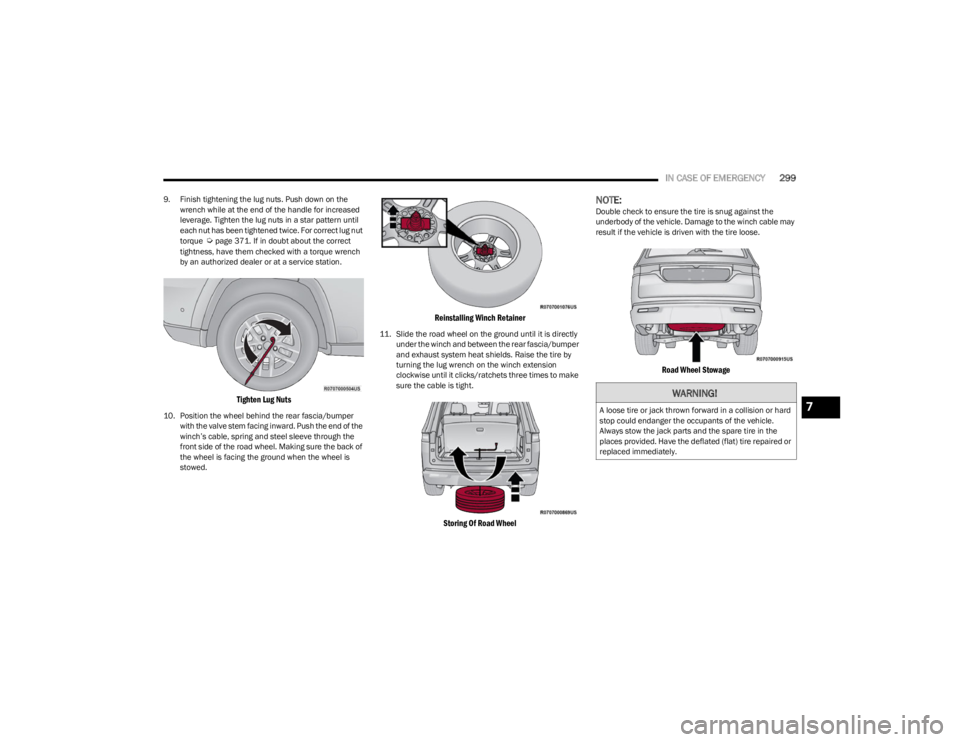
9. Finish tightening the lug nuts. Push down on the
wrench while at the end of the handle for increased
leverage. Tighten the lug nuts in a star pattern until
each nut has been tightened twice. For correct lug nut
torque
Úpage 371. If in doubt about the correct
tightness, have them checked with a torque wrench
by an authorized dealer or at a service station.
Tighten Lug Nuts
10. Position the wheel behind the rear fascia/bumper with the valve stem facing inward. Push the end of the
winch’s cable, spring and steel sleeve through the
front side of the road wheel. Making sure the back of
the wheel is facing the ground when the wheel is
stowed.
Reinstalling Winch Retainer
11. Slide the road wheel on the ground until it is directly under the winch and between the rear fascia/bumper
and exhaust system heat shields. Raise the tire by
turning the lug wrench on the winch extension
clockwise until it clicks/ratchets three times to make
sure the cable is tight.
Storing Of Road Wheel
NOTE:Double check to ensure the tire is snug against the
underbody of the vehicle. Damage to the winch cable may
result if the vehicle is driven with the tire loose.
Road Wheel Stowage
WARNING!
A loose tire or jack thrown forward in a collision or hard
stop could endanger the occupants of the vehicle.
Always stow the jack parts and the spare tire in the
places provided. Have the deflated (flat) tire repaired or
replaced immediately.7
23_WS_OM_EN_USC_t.book Page 299
Page 302 of 396
300IN CASE OF EMERGENCY
12. Lower the jack to the fully closed position.
13. Return the Jack and tools back into the jack storage
bin. Reinstall the jack storage cover by firmly pushing
down until the clips lock into position.
14. After 25 miles (40 km), check the lug nut torque with a torque wrench to ensure that all lug nuts are
properly seated against the wheel.
15. Have the road wheel and tire repaired as soon as possible and properly secure the spare tire, jack and
tool kit.
NOTE:Do not drive with the spare tire installed for more than
50 miles (80 km) at a max speed of 50 mph (80 km/h).
JUMP STARTING
If your vehicle has a discharged battery, it can be jump
started using a set of jumper cables and a battery in
another vehicle, or by using a portable battery booster
pack. Jump starting can be dangerous if done improperly,
so please follow the procedures in this section carefully.
NOTE:When using a portable battery booster pack, follow the
manufacturer's operating instructions and precautions.
PREPARATIONS FOR JUMP START
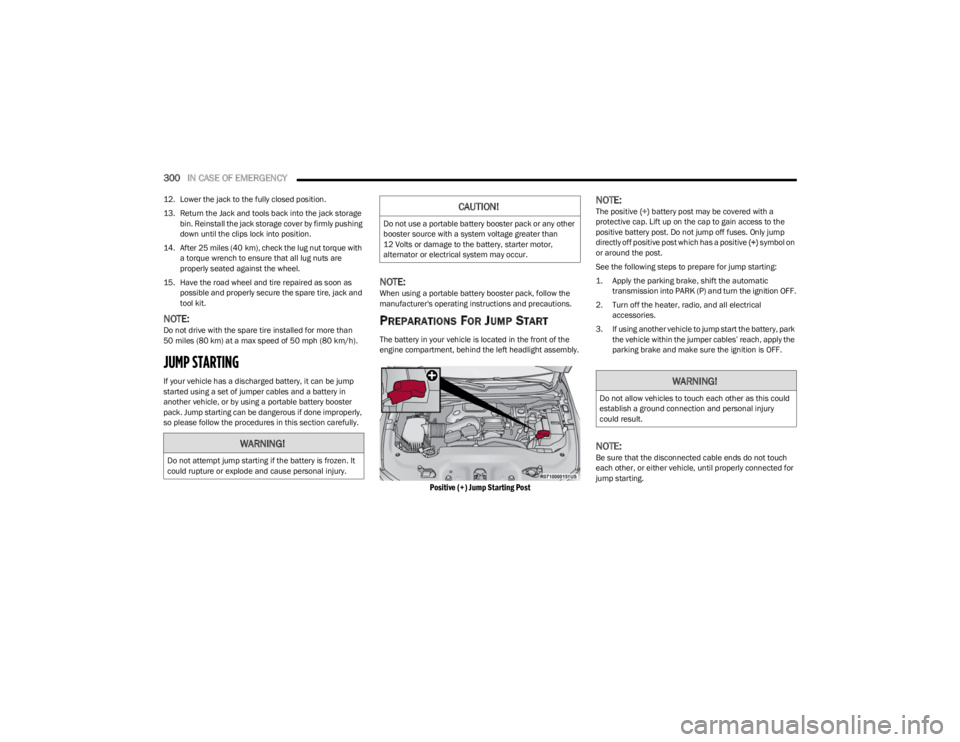
The battery in your vehicle is located in the front of the
engine compartment, behind the left headlight assembly.
Positive (+) Jump Starting Post
NOTE:The positive (+) battery post may be covered with a
protective cap. Lift up on the cap to gain access to the
positive battery post. Do not jump off fuses. Only jump
directly off positive post which has a positive (+) symbol on
or around the post.
See the following steps to prepare for jump starting:
1. Apply the parking brake, shift the automatic transmission into PARK (P) and turn the ignition OFF.
2. Turn off the heater, radio, and all electrical accessories.
3. If using another vehicle to jump start the battery, park the vehicle within the jumper cables’ reach, apply the
parking brake and make sure the ignition is OFF.
NOTE:Be sure that the disconnected cable ends do not touch
each other, or either vehicle, until properly connected for
jump starting.
WARNING!
Do not attempt jump starting if the battery is frozen. It
could rupture or explode and cause personal injury.
CAUTION!
Do not use a portable battery booster pack or any other
booster source with a system voltage greater than
12 Volts or damage to the battery, starter motor,
alternator or electrical system may occur.
WARNING!
Do not allow vehicles to touch each other as this could
establish a ground connection and personal injury
could result.
23_WS_OM_EN_USC_t.book Page 300
Page 306 of 396
304IN CASE OF EMERGENCY
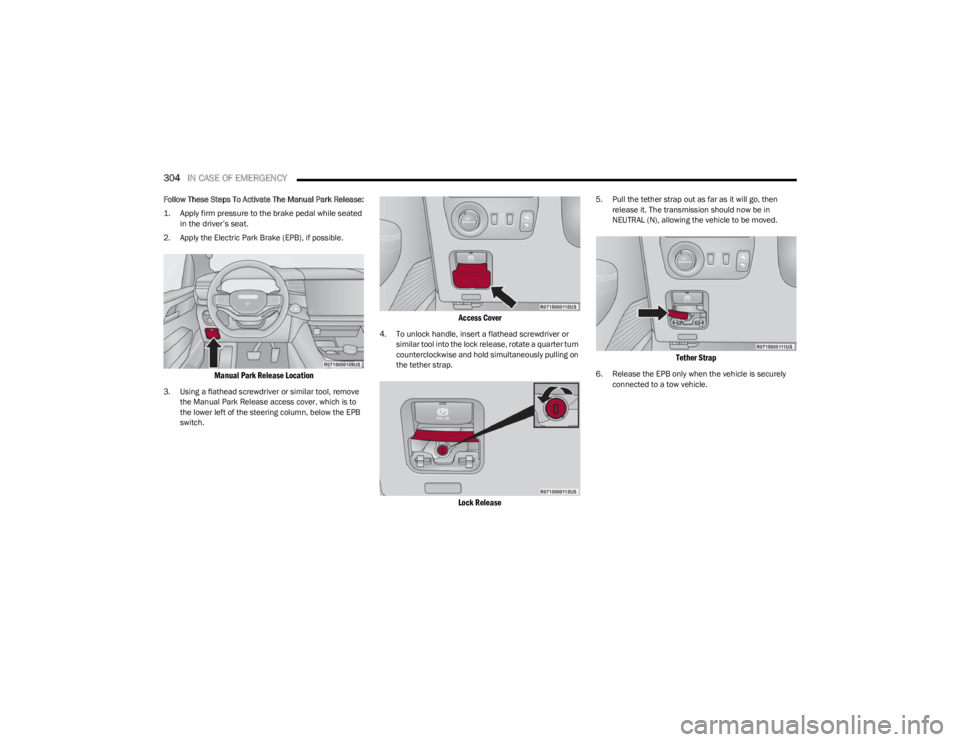
Follow These Steps To Activate The Manual Park Release:
1. Apply firm pressure to the brake pedal while seated
in the driver’s seat.
2. Apply the Electric Park Brake (EPB), if possible.
Manual Park Release Location
3. Using a flathead screwdriver or similar tool, remove the Manual Park Release access cover, which is to
the lower left of the steering column, below the EPB
switch.
Access Cover
4. To unlock handle, insert a flathead screwdriver or similar tool into the lock release, rotate a quarter turn
counterclockwise and hold simultaneously pulling on
the tether strap.
Lock Release
5. Pull the tether strap out as far as it will go, then release it. The transmission should now be in
NEUTRAL (N), allowing the vehicle to be moved.
Tether Strap
6. Release the EPB only when the vehicle is securely connected to a tow vehicle.
23_WS_OM_EN_USC_t.book Page 304
Page 307 of 396
IN CASE OF EMERGENCY305
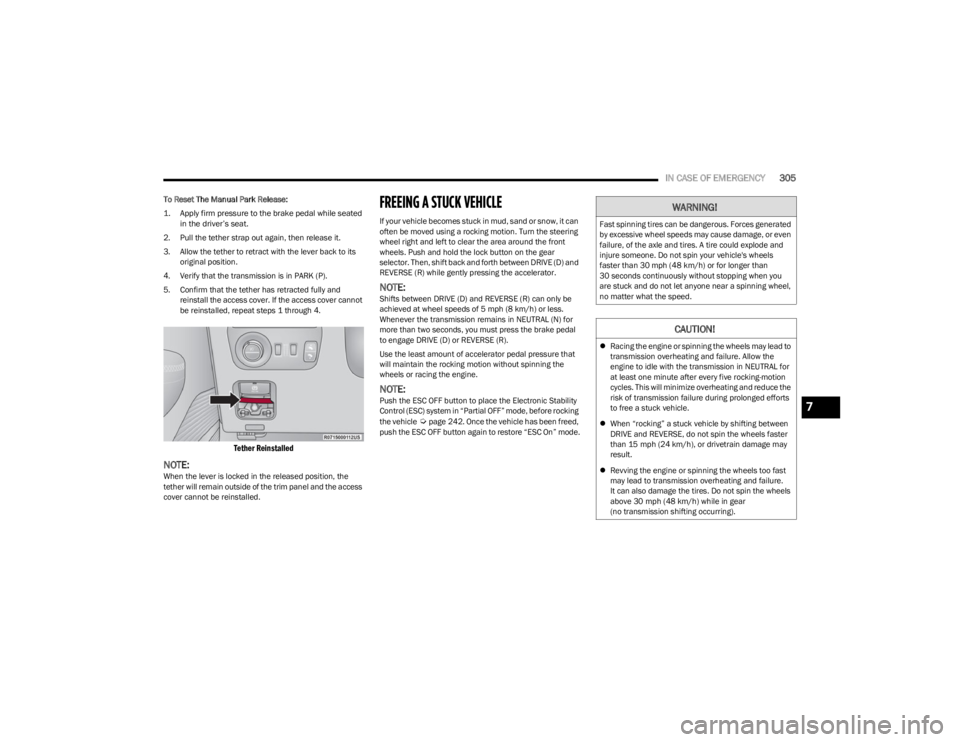
To Reset The Manual Park Release:
1. Apply firm pressure to the brake pedal while seated
in the driver’s seat.
2. Pull the tether strap out again, then release it.
3. Allow the tether to retract with the lever back to its original position.
4. Verify that the transmission is in PARK (P).
5. Confirm that the tether has retracted fully and reinstall the access cover. If the access cover cannot
be reinstalled, repeat steps 1 through 4.
Tether Reinstalled
NOTE:When the lever is locked in the released position, the
tether will remain outside of the trim panel and the access
cover cannot be reinstalled.
FREEING A STUCK VEHICLE
If your vehicle becomes stuck in mud, sand or snow, it can
often be moved using a rocking motion. Turn the steering
wheel right and left to clear the area around the front
wheels. Push and hold the lock button on the gear
selector. Then, shift back and forth between DRIVE (D) and
REVERSE (R) while gently pressing the accelerator.
NOTE:Shifts between DRIVE (D) and REVERSE (R) can only be
achieved at wheel speeds of 5 mph (8 km/h) or less.
Whenever the transmission remains in NEUTRAL (N) for
more than two seconds, you must press the brake pedal
to engage DRIVE (D) or REVERSE (R).
Use the least amount of accelerator pedal pressure that
will maintain the rocking motion without spinning the
wheels or racing the engine.
NOTE:Push the ESC OFF button to place the Electronic Stability
Control (ESC) system in “Partial OFF” mode, before rocking
the vehicle
Úpage 242. Once the vehicle has been freed,
push the ESC OFF button again to restore “ESC On” mode.
WARNING!
Fast spinning tires can be dangerous. Forces generated
by excessive wheel speeds may cause damage, or even
failure, of the axle and tires. A tire could explode and
injure someone. Do not spin your vehicle's wheels
faster than 30 mph (48 km/h) or for longer than
30 seconds continuously without stopping when you
are stuck and do not let anyone near a spinning wheel,
no matter what the speed.
CAUTION!
Racing the engine or spinning the wheels may lead to
transmission overheating and failure. Allow the
engine to idle with the transmission in NEUTRAL for
at least one minute after every five rocking-motion
cycles. This will minimize overheating and reduce the
risk of transmission failure during prolonged efforts
to free a stuck vehicle.
When “rocking” a stuck vehicle by shifting between
DRIVE and REVERSE, do not spin the wheels faster
than 15 mph (24 km/h), or drivetrain damage may
result.
Revving the engine or spinning the wheels too fast
may lead to transmission overheating and failure.
It can also damage the tires. Do not spin the wheels
above 30 mph (48 km/h) while in gear
(no transmission shifting occurring).
7
23_WS_OM_EN_USC_t.book Page 305
Page 310 of 396
308IN CASE OF EMERGENCY
EMERGENCY TOW HOOKS —
I
F EQUIPPED
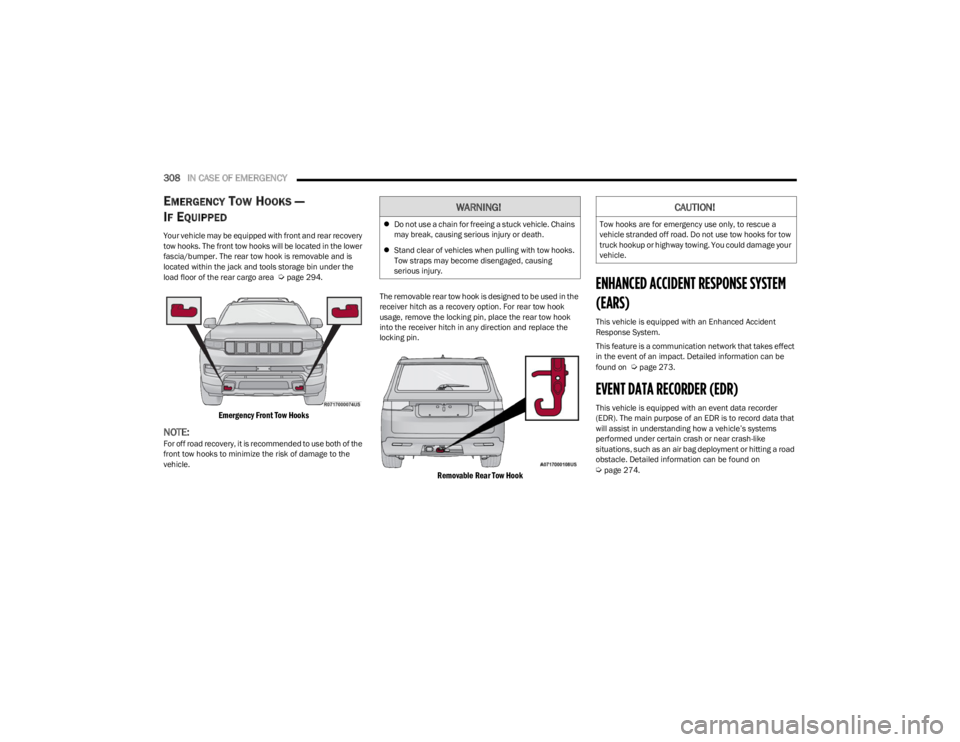
Your vehicle may be equipped with front and rear recovery
tow hooks. The front tow hooks will be located in the lower
fascia/bumper. The rear tow hook is removable and is
located within the jack and tools storage bin under the
load floor of the rear cargo area
Úpage 294.
Emergency Front Tow Hooks
NOTE:For off road recovery, it is recommended to use both of the
front tow hooks to minimize the risk of damage to the
vehicle. The removable rear tow hook is designed to be used in the
receiver hitch as a recovery option. For rear tow hook
usage, remove the locking pin, place the rear tow hook
into the receiver hitch in any direction and replace the
locking pin.
Removable Rear Tow Hook
ENHANCED ACCIDENT RESPONSE SYSTEM
(EARS)
This vehicle is equipped with an Enhanced Accident
Response System.
This feature is a communication network that takes effect
in the event of an impact. Detailed information can be
found on
Úpage 273.
EVENT DATA RECORDER (EDR)
This vehicle is equipped with an event data recorder
(EDR). The main purpose of an EDR is to record data that
will assist in understanding how a vehicle’s systems
performed under certain crash or near crash-like
situations, such as an air bag deployment or hitting a road
obstacle. Detailed information can be found on
Úpage 274.
WARNING!
Do not use a chain for freeing a stuck vehicle. Chains
may break, causing serious injury or death.
Stand clear of vehicles when pulling with tow hooks.
Tow straps may become disengaged, causing
serious injury.
CAUTION!
Tow hooks are for emergency use only, to rescue a
vehicle stranded off road. Do not use tow hooks for tow
truck hookup or highway towing. You could damage your
vehicle.
23_WS_OM_EN_USC_t.book Page 308
Page 319 of 396

SERVICING AND MAINTENANCE317
NOTE:
After adding oil to the engine, always reinstall the oil
cap securely by rotating clockwise until it stops. Never
run the engine without the oil fill cap as this could
cause an oil leak.
Because the oil level is automatically detected only
when the engine has been off and restarted (after four
minutes), the system cannot immediately detect a
sudden drop in oil level while driving (for example, if the
oil pan starts to leak due to damage during an off-road
event).
CHECKING OIL LEVEL — 5.7L & 6.4L
E
NGINES
To ensure proper engine lubrication, the engine oil must
be maintained at the correct level. Check the oil level at
regular intervals, such as every fuel stop. The best time to
check the engine oil level is about five minutes after a fully
warmed up engine is shut off.
Checking the oil while the vehicle is on level ground will
improve the accuracy of the oil level readings.
There are four possible dipstick types:
Crosshatched zone.
Crosshatched zone marked SAFE.
Crosshatched zone marked with MIN at the low end of
the range and MAX at the high end of the range.
Crosshatched zone marked with dimples at the MIN
and the MAX ends of the range.
NOTE:Always maintain the oil level within the crosshatch
markings on the dipstick.
Adding 1 qt (1 L) of oil when the reading is at the low end
of the dipstick range will raise the oil level to the high end
of the range marking.
ADDING WASHER FLUID
The instrument cluster display will indicate when the
washer fluid level is low. When the sensor detects a low
fluid level, the Low Washer Fluid Warning Light will turn on
and the "Washer Fluid Low" message will be displayed.
The fluid reservoir for the windshield washers and the rear
window washer is shared. The fluid reservoir is located in
the engine compartment, be sure to check the fluid level
at regular intervals. Fill the reservoir with windshield
washer solvent only (not radiator antifreeze). When
refilling the washer fluid reservoir, take some washer fluid
and apply it to a cloth or towel and wipe clean the wiper
blades, this will help blade performance. To prevent
freeze-up of your windshield washer system in cold
weather, select a solution or mixture that meets or
exceeds the temperature range of your climate. This rating
information can be found on most washer fluid containers.
NOTE:Use care when filling under hood fluids such as engine oil,
washer fluid, antifreeze, etc. to minimize spillage onto top
of engine. Any excess fluid that is spilled onto the top of
the engine should be removed using compressed air or an
absorbent cloth.
CAUTION!
If the “Critically Low or Critically High” Oil Level Warning
Light is illuminated, the following steps should be
taken:
Critically Low: add two quarts of manufacturer speci -
fied oil as soon as possible
Úpage 376. Continuing
to operate the vehicle with “Critically Low” oil level
may damage the engine.
Critically High: contact an authorized dealer for
service. Continuing to operate the vehicle with “Criti -
cally High” oil level may damage the engine.
Do not use any oils that are not manufacturer specified
and API approved.
Used engine oil and oil filters contain substances which
are harmful to the environment. When oil and filters are
changed contact an authorized dealer and dispose of in
a safe and responsible manner.
WARNING!
Commercially available windshield washer solvents are
flammable. They could ignite and burn you. Care must
be exercised when filling or working around the washer
solution.
8
23_WS_OM_EN_USC_t.book Page 317
Page 324 of 396
322SERVICING AND MAINTENANCE
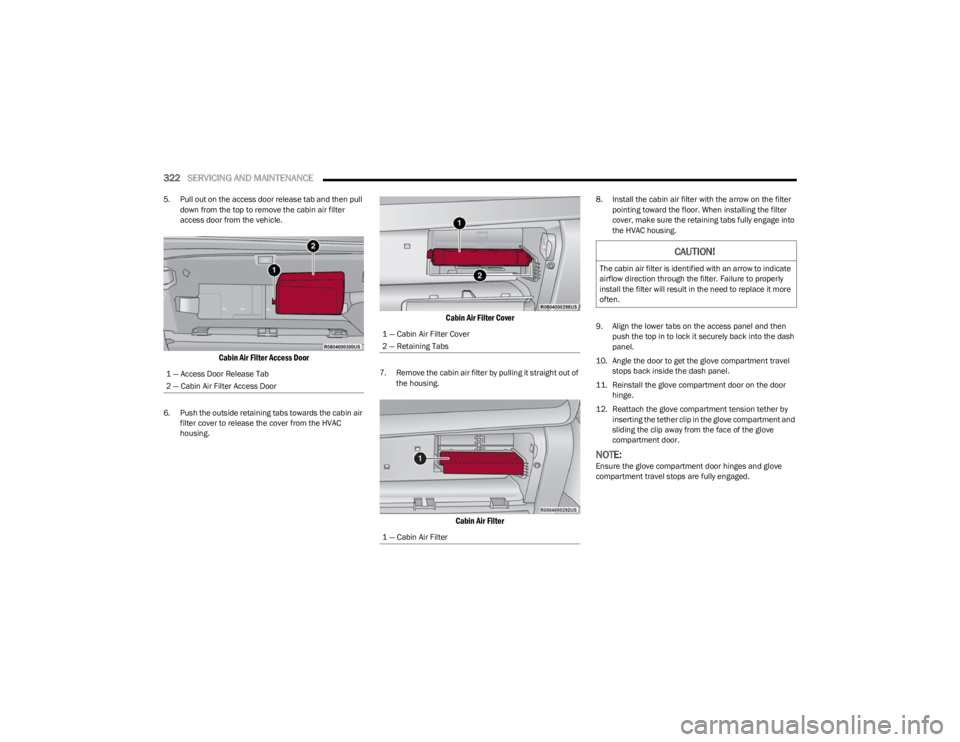
5. Pull out on the access door release tab and then pull
down from the top to remove the cabin air filter
access door from the vehicle.
Cabin Air Filter Access Door
6. Push the outside retaining tabs towards the cabin air filter cover to release the cover from the HVAC
housing.
Cabin Air Filter Cover
7. Remove the cabin air filter by pulling it straight out of the housing.
Cabin Air Filter
8. Install the cabin air filter with the arrow on the filter pointing toward the floor. When installing the filter
cover, make sure the retaining tabs fully engage into
the HVAC housing.
9. Align the lower tabs on the access panel and then push the top in to lock it securely back into the dash
panel.
10. Angle the door to get the glove compartment travel stops back inside the dash panel.
11. Reinstall the glove compartment door on the door hinge.
12. Reattach the glove compartment tension tether by inserting the tether clip in the glove compartment and
sliding the clip away from the face of the glove
compartment door.
NOTE:Ensure the glove compartment door hinges and glove
compartment travel stops are fully engaged.
1 — Access Door Release Tab
2 — Cabin Air Filter Access Door
1 — Cabin Air Filter Cover
2 — Retaining Tabs
1 — Cabin Air Filter
CAUTION!
The cabin air filter is identified with an arrow to indicate
airflow direction through the filter. Failure to properly
install the filter will result in the need to replace it more
often.
23_WS_OM_EN_USC_t.book Page 322
Page 325 of 396
SERVICING AND MAINTENANCE323
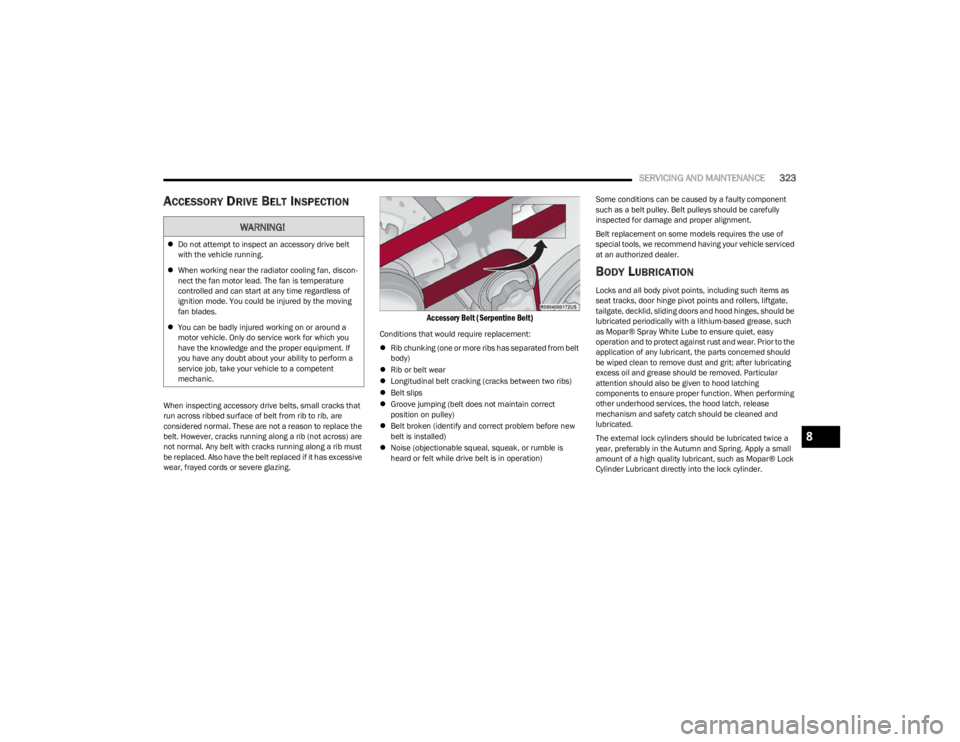
ACCESSORY DRIVE BELT INSPECTION
When inspecting accessory drive belts, small cracks that
run across ribbed surface of belt from rib to rib, are
considered normal. These are not a reason to replace the
belt. However, cracks running along a rib (not across) are
not normal. Any belt with cracks running along a rib must
be replaced. Also have the belt replaced if it has excessive
wear, frayed cords or severe glazing.
Accessory Belt (Serpentine Belt)
Conditions that would require replacement:
Rib chunking (one or more ribs has separated from belt
body)
Rib or belt wear
Longitudinal belt cracking (cracks between two ribs)
Belt slips
Groove jumping (belt does not maintain correct
position on pulley)
Belt broken (identify and correct problem before new
belt is installed)
Noise (objectionable squeal, squeak, or rumble is
heard or felt while drive belt is in operation) Some conditions can be caused by a faulty component
such as a belt pulley. Belt pulleys should be carefully
inspected for damage and proper alignment.
Belt replacement on some models requires the use of
special tools, we recommend having your vehicle serviced
at an authorized dealer.
BODY LUBRICATION
Locks and all body pivot points, including such items as
seat tracks, door hinge pivot points and rollers, liftgate,
tailgate, decklid, sliding doors and hood hinges, should be
lubricated periodically with a lithium-based grease, such
as Mopar® Spray White Lube to ensure quiet, easy
operation and to protect against rust and wear. Prior to the
application of any lubricant, the parts concerned should
be wiped clean to remove dust and grit; after lubricating
excess oil and grease should be removed. Particular
attention should also be given to hood latching
components to ensure proper function. When performing
other underhood services, the hood latch, release
mechanism and safety catch should be cleaned and
lubricated.
The external lock cylinders should be lubricated twice a
year, preferably in the Autumn and Spring. Apply a small
amount of a high quality lubricant, such as Mopar® Lock
Cylinder Lubricant directly into the lock cylinder.
WARNING!
Do not attempt to inspect an accessory drive belt
with the vehicle running.
When working near the radiator cooling fan, discon -
nect the fan motor lead. The fan is temperature
controlled and can start at any time regardless of
ignition mode. You could be injured by the moving
fan blades.
You can be badly injured working on or around a
motor vehicle. Only do service work for which you
have the knowledge and the proper equipment. If
you have any doubt about your ability to perform a
service job, take your vehicle to a competent
mechanic.
8
23_WS_OM_EN_USC_t.book Page 323
Page 340 of 396
338SERVICING AND MAINTENANCE
Interior Power Distribution Center
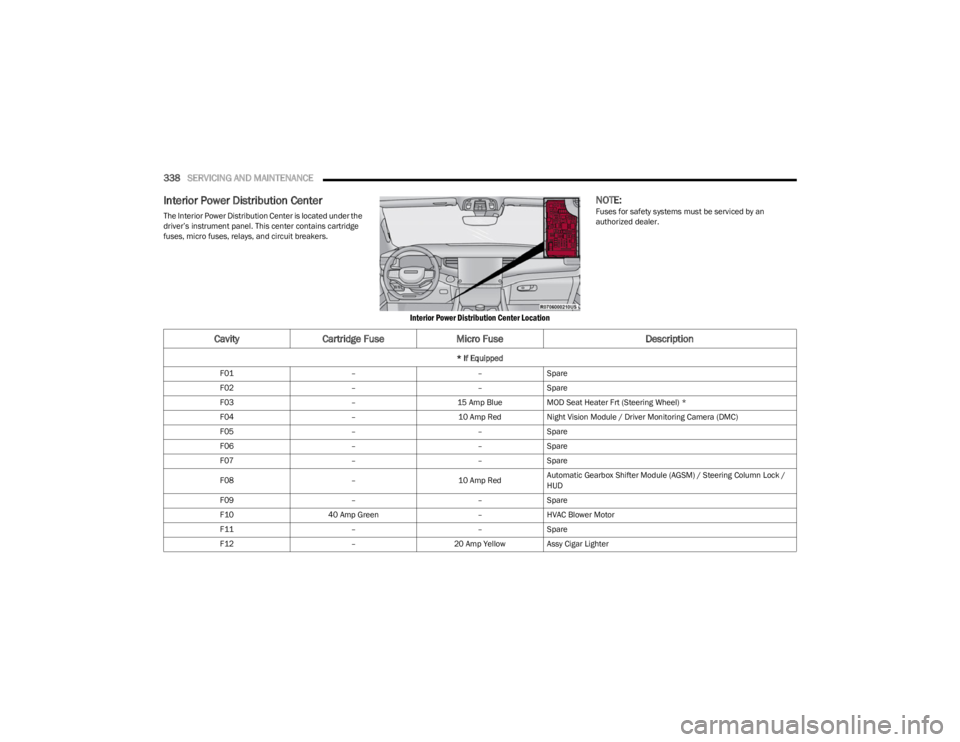
The Interior Power Distribution Center is located under the
driver’s instrument panel. This center contains cartridge
fuses, micro fuses, relays, and circuit breakers.
Interior Power Distribution Center Location
NOTE:Fuses for safety systems must be serviced by an
authorized dealer.
CavityCartridge Fuse Micro Fuse Description
* If Equipped
F01 ––Spare
F02 ––Spare
F03 –15 Amp BlueMOD Seat Heater Frt (Steering Wheel) *
F04 –10 Amp RedNight Vision Module / Driver Monitoring Camera (DMC)
F05 ––Spare
F06 ––Spare
F07 ––Spare
F08 –10 Amp RedAutomatic Gearbox Shifter Module (AGSM) / Steering Column Lock /
HUD
F09 ––Spare
F10 40 Amp Green –HVAC Blower Motor
F11 ––Spare
F12 –20 Amp Yellow Assy Cigar Lighter
23_WS_OM_EN_USC_t.book Page 338
Page 381 of 396

CUSTOMER ASSISTANCE379
What to Do
If your vehicle requires jump start assistance, out of
gas/fuel delivery, tire service, lockout service or towing as
a result of a mechanical breakdown, dial toll-free: USA:
833-667-4825/Canada: 800-363-4869. Provide your
name, Vehicle Identification Number (VIN) required for
covered services, license plate number, and your location,
including the telephone number from which you are
calling. Briefly describe the nature of the problem and
answer a few simple questions. You will be given the name
of the service provider and an estimated time of arrival. If
you feel you are in an unsafe situation, please let us know.
With your consent, we will contact local police or safety
authorities.
If Unable to Contact Roadside Assistance
If you are unable to contact Roadside Assistance or
unable to provide a valid Vehicle Identification Number
(VIN), and you obtain towing services on your own, you may
submit your original receipts from the licensed towing or
service facility, for services rendered within 30 days of the
occurrence. Be sure to include your VIN, odometer
mileage at the time of service, and current mailing
address. We will process the claim based on vehicle and
service eligibility. If eligible, we will reimburse you for the
reasonable amount actually paid, based on the usual and
customary charges for that service in the area where they
were provided. FCA US LLC’s determination relating to reimbursement is
final. Correspondence should be mailed to:
FCA US LLC Customer Assistance
P.O. Box 9145
Medford, MA 02155
Attention Claims Department
FCA US LLC reserves the right to modify the terms or
discontinue the Roadside Assistance Program at any time.
The Roadside Assistance program is subject to restrictions
and conditions of use, which are determined solely by FCA
US LLC.
Flat Tire Service
If you are inconvenienced by a flat tire, we will dispatch a
service provider to use your vehicle’s temporary spare tire
(if equipped) as recommended in your Owner’s Manual.
This is not a permanent flat tire repair.
Out of Gas/Fuel Delivery
Drivers cannot always count on a gas station being
nearby, especially when traveling away from home. We will
dispatch a service provider to deliver a small amount of
fuel (maximum two gallons) to get you to a nearby station.
This service is limited to two occurrences in a 12-month
period.
Battery Jump Assistance
No time is a good time for a depleted battery. With
Roadside Assistance, you do not have to worry about
being stranded. We will dispatch a service provider to
provide you with a battery jump anytime, day or night.Lockout Service
Whether the keys are locked in your vehicle or frozen locks
are keeping you from getting on your way, help is just a
phone call away. This service is limited to providing access
to the vehicle’s seating area. It does not cover the cost of
replacement keys.
Towing Service
Our towing service gives you peace of mind and
confidence. If your vehicle becomes disabled as a result of
a mechanical breakdown, Roadside Assistance will
dispatch a towing service to transport your vehicle to the
closest authorized Chrysler, Dodge, Jeep®, or Ram dealer.
If you choose to go to another dealer, you will be
responsible for the cost if the extra distance exceeds
10 miles.
FCA U S LLC CUSTOMER CENTER
P.O. Box 21–8004
Auburn Hills, MI 48321–8004
Phone: (833) 667-4825
WAGONEER CLIENT SERVICES CANADA
P.O. Box 1621
Windsor, Ontario N9A 4H6
Phone: 1-844-472-6301 (844-GRAND01)
10
23_WS_OM_EN_USC_t.book Page 379