manual transmission JEEP WAGONEER 2023 User Guide
[x] Cancel search | Manufacturer: JEEP, Model Year: 2023, Model line: WAGONEER, Model: JEEP WAGONEER 2023Pages: 396, PDF Size: 15.17 MB
Page 191 of 396
STARTING AND OPERATING189
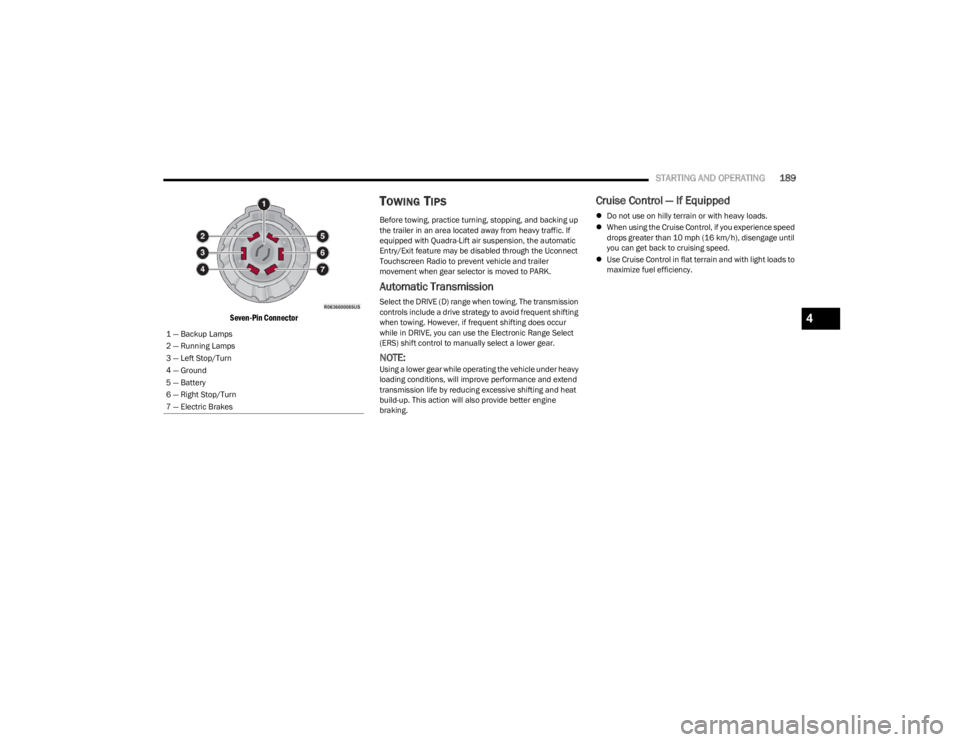
Seven-Pin Connector
TOWING TIPS
Before towing, practice turning, stopping, and backing up
the trailer in an area located away from heavy traffic. If
equipped with Quadra-Lift air suspension, the automatic
Entry/Exit feature may be disabled through the Uconnect
Touchscreen Radio to prevent vehicle and trailer
movement when gear selector is moved to PARK.
Automatic Transmission
Select the DRIVE (D) range when towing. The transmission
controls include a drive strategy to avoid frequent shifting
when towing. However, if frequent shifting does occur
while in DRIVE, you can use the Electronic Range Select
(ERS) shift control to manually select a lower gear.
NOTE:Using a lower gear while operating the vehicle under heavy
loading conditions, will improve performance and extend
transmission life by reducing excessive shifting and heat
build-up. This action will also provide better engine
braking.
Cruise Control — If Equipped
Do not use on hilly terrain or with heavy loads.
When using the Cruise Control, if you experience speed
drops greater than 10 mph (16 km/h), disengage until
you can get back to cruising speed.
Use Cruise Control in flat terrain and with light loads to
maximize fuel efficiency.
1 — Backup Lamps
2 — Running Lamps
3 — Left Stop/Turn
4 — Ground
5 — Battery
6 — Right Stop/Turn
7 — Electric Brakes
4
23_WS_OM_EN_USC_t.book Page 189
Page 197 of 396

STARTING AND OPERATING195
If you stall or begin to lose forward motion while climbing
a steep hill, allow your vehicle to come to a stop and
immediately apply the brakes. Restart the engine, and
shift into REVERSE (R). Back slowly down the hill, allowing
the compression braking of the engine to help regulate
your speed. If the brakes are required to control vehicle
speed, apply them lightly and avoid locking or skidding the
tires.
Remember, never drive diagonally across a hill. Always
drive straight up or down.
If the wheels start to slip as you approach the crest of a
hill, ease off the accelerator and maintain forward motion
by turning the front wheels slowly. This may provide a fresh
“bite” into the surface and will usually provide traction to
complete the climb.Traction Downhill
When descending mountains or hills, use Hill Descent
Control or Selec-Speed Control to avoid repeated heavy
braking.
If not equipped with Hill Descent Control or Selec-Speed
Control use the following procedure:
Shift the transmission into a low gear, and the transfer
case into 4WD LOW range. Let the vehicle go slowly down
the hill with all four wheels turning against engine
compression drag. This will permit you to control the
vehicle speed and direction.
When descending mountains or hills, repeated braking
can cause brake fade with loss of braking control. Avoid
repeated heavy braking by downshifting the transmission
whenever possible.
After Driving Off-Road
Off-road operation puts more stress on your vehicle than
does most on-road driving. After going off-road, it is always
a good idea to check for damage. That way you can get any
problems taken care of right away and have your vehicle
ready when you need it.
Completely inspect the underbody of your vehicle.
Check tires, body structure, steering, suspension, and
exhaust system for damage.
Inspect the radiator for mud and debris and clean as
required.
Check threaded fasteners for looseness, particularly
on the chassis, drivetrain components, steering, and
suspension. Retighten them, if required, and torque to
the values specified in the Service Manual.
Check for accumulations of plants or brush. These
things could be a fire hazard. They might hide damage
to fuel lines, brake hoses, axle pinion seals, and
propeller shafts.
After extended operation in mud, sand, water, or
similar dirty conditions, have the radiator, fan, brake
rotors, wheels, brake linings, and axle yokes inspected
and cleaned as soon as possible.
If you experience unusual vibration after driving in
mud, slush or similar conditions, check the wheels for
impacted material. Impacted material can cause a
wheel imbalance and freeing the wheels of it will
correct the situation.
WARNING!
If the engine stalls, you lose forward motion, or cannot
make it to the top of a steep hill or grade, never attempt
to turn around. To do so may result in tipping and rolling
the vehicle. Always back carefully straight down a hill in
REVERSE gear. Never back down a hill in NEUTRAL
using only the brake.
WARNING!
Abrasive material in any part of the brakes may cause
excessive wear or unpredictable braking. You might not
have full braking power when you need it to prevent a
collision. If you have been operating your vehicle in dirty
conditions, get your brakes checked and cleaned as
necessary.
4
23_WS_OM_EN_USC_t.book Page 195
Page 247 of 396
SAFETY245
Disabling And Enabling HSA
This feature can be turned on or turned off. To change the
current setting, proceed as follows:
If disabling HSA using your instrument cluster display,
see
Úpage 99 for further information.
If disabling HSA using Uconnect Settings, see
Úpage 197 for further information.
Towing With HSA
HSA will also provide assistance to mitigate roll back while
towing a trailer.
Rain Brake Support (RBS)
RBS may improve braking performance in wet conditions.
It will periodically apply a small amount of brake pressure
to remove any water buildup on the front brake rotors. It
functions when the windshield wipers are in LO or HI
speed. When RBS is active, there is no notification to the
driver and no driver interaction is required.
Ready Alert Braking (RAB)
RAB may reduce the time required to reach full braking
during emergency braking situations. It anticipates when
an emergency braking situation may occur by monitoring
how fast the throttle is released by the driver. The
Electronic Brake Controller (EBC) will prepare the brake
system for a panic stop.
Selec-Speed Control (SSC) — If Equipped
Selec-Speed Control (SSC) is intended for
off-road driving in 4WD Low only. SSC
maintains vehicle speed by actively controlling
engine torque and brakes.
SSC has three states:
1. Off (feature is not enabled and will not activate)
2. Enabled (feature is enabled and ready but activation conditions are not met, or driver is actively overriding
with brake or throttle application)
3. Active (feature is enabled and actively controlling vehicle speed)
Enabling SSC
SSC is enabled by pushing the SSC switch, but the
following conditions must also be met to enable SSC:
The driveline is in 4WD Low.
The vehicle speed is below 5 mph (8 km/h).
The parking brake is released.
The driver door is closed.
The driver is not applying throttle.
Activating SSC
Once SSC is enabled it will activate automatically once the
following conditions are met:
Driver releases throttle.
Driver releases brake.
Transmission is in any selection other than PARK.
Vehicle speed is below 20 mph (32 km/h).WARNING!
There may be situations where the Hill Start Assist
(HSA) will not activate and slight rolling may occur, such
as on minor hills or with a loaded vehicle, or while
pulling a trailer. HSA is not a substitute for active driving
involvement. It is always the driver’s responsibility to be
attentive to distance to other vehicles, people, and
objects, and most importantly brake operation to
ensure safe operation of the vehicle under all road
conditions. Your complete attention is always required
while driving to maintain safe control of your vehicle.
Failure to follow these warnings can result in a collision
or serious personal injury.
WARNING!
If you use a trailer brake controller with your trailer,
the trailer brakes may be activated and deactivated
with the brake switch. If so, there may not be enough
brake pressure to hold both the vehicle and the
trailer on a hill when the brake pedal is released. In
order to avoid rolling down an incline while resuming
acceleration, manually activate the trailer brake or
apply more vehicle brake pressure prior to releasing
the brake pedal.
HSA is not a parking brake. Always apply the parking
brake fully when exiting your vehicle. Also, be certain
to place the transmission in PARK.
Failure to follow these warnings can result in a colli -
sion or serious personal injury.
6
23_WS_OM_EN_USC_t.book Page 245
Page 305 of 396
IN CASE OF EMERGENCY303
IF YOUR ENGINE OVERHEATS
If the vehicle is overheating, it will need to be serviced by
an authorized dealer.
Potential signs of vehicle overheating can be:
Temperature gauge is at HOT (H)
Strong smell of coolant
White smoke coming from engine or exhaust
Coolant bottle coolant has bubbles present In the event it is observed that the temperature gauge is
moving towards or close to the HOT (H) position, you can
reduce the potential for overheating by taking the
appropriate action.
On the highways — slow down.
In city traffic — while stopped, place the transmission in
NEUTRAL (N), but do not increase the engine idle speed
while preventing vehicle motion with the brakes.
If your Air Conditioner (A/C) is on, turn it off. The A/C
system adds heat to the engine cooling system and
turning the A/C off can help remove this heat.
You can also turn the temperature control to maximum
heat, the mode control to floor and the blower control
to high. This allows the heater core to act as a supple -
ment to the radiator and aids in removing heat from the
engine cooling system.
MANUAL PARK RELEASE
To move the vehicle in cases where the transmission will
not shift out of PARK (P) (such as a depleted battery), a
Manual Park Release is available.
WARNING!
Never have any smoking materials lit in or near the
vehicle when the fuel door is open or the tank is
being filled.
Never add fuel when the engine is running. This is in
violation of most state and federal fire regulations
and may cause the Malfunction Indicator Light to
turn on.
A fire may result if fuel is pumped into a portable
container that is inside of a vehicle. You could be
burned. Always place fuel containers on the ground
while filling.
WARNING!
You or others can be badly burned by hot engine
coolant (antifreeze) or steam from your radiator. If you
see or hear steam coming from under the hood, do not
open the hood until the radiator has had time to cool.
Never try to open a cooling system pressure cap when
the radiator or coolant bottle is hot.
CAUTION!
Driving with a hot cooling system could damage your
vehicle. If the temperature gauge reads HOT (H), as
soon as it’s safe, pull over and stop the vehicle. Idle the
vehicle with the air conditioner turned off until the
pointer drops back into the normal range. If the pointer
remains on HOT (H), and you hear continuous chimes,
turn the engine off immediately and call for service.
WARNING!
You should be seated in the driver’s seat with your foot
firmly placed on the brake pedal to maintain control of
the vehicle before activating the Manual Park Release.
If possible, you should apply the parking brake.
Activating the Manual Park Release will allow your
vehicle to roll away if it is not secured or properly
connected to a tow vehicle. Activating the Manual Park
Release on an unsecured vehicle could lead to serious
injury or death for those in or around the vehicle.
7
23_WS_OM_EN_USC_t.book Page 303
Page 306 of 396
304IN CASE OF EMERGENCY
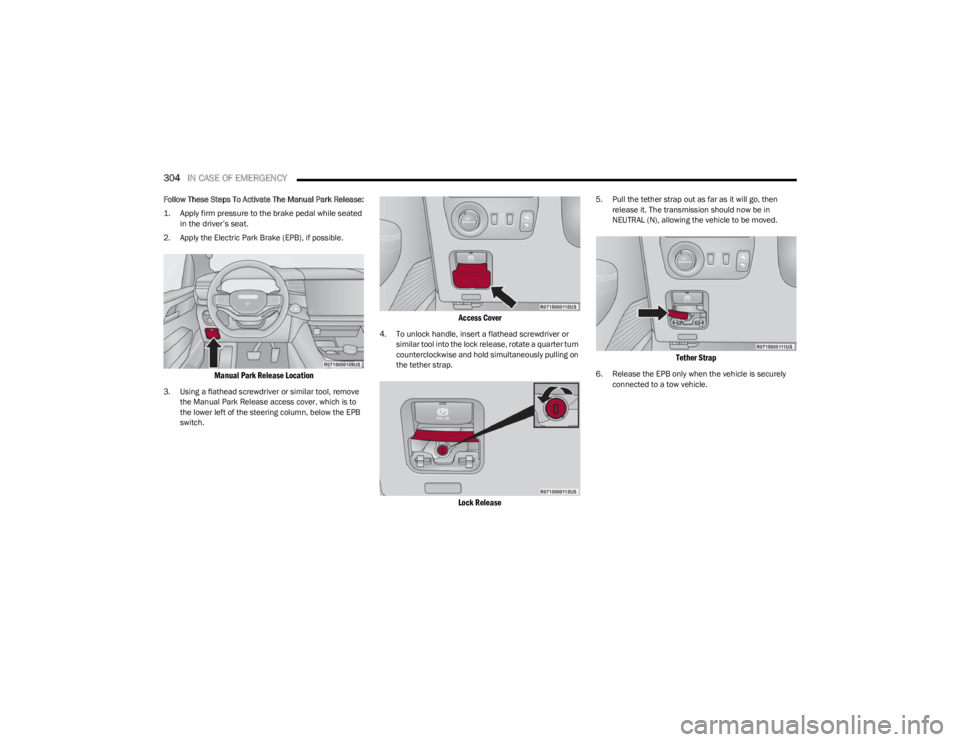
Follow These Steps To Activate The Manual Park Release:
1. Apply firm pressure to the brake pedal while seated
in the driver’s seat.
2. Apply the Electric Park Brake (EPB), if possible.
Manual Park Release Location
3. Using a flathead screwdriver or similar tool, remove the Manual Park Release access cover, which is to
the lower left of the steering column, below the EPB
switch.
Access Cover
4. To unlock handle, insert a flathead screwdriver or similar tool into the lock release, rotate a quarter turn
counterclockwise and hold simultaneously pulling on
the tether strap.
Lock Release
5. Pull the tether strap out as far as it will go, then release it. The transmission should now be in
NEUTRAL (N), allowing the vehicle to be moved.
Tether Strap
6. Release the EPB only when the vehicle is securely connected to a tow vehicle.
23_WS_OM_EN_USC_t.book Page 304
Page 307 of 396
IN CASE OF EMERGENCY305
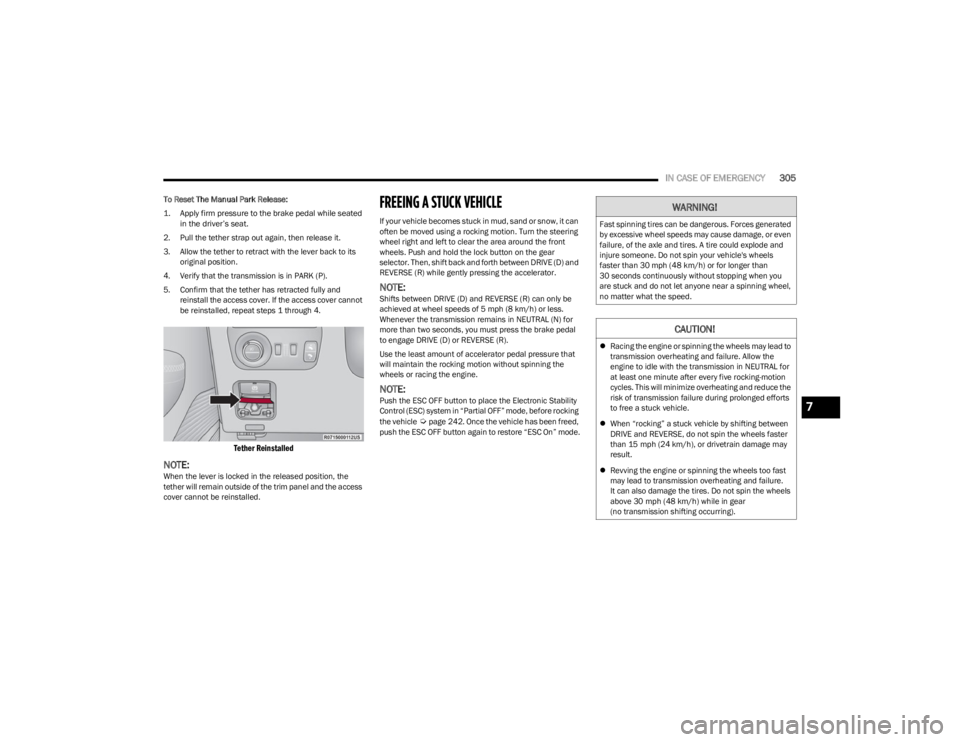
To Reset The Manual Park Release:
1. Apply firm pressure to the brake pedal while seated
in the driver’s seat.
2. Pull the tether strap out again, then release it.
3. Allow the tether to retract with the lever back to its original position.
4. Verify that the transmission is in PARK (P).
5. Confirm that the tether has retracted fully and reinstall the access cover. If the access cover cannot
be reinstalled, repeat steps 1 through 4.
Tether Reinstalled
NOTE:When the lever is locked in the released position, the
tether will remain outside of the trim panel and the access
cover cannot be reinstalled.
FREEING A STUCK VEHICLE
If your vehicle becomes stuck in mud, sand or snow, it can
often be moved using a rocking motion. Turn the steering
wheel right and left to clear the area around the front
wheels. Push and hold the lock button on the gear
selector. Then, shift back and forth between DRIVE (D) and
REVERSE (R) while gently pressing the accelerator.
NOTE:Shifts between DRIVE (D) and REVERSE (R) can only be
achieved at wheel speeds of 5 mph (8 km/h) or less.
Whenever the transmission remains in NEUTRAL (N) for
more than two seconds, you must press the brake pedal
to engage DRIVE (D) or REVERSE (R).
Use the least amount of accelerator pedal pressure that
will maintain the rocking motion without spinning the
wheels or racing the engine.
NOTE:Push the ESC OFF button to place the Electronic Stability
Control (ESC) system in “Partial OFF” mode, before rocking
the vehicle
Úpage 242. Once the vehicle has been freed,
push the ESC OFF button again to restore “ESC On” mode.
WARNING!
Fast spinning tires can be dangerous. Forces generated
by excessive wheel speeds may cause damage, or even
failure, of the axle and tires. A tire could explode and
injure someone. Do not spin your vehicle's wheels
faster than 30 mph (48 km/h) or for longer than
30 seconds continuously without stopping when you
are stuck and do not let anyone near a spinning wheel,
no matter what the speed.
CAUTION!
Racing the engine or spinning the wheels may lead to
transmission overheating and failure. Allow the
engine to idle with the transmission in NEUTRAL for
at least one minute after every five rocking-motion
cycles. This will minimize overheating and reduce the
risk of transmission failure during prolonged efforts
to free a stuck vehicle.
When “rocking” a stuck vehicle by shifting between
DRIVE and REVERSE, do not spin the wheels faster
than 15 mph (24 km/h), or drivetrain damage may
result.
Revving the engine or spinning the wheels too fast
may lead to transmission overheating and failure.
It can also damage the tires. Do not spin the wheels
above 30 mph (48 km/h) while in gear
(no transmission shifting occurring).
7
23_WS_OM_EN_USC_t.book Page 305
Page 391 of 396

389
S
Safety Checks Inside Vehicle ...................................... 287
Safety Checks Outside Vehicle ................................... 289
Safety Defects, Reporting............................................ 381
Safety Information, Tire ............................................... 349
Safety Tips .................................................................... 287
Safety, Exhaust Gas ..................................................... 289
Schedule, Maintenance............................................... 309
Screen, Passenger ....................................................... 221
Seat Belt Reminder...................................................... 111
Seat Belts ............................................................ 257
, 287
Adjustable Shoulder Belt........................................ 260
Adjustable Upper Shoulder Anchorage ................. 260
Adjustable Upper Shoulder Belt Anchorage.......... 260
Automatic Locking Retractor (ALR)........................ 263
Child Restraints ...................................................... 275
Energy Management Feature ................................ 263
Extender .................................................................. 262
Front Seat..............................................257
, 258, 259
Inspection................................................................ 287 Lap/Shoulder Belt Operation................................. 259
Lap/Shoulder Belt Untwisting ................................ 260
Lap/Shoulder Belts ................................................ 258
Operating Instructions ............................................ 259
Pregnant Women .................................................... 263
Pretensioners.......................................................... 263
Rear Seat ................................................................ 258Reminder........................................................ 117
, 257
Seat Belt Extender .................................................. 262 Seat Belt Pretensioner ........................................... 263Seat Belt Reminder ................................................ 117
Untwisting Procedure ............................................. 260 Seat Belts Maintenance ............................................... 369
Seats........................................................... 33
, 38, 39, 43
Adjustment.......................................................... 33, 39
Bolster ........................................................................ 39
Cushion Extender ...................................................... 40
Easy Entry .................................................................. 40
Heated........................................................................ 43
Memory ...................................................................... 31
Power Lumbar ........................................................... 40
Power Massage ......................................................... 42
Rear Folding............................................................... 33
Tilting .......................................................................... 33
Vented ........................................................................ 44
Ventilated ................................................................... 44
Second Row USB ............................................................ 78 Security Alarm .................................................24
, 25, 111
Arm The System......................................................... 24
Disarm The System ................................................... 24
Selec-Terrain ................................................................. 131
Semi-Automatic ParkSense Active Park Assist ...........165
Sentry Key (Immobilizer) ................................................ 20
Sentry Key Replacement................................................ 20
Service Assistance........................................................ 378
Service Contract ...........................................................380
Service Manuals ...........................................................381
Settings ......................................................................... 197
Shifting .......................................................................... 125 Automatic Transmission ............................... 125
, 126
Shoulder Belts .............................................................. 258
Side Steps, Power........................................................... 27
Signals, Turn ....................................................... 116
, 289
Snow Chains (Tire Chains) ...........................................364 Snow Tires .................................................................... 361
Spare Tire Removal ...................................................... 295
Spare Tires ................................................. 295
, 361, 362
Speed Control Accel/Decel ............................................................. 138
Accel/Decel (ACC Only) ........................................... 142
Cancel ...................................................................... 139Resume.................................................................... 139
Set ............................................................................ 138
Speed Control (Cruise Control) .................................... 138
Starting................................................................... 22
, 119
Button ........................................................................ 20
Cold Weather........................................................... 122
Engine Block Heater ............................................... 122
Engine Fails To Start ............................................... 121
Remote ...................................................................... 22
Starting And Operating................................................. 119
Starting Procedures ..................................................... 119
Steering ........................................................................... 30 Power ....................................................................... 135
Tilt Column................................................................. 30
Wheel, Heated ........................................................... 31
Wheel, Tilt .................................................................. 30
Steering Wheel Audio Controls .................................... 221
Steering Wheel Mounted Sound System Controls ..... 221
Steps, Power Side .......................................................... 27
Storage ............................................................................ 73 Storage, Vehicle............................................................ 368
Storing Your Vehicle ..................................................... 368
Streaming ..................................................................... 228
Sun Roof .................................................................. 83
, 85
11
23_WS_OM_EN_USC_t.book Page 389