traction control JEEP WRANGLER UNLIMITED 2013 User Guide
[x] Cancel search | Manufacturer: JEEP, Model Year: 2013, Model line: WRANGLER UNLIMITED, Model: JEEP WRANGLER UNLIMITED 2013Pages: 655, PDF Size: 9.04 MB
Page 466 of 655
WARNING!Electronic Stability Control (ESC) cannot prevent the
natural laws of physics from acting on the vehicle,
nor can it increase the traction afforded by prevailing
road conditions. ESC cannot prevent accidents, in-
cluding those resulting from excessive speed in
turns, driving on very slippery surfaces, or hydro-
planing. ESC also cannot prevent accidents resulting
from loss of vehicle control due to inappropriate
driver input for the conditions. Only a safe, attentive,
and skillful driver can prevent accidents. The capa-
bilities of an ESC equipped vehicle must never be
exploited in a reckless or dangerous manner which
could jeopardize the user ’s safety or the safety of
others. The ESC system has three available operating modes in
4H range. The system has one operating mode in 4L
range. Two-wheel drive vehicles and four-wheel drive
vehicles in 2H range have two operating modes.
4H Range (4WD Models)
On
This is the normal operating mode for ESC in 4H range.
Partial Off
This mode is entered by momentarily pressing the ESC
OFF switch.
ESC Off
This mode is entered by pressing and holding momen-
tarily pressing the ESC OFF switch for 5 seconds.464 STARTING AND OPERATING
Page 473 of 655
Enabling HDC
1. Shift the transfer case into 4WD LOW range. Refer to
“Four-Wheel Drive Operation” in “Starting and Oper-
ating” for further information.
2. Press the “Hill Descent” button. The “Hill Descent
Control Indicator Light” in the instrument cluster will
turn on solid.
NOTE: If the transfer case is not in 4WD LOW range, the
“Hill Descent Control Indicator Light” will flash for five
seconds and HDC will not be enabled.
Disabling HDC
Press the “Hill Descent” button or shift the transfer case
out of 4WD LOW range. The “Hill Descent Control
Indicator” light in the instrument cluster will turn off. TIRE SAFETY INFORMATION
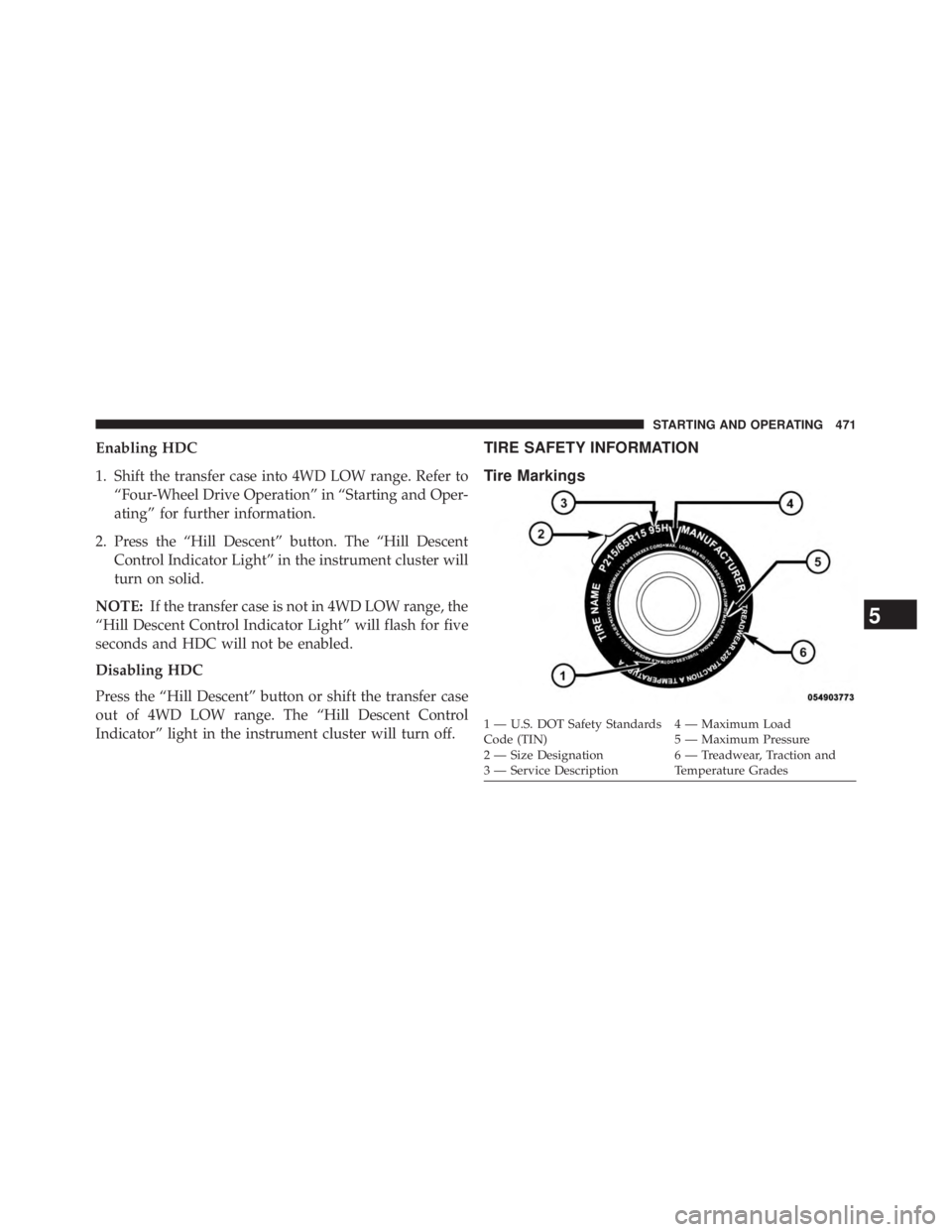
Tire Markings
1 — U.S. DOT Safety Standards
Code (TIN) 4 — Maximum Load
2 — Size Designation 5 — Maximum Pressure
3 — Service Description 6 — Treadwear, Traction and
Temperature Grades
5 STARTING AND OPERATING 471
Page 494 of 655
WARNING!• Do not use a tire, wheel size or rating other than that
specified for your vehicle. Some combinations of
unapproved tires and wheels may change suspension
dimensions and performance characteristics, result-
ing in changes to steering, handling, and braking of
your vehicle. This can cause unpredictable handling
and stress to steering and suspension components.
You could lose control and have a collision resulting
in serious injury or death. Use only the tire and wheel
sizes with load ratings approved for your vehicle.
• Never use a tire with a smaller load index or
capacity, other than what was originally equipped
on your vehicle. Using a tire with a smaller load
index could result in tire overloading and failure.
You could lose control and have a collision. (Continued) WARNING! (Continued)• Failure to equip your vehicle with tires having
adequate speed capability can result in sudden tire
failure and loss of vehicle control.
CAUTION!Replacing original tires with tires of a different size may
result in false speedometer and odometer readings.
TIRE CHAINS (TRACTION DEVICES)
Use of traction devices require sufficient tire-to-body
clearance. Follow these recommendations to guard
against damage.
• Traction device must be of proper size for the tire, as
recommended by the traction device manufacturer.
• Install on Rear Tires Only.492 STARTING AND OPERATING
Page 495 of 655
• P225/75R16 or a P235/65R17 tire with the use of a
traction device that meets the SAE type “Class S”
specification is recommended.
WARNING!Using tires of different size and type (M+S, Snow)
between front and rear axles can cause unpredictable
handling. You could lose control and have a collision.
CAUTION!To avoid damage to your vehicle or tires, observe the
following precautions:
• Because of restricted traction device clearance be-
tween tires and other suspension components, it is
important that only traction devices in good condi-
tion are used. Broken devices can cause serious
damage. Stop the vehicle immediately if noise occurs (Continued) CAUTION! (Continued)that could indicate device breakage. Remove the
damaged parts of the device before further use.
• Install device as tightly as possible and then re-
tighten after driving about ½ mile (0.8 km).
• Do not exceed 30 mph (48 km/h).
• Drive cautiously and avoid severe turns and large
bumps, especially with a loaded vehicle.
• Do not drive for prolonged period on dry pave-
ment.
• Observe the traction device manufacturer ’s instruc-
tions on the method of installation, operating speed,
and conditions for use. Always use the suggested
operating speed of the device manufacturer ’s if it is
less than 30 mph (48 km/h).
• Do not use traction devices on a compact spare tire.
5 STARTING AND OPERATING 493
Page 634 of 655
Traction Grades
The Traction grades, from highest to lowest, are AA, A, B,
and C. These grades represent the tire’s ability to stop on
wet pavement, as measured under controlled conditions on
specified government test surfaces of asphalt and concrete.
A tire marked C may have poor traction performance.
WARNING!The traction grade assigned to this tire is based on
straight-ahead braking traction tests, and does not
include acceleration, cornering, hydroplaning, or
peak traction characteristics.
Temperature Grades
The temperature grades are A (the highest), B, and C,
representing the tire’s resistance to the generation of heat
and its ability to dissipate heat, when tested under controlled conditions on a specified indoor laboratory
test wheel. Sustained high temperature can cause the
material of the tire to degenerate and reduce tire life, and
excessive temperature can lead to sudden tire failure. The
grade C corresponds to a level of performance, which all
passenger car tires must meet under the Federal Motor
Vehicle Safety Standard No. 109. Grades B and A repre-
sent higher levels of performance on the laboratory test
wheel, than the minimum required by law.
WARNING!The temperature grade for this tire is established for
a tire that is properly inflated and not overloaded.
Excessive speed, under-inflation, or excessive load-
ing, either separately or in combination, can cause
heat buildup and possible tire failure.632 IF YOU NEED CONSUMER ASSISTANCE
Page 639 of 655
Cruise Light ............................ .306
Cupholders ............................ .188
Customer Assistance ...................... .625
Data Recorder, Event .......................75
Daytime Running Lights ................... .171
Dealer Service ........................... .564
Defroster, Rear Window .................... .294
Defroster, Windshield ..................... .101
Delay (Intermittent) Wipers ................. .174
Diagnostic System, Onboard ................ .562
Dimmer Switch, Headlight .................. .170
Dipsticks
Oil (Engine) ......................... .566
Power Steering ....................... .451
Disabled Vehicle Towing ................... .556
Disarming, Theft System .....................20
Disposal
Antifreeze (Engine Coolant) .............. .581 Door Locks ..............................36
Door Locks, Automatic ......................39
Doors ..................................31
Driver’s Seat Back Tilt ..................... .154
Driving ............................... .436
Dual Top .............................. .191
Electrical Outlet, Auxiliary (Power Outlet) ....... .182
Electrical Power Outlets .................... .182
Electric Remote Mirrors .....................113
Electronic Brake Control System .............. .456
Brake Assist System .................... .457
Electronic Roll Mitigation ................ .462
Traction Control System ................. .457
Electronic Roll Mitigation (ERM) ............. .462
Electronic Speed Control (Cruise Control) ....... .178
Electronic Stability Control (ESC) ............. .463
Electronic Throttle Control Warning Light ....... .314
Electronic Vehicle Information Center (EVIC) ..... .315
10 INDEX 637
Page 645 of 655
Illuminated Entry .......................21
Instrument Cluster ..................... .167
Interior ............................. .171
Lights On Reminder .................... .170
Low Fuel ........................... .300
Oil Pressure ......................... .301
Passing ............................. .170
Rear Servicing ........................ .609
Rear Tail ............................ .609
Seat Belt Reminder ..................... .301
Security Alarm (Theft Alarm) ............. .305
Service ............................. .607
Side Marker ......................... .609
Theft Alarm (Security Alarm) ............. .305
Tire Pressure Monitoring (TPMS) ........... .306
Traction Control ....................... .468
Turn Signal .......................... .103
Voltage ............................. .300
Warning (Instrument Cluster Description) .... .300 Loading Vehicle ......................... .513
Tires ............................... .477
Locking Axle ........................... .433
Locks ..................................36
Automatic Door ........................39
Child Protection ........................40
Door ................................36
Power Door ...........................38
Lubrication, Body ........................ .572
Maintenance Free Battery ................... .570
Maintenance Procedures ................... .565
Maintenance Schedule ..................... .614
Malfunction Indicator Light (Check Engine) .......311
Manual, Service ......................... .630
Manual Transmission ..................... .414
Fluid Level Check ..................... .589
Lubricant Selection ..................... .588
Shift Speeds ......................... .415
10 INDEX 643
Page 652 of 655
Recreational ......................... .532
Weight ............................. .519
Towing Assistance ........................ .130
Trac-Lok Rear Axle ....................... .432
Traction Control ......................... .457
Trailer Sway Control (TSC) ................. .469
Trailer Towing .......................... .515
Cooling System Tips ................... .531
Hitches ............................. .518
Minimum Requirements ................. .525
Trailer and Tongue Weight ............... .524
Wiring ............................. .529
Trailer Towing Guide ...................... .519
Trailer Weight ........................... .519
Transfer Case ........................... .589
Four-Wheel-Drive Operation .............. .428
Maintenance ......................... .589
Transmission ........................... .585
Automatic ........................... .420 Manual ............................. .414
Range Indicator ....................... .306
Shifting ............................. .418
Transmitter Battery Service
(Remote Keyless Entry) ....................27
Tread Wear Indicators ..................... .490
Trip Computer .......................... .315
Trip Odometer .......................... .308
Trip Odometer Reset Button ................. .306
Turn Signals ............................ .169
UCI Connector .......................... .382
Uconnect™ (Hands-Free Phone) ...............114
Uniform Tire Quality Grades ................ .631
Universal Consumer Interface (UCI) Connector . . . .382
Unleaded Gasoline ....................... .506
Untwisting Procedure, Seat Belt ................55
Upholstery Care ......................... .594650 INDEX