engine JEEP WRANGLER UNLIMITED 2013 Manual PDF
[x] Cancel search | Manufacturer: JEEP, Model Year: 2013, Model line: WRANGLER UNLIMITED, Model: JEEP WRANGLER UNLIMITED 2013Pages: 655, PDF Size: 9.04 MB
Page 510 of 655
E-85 Usage In Non-Flex Fuel Vehicles
Non-FFV vehicles are compatible with gasoline contain-
ing 10% ethanol (E10). Gasoline with higher ethanol
content may void the vehicle’s warranty.
If a Non-FFV vehicle is inadvertently fueled with E-85
fuel, the engine will have some or all of these symptoms:
• operate in a lean mode
• OBD II “Malfunction Indicator Light” on
• poor engine performance
• poor cold start and cold drivability
• increased risk for fuel system component corrosion
To fix a Non-FFV vehicle inadvertently fueled once with
E-85 perform the following:
• drain the fuel tank (see your authorized dealer) • change the engine oil and oil filter
• disconnect and reconnect the battery to reset the
engine controller memory
More extensive repairs will be required for prolonged
exposure to E-85 fuel.
MMT In Gasoline
MMT is a manganese-containing metallic additive that is
blended into some gasoline to increase octane. Gasoline
blended with MMT provides no performance advantage
beyond gasoline of the same octane number without
MMT. Gasoline blended with MMT reduces spark plug
life and reduces emissions system performance in some
vehicles. The manufacturer recommends that gasoline
without MMT be used in your vehicle. The MMT content
of gasoline may not be indicated on the gasoline pump,
therefore, you should ask your gasoline retailer whether
the gasoline contains MMT. It is even more important to
look for gasoline without MMT in Canada, because MMT508 STARTING AND OPERATING
Page 511 of 655
can be used at levels higher than those allowed in the
United States. MMT is prohibited in Federal and Califor-
nia reformulated gasoline.
Materials Added To Fuel
All gasoline sold in the United States is required to contain
effective detergent additives. Use of additional detergents
or other additives is not needed under normal conditions
and they would result in additional cost. Therefore, you
should not have to add anything to the fuel.
Fuel System Cautions
CAUTION!Follow these guidelines to maintain your vehicle’s
performance:
• The use of leaded gas is prohibited by Federal law.
Using leaded gasoline can impair engine perfor-
mance and damage the emissions control system. (Continued) CAUTION! (Continued)• An out-of-tune engine or certain fuel or ignition
malfunctions can cause the catalytic converter to
overheat. If you notice a pungent burning odor or
some light smoke, your engine may be out of tune or
malfunctioning and may require immediate service.
Contact your authorized dealer for service assistance.
• The use of fuel additives, which are now being sold
as octane enhancers, is not recommended. Most of
these products contain high concentrations of metha-
nol. Fuel system damage or vehicle performance
problems resulting from the use of such fuels or
additives is not the responsibility of the manufac-
turer.
NOTE: Intentional tampering with the emissions control
system can result in civil penalties being assessed against
you.
5 STARTING AND OPERATING 509
Page 512 of 655
Carbon Monoxide Warnings
WARNING!Carbon monoxide (CO) in exhaust gases is deadly.
Follow the precautions below to prevent carbon
monoxide poisoning:
• Do not inhale exhaust gases. They contain carbon
monoxide, a colorless and odorless gas, which can
kill. Never run the engine in a closed area, such as
a garage, and never sit in a parked vehicle with the
engine running for an extended period. If the
vehicle is stopped in an open area with the engine
running for more than a short period, adjust the
ventilation system to force fresh, outside air into
the vehicle. (Continued) WARNING! (Continued)• Guard against carbon monoxide with proper main-
tenance. Have the exhaust system inspected every
time the vehicle is raised. Have any abnormal
conditions repaired promptly. Until repaired, drive
with all side windows fully open.
ADDING FUEL
Fuel Filler Cap (Gas Cap)
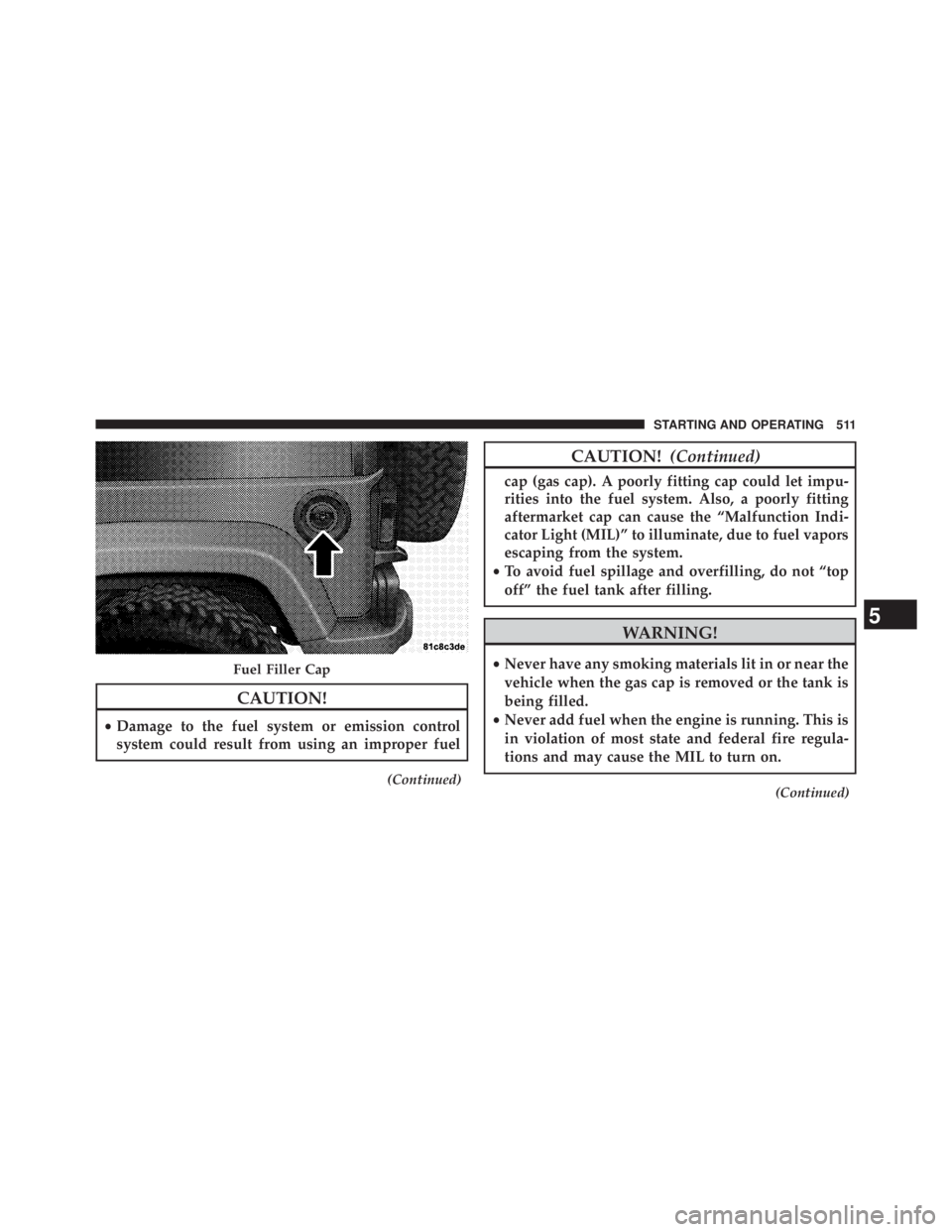
The gas cap is located on the driver’s side of the vehicle.
If the gas cap is lost or damaged, be sure the replacement
cap is the correct one for this vehicle.510 STARTING AND OPERATING
Page 513 of 655
CAUTION!• Damage to the fuel system or emission control
system could result from using an improper fuel (Continued) CAUTION! (Continued)cap (gas cap). A poorly fitting cap could let impu-
rities into the fuel system. Also, a poorly fitting
aftermarket cap can cause the “Malfunction Indi-
cator Light (MIL)” to illuminate, due to fuel vapors
escaping from the system.
• To avoid fuel spillage and overfilling, do not “top
off” the fuel tank after filling.
WARNING!• Never have any smoking materials lit in or near the
vehicle when the gas cap is removed or the tank is
being filled.
• Never add fuel when the engine is running. This is
in violation of most state and federal fire regula-
tions and may cause the MIL to turn on. (Continued)Fuel Filler Cap
5 STARTING AND OPERATING 511
Page 521 of 655
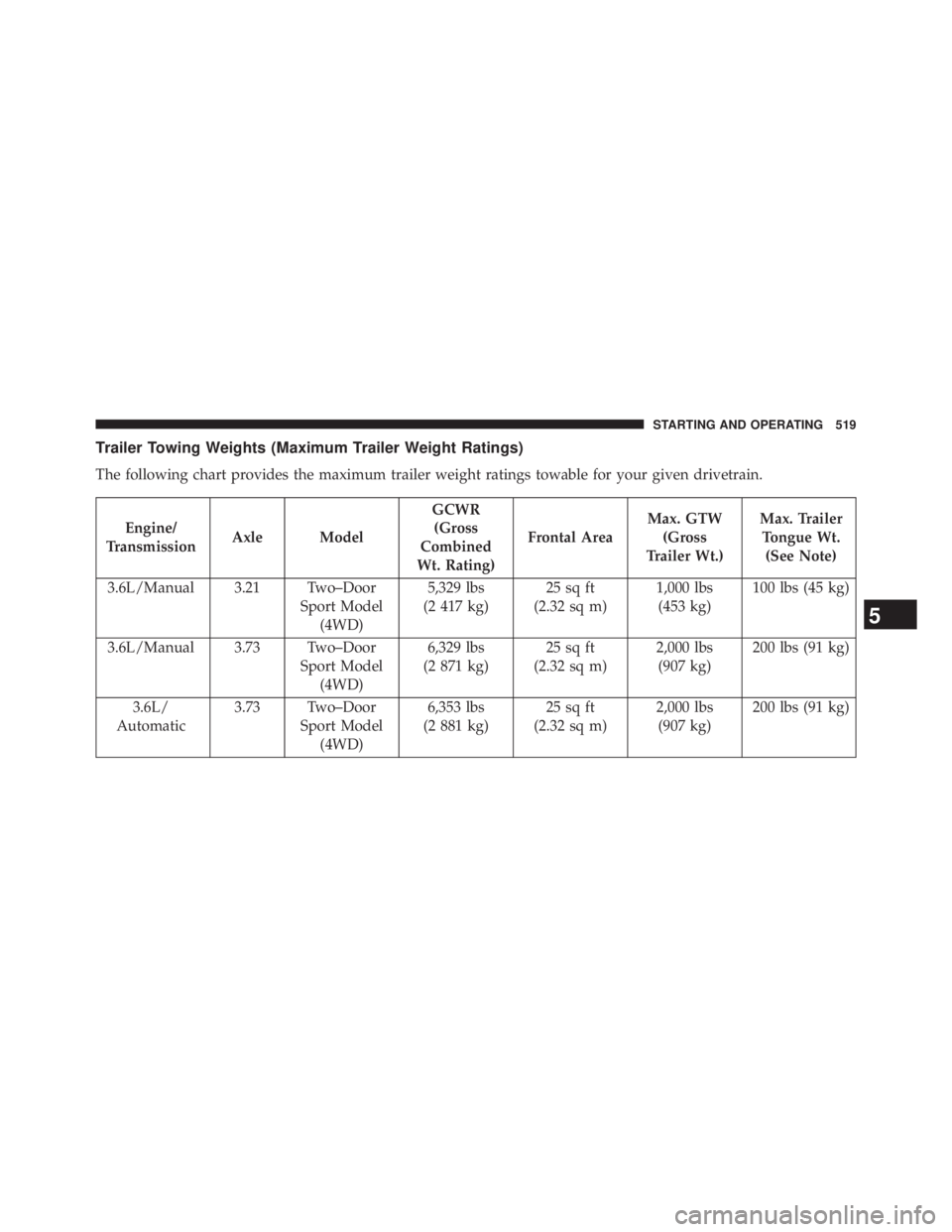
Trailer Towing Weights (Maximum Trailer Weight Ratings)
The following chart provides the maximum trailer weight ratings towable for your given drivetrain.
Engine/
Transmission Axle Model GCWR
(Gross
Combined
Wt. Rating) Frontal Area Max. GTW
(Gross
Trailer Wt.) Max. Trailer
Tongue Wt.
(See Note)
3.6L/Manual 3.21 Two–Door
Sport Model
(4WD) 5,329 lbs
(2 417 kg) 25 sq ft
(2.32 sq m) 1,000 lbs
(453 kg) 100 lbs (45 kg)
3.6L/Manual 3.73 Two–Door
Sport Model
(4WD) 6,329 lbs
(2 871 kg) 25 sq ft
(2.32 sq m) 2,000 lbs
(907 kg) 200 lbs (91 kg)
3.6L/
Automatic 3.73 Two–Door
Sport Model
(4WD) 6,353 lbs
(2 881 kg) 25 sq ft
(2.32 sq m) 2,000 lbs
(907 kg) 200 lbs (91 kg)
5 STARTING AND OPERATING 519
Page 522 of 655
Engine/
Transmission Axle Model GCWR
(Gross
Combined
Wt. Rating) Frontal Area Max. GTW
(Gross
Trailer Wt.) Max. Trailer
Tongue Wt.
(See Note)
3.6L/Manual 3.21 Two–Door
Sahara Model
(4WD) 5,430 lbs
(2 463 kg) 25 sq ft
(2.32 sq m) 1,000 lbs
(453 kg) 100 lbs (45 kg)
3.6L/Manual 3.73 Two–Door
Sahara Model
(4WD) 6,430 lbs
(2 916 kg) 25 sq ft
(2.32 sq m) 2,000 lbs
(907 kg) 200 lbs (91 kg)
3.6L/
Automatic 3.73 Two–Door
Sahara Model
(4WD) 6,454 lbs
(2 927 kg) 25 sq ft
(2.32 sq m) 2,000 lbs
(907 kg) 200 lbs (91 kg)
3.6L/Manual 4.10 2–Door
Rubicon
Model (4WD) 6,507 lbs
(2 951 kg) 25 sq ft
(2.32 sq m) 2,000 lbs
(907 kg) 200 lbs (91 kg)520 STARTING AND OPERATING
Page 523 of 655
Engine/
Transmission Axle Model GCWR
(Gross
Combined
Wt. Rating) Frontal Area Max. GTW
(Gross
Trailer Wt.) Max. Trailer
Tongue Wt.
(See Note)
3.6L/
Automatic 4.10 Two–Door
Rubicon
Model (4WD) 6,533 lbs
(2 963 kg) 25 sq ft
(2.32 sq m) 2,000 lbs
(907 kg) 200 lbs (91 kg)
3.6L/Manual 3.21 Four–Door
Sport Model
(4WD) 5,742 lbs
(2 604 kg) 32 sq ft
(2.97 sq m) 1,000 lbs
(453 kg) 100 lbs (45 kg)
3.6L/Manual 3.73 Four–Door
Sport Model
(4WD) 8,242 lbs
(3 738 kg) 32 sq ft
(2.97 sq m) 3,500 lbs (1
587 kg) 350 lbs
(159 kg)
3.6L/
Automatic 3.73 Four–Door
Sport Model
(4WD) 8,257 lbs
(3 745 kg) 32 sq ft
(2.97 sq m) 3,500 lbs (1
587 kg) 350 lbs
(159 kg)
5 STARTING AND OPERATING 521
Page 524 of 655
Engine/
Transmission Axle Model GCWR
(Gross
Combined
Wt. Rating) Frontal Area Max. GTW
(Gross
Trailer Wt.) Max. Trailer
Tongue Wt.
(See Note)
3.6L/Manual 3.21 Four–Door
Sahara Model
(4WD) 5,782 lbs
(2 623 kg) 32 sq ft
(2.97 sq m) 1,000 lbs
(453 kg) 100 lbs (45 kg)
3.6L/Manual 3.73 Four–Door
Sahara Model
(4WD) 8,282 lbs
(3 757 kg) 32 sq ft
(2.97 sq m) 3,500 lbs
(1 587 kg) 350 lbs
(159 kg)
3.6L/
Automatic 3.73 Four–Door
Sahara Model
(4WD) 8,297 lbs
(3 763 kg) 32 sq ft
(2.97 sq m) 3,500 lbs
(1 587 kg) 350 lbs
(159 kg)
3.6L/Manual 4.10 Four–Door
Rubicon
Model (4WD) 8,406 lbs
(3 813 kg) 32 sq ft
(2.97 sq m) 3,500 lbs
(1 587 kg) 350 lbs
(159 kg)522 STARTING AND OPERATING
Page 525 of 655
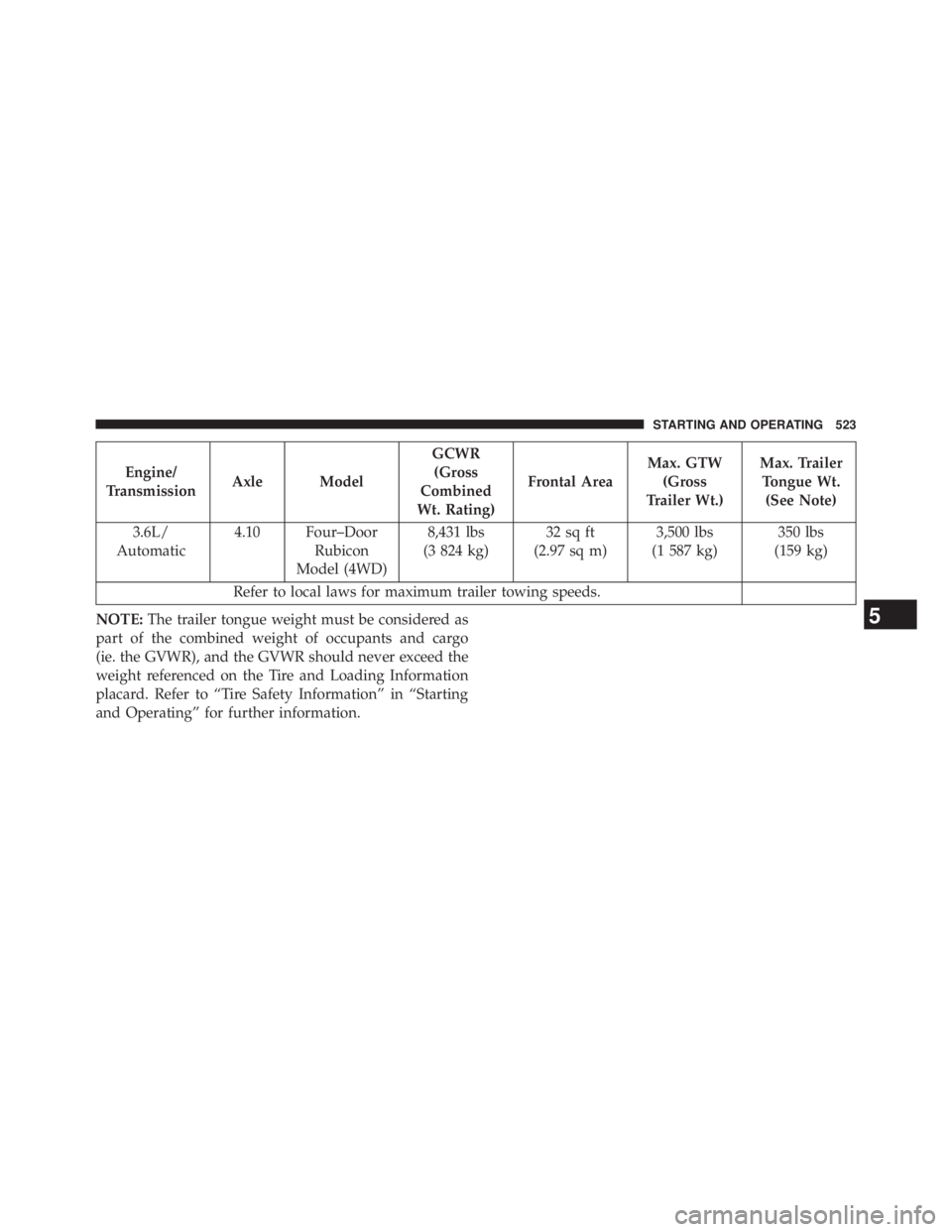
Engine/
Transmission Axle Model GCWR
(Gross
Combined
Wt. Rating) Frontal Area Max. GTW
(Gross
Trailer Wt.) Max. Trailer
Tongue Wt.
(See Note)
3.6L/
Automatic 4.10 Four–Door
Rubicon
Model (4WD) 8,431 lbs
(3 824 kg) 32 sq ft
(2.97 sq m) 3,500 lbs
(1 587 kg) 350 lbs
(159 kg)
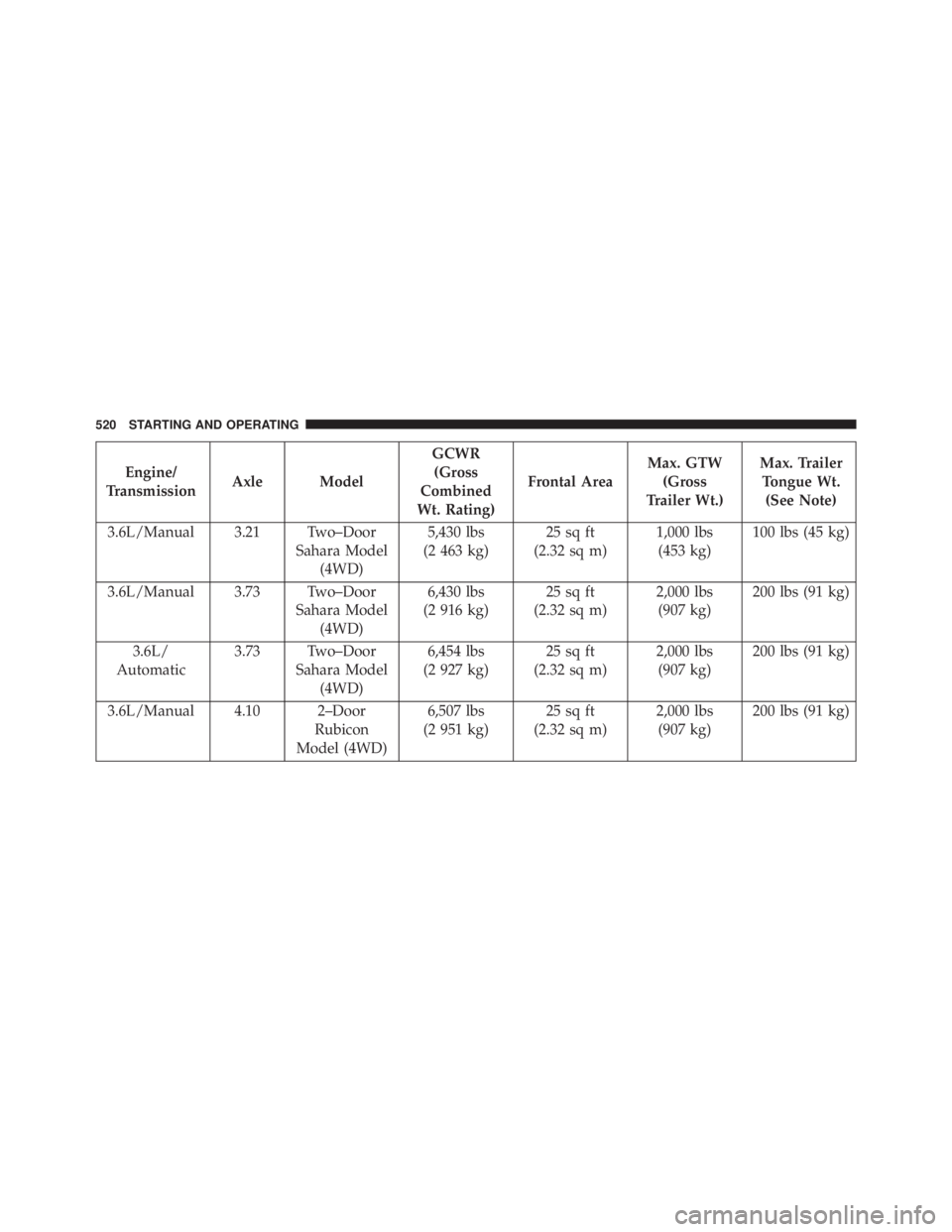
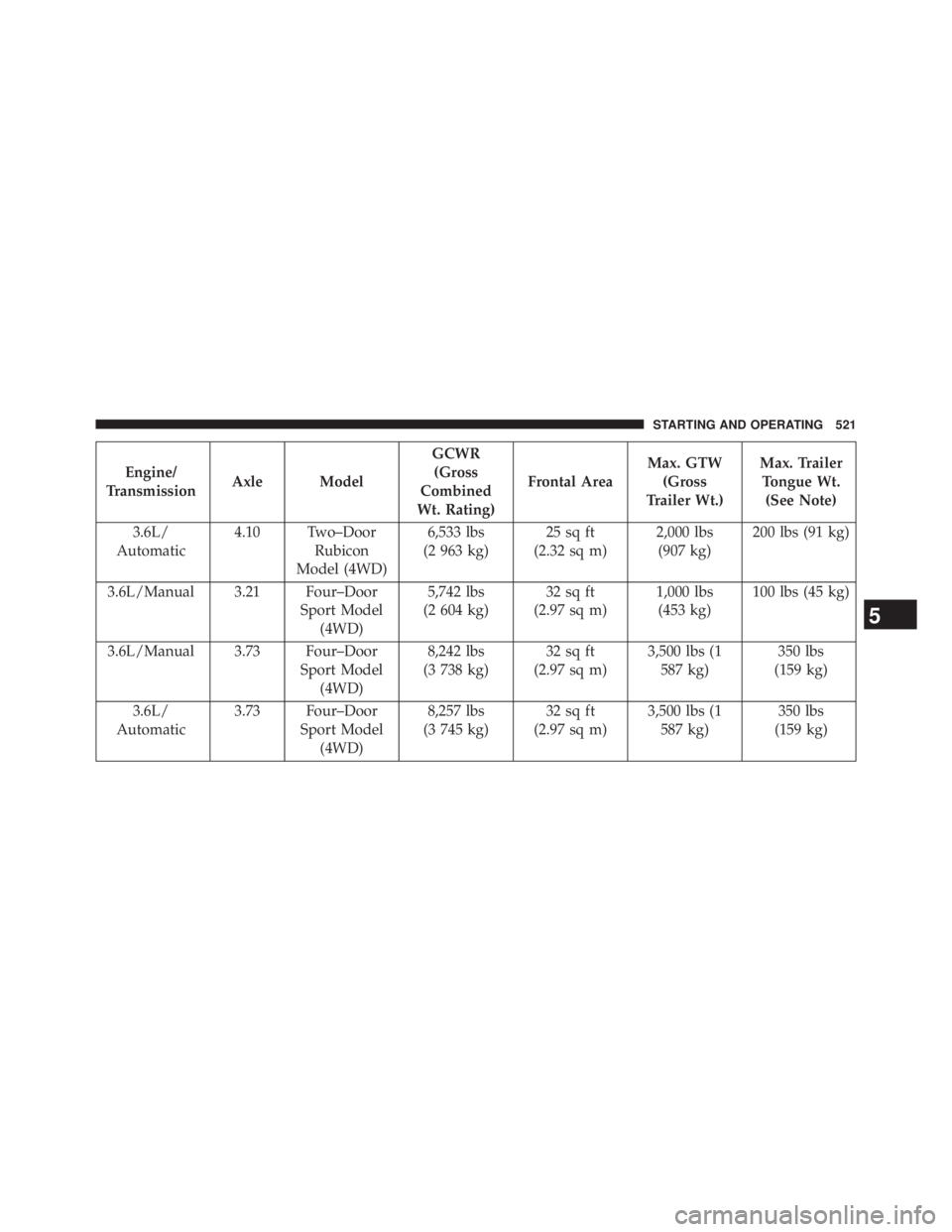
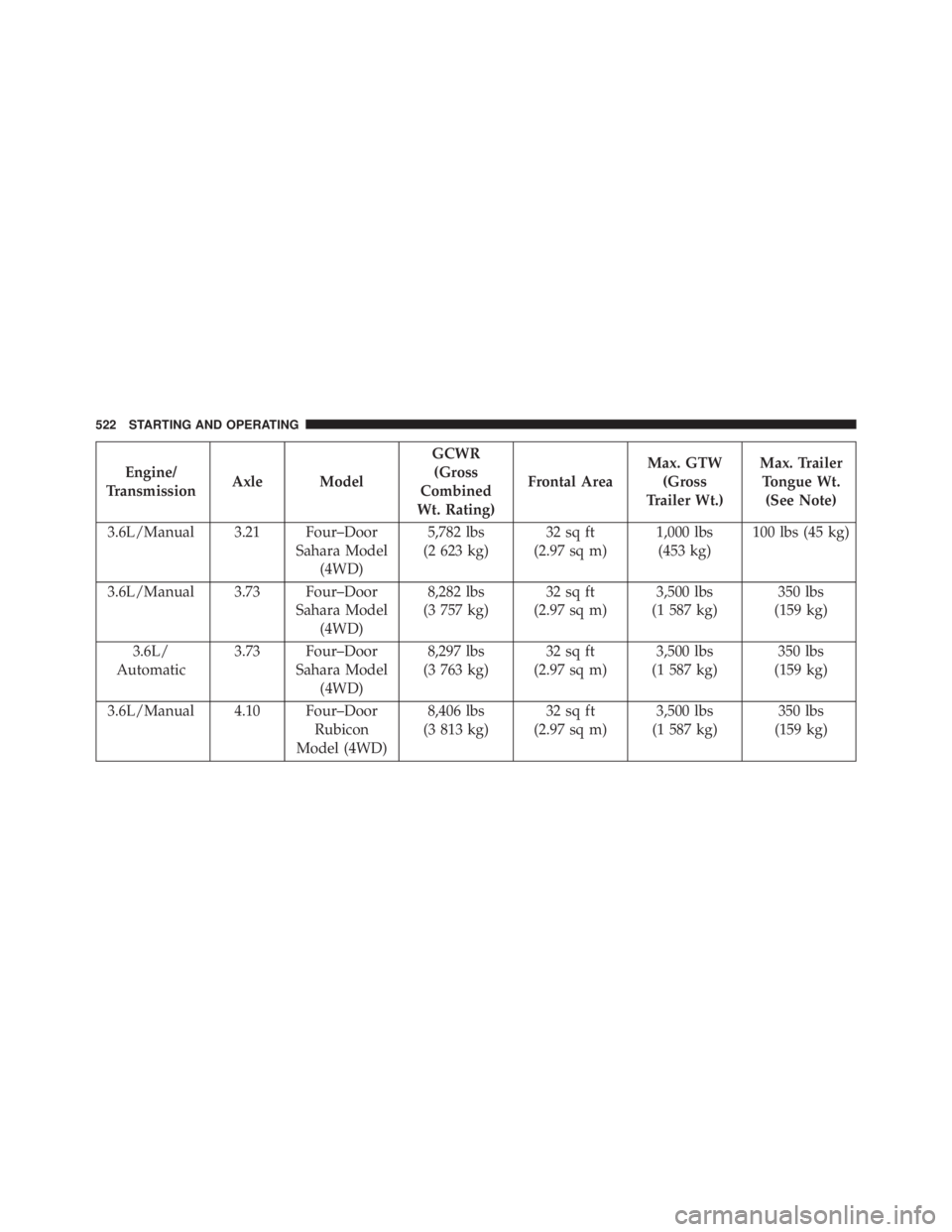
Refer to local laws for maximum trailer towing speeds.
NOTE: The trailer tongue weight must be considered as
part of the combined weight of occupants and cargo
(ie. the GVWR), and the GVWR should never exceed the
weight referenced on the Tire and Loading Information
placard. Refer to “Tire Safety Information” in “Starting
and Operating” for further information.
5 STARTING AND OPERATING 523
Page 527 of 655
NOTE: Remember that everything put into or on the
trailer adds to the load on your vehicle. Also, additional
factory-installed options or dealer-installed options must
be considered as part of the total load on your vehicle.
Refer to the “Tire and Loading Information” placard for
the maximum combined weight of occupants and cargo
for your vehicle.
Towing Requirements
To promote proper break-in of your new vehicle drive-
train components, the following guidelines are recom-
mended:
NOTE: Trailer towing requires special rear axle lubri-
cant. Refer to “Fluids, Lubricants, and Genuine Parts” in
“Maintaining Your Vehicle” for the correct fluid type. CAUTION!• Do not tow a trailer at all during the first 500 miles
(805 km) the new vehicle is driven. The engine, axle
or other parts could be damaged.
• Then, during the first 500 miles (805 km) that a
trailer is towed, do not drive over 50 mph (80 km/h)
and do not make starts at full throttle. This helps
the engine and other parts of the vehicle wear in at
the heavier loads.
5 STARTING AND OPERATING 525