fuel JEEP WRANGLER UNLIMITED 2020 Owner handbook (in English)
[x] Cancel search | Manufacturer: JEEP, Model Year: 2020, Model line: WRANGLER UNLIMITED, Model: JEEP WRANGLER UNLIMITED 2020Pages: 330, PDF Size: 9.16 MB
Page 151 of 330
149
For additional information on the appropriate
use of each transfer case mode position, see
the information below:
2H
Two-Wheel Drive High Range — This range is
for normal street and highway driving on dry,
hard surfaced roads.
4H AUTO
Four-Wheel Drive Auto High Range — This
range sends power to the front wheels. The
four-wheel drive system will be automatically
engaged when the vehicle senses a loss of
traction. Additional traction for varying road
conditions.
4H PT
Four-Wheel Drive Part Time High Range —
This range maximizes torque to the front
driveshaft, forcing the front and rear wheels
to rotate at the same speed. This range
provides additional traction for loose, slip-
pery road surfaces only. NEUTRAL (N)
Neutral — This range disengages both the
front and rear driveshafts from the power
-
train. To be used for flat towing behind
another vehicle.
Refer to “Recreational Towing” in this
chapter for further information. 4L
Four-Wheel Drive Low Range — This range
provides low speed four-wheel drive. It maxi
-
mizes torque to the front driveshaft, forcing
the front and rear wheels to rotate at the
same speed. This range provides additional
traction and maximum pulling power for
loose, slippery road surfaces only. Do not
exceed 25 mph (40 km/h).
This transfer case is designed to be driven in
the 2H mode or 4H AUTO mode for normal
street and highway conditions on dry hard
surfaced roads. Driving the vehicle in 2H will
have greater fuel economy benefits as the
front axle is not engaged in 2H.
For variable driving conditions, the 4H AUTO
mode can be used. In this mode, the front
axle is engaged, but the vehicle's power is
sent to the rear wheels. Four-wheel drive will
be automatically engaged when the vehicle
senses a loss of traction. Because the front
axle is engaged, this mode will result in lower
fuel economy than the 2H mode.
WARNING!
You or others could be injured or killed if
you leave the vehicle unattended with the
transfer case in the NEUTRAL (N) position
without first fully engaging the parking
brake. The transfer case NEUTRAL (N)
position disengages both the front and rear
driveshafts from the powertrain, and will
allow the vehicle to roll, even if the
automatic transmission is in PARK. The
parking brake should always be applied
when the driver is not in the vehicle.
2020_JEEP_JL_WRANGLER_UG_RHD_UK.book Page 149
Page 155 of 330
153
NOTE:
The stabilizer/sway bar may be torque locked
due to left and right suspension height
differences. This condition is due to driving
surface differences or vehicle loading. In
order for the stabilizer/sway bar to discon-
nect/reconnect, the right and left halves of
the bar must be aligned. This alignment may
require that the vehicle be driven onto level
ground or rocked from side to side.
To return to on-road mode, push the SWAY
BAR switch again.
STOP/START SYSTEM —
AUTOMATIC TRANSMISSION
(IF EQUIPPED)
The Stop/Start function is developed to
reduce fuel consumption. The system will
stop the engine automatically during a
vehicle stop if the required conditions are
met. Releasing the brake pedal or pressing
the accelerator pedal will automatically
re-start the engine.
Engine Stop/Start (ESS) vehicles have been
upgraded with a heavy duty starter,
enhanced battery, and other upgraded
engine parts, to handle the additional engine
starts.
NOTE:
It is recommended that the Stop/Start
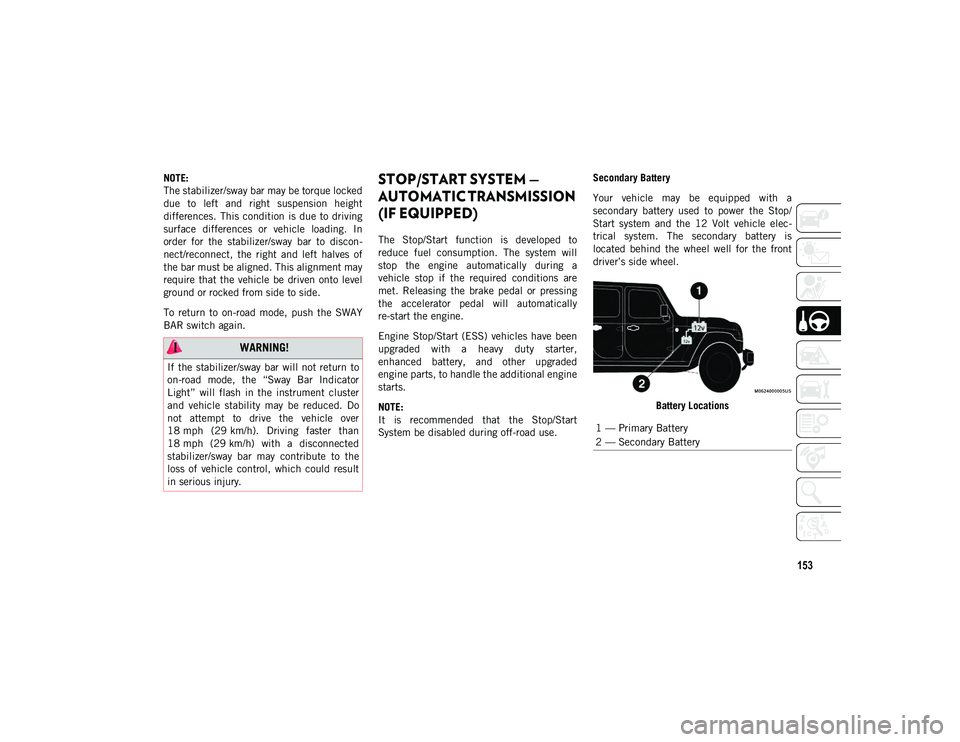
System be disabled during off-road use. Secondary Battery
Your vehicle may be equipped with a
secondary battery used to power the Stop/
Start system and the 12 Volt vehicle elec
-
trical system. The secondary battery is
located behind the wheel well for the front
driver’s side wheel.
Battery Locations
WARNING!
If the stabilizer/sway bar will not return to
on-road mode, the “Sway Bar Indicator
Light” will flash in the instrument cluster
and vehicle stability may be reduced. Do
not attempt to drive the vehicle over
18 mph (29 km/h). Driving faster than
18 mph (29 km/h) with a disconnected
stabilizer/sway bar may contribute to the
loss of vehicle control, which could result
in serious injury.
1 — Primary Battery
2 — Secondary Battery
2020_JEEP_JL_WRANGLER_UG_RHD_UK.book Page 153
Page 171 of 330

169
(Continued)
REFUELING THE VEHICLE
Fuel Filler Cap
The fuel filler cap is located on the
passenger's side of the vehicle. If the fuel
filler cap is lost or damaged, be sure the
replacement cap is the correct one for this
vehicle.Fuel Filler Door Fuel Filler Cap
WARNING!
Never have any smoking materials lit in
or near the vehicle when the fuel door is
open or the tank is being filled.
Never add fuel when the engine is
running. This is in violation of most
countries regulations and may cause the
“Malfunction Indicator Light” to turn on.
Do not apply any object/cap to the end of
the filler which is not provided for the
car. The use of non-compliant objects/
plugs could cause a pressure increase
inside the tank, resulting in dangerous
situations.
A fire may result if fuel is pumped into a
portable container that is inside of a
vehicle. You could be burned. Always
place fuel containers on the ground
while filling.
CAUTION!
Damage to the fuel system or emission
control system could result from using
an improper fuel filler cap. A poorly
fitting cap could let impurities into the
fuel system. Also, a poorly fitting after
-
market cap can cause the “Malfunction
Indicator Light (MIL)” to illuminate, due
to fuel vapors escaping from the system.
To avoid fuel spillage and overfilling, do
not “top off” the fuel tank after filling.
WARNING! (Continued)
2020_JEEP_JL_WRANGLER_UG_RHD_UK.book Page 169
Page 172 of 330

STARTING AND OPERATING
170
(Continued)
NOTE:
When the fuel nozzle “clicks” or shuts off,
the fuel tank is full.
Tighten the fuel filler cap about a quarter
turn until you hear one click. This is an
indication that the cap is properly tight-
ened.
If the fuel filler cap is not tightened properly,
the MIL will come on. Be sure the cap is
tightened every time the vehicle is refueled.
Loose Fuel Filler Cap Message
After fuel has been added, the vehicle diag -
nostic system can determine if the fuel filler
cap is possibly loose, improperly installed,
or damaged. If the system detects a
malfunction, the “gASCAP” message will
display in the odometer display. Tighten the
gas cap until a "clicking" sound is heard.
This is an indication that the gas cap is
properly tightened. Push the odometer reset
button to turn the message off. If the
problem persists, the message will appear
the next time the vehicle is started. This
might indicate a damaged cap. If the
problem is detected twice in a row, the
system will turn on the MIL. Resolving the
problem will turn the MIL off.
REFUELING THE VEHICLE —
DIESEL
The fuel filler cap is located on the
passenger's side of the vehicle. If the fuel
filler cap is lost or damaged, be sure the
replacement cap is the correct one for this
vehicle.
Fuel Filler Door Fuel and AdBlue® (UREA) Fill Location
1 — Diesel Fuel Filler
2 — AdBlue® Filler
WARNING!
Never have any smoking materials lit in
or near the vehicle when the fuel door is
open or the tank is being filled.
Never add fuel when the engine is
running. This is in violation of most
countries regulations and may cause the
“Malfunction Indicator Light” to turn on.
2020_JEEP_JL_WRANGLER_UG_RHD_UK.book Page 170
Page 173 of 330

171
NOTE:
When the fuel nozzle “clicks” or shuts off,
the fuel tank is full.
Tighten the fuel filler cap about a quarter
turn until you hear one click. This is an
indication that the cap is properly tight-
ened.
If the fuel filler cap is not tightened prop -
erly, the MIL will come on. Be sure the
cap is tightened every time the vehicle is
refueled.
AdBlue® (UREA) — If Equipped
The vehicle is equipped with an AdBlue®
UREA injection system and Selective Cata -
lytic Reduction to meet emission standards.
These two systems ensure compliance with
the diesel emissions requirements; at the
same, they ensure fuel-efficiency, handling,
torque and power. For messages and system
warnings, refer to the “Warning Lights And
Messages” in the “Getting To Know Your
Instrument Panel" section. AdBlue® (UREA)
is a very stable product with a long shelf life.
Stored at temperatures LOWER than 90°F
(32°C), it has a shelf life of at least one year.
For more information on the AdBlue®
(UREA) liquid type, see the “Fluids and
lubricants” in the “Technical specifications”
section. The vehicle is equipped with an
automatic AdBlue® (UREA) heating system
when the engine starts allowing the system
to work correctly at temperatures lower than
12°F (-11°C).
NOTE:
AdBlue® (UREA) freezes at temperatures
lower than 12°F (-11°C).Do not apply any object/cap to the end of
the filler which is not provided for the
car. The use of non-compliant objects/
plugs could cause a pressure increase
inside the tank, resulting in dangerous
situations.
A fire may result if fuel is pumped into a
portable container that is inside of a
vehicle. You could be burned. Always
place fuel containers on the ground
while filling.
CAUTION!
Damage to the fuel system or emission
control system could result from using
an improper fuel filler cap. A poorly
fitting cap could let impurities into the
fuel system. Also, a poorly fitting after -
market cap can cause the “Malfunction
Indicator Light (MIL)” to illuminate, due
to fuel vapors escaping from the system.
To avoid fuel spillage and overfilling, do
not “top off” the fuel tank after filling.
WARNING! (Continued)
CAUTION!
For diesel engines, only use diesel fuel for
motor vehicles in accordance with EN 590
European specifications. The use of other
products or mixtures may damage the
engine beyond repair and consequently
void the warranty, due to the damage
caused. If you accidentally introduce other
types of fuel into the tank, do not start the
engine. Empty the tank. If the engine has
been run for even an extremely limited
amount of time, you must not only drain
the fuel tank, but the rest of the supply
circuit as well.
2020_JEEP_JL_WRANGLER_UG_RHD_UK.book Page 171
Page 174 of 330
STARTING AND OPERATING
172
AdBlue® (UREA) Storage
AdBlue® (UREA) is considered a very stable
product with a long shelf life. If AdBlue®
(UREA) is kept in temperatures between 10°
and 90°F (-12° and 32°C), it will last a
minimum of one year.
AdBlue® (UREA) is subject to freezing at the
lowest temperatures. For example, AdBlue®
(UREA) may freeze at temperatures at or
below 12°F (-11°C). The system has been
designed to operate in this environment.
NOTE:
When working with AdBlue® (UREA), it is
important to know that:
Any containers or parts that come into
contact with AdBlue® (UREA) must be
AdBlue® (UREA) compatible (plastic or
stainless steel). Copper, brass, aluminum,
iron or non-stainless steel should be
avoided as they are subject to corrosion by
AdBlue® (UREA).
If AdBlue® (UREA) is spilled, it should be
wiped up completely.
Adding AdBlue® (UREA)
Preliminary Conditions
AdBlue® (UREA) freezes at temperatures
lower than 12°F (-11°C). If the car stands for
a long time at this temperature refilling
could be difficult. For this reason, it is
advised to park the vehicle in a garage and/
or heated environment and wait for the urea
to return to liquid state before topping up.
Proceed as follows:
Park the car on flat ground and stop the
engine by placing the ignition to the OFF
position.
Open the fuel door, undo and remove the
cap (blue) from the AdBlue® (UREA)
filler.
Refilling With Nozzles
You can fill up at any AdBlue® (UREA)
distributor.
Proceed as follows:
Insert the AdBlue® (UREA) nozzle in the
filler, start refilling and stop refilling at the
first shut-off (the shut-off indicates that the AdBlue® (UREA) tank is full). Do not
proceed with the refilling, to prevent
spillage of AdBlue® (UREA).
Extract the nozzle.
Refilling With Containers
Proceed as follows:
Check the expiration date.
Read the advice for use on the label before
pouring the content of the bottle into the
AdBlue® (UREA) tank.
If systems which cannot be screwed in
(e.g. tanks) are used for refilling, after the
indication appears on the instrument
panel display refer to “Warning lights And
Messages” in the “Getting To Know Your
Instrument Panel” for further information,
fill the AdBlue® (UREA) tank with no
more than 2 Gallons (8 liters).
If containers which can be screwed to the
filler are used, the reservoir is full when
the AdBlue® (UREA) level in the
container stops pouring out. Do not
proceed further.
2020_JEEP_JL_WRANGLER_UG_RHD_UK.book Page 172
Page 175 of 330
173
Operations After Refilling
Proceed as follows:
Fit the cap back on the AdBlue® (UREA)
filler by turning it clockwise and screwing
it completely.
Place the ignition in RUN (it is not neces-
sary to start the engine).
Wait for the indication on the instrument
panel to switch off before moving the car.
The indication may stay on for a few seconds
to approximately half a minute. If the engine
is started and the car is moved, the indica-
tion will remain on for longer. This will not
compromise engine operation.
If the AdBlue® (UREA) was topped up
when the tank was empty, wait for
2 minutes before starting the engine.
NOTE:
If AdBlue® (UREA) is spilled out of the
filler neck, clean up well the area and
proceed to filling up again. If the liquid
crystallizes, eliminate it with a sponge and
warm water.
DO NOT EXCEED THE MAXIMUM LEVEL:
this could cause damage to the reservoir.
AdBlue® (UREA) freezes at under 12°F
(-11°C). Although the system is designed
to operate below the freezing point of the
AdBlue® (UREA), it is advisable not to fill
the tank beyond the maximum level
because if the AdBlue® (UREA) freezes
the system can be damaged. Follow the
instructions in this section.
If the AdBlue® (UREA) is spilled on
painted surfaces or aluminum, immedi -
ately clean the area with water and use
absorbent material to collect the fluid that
has been spilled on the ground.
Do not try to start the engine if AdBlue®
(UREA) was accidentally added to the
diesel fuel tank, this can result in serious
engine damage, contact an authorized
dealer.
Do not add additives or other fluids to
AdBlue® (UREA), doing so could damage
the system.
The use of non-conforming or degraded
AdBlue® (UREA) may lead to indications
appearing on the instrument panel display
refer to “Warning Lights And Messages” in
the “Getting To Know Your Instrument
Panel” for further information.
Never pour AdBlue® (UREA) into another
container: it could be contaminated.
If the AdBlue® (UREA) runs out, see refer
to “Warning Lights And Messages” in the
“Getting To Know Your Instrument Panel”
for further information to continue using
the car normally.
2020_JEEP_JL_WRANGLER_UG_RHD_UK.book Page 173
Page 177 of 330
175
Curb Weight
The curb weight of a vehicle is defined as the
total weight of the vehicle with all fluids,
including vehicle fuel, at full capacity condi-
tions, and with no occupants or cargo loaded
into the vehicle. The front and rear curb
weight values are determined by weighing
your vehicle on a commercial scale before
any occupants or cargo are added.
Loading
The actual total weight and the weight of the
front and rear of your vehicle at the ground
can best be determined by weighing it when
it is loaded and ready for operation. The entire vehicle should first be weighed on
a commercial scale to ensure that the GVWR
has not been exceeded. The weight on the
front and rear of the vehicle should then be
determined separately to be sure that the
load is properly distributed over the front and
rear axle. Weighing the vehicle may show
that the GAWR of either the front or rear
axles has been exceeded but the total load is
within the specified GVWR. If so, weight
must be shifted from front to rear or rear to
front as appropriate until the specified
weight limitations are met. Store the heavier
items down low and be sure that the weight
is distributed equally. Stow all loose items
securely before driving.Improper weight distributions can have an
adverse effect on the way your vehicle steers
and handles and the way the brakes operate.
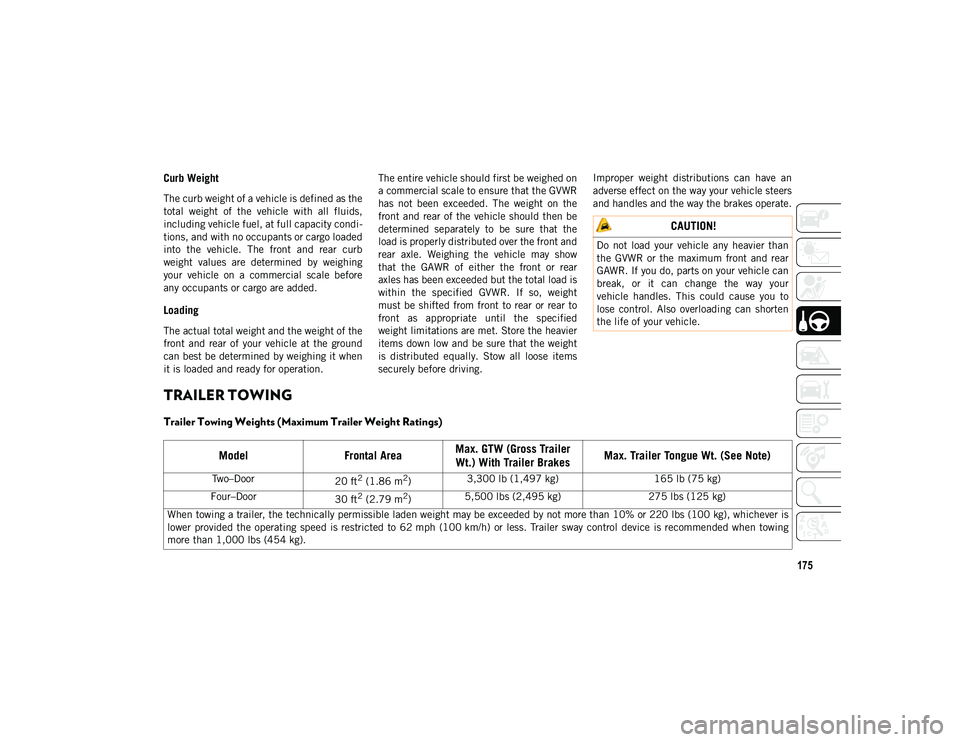
TRAILER TOWING
Trailer Towing Weights (Maximum Trailer Weight Ratings)
CAUTION!
Do not load your vehicle any heavier than
the GVWR or the maximum front and rear
GAWR. If you do, parts on your vehicle can
break, or it can change the way your
vehicle handles. This could cause you to
lose control. Also overloading can shorten
the life of your vehicle.
Model
Frontal AreaMax. GTW (Gross Trailer
Wt.) With Trailer Brakes Max. Trailer Tongue Wt. (See Note)
Two–Door
20 ft2 (1.86 m2)3,300 lb (1,497 kg)
165 lb (75 kg)
Four–Door 30 ft
2 (2.79 m2)5,500 lbs (2,495 kg)
275 lbs (125 kg)
When towing a trailer, the technically permissible laden weight may be exceeded by not more than 10% or 220 lbs (100 kg), whichever is
lower provided the operating speed is restricted to 62 mph (100 km/h) or less. Trailer sway control device is recommended when towing
more than 1,000 lbs (454 kg).
2020_JEEP_JL_WRANGLER_UG_RHD_UK.book Page 175
Page 186 of 330

IN CASE OF EMERGENCY
184
Power Distribution Center (PDC)
The Power Distribution Center (PDC) is
located in the engine compartment near the
battery. This center contains cartridge fuses,
mini fuses, and relays. The PDC top cover is
labeled with each serviceable fuse/relay loca-
tion, function, and size. NOTE:
Fuses for safety systems (marked with *)
must be serviced by an authorized dealer.
Power Distribution Center
CavityCartridge Fuse Micro Fuse Description
F01– –Spare
F02 40 Amp Green –Starter
(*)
F03 –5 Amp Tan Intelligent Battery Sensor (IBS)
(*)
F04 –20 Amp Yellow Fuel Pump MTR/FPCM
(*)
F05 –5 Amp Tan Security Gateway
(*)
F06 – –Spare
F07 –15 Amp Blue Low Temp Radiator Cooling Pump (LTR) — If Equipped
(*)
F08 –15 Amp Blue Trans Control Module TCM-8HP CYGNUS
(*)
2020_JEEP_JL_WRANGLER_UG_RHD_UK.book Page 184
Page 192 of 330
IN CASE OF EMERGENCY
190
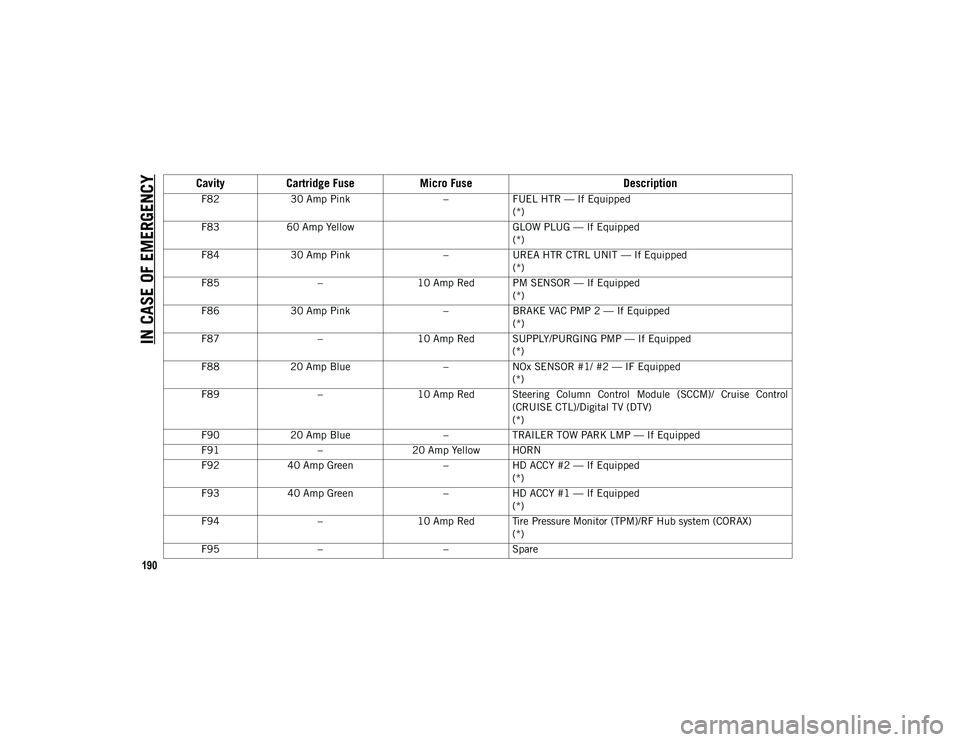
F8230 Amp Pink –FUEL HTR — If Equipped
(*)
F83 60 Amp Yellow GLOW PLUG — If Equipped
(*)
F84 30 Amp Pink –UREA HTR CTRL UNIT — If Equipped
(*)
F85 –10 Amp Red PM SENSOR — If Equipped
(*)
F86 30 Amp Pink –BRAKE VAC PMP 2 — If Equipped
(*)
F87 –10 Amp Red SUPPLY/PURGING PMP — If Equipped
(*)
F88 20 Amp Blue –NOx SENSOR #1/ #2 — IF Equipped
(*)
F89 –10 Amp Red Steering Column Control Module (SCCM)/ Cruise Control
(CRUISE CTL)/Digital TV (DTV)
(*)
F90 20 Amp Blue –TRAILER TOW PARK LMP — If Equipped
F91 –20 Amp Yellow HORN
F92 40 Amp Green –HD ACCY #2 — If Equipped
(*)
F93 40 Amp Green –HD ACCY #1 — If Equipped
(*)
F94 –10 Amp Red Tire Pressure Monitor (TPM)/RF Hub system (CORAX)
(*)
F95 – –Spare
Cavity Cartridge Fuse Micro Fuse Description
2020_JEEP_JL_WRANGLER_UG_RHD_UK.book Page 190