warning KIA Amanti 2008 1.G Owner's Guide
[x] Cancel search | Manufacturer: KIA, Model Year: 2008, Model line: Amanti, Model: KIA Amanti 2008 1.GPages: 283, PDF Size: 20.47 MB
Page 43 of 283
333
Knowing your vehicle
Since the inertial locks do not require a
collision in order to lock up, you may
become aware of the safety belts locking
while braking or going around sharp cor-
ners.The rear safety belts use a special auto-
lock feature designed to allow a child
restraint to be used without an added
locking clip. These safety belt positions
normally lock only under extreme or
emergency conditions (emergency lock
mode). However, they can be adjusted so
that they remain in fixed and locked when
a child restraint system is in place. (Use
this auto-lock mode only to secure a child
restraint, never for passengers restrained
by the safety belts.) Page 3-46 gives
instructions on placing the safety belt in
the auto lock mode.
The driver’s safety belt can only operate
in the emergency lock mode.Safety belts provide the best restraint
when:
• The seatback is upright.
• The occupant is sitting upright (not
slouched).
• The lap belt is snug across the hips.
• The shoulder belt is snug across the chest.
• The knees are straight forward.
To help you remember to fasten your
safety belt, a warning light will come on
and a chime will sound. See Safety Belt
Warning Light and Chime on page 3-35.
WARNING
Always u se the rear seat position(s)
to install your child restraint(s).
Never install a child restraint sys-
tem in the front passenger position,
as an inflating air bag could cau se
serious or fatal injury to a child in
that position.
WARNING- After a colli- sion
• Lap/s houlder belt assemblies
may be s tretched or damaged
when subjected to the stress and
force s of a collision.
• The entire res traint system
s hould be ins pected following
any collision. All belts, retractor s,
anchor s and hardware damaged
by a collision should be replaced
before the vehicle is operated
again.
Page 44 of 283
Knowing your vehicle
343
WARNING - Cargo area
(if equipped)
Passenger s should never be
allowed to ride in the cargo area of
a vehicle. No safety belt s are pro-
vided for the cargo area. Per sons
riding in the vehicle without a fa s-
tened safety belt are much more
likely to suffer serious bodily injury
or death during an accident.
WARNING- Twisted belts
A twisted or jammed safety belt
cannot restrain you properly. If you
cannot untwi st or unjam the safety
belt, have an authorized Kia dealer
repair or replace it immediately.
Never drive or ride with a twisted or
jammed safety belt.
WARNING- Belt use
Safety belts mu st be used correctly
to work properly in an accident.
Each seating po sition in your vehi-
cle has a specific safety belt assem-
bly that includes a buckle and
tongue designed to be used togeth-
er.
For greatest effectiveness, follow
thes e guidelines in using safety
belts:
•U se the shoulder portion of the
safety belt on the out side shoul-
der only. Never wear the shoulder
portion under the arm.
• Never swing the s afety belt
around your neck to fit over the
inside shoulder.
• Never wear the shoulder portion of the safety belt across the neck
or face.
(Continued)
(Continued)
• Wear the lap portion a s low as
possible. Be sure that the lap belt
fits snugly around the hips .
Never wear a lap portion of a
lap/shoulder belt over your wai st;
it should always go over the
stronger area of your hip s.
• Never use a single safety belt for
more than one per son.
• The front s eatbacks should
always remain in a comfortable,
upright po sition when the vehicle
is moving.
Page 45 of 283
335
Knowing your vehicle
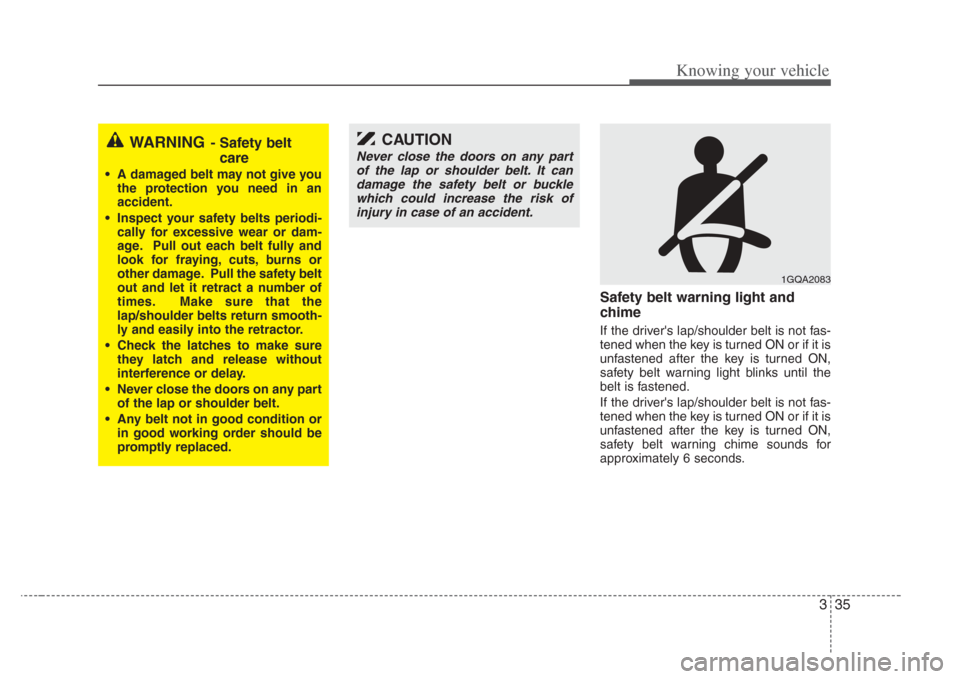
Safety belt warning light and
chime
If the driver's lap/shoulder belt is not fas-
tened when the key is turned ON or if it is
unfastened after the key is turned ON,
safety belt warning light blinks until the
belt is fastened.
If the driver's lap/shoulder belt is not fas-
tened when the key is turned ON or if it is
unfastened after the key is turned ON,
safety belt warning chime sounds for
approximately 6 seconds.
1GQA2083
WARNING- Safety beltcare
• A damaged belt may not give you
the protection you need in an
accident.
•In spect your safety belt s periodi-
cally for excessive wear or dam-
age. Pull out each belt fully and
look for fraying, cut s, burns or
other damage. Pull the safety belt
out and let it retract a number of
times . Make sure that the
lap/shoulder belts return smooth-
ly and easily into the retractor.
• Check the latches to make sure they latch and releas e without
interference or delay.
• Never close the door s on any part
of the lap or shoulder belt.
• Any belt not in good condition or in good working order should be
promptly replaced.
CAUTION
Never close the door s on any part
of the lap or shoulder belt. It can
damage the safety belt or buckle which could increase the risk ofinjury in case of an accident.
Page 47 of 283
337
Knowing your vehicle
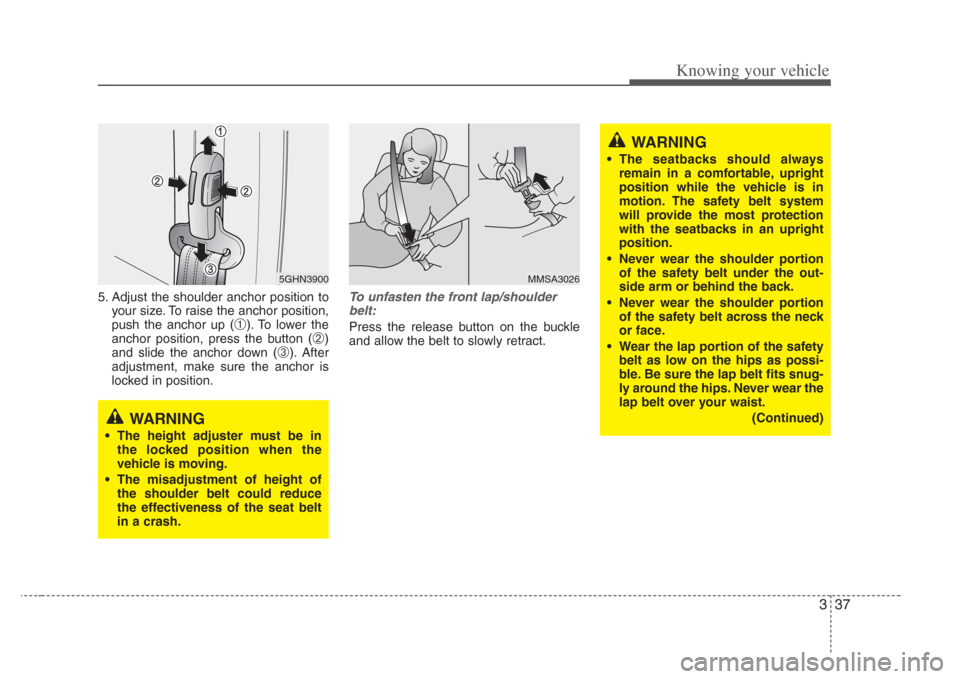
5. Adjust the shoulder anchor position toyour size. To raise the anchor position,
push the anchor up (
➀). To lower the
anchor position, press the button (
➁)
and slide the anchor down (
➂). After
adjustment, make sure the anchor is
locked in position.
To unfasten the front lap/shoulder belt:
Press the release button on the buckle
and allow the belt to slowly retract.
MMSA30265GHN3900
WARNING
• The height adju ster must be in
the locked pos ition when the
vehicle is moving.
• The misadjustment of height of the shoulder belt could reduce
the effectiveness of the seat belt
in a crash.
WARNING
• The seatbacks should always
remain in a comfortable, upright
position while the vehicle is in
motion. The safety belt system
will provide the most protection
with the seatbacks in an upright
position.
• Never wear the shoulder portion of the safety belt under the out-
side arm or behind the back.
• Never wear the shoulder portion of the safety belt across the neck
or face.
• Wear the lap portion of the safety
belt as low on the hips a s possi-
ble. Be sure the lap belt fits snug-
ly around the hip s. Never wear the
lap belt over your wai st.
(Continued)
Page 48 of 283
Knowing your vehicle
383
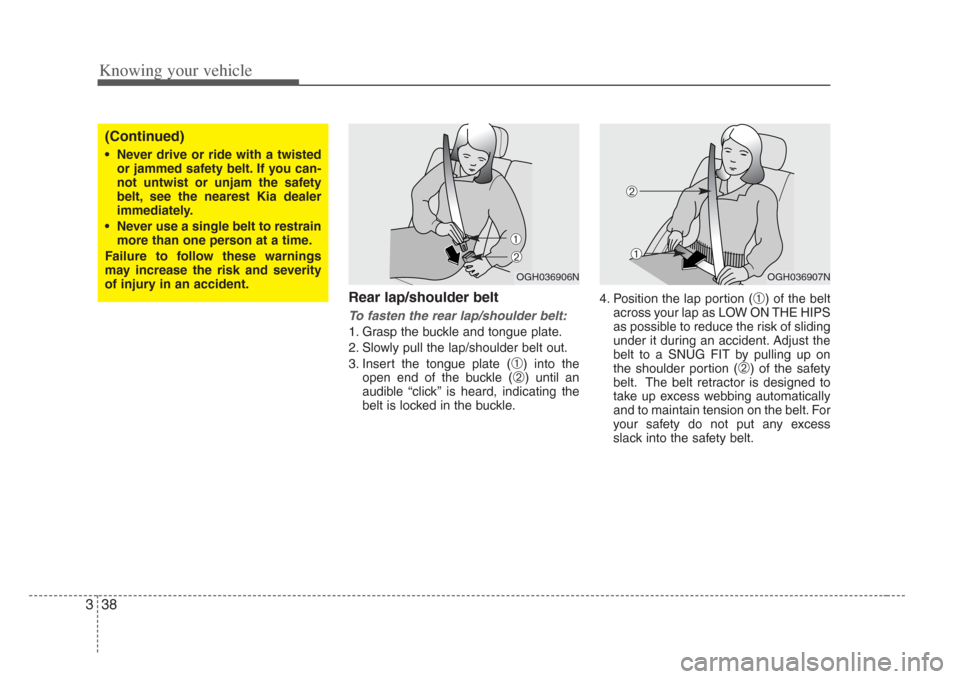
Rear lap/shoulder belt
To f asten the rear lap/ shoulder belt:
1. Grasp the buckle and tongue plate.
2. Slowly pull the lap/shoulder belt out.
3. Insert the tongue plate (
➀) into the
open end of the buckle (
➁) until an
audible “click’’ is heard, indicating the
belt is locked in the buckle. 4. Position the lap portion (
➀) of the belt
across your lap as LOW ON THE HIPS
as possible to reduce the risk of sliding
under it during an accident. Adjust the
belt to a SNUG FIT by pulling up on
the shoulder portion (
➁) of the safety
belt. The belt retractor is designed to
take up excess webbing automatically
and to maintain tension on the belt. For
your safety do not put any excess
slack into the safety belt.
(Continued)
• Never drive or ride with a twi sted
or jammed safety belt. If you can-
not untwist or unjam the safety
belt, see the nearest Kia dealer
immediately.
• Never use a single belt to restrain more than one per son at a time.
Failure to follow thes e warnings
may increase the risk and severity
of injury in an accident.
OGH036906NOGH036907N
➀
➁➀
➁
Page 49 of 283
339
Knowing your vehicle
To unfasten:
Press the release button on the buckle
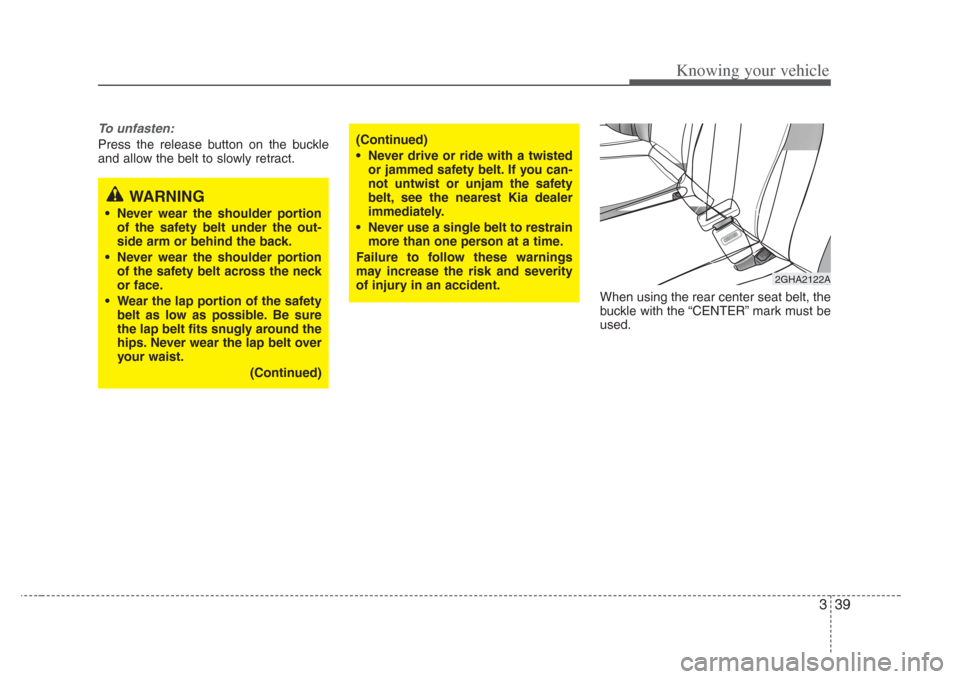
and allow the belt to slowly retract.When using the rear center seat belt, the
buckle with the “CENTER” mark must be
used.
WARNING
• Never wear the shoulder portionof the safety belt under the out-
side arm or behind the back.
• Never wear the shoulder portion of the safety belt across the neck
or face.
• Wear the lap portion of the safety
belt as low as possible. Be sure
the lap belt fits snugly around the
hips. Never wear the lap belt over
your waist.
(Continued)
(Continued)
• Never drive or ride with a twi sted
or jammed safety belt. If you can-
not untwist or unjam the safety
belt, see the nearest Kia dealer
immediately.
• Never use a single belt to restrain more than one per son at a time.
Failure to follow thes e warnings
may increase the risk and severity
of injury in an accident.
2GHA2122A
Page 50 of 283
Knowing your vehicle
403
Proper use and care of the safety
belt system
To ensure that the safety belts provide
the maximum protection, please follow
these instructions:
• Use the belts at all times - even on
short trips.
• If the safety belt is twisted, straighten it prior to use.
• Keep sharp edges and damaging objects away from the belts.
• Periodically inspect belt webbing, anchors, buckles and all other parts for
signs of wear and damage. Replace
damaged, excessively worn or ques-
tionable parts immediately. • To clean the belt webbing, use a mild
soap solution recommended for clean-
ing upholstery or carpets. Follow the
instructions provided with the soap.
Do not bleach or dye the webbing
because this may weaken the webbing
fibers and allow them to fail when
loaded in a collision.
• Do not make modifications or additions to the safety belt.
• After wearing a safety belt, make sure it fully retracts to the stowed position.
Do not allow the belt to get caught in
the door when you close it.
Restraint of pregnant women
Pregnant women should wear lap/shoul-
der belt assemblies whenever possible
according to specific recommendations
by their doctors. The lap portion of the
belt should be worn AS SNUGLY AND
LOW AS POSSIBLE.
WARNING - Pregnantwomen
Pregnant women must never place
the lap portion of the safety belt
over the area of the abdomen where
the fetus i s located or above the
abdomen where the belt could
crush the fetus during an impact.
Page 51 of 283
341
Knowing your vehicle
Restraint of infants and small
children
To increase their safety, infants and
young children should always be
restrained by a restraint system
approved for their age and size.
Never allow a child to stand or kneel on
the seat of a moving vehicle. Never allow
a safety belt to be placed around both a
child and an adult or around two children
at the same time.
It is best for children to be seated in the
rear seats. Many companies manufacture child
restraint systems (often called child
seats) for infants and small children. An
acceptable child restraint system must
always satisfy Canadian Motor Vehicle
Safety Standards. Make sure that any
child-restraint system you use in your
vehicle is labelled as complying with
Federal Safety Standards.
The child-restraint system should be
chosen to fit both the size of the child and
the size of the vehicle seat. Be sure to fol-
low any instructions provided by the
child-restraint system manufacturer
when installing the child-restraint system.
WARNING- Children on
laps
Never hold a child on your lap or in
your arms in a moving vehicle.
Even a very strong per son cannot
hold onto a child in the event of
even a minor collision.
WARNING- Infants and
young children
• Infants and young children are at
much greater ris k of serious injury
or death in an accident or s udden
s top if they are unres trained or
res trained improperly. Follow all
ins tructions in this s ection of your
Kia manual and the ins tructions
that came on and with an
improved child s afety restraint
s ystem. The child res traint must
be correctly ins talled in the vehi-
cle, and the child mus t be correct-
ly in stalled in the child res traint.
• All children under 12 are safest in the back seat.
• Never install a child or infant seat in the front passenger position.
The baby could be injured or
killed by the air bag if it deploys in
an accident.
•
Never allow a child to s tand or
kneel on the s eat of a moving vehi-
cle. In sis t the child s it down in an
approved res traint system.
Page 52 of 283
Knowing your vehicle
423
Restraint of larger children
As children grow, they may need to use
new child-restraint systems, including
larger child seats or booster seats, which
are appropriate for their increased size.
A child who has outgrown available child-
restraint systems should use the belts
provided in the vehicle. When seated in
the rear outboard seats, the child should
be restrained by the lap/shoulder belt.
If the shoulder belt portion slightly touch-
es the child’s neck or face, try placing the
child closer to the center of the vehicle. If
the shoulder belt still touches their face
or neck they may need to be returned to
a child restraint system. In addition, after-
market devices are available from inde-
pendent manufacturers which help pull
the shoulder belt down and away from
the child’s face or neck.
Larger children should use one of the
seat belts provided.WARNING- Shoulder belts
on small children
• Never allow a shoulder belt to be
in contact with a child’ s neck or
face while the vehicle is in
motion.
• If safety belt s are not properly
worn and adjusted, there is a risk
of death or serious injury to a
child.
WARNING- Hot metal parts
Safety belts and seats can become
hot in a vehicle that has been
clo sed during warm/hot weather;
they could burn a child. Check seat
cover s and buckles before you
place a child anywhere near them.
Page 53 of 283
343
Knowing your vehicle
Child restraint system
(if equipped)
For small children and babies, the use of
a child seat or infant seat is required by
law. This child seat or infant seat should
be of appropriate size for the child and
should be installed in accordance with
the manufacturer's instructions. It is
strongly recommended that the seat be
placed in the vehicle's rear seat since
this can make an important contribution
to safety.
Children riding in the car should sit on
the rear seat and must always be proper-
ly restrained to minimize the risk of injury
in an accident, sudden stop or sudden
maneuver. According to accident statis-
tics, children are safer when properly
restrained in the rear seats than in the
front seat. You are required by law to use safety
restraints for children. If small children
ride in your vehicle you must put them in
a child restraint system (safety seat).
Children could be injured or killed in a
crash if their restraints are not properly
secured. For small children and babies, a
child seat or infant seat must be used.
Before buying a particular child restraint
system, make sure it fits your car and
seat belts, and fits your child. Follow all
the instructions provided by the manufac-
turer when installing the child restraint
system.
ADAIRBAG
WARNING
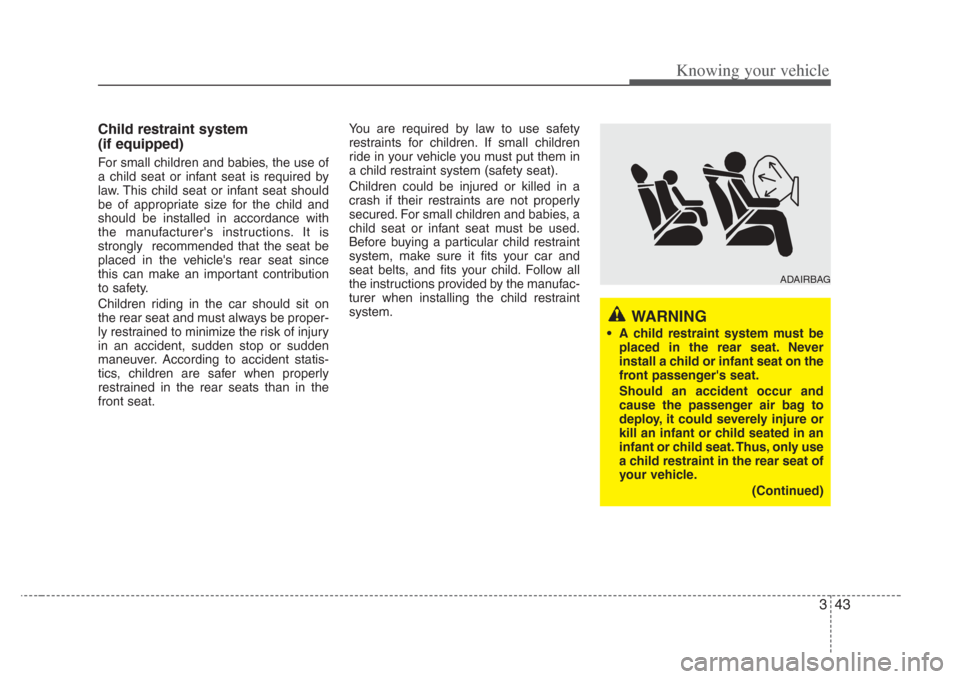
• A child restraint
system must be
placed in the rear s eat. Never
install a child or infant seat on the
front passenger's seat.
Should an accident occur and
cause the passenger air bag to
deploy, it could severely injure or
kill an infant or child seated in an
infant or child seat. Thus, only use
a child restraint in the rear seat of
your vehicle.
(Continued)