child restraint KIA AMANTI 2009 User Guide
[x] Cancel search | Manufacturer: KIA, Model Year: 2009, Model line: AMANTI, Model: KIA AMANTI 2009Pages: 321, PDF Size: 23.77 MB
Page 61 of 321

349
Knowing your vehicle
Child seat lower anchorsSome child seat manufacturers make
child restraint seats that are labeled as
LATCH or LATCH compatible. LATCH
stands for “Lower Anchors and Tethers
for Children”. These seats include two
rigid or webbing mounted attachments
that connect to two lower anchors and a
tether anchors at specific seating posi-
tions in your vehicle. This type of child
restraint seat eliminates the need to use
seat belts to attach the child seat in the
rear seats.
WARNING
- Tether strap
If the tether strap is secured incor-
rectly, the child restraint seat may
not be restrained properly in the
event of a collision. Do not mount
more than one child restraint seat
to a tether anchorage, since the
anchorage can then fail in a colli-
sion.
2GHN2025A
WARNING
- Child restraint
Check that the child restraint sys-
tem is secure by pushing and
pulling it in different directions.
Incorrectly fitted child restraints
may swing, twist, tip or come away
causing death or injury.
WARNING
- Child restraintanchorage
Child restraint anchorages are
designed to withstand only those
loads imposed by correctly fitted
child restraints. Under no circum-
stances are they to be used for
adult seat belts or harnesses or
for attaching other items or
equipment to the vehicle.
The tether strap may not work properly if attached somewhere
other than the correct tether
anchor.
Page 62 of 321

Knowing your vehicle50
3There is a child restraint symbol located
on the lower portion of each side of the
rear seatbacks. These symbols indicate
the position of the lower anchors for child
restraints so equipped. LATCH anchors have been provided in
your vehicle. The LATCH anchors are
located in the left and right outboard rear
seating positions. Their locations are
shown in the illustration. There is no
LATCH anchor provided for the center
rear seating position.
The LATCH anchors are located between
the seatback and the seat cushion of the
rear seat left and right outboard seating
positions.Follow the child seat manufacturer’s
instructions to properly install child
restraint seats with LATCH or LATCH-
compatible attachments.
Once you have installed the LATCH child
restraint, assure that the seat is properly
attached to the LATCH and tether
anchors. Also, test the child restraint seat
before you place the child in it. Tilt the
seat from side to side. Also try to tug the
seat forward. Check to see if the anchors
hold the seat in place.
6GHA2127
2GHA2127/SBGQ03102
CAUTION
Do not allow the rear seat belt web-
bing to get scratched or pinched bythe child-seat latch and LATCH anchor during the installation.
ISOFIX AnchorISOFIX Anchor
Position Indicator
Page 63 of 321

351
Knowing your vehicle
WARNING
If the child restraint is not anchored
properly, the risk of a child being
seriously injured or killed in a colli-
sion greatly increases.
WARNING
When using the vehicle’s “LATCH”
system to install a child restraint
system in the rear seat, all unused
vehicle rear seat belt metal latch
plates or tabs must be latched
securely in their seat belt buckles
and the seat belt webbing must be
retracted behind the child restraint
to prevent the child from reaching
and taking hold of unretracted seat
belts. Unlatched metal latch plates
or tabs may allow the child to reach
the unretracted seat belts which
may result in strangulation and a
serious injury or death to the child
in the child restraint.
WARNING
Do not mount more than onechild restraint to a single tether or
to a child restraint lower anchor-
age point. The improper
increased load may cause the
anchorage points or tether
anchor to break, causing serious
injury or death.
Do not install a child restraint seat at the rear center seating
position using the vehicle’s
LATCH anchors. The LATCH
anchors are only provided for the
left and right outboard rear seat-
ing positions. Do not misuse the
LATCH anchors by attempting to
attach a child restraint seat in the
middle rear seating position to
the LATCH anchors.
In a crash, the child restraint seat
LATCH attachments may not be
strong enough to secure the child
restraint seat improperly in the
rear center seating position and
may break, causing serious injury
or death.
(Continued)
(Continued)
Attach the LATCH or LATCH-com-patible child restraint seat only to
the appropriate locations shown
in the illustration.
Always follow the installation and use instructions provided by the
manufacturer of the child restraint.
Page 72 of 321
Knowing your vehicle60
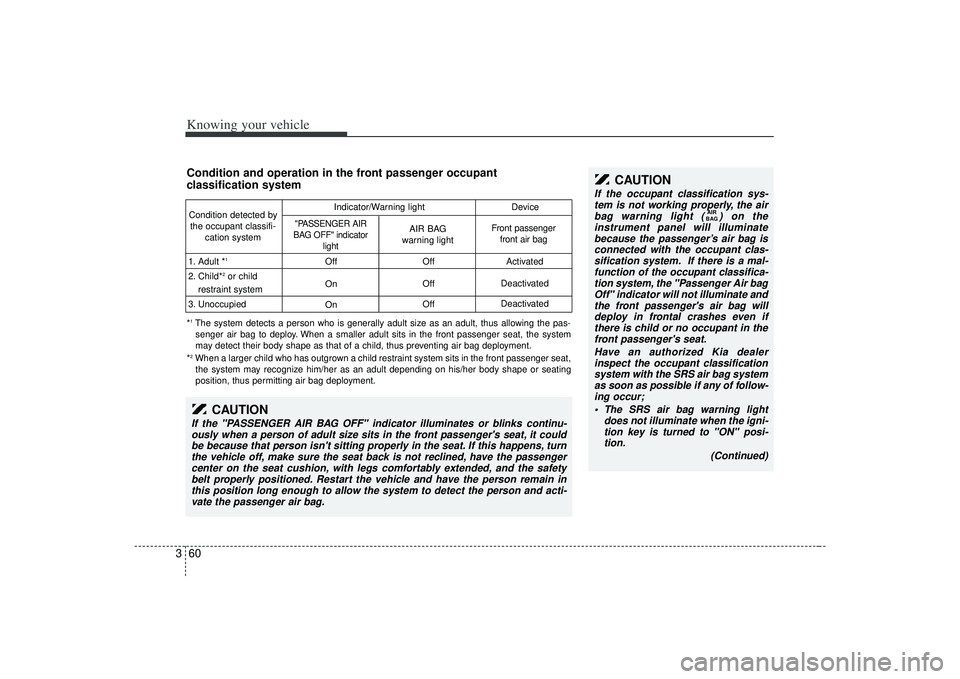
3Condition and operation in the front passenger occupant
classification systemCondition detected by
the occupant classifi- cation system
1. Adult *
1
2. Child*
2or child
restraint system
3. Unoccupied Off
On
On Off
Off
Off
Activated
Deactivated
Deactivated
"PASSENGER AIR
BAG OFF" indicator light
AIR BAG
warning light Front passenger
front air bag
Indicator/Warning light
Device
*1The system detects a person who is generally adult size as an adult, thus allowing the pas-
senger air bag to deploy. When a smaller adult sits in the front passenger seat, the system
may detect their body shape as that of a child, thus preventing air bag deployment.
*2When a larger child who has outgrown a child restraint system sits in the front passenger seat, the system may recognize him/her as an adult depending on his/her body shape or seating
position, thus permitting air bag deployment.
CAUTION
If the "PASSENGER AIR BAG OFF" indicator illuminates or blinks continu- ously when a person of adult size sits in the front passenger's seat, it could be because that person isn't sitting properly in the seat. If this happens, turnthe vehicle off, make sure the seat back is not reclined, have the passengercenter on the seat cushion, with legs comfortably extended, and the safetybelt properly positioned. Restart the vehicle and have the person remain in this position long enough to allow the system to detect the person and acti-vate the passenger air bag.
CAUTION
If the occupant classification sys- tem is not working properly, the airbag warning light ( ) on theinstrument panel will illuminate because the passenger’s air bag isconnected with the occupant clas-sification system. If there is a mal- function of the occupant classifica-tion system, the "Passenger Air bag Off" indicator will not illuminate andthe front passenger's air bag will deploy in frontal crashes even ifthere is child or no occupant in the front passenger's seat.
Have an authorized Kia dealerinspect the occupant classification system with the SRS air bag systemas soon as possible if any of follow-ing occur;
The SRS air bag warning light does not illuminate when the igni-tion key is turned to "ON" posi-tion.
(Continued)
AIR
BAG
Page 73 of 321
361
Knowing your vehicle
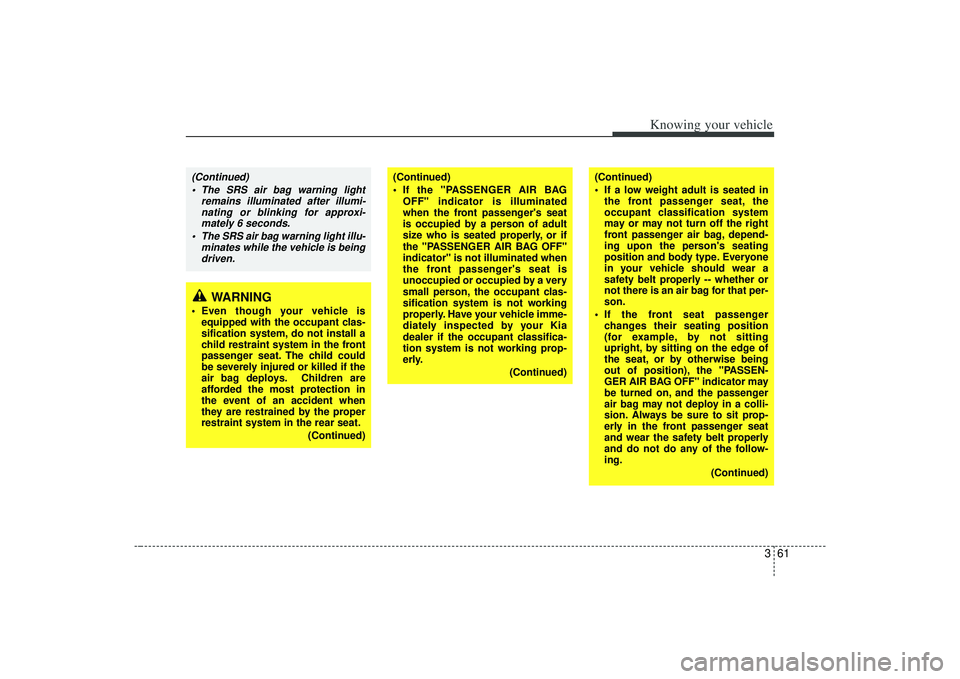
WARNING
Even though your vehicle isequipped with the occupant clas-
sification system, do not install a
child restraint system in the front
passenger seat. The child could
be severely injured or killed if the
air bag deploys. Children are
afforded the most protection in
the event of an accident when
they are restrained by the proper
restraint system in the rear seat.
(Continued)
(Continued)
If the "PASSENGER AIR BAGOFF" indicator is illuminated
when the front passenger's seat
is occupied by a person of adult
size who is seated properly, or if
the "PASSENGER AIR BAG OFF"
indicator" is not illuminated when
the front passenger's seat is
unoccupied or occupied by a very
small person, the occupant clas-
sification system is not working
properly. Have your vehicle imme-
diately inspected by your Kia
dealer if the occupant classifica-
tion system is not working prop-
erly.
(Continued)
(Continued)
If a low weight adult is seated inthe front passenger seat, the
occupant classification system
may or may not turn off the right
front passenger air bag, depend-
ing upon the person's seating
position and body type. Everyone
in your vehicle should wear a
safety belt properly -- whether or
not there is an air bag for that per-
son.
If the front seat passenger changes their seating position
(for example, by not sitting
upright, by sitting on the edge of
the seat, or by otherwise being
out of position), the "PASSEN-
GER AIR BAG OFF" indicator may
be turned on, and the passenger
air bag may not deploy in a colli-
sion. Always be sure to sit prop-
erly in the front passenger seat
and wear the safety belt properly
and do not do any of the follow-
ing.
(Continued)
(Continued) The SRS air bag warning light remains illuminated after illumi-nating or blinking for approxi-mately 6 seconds.
The SRS air bag warning light illu- minates while the vehicle is beingdriven.
Page 76 of 321
Knowing your vehicle64
3
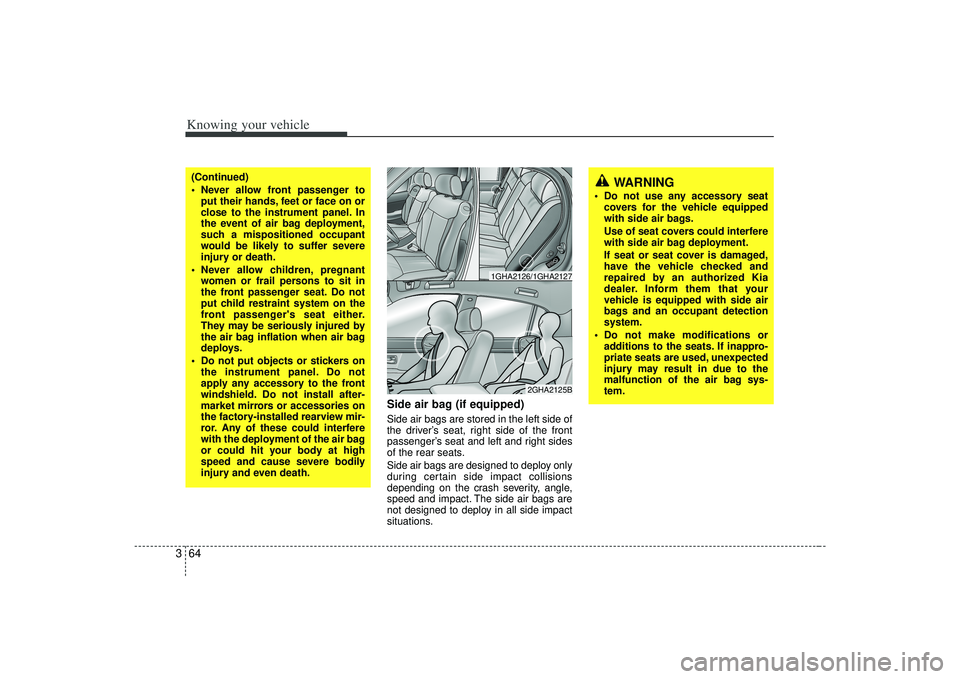
Side air bag (if equipped)Side air bags are stored in the left side of
the driver’s seat, right side of the front
passenger’s seat and left and right sides
of the rear seats.
Side air bags are designed to deploy only
during certain side impact collisions
depending on the crash severity, angle,
speed and impact. The side air bags are
not designed to deploy in all side impact
situations.
WARNING
Do not use any accessory seat
covers for the vehicle equipped
with side air bags.
Use of seat covers could interfere
with side air bag deployment.
If seat or seat cover is damaged,
have the vehicle checked and
repaired by an authorized Kia
dealer. Inform them that your
vehicle is equipped with side air
bags and an occupant detection
system.
Do not make modifications or additions to the seats. If inappro-
priate seats are used, unexpected
injury may result in due to the
malfunction of the air bag sys-
tem.
2GHA2125B
1GHA2126/1GHA2127
(Continued)
Never allow front passenger toput their hands, feet or face on or
close to the instrument panel. In
the event of air bag deployment,
such a mispositioned occupant
would be likely to suffer severe
injury or death.
Never allow children, pregnant women or frail persons to sit in
the front passenger seat. Do not
put child restraint system on the
front passenger's seat either.
They may be seriously injured by
the air bag inflation when air bag
deploys.
Do not put objects or stickers on the instrument panel. Do not
apply any accessory to the front
windshield. Do not install after-
market mirrors or accessories on
the factory-installed rearview mir-
ror. Any of these could interfere
with the deployment of the air bag
or could hit your body at high
speed and cause severe bodily
injury and even death.
Page 77 of 321
365
Knowing your vehicle
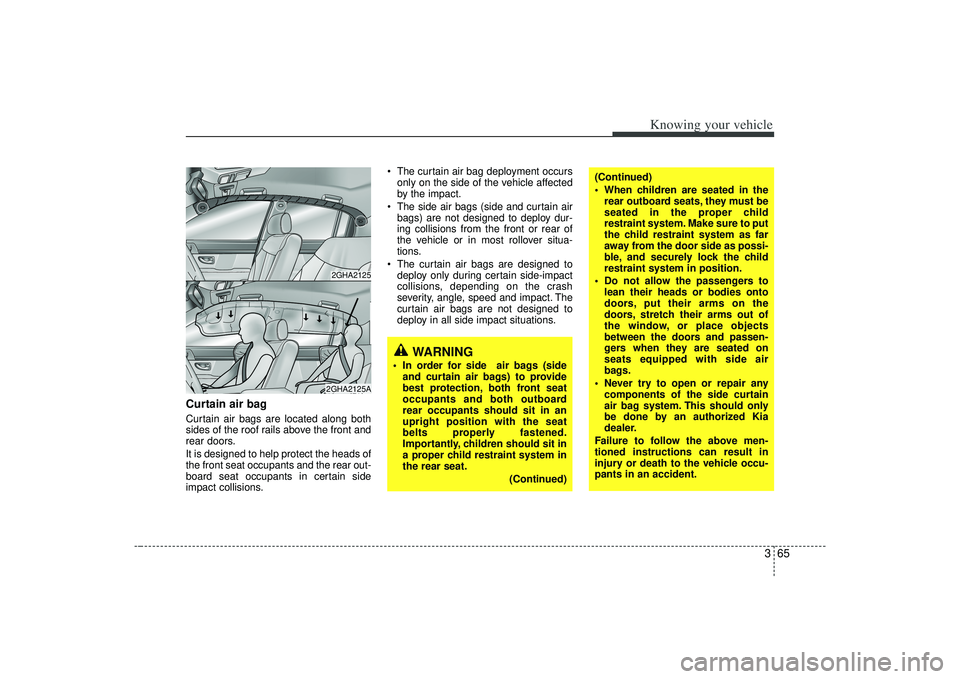
Curtain air bagCurtain air bags are located along both
sides of the roof rails above the front and
rear doors.
It is designed to help protect the heads of
the front seat occupants and the rear out-
board seat occupants in certain side
impact collisions. The curtain air bag deployment occurs
only on the side of the vehicle affected
by the impact.
The side air bags (side and curtain air bags) are not designed to deploy dur-
ing collisions from the front or rear of
the vehicle or in most rollover situa-
tions.
The curtain air bags are designed to deploy only during certain side-impact
collisions, depending on the crash
severity, angle, speed and impact. The
curtain air bags are not designed to
deploy in all side impact situations.
WARNING
In order for side air bags (sideand curtain air bags) to provide
best protection, both front seat
occupants and both outboard
rear occupants should sit in an
upright position with the seat
belts properly fastened.
Importantly, children should sit in
a proper child restraint system in
the rear seat.
(Continued)
(Continued)
When children are seated in therear outboard seats, they must be
seated in the proper child
restraint system. Make sure to put
the child restraint system as far
away from the door side as possi-
ble, and securely lock the child
restraint system in position.
Do not allow the passengers to lean their heads or bodies onto
doors, put their arms on the
doors, stretch their arms out of
the window, or place objects
between the doors and passen-
gers when they are seated on
seats equipped with side air
bags.
Never try to open or repair any components of the side curtain
air bag system. This should only
be done by an authorized Kia
dealer.
Failure to follow the above men-
tioned instructions can result in
injury or death to the vehicle occu-
pants in an accident.
2GHA21252GHA2125A
Page 85 of 321
373
Knowing your vehicle
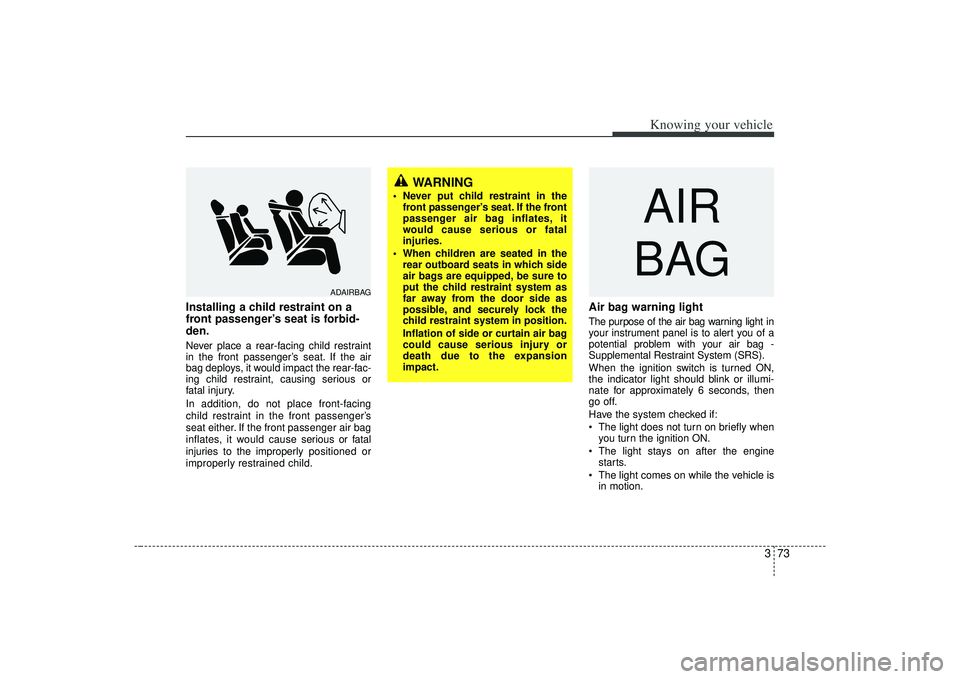
Installing a child restraint on a
front passenger’s seat is forbid-
den.Never place a rear-facing child restraint
in the front passenger’s seat. If the air
bag deploys, it would impact the rear-fac-
ing child restraint, causing serious or
fatal injury.
In addition, do not place front-facing
child restraint in the front passenger’s
seat either. If the front passenger air bag
inflates, it would cause serious or fatal
injuries to the improperly positioned or
improperly restrained child.
Air bag warning lightThe purpose of the air bag warning light in
your instrument panel is to alert you of a
potential problem with your air bag -
Supplemental Restraint System (SRS).
When the ignition switch is turned ON,
the indicator light should blink or illumi-
nate for approximately 6 seconds, then
go off.
Have the system checked if:
The light does not turn on briefly when you turn the ignition ON.
The light stays on after the engine starts.
The light comes on while the vehicle is in motion.
ADAIRBAG
AIR
BAG
WARNING
Never put child restraint in the front passenger’s seat. If the front
passenger air bag inflates, it
would cause serious or fatal
injuries.
When children are seated in the rear outboard seats in which side
air bags are equipped, be sure to
put the child restraint system as
far away from the door side as
possible, and securely lock the
child restraint system in position.
Inflation of side or curtain air bag
could cause serious injury or
death due to the expansion
impact.
Page 209 of 321
517
Driving tips
If you carry items inside your vehicle
- like suitcases, tools, packages, or
anything else - they are moving as
fast as the vehicle. If you have to stop
or turn quickly, or if there is a crash,
the items will keep going and can
cause an injury if they strike the driv-
er or a passenger.This section will guide you in the
proper loading of your vehicle and/or
trailer, to keep your loaded vehicle
weight within its design rating capa-
bility, with or without a trailer.
Properly loading your vehicle will
provide maximum return of the vehi-
cle design performance. Before load-
ing your vehicle, familiarize yourself
with the following terms for determin-
ing your vehicle's weight ratings, with
or without a trailer, from the vehicle's
specifications and the compliance
label:
Base curb weight
This is the weight of the vehicle
including a full tank of fuel and all
standard equipment. It does not
include passengers, cargo, or option-
al equipment.
Vehicle curb weight
This is the weight of your new vehicle
when you picked it up from your deal-
er plus any aftermarket equipment.
Cargo weight
This figure includes all weight added
to the Base Curb Weight, including
cargo and optional equipment.GAW (Gross axle weight)
This is the total weight placed on
each axle (front and rear) - including
vehicle curb weight and all payload.
GAWR (Gross axle weight rating)This is the maximum allowable
weight that can be carried by a single
axle (front or rear). These numbers
are shown on the compliance label.
The total load on each axle must
never exceed its GAWR.
GVW (Gross vehicle weight)
This is the Base Curb Weight plus
actual Cargo Weight plus passen-
gers.
GVWR (Gross vehicle weight rating)
This is the maximum allowable
weight of the fully loaded vehicle
(including all options, equipment,
passengers and cargo). The GVWR
is shown on the compliance label
located on the driver’s door sill.
WARNING
- Loose cargo
Items you carry inside your
vehicle can strike and injure
occupants in a sudden stop or
turn, or in a crash.
Put items in the cargo area of your vehicle. Try to spread the
weight evenly.
Never stack items, like suit- cases, inside the vehicle
above the tops of the seats.
Do not leave an unsecured child restraint in your vehicle.
When you carry something inside the vehicle, secure it.
Do not drive with a seat folded down unless necessary.
WEIGHT OF THE VEHICLE
Page 314 of 321

10
3
Index
California Perchlorate Notice ··················\
··················\
··· 7-52
Capacities ··················\
··················\
··················\
··················\
·8-3
Careof the Safety Belt System, Proper Use and ·················3-40\
Exterior ··················\
··················\
··················\
··················\
7-48
Interior ··················\
··················\
··················\
··················\
·7-51
Catalytic Converters, Operating Precautions for·············5-4
Chain Installation ··················\
··················\
··················\
·············5-11
Safety ··················\
··················\
··················\
··················\
···5-21
Tire··················\
··················\
··················\
··················\
·······5-10
Charging System Warning ··················\
··················\
·········4-32
Child Restraint System ··················\
··················\
··················\
····3-43
Safety Lock, Rear Door··················\
··················\
···········3-12
Children Restraint of Infants and Small ··················\
··················\
·3-41
Restraint of Larger··················\
··················\
··················\
·3-42
Cigarette Lighter ··················\
··················\
··················\
······3-91
Cleaner, Air ··················\
··················\
··················\
··············7-21
Cleaning Interior Window Glass·················\
··················\
··············7-51
Lap/Shoulder Belt Webbing ··················\
··················\
····7-51
Upholstery and Interior Trim··················\
··················\
···7-51
Climate Control System, Automatic ··················\
············4-46 Air Filter ··················\
··················\
··················\
················7-22
Clock ··················\
··················\
··················\
··················\
······3-95 Cluster, Instrument··················\
··················\
··················\
···4-25
Compartment, Engine··················\
··················\
·········2-4, 7-12
Consumer Assistance ··················\
··················\
··················\
·9-2
Coolant Level, Checking the ··················\
··················\
·····7-14
Cooling System, Engine ··················\
··················\
············7-14
Cruise Control System ··················\
··················\
···············4-19
Cup Holder··················\
··················\
··················\
···············3-92
Day/Night Rearview Mirror ··················\
··················\
······3-86
Defroster ··················\
··················\
··················\
··················\
4-44
Rear Window ··················\
··················\
··················\
·········4-44
Dimensions ··················\
··················\
··················\
················8-2
Disc Brake Wear Indicators ··················\
··················\
·······4-11
Dome Light ··················\
··················\
··················\
··············3-88
Door Child Safety Lock, Rear ··················\
··················\
··········3-12
Courtesy Lamp ··················\
··················\
··················\
······3-88
Locks ··················\
··················\
··················\
··················\
·····3-9
Open Display ··················\
··················\
··················\
·········4-34
Driver Position Memory System ··················\
·················3-28\
Driving at Night ··················\
··················\
··················\
··················\
··5-8
Conditions, Special ··················\
··················\
··················\
··5-7
Conditions, Hazardous ··················\
··················\
··············5-7
in Flooded Areas··················\
··················\
··················\
····5-12
in the Rain ··················\
··················\
··················\
···············5-8
Tips ··················\
··················\
··················\
··················\
········5-1C
D