lock KIA AMANTI 2009 Owner's Manual
[x] Cancel search | Manufacturer: KIA, Model Year: 2009, Model line: AMANTI, Model: KIA AMANTI 2009Pages: 321, PDF Size: 23.77 MB
Page 35 of 321
323
Knowing your vehicle
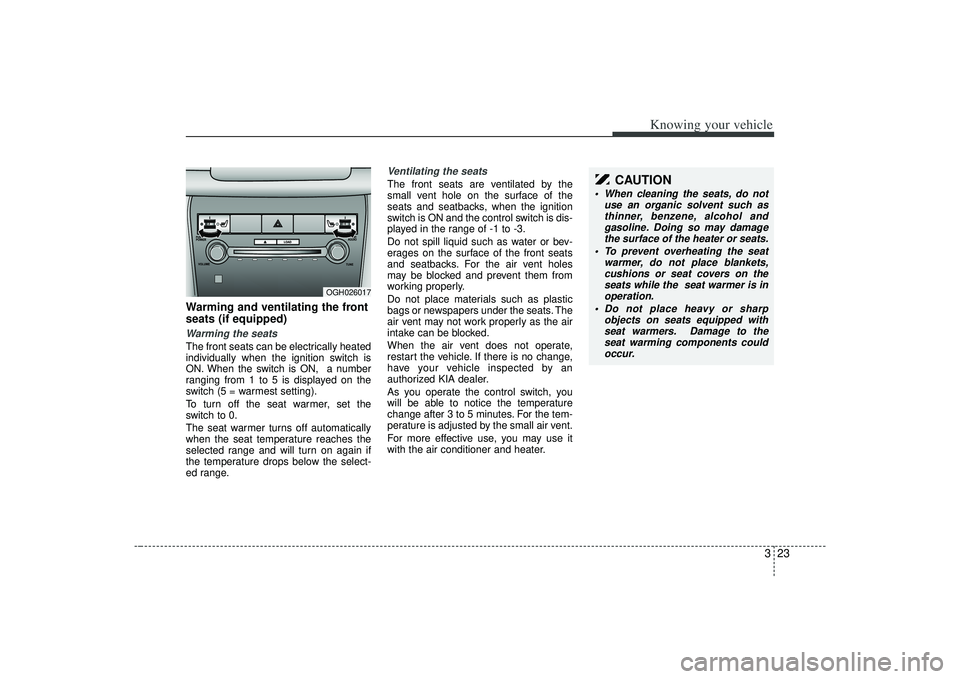
Warming and ventilating the front
seats (if equipped)Warming the seatsThe front seats can be electrically heated
individually when the ignition switch is
ON. When the switch is ON, a number
ranging from 1 to 5 is displayed on the
switch (5 = warmest setting).
To turn off the seat warmer, set the
switch to 0.
The seat warmer turns off automatically
when the seat temperature reaches the
selected range and will turn on again if
the temperature drops below the select-
ed range.
Ventilating the seatsThe front seats are ventilated by the
small vent hole on the surface of the
seats and seatbacks, when the ignition
switch is ON and the control switch is dis-
played in the range of -1 to -3.
Do not spill liquid such as water or bev-
erages on the surface of the front seats
and seatbacks. For the air vent holes
may be blocked and prevent them from
working properly.
Do not place materials such as plastic
bags or newspapers under the seats. The
air vent may not work properly as the air
intake can be blocked.
When the air vent does not operate,
restart the vehicle. If there is no change,
have your vehicle inspected by an
authorized KIA dealer.
As you operate the control switch, you
will be able to notice the temperature
change after 3 to 5 minutes. For the tem-
perature is adjusted by the small air vent.
For more effective use, you may use it
with the air conditioner and heater.
OGH026017
CAUTION
When cleaning the seats, do notuse an organic solvent such asthinner, benzene, alcohol and gasoline. Doing so may damagethe surface of the heater or seats.
To prevent overheating the seat warmer, do not place blankets,cushions or seat covers on the seats while the seat warmer is inoperation.
Do not place heavy or sharp objects on seats equipped withseat warmers. Damage to theseat warming components couldoccur.
Page 41 of 321
329
Knowing your vehicle
Storing and recalling with trans-
mitterStoring with the transmitterTurn the ignition switch to LOCK from ON
and lock all the doors using the transmit-
ter. The seat and outside rearview mirror
positions will be stored in the system
memory.
Driver’s position recalling with trans-mitterUnlock the door with the transmitter,
positions stored in the system memory
will be recalled automatically.
If using two transmitters, recalling times
may vary because stored positions in
each transmitter may be different.
Example) If doors are locked with trans-
mitter A and unlocked with transmitter B,
the positions memorized when unlocked
with transmitter B will be recalled and
may take slightly longer than if unlocked
with transmitter A.
Page 44 of 321
Knowing your vehicle32
3
Safety belt restraint system
We strongly recommend that the driver
and all passengers be properly
restrained at all times by using the safety
belts provided with the vehicle. Proper
use of the safety belts decreases the risk
of severe injury or death in accidents or
sudden stops. In most states, and in
Canada, the law requires their use.
All seats have lap/shoulder belts. Inertial
locks in the safety belt retractors allow all
of the lap/shoulder safety belts to remain
unlocked during normal vehicle opera-
tion. This allows the occupants some
freedom of movement and increased
comfort while using the safety belts. If a
force is applied to the vehicle, such as a
strong stop, a sharp turn, or a collision,
the safety belt retractors will automatical-
ly lock the safety belts.
WARNING
Do not strike the pre-tensioner
seat belt assemblies.
Do not attempt to service or repair the pre-tensioner seat belt
system in any manner.
Improper handling of the pre-ten- sioner seat belt assemblies, and
failure to heed the warnings not
to strike, modify, inspect, place,
service or repair the pre-tension-
er seat belt assemblies may lead
to improper operation or inadver-
tent activation causing serious
injury.
Always wear the seat belts
when driving or riding in a motor
vehicle.
WARNING
- Safety belts
To minimize the risk of serious or
fatal injury in an accident, the driv-
er and all passengers should use
the appropriate safety restraints for
their age and size. The presence of
air bags does not change the need
to be properly restrained by a safe-
ty belt or size-appropriate child
restraint. In fact, air bags are
designed to work the best when
passengers are correctly restrained
in the vehicle. Be sure you are
familiar with the information in this
section, including the information
on infant and child restraints. Read
the safety warnings on the sun
visors of your vehicle also.
Page 45 of 321
333
Knowing your vehicle
Since the inertial locks do not require a
collision in order to lock up, you may
become aware of the safety belts locking
while braking or going around sharp cor-
ners.The rear safety belts use a special auto-
lock feature designed to allow a child
restraint to be used without an added
locking clip. These safety belt positions
normally lock only under extreme or
emergency conditions (emergency lock
mode). However, they can be adjusted so
that they remain in fixed and locked when
a child restraint system is in place. (Use
this auto-lock mode only to secure a child
restraint, never for passengers restrained
by the safety belts.) Page 3-46 gives
instructions on placing the safety belt in
the auto lock mode.
The driver’s safety belt can only operate
in the emergency lock mode.Safety belts provide the best restraint
when:
The seatback is upright.
The occupant is sitting upright (not
slouched).
The lap belt is snug across the hips.
The shoulder belt is snug across the chest.
The knees are straight forward.
To help you remember to fasten your
safety belt, a warning light will come on
and a chime will sound. See Safety Belt
Warning Light and Chime on page 3-35.
WARNING
Always use the rear seat position(s)
to install your child restraint(s).
Never install a child restraint sys-
tem in the front passenger position,
as an inflating air bag could cause
serious or fatal injury to a child in
that position.
WARNING
- After a colli- sion
Lap/shoulder belt assemblies
may be stretched or damaged
when subjected to the stress and
forces of a collision.
The entire restraint system should be inspected following
any collision. All belts, retractors,
anchors and hardware damaged
by a collision should be replaced
before the vehicle is operated
again.
Page 48 of 321
Knowing your vehicle36
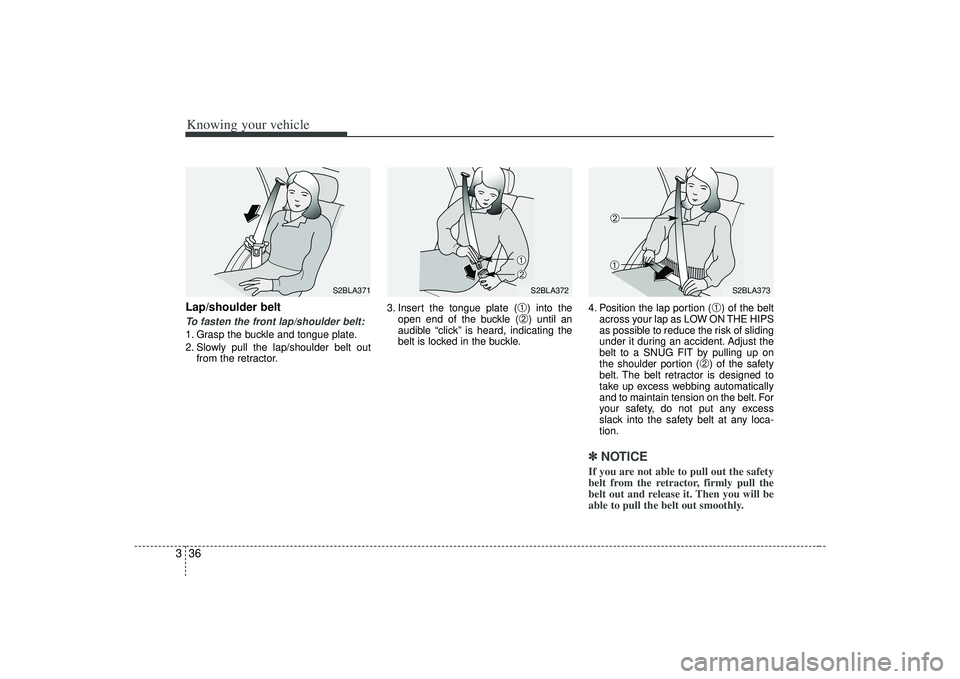
3Lap/shoulder beltTo fasten the front lap/shoulder belt:1. Grasp the buckle and tongue plate.
2. Slowly pull the lap/shoulder belt out
from the retractor. 3. Insert the tongue plate (
➀) into the
open end of the buckle (➁) until an
audible “click” is heard, indicating the
belt is locked in the buckle. 4. Position the lap portion (
➀) of the belt
across your lap as LOW ON THE HIPS
as possible to reduce the risk of sliding
under it during an accident. Adjust the
belt to a SNUG FIT by pulling up on
the shoulder portion (
➁) of the safety
belt. The belt retractor is designed to
take up excess webbing automatically
and to maintain tension on the belt. For
your safety, do not put any excess
slack into the safety belt at any loca-
tion.
✽ ✽ NOTICEIf you are not able to pull out the safety
belt from the retractor, firmly pull the
belt out and release it. Then you will be
able to pull the belt out smoothly.
S2BLA371
S2BLA372
S2BLA373
➀➁
➀➁
Page 49 of 321
337
Knowing your vehicle
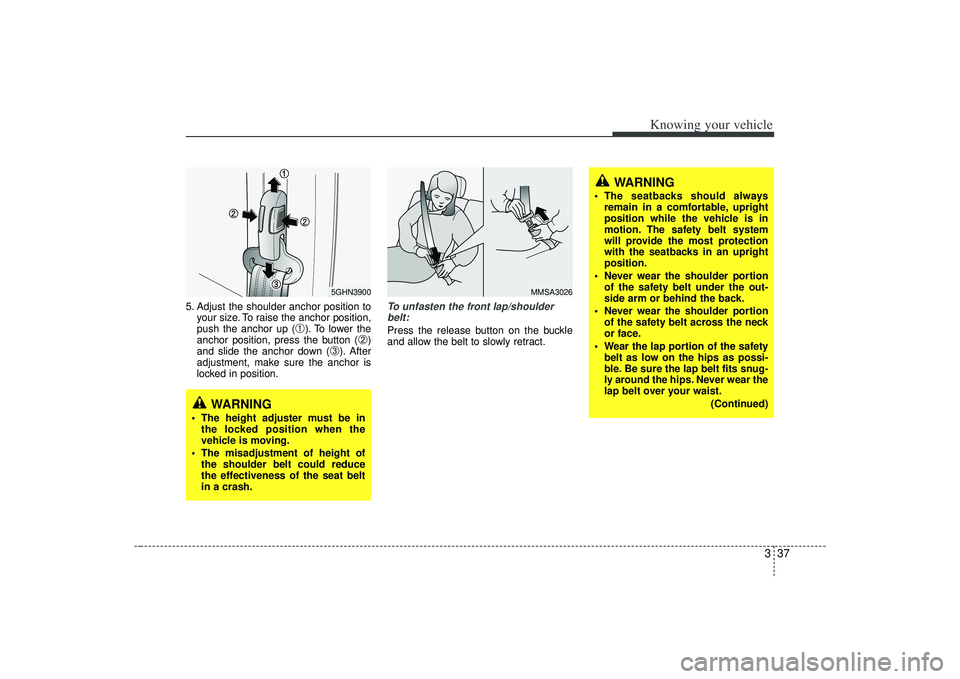
5. Adjust the shoulder anchor position toyour size. To raise the anchor position,
push the anchor up (
➀). To lower the
anchor position, press the button (
➁)
and slide the anchor down (
➂). After
adjustment, make sure the anchor is
locked in position.
To unfasten the front lap/shoulder belt:Press the release button on the buckle
and allow the belt to slowly retract.
MMSA3026
5GHN3900
WARNING
The height adjuster must be in the locked position when the
vehicle is moving.
The misadjustment of height of the shoulder belt could reduce
the effectiveness of the seat belt
in a crash.
WARNING
The seatbacks should alwaysremain in a comfortable, upright
position while the vehicle is in
motion. The safety belt system
will provide the most protection
with the seatbacks in an upright
position.
Never wear the shoulder portion of the safety belt under the out-
side arm or behind the back.
Never wear the shoulder portion of the safety belt across the neck
or face.
Wear the lap portion of the safety belt as low on the hips as possi-
ble. Be sure the lap belt fits snug-
ly around the hips. Never wear the
lap belt over your waist.
(Continued)
Page 50 of 321
Knowing your vehicle38
3
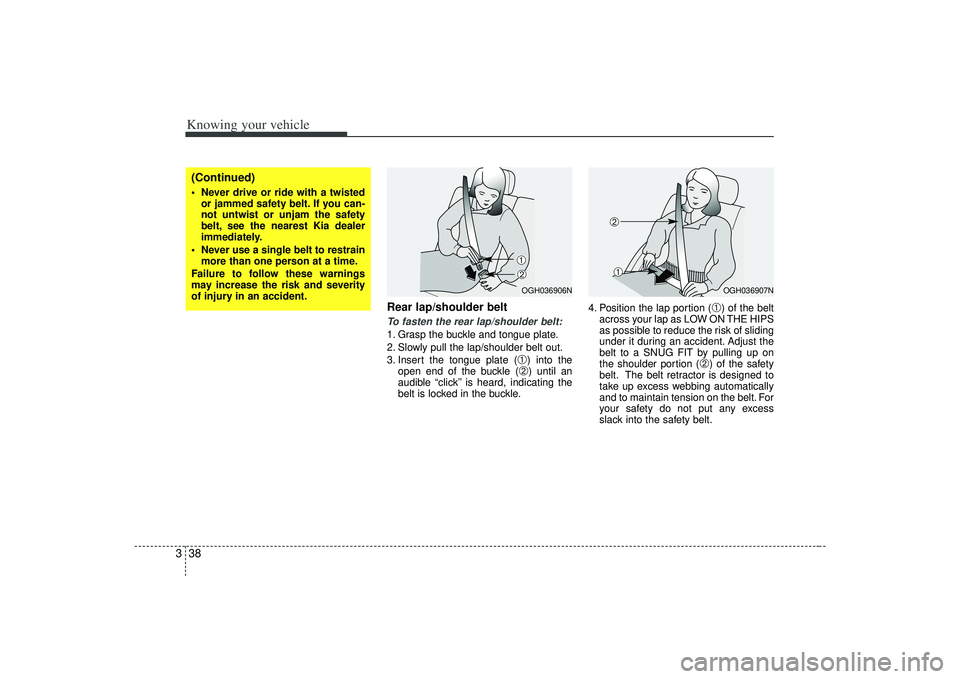
Rear lap/shoulder belt To fasten the rear lap/shoulder belt:1. Grasp the buckle and tongue plate.
2. Slowly pull the lap/shoulder belt out.
3. Insert the tongue plate (
➀) into the
open end of the buckle (➁) until an
audible “click’’ is heard, indicating the
belt is locked in the buckle. 4. Position the lap portion (
➀) of the belt
across your lap as LOW ON THE HIPS
as possible to reduce the risk of sliding
under it during an accident. Adjust the
belt to a SNUG FIT by pulling up on
the shoulder portion (
➁) of the safety
belt. The belt retractor is designed to
take up excess webbing automatically
and to maintain tension on the belt. For
your safety do not put any excess
slack into the safety belt.
(Continued) Never drive or ride with a twisted or jammed safety belt. If you can-
not untwist or unjam the safety
belt, see the nearest Kia dealer
immediately.
Never use a single belt to restrain more than one person at a time.
Failure to follow these warnings
may increase the risk and severity
of injury in an accident.
OGH036906N
OGH036907N
➀➁
➀➁
Page 57 of 321
345
Knowing your vehicle
Installing a child restraint system For safety reasons, we recommend that
the child restraint system be used in the
rear seats.Never place a rear-facing
child restraint in the front passenger
seat, because of the danger that an
inflating passenger side air bag could
impact the rear-facing child restraint
and kill the child.
Since all passenger’s (except driver’s)
safety belts move freely under normal
conditions and only lock under extreme
or emergency conditions (emergency
lock mode), you must manually change
these safety belts to the auto lock mode
to secure a child restraint.✽ ✽ NOTICEThe driver’s safety belt incorporates the
emergency lock mode only.
WARNING
Do not install any child restraint
system in the front passenger
seat. Should an accident occur
and cause the passenger air bag
to deploy, it could severely injure
or kill an infant or child seated in
an infant or child seat. Therefore,
only use a child restraint system
in the rear seat of your vehicle.
If the child restraint seat is not anchored properly, the risk of a
child being seriously injured or
killed in a collision greatly
increases.
WARNING
Before installing the childrestraint system, read the instruc-
tions supplied by the child
restraint system manufacturer.
If the seat belt does not operate as described, have the system
checked immediately by your
authorized Kia dealer.
Failure to observe this manual instructions regarding child
restraint system and the instruc-
tions provided with the child
restraint system could increase
the chance and/or severity of
injury in an accident.
Page 58 of 321
Knowing your vehicle46
3Placing a passenger safety belt
into the auto lock modeThe use of the auto lock mode will
ensure that the normal movement of the
child in the vehicle does not cause the
safety belt to be pulled out and loosen
the firmness of its hold on the child
restraint system. To secure a child
restraint system, use the following proce-
dure.
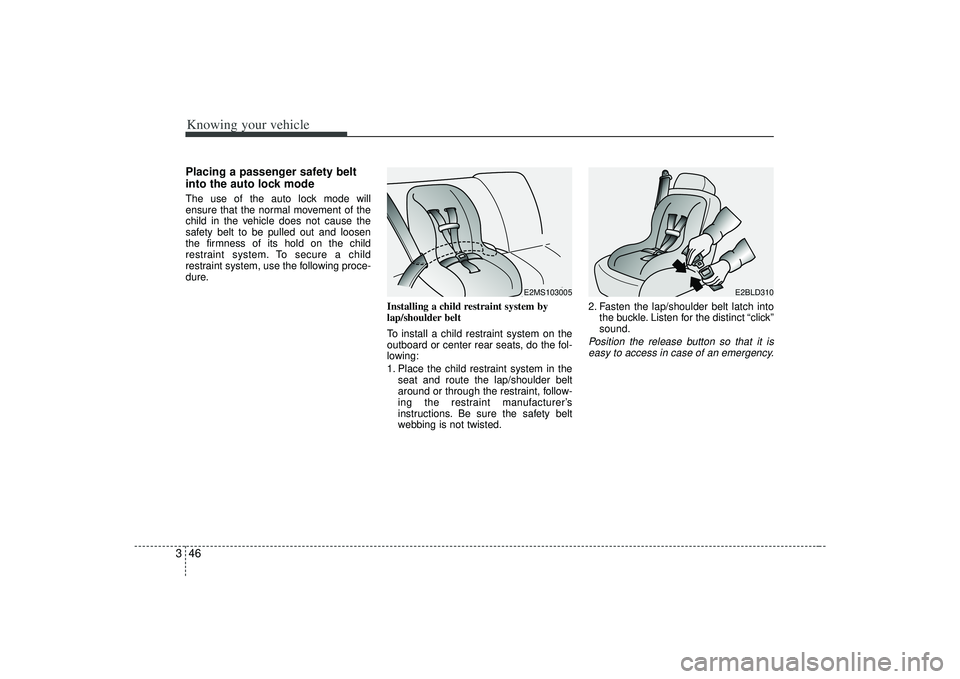
Installing a child restraint system by
lap/shoulder belt
To install a child restraint system on the
outboard or center rear seats, do the fol-
lowing:
1. Place the child restraint system in theseat and route the lap/shoulder belt
around or through the restraint, follow-
ing the restraint manufacturer’s
instructions. Be sure the safety belt
webbing is not twisted. 2. Fasten the lap/shoulder belt latch into
the buckle. Listen for the distinct “click”
sound.
Position the release button so that it iseasy to access in case of an emergency.
E2MS103005
E2BLD310
Page 59 of 321
347
Knowing your vehicle
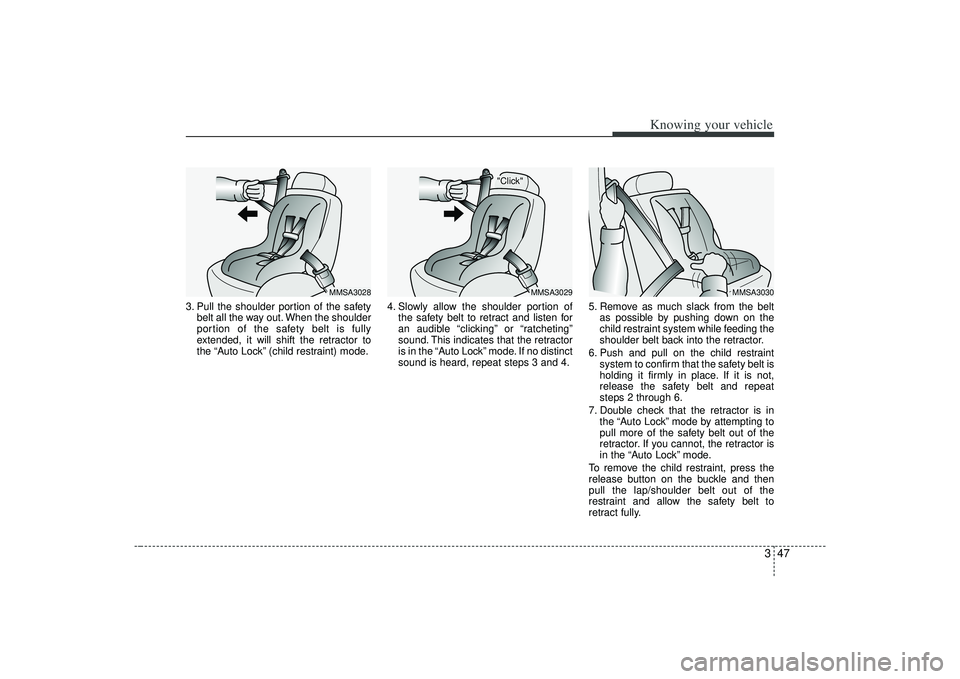
3. Pull the shoulder portion of the safetybelt all the way out. When the shoulder
portion of the safety belt is fully
extended, it will shift the retractor to
the “Auto Lock” (child restraint) mode. 4. Slowly allow the shoulder portion of
the safety belt to retract and listen for
an audible “clicking” or “ratcheting”
sound. This indicates that the retractor
is in the “Auto Lock” mode. If no distinct
sound is heard, repeat steps 3 and 4. 5. Remove as much slack from the belt
as possible by pushing down on the
child restraint system while feeding the
shoulder belt back into the retractor.
6. Push and pull on the child restraint system to confirm that the safety belt is
holding it firmly in place. If it is not,
release the safety belt and repeat
steps 2 through 6.
7. Double check that the retractor is in the “Auto Lock” mode by attempting to
pull more of the safety belt out of the
retractor. If you cannot, the retractor is
in the “Auto Lock” mode.
To remove the child restraint, press the
release button on the buckle and then
pull the lap/shoulder belt out of the
restraint and allow the safety belt to
retract fully.
MMSA3028
"Click"
MMSA3029
MMSA3030