fuel KIA AMANTI 2009 Owners Manual
[x] Cancel search | Manufacturer: KIA, Model Year: 2009, Model line: AMANTI, Model: KIA AMANTI 2009Pages: 321, PDF Size: 23.77 MB
Page 1 of 321
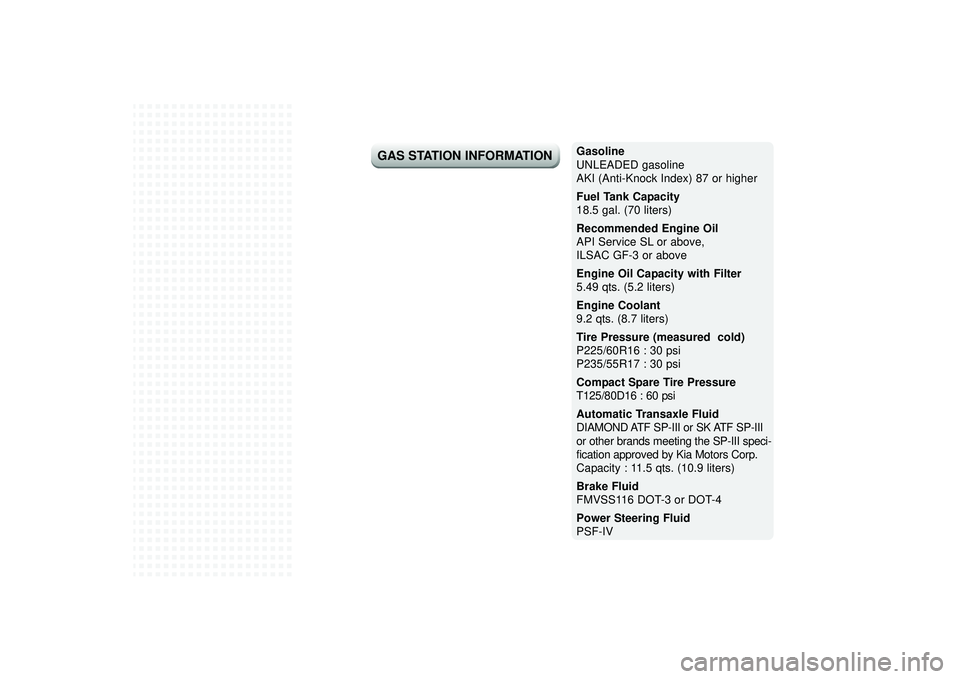
Gasoline
UNLEADED gasoline
AKI (Anti-Knock Index) 87 or higher
Fuel Tank Capacity
18.5 gal. (70 liters)
Recommended Engine Oil
API Service SL or above,
ILSAC GF-3 or above
Engine Oil Capacity with Filter
5.49 qts. (5.2 liters)
Engine Coolant
9.2 qts. (8.7 liters)
Tire Pressure (measured cold)
P225/60R16 : 30 psi
P235/55R17 : 30 psi
Compact Spare Tire PressureT125/80D16 : 60 psiAutomatic Transaxle FluidDIAMOND ATF SP-III or SK ATF SP-III
or other brands meeting the SP-III speci-
fication approved by Kia Motors Corp. Capacity : 11.5 qts. (10.9 liters)
Brake Fluid
FMVSS116 DOT-3 or DOT-4
Power Steering Fluid
PSF-IV
GAS STATION INFORMATION
Page 10 of 321
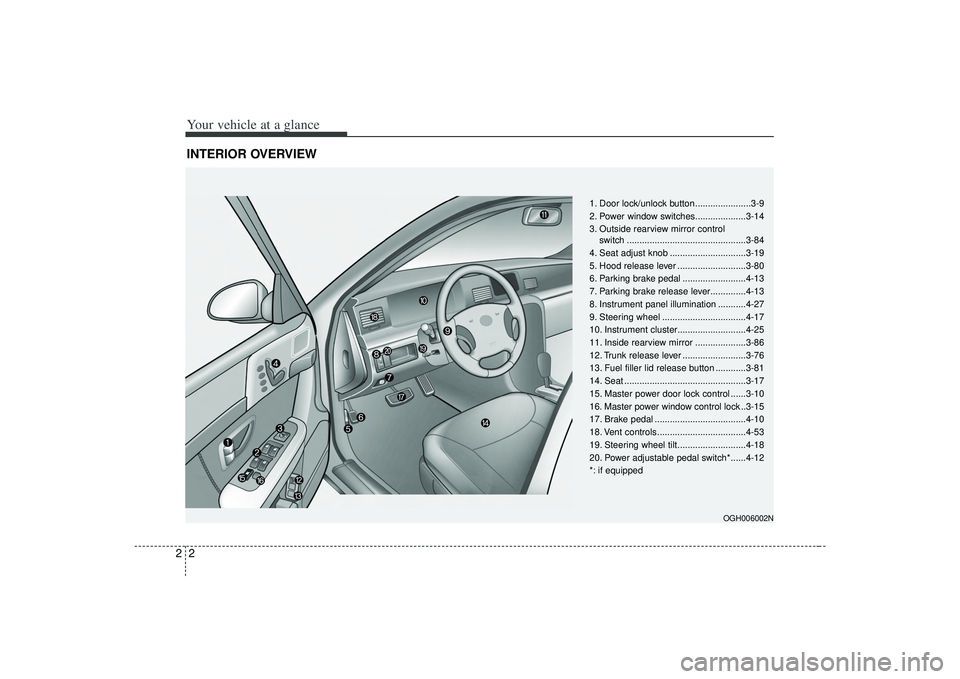
Your vehicle at a glance22INTERIOR OVERVIEW
OGH006002N
1. Door lock/unlock button ......................3-9
2. Power window switches....................3-14
3. Outside rearview mirror control switch ...............................................3-84
4. Seat adjust knob ..............................3-19
5. Hood release lever ...........................3-80
6. Parking brake pedal .........................4-13
7. Parking brake release lever..............4-13
8. Instrument panel illumination ...........4-27
9. Steering wheel .................................4-17
10. Instrument cluster...........................4-25
11. Inside rearview mirror ....................3-86
12. Trunk release lever .........................3-76
13. Fuel filler lid release button ............3-81
14. Seat ................................................3-17
15. Master power door lock control ......3-10
16. Master power window control lock ..3-15
17. Brake pedal ....................................4-10
18. Vent controls...................................4-53
19. Steering wheel tilt...........................4-18
20. Power adjustable pedal switch*......4-12
*: if equipped
Page 13 of 321

3
Keys / 3-2
Remote keyless entry / 3-4
Immobilizer system / 3-7
Door locks / 3-9
Windows / 3-13
Seats / 3-17
Driver position memory system / 3-28
Safety belts / 3-30
Air bags-advanced supplemental restraint system / 3-52
Trunk / 3-76
Hood / 3-80
Fuel filler lid / 3-81
Mirrors / 3-84
Interior lights / 3-88
Storage compartments / 3-89
Interior features / 3-91
Sunroof / 3-96
Antenna / 3-98
Audio remote control / 3-99
Audio systems / 3-100
Knowing your vehicle
Page 93 of 321
381
Knowing your vehicle
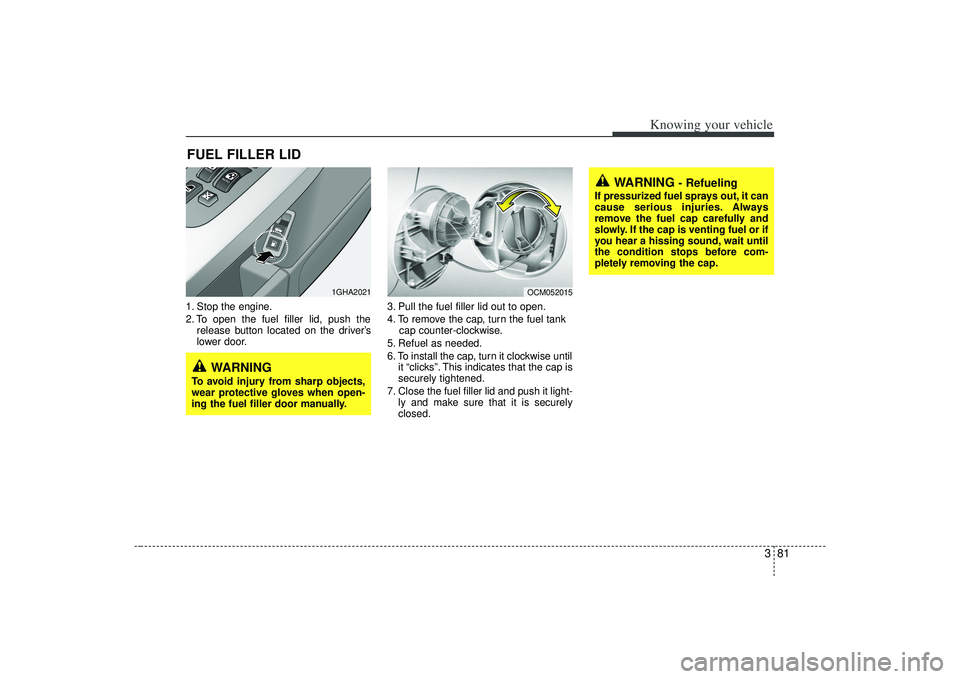
1. Stop the engine.
2. To open the fuel filler lid, push therelease button located on the driver’s
lower door. 3. Pull the fuel filler lid out to open.
4. To remove the cap, turn the fuel tank
cap counter-clockwise.
5. Refuel as needed.
6. To install the cap, turn it clockwise until it “clicks”. This indicates that the cap is
securely tightened.
7. Close the fuel filler lid and push it light- ly and make sure that it is securely
closed.FUEL FILLER LID
1GHA2021
OCM052015
WARNING
To avoid injury from sharp objects,
wear protective gloves when open-
ing the fuel filler door manually.
WARNING
- Refueling
If pressurized fuel sprays out, it can
cause serious injuries. Always
remove the fuel cap carefully and
slowly. If the cap is venting fuel or if
you hear a hissing sound, wait until
the condition stops before com-
pletely removing the cap.
Page 94 of 321
Knowing your vehicle82
3
WARNING
Automotive fuels are flammable/
explosive materials. When refuel-
ing, please note the following
guidelines carefully. Failure to fol-
low these guidelines may result in
severe personal injury, severe
burns or death by fire or explosion.
Before refueling always note the
location of the Emergency
Gasoline Shut-Off, if available, at
the gas station facility.
Note and follow all safety precau-
tions and warning posted at the
facility.
Before touching the fuel nozzle or fuel filler cap, you should elimi-
nate potentially dangerous static
electricity discharge by touching
another metal part of the front of
the vehicle, a safe distance away
from the fuel filler neck, nozzle, or
other gas source.
(Continued)
(Continued)
Do not get back into a vehicleonce you have begun refueling.
Do not touch, rub or slide against
any item or fabric (polyester,
satin, nylon, etc.) capable of pro-
ducing static electricity. Static
electricity discharge can ignite
fuel vapors resulting in explo-
sion. If you must re-enter the
vehicle, you should once again
eliminate potentially dangerous
static electricity discharge by
touching a metal part of the vehi-
cle, away from the fuel filler neck,
nozzle or other gasoline source.
When using a portable fuel con-
tainer be sure to place the contain-
er on the ground prior to refueling.
Static electricity discharge from
the container can ignite fuel vapors
causing a fire. Once refueling has
begun, contact with the vehicle
should be maintained until the fill-
ing is complete. Use only portable
fuel containers designed to carry
and store gasoline.
(Continued)
(Continued)
Do not use cellular phones around a gas station or while
refueling any vehicle. Electric
current and/or electronic interfer-
ence from cellular phones can
potentially ignite fuel vapors
causing a fire. If you must use
your cellular phone use it in a
place away from the gas station.
When refueling always shut the engine off. Sparks produced by
electrical components related to
the engine can ignite fuel vapors
causing a fire. Always insure that
the engine is OFF before and dur-
ing refueling. Once refueling is
complete, check to make sure the
fuel filler cap and door are
securely closed, before starting
the engine.
(Continued)
Page 95 of 321
383
Knowing your vehicle
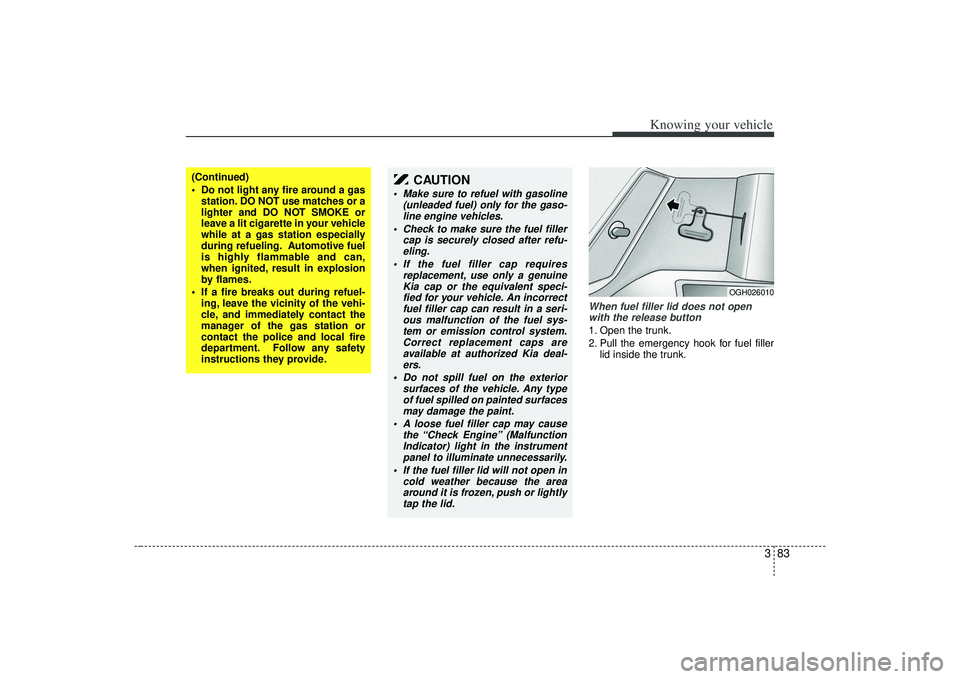
When fuel filler lid does not openwith the release button1. Open the trunk.
2. Pull the emergency hook for fuel filler lid inside the trunk.
OGH026010
(Continued)
Do not light any fire around a gasstation. DO NOT use matches or a
lighter and DO NOT SMOKE or
leave a lit cigarette in your vehicle
while at a gas station especially
during refueling. Automotive fuel
is highly flammable and can,
when ignited, result in explosion
by flames.
If a fire breaks out during refuel- ing, leave the vicinity of the vehi-
cle, and immediately contact the
manager of the gas station or
contact the police and local fire
department. Follow any safety
instructions they provide.
CAUTION
Make sure to refuel with gasoline (unleaded fuel) only for the gaso-line engine vehicles.
Check to make sure the fuel filler cap is securely closed after refu-eling.
If the fuel filler cap requires replacement, use only a genuineKia cap or the equivalent speci- fied for your vehicle. An incorrectfuel filler cap can result in a seri-ous malfunction of the fuel sys- tem or emission control system.Correct replacement caps are available at authorized Kia deal-ers.
Do not spill fuel on the exterior surfaces of the vehicle. Any typeof fuel spilled on painted surfaces may damage the paint.
A loose fuel filler cap may cause the “Check Engine” (MalfunctionIndicator) light in the instrument panel to illuminate unnecessarily.
If the fuel filler lid will not open in cold weather because the areaaround it is frozen, push or lightlytap the lid.
Page 143 of 321
47
Driving your vehicle
R (reverse)Use this position to drive the vehicle
backward.✽ ✽NOTICEAlways come to a complete stop before
shifting into or out of R (Reverse); you
may damage the transaxle if you shift
into R while the vehicle is in motion,
except as explained in “Rocking the
Vehicle”, in this manual.
N (neutral)With the gearshift in the N position, the
wheels and transaxle are not locked. The
vehicle will roll freely even on the slight-
est incline unless the parking brake or
service brakes are applied.D (drive)This is the normal forward driving posi-
tion. The transaxle will automatically shift
through a 5-gear sequence, providing the
best fuel economy and power.
For extra power when passing another
vehicle or climbing grades, depress the
accelerator fully, at which time the
transaxle will automatically downshift to
the next lower gear.✽ ✽NOTICEAlways come to a complete stop before
shifting into D (Drive).
(Continued)
Before leaving the driver’s seat,
always make sure the shift lever
is in the P (PARK) position. Set
the parking brake fully, shut the
engine off and take the key with
you. Unexpected and sudden
vehicle movement can occur if
you do not follow these precau-
tions in the order specified.
Never leave a child unattended in a vehicle.
CAUTION
The transaxle may be damaged ifyou shift into P (Park) while thevehicle is in motion.
WARNING
Always apply the brake pedal when
you stop the vehicle on an inclined
road with the shift lever in the D
(Drive) position. Do NOT rely on the
engine and transaxle to prevent the
vehicle from rolling down the hill.
Before attempting to backup on an
inclined road, always apply the
brake pedal before moving the shift
lever to the R (Reverse) position.
Page 161 of 321
425
Driving your vehicle
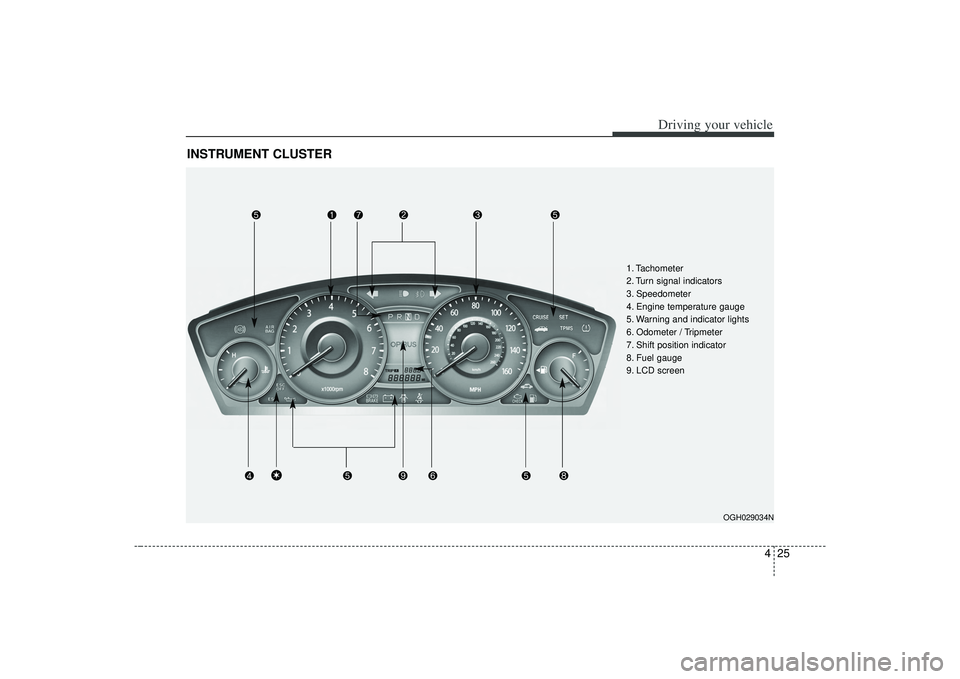
INSTRUMENT CLUSTER
OGH029034N
1. Tachometer
2. Turn signal indicators
3. Speedometer
4. Engine temperature gauge
5. Warning and indicator lights
6. Odometer / Tripmeter
7. Shift position indicator
8. Fuel gauge
9. LCD screen
\b
Page 163 of 321
427
Driving your vehicle
Fuel gaugeThe fuel gauge indicates the approxi-
mate amount of fuel remaining in the fuel
tank.
Fuel tank capacity - 18.49 US gal. (70
liters).
The fuel gauge is supplemented by a low
fuel warning light, which will illuminate
when the fuel tank is nearly empty.
Trip computerThe trip computer is a microcomputer-
controlled driver information system that
displays information related to driving,
including odometer, tripmeter, driving
time, average speed, average fuel con-
sumption, instant fuel consumption and
distance to empty on the display when
the ignition switch is in the ON position.
All stored driving information (except
odometer) is reset if the battery is dis-
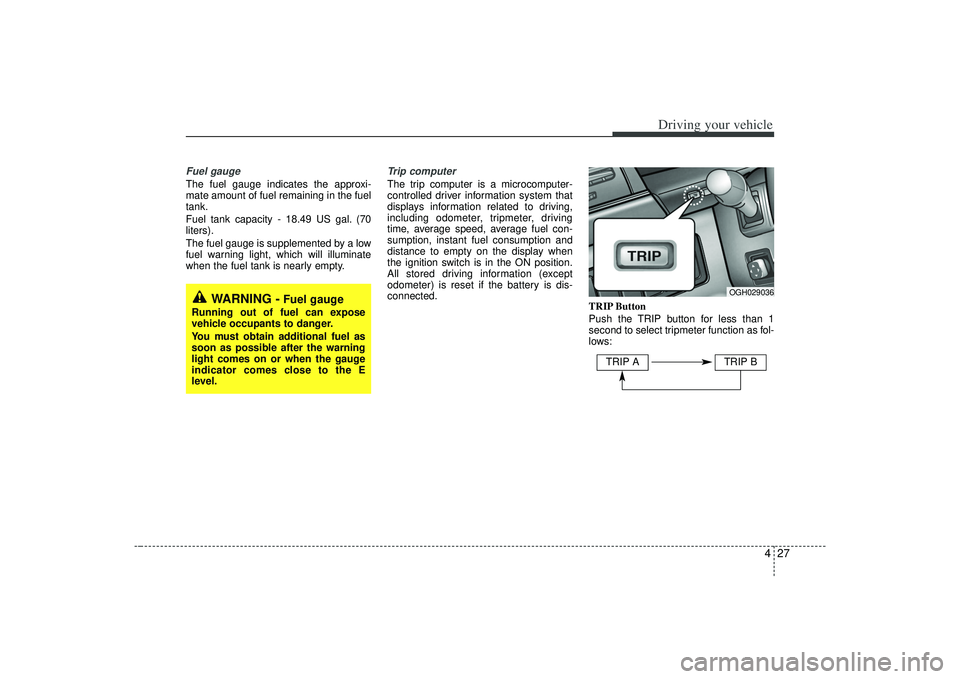
connected.TRIP Button
Push the TRIP button for less than 1
second to select tripmeter function as fol-
lows:
WARNING -
Fuel gauge
Running out of fuel can expose
vehicle occupants to danger.
You must obtain additional fuel as
soon as possible after the warning
light comes on or when the gauge
indicator comes close to the E
level.
OGH029036
TRIP A
TRIP B
Page 164 of 321
Driving your vehicle28
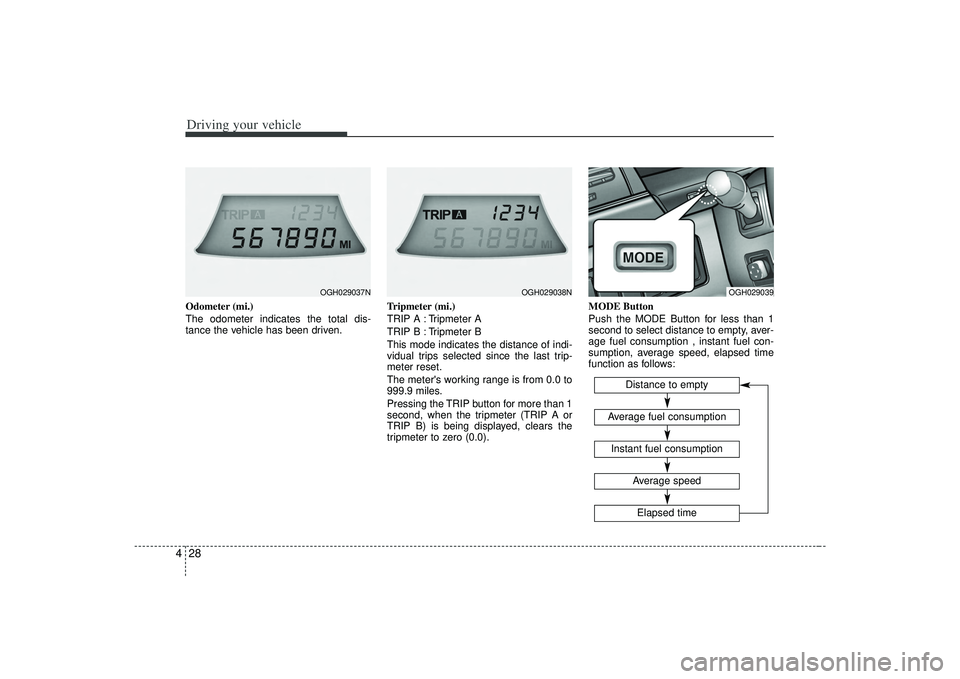
4Odometer (mi.)
The odometer indicates the total dis-
tance the vehicle has been driven. Tripmeter (mi.)
TRIP A : Tripmeter A
TRIP B : Tripmeter B
This mode indicates the distance of indi-
vidual trips selected since the last trip-
meter reset.
The meter's working range is from 0.0 to
999.9 miles.
Pressing the TRIP button for more than 1
second, when the tripmeter (TRIP A or
TRIP B) is being displayed, clears the
tripmeter to zero (0.0).MODE Button
Push the MODE Button for less than 1
second to select distance to empty, aver-
age fuel consumption , instant fuel con-
sumption, average speed, elapsed time
function as follows:
OGH029037N
OGH029038N
OGH029039
Distance to empty
Instant fuel consumptionAverage fuel consumption
Elapsed timeAverage speed