four wheel drive KIA AMANTI 2009 Owners Manual
[x] Cancel search | Manufacturer: KIA, Model Year: 2009, Model line: AMANTI, Model: KIA AMANTI 2009Pages: 321, PDF Size: 23.77 MB
Page 202 of 321
Driving tips10
5Snow tires If you mount snow tires on your Kia,
make sure they are radial tires of the
same size and load range as the original
tires. Mount snow tires on all four wheels
to balance your vehicle’s handling in all
weather conditions. Keep in mind that the
traction provided by snow tires on dry
roads may not be as high as your vehi-
cle's original equipment tires. You should
drive cautiously even when the roads are
clear. Check with the tire dealer for max-
imum speed recommendations.Do not install studded tires without first
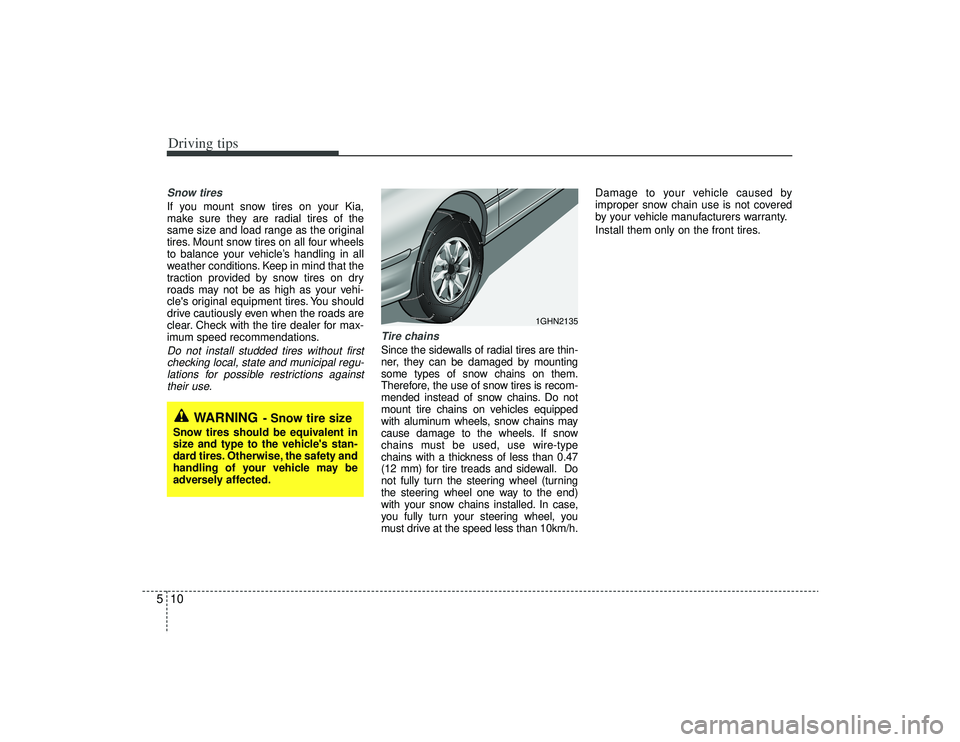
checking local, state and municipal regu- lations for possible restrictions againsttheir use. Tire chains
Since the sidewalls of radial tires are thin-
ner, they can be damaged by mounting
some types of snow chains on them.
Therefore, the use of snow tires is recom-
mended instead of snow chains. Do not
mount tire chains on vehicles equipped
with aluminum wheels, snow chains may
cause damage to the wheels. If snow
chains must be used, use wire-type
chains with a thickness of less than 0.47
(12 mm) for tire treads and sidewall. Do
not fully turn the steering wheel (turning
the steering wheel one way to the end)
with your snow chains installed. In case,
you fully turn your steering wheel, you
must drive at the speed less than 10km/h. Damage to your vehicle caused by
improper snow chain use is not covered
by your vehicle manufacturers warranty.
Install them only on the front tires.
WARNING
- Snow tire size
Snow tires should be equivalent in
size and type to the vehicle's stan-
dard tires. Otherwise, the safety and
handling of your vehicle may be
adversely affected.
1GHN2135
Page 239 of 321
In case of an emergency16
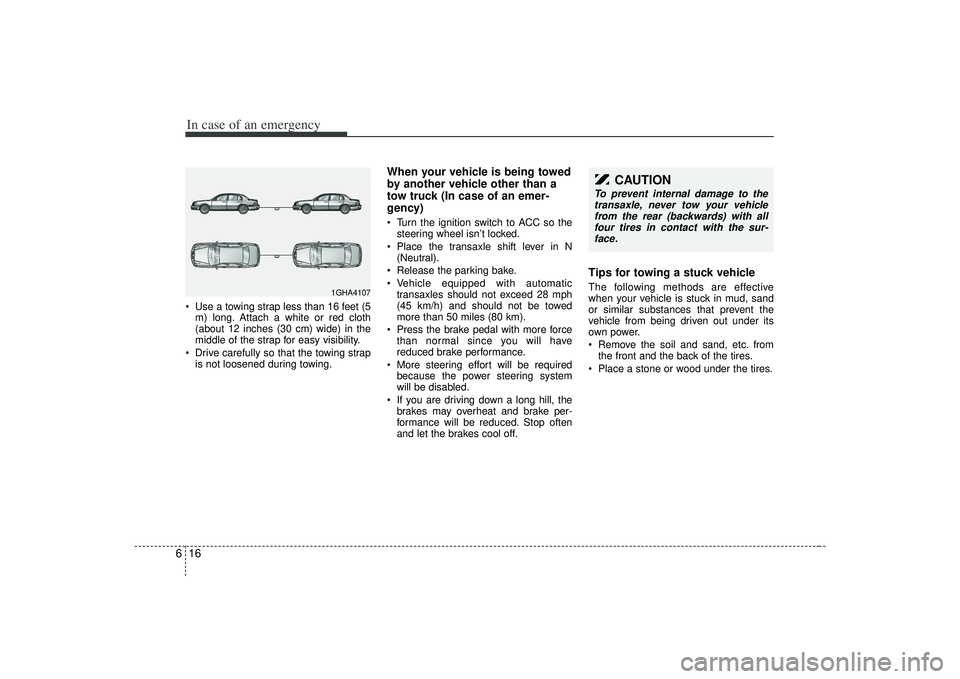
6 Use a towing strap less than 16 feet (5
m) long. Attach a white or red cloth
(about 12 inches (30 cm) wide) in the
middle of the strap for easy visibility.
Drive carefully so that the towing strap is not loosened during towing.
When your vehicle is being towed
by another vehicle other than a
tow truck (In case of an emer-
gency) Turn the ignition switch to ACC so thesteering wheel isn’t locked.
Place the transaxle shift lever in N (Neutral).
Release the parking bake.
Vehicle equipped with automatic transaxles should not exceed 28 mph
(45 km/h) and should not be towed
more than 50 miles (80 km).
Press the brake pedal with more force than normal since you will have
reduced brake performance.
More steering effort will be required because the power steering system
will be disabled.
If you are driving down a long hill, the brakes may overheat and brake per-
formance will be reduced. Stop often
and let the brakes cool off.
Tips for towing a stuck vehicleThe following methods are effective
when your vehicle is stuck in mud, sand
or similar substances that prevent the
vehicle from being driven out under its
own power.
Remove the soil and sand, etc. fromthe front and the back of the tires.
Place a stone or wood under the tires.
1GHA4107
CAUTION
To prevent internal damage to the transaxle, never tow your vehiclefrom the rear (backwards) with allfour tires in contact with the sur- face.
Page 244 of 321

621
In case of an emergency
This device complies with Part 15
of the FCC rules.Operation is sub-
ject to the following two conditions:
1. This device may not cause harm- ful interference, and
2. This device must accept any inter- ference received, including inter-
ference that may cause undesired
operation.
WARNING - TPMS
The TPMS cannot alert you tosevere and sudden tire dam-
age caused by external fac-
tors.
If you feel any vehicle instabil- ity, immediately take your foot
off the accelerator and slowly
move to a safe position off the
road.
WARNING
Tampering with, modifying, or
disabling the Tire Pressure
Monitoring System (TPMS)
components may interfere with
the system's ability to warn the
driver of low tire pressure con-
ditions and/or TPMS malfunc-
tions. Tampering with, modify-
ing, or disabling the Tire
Pressure Monitoring System
(TPMS) components may void
the warranty for that portion of
the vehicle.
WARNING
Changes or modifications not
expressly approved by the party
responsible for compliance
could void the user's authority
to operate the equipment.
CAUTION
Do not use any tire sealant if your vehicle is equipped witha Tire Pressure MonitoringSystem. The liquid sealant candamage the tire pressure sen-sors.
In order for the system to cor- rectly monitor tires for under-inflation, there should be atotal of exactly 4 sensors fit-ted to each of the four drivenwheel positions. There shouldbe no other sensors in thevehicle include spare tireposition since this couldcause the system to monitorthe wrong sensors.
Page 290 of 321
Maintenance40
7Snow tires
If you equip your car with snow tires,
they should be the same size and
have the same load capacity as the
original tires. Snow tires should be
installed on all four wheels; other-
wise, poor handling may result.
Snow tires should carry 4 psi (28
kPa) more air pressure than the
pressure recommended for the stan-
dard tires on the tire label on the dri-
ver's side of the center pillar, or up to
the maximum pressure shown on the
tire sidewall, whichever is less.
Do not drive faster than 75 mph (120
km/h) when your car is equipped with
snow tires.
Tire chains
Tire chains, if necessary, should be
installed on the drive wheels (front
wheel).
Be sure that the chains are installed
in accordance with the manufactur-
er's instructions.
To minimize tire and chain wear, do
not continue to use tire chains when
they are no longer needed.
✽ ✽
NOTICE• If you hear noise caused by chains
contacting the body, retighten the
chain to avoid contact with the
vehicle body.
• To prevent body damage, retight- en the chains after driving 0.3 ~
0.6 miles (0.5 ~ 1.0 km).
WARNING
- Snow or ice
When driving on roads cov- ered with snow or ice, drive at
less than 20 mph (30 km/h).
Use the SAE “S” class or wire chains.
Do not use tire chains on vehi- cles equipped with aluminum
wheels. In unavoidable cir-
cumstance, use a wire type
chain.
Use wire chains less than 15mm to prevent damage to
the chain’s connection.