air condition KIA BORREGO 2017 Service Manual
[x] Cancel search | Manufacturer: KIA, Model Year: 2017, Model line: BORREGO, Model: KIA BORREGO 2017Pages: 548, PDF Size: 36.78 MB
Page 480 of 548
Maintenance
44
8
Remove the valve cap from the tire
valve stem. Press the tire gauge firm-
ly onto the valve to get a pressure
measurement. If the cold tire inflationpressure matches the recommendedpressure on the tire and loading
information label, no further adjust-
ment is necessary. If the pressure is
low, add air until you reach the rec-ommended amount.
If you overfill the tire, release air by pushing on the metal stem in the
center of the tire valve. Recheck the
tire pressure with the tire gauge. Be
sure to put the valve caps back on
the valve stems. They help prevent
leaks by keeping out dirt and mois-
ture. Tire rotation
To equalize tread wear, it is recom- mended that the tires be rotated
every 12,000 km (7,500 miles) or
sooner if irregular wear develops.
During rotation, check the tires for
correct balance.
When rotating tires, check for uneven
wear and damage. Abnormal wear is
usually caused by incorrect tire pres-
sure, improper wheel alignment, out-
of-balance wheels, severe braking or
severe cornering. Look for bumps or
bulges in the tread or side of tire.
Replace the tire if you find either of
these conditions. Replace the tire if
fabric or cord is visible. After rotation,
be sure to bring the front and rear tire
pressures to specification and check
lug nut tightness.
Refer to “Tire and wheels” in chapter 9.
WARNING
Inspect your tires frequently for proper inflation as well as
wear and damage. Always use
a tire pressure gauge.
Tires with too much or too little pressure wear unevenly caus-
ing poor handling, loss of vehi-
cle control, and sudden tirefailure leading to accidents,
injuries, and even death. Therecommended cold tire pres-
sure for your vehicle can be
found in this manual and onthe tire label located on the dri-
ver's side center pillar.
Worn tires can cause acci- dents. Replace tires that are
worn, show uneven wear, or
are damaged.
Remember to check the pres- sure of your spare tire. Kia
recommends that you check
the spare every time you
check the pressure of the
other tires on your vehicle.
Page 488 of 548
Maintenance
52
8
Low aspect ratio tire (if equipped)
Low aspect ratio tires, whose aspect
ratio is lower than 50, are provided
for sporty looks.
Because the low aspect ratio tires
are optimized for handling and brak-
ing, it may be more uncomfortable to
ride in and there is more noise com-
pare with normal tires.CAUTION
Because the sidewall of the low
aspect ratio tire is shorter thanthe normal, the wheel and tire of the low aspect ratio tire is easi-er to be damaged. So, follow theinstructions below.
- When driving on a rough road or off road, drive cautiouslybecause tires and wheels maybe damaged. And after driv-ing, inspect tires and wheels.
- When passing over a pothole, speed bump, manhole, or curbstone, drive slowly so that thetires and wheels are not dam-aged.
- If the tire is impacted, we rec- ommend that you inspect thetire condition or contact anauthorized Kia dealer.
- To prevent damage to the tire, inspect the tire condition andpressure every 3,000km.
CAUTION
It is not easy to recognize the tire damage with your owneyes. But if there is the slight- est hint of tire damage, eventhough you cannot see the tiredamage with your own eyes, have the tire checked orreplaced because the tiredamage may cause air leak- age from the tire.
If the tire is damaged by driv- ing on a rough road, off road,pothole, manhole, or curbstone, it will not be covered by the warranty.
You can find out the tire infor- mation on the tire sidewall.
Page 517 of 548
881
Maintenance
Corrosion protection
Protecting your vehicle from corrosion
By using the most advanced design
and construction practices to combat
corrosion, we produce vehicles of the
highest quality. However, this is only
part of the job. To achieve the long-
term corrosion resistance your vehi-
cle can deliver, the owner's coopera-tion and assistance is also required.
Common causes of corrosion The most common causes of corro-
sion on your vehicle are:
Road salt, dirt and moisture that isallowed to accumulate underneath
the vehicle.
Removal of paint or protective coatings by stones, gravel, abra-
sion or minor scrapes and dents
which leave unprotected metal
exposed to corrosion. High-corrosion areas
If you live in an area where your vehi-
cle is regularly exposed to corrosive
materials, corrosion protection is par-
ticularly important. Some of the com-
mon causes of accelerated corrosion
are road salts, dust control chemicals,
ocean air and industrial pollution.
Moisture breeds corrosion Moisture creates the conditions in
which corrosion is most likely to
occur. For example, corrosion is
accelerated by high humidity, partic-
ularly when temperatures are just
above freezing. In such conditions,
the corrosive material is kept in con-
tact with the vehicle’s surface by
moisture that evaporate slowly.
Mud is particularly corrosive
because it dries slowly and holds
moisture in contact with the vehicle.
Although the mud appears to be dry,it can still retain moisture and pro-mote corrosion.
High temperatures can also acceler-
ate corrosion of parts that are not
properly ventilated so the moisturecan be dispersed. For all these reasons, it is particular-
ly important to keep your vehicle
clean and free of mud or accumula-
tions of other materials. This applies
not only to the visible surfaces but
particularly to the underside of the
vehicle.
To help prevent corrosion
You can help prevent corrosion from
getting started by observing the fol-
lowing:
Page 523 of 548
887
Maintenance
Do not operate the engine in con-fined or closed areas (such as
garages) any more than what is
necessary to move the vehicle in orout of the area.
When the vehicle is stopped in an open area for more than a short
time with the engine running,
adjust the ventilation system (as
needed) to draw outside air into the
vehicle.
Never sit in a parked or stopped vehicle for any extended time with
the engine running.
When the engine stalls or fails to start, excessive attempts to restart
the engine may cause damage tothe emission control system.Operating precautions for catalyt-
ic converters (if equipped)Your vehicle is equipped with a cat-
alytic converter emission control
device.
Therefore, the following precautions
must be observed:
Use only UNLEADED FUEL for gasoline engines.
Do not operate the vehicle when there are signs of engine malfunc-
tion, such as misfire or a noticeable
loss of performance.
Do not misuse or abuse the engine. Examples of misuse arecoasting with the ignition off and
descending steep grades in gear
with the ignition off.
Do not operate the engine at high idle speed for extended periods (5
minutes or more).
Do not modify or tamper with any part of the engine or emission con-
trol system. All inspections and
adjustments must be made by an
authorized Kia dealer.
Avoid driving with an extremely low fuel level. Running out of fuel could
cause the engine to misfire, dam-
aging the catalytic converter.
WARNING - Fire
A hot exhaust system can ignite flammable items under
your vehicle. Do not park the
vehicle over or near flamma-
ble objects, such as grass,
vegetation, paper, leaves, etc.
The exhaust system and cat- alytic system are very hotwhile the engine is running or
immediately after the engine
is turned off. Keep away from
the exhaust system and cat-
alytic, you may get burned.
Also, do not remove the heat
sink around the exhaust sys-
tem, do not seal the bottom of
the vehicle or do not coat the
vehicle for corrosion control.
It may present a fire risk under
certain conditions.
Page 524 of 548

Failure to observe these precautions could result in damage to the catalyt-
ic converter and to your vehicle.
Additionally, such actions could void
your warranties.Diesel Particulate Filter (if equipped)
The Diesel Particulate Filter (DPF)
system removes the soot in the
exhaust gas.
Unlike a disposable air filter, the DPF
system automatically burns (oxidizes)
and removes the accumulated soot
according to the driving condition. In
other words, the active burning byengine control system and high
exhaust gas temperature caused by
normal/high driving condition burns
and removes the accumulated soot.
However, if the vehicle continues to
be driven at repeated short distance
or driven at low speed for a long
time, the accumulated soot may not
be automatically removed because
of low exhaust gas temperature.
More than a certain amount of sootdeposited, the malfunction indicator
light ( ) illuminates. When the malfunction indicator light
blinks, it may stop blinking by driving
the vehicle at more than 60 km/h (37mph) or at more than second gear
with 1500 ~ 2500 engine rpm for a
certain time (for about 25 minutes). If the malfunction indicator light ( )
continues to be blinked or the warn-
ing massage “Check exhaust system”
illuminates in spite of the procedure,
please visit an authorized Kia dealer
and the check the DPF system.
If you continue to drive with the mal-
function indicator light blinking for a
long time, the DPF system can bedamaged and fuel consumption can
be worsen.
CAUTION -
Diesel Fuel
(if equipped with DPF)
It is recommended to use the regulated automotive diesel fuelfor diesel vehicle equipped withthe DPF system.
If you use diesel fuel includinghigh sulfur (more than 50 ppmsulfur) and unspecified addi-tives, it can cause the DPF sys-tem to be damaged and white smoke can be emitted.
888
Maintenance
Page 525 of 548
Specifications & Consumer information
Dimensions . . . . . . . . . . . . . . . . . . . . . . . . . . . . . . . . 9-2
Engine . . . . . . . . . . . . . . . . . . . . . . . . . . . . . . . . . . . . 9-2
Gross vehicle weight . . . . . . . . . . . . . . . . . . . . . . . . 9-3
Luggage volume . . . . . . . . . . . . . . . . . . . . . . . . . . . . 9-3
Air conditioning system . . . . . . . . . . . . . . . . . . . . . . 9-4
Bulb wattage . . . . . . . . . . . . . . . . . . . . . . . . . . . . . . . 9-4
Tires and wheels . . . . . . . . . . . . . . . . . . . . . . . . . . . . 9-5
Recommended lubricants and capacities . . . . . . . . 9-6• Recommended sae viscosity number . . . . . . . . . . . . 9-8
Vehicle identification number (VIN) . . . . . . . . . . . 9-9
Vehicle certification label. . . . . . . . . . . . . . . . . . . . . 9-9
Tire specification and pressure label . . . . . . . . . . 9-10
Engine number . . . . . . . . . . . . . . . . . . . . . . . . . . . . 9-10
Air conditioner compressor label . . . . . . . . . . . . . 9-10
Declaration of conformity . . . . . . . . . . . . . . . . . . . 9-11
9
Page 528 of 548
Specifications & Consumer information
4
9
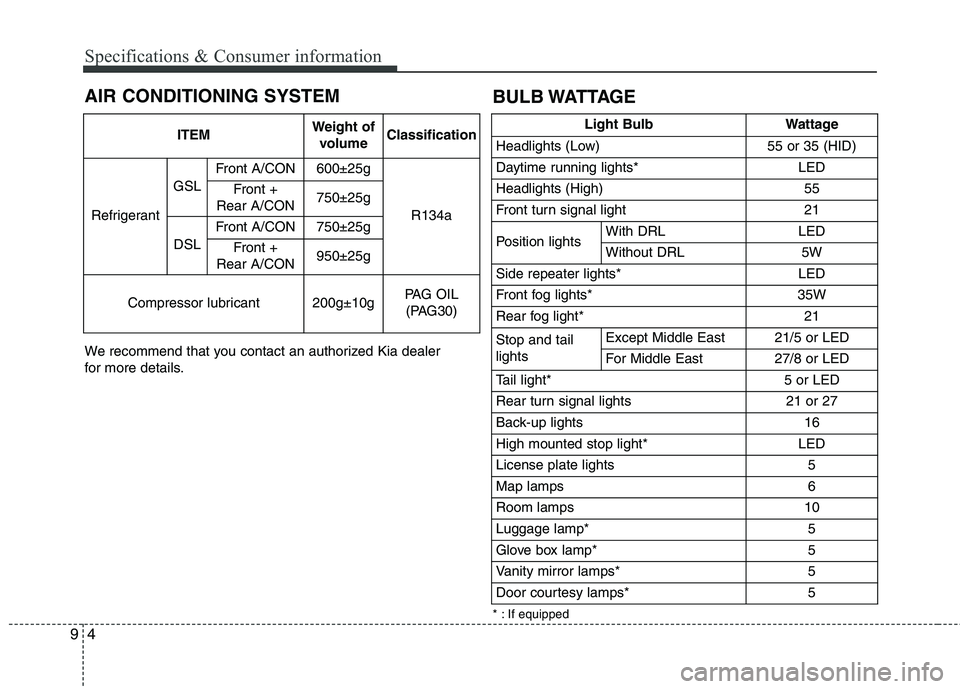
AIR CONDITIONING SYSTEM
We recommend that you contact an authorized Kia dealer
for more details.
ITEMWeight of
volumeClassification
Refrigerant
GSL
Front A/CON600±25g
R134a
Front +
Rear A/CON750±25g
DSL
Front A/CON750±25g
Front +
Rear A/CON950±25g
Compressor lubricant200g±10gPAG OIL (PAG30)
* : If equipped
BULB WATTAGE
Light BulbWattage
Headlights (Low)55 or 35 (HID)
Daytime running lights* LED
Headlights (High)55
Front turn signal light21
Position lightsWith DRLLED
Without DRL5W
Side repeater lights* LED
Front fog lights* 35W
Rear fog light*21
Stop and tail lightsExcept Middle East21/5 or LED
For Middle East 27/8 or LED
Tail light*5 or LED
Rear turn signal lights 21 or 27
Back-up lights16
High mounted stop light*LED
License plate lights5
Map lamps6
Room lamps10
Luggage lamp*5
Glove box lamp*5
Vanity mirror lamps*5
Door courtesy lamps*5
Page 534 of 548
Specifications & Consumer information
10
9
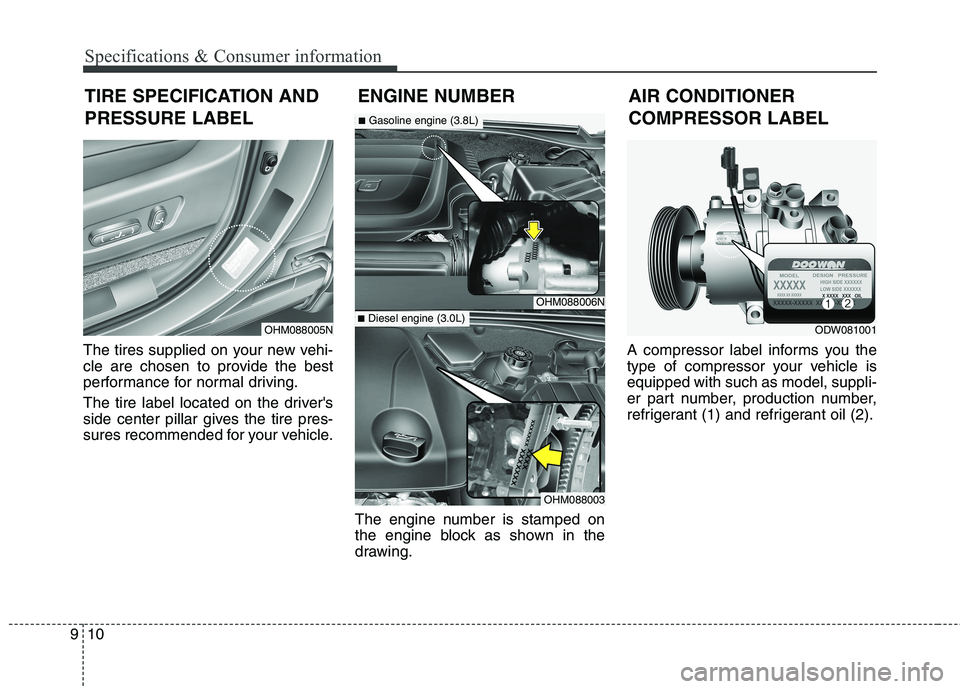
The tires supplied on your new vehi-
cle are chosen to provide the best
performance for normal driving.
The tire label located on the driver's
side center pillar gives the tire pres-
sures recommended for your vehicle.
The engine number is stamped on
the engine block as shown in the
drawing.A compressor label informs you the
type of compressor your vehicle isequipped with such as model, suppli-
er part number, production number,
refrigerant (1) and refrigerant oil (2).
OHM088005N
TIRE SPECIFICATION AND PRESSURE LABEL
ENGINE NUMBER
OHM088006N
OHM088003
■
Gasoline engine (3.8L)
■ Diesel engine (3.0L)
AIR CONDITIONER COMPRESSOR LABEL
ODW081001
Page 537 of 548
Index
2
I
A/V Mode (cluster)........................................................4-60
Air bag warning label ....................................................3-72
Air bag warning light ....................................................3-55
Air bags..........................................................................3-51
Operation ....................................................................3-52
Air bag warning light ..................................................3-55
SRS components and functions ..................................3-56
Driver's and passenger's front air bag ........................3-59
Side air bag ................................................................3-61
Curtain air bag ............................................................3-63
Inflation conditions ....................................................3-67
Non-inflation conditions ............................................3-68
SRS Care ....................................................................3-70
Air bag warning label ................................................3-72
Air cleaner ....................................................................8-31 Filter replacement ......................................................8-31
Air conditioner compressor label ..................................9-10
Air conditioning system lubricants..................................9-4
Air leveling system (ALS) ............................................6-49 N (Normal) - Ordinary driving mode ........................6-49
HI (High) - Off road driving mode ............................6-49
LO (Low) - Loading mode ........................................6-50
Air ventilation seat ......................................................4-146
Anti-lock brake system (ABS) ......................................6-38
Appearance care ............................................................8-77 Exterior care ................................................................8-77 Interior care ................................................................8-83
Armed stage ..................................................................4-14
AUDIO (With Touch Screen) ........................................5-7 Feature of Your Audio ..................................................5-8
Radio Mode (Type-1)..................................................5-20
Radio Mode (Type-2)..................................................5-23
Media Mode ................................................................5-25
Phone Mode ................................................................5-40 Bluetooth ®
Wireless Technology (Type-1) ................5-41
Bluetooth ®
Wireless Technology (Type-2) ................5-48
Voice Recognition Mode ............................................5-55
Setup Mode (Type-1) ..................................................5-63
Setup Mode (Type-2) ..................................................5-72
Audio system ..................................................................5-2 Antenna ........................................................................5-2
Steering wheel audio controls ......................................5-3
Aux, USB port ..............................................................5-4
How vehicle audio works ............................................5-4
Auto light ....................................................................4-100
Automatic transaxle ......................................................6-16 Manual mode ..............................................................6-19
Shift-lock override ......................................................6-20
Battery............................................................................8-38 For best battery service ..............................................8-38Battery capacity label..................................................8-40
A
B
Page 538 of 548
I3
Index
Battery recharging ......................................................8-40
Reset items ..................................................................8-41
Battery replacement ......................................................4-12
Battery saver function ....................................................4-98
Before driving ..................................................................6-4
Blind Spot Detection System(BSD) ..............................6-62 BSD (Blind Spot Detection) /LCA (Lane Change Assist) ......................................6-63
RCTA (Rear cross traffic alert) ..................................6-66
Bonnet see the hood ......................................................4-29
Brake system..................................................................6-34 Power brakes ..............................................................6-34
Parking brake ............................................................6-36
Anti-lock brake system (ABS)....................................6-38
Electronic stability control (ESC) ..............................6-40
Hill-start assist control (HAC) ....................................6-45
Brakes fluid....................................................................8-27 Checking the brake fluid level ....................................8-27
Bulb replacement ..........................................................8-68
Bulb wattage ....................................................................9-4
Button start/stop, see engine start/stop button ..............6-10
Camera (Rear view) ......................................................4-96
Capacities (Lubricants) ....................................................9-6Care Care of seat belts ........................................................3-38 SRS Care ....................................................................3-70
Tire care ......................................................................8-42
Exterior care ................................................................8-77
Interior care ................................................................8-83
Care of seat belts ..........................................................3-38
Center console storage ................................................4-138
Central door lock switch................................................4-19
Chains - Tire ..................................................................6-76
Checking tire inflation pressure ....................................8-43
Child restraint system ....................................................3-39 "Installing a child restraint systemwith a lap belt" ....3-42"Installing a child restraint systemwith a lap/shoulder belt" ....................................................3-42
"Securing a child restraint seat withtether anchor system" ........................................................3-46
"Securing a child restraint systemwith “ISOFIX” system and “TetherAnchorage” system" ............................3-47
Child-protector rear door lock ......................................4-20
Climate control air filter ................................................8-33 Filter inspection ..........................................................8-33
Filter replacement ......................................................8-33
Climate control system Automatic climate control system ............................4-117
Automatic heating and air conditioning ..................4-119
Manual heating and air conditioning ........................4-120
Rear heating and air conditioning ............................4-128
Coat hook ....................................................................4-148
Combined instrument, see instrument cluster ..............4-47
C