towing KIA BORREGO 2017 Owners Manual
[x] Cancel search | Manufacturer: KIA, Model Year: 2017, Model line: BORREGO, Model: KIA BORREGO 2017Pages: 548, PDF Size: 36.78 MB
Page 47 of 548
Safety features of your vehicle
30
3
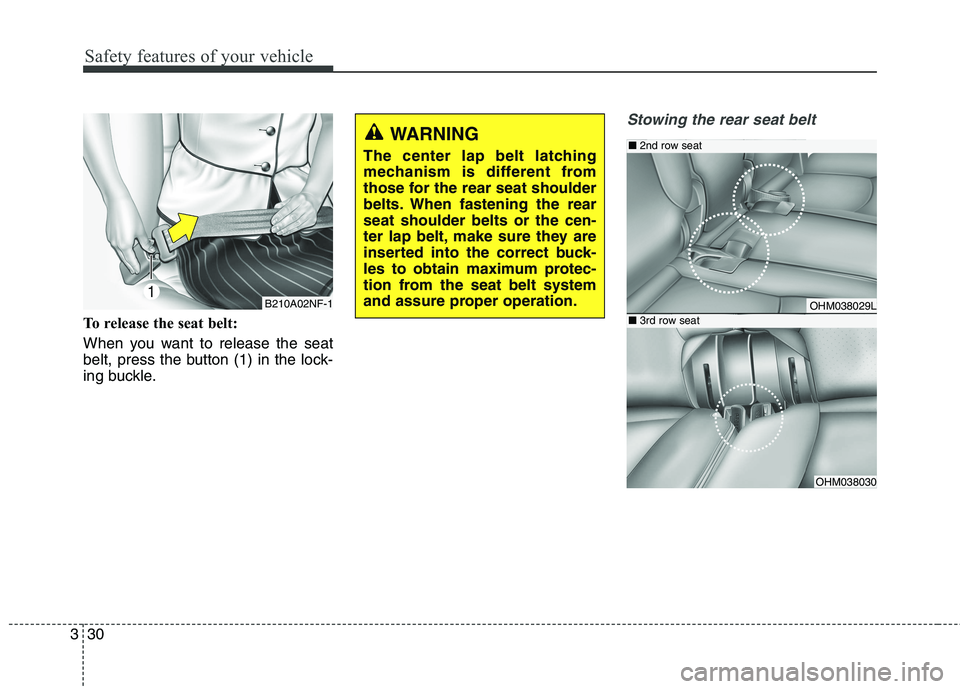
To release the seat belt:
When you want to release the seat
belt, press the button (1) in the lock-
ing buckle.
Stowing the rear seat belt
B210A02NF-1
WARNING
The center lap belt latching
mechanism is different from
those for the rear seat shoulder
belts. When fastening the rearseat shoulder belts or the cen-
ter lap belt, make sure they are
inserted into the correct buck-
les to obtain maximum protec-
tion from the seat belt system
and assure proper operation.
OHM038029L
OHM038030
■ 2nd row seat
■3rd row seat
Page 177 of 548
Features of your vehicle
88
4
Non-operational conditions of rear parking assist system The rear parking assist system
may not operate properly when:
1. Moisture is frozen to the sensor. (It
will operate normally when the moisture has been cleared.)
2. The sensor is covered with foreign matter, such as snow or water, or
the sensor cover is blocked. (It will
operate normally when the materi-
al is removed or the sensor is no
longer blocked.)
3. Driving on uneven road surfaces (unpaved roads, gravel, bumps,
gradient).
4. Objects generating excessive noise (vehicle horns, loud motor-
cycle engines, or truck air brakes)
are within range of the sensor.
5. Heavy rain or water spray exists.
6. Wireless transmitters or mobile phones are within range of the
sensor.
7. The sensor is covered with snow.
8. Trailer towing The detecting range may decrease when:
1. The sensor is stained with foreign
matter such as snow or water.
(The sensing range will return to
normal when removed.)
2. Outside air temperature is extremely hot or cold.
The following objects may not be
recognized by the sensor:
1. Sharp or slim objects such as ropes, chains or small poles.
2. Objects which tend to absorb the sensor frequency such as clothes,
spongy material or snow.
3. Undetectable objects smaller than 1 m (40 in.) in height and narrower
than 14 cm (6 in.) in diameter.
✽✽ NOTICE
The indicator may differ from the
illustration as objects or sensors sta-
tus.
If the indicator blinks, we recom-
mend that the system be checked by
an authorized Kia dealer.
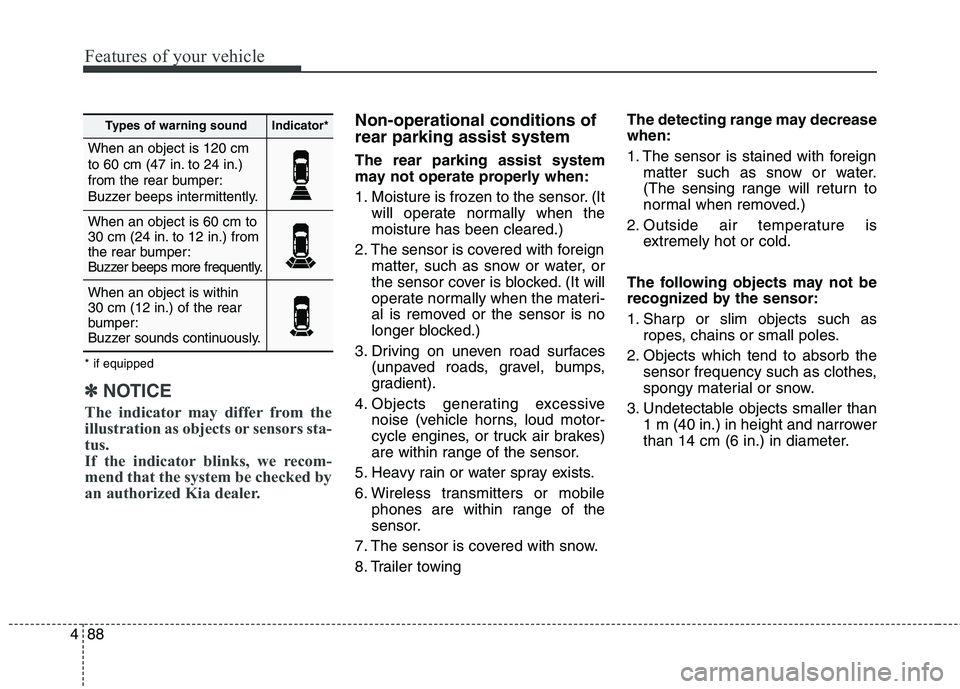
When an object is 120 cm
to 60 cm (47 in. to 24 in.)
from the rear bumper:
Buzzer beeps intermittently. When an object is 60 cm to
30 cm (24 in. to 12 in.) from
the rear bumper:
Buzzer beeps more frequently. When an object is within 30 cm (12 in.) of the rear
bumper:
Buzzer sounds continuously.
Types of warning soundIndicator*
* if equipped
Page 349 of 548
625
Driving your vehicle
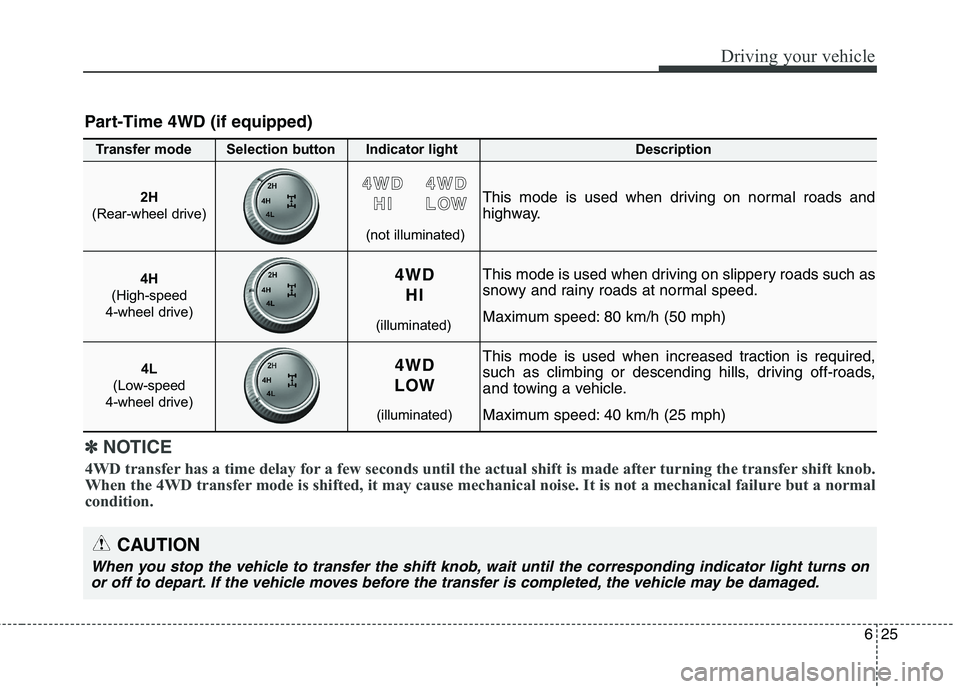
This mode is used when driving on slippery roads such as
snowy and rainy roads at normal speed.
Maximum speed: 80 km/h (50 mph)
2H
(Rear-wheel drive)
✽✽ NOTICE
4WD transfer has a time delay for a few seconds until the actual shift is made after turning the transfe r shift knob.
When the 4WD transfer mode is shifted, it may cause mechanical noise. It is not a mechanical failur e but a normal
condition.
Part-Time 4WD (if equipped)
Transfer mode Selection button Indicator light Description
This mode is used when driving on normal roads and
highway.
4H
(High-speed
4-wheel drive)
This mode is used when increased traction is required,
such as climbing or descending hills, driving off-roads,
and towing a vehicle.
Maximum speed: 40 km/h (25 mph)
4L
(Low-speed
4-wheel drive)
44 WW DD
H
H II
4WD
HI
4WD
LOW
44 WW DD
L
L OO WW
(not illuminated)
(illuminated)(illuminated)
CAUTION
When you stop the vehicle to transfer the shift knob, wait until the corresponding indicator light turns on or off to depart. If the vehicle moves before the transfer is completed, the vehicle may be damaged.
Page 351 of 548
627
Driving your vehicle
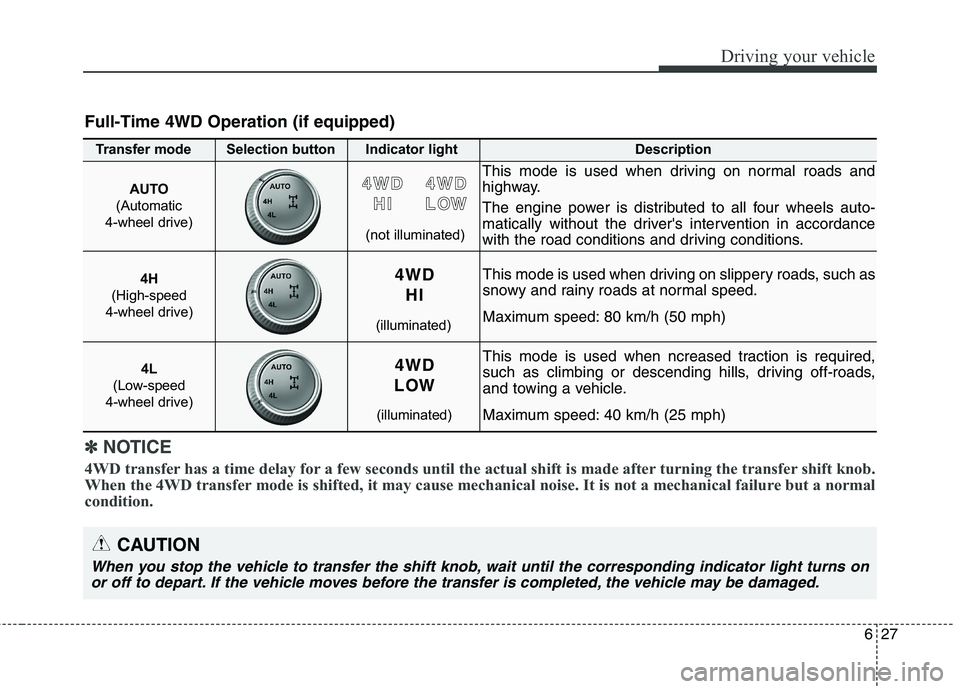
This mode is used when driving on slippery roads, such as
snowy and rainy roads at normal speed.
Maximum speed: 80 km/h (50 mph)
AUTO
(Automatic
4-wheel drive)
✽✽ NOTICE
4WD transfer has a time delay for a few seconds until the actual shift is made after turning the transfe r shift knob.
When the 4WD transfer mode is shifted, it may cause mechanical noise. It is not a mechanical failur e but a normal
condition.
Full-Time 4WD Operation (if equipped)
Transfer mode Selection button Indicator light Description
This mode is used when driving on normal roads and
highway.
The engine power is distributed to all four wheels auto-
matically without the driver's intervention in accordance
with the road conditions and driving conditions.
4H
(High-speed
4-wheel drive)
This mode is used when ncreased traction is required,
such as climbing or descending hills, driving off-roads,
and towing a vehicle.
Maximum speed: 40 km/h (25 mph)
4L
(Low-speed
4-wheel drive)
44 WW DD
H
H II
4WD
HI
4WD
LOW
44 WW DD
L
L OO WW
(not illuminated)
(illuminated)(illuminated)
CAUTION
When you stop the vehicle to transfer the shift knob, wait until the corresponding indicator light turns on or off to depart. If the vehicle moves before the transfer is completed, the vehicle may be damaged.
Page 405 of 548
What to do in an emergency
Road warning . . . . . . . . . . . . . . . . . . . . . . . . . . . . . . 7-2• Hazard warning flasher . . . . . . . . . . . . . . . . . . . . . . . 7-2
In case of an emergency while driving . . . . . . . . . . 7-3
. . . . . . . . . . . . . . . 7-3
. . . . . . . . . . . . . . . . . . . . 7-3
If the engine will not start . . . . . . . . . . . . . . . . . . . . 7-4 . . . . 7-4
. . . . 7-4
Emergency starting . . . . . . . . . . . . . . . . . . . . . . . . . 7-5
. . . . . . . . . . . . . . . . . . . . . . . . . . . . . . . . 7-7
If the engine overheats . . . . . . . . . . . . . . . . . . . . . . . 7-8
Tire Pressure Monitoring System (TPMS) . . . . . . 7-9 . . . . . . . . . . . . . . . . . . . . . . . . . . . . 7-9
. . . . . . . . . . . . . . . . . . . . . . 7-11
. . . . . . . . . . . . . . . 7-11
malfunction indicator . . . . . . . . . . . . . . . . . . . . . . . . 7-12
. . . . . . . . . . . . . . . . . . . . 7-13
If you have a flat tire (with spare tire ) . . . . . . . . 7-16 . . . . . . . . . . . . . . . . . . . . . . . . . . . . . . . 7-16
. . . . . . . . . . . . 7-17
. . . . . . . . . . . . . . . . . . . . . . . . . . . . . . . . . . . 7-25 . . . . . . . . . . 7-26
Towing . . . . . . . . . . . . . . . . . . . . . . . . . . . . . . . . . . . 7-27 . . . . . . . . . . . . . . . . . . . . . . . . . . . . . . . 7-27
. . . . . . . . . . . . . . . . . . . . . . . . . . . . 7-28
. . . . . . . . . . . . . . 7-31
Emergency Commodity . . . . . . . . . . . . . . . . . . . . . 7-32 . . . . . . . . . . . . . . . . . . . . . . . . . . . . . 7-32
. . . . . . . . . . . . . . . . . . . . . . . . . . . . . . . . . 7-32
. . . . . . . . . . . . . . . . . . . . . . . . . . . . 7-32
. . . . . . . . . . . . . . . . . . . . . . . . . . . 7-32
7
Page 409 of 548
75
What to do in an emergency
EMERGENCY STARTING
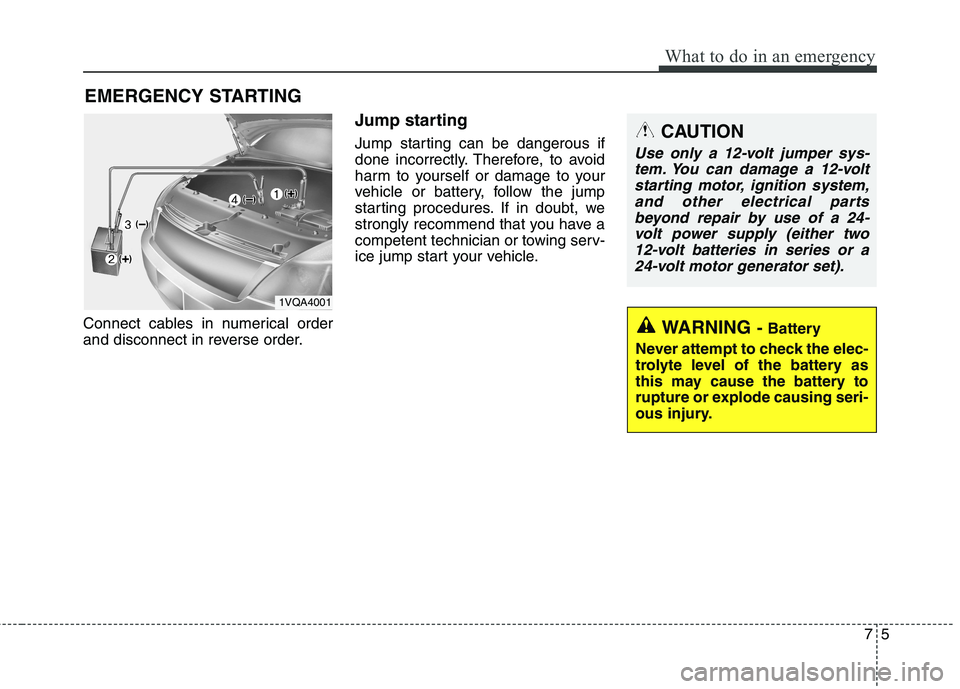
Connect cables in numerical order
and disconnect in reverse order. Jump starting
Jump starting can be dangerous if
done incorrectly. Therefore, to avoid
harm to yourself or damage to your
vehicle or battery, follow the jump
starting procedures. If in doubt, we
strongly recommend that you have a
competent technician or towing serv-
ice jump start your vehicle.
CAUTION
Use only a 12-volt jumper sys-
tem. You can damage a 12-voltstarting motor, ignition system, and other electrical partsbeyond repair by use of a 24-volt power supply (either two12-volt batteries in series or a 24-volt motor generator set).
WARNING - Battery
Never attempt to check the elec-
trolyte level of the battery as
this may cause the battery to
rupture or explode causing seri-
ous injury.
1VQA4001
Page 431 of 548
727
What to do in an emergency
TOWING
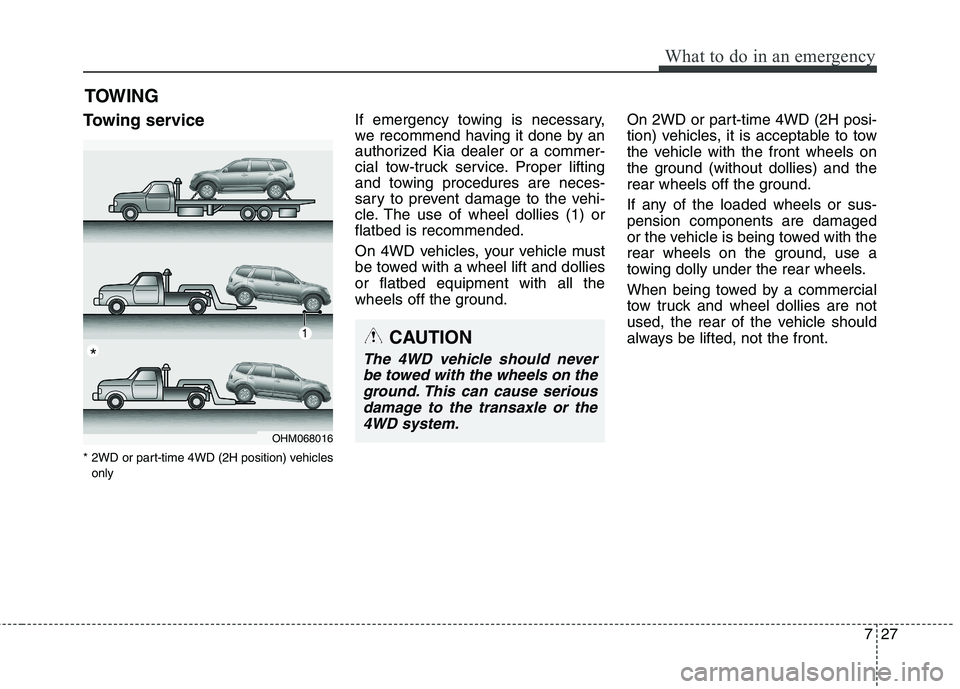
Towing service
* 2WD or part-time 4WD (2H position) vehicles only If emergency towing is necessary,
we recommend having it done by an
authorized Kia dealer or a commer-
cial tow-truck service. Proper lifting
and towing procedures are neces-
sary to prevent damage to the vehi-
cle. The use of wheel dollies (1) orflatbed is recommended.
On 4WD vehicles, your vehicle must
be towed with a wheel lift and dolliesor flatbed equipment with all the
wheels off the ground.
On 2WD or part-time 4WD (2H posi-
tion) vehicles, it is acceptable to tow
the vehicle with the front wheels on
the ground (without dollies) and the
rear wheels off the ground.
If any of the loaded wheels or sus- pension components are damaged
or the vehicle is being towed with the
rear wheels on the ground, use a
towing dolly under the rear wheels.
When being towed by a commercial
tow truck and wheel dollies are not
used, the rear of the vehicle should
always be lifted, not the front.
OHM068016
CAUTION
The 4WD vehicle should never
be towed with the wheels on theground. This can cause serious damage to the transaxle or the4WD system.*
Page 432 of 548
What to do in an emergency
28
7
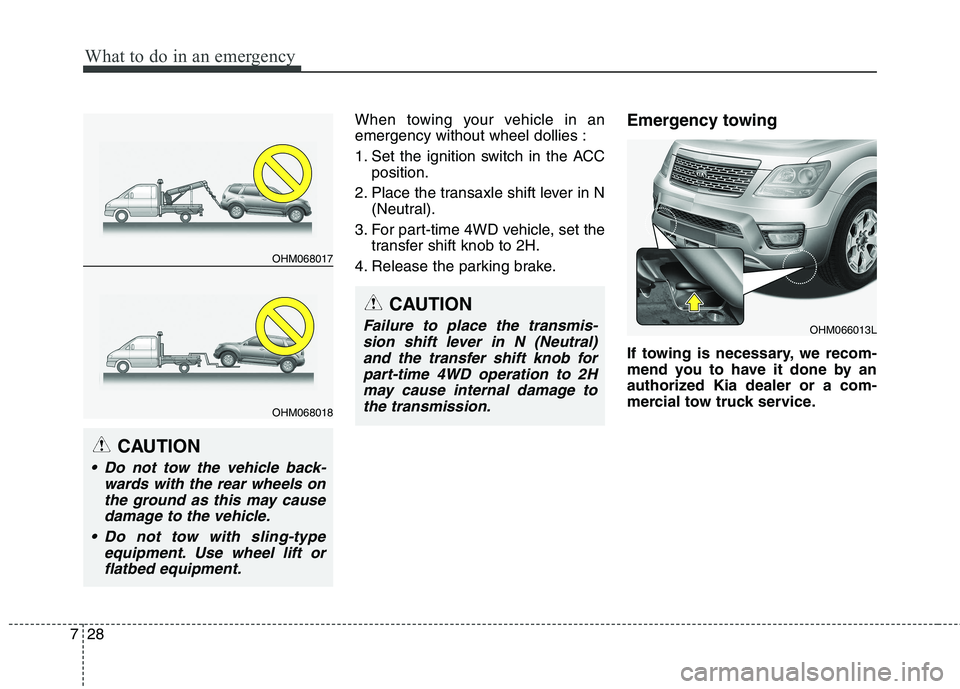
When towing your vehicle in an emergency without wheel dollies :
1. Set the ignition switch in the ACC
position.
2. Place the transaxle shift lever in N (Neutral).
3. For part-time 4WD vehicle, set the transfer shift knob to 2H.
4. Release the parking brake. Emergency towing
If towing is necessary, we recom-
mend you to have it done by an
authorized Kia dealer or a com-
mercial tow truck service.
CAUTION
Failure to place the transmis-
sion shift lever in N (Neutral)and the transfer shift knob for part-time 4WD operation to 2Hmay cause internal damage tothe transmission.
OHM068017
OHM068018
CAUTION
Do not tow the vehicle back- wards with the rear wheels onthe ground as this may causedamage to the vehicle.
Do not tow with sling-type equipment. Use wheel lift orflatbed equipment.
OHM066013L
Page 433 of 548
729
What to do in an emergency
If towing service is not available in an
emergency, your vehicle may be
temporarily towed using a cable or
chain secured to the emergency tow-ing hook under the front (or rear) of
the vehicle. Use extreme caution
when towing the vehicle. A driver
must be in the vehicle to steer it and
operate the brakes.
Towing in this manner may be done
only on hard-surfaced roads for a
short distance and at low speed.
Also, the wheels, axles, power train,
steering and brakes must all be ingood condition.
Do not use the tow hooks to pull avehicle out of mud, sand or other
conditions from which the vehicle
cannot be driven out under its own
power.
Avoid towing a vehicle heavier than the vehicle doing the towing.
The drivers of both vehicles should communicate with each other fre-
quently. Before emergency towing, check if
the hook is not broken or dam-aged.
Fasten the towing cable or chain securely to the hook.
Do not jerk the hook. Apply it steadily and with even force.
To avoid damaging the hook, do not pull from the side or at a verti-
cal angle. Always pull straightahead.CAUTION
Attach a towing strap to the
tow hook.
Using a portion of the vehicle other than the tow hooks fortowing may damage the bodyof your vehicle.
Use only a cable or chain specifically intended for usein towing vehicles. Securely fasten the cable or chain tothe towing hook provided.
WARNING
Use extreme caution when tow-
ing the vehicle.
Avoid sudden starts or erratic driving maneuvers which
would place excessive stress
on the emergency towing hook
and towing cable or chain. The
hook and towing cable or
chain may break and cause
serious injury or damage.
If the disabled vehicle is unable to be moved, do not
forcibly continue the towing.
We recommend that you con-
tact an authorized Kia dealer
or a commercial tow truck
service for assistance.
Tow the vehicle as straight ahead as possible.
Keep away from the vehicle during towing.
Page 434 of 548
What to do in an emergency
30
7
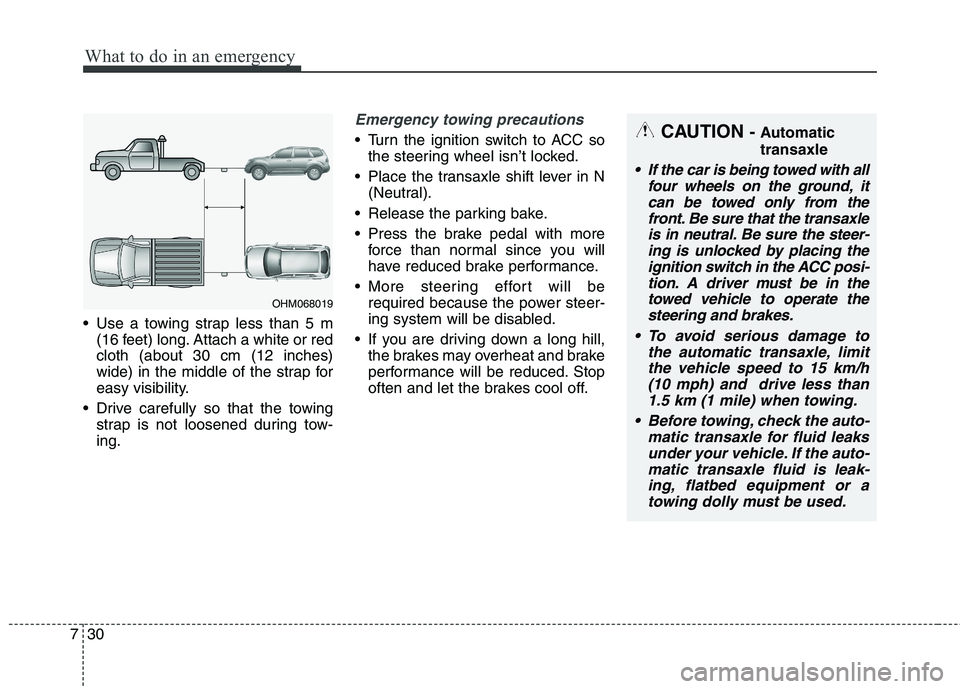
Use a towing strap less than 5 m
(16 feet) long. Attach a white or red cloth (about 30 cm (12 inches)
wide) in the middle of the strap for
easy visibility.
Drive carefully so that the towing strap is not loosened during tow-ing.
Emergency towing precautions
Turn the ignition switch to ACC sothe steering wheel isn’t locked.
Place the transaxle shift lever in N (Neutral).
Release the parking bake.
Press the brake pedal with more force than normal since you will
have reduced brake performance.
More steering effort will be required because the power steer-
ing system will be disabled.
If you are driving down a long hill, the brakes may overheat and brake
performance will be reduced. Stop
often and let the brakes cool off.
OHM068019
CAUTION - Automatic transaxle
If the car is being towed with all
four wheels on the ground, itcan be towed only from the front. Be sure that the transaxleis in neutral. Be sure the steer-ing is unlocked by placing the ignition switch in the ACC posi-tion. A driver must be in thetowed vehicle to operate the steering and brakes.
To avoid serious damage to the automatic transaxle, limitthe vehicle speed to 15 km/h(10 mph) and drive less than 1.5 km (1 mile) when towing.
Before towing, check the auto- matic transaxle for fluid leaksunder your vehicle. If the auto-matic transaxle fluid is leak- ing, flatbed equipment or atowing dolly must be used.