height KIA Cadenza 2014 1.G User Guide
[x] Cancel search | Manufacturer: KIA, Model Year: 2014, Model line: Cadenza, Model: KIA Cadenza 2014 1.GPages: 415, PDF Size: 5.09 MB
Page 160 of 415

Features of your vehicle
92
4
The detecting range may decrease
when:
1. The sensor is stained with foreign
matter such as snow or water.
(The sensing range will return to
normal when removed.)
2. Outside air temperature is extremely hot or cold.
The following objects may not be
recognized by the sensor:
1. Sharp or slim objects such as ropes, chains or small poles.
2. Objects which tend to absorb the sensor frequency such as clothes,
spongy material or snow.
3. Undetectable objects smaller than 1 m (40 in.) in height and narrower
than 14 cm (6 in.) in diameter.Rear parking assist system
precautions
The rear parking assist systemmay not sound sequentially
depending on the speed and
shapes of the objects detected.
The rear parking assist system may malfunction if the vehicle
bumper height or sensor installa-
tion has been modified or dam-
aged. Any non-factory installed
equipment or accessories may
also interfere with the sensor per-
formance.
The sensor may not recognize objects less than 30 cm (11 in.)
from the sensor, or it may sense an
incorrect distance. Use caution.
When the sensor is frozen or stained with snow, dirt, or water,
the sensor may be inoperative until
the stains are removed using a soft
cloth.
Do not push, scratch or strike the sensor. Sensor damage could
occur.
✽ ✽ NOTICE
This system can only sense objects
within the range and location of the
sensors; It can not detect objects in
other areas where sensors are not
installed. Also, small or slim objects,
such as poles or objects located
between sensors may not be detected
by the sensors.
Always visually check behind the
vehicle when backing up.
Be sure to inform any drivers of the
vehicle that may be unfamiliar with
the system regarding the systems
capabilities and limitations.
Page 238 of 415
Driving your vehicle
28
5
Anti-lock brake system (ABS)
ABS (or ESC) will not prevent acci-
dents due to improper or dangerous
driving maneuvers. Even though
vehicle control is improved during
emergency braking, always maintain
a safe distance between you and
objects ahead. Vehicle speeds
should always be reduced during
extreme road conditions.
The vehicle should be driven at
reduced speeds in the following cir-
cumstances:
When driving on rough, gravel or
snow-covered roads
When driving on roads where the road surface is pitted or has differ-
ent surface heights.
Driving in these conditions increases
the stopping distance for your vehi-
cle. The ABS continuously senses the
speed of the wheels. If the wheels
are going to lock, the ABS system
repeatedly modulates the hydraulic
brake pressure to the wheels.
When you apply your brakes under
conditions which may lock the
wheels, you may hear a “tik-tik’’
sound from the brakes, or feel a cor-
responding sensation in the brake
pedal. This is normal and it means
your ABS is active.
In order to obtain the maximum ben-
efit from your ABS in an emergency
situation, do not attempt to modulate
your brake pressure and do not try to
pump your brakes. Press your brake
pedal as hard as possible or as hard
as the situation allows the ABS to
control the force being delivered to
the brakes.
✽ ✽
NOTICE
A click sound may be heard in the
engine compartment when the vehi-
cle begins to move after the engine is
started. These conditions are normal
and indicate that the anti-lock brake
system is functioning properly.
Even with the anti-lock brake sys-
tem, your vehicle still requires suf-
ficient stopping distance. Always
maintain a safe distance from the
vehicle in front of you.
Always slow down when cornering. The anti-lock brake system cannot
prevent accidents resulting from
excessive speeds.
On loose or uneven road surfaces, operation of the anti-lock brake
system may result in a longer stop-
ping distance than for vehicles
equipped with a conventional
brake system.
Page 273 of 415

563
Driving your vehicle
Non-operating condition
Driver's Attention
The driver must be cautious in the
following situations in which the sys-
tem may not assist the driver and
may not function properly.
- Curved roads, tollgates, etc.
- The surrounding of the sensor iscovered by rain, snow, mud, etc
- The rear bumper near the sensor is covered or hidden with a foreign
matter such as a sticker, bumper
guard, bicycle stand etc.
- The rear bumper is damaged or the sensor is out of place.
- The height of the vehicle is changed or altered such as when
the trunk is loaded with heavy
objects, or has abnormal tire pres-
sure etc.
- Due to bad weather such as heavy rain or snow.
- A fixed object is near such as a guardrail, tunnel, animals etc.
- A lot of amount of metal sub- stances are near the vehicles such
as a construction area. - A big vehicle is near such as a bus
or truck.
- A motorcycle or bicycle is near.
- A flat trailer like vehicle is near.
- If the vehicle has started at the same time as the vehicle next to it
and has accelerated.
- When the other vehicle passes by very fast.
- When changing lanes.
- When going down or up a steep road where the height of the lane is
different.
- When the other vehicle drives at the rear very nearby or drives very
close.
- When the temperature near the bumper is high.
- When a trailer or carrier is installed.
Outside rearview mirror may not alert the driver when:
- The outside rearview mirror hous- ing is covered with foreign matter.
- The window is covered with foreign matter.
- The windows are severely tinted.
Page 364 of 415
751
Maintenance
Compact spare tire replacement
A compact spare tire has a shorter
tread life than a regular size tire.
Replace it when you can see the
tread wear indicator bars on the tire.
The replacement compact spare tire
should be the same size and design
tire as the one provided with your
new vehicle and should be mounted
on the same compact spare tire
wheel. The compact spare tire is not
designed to be mounted on a regular
size wheel, and the compact spare
tire wheel is not designed for mount-
ing a regular size tire.
Wheel replacement
When replacing the metal wheels for
any reason, make sure the new
wheels are equivalent to the original
factory units in diameter, rim width
and offset.
Tire traction
Tire traction can be reduced if you
drive on worn tires, tires that are
improperly inflated or on slippery
road surfaces. Tires should be
replaced when tread wear indicators
appear. Slow down whenever there
is rain, snow or ice on the road to
reduce the possibility of losing con-
trol of the vehicle.
Tire maintenance
In addition to proper inflation, correct
wheel alignment helps to decrease
tire wear. If you find a tire is worn
unevenly, have your dealer check the
wheel alignment.
When you have new tires installed,
make sure they are balanced. This
will increase vehicle ride comfort and
tire life. Additionally, a tire should
always be rebalanced if it is removed
from the wheel.
WARNING
A wheel that is not the correct
size may adversely affect wheel
and bearing life, braking and
stopping abilities, handling
characteristics, ground clear-
ance, body-to-tire clearance,
snow chain clearance,
speedometer and odometer cal-
ibration, headlight aim and
bumper height.
Page 365 of 415
Maintenance
52
7
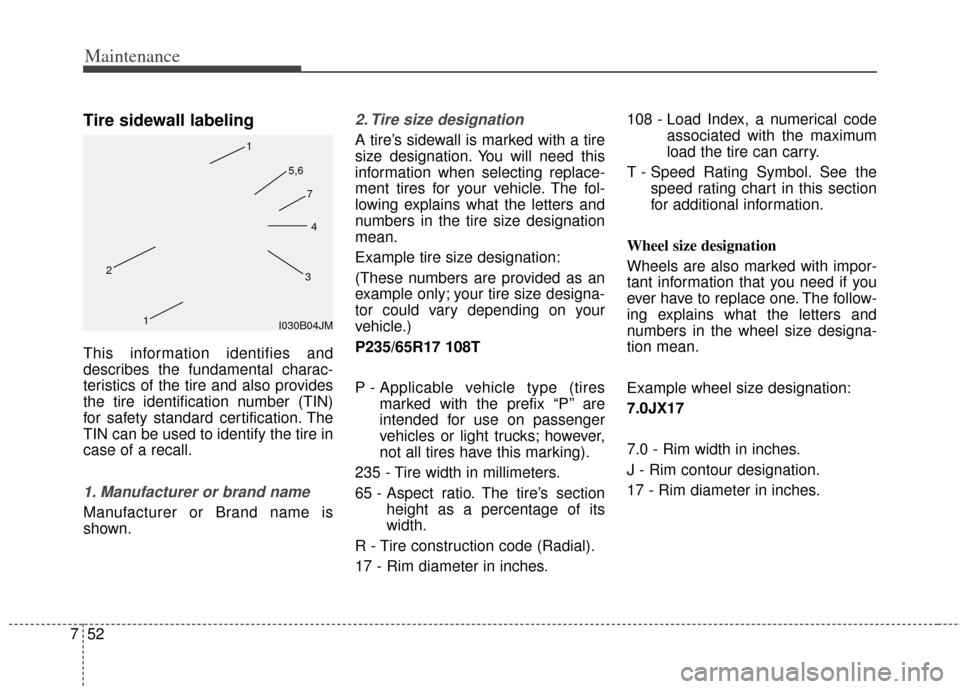
Tire sidewall labeling
This information identifies and
describes the fundamental charac-
teristics of the tire and also provides
the tire identification number (TIN)
for safety standard certification. The
TIN can be used to identify the tire in
case of a recall.
1. Manufacturer or brand name
Manufacturer or Brand name is
shown.
2. Tire size designation
A tire’s sidewall is marked with a tire
size designation. You will need this
information when selecting replace-
ment tires for your vehicle. The fol-
lowing explains what the letters and
numbers in the tire size designation
mean.
Example tire size designation:
(These numbers are provided as an
example only; your tire size designa-
tor could vary depending on your
vehicle.)
P235/65R17 108T
P - Applicable vehicle type (tires
marked with the prefix “P’’ are
intended for use on passenger
vehicles or light trucks; however,
not all tires have this marking).
235 - Tire width in millimeters.
65 - Aspect ratio. The tire’s section height as a percentage of its
width.
R - Tire construction code (Radial).
17 - Rim diameter in inches. 108 - Load Index, a numerical code
associated with the maximum
load the tire can carry.
T - Speed Rating Symbol. See the speed rating chart in this section
for additional information.
Wheel size designation
Wheels are also marked with impor-
tant information that you need if you
ever have to replace one. The follow-
ing explains what the letters and
numbers in the wheel size designa-
tion mean.
Example wheel size designation:
7.0JX17
7.0 - Rim width in inches.
J - Rim contour designation.
17 - Rim diameter in inches.
I030B04JM
1
1
2
34
5,6
7
Page 369 of 415

Maintenance
56
7
Tire terminology and definitions
Air Pressure: The amount of air
inside the tire pressing outward on
the tire. Air pressure is expressed in
pounds per square inch (psi) or kilo-
pascal (kPa).
Accessory Weight : This means the
combined weight of optional acces-
sories. Some examples of optional
accessories are, automatic
transaxle, power seats, and air con-
ditioning.
Aspect Ratio : The relationship of a
tire's height to its width.
Belt: A rubber coated layer of cords
that is located between the plies and
the tread. Cords may be made from
steel or other reinforcing materials.
Bead: The tire bead contains steel
wires wrapped by steel cords that
hold the tire onto the rim.
Bias Ply Tire : A pneumatic tire in
which the plies are laid at alternate
angles less than 90 degrees to the
centerline of the tread. Cold Tire Pressure: The amount of
air pressure in a tire, measured in
pounds per square inch (psi) or kilo-
pascals (kPa) before a tire has built
up heat from driving.
Curb Weight: This means the weight
of a motor vehicle with standard and
optional equipment including the
maximum capacity of fuel, oil and
coolant, but without passengers and
cargo.
DOT Markings: The DOT code
includes the Tire Identification
Number (TIN), an alphanumeric des-
ignator which can also identify the
tire manufacturer, production plant,
brand and date of production.
GVWR: Gross Vehicle Weight Rating
GAWR FRT: Gross Axle Weight
Rating for the Front Axle.
GAWR RR: Gross Axle Weight
Rating for the Rear axle.
Intended Outboard Sidewall
: The
side of an asymmetrical tire, that
must always face outward when
mounted on a vehicle.
Kilopascal (kPa): The metric unit for
air pressure.
Load Index: An assigned number
ranging from 1 to 279 that corre-
sponds to the load carrying capacity
of a tire.
Maximum Inflation Pressure: The
maximum air pressure to which a
cold tire may be inflated. The maxi-
mum air pressure is molded onto the
sidewall.
Maximum Load Rating : The load
rating for a tire at the maximum per-
missible inflation pressure for that
tire.
Maximum Loaded Vehicle Weight:
The sum of curb weight; accessory
weight; vehicle capacity weight; and
production options weight.
Normal Occupant Weight: The
number of occupants a vehicle is
designed to seat multiplied by 68 kg
(150 pounds).
Page 399 of 415

Specifications & Consumer information
28
DIMENSIONS
*1: with R17 tire
*
2: with R18/R19 tire Item mm (in)
Overall length 4970 (195.7) Overall width 1850 (72.8)
Overall height 1475 (58.1) Front tread 1602 (63.1)*
1/ 1601 (63.0)*2
Rear tread 1601 (63.0)*1/ 1600 (62.9)*2
Wheelbase 2845 (112.0)
ItemTire size Wheel size Inflation pressure kPa (psi)
Wheel lug nut torque
kg•m (lb N
Normal load *1Maximum load
Front Rear Front Rear
Full size tire P245/45R18 7.5Jx18
220
(32) 220
(32) 220
(32) 220
(32)
9~11
(65~79, 88~107)
P245/40R19 8.0Jx19 220
(32) 220
(32) 220
(32) 220
(32)
Compact spare tire T135/80D17 4.0Tx17 420
(60) 420
(60) 420
(60) 420
(60)
*1: Normal load : Up to 3 persons
TIRES AND WHEELS
Page 410 of 415

I5
Index
Washer fluid . . . . . . . . . . . . . . . . . . . . . . . . . . . . . . . 7-35
Fog light . . . . . . . . . . . . . . . . . . . . . . . . . . . . . . . . . . . 4-\
102
Folding the outside rearview mirror . . . . . . . . . . . . . . . 4-50
Front seat adjustment - power . . . . . . . . . . . . . . . . . . . . 3-4
Fuel Economy . . . . . . . . . . . . . . . . . . . . . . . . . . . . . . . . 4-73
Fuel filler lid . . . . . . . . . . . . . . . . . . . . . . . . . . . . . . . . . 4-29
Fuel Gauge . . . . . . . . . . . . . . . . . . . . . . . . . . . . . . . . . . 4-55\
Fuel requirements . . . . . . . . . . . . . . . . . . . . . . . . . . . . . . 1-3
Fuse switch . . . . . . . . . . . . . . . . . . . . . . . . . . . . . . . . . . 7-63\
Fuses . . . . . . . . . . . . . . . . . . . . . . . . . . . . . . . . . . . . \
. . . 7-61 Fuse switch . . . . . . . . . . . . . . . . . . . . . . . . . . . . . . . . 7-63
Fuse/relay panel description. . . . . . . . . . . . . . . . . . . 7-65
Instrument panel fuse . . . . . . . . . . . . . . . . . . . . . . . . 7-65
Main fuse . . . . . . . . . . . . . . . . . . . . . . . . . . . . . . . . . 7-64
Multi fuse . . . . . . . . . . . . . . . . . . . . . . . . . . . . . . . . . 7-64
Gauges . . . . . . . . . . . . . . . . . . . . . . . . . . . . . . . . . . . . \
. 4-54
Glove box . . . . . . . . . . . . . . . . . . . . . . . . . . . . . . . . . . 4-13\
0
Glove box lamp. . . . . . . . . . . . . . . . . . . . . . . . . . . . . . 4-110
Gross vehicle weight. . . . . . . . . . . . . . . . . . . . . . . . . . . . 8-3
Hazard warning flasher . . . . . . . . . . . . . . . . . . . . . . . . . 4-96
Hazardous driving conditions . . . . . . . . . . . . . . . . . . . . 5-66
Headlamp escort function . . . . . . . . . . . . . . . . . . . . . . . 4-97 Headlight leveling device . . . . . . . . . . . . . . . . . . . . . . 4-103
Headrest(front) . . . . . . . . . . . . . . . . . . . . . . . . . . . . . . . . 3-9
Headrest(rear) . . . . . . . . . . . . . . . . . . . . . . . . . . . . . . . . 3-11
Heated steering wheel. . . . . . . . . . . . . . . . . . . . . . . . . . 4-39
Heater . . . . . . . . . . . . . . . . . . . . . . . . . . . . . . . . . . . . \
. 4-113
Height adjustment . . . . . . . . . . . . . . . . . . . . . . . . . . . . . 3-16
High - beam operation . . . . . . . . . . . . . . . . . . . . . . . . 4-110
Highway driving . . . . . . . . . . . . . . . . . . . . . . . . . . . . . . 5-69
Hill-start assist control (HAC) . . . . . . . . . . . . . . . . . . . 5-33
HomeLink system . . . . . . . . . . . . . . . . . . . . . . . . . . . . . 4-40
Hood . . . . . . . . . . . . . . . . . . . . . . . . . . . . . . . . . . . . \
. . . 4-27
Horn . . . . . . . . . . . . . . . . . . . . . . . . . . . . . . . . . . . . \
. . . 4-39
How to use this manual . . . . . . . . . . . . . . . . . . . . . . . . . 1-2
Immobilizer system . . . . . . . . . . . . . . . . . . . . . . . . . . . 4-11
Indicator light . . . . . . . . . . . . . . . . . . . . . . . . . . . . . . . . 4-86
Inflation and non inflation conditions . . . . . . . . . . . . . 3-48
Inside rearview mirror . . . . . . . . . . . . . . . . . . . . . . . . . 4-40
Instrument cluster . . . . . . . . . . . . . . . . . . . . . . . . . . . . . 4-52
Gauges . . . . . . . . . . . . . . . . . . . . . . . . . . . . . . . . . . . 4-\
54
Instrument panel illumination . . . . . . . . . . . . . . . . . 4-53
LCD Display Control . . . . . . . . . . . . . . . . . . . . . . . . 4-53
Transaxle Shift Indicator . . . . . . . . . . . . . . . . . . . . . 4-58
Instrument panel fuse . . . . . . . . . . . . . . . . . . . . . . . . . . 7-62
Instrument panel overview . . . . . . . . . . . . . . . . . . . . . . . 2-5
Interior care. . . . . . . . . . . . . . . . . . . . . . . . . . . . . . . . . . 7-79\
G
H
I
Page 413 of 415

Index
8I
Rear curtain. . . . . . . . . . . . . . . . . . . . . . . . . . . . . . . . . 4-139
Rear parking assist system . . . . . . . . . . . . . . . . . . . . . . 4-90
Rear seat adjustment . . . . . . . . . . . . . . . . . . . . . . . . . . . 3-11
Rear view camera . . . . . . . . . . . . . . . . . . . . . . . . . . . . . 4-94
Recommended cold tire inflation pressures . . . . . . . . . 7-46
Recommended lubricants and capacities . . . . . . . . . . . . 8-5Recommended SAE viscosity number. . . . . . . . . . . . 8-6
Record your key number . . . . . . . . . . . . . . . . . . . . . . . . 4-4
Remote keyless entry system operations . . . . . . . . . . . . 4-6
Reverse parking aid function . . . . . . . . . . . . . . . . . . . . 4-50
Road warning . . . . . . . . . . . . . . . . . . . . . . . . . . . . . . . . . 6-2
Rocking the vehicle . . . . . . . . . . . . . . . . . . . . . . . . . . . 5-66
Room lamp . . . . . . . . . . . . . . . . . . . . . . . . . . . . . . . . . 4-108
Rotation (Tire) . . . . . . . . . . . . . . . . . . . . . . . . . . . . . . . 7-50
Scheduled maintenance service . . . . . . . . . . . . . . . . . . . 7-8
Seat belt Precautions. . . . . . . . . . . . . . . . . . . . . . . . . . . 3-21
Seat belt restraint system . . . . . . . . . . . . . . . . . . . . . . . 3-13
Seat belt warning . . . . . . . . . . . . . . . . . . . . . . . . . . . . . 3-14
Seat belts . . . . . . . . . . . . . . . . . . . . . . . . . . . . . . . . . . . . \
3-13 3 point system seat belt . . . . . . . . . . . . . . . . . . . . . . 3-15
Height adjustment . . . . . . . . . . . . . . . . . . . . . . . . . . 3-16
Pre-tensioner seat belt . . . . . . . . . . . . . . . . . . . . . . . 3-18
Seat belt Precautions . . . . . . . . . . . . . . . . . . . . . . . . 3-21 Seat belt restraint system . . . . . . . . . . . . . . . . . . . . . 3-13
Seat belt warning . . . . . . . . . . . . . . . . . . . . . . . . . . . 3-14
Seat warmer . . . . . . . . . . . . . . . . . . . . . . . . . . . . . . . . 4-133
Seatback pocket . . . . . . . . . . . . . . . . . . . . . . . . . . . . . . 3-10
Seats . . . . . . . . . . . . . . . . . . . . . . . . . . . . . . . . . . . . \
. . . . 3-2 Armrest (rear) . . . . . . . . . . . . . . . . . . . . . . . . . . . . . . 3-12
Front seat adjustment - power . . . . . . . . . . . . . . . . . . 3-4
Headrest(front) . . . . . . . . . . . . . . . . . . . . . . . . . . . . . . 3-9
Headrest(rear) . . . . . . . . . . . . . . . . . . . . . . . . . . . . . . 3-11
Rear seat adjustment . . . . . . . . . . . . . . . . . . . . . . . . 3-11
Seatback pocket . . . . . . . . . . . . . . . . . . . . . . . . . . . . 3-10
Service Mode . . . . . . . . . . . . . . . . . . . . . . . . . . . . . . . . 4-60
Shift lock system . . . . . . . . . . . . . . . . . . . . . . . . . . . . . 5-14
Side air bag . . . . . . . . . . . . . . . . . . . . . . . . . . . . . . . . . . 3-45\
Smart cruise control system . . . . . . . . . . . . . . . . . . . . . 5-41
Smart key . . . . . . . . . . . . . . . . . . . . . . . . . . . . . . . . . . . . \
4-4 Battery replacement . . . . . . . . . . . . . . . . . . . . . . . . . . 4-8
Immobilizer system . . . . . . . . . . . . . . . . . . . . . . . . . 4-11
Record your key number . . . . . . . . . . . . . . . . . . . . . . 4-4
Remote keyless entry system operations . . . . . . . . . . 4-6
Smart key functions . . . . . . . . . . . . . . . . . . . . . . . . . . 4-4
Smart key precautions . . . . . . . . . . . . . . . . . . . . . . . . 4-5
Transmitter precautions . . . . . . . . . . . . . . . . . . . . . . . 4-7
Smart key functions . . . . . . . . . . . . . . . . . . . . . . . . . . . . 4-4
Smart key precautions. . . . . . . . . . . . . . . . . . . . . . . . . . . 4-5
Smooth cornering . . . . . . . . . . . . . . . . . . . . . . . . . . . . . 5-67
Snow tires . . . . . . . . . . . . . . . . . . . . . . . . . . . . . . . . . . . 5-\
70
R
S