child seat KIA CADENZA 2017 Owner's Manual
[x] Cancel search | Manufacturer: KIA, Model Year: 2017, Model line: CADENZA, Model: KIA CADENZA 2017Pages: 500, PDF Size: 10.37 MB
Page 69 of 500
353
Safety features of your vehicle
✽
✽NOTICE
The PASSENGER AIR BAG “OFF”
indicator illuminates for about 4 sec-
onds after the Engine Start/Stop
button is turned to the ON position
or after the engine is started. If the
front passenger seat is occupied, the
occupant detection sensor will then
classify the front passenger after
several more seconds.
Even though your vehicle is
equipped with the occupant detec-
tion system, never install a child
restraint system in the front pas-
senger's seat. A deploying air bag
can forcefully strike a child result-
ing in serious injuries or death. Any
child age 12 and under should ride
in the rear seat. Children too large
for child restraints should use the
available lap/shoulder belts. No
matter what type of crash, children
of all ages are safer when
restrained in the rear seat.
If the PASSENGER AIR BAG “OFF” indicator is illuminated when
the front passenger's seat is occu-
pied by an adult and he/she sits
properly (sitting upright with the
seatback in an upright position,
centered on the seat cushion with
their seat belt on, legs comfortably
extended and their feet on the
floor), have that person sit in the
rear seat. Any child age 12 and under should
ride in the rear seat. Children too
large for child restraints should use
the available lap/shoulder belts. No
matter what type of crash, children of
all ages are safer when restrained in
the rear seat.
If the occupant detection system is
not working properly, the SRS air
bag warning light on the instrument
panel will illuminate because the
passenger's front air bag is connect-
ed with the occupant detection sys-
tem. If there is a malfunction of the
occupant detection system, the PAS-
SENGER AIR BAG “OFF” indicator
will not illuminate and the passen-
ger's front air bag will inflate in frontal
impact crashes even if there is no
occupant in the front passenger's
seat.
Page 70 of 500
Safety features of your vehicle
54
3
Driver's and passenger's front
air bagYour vehicle is equipped with an
Advanced Supplemental Restraint
(Air Bag) System and lap/shoulder
belts at both the driver and passen-
ger seating position.
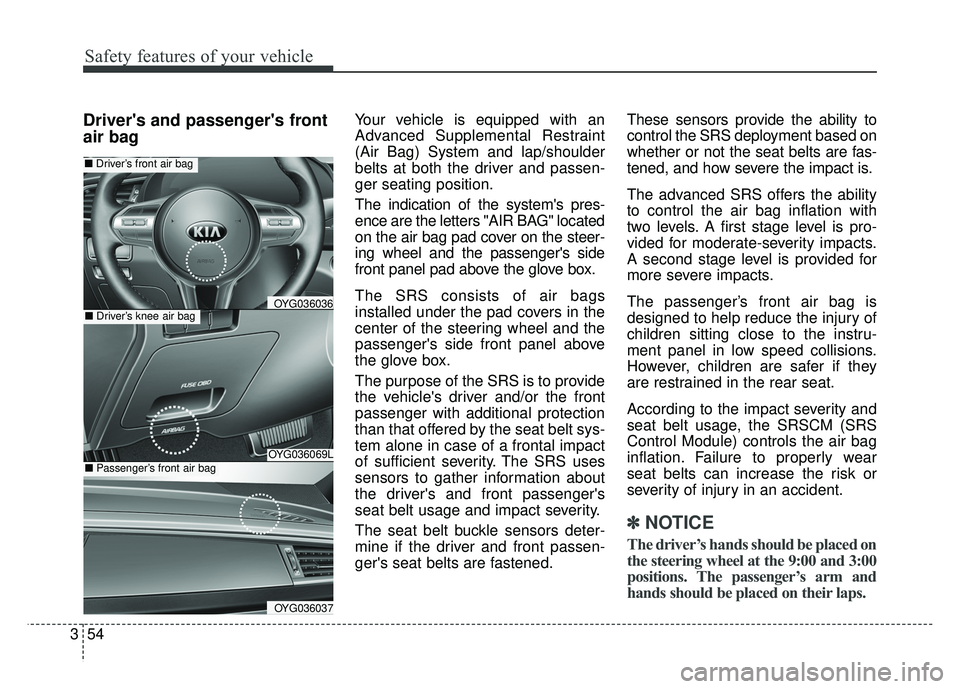
The indication of the system's pres-
ence are the letters "AIR BAG" located
on the air bag pad cover on the steer-
ing wheel and the passenger's side
front panel pad above the glove box.
The SRS consists of air bags
installed under the pad covers in the
center of the steering wheel and the
passenger's side front panel above
the glove box.
The purpose of the SRS is to provide
the vehicle's driver and/or the front
passenger with additional protection
than that offered by the seat belt sys-
tem alone in case of a frontal impact
of sufficient severity. The SRS uses
sensors to gather information about
the driver's and front passenger's
seat belt usage and impact severity.
The seat belt buckle sensors deter-
mine if the driver and front passen-
ger's seat belts are fastened. These sensors provide the ability to
control the SRS deployment based on
whether or not the seat belts are fas-
tened, and how severe the impact is.
The advanced SRS offers the ability
to control the air bag inflation with
two levels. A first stage level is pro-
vided for moderate-severity impacts.
A second stage level is provided for
more severe impacts.
The passenger’s front air bag is
designed to help reduce the injury of
children sitting close to the instru-
ment panel in low speed collisions.
However, children are safer if they
are restrained in the rear seat.
According to the impact severity and
seat belt usage, the SRSCM (SRS
Control Module) controls the air bag
inflation. Failure to properly wear
seat belts can increase the risk or
severity of injury in an accident.
✽ ✽
NOTICE
The driver’s hands should be placed on
the steering wheel at the 9:00 and 3:00
positions. The passenger’s arm and
hands should be placed on their laps.
OYG036069L
■ Driver’s front air bag
■Driver’s knee air bagOYG036036
OYG036037
■Passenger’s front air bag
Page 224 of 500
4143
Features of your vehicle
During mild weather or under condi-
tions where the operation of the seat
warmer is not needed, keep the
switches in the “OFF” position.Temperature control (Manual)
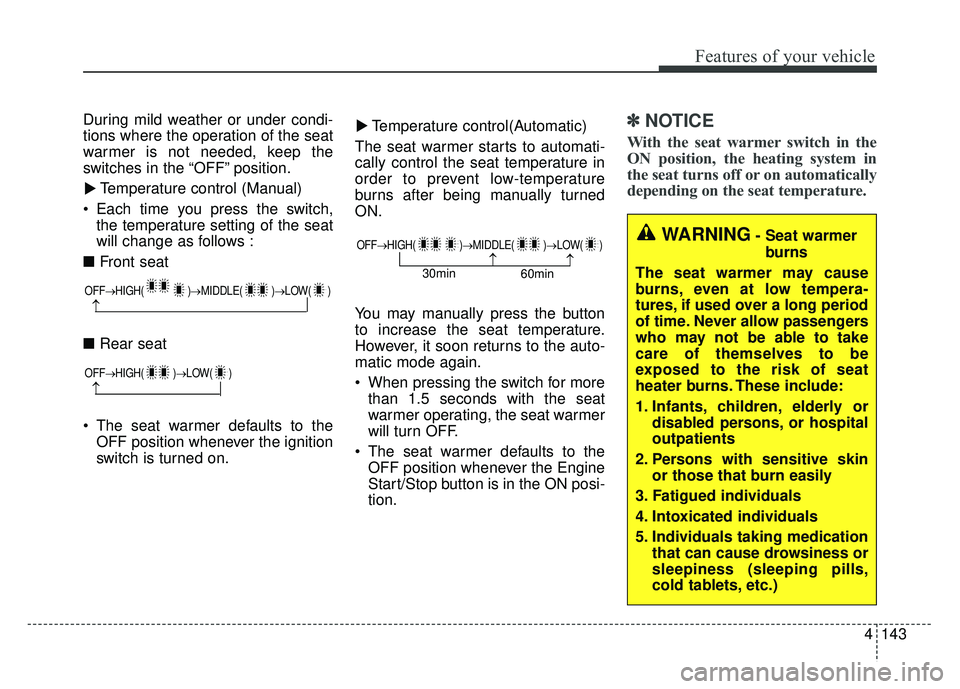
Each time you press the switch, the temperature setting of the seat
will change as follows :
■ Front seat
■ Rear seat
The seat warmer defaults to the OFF position whenever the ignition
switch is turned on. Temperature control(Automatic)
The seat warmer starts to automati-
cally control the seat temperature in
order to prevent low-temperature
burns after being manually turned
ON.
You may manually press the button
to increase the seat temperature.
However, it soon returns to the auto-
matic mode again.
When pressing the switch for more than 1.5 seconds with the seat
warmer operating, the seat warmer
will turn OFF.
The seat warmer defaults to the OFF position whenever the Engine
Start/Stop button is in the ON posi-
tion.✽ ✽ NOTICE
With the seat warmer switch in the
ON position, the heating system in
the seat turns off or on automatically
depending on the seat temperature.▼
▼
OFF→
HIGH( )→ MIDDLE( )→LOW( )
→
OFF→HIGH( )→ LOW( )
→
OFF→HIGH( )→ MIDDLE( )→LOW( )
→→30min
60min
WARNING- Seat warmer
burns
The seat warmer may cause
burns, even at low tempera-
tures, if used over a long period
of time. Never allow passengers
who may not be able to take
care of themselves to be
exposed to the risk of seat
heater burns. These include:
1. Infants, children, elderly or disabled persons, or hospital
outpatients
2. Persons with sensitive skin or those that burn easily
3. Fatigued individuals
4. Intoxicated individuals
5. Individuals taking medication that can cause drowsiness or
sleepiness (sleeping pills,
cold tablets, etc.)
Page 340 of 500
5103
Driving your vehicle
Towing capacity:
We do not recommend using this
vehicle for trailer towing.
Cargo capacity:
The cargo capacity of your vehicle
will increase or decrease depending
on the weight and the number of
occupants.
Steps For Determining CorrectLoad Limit -
1. Locate the statement "The com- bined weight of occupants and
cargo should never exceed XXX
kg or XXX lbs.'' on your vehicle's
placard.
2. Determine the combined weight of the driver and passengers that will
be riding in your vehicle.
3. Subtract the combined weight of the driver and passengers from
XXX kg or XXX lbs.
4. The resulting figure equals the available amount of cargo and lug-
gage load capacity. For example, if
the "XXX" amount equals 1400
lbs. and there will be five 150 lbs.
passengers in your vehicle, the
amount of available cargo and lug-
gage load capacity is 650 lbs.
(1400-750 (5 x 150) = 650 lbs.) 5. Determine the combined weight of
luggage and cargo being loaded
on the vehicle. That weight may
not safely exceed the available
cargo and luggage load capacity
calculated in Step 4.
6. If your vehicle will be towing a trail- er, load from your trailer will be
transferred to your vehicle. Consult
this manual to determine how this
reduces the available cargo and
luggage load capacity of your
vehicle.
WARNING - Loose cargo
Do not travel with unsecured
blunt objects in the passenger
compartment of your vehicle
(e.g. suit cases or unsecured
child seats). These items may
strike occupant during a sud-
den stop or crash.
Page 489 of 500
Index
4I
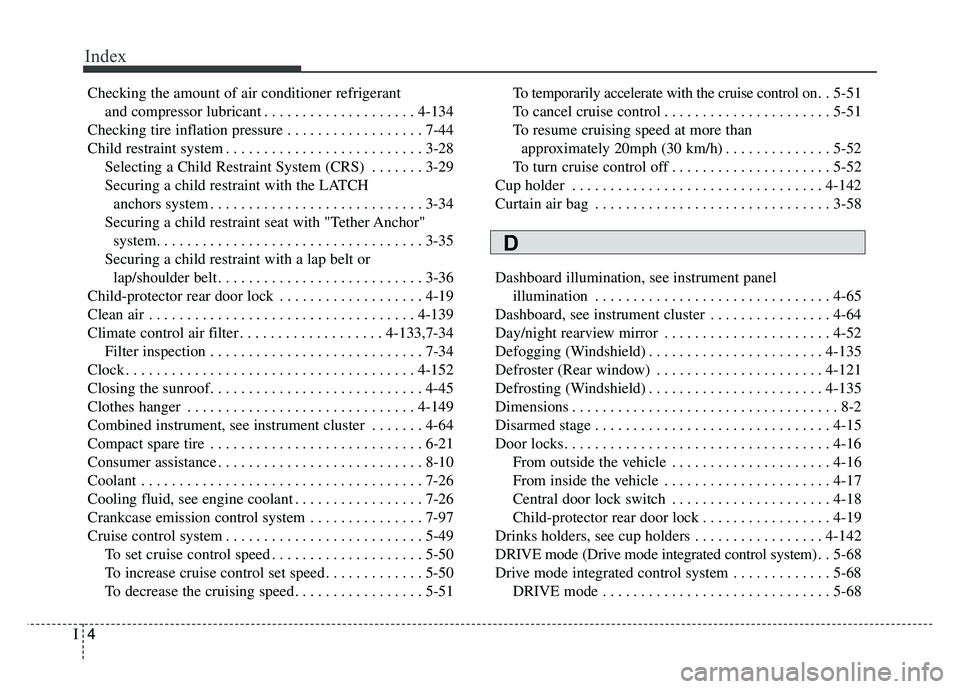
Checking the amount of air conditioner refrigerantand compressor lubricant . . . . . . . . . . . . . . . . . . . . 4-134
Checking tire inflation pressure . . . . . . . . . . . . . . . . . . 7-44
Child restraint system . . . . . . . . . . . . . . . . . . . . . . . . . . 3-28 Selecting a Child Restraint System (CRS) . . . . . . . 3-29
Securing a child restraint with the LATCHanchors system . . . . . . . . . . . . . . . . . . . . . . . . . . . . 3-34
Securing a child restraint seat with "Tether Anchor" system. . . . . . . . . . . . . . . . . . . . . . . . . . . . . . . . . . . 3-\
35
Securing a child restraint with a lap belt or lap/shoulder belt . . . . . . . . . . . . . . . . . . . . . . . . . . . 3-36
Child-protector rear door lock . . . . . . . . . . . . . . . . . . . 4-19
Clean air . . . . . . . . . . . . . . . . . . . . . . . . . . . . . . . . . . . 4-\
139
Climate control air filter . . . . . . . . . . . . . . . . . . . 4-133,7-34 Filter inspection . . . . . . . . . . . . . . . . . . . . . . . . . . . . 7-34
Clock . . . . . . . . . . . . . . . . . . . . . . . . . . . . . . . . . . . . \
. . 4-152
Closing the sunroof. . . . . . . . . . . . . . . . . . . . . . . . . . . . 4-45
Clothes hanger . . . . . . . . . . . . . . . . . . . . . . . . . . . . . . 4-149
Combined instrument, see instrument cluster . . . . . . . 4-64
Compact spare tire . . . . . . . . . . . . . . . . . . . . . . . . . . . . 6-21
Consumer assistance . . . . . . . . . . . . . . . . . . . . . . . . . . . 8-10
Coolant . . . . . . . . . . . . . . . . . . . . . . . . . . . . . . . . . . . . \
. 7-26
Cooling fluid, see engine coolant . . . . . . . . . . . . . . . . . 7-26
Crankcase emission control system . . . . . . . . . . . . . . . 7-97
Cruise control system . . . . . . . . . . . . . . . . . . . . . . . . . . 5-49 To set cruise control speed . . . . . . . . . . . . . . . . . . . . 5-50
To increase cruise control set speed . . . . . . . . . . . . . 5-50
To decrease the cruising speed . . . . . . . . . . . . . . . . . 5-51 To temporarily accelerate with the cruise control on. .
5-51
To cancel cruise control . . . . . . . . . . . . . . . . . . . . . . 5-51
To resume cruising speed at more than approximately 20mph (30 km/h) . . . . . . . . . . . . . . 5-52
To turn cruise control off . . . . . . . . . . . . . . . . . . . . . 5-52
Cup holder . . . . . . . . . . . . . . . . . . . . . . . . . . . . . . . . . 4-142
Curtain air bag . . . . . . . . . . . . . . . . . . . . . . . . . . . . . . . 3-58
Dashboard illumination, see instrument panel illumination . . . . . . . . . . . . . . . . . . . . . . . . . . . . . . . 4-65
Dashboard, see instrument cluster . . . . . . . . . . . . . . . . 4-64
Day/night rearview mirror . . . . . . . . . . . . . . . . . . . . . . 4-52
Defogging (Windshield) . . . . . . . . . . . . . . . . . . . . . . . 4-135
Defroster (Rear window) . . . . . . . . . . . . . . . . . . . . . . 4-121
Defrosting (Windshield) . . . . . . . . . . . . . . . . . . . . . . . 4-135
Dimensions . . . . . . . . . . . . . . . . . . . . . . . . . . . . . . . . . . . 8-\
2
Disarmed stage . . . . . . . . . . . . . . . . . . . . . . . . . . . . . . . 4-15
Door locks. . . . . . . . . . . . . . . . . . . . . . . . . . . . . . . . . . . 4-\
16 From outside the vehicle . . . . . . . . . . . . . . . . . . . . . 4-16
From inside the vehicle . . . . . . . . . . . . . . . . . . . . . . 4-17
Central door lock switch . . . . . . . . . . . . . . . . . . . . . 4-18
Child-protector rear door lock . . . . . . . . . . . . . . . . . 4-19
Drinks holders, see cup holders . . . . . . . . . . . . . . . . . 4-142
DRIVE mode (Drive mode integrated control system) . . 5-68
Drive mode integrated control system . . . . . . . . . . . . . 5-68 DRIVE mode . . . . . . . . . . . . . . . . . . . . . . . . . . . . . . 5-68
D
Page 492 of 500
I7
Index
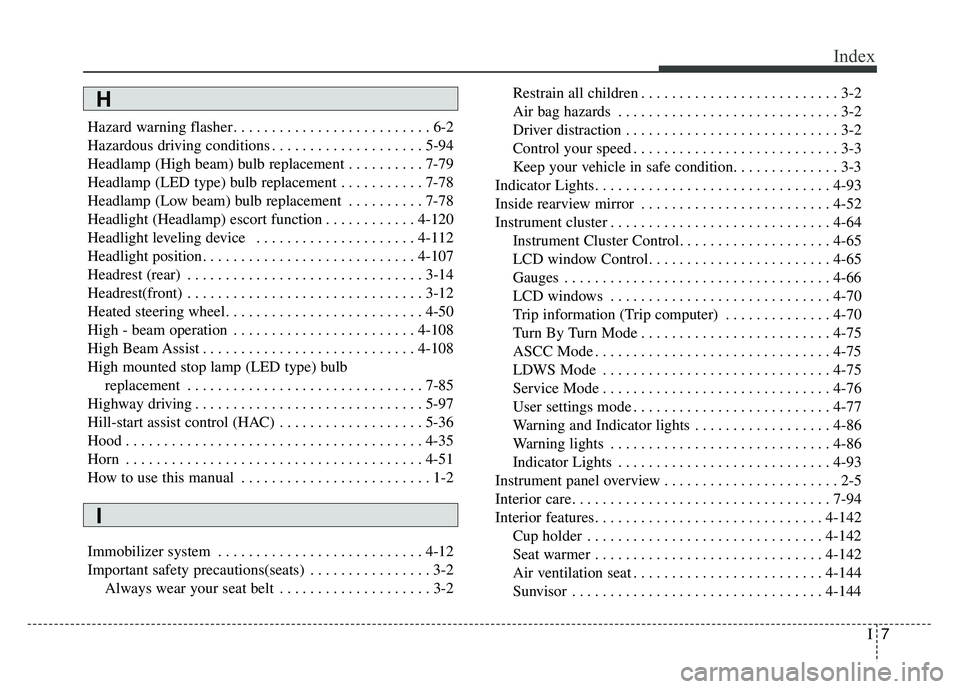
Hazard warning flasher . . . . . . . . . . . . . . . . . . . . . . . . . . 6-2
Hazardous driving conditions . . . . . . . . . . . . . . . . . . . . 5-94
Headlamp (High beam) bulb replacement . . . . . . . . . . 7-79
Headlamp (LED type) bulb replacement . . . . . . . . . . . 7-78
Headlamp (Low beam) bulb replacement . . . . . . . . . . 7-78
Headlight (Headlamp) escort function . . . . . . . . . . . . 4-120
Headlight leveling device . . . . . . . . . . . . . . . . . . . . . 4-112
Headlight position. . . . . . . . . . . . . . . . . . . . . . . . . . . . 4-107
Headrest (rear) . . . . . . . . . . . . . . . . . . . . . . . . . . . . . . . 3-14
Headrest(front) . . . . . . . . . . . . . . . . . . . . . . . . . . . . . . . 3-12
Heated steering wheel. . . . . . . . . . . . . . . . . . . . . . . . . . 4-50
High - beam operation . . . . . . . . . . . . . . . . . . . . . . . . 4-108
High Beam Assist . . . . . . . . . . . . . . . . . . . . . . . . . . . . 4-108
High mounted stop lamp (LED type) bulbreplacement . . . . . . . . . . . . . . . . . . . . . . . . . . . . . . . 7-85
Highway driving . . . . . . . . . . . . . . . . . . . . . . . . . . . . . . 5-97
Hill-start assist control (HAC) . . . . . . . . . . . . . . . . . . . 5-36
Hood . . . . . . . . . . . . . . . . . . . . . . . . . . . . . . . . . . . . \
. . . 4-35
Horn . . . . . . . . . . . . . . . . . . . . . . . . . . . . . . . . . . . . \
. . . 4-51
How to use this manual . . . . . . . . . . . . . . . . . . . . . . . . . 1-2
Immobilizer system . . . . . . . . . . . . . . . . . . . . . . . . . . . 4-12
Important safety precautions(seats) . . . . . . . . . . . . . . . . 3-2 Always wear your seat belt . . . . . . . . . . . . . . . . . . . . 3-2 Restrain all children . . . . . . . . . . . . . . . . . . . . . . . . . . 3-2
Air bag hazards . . . . . . . . . . . . . . . . . . . . . . . . . . . . . 3-2
Driver distraction . . . . . . . . . . . . . . . . . . . . . . . . . . . . 3-2
Control your speed . . . . . . . . . . . . . . . . . . . . . . . . . . . 3-3
Keep your vehicle in safe condition. . . . . . . . . . . . . . 3-3
Indicator Lights. . . . . . . . . . . . . . . . . . . . . . . . . . . . . . . 4-93
Inside rearview mirror . . . . . . . . . . . . . . . . . . . . . . . . . 4-52
Instrument cluster . . . . . . . . . . . . . . . . . . . . . . . . . . . . . 4-64 Instrument Cluster Control. . . . . . . . . . . . . . . . . . . . 4-65
LCD window Control. . . . . . . . . . . . . . . . . . . . . . . . 4-65
Gauges . . . . . . . . . . . . . . . . . . . . . . . . . . . . . . . . . . . 4-\
66
LCD windows . . . . . . . . . . . . . . . . . . . . . . . . . . . . . 4-70
Trip information (Trip computer) . . . . . . . . . . . . . . 4-70
Turn By Turn Mode . . . . . . . . . . . . . . . . . . . . . . . . . 4-75
ASCC Mode . . . . . . . . . . . . . . . . . . . . . . . . . . . . . . . 4-75
LDWS Mode . . . . . . . . . . . . . . . . . . . . . . . . . . . . . . 4-75
Service Mode . . . . . . . . . . . . . . . . . . . . . . . . . . . . . . 4-76
User settings mode . . . . . . . . . . . . . . . . . . . . . . . . . . 4-77
Warning and Indicator lights . . . . . . . . . . . . . . . . . . 4-86
Warning lights . . . . . . . . . . . . . . . . . . . . . . . . . . . . . 4-86
Indicator Lights . . . . . . . . . . . . . . . . . . . . . . . . . . . . 4-93
Instrument panel overview . . . . . . . . . . . . . . . . . . . . . . . 2-5
Interior care. . . . . . . . . . . . . . . . . . . . . . . . . . . . . . . . . . 7-94\
Interior features. . . . . . . . . . . . . . . . . . . . . . . . . . . . . . 4-142 Cup holder . . . . . . . . . . . . . . . . . . . . . . . . . . . . . . . 4-142
Seat warmer . . . . . . . . . . . . . . . . . . . . . . . . . . . . . . 4-142
Air ventilation seat . . . . . . . . . . . . . . . . . . . . . . . . . 4-144
Sunvisor . . . . . . . . . . . . . . . . . . . . . . . . . . . . . . . . . 4-144
H
I
Page 496 of 500
I11
Index
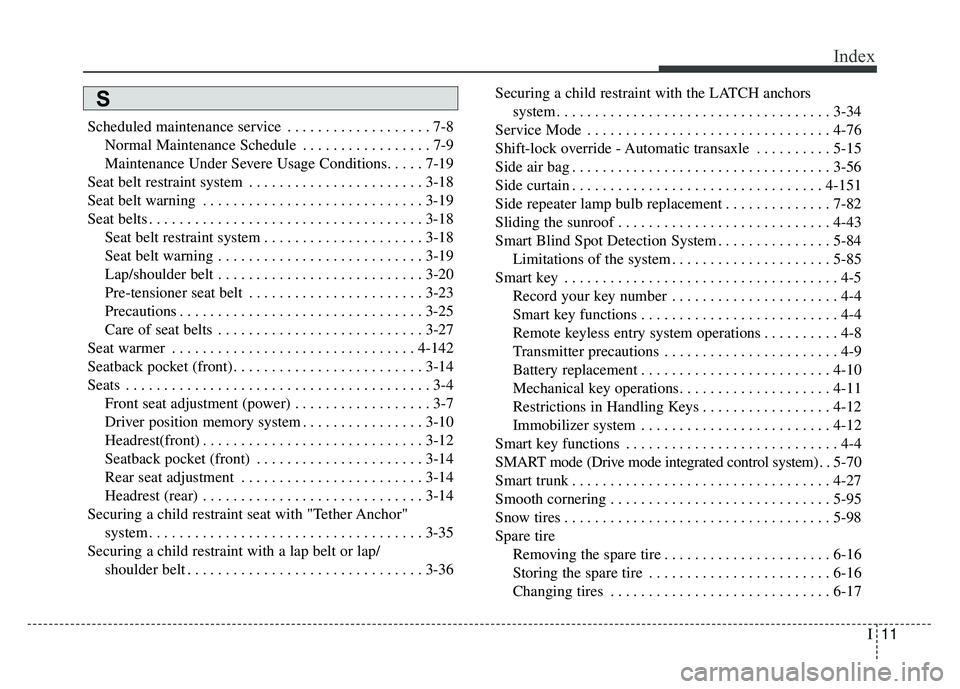
Scheduled maintenance service . . . . . . . . . . . . . . . . . . . 7-8Normal Maintenance Schedule . . . . . . . . . . . . . . . . . 7-9
Maintenance Under Severe Usage Conditions. . . . . 7-19
Seat belt restraint system . . . . . . . . . . . . . . . . . . . . . . . 3-18
Seat belt warning . . . . . . . . . . . . . . . . . . . . . . . . . . . . . 3-19
Seat belts . . . . . . . . . . . . . . . . . . . . . . . . . . . . . . . . . . . . \
3-18 Seat belt restraint system . . . . . . . . . . . . . . . . . . . . . 3-18
Seat belt warning . . . . . . . . . . . . . . . . . . . . . . . . . . . 3-19
Lap/shoulder belt . . . . . . . . . . . . . . . . . . . . . . . . . . . 3-20
Pre-tensioner seat belt . . . . . . . . . . . . . . . . . . . . . . . 3-23
Precautions . . . . . . . . . . . . . . . . . . . . . . . . . . . . . . . . 3-25
Care of seat belts . . . . . . . . . . . . . . . . . . . . . . . . . . . 3-27
Seat warmer . . . . . . . . . . . . . . . . . . . . . . . . . . . . . . . . 4-142
Seatback pocket (front) . . . . . . . . . . . . . . . . . . . . . . . . . 3-14
Seats . . . . . . . . . . . . . . . . . . . . . . . . . . . . . . . . . . . . \
. . . . 3-4 Front seat adjustment (power) . . . . . . . . . . . . . . . . . . 3-7
Driver position memory system . . . . . . . . . . . . . . . . 3-10
Headrest(front) . . . . . . . . . . . . . . . . . . . . . . . . . . . . . 3-12
Seatback pocket (front) . . . . . . . . . . . . . . . . . . . . . . 3-14
Rear seat adjustment . . . . . . . . . . . . . . . . . . . . . . . . 3-14
Headrest (rear) . . . . . . . . . . . . . . . . . . . . . . . . . . . . . 3-14
Securing a child restraint seat with "Tether Anchor" system . . . . . . . . . . . . . . . . . . . . . . . . . . . . . . . . . . . . \
3-35
Securing a child restraint with a lap belt or lap/ shoulder belt . . . . . . . . . . . . . . . . . . . . . . . . . . . . . . . 3-36 Securing a child restraint with the LATCH anchors
system . . . . . . . . . . . . . . . . . . . . . . . . . . . . . . . . . . . . \
3-34
Service Mode . . . . . . . . . . . . . . . . . . . . . . . . . . . . . . . . 4-76
Shift-lock override - Automatic transaxle . . . . . . . . . . 5-15
Side air bag . . . . . . . . . . . . . . . . . . . . . . . . . . . . . . . . . . 3-56\
Side curtain . . . . . . . . . . . . . . . . . . . . . . . . . . . . . . . . . 4-151
Side repeater lamp bulb replacement . . . . . . . . . . . . . . 7-82
Sliding the sunroof . . . . . . . . . . . . . . . . . . . . . . . . . . . . 4-43
Smart Blind Spot Detection System . . . . . . . . . . . . . . . 5-84 Limitations of the system . . . . . . . . . . . . . . . . . . . . . 5-85
Smart key . . . . . . . . . . . . . . . . . . . . . . . . . . . . . . . . . . . . \
4-5 Record your key number . . . . . . . . . . . . . . . . . . . . . . 4-4
Smart key functions . . . . . . . . . . . . . . . . . . . . . . . . . . 4-4
Remote keyless entry system operations . . . . . . . . . . 4-8
Transmitter precautions . . . . . . . . . . . . . . . . . . . . . . . 4-9
Battery replacement . . . . . . . . . . . . . . . . . . . . . . . . . 4-10
Mechanical key operations. . . . . . . . . . . . . . . . . . . . 4-11
Restrictions in Handling Keys . . . . . . . . . . . . . . . . . 4-12
Immobilizer system . . . . . . . . . . . . . . . . . . . . . . . . . 4-12
Smart key functions . . . . . . . . . . . . . . . . . . . . . . . . . . . . 4-4
SMART mode (Drive mode integrated control system) . . 5-70
Smart trunk . . . . . . . . . . . . . . . . . . . . . . . . . . . . . . . . . . 4-27\
Smooth cornering . . . . . . . . . . . . . . . . . . . . . . . . . . . . . 5-95
Snow tires . . . . . . . . . . . . . . . . . . . . . . . . . . . . . . . . . . . 5-\
98
Spare tire Removing the spare tire . . . . . . . . . . . . . . . . . . . . . . 6-16
Storing the spare tire . . . . . . . . . . . . . . . . . . . . . . . . 6-16
Changing tires . . . . . . . . . . . . . . . . . . . . . . . . . . . . . 6-17
S