check oil KIA Carens 2007 2.G User Guide
[x] Cancel search | Manufacturer: KIA, Model Year: 2007, Model line: Carens, Model: KIA Carens 2007 2.GPages: 343, PDF Size: 3.61 MB
Page 282 of 343
Maintenance12
7EXPLANATION OF SCHEDULED MAINTENANCE ITEMSG050100AUNEngine oil and filterThe engine oil and filter should be
changed at the intervals specified in the
maintenance schedule. If the car is being
driven in severe conditions, more fre-
quent oil and filter changes are required.G050200AUNDrive beltsInspect all drive belts for evidence of
cuts, cracks, excessive wear or oil satu-
ration and replace if necessary. Drive
belts should be checked periodically for
proper tension and adjusted as neces-
sary.
G050300AUNFuel filter (cartridge)A clogged filter can limit the speed at
which the vehicle may be driven, damage
the emission system and cause multiple
issues such as hard starting. If an exces-
sive amount of foreign matter accumu-
lates in the fuel tank, the filter may
require replacement more frequently.
After installing a new filter, run the engine
for several minutes, and check for leaks
at the connections. Fuel filters should be
installed by an authorized KIA dealer.
G050400AUN-EUFuel lines, fuel hoses and con-
nectionsCheck the fuel lines, fuel hoses and con-
nections for leakage and damage. Have
an authorized KIA dealer replace any
damaged or leaking parts immediately.
Page 285 of 343
715
Maintenance
G052200AUNSteering gear box, linkage &
boots/lower arm ball jointWith the vehicle stopped and engine off,
check for excessive free-play in the
steering wheel.
Check the linkage for bends or damage.
Check the dust boots and ball joints for
deterioration, cracks, or damage.
Replace any damaged parts.G052300AUNPower steering pump, belt and
hosesCheck the power steering pump and
hoses for leakage and damage. Replace
any damaged or leaking parts immedi-
ately. Inspect the power steering belt for
evidence of cuts, cracks, excessive wear,
oiliness and proper tension. Replace or
adjust it if necessary.
G052400AUNDrive shafts and bootsCheck the drive shafts, boots and clamps
for cracks, deterioration, or damage.
Replace any damaged parts and, if nec-
essary, repack the grease.G052500AUNAir conditioning refrigerant
(if equipped)Check the air conditioning lines and con-
nections for leakage and damage.
Page 286 of 343
Maintenance16
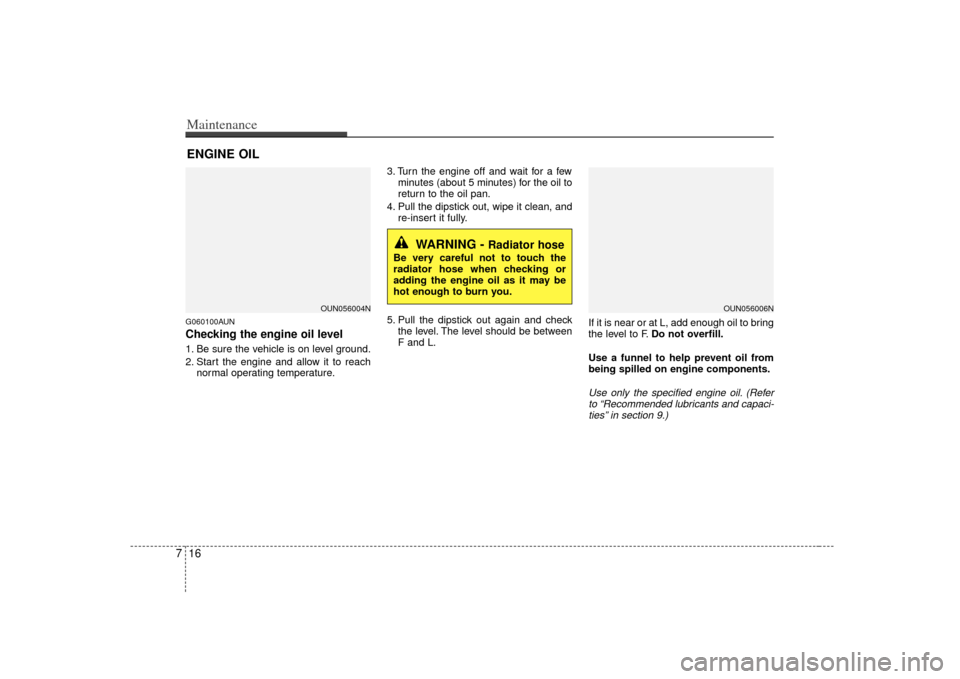
7ENGINE OILG060100AUNChecking the engine oil level 1. Be sure the vehicle is on level ground.
2. Start the engine and allow it to reach
normal operating temperature. 3. Turn the engine off and wait for a few
minutes (about 5 minutes) for the oil to
return to the oil pan.
4. Pull the dipstick out, wipe it clean, and re-insert it fully.
5. Pull the dipstick out again and check the level. The level should be between
F and L. If it is near or at L, add enough oil to bring
the level to F.
Do not overfill.
Use a funnel to help prevent oil from
being spilled on engine components.
Use only the specified engine oil. (Refer to “Recommended lubricants and capaci- ties” in section 9.)
WARNING -
Radiator hose
Be very careful not to touch the
radiator hose when checking or
adding the engine oil as it may be
hot enough to burn you.
OUN056004N
OUN056006N
Page 287 of 343
717
Maintenance
G060200AUNChanging the engine oil and filterHave engine oil and filter changed by an
authorized KIA dealer according to the
Maintenance Schedule at the beginning
of this section.
G070000AUNThe high-pressure cooling system has a
reservoir filled with year-round antifreeze
coolant. The reservoir is filled at the fac-
tory.
Check the antifreeze protection and
coolant level at least once a year, at the
beginning of the winter season, and
before traveling to a colder climate.G070100AUNChecking the coolant level
WARNING
Used engine oil may cause irrita-
tion or cancer of the skin if left in
contact with the skin for prolonged
periods of time. Used engine oil
contains chemicals that have
caused cancer in laboratory ani-
mals. Always protect your skin by
washing your hands thoroughly
with soap and warm water as soon
as possible after handling used oil.
ENGINE COOLANT
WARNING
- Removing
radiator cap
Never attempt to remove the radi-
ator cap while the engine is oper-
ating or hot. Doing so might lead
to cooling system and engine
damage and could result in seri-
ous personal injury from escap-
ing hot coolant or steam.
(Continued)
(Continued)
Turn the engine off and wait untilit cools down. Use extreme care
when removing the radiator cap.
Wrap a thick towel around it, and
turn it counterclockwise slowly to
the first stop. Step back while the
pressure is released from the
cooling system. When you are
sure all the pressure has been
released, press down on the cap,
using a thick towel, and continue
turning counterclockwise to
remove it.
Even if the engine is not operat- ing, do not remove the radiator
cap or the drain plug while the
engine and radiator are hot. Hot
coolant and steam may still blow
out under pressure, causing seri-
ous injury.
Page 290 of 343
Maintenance20
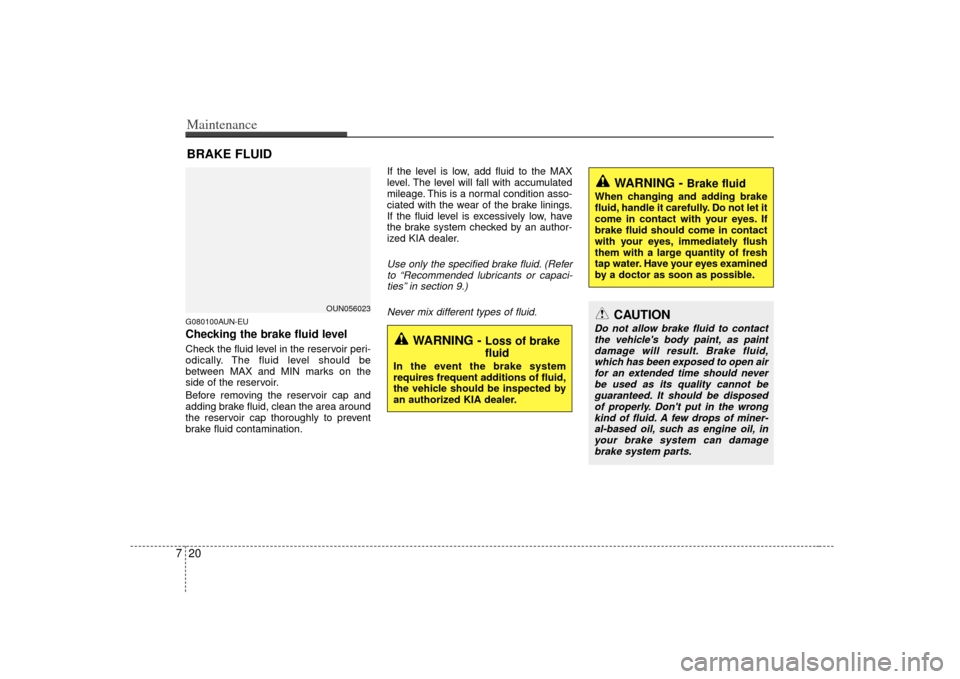
7BRAKE FLUIDG080100AUN-EUChecking the brake fluid level Check the fluid level in the reservoir peri-
odically. The fluid level should be
between MAX and MIN marks on the
side of the reservoir.
Before removing the reservoir cap and
adding brake fluid, clean the area around
the reservoir cap thoroughly to prevent
brake fluid contamination. If the level is low, add fluid to the MAX
level. The level will fall with accumulated
mileage. This is a normal condition asso-
ciated with the wear of the brake linings.
If the fluid level is excessively low, have
the brake system checked by an author-
ized KIA dealer.
Use only the specified brake fluid. (Refer
to “Recommended lubricants or capaci-ties” in section 9.)
Never mix different types of fluid.
WARNING -
Brake fluid
When changing and adding brake
fluid, handle it carefully. Do not let it
come in contact with your eyes. If
brake fluid should come in contact
with your eyes, immediately flush
them with a large quantity of fresh
tap water. Have your eyes examined
by a doctor as soon as possible.
WARNING -
Loss of brake
fluid
In the event the brake system
requires frequent additions of fluid,
the vehicle should be inspected by
an authorized KIA dealer.
OUN056023
CAUTION
Do not allow brake fluid to contactthe vehicle's body paint, as paintdamage will result. Brake fluid,which has been exposed to open air for an extended time should neverbe used as its quality cannot beguaranteed. It should be disposed of properly. Don't put in the wrongkind of fluid. A few drops of miner- al-based oil, such as engine oil, inyour brake system can damagebrake system parts.
Page 291 of 343
721
Maintenance
POWER STEERING FLUIDG090100AUNChecking the power steering fluid
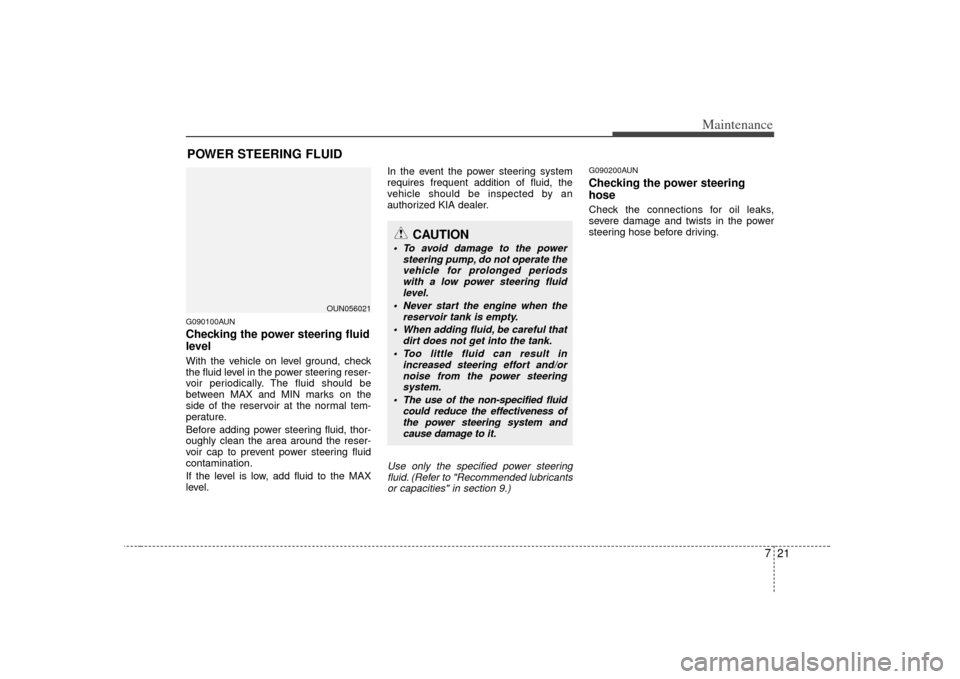
level With the vehicle on level ground, check
the fluid level in the power steering reser-
voir periodically. The fluid should be
between MAX and MIN marks on the
side of the reservoir at the normal tem-
perature.
Before adding power steering fluid, thor-
oughly clean the area around the reser-
voir cap to prevent power steering fluid
contamination.
If the level is low, add fluid to the MAX
level.In the event the power steering system
requires frequent addition of fluid, the
vehicle should be inspected by an
authorized KIA dealer.
Use only the specified power steering
fluid. (Refer to "Recommended lubricants or capacities" in section 9.)
G090200AUNChecking the power steering
hoseCheck the connections for oil leaks,
severe damage and twists in the power
steering hose before driving.
CAUTION
To avoid damage to the power steering pump, do not operate thevehicle for prolonged periods with a low power steering fluidlevel.
Never start the engine when the reservoir tank is empty.
When adding fluid, be careful that dirt does not get into the tank.
Too little fluid can result in increased steering effort and/ornoise from the power steeringsystem.
The use of the non-specified fluid could reduce the effectiveness ofthe power steering system andcause damage to it.
OUN056021
Page 299 of 343
729
Maintenance
G190200AUNBattery recharging Your vehicle has a maintenance-free,
calcium-based battery.
If the battery becomes discharged in ashort time (because, for example, the
headlights or interior lights were left on
while the vehicle was not in use),
recharge it by slow charging (trickle)
for 10 hours.
If the battery gradually discharges because of high electric load while the
vehicle is being used, recharge it at 20-
30A for two hours.
(Continued)
When lifting a plastic-cased bat-tery, excessive pressure on the
case may cause battery acid to
leak, resulting in personal injury.
Lift with a battery carrier or with
your hands on opposite corners.
Never attempt to recharge the battery when the battery cables
are connected.
The electrical ignition system works with high voltage. Never
touch these components with the
engine running or the ignition
switched on.
Failure to follow the above warn-
ings can result in serious bodily
injury or death.
WARNING
- Recharging battery
When recharging the battery,
observe the following precautions:
The battery must be removed
from the vehicle and placed in an
area with good ventilation.
Do not allow cigarettes, sparks, or flame near the battery.
Watch the battery during charg- ing, and stop or reduce the charg-
ing rate if the battery cells begin
gassing (boiling) violently or if
the temperature of the electrolyte
of any cell exceeds 49°C (120°F).
Wear eye protection when check- ing the battery during charging.
Disconnect the battery charger in the following order.
1. Turn off the battery charger main switch.
2. Unhook the negative clamp from the negative battery terminal.
3. Unhook the positive clamp from the positive battery terminal.
Page 320 of 343
Maintenance50
7
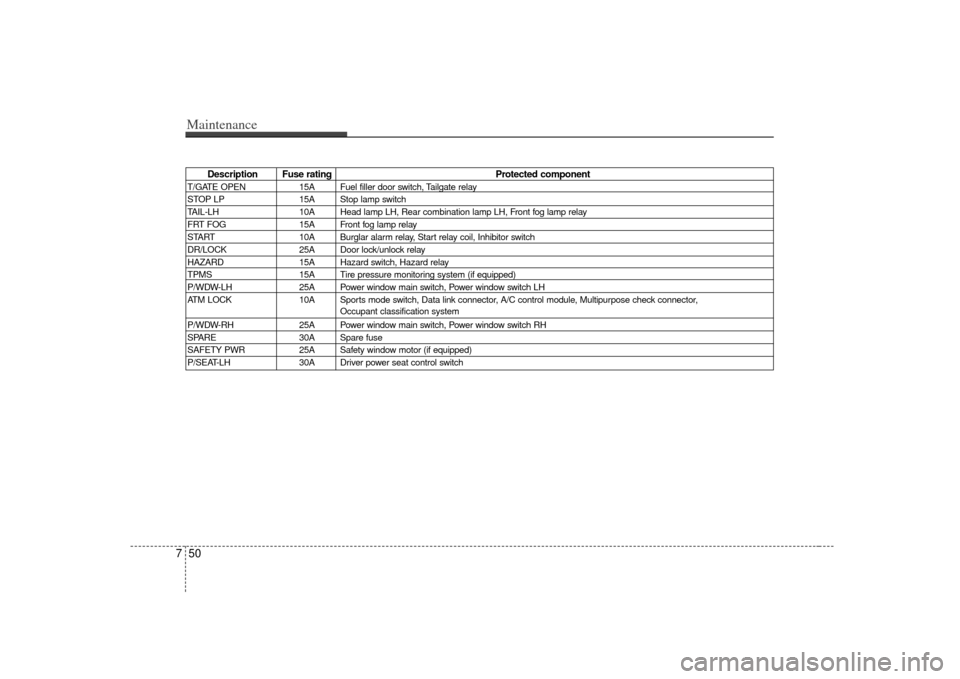
Description Fuse rating Protected component
T/GATE OPEN15A Fuel filler door switch, Tailgate relay
STOP LP 15A Stop lamp switch
TAIL-LH 10A Head lamp LH, Rear combination lamp LH, Front fog lamp relay
FRT FOG 15A Front fog lamp relay
START 10A Burglar alarm relay, Start relay coil, Inhibitor switch
DR/LOCK 25A Door lock/unlock relay
HAZARD 15A Hazard switch, Hazard relay
TPMS 15A Tire pressure monitoring system (if equipped)
P/WDW-LH 25A Power window main switch, Power window switch LH
ATM LOCK 10A Sports mode switch, Data link connector, A/C control module, Multipurpose check connector,
Occupant classification system
P/WDW-RH 25A Power window main switch, Power window switch RH
SPARE 30A Spare fuse
SAFETY PWR 25A Safety window motor (if equipped)
P/SEAT-LH 30A Driver power seat control switch
Page 322 of 343
Maintenance52
7
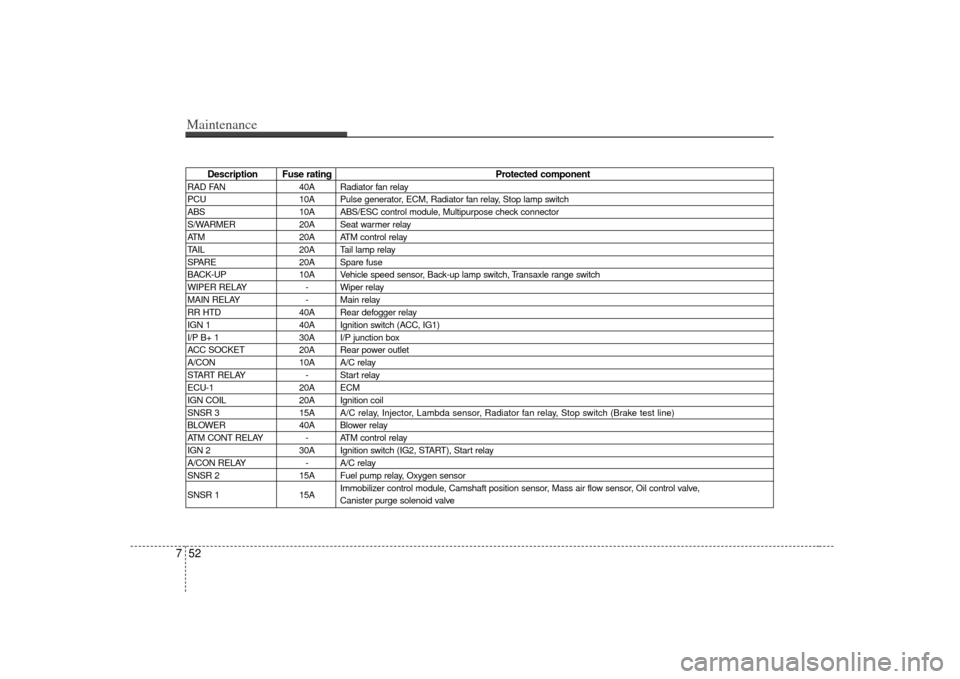
Description Fuse rating Protected component
RAD FAN40A Radiator fan relay
PCU 10A Pulse generator, ECM, Radiator fan relay, Stop lamp switch
ABS 10A ABS/ESC control module, Multipurpose check connector
S/WARMER 20A Seat warmer relay
ATM 20A ATM control relay
TAIL 20A Tail lamp relay
SPARE 20A Spare fuse
BACK-UP 10A Vehicle speed sensor, Back-up lamp switch, Transaxle range switch
WIPER RELAY - Wiper relay
MAIN RELAY - Main relay
RR HTD 40A Rear defogger relay
IGN 1 40A Ignition switch (ACC, IG1)
I/P B+ 1 30A I/P junction box
ACC SOCKET 20A Rear power outlet
A/CON 10A A/C relay
START RELAY - Start relay
ECU-1 20A ECM
IGN COIL 20A Ignition coil
SNSR 3 15AA/C relay, Injector, Lambda sensor, Radiator fan relay, Stop switch (Brake test line)
BLOWER 40A Blower relay
ATM CONT RELAY - ATM control relay
IGN 2 30A Ignition switch (IG2, START), Start relay
A/CON RELAY - A/C relay
SNSR 2 15A Fuel pump relay, Oxygen sensor
SNSR 1 15AImmobilizer control module, Camshaft position sensor, Mass air flow sensor, Oil control valve,
Canister purge solenoid valve
Page 339 of 343
95
Specifications
I040100AUN-EURecommended SAE viscosity
number
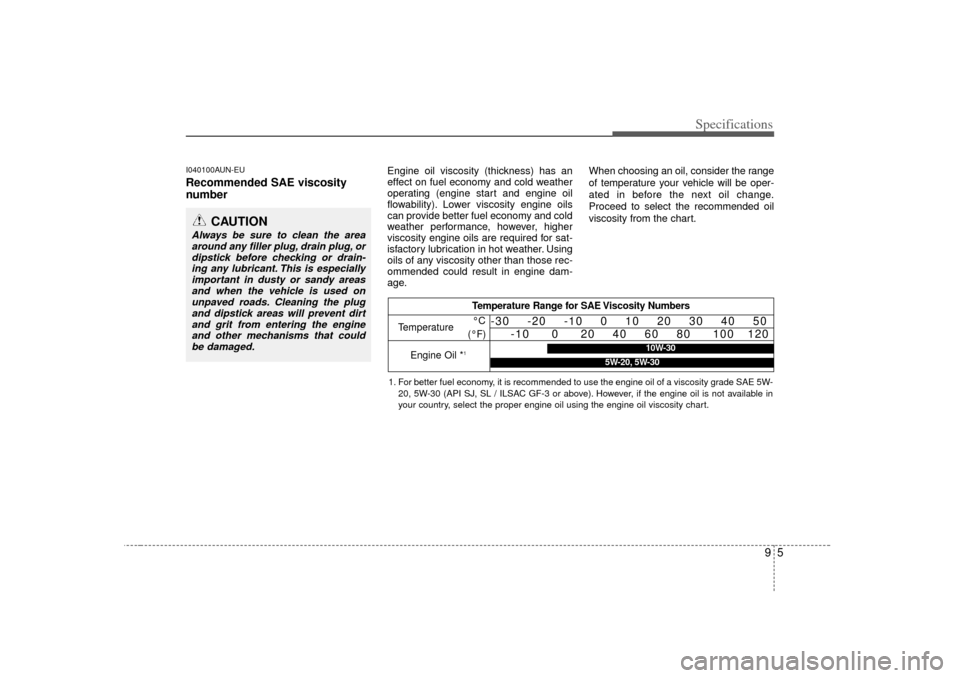
Engine oil viscosity (thickness) has an
effect on fuel economy and cold weather
operating (engine start and engine oil
flowability). Lower viscosity engine oils
can provide better fuel economy and cold
weather performance, however, higher
viscosity engine oils are required for sat-
isfactory lubrication in hot weather. Using
oils of any viscosity other than those rec-
ommended could result in engine dam-
age.When choosing an oil, consider the range
of temperature your vehicle will be oper-
ated in before the next oil change.
Proceed to select the recommended oil
viscosity from the chart.
CAUTION
Always be sure to clean the area
around any filler plug, drain plug, ordipstick before checking or drain- ing any lubricant. This is especiallyimportant in dusty or sandy areasand when the vehicle is used on unpaved roads. Cleaning the plugand dipstick areas will prevent dirtand grit from entering the engineand other mechanisms that could be damaged.
Temperature Range for SAE Viscosity Numbers
Temperature
Engine Oil *
1°C
(°F)
-30 -20 -10 0 10 20 30 40 50 -10 0 20 40 60 80 100 120
1. For better fuel economy, it is recommended to use the engine oil of a viscosity grade SAE 5W-
20, 5W-30 (API SJ, SL / ILSAC GF-3 or above). However, if the engine oil is not available in
your country, select the proper engine oil using the engine oil viscosity chart.
10W-30
5W-20, 5W-30