Fold KIA Carens 2016 3.G Owner's Manual
[x] Cancel search | Manufacturer: KIA, Model Year: 2016, Model line: Carens, Model: KIA Carens 2016 3.GPages: 586, PDF Size: 22.03 MB
Page 14 of 586
Your vehicle at a glance
42
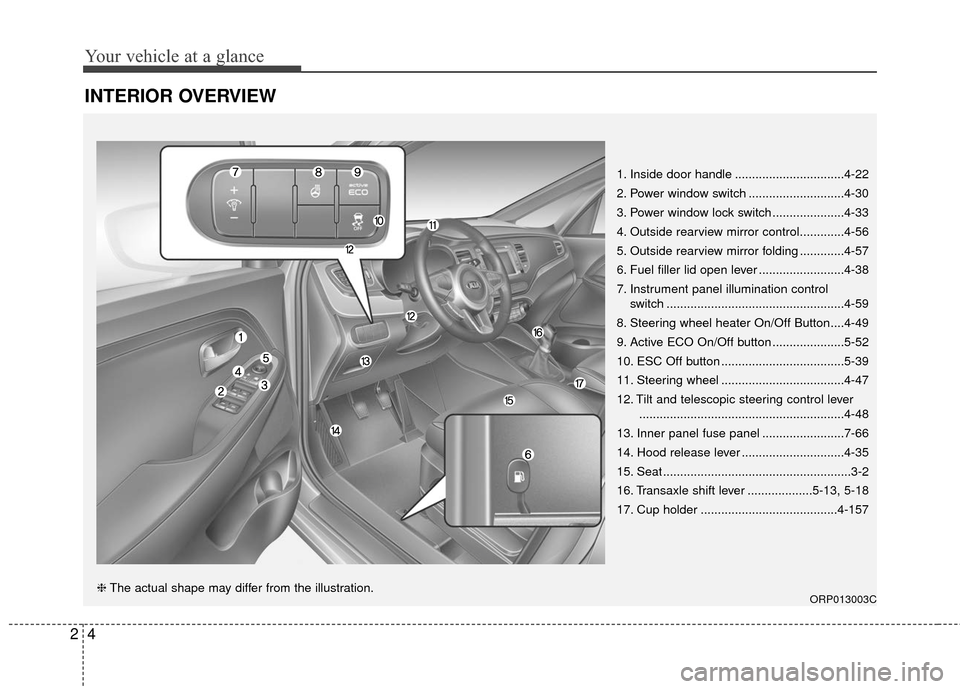
INTERIOR OVERVIEW
1. Inside door handle ................................4-22
2. Power window switch ............................4-30
3. Power window lock switch .....................4-33
4. Outside rearview mirror control.............4-56
5. Outside rearview mirror folding .............4-57
6. Fuel filler lid open lever .........................4-38
7. Instrument panel illumination control switch ....................................................4-59
8. Steering wheel heater On/Off Button....4-49
9. Active ECO On/Off button .....................5-52
10. ESC Off button ....................................5-39
11. Steering wheel ....................................4-47
12. Tilt and telescopic steering control lever ............................................................4-48
13. Inner panel fuse panel ........................7-66
14. Hood release lever ..............................4-35
15. Seat .......................................................3-2
16. Transaxle shift lever ...................5-13, 5-18
17. Cup holder ........................................4-157
ORP013003C❈ The actual shape may differ from the illustration.
Page 18 of 586
Safety features of your vehicle
23
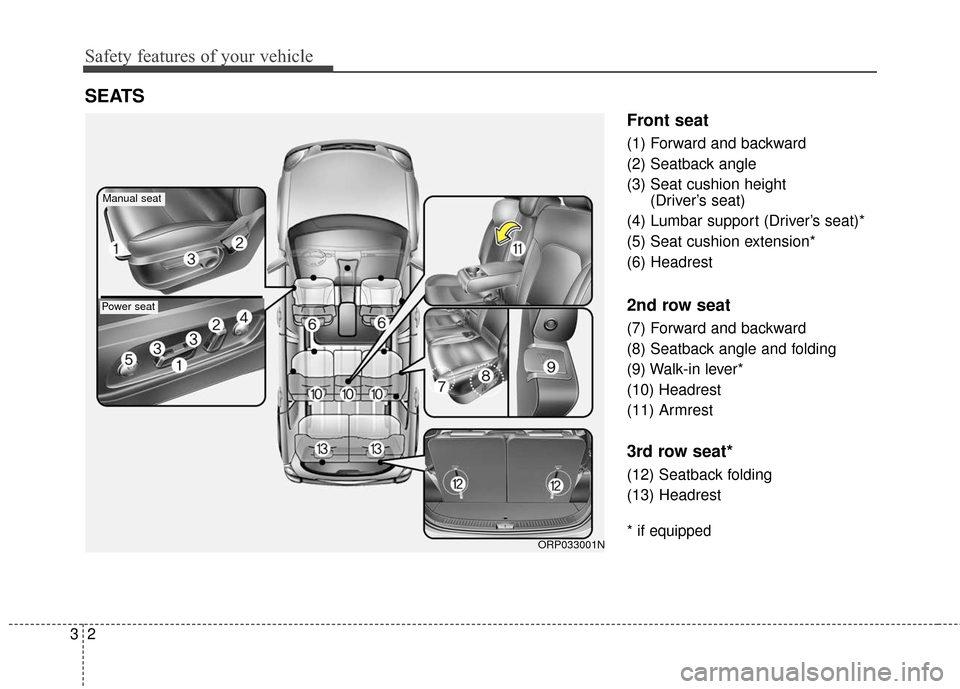
Front seat
(1) Forward and backward
(2) Seatback angle
(3) Seat cushion height (Driver’s seat)
(4) Lumbar support (Driver’s seat)*
(5) Seat cushion extension*
(6) Headrest
2nd row seat
(7) Forward and backward
(8) Seatback angle and folding
(9) Walk-in lever*
(10) Headrest
(11) Armrest
3rd row seat*
(12) Seatback folding
(13) Headrest
* if equipped
SEATS
ORP033001N
Manual seat
Power seat
Page 20 of 586
Safety features of your vehicle
43
WARNING - Driver’s seat
Never attempt to adjust the seat while the vehicle is mov-
ing. This could result in loss of
control of your vehicle.
Do not allow anything to inter- fere with the normal position
of the seatback and seatback
adjustment.
Always drive and ride with your seatback upright and the
lap portion of the seat belt
snug and low across the hips.
This is the best position to pro-
tect you in case of an accident.
In order to avoid unnecessary and perhaps severe air bag
injuries, always sit as far back
as possible from the steering
wheel while maintaining com-
fortable control of the vehicle.
We recommend that your chest
be at least 25 cm (10 inches)
away from the steering wheel.WARNING - Rear seat-
backs
The rear seatback must be securely latched. If not, pas-
sengers and objects could be
thrown forward resulting in
serious injury or death in the
event of a sudden stop or col-
lision.
Luggage and other cargo should be laid flat in the cargo
area. If objects are large,
heavy, or must be piled, they
must be secured. Under no
circumstances should cargo
be piled higher than the seat-
backs. Failure to follow these
warnings could result in seri-
ous injury or death in the
event of a sudden stop, colli-
sion or rollover.
(Continued)(Continued)
No passenger should ride inthe cargo area or sit or lie on
folded seatbacks while the
vehicle is moving.
All passengers must be prop-
erly seated in seats and
restrained properly while rid-
ing.
When resetting the seatback to the upright position, make
sure it is securely latched by
pushing it forward and back-
wards.
To avoid the possibility of burns, do not remove the car-
pet in the cargo area.
Emission control devices
beneath this floor generate
high temperatures.
Page 30 of 586
Safety features of your vehicle
14
3
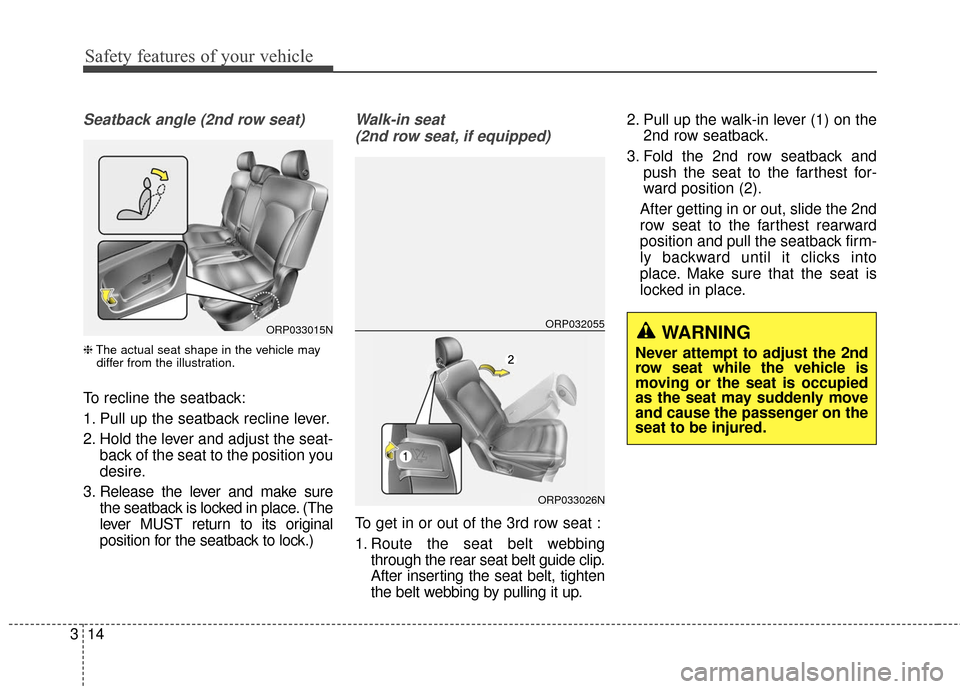
Seatback angle (2nd row seat)
❈ The actual seat shape in the vehicle may
differ from the illustration.
To recline the seatback:
1. Pull up the seatback recline lever.
2. Hold the lever and adjust the seat- back of the seat to the position you
desire.
3. Release the lever and make sure the seatback is locked in place. (The
lever MUST return to its original
position for the seatback to lock.)
Walk-in seat
(2nd row seat, if equipped)
To get in or out of the 3rd row seat :
1. Route the seat belt webbing through the rear seat belt guide clip.
After inserting the seat belt, tighten
the belt webbing by pulling it up. 2. Pull up the walk-in lever (1) on the
2nd row seatback.
3. Fold the 2nd row seatback and push the seat to the farthest for-
ward position (2).
After getting in or out, slide the 2nd
row seat to the farthest rearward
position and pull the seatback firm-
ly backward until it clicks into
place. Make sure that the seat is
locked in place.
ORP033015NORP032055
ORP033026N
WARNING
Never attempt to adjust the 2nd
row seat while the vehicle is
moving or the seat is occupied
as the seat may suddenly move
and cause the passenger on the
seat to be injured.
Page 31 of 586
315
Safety features of your vehicle
Folding the rear seat
The rear seatbacks can be folded to
facilitate carrying long items or to
increase the luggage capacity of the
vehicle.
WARNING
The purpose of the fold-down
rear seatbacks is to allow you to
carry longer objects that could
not be accommodated in the
cargo area.
Never allow passengers to sit
on top of the folded down seat-
back while the vehicle is mov-
ing. This is not a proper seating
position and no seat belts are
available for use. This could
result in serious injury or death
in case of an accident or sud-
den stop. Objects carried on the
folded down seatback should
not extend higher than the top
of the front seatbacks. This
could allow cargo to slide for-
ward and cause injury or dam-
age during sudden stops.
2nd row seat3rd row seat (if equipped)
ORP032064/ORP032055/ORP032067/ORP032021
❈ The actual seat shape in the vehicle may differ from the illustration.
Page 32 of 586
Safety features of your vehicle
16
3
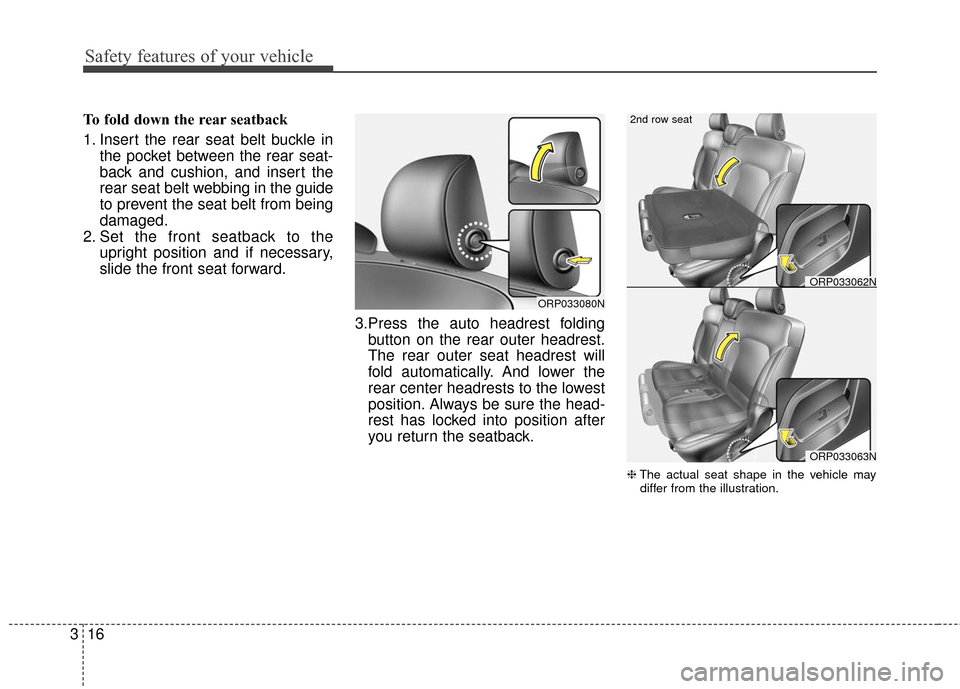
To fold down the rear seatback
1. Insert the rear seat belt buckle in
the pocket between the rear seat-
back and cushion, and insert the
rear seat belt webbing in the guide
to prevent the seat belt from being
damaged.
2. Set the front seatback to the upright position and if necessary,
slide the front seat forward.
3.Press the auto headrest foldingbutton on the rear outer headrest.
The rear outer seat headrest will
fold automatically. And lower the
rear center headrests to the lowest
position. Always be sure the head-
rest has locked into position after
you return the seatback.
❈ The actual seat shape in the vehicle may
differ from the illustration.
ORP033080N
ORP033063N
ORP033062N
2nd row seat
Page 33 of 586
317
Safety features of your vehicle
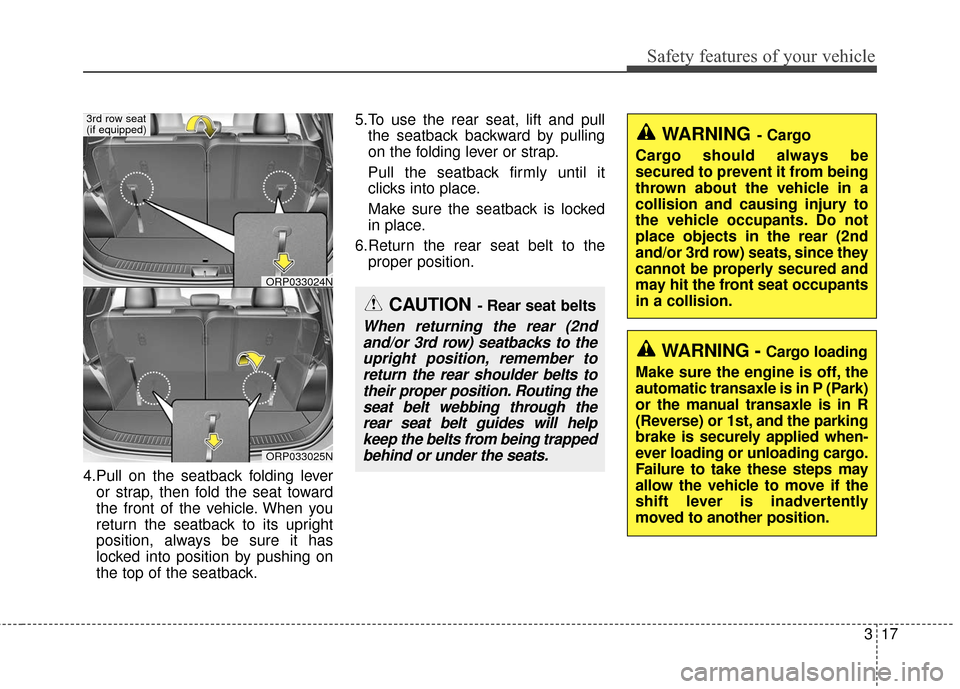
4.Pull on the seatback folding leveror strap, then fold the seat toward
the front of the vehicle. When you
return the seatback to its upright
position, always be sure it has
locked into position by pushing on
the top of the seatback. 5.To use the rear seat, lift and pull
the seatback backward by pulling
on the folding lever or strap.
Pull the seatback firmly until it
clicks into place.
Make sure the seatback is locked
in place.
6.Return the rear seat belt to the proper position.
ORP033025N
ORP033024N
3rd row seat
(if equipped)
CAUTION- Rear seat belts
When returning the rear (2ndand/or 3rd row) seatbacks to theupright position, remember toreturn the rear shoulder belts totheir proper position. Routing theseat belt webbing through therear seat belt guides will helpkeep the belts from being trappedbehind or under the seats.
WARNING- Cargo
Cargo should always be
secured to prevent it from being
thrown about the vehicle in a
collision and causing injury to
the vehicle occupants. Do not
place objects in the rear (2nd
and/or 3rd row) seats, since they
cannot be properly secured and
may hit the front seat occupants
in a collision.
WARNING - Cargo loading
Make sure the engine is off, the
automatic transaxle is in P (Park)
or the manual transaxle is in R
(Reverse) or 1st, and the parking
brake is securely applied when-
ever loading or unloading cargo.
Failure to take these steps may
allow the vehicle to move if the
shift lever is inadvertently
moved to another position.
Page 44 of 586
Safety features of your vehicle
28
3
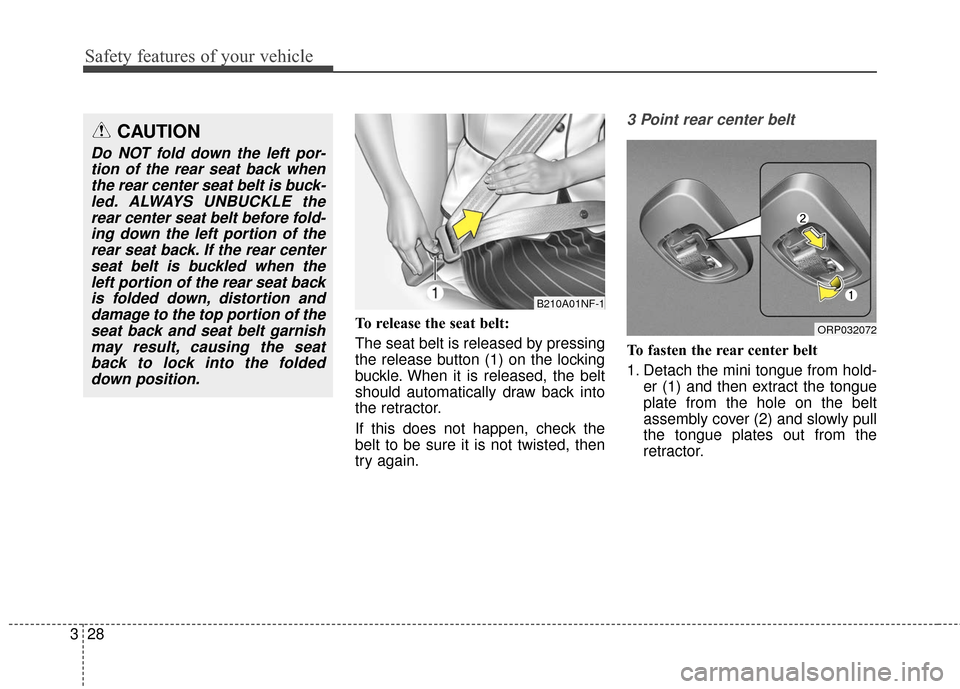
To release the seat belt:
The seat belt is released by pressing
the release button (1) on the locking
buckle. When it is released, the belt
should automatically draw back into
the retractor.
If this does not happen, check the
belt to be sure it is not twisted, then
try again.
3 Point rear center belt
To fasten the rear center belt
1. Detach the mini tongue from hold-
er (1) and then extract the tongue
plate from the hole on the belt
assembly cover (2) and slowly pull
the tongue plates out from the
retractor.
CAUTION
Do NOT fold down the left por-tion of the rear seat back whenthe rear center seat belt is buck-led. ALWAYS UNBUCKLE therear center seat belt before fold-ing down the left portion of therear seat back. If the rear centerseat belt is buckled when theleft portion of the rear seat backis folded down, distortion anddamage to the top portion of theseat back and seat belt garnishmay result, causing the seatback to lock into the foldeddown position.
B210A01NF-1
ORP032072
Page 56 of 586
Safety features of your vehicle
40
3
Periodic inspection
All seat belts should be inspected
periodically for wear or damage of
any kind. Any damaged parts should
be replaced as soon as possible.
Keep belts clean and dry
Seat belts should be kept clean and
dry. If belts become dirty, they can be
cleaned by using a mild soap solu-
tion and warm water. Bleach, dye,
strong detergents or abrasives
should not be used because they
may damage and weaken the fabric.
When to replace seat belts
The entire in-use seat belt assembly
or assemblies should be replaced if
the vehicle has been involved in an
accident. This should be done even if
no damage is visible. Additional
questions concerning seat belt oper-
ation should be directed to an
authorized Kia dealer.
WARNING
When you return the rear seat-
back to its upright position after
the rear seatback has been fold-
ed down, be careful not to dam-
age the seat belt webbing or
buckle. Be sure that the web-
bing or buckle does not get
caught or pinched in the rear
seat. A seat belt with damaged
webbing or buckle could possi-
bly fail during a collision or sud-
den stop, resulting in serious
injury. If the webbing or buckles
are damaged, get them replaced
immediately.
Page 95 of 586
379
Safety features of your vehicle
Additional safety precautions
Never let passengers ride in the
cargo area or on top of a folded-
down back seat. All occupants
should sit upright, fully back in their
seats with their seat belts on and
their feet on the floor.
Passengers should not move
out of or change seats while the
vehicle is moving. A passenger
who is not wearing a seat belt dur-
ing a crash or emergency stop can
be thrown against the inside of the
vehicle, against other occupants,
or out of the vehicle.
Each seat belt is designed to
restrain one occupant. If more
than one person uses the same
seat belt, they could be seriously
injured or killed in a collision.
Do not use any accessories on
seat belts. Devices claiming to
improve occupant comfort or repo-
sition the seat belt can reduce the
protection provided by the seat belt
and increase the chance of serious
injury in a crash.
Passengers should not place
hard or sharp objects between
themselves and the air bags.
Carrying hard or sharp objects on
your lap or in your mouth can result
in injuries if an air bag inflates.
Keep occupants away from the
air bag covers. All occupants
should sit upright, fully back in their
seats with their seat belts on and
their feet on the floor. If occupants
are too close to the air bag covers,
they could be injured if the air bags
inflate.
Do not attach or place objects
on or near the air bag covers.
Any object attached to or placed
on the front or side air bag covers
could interfere with the proper
operation of the air bags.
Do not modify the front seats.
Modification of the front seats
could interfere with the operation of
the supplemental restraint system
sensing components or side air
bags.
Do not place items under the
front seats. Placing items under
the front seats could interfere with
the operation of the supplemental
restraint system sensing compo-
nents and wiring harnesses.
Never hold an infant or child on
your lap. The infant or child could
be seriously injured or killed in the
event of a crash. All infants and chil-
dren should be properly restrained
in appropriate child safety seats or
seat belts in the rear seat.