ignition KIA Carens 2017 3.G Owner's Manual
[x] Cancel search | Manufacturer: KIA, Model Year: 2017, Model line: Carens, Model: KIA Carens 2017 3.GPages: 625, PDF Size: 19.69 MB
Page 497 of 625
What to do in an emergency
26
7
When towing your vehicle in an
emergency without wheel dollies :
1.Set the ignition switch in the ACC
position.
2.Place the transaxle shift lever in N (Neutral).
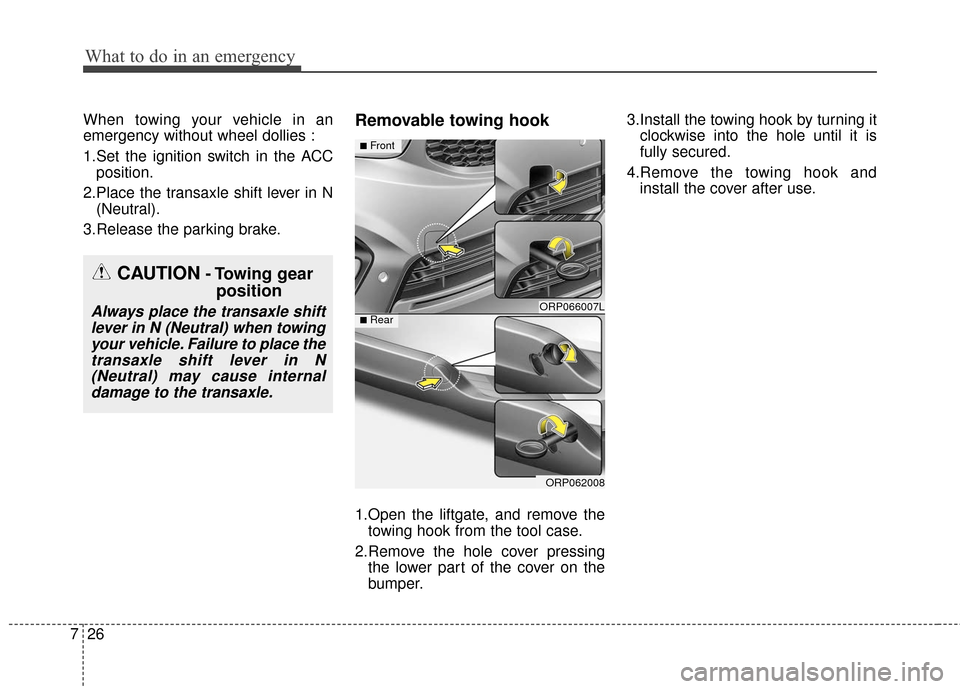
3.Release the parking brake.Removable towing hook
1.Open the liftgate, and remove the towing hook from the tool case.
2.Remove the hole cover pressing the lower part of the cover on the
bumper. 3.Install the towing hook by turning it
clockwise into the hole until it is
fully secured.
4.Remove the towing hook and install the cover after use.
CAUTION- Towing gear position
Always place the transaxle shift
lever in N (Neutral) when towingyour vehicle. Failure to place thetransaxle shift lever in N(Neutral) may cause internaldamage to the transaxle.ORP066007L
ORP062008
■Front
■Rear
Page 499 of 625
What to do in an emergency
28
7
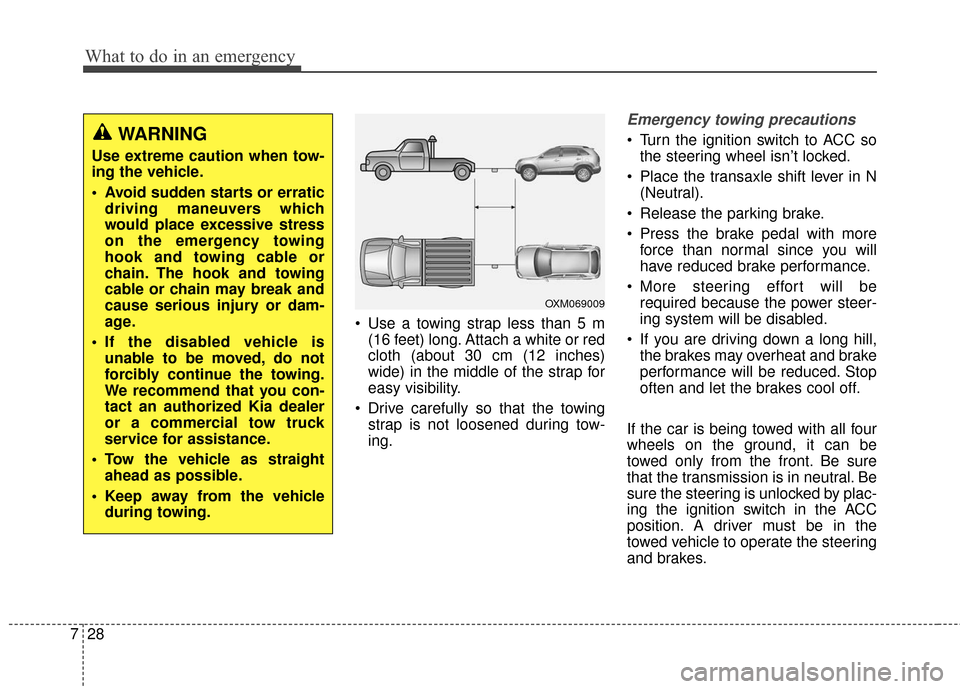
Use a towing strap less than 5 m
(16 feet) long. Attach a white or red
cloth (about 30 cm (12 inches)
wide) in the middle of the strap for
easy visibility.
Drive carefully so that the towing strap is not loosened during tow-
ing.
Emergency towing precautions
Turn the ignition switch to ACC sothe steering wheel isn’t locked.
Place the transaxle shift lever in N (Neutral).
Release the parking brake.
Press the brake pedal with more force than normal since you will
have reduced brake performance.
More steering effort will be required because the power steer-
ing system will be disabled.
If you are driving down a long hill, the brakes may overheat and brake
performance will be reduced. Stop
often and let the brakes cool off.
If the car is being towed with all four
wheels on the ground, it can be
towed only from the front. Be sure
that the transmission is in neutral. Be
sure the steering is unlocked by plac-
ing the ignition switch in the ACC
position. A driver must be in the
towed vehicle to operate the steering
and brakes.WARNING
Use extreme caution when tow-
ing the vehicle.
Avoid sudden starts or erratic driving maneuvers which
would place excessive stress
on the emergency towing
hook and towing cable or
chain. The hook and towing
cable or chain may break and
cause serious injury or dam-
age.
If the disabled vehicle is unable to be moved, do not
forcibly continue the towing.
We recommend that you con-
tact an authorized Kia dealer
or a commercial tow truck
service for assistance.
Tow the vehicle as straight ahead as possible.
Keep away from the vehicle during towing.
OXM069009
Page 500 of 625
729
What to do in an emergency
CAUTION - Automatic
transaxle
If the car is being towed with allfour wheels on the ground, itcan be towed only from thefront. Be sure that the transaxleis in neutral. Be sure the steer-ing is unlocked by placing theignition switch in the ACC posi-tion. A driver must be in thetowed vehicle to operate thesteering and brakes.
To avoid serious damage to the automatic transaxle, limitthe vehicle speed to 15 km/h(10 mph) and drive less than1.5 km (1 mile) when towing.
Before towing, check under your vehicle for leaking auto-matic transaxle fluid. If theautomatic transaxle fluid isleaking, a flatbed equipmentor towing dolly must be used.
Page 546 of 625
Maintenance
46
8
Battery recharging
Your vehicle has a maintenance-free,
calcium-based battery.
If the battery becomes discharged
in a short time (because, for exam-
ple, the headlights or interior lights
were left on while the vehicle was
not in use), recharge it by slow
charging (trickle) for 10 hours.
If the battery gradually discharges because of high electric load while
the vehicle is being used, recharge
it at no more than 20-30A for two
hours.(Continued)
An inappropriately dis-posed battery can be
harmful to the environ-
ment and human health.
Dispose the battery
according to your local
law(s) or regulation.
When lifting a plastic-cased battery, excessive pressure
on the case may cause battery
acid to leak, resulting in per-
sonal injury. Lift with a battery
carrier or with your hands on
opposite corners.
Never attempt to recharge the battery when the battery
cables are connected.
The electrical ignition system works with high voltage.
Never touch these compo-
nents with the engine running
or the ignition switched on.
Failure to follow the above
warnings can result in serious
bodily injury or death.CAUTION
If you connect unauthorized electronic devices to the bat-tery, the battery may be dis-charged. Never use unautho-rized devices.
Page 568 of 625
Maintenance
68
8
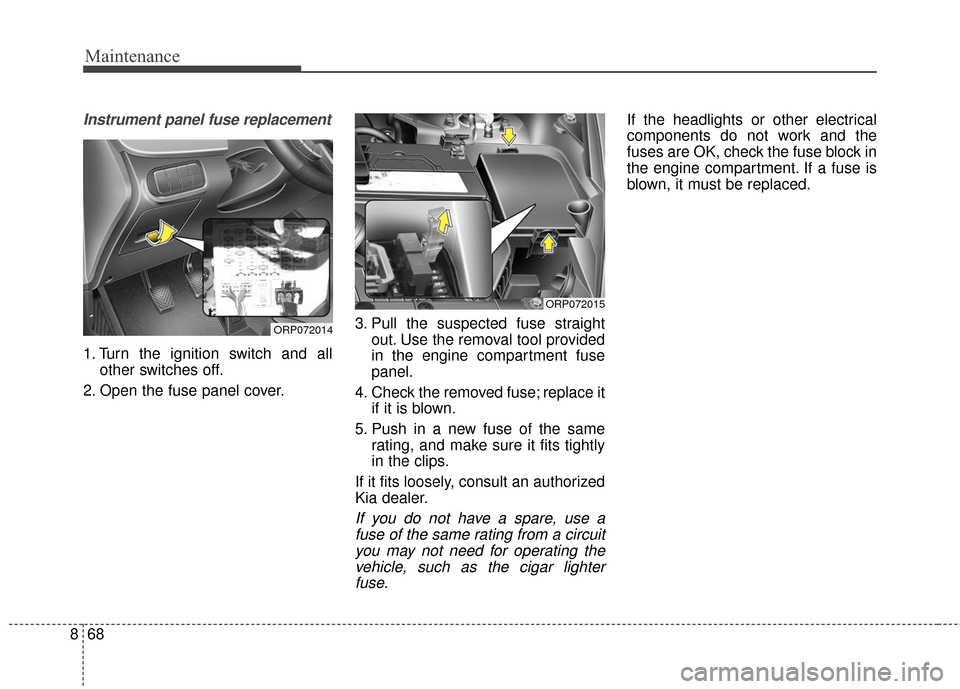
Instrument panel fuse replacement
1. Turn the ignition switch and all
other switches off.
2. Open the fuse panel cover. 3. Pull the suspected fuse straight
out. Use the removal tool provided
in the engine compartment fuse
panel.
4. Check the removed fuse; replace it if it is blown.
5. Push in a new fuse of the same rating, and make sure it fits tightly
in the clips.
If it fits loosely, consult an authorized
Kia dealer.
If you do not have a spare, use a fuse of the same rating from a circuityou may not need for operating thevehicle, such as the cigar lighterfuse.
If the headlights or other electrical
components do not work and the
fuses are OK, check the fuse block in
the engine compartment. If a fuse is
blown, it must be replaced.
ORP072014
ORP072015
Page 569 of 625
869
Maintenance
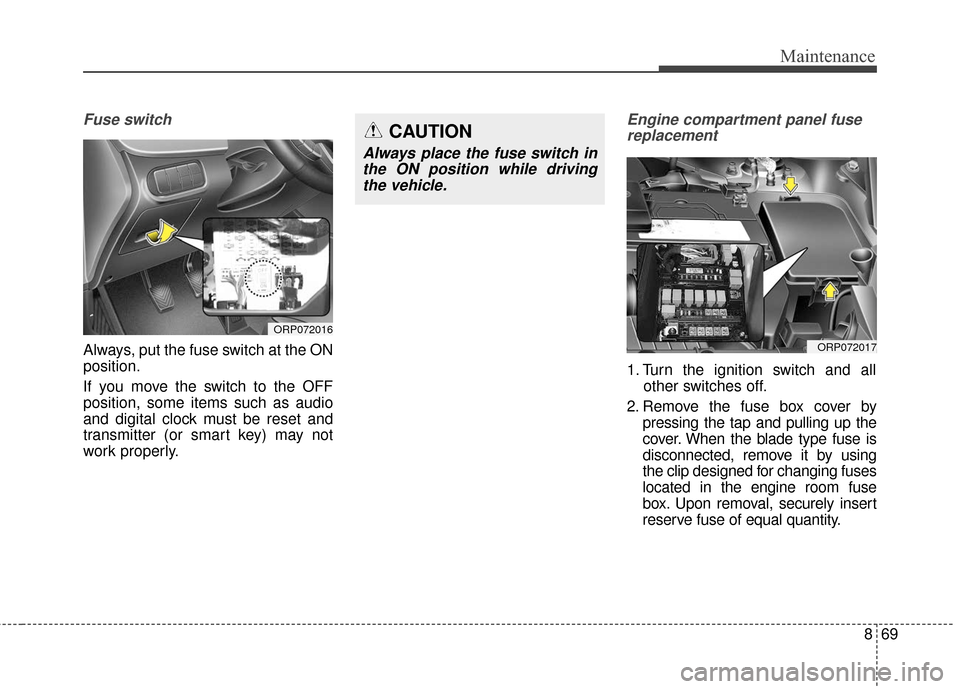
Fuse switch
Always, put the fuse switch at the ON
position.
If you move the switch to the OFF
position, some items such as audio
and digital clock must be reset and
transmitter (or smart key) may not
work properly.
Engine compartment panel fusereplacement
1. Turn the ignition switch and all other switches off.
2. Remove the fuse box cover by pressing the tap and pulling up the
cover. When the blade type fuse is
disconnected, remove it by using
the clip designed for changing fuses
located in the engine room fuse
box. Upon removal, securely insert
reserve fuse of equal quantity.
ORP072016
CAUTION
Always place the fuse switch inthe ON position while drivingthe vehicle.
ORP072017
Page 574 of 625
Maintenance
74
8
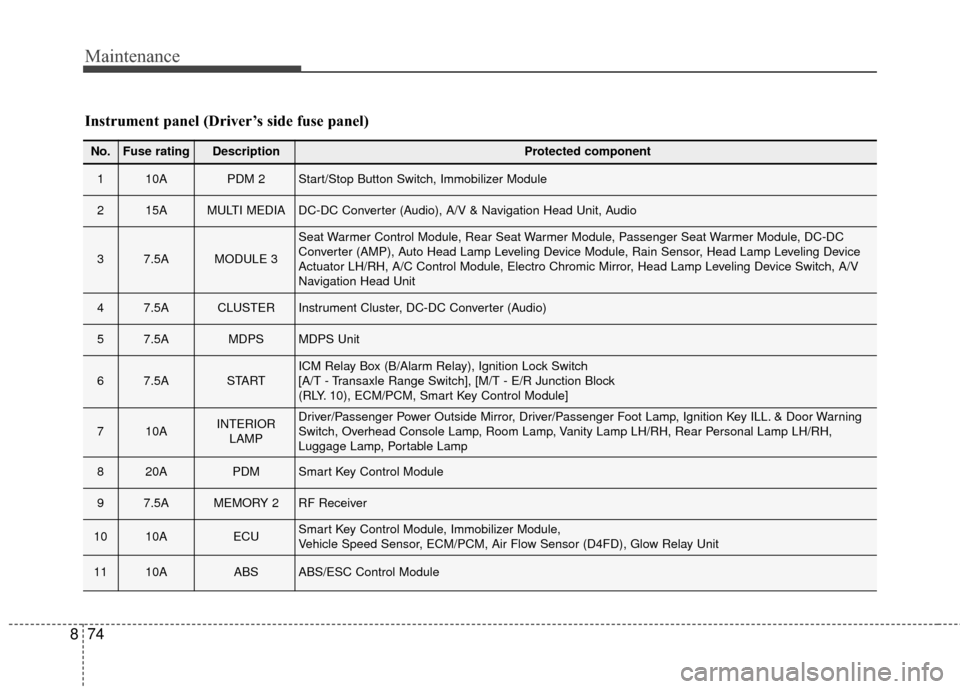
Instrument panel (Driver’s side fuse panel)
No.Fuse ratingDescriptionProtected component
110APDM 2Start/Stop Button Switch, Immobilizer Module
215AMULTI MEDIADC-DC Converter (Audio), A/V & Navigation Head Unit, Audio
37.5AMODULE 3
Seat Warmer Control Module, Rear Seat Warmer Module, Passenger Seat Warmer Module, DC-DC
Converter (AMP), Auto Head Lamp Leveling Device Module, Rain Sensor, Head Lamp Leveling Device
Actuator LH/RH, A/C Control Module, Electro Chromic Mirror, Head Lamp Leveling Device Switch, A/V
Navigation Head Unit
47.5ACLUSTERInstrument Cluster, DC-DC Converter (Audio)
57.5AMDPSMDPS Unit
67.5ASTARTICM Relay Box (B/Alarm Relay), Ignition Lock Switch
[A/T - Transaxle Range Switch], [M/T - E/R Junction Block
(RLY. 10), ECM/PCM, Smart Key Control Module]
710AINTERIOR
LAMPDriver/Passenger Power Outside Mirror, Driver/Passenger Foot Lamp, Ignition Key ILL. & Door Warning
Switch, Overhead Console Lamp, Room Lamp, Vanity Lamp LH/RH, Rear Personal Lamp LH/RH,
Luggage Lamp, Portable Lamp
820APDMSmart Key Control Module
97.5AMEMORY 2RF Receiver
1010AECUSmart Key Control Module, Immobilizer Module,
Vehicle Speed Sensor, ECM/PCM, Air Flow Sensor (D4FD), Glow Relay Unit
1110AABSABS/ESC Control Module
Page 577 of 625
877
Maintenance
Fuse Fuse ratingDescriptionProtected component
MULTIFUSE
80AMDPSMDPS Unit
60AB+1Smart Junction Block (IPS 1, IPS 2, IPS 3, IPS 4, Fuse - F2/F9/F22/F29/F36)
40AIG2RLY. 10 (Start Relay), Ignition Switch (W/O Button Start), RLY. 3 (PDM 3 (IG2) Relay, With Button Start)
40AABS 1ABS/ESC Control Module
40ARR HTDRLY. 6 (Rear Defogger Relay)
40ABLOWERRLY. 2 (Blower Relay)
40AABS 2ABS/ESC Control Module, Multipurpose Check Connector
60AB+2Smart Junction Block (IPS 5, IPS 6, IPS 7, IPS 8, Fuse - F31/F37/F38)
FUSE
50AB+4E/R Junction Block (Fuse - F29/F30/F31)
30AEPB 1Electric Parking Brake Module
50AC/FANRLY. 1 (C/Fan 1 Relay), RLY. 5 (C/Fan 2 Relay)
30AEPB 2Electric Parking Brake Module
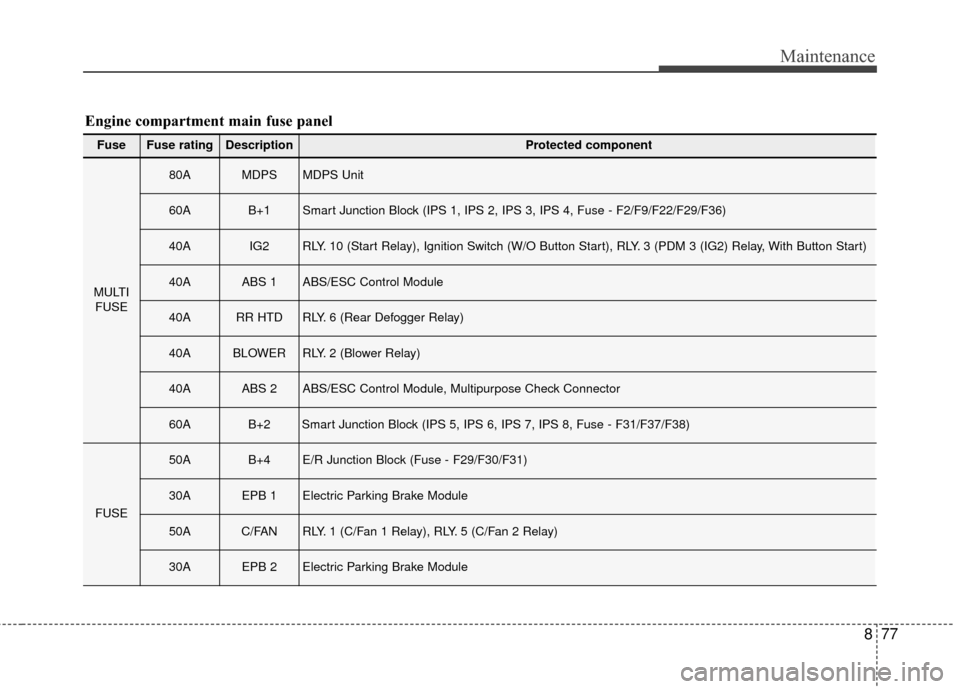
Engine compartment main fuse panel
Page 578 of 625
Maintenance
78
8
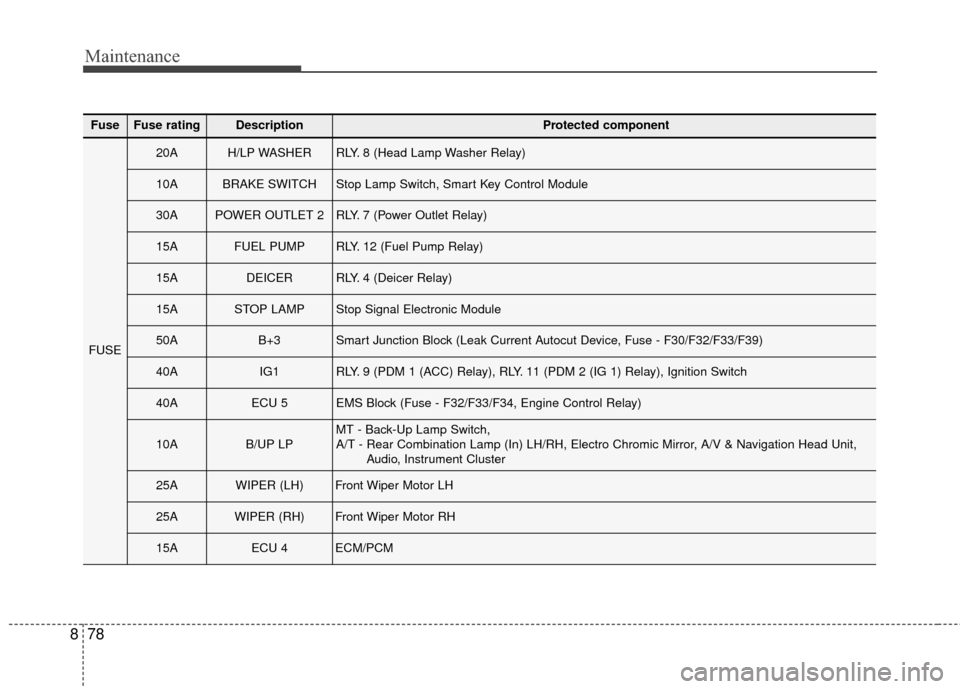
FuseFuse ratingDescriptionProtected component
FUSE
20AH/LP WASHERRLY. 8 (Head Lamp Washer Relay)
10ABRAKE SWITCHStop Lamp Switch, Smart Key Control Module
30APOWER OUTLET 2RLY. 7 (Power Outlet Relay)
15AFUEL PUMPRLY. 12 (Fuel Pump Relay)
15ADEICERRLY. 4 (Deicer Relay)
15ASTOP LAMPStop Signal Electronic Module
50AB+3Smart Junction Block (Leak Current Autocut Device, Fuse - F30/F32/F33/F39)
40AIG1RLY. 9 (PDM 1 (ACC) Relay), RLY. 11 (PDM 2 (IG 1) Relay), Ignition Switch
40AECU 5EMS Block (Fuse - F32/F33/F34, Engine Control Relay)
10AB/UP LPMT - Back-Up Lamp Switch,
A/T - Rear Combination Lamp (In) LH/RH, Electro Chromic Mirror, A/V & Navigation Head Unit,
Audio, Instrument Cluster
25AWIPER (LH)Front Wiper Motor LH
25AWIPER (RH)Front Wiper Motor RH
15AECU 4ECM/PCM
Page 579 of 625
879
Maintenance
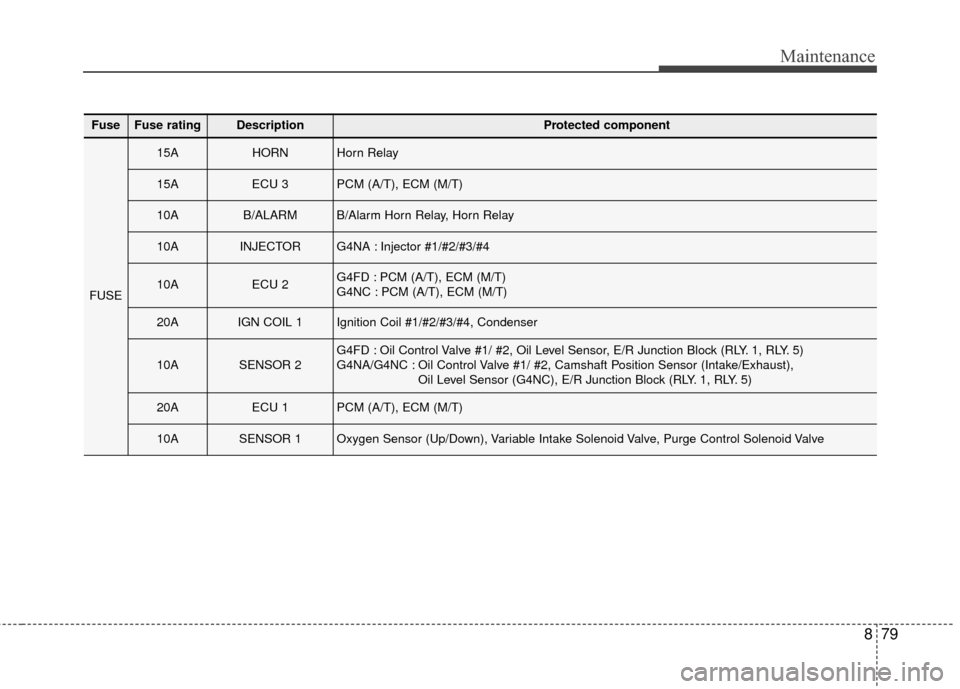
FuseFuse ratingDescriptionProtected component
FUSE
15AHORNHorn Relay
15AECU 3PCM (A/T), ECM (M/T)
10AB/ALARMB/Alarm Horn Relay, Horn Relay
10AINJECTORG4NA : Injector #1/#2/#3/#4
10AECU 2G4FD : PCM (A/T), ECM (M/T)
G4NC : PCM (A/T), ECM (M/T)
20AIGN COIL 1Ignition Coil #1/#2/#3/#4, Condenser
10ASENSOR 2G4FD : Oil Control Valve #1/ #2, Oil Level Sensor, E/R Junction Block (RLY. 1, RLY. 5)
G4NA/G4NC : Oil Control Valve #1/ #2, Camshaft Position Sensor (Intake/Exhaust),Oil Level Sensor (G4NC), E/R Junction Block (RLY. 1, RLY. 5)
20AECU 1PCM (A/T), ECM (M/T)
10ASENSOR 1Oxygen Sensor (Up/Down), Variable Intake Solenoid Valve, Purge Control Solenoid Valve