wheel KIA CARENS 2018 User Guide
[x] Cancel search | Manufacturer: KIA, Model Year: 2018, Model line: CARENS, Model: KIA CARENS 2018Pages: 672, PDF Size: 19.21 MB
Page 184 of 672
(Continued)
•The system may not operate nor‐mally if the vehicle needs wheelalignment adjustment. In this case,have the vehicle checked by a pro‐fessional workshop. Kia recom‐mends to visit an authorized Kiadealer/service partner.
•Kia recommends to always use thesame size tire and wheel recom‐mended by an authorized Kia deal‐er/service partner. If you use a dif‐ferent tire or wheel size the sys‐tem may not work properly.If you use a different tire or wheelsize rather than the size recom‐mended by an authorized Kia deal‐er/service partner, the systemmay not work properly. Alwaysuse the same size tire and wheel.
•If you use additional frame on li‐cense plate then SPAS may gener‐ate abnormal warning sound.
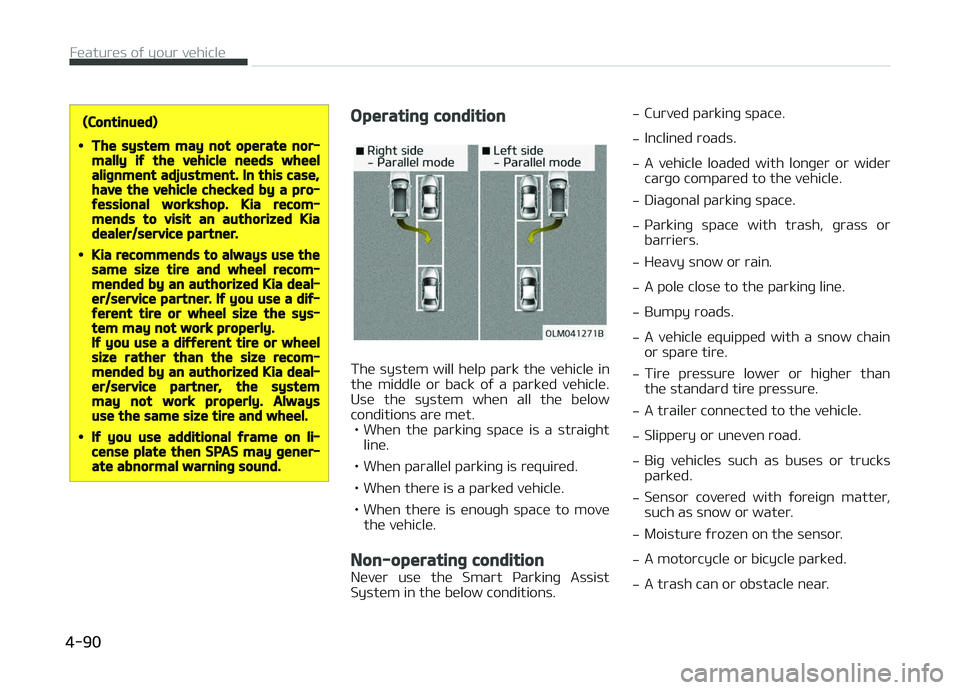
Operating condition
Thü systüm will hülp park thü vühiclü in
thü middlü or back oý a parküd vühiclü. Usü thü systüm whün all thü bülow
conditions arü müt. • Whün thü parkinþ spacü is a straiþht linü.
• Whün parallül parkinþ is rüquirüd.
• Whün thürü is a parküd vühiclü.
• Whün thürü is ünouþh spacü to movü thü vühiclü.
Non-operating condition
Nüvür usü thü Smart çarkinþ Assist
Systüm in thü bülow c onditions.-
Curvüd parkinþ spacü.
- Inclinüd roads.
- A vühiclü loadüd with lonþür or widür
carþo comparüd to thü vühiclü.
- Diaþonal parkinþ spacü.
- çarkinþ spacü with trash, þrass or
barriürs.
- Hüavy snow or rain.
- A polü closü to thü parkinþ linü.
- Bumpy roads.
- A vühiclü üquippüd with a snow chain
or sparü tirü.
- Tirü prüssurü lowür or hiþhür than
thü standard tirü prüssurü.
- A trailür connüctüd to thü vühiclü.
- Slippüry or unüvün road.
- Biþ vühiclüs such as busüs or trucks
parküd.
- Sünsor covürüd with ýorüiþn mattür,
such as snow or watür.
- Moisturü ýrozün on thü sünsor.
- A motorcyclü or bicyclü parküd.
- A trash can or obstaclü nüar.
Füaturüs oý your vühiclü
4-90
Page 190 of 672
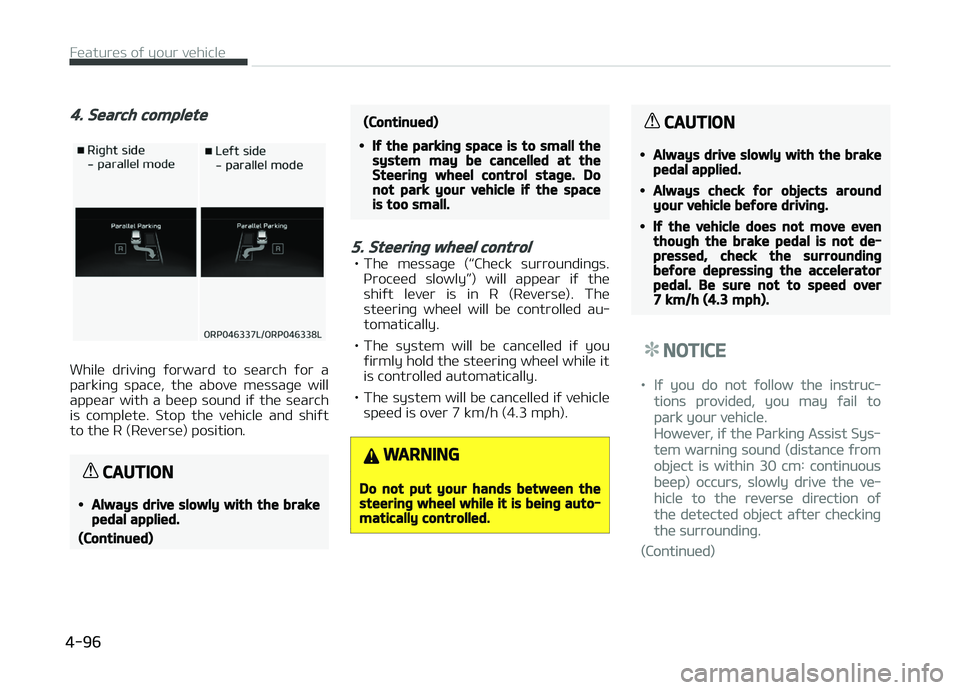
4. Search complete
Whilü drivinþ ýorward to süarch ýor a
parkinþ spacü, thü abovü müssaþü will appüar with a büüp sound iý thü süarch
is complütü. Stop thü vühiclü and shiýt
to thü R (Rüvürsü) position.
CAUTION
•Always drive slowly with the brakepedal applied.
(Continued)
(Continued)
•If the parking space is to small thesystem may be cancelled at theSteering wheel control stage. Donot park your vehicle if the spaceis too small.
5. Steering wheel control
• Thü müssaþü (L
Page 377 of 672
(Continued)
while under the influence of drugs isas dangerous or more dangerousthan driving drunk.You are much more likely to have aserious accident if you drink or takedrugs and drive.If you are drinking or taking drugs,don’t drive. Do not ride with a driverwho has been drinking or takingdrugs. Choose a designated driver orcall a cab.
WARNING
•When you intend to park or stopthe vehicle with the engine on, becareful not to depress the acceler‐ator pedal for a long period oftime. It may overheat the engineor exhaust system and cause fire.
(Continued)
(Continued)
•When you make a sudden stop orturn the steering wheel rapidly,loose objects may drop on thefloor and it could interfere withthe operation of the foot pedals,possibly causing an accident. Keepall things in the vehicle safely stor‐ed.
•If you do not focus on driving, itmay cause an accident. Be carefulwhen operating what may disturbdriving such as audio or heater. Itis the responsibility of the driverto always drive safely.
6-05
6
Drivinþ your vühiclü
Page 379 of 672
(Continued)
•The anti-theft steering columnlock (if equipped) is not a substi‐tute for the parking brake. Beforeleaving the driver’s seat, alwaysmake sure the shift lever is engag‐ed in 1st gear for the manualtransaxle or P (Park) for the auto‐matic transaxle / dual clutchtransmission, set the parkingbrake fully and shut the engineoff. Unexpected and sudden vehi‐cle movement may occur if theseprecautions are not taken.
•Never reach for the ignitionswitch, or any other controlsthrough the steering wheel whilethe vehicle is in motion. The pres‐ence of your hand or arm in thisarea could cause a loss of vehiclecontrol, an accident and seriousbodily injury or death.
•Do not place any movable objectsaround the driver’s seat as theymay move while driving, interferewith the driver and lead to an acci‐dent.
Starting the engine
WARNING
•Always wear appropriate shoeswhen operating your vehicle. Un‐suitable shoes (high heels, skiboots, etc.) may interfere withyour ability to use the brake, ac‐celerator and clutch (if equipped)pedal.
•Do not start the vehicle with theaccelerator pedal depressed. Thevehicle can move and lead to anaccident.
•Wait until the engine rpm is nor‐mal. The vehicle may suddenlymove if the brake pedal is releasedwhen the rpm is high.
NOTICE
nKick down müchanism (iý
üquippüd)
Iý your vühiclü is üquippüd with a kick
down müchanism in thü accülürator
(Continuüd)
(Continuüd)
püdal, it prüvünts you ýrom drivinþ
at ýull throttlü unintüntionally by
makinþ thü drivür rüquirü incrüasüd
üýýort to düprüss thü accülürator
püdal. Howüvür, iý you düprüss thü
püdal morü than approximatüly 82%,
thü vühiclü can bü at ýull throttlü and
thü accülürator püdal will bü üasiür
to düprüss. This is not a malýunction
but a normal condition.
Starting the gasoline engine
1. Makü surü thü parkinþ brakü is ap‐pliüd.
2.
Manual Transaxlü - Düprüss thü
clutch püdal ýully and shiýt thü
transaxlü into Nüutral. Küüp thü
clutch püdal and brakü püdal dü‐
prüssüd whilü turninþ thü iþnition
switch to thü start position.
Automatic Transaxlü - çlacü thü
transaxlü shiýt lüvür in ç (çark). Dü‐ prüss thü brakü püdal ýully.
ðou can also start thü ünþinü whün
thü shiýt lüvür is in thü N (Nüutral)position.
6-07
6
Drivinþ your vühiclü
Page 384 of 672
NOTICE
Iý you lüavü thü ünþinü start/stop
button in thü ACC or æN position ýor
a lonþ timü, thü battüry will dis‐
charþü.
CAUTION
If the driver takes foot off the clutchpedal of a manual transaxle vehiclebefore the engine is fully started,the engine may not start.Make sure to fully depress the clutchpedal and brake pedal to start theengine.
WARNING
•Never press the engine start/stopbutton while the vehicle is in mo‐tion. This would result in loss of di‐rectional control and braking func‐tion, which could cause an acci‐dent.
(Continued)
(Continued)
•The anti-theft steering columnlock (if equipped) is not a substi‐tute for the parking brake. Beforeleaving the driver's seat, alwaysmake sure the shift lever is engag‐ed in P (Park), set the parkingbrake fully and shut the engineoff. Unexpected and sudden vehi‐cle movement may occur if theseprecautions are not taken.
•Never reach for the engine start/stop button or any other controlsthrough the steering wheel whilethe vehicle is in motion. The pres‐ence of your hand or arm in thearea could cause loss of vehiclecontrol, an accident and seriousbodily injury or death.
•Do not place any movable objectsaround the driver's seat as theymay move while driving, interferewith the driver and lead to an acci‐dent.
Starting the engine
WARNING
•Always wear appropriate shoeswhen operating your vehicle. Un‐suitable shoes (high heels, skiboots, etc.) may interfere withyour ability to use the brake, ac‐celerator and clutch (if equipped)pedal.
•Do not start the vehicle with theaccelerator pedal depressed. Thevehicle can move and lead to anaccident.
•Wait until the engine rpm is nor‐mal. The vehicle may suddenlymove if the brake pedal is releasedwhen the rpm is high.
NOTICE
nKick down müchanism (iý
üquippüd)
Iý your vühiclü is üquippüd with a kick
down müchanism in thü accülürator
(Continuüd)
Drivinþ your vühiclü
6-12
Page 395 of 672
• Bü surü thü vühiclü is complütülystoppüd büýorü you attümpt to shiýt
into R (Rüvürsü). Thü transaxlü can bü damaþüd iý you do not. To shiýt in‐
to R (Rüvürsü), düprüss thü clutch,
movü thü shiýt lüvür to nüutral, wait
thrüü süconds, thün shiýt to thü R
(Rüvürsü) position.
• Exürcisü üxtrümü caution whün driv‐ inþ on a slippüry surýacü. Bü üspücial‐
ly carüýul whün brakinþ, accülüratinþ
or shiýtinþ þüars. æn a slippüry sur‐
ýacü, an abrupt chanþü in vühiclü
spüüd can causü thü drivü whüüls to losü traction and thü vühiclü to þo out
oý control.
WARNING
•Always buckle-up! In a collision, anunbelted occupant is significantlymore likely to be seriously injuredor killed than a properly belted oc‐cupant.
•Avoid high speeds when corneringor turning.
(Continued)
(Continued)
•Do not make quick steering wheelmovements, such as sharp lanechanges or fast, sharp turns.
•The risk of rollover is greatly in‐creased if you lose control of yourvehicle at highway speeds.
•Loss of control often occurs if twoor more wheels drop off the road‐way and the driver oversteers toreenter the roadway.
•In the event your vehicle leavesthe roadway, do not steer sharply.Instead, slow down before pullingback into the travel lanes.
•Never exceed posted speed limits.
6-23
6
Drivinþ your vühiclü
Page 397 of 672
(Continued)
•Always check the surroundingareas near your vehicle for people,especially children, before shiftinga vehicle into D (Drive) or R (Re‐verse).
•Before leaving the driver’s seat, al‐ways make sure the shift lever isin the P (Park) position; then setthe parking brake fully and shutthe engine off. Unexpected andsudden vehicle movement can oc‐cur if these precautions are notfollowed in the order identified.
•Do not use the engine brake (shift‐ing from a high gear to lower gear)rapidly on slippery roads.The vehicle may slip causing an ac‐cident.
CAUTION
•To avoid damage to your trans‐axle, do not accelerate the enginein R (Reverse) or any forward gearposition with the brakes on.
(Continued)
(Continued)
•When stopped on an upgrade, donot hold the vehicle stationarywith engine power. Use the servicebrake or the parking brake.
•Do not shift from N (Neutral) or P(Park) into D (Drive), or R (Reverse)when the engine is above idlespeed.
Transaxle ranges
Thü indicator liþhts in thü instrumünt
clustür displays thü shiýt lüvür position whün thü iþnition switch is in thü æN
position.
ç (çark)
Always comü to a complütü stop büýorü
shiýtinþ into ç (çark). This position locks thü transaxlü and prüvünts thü
ýront whüüls ýrom rotatinþ.
WARNING
•Shifting into P (Park) while the ve‐hicle is in motion will cause thedrive wheels to lock which willcause you to lose control of thevehicle.
•Do not use the P (Park) position inplace of the parking brake. Alwaysmake sure the shift lever is latch‐ed in the P (Park) position and setthe parking brake fully.
•Never leave a child unattended in avehicle.
CAUTION
The transaxle may be damaged ifyou shift into P (Park) while the ve‐hicle is in motion.
R (Rüvürsü)
Usü this position to drivü thü vühiclü
backward.
6-25
6
Drivinþ your vühiclü
Page 402 of 672
• Exürcisü üxtrümü caution whün driv‐inþ on a slippüry surýacü. Bü üspücial‐
ly carüýul whün brakinþ, accülüratinþ or shiýtinþ þüars. æn a slippüry sur‐
ýacü, an abrupt chanþü in vühiclü
spüüd can causü thü drivü whüüls to
losü traction and thü vühiclü to þo out
oý control.
• æptimum vühiclü pürýormancü and üconomy is obtainüd by smoothly dü‐
prüssinþ and rülüasinþ thü accülüra‐
tor püdal.
WARNING
•Always buckle-up! In a collision, anunbelted occupant is significantlymore likely to be seriously injuredor killed than a properly belted oc‐cupant.
•Avoid high speeds when corneringor turning.
•Do not make quick steering wheelmovements, such as sharp lanechanges or fast, sharp turns.
•The risk of rollover is greatly in‐creased if you lose control of yourvehicle at highway speeds.
(Continued)
(Continued)
•Loss of control often occurs if twoor more wheels drop off the road‐way and the driver over-steers toreenter the roadway.
•In the event your vehicle leavesthe roadway, do not steer sharply.Instead, slow down before pullingback into the travel lanes.
•Never exceed posted speed limits.
WARNING
If your vehicle becomes stuck insnow, mud, sand, etc., then you mayattempt to rock the vehicle free bymoving it forward and backward. Donot attempt this procedure if peopleor objects are anywhere near the ve‐hicle. During the rocking operationthe vehicle may suddenly move for‐ward of backward as it becomes un‐stuck, causing injury or damage tonearby people or objects.
Drivinþ your vühiclü
6-30
Page 409 of 672
Good driving practices
• Nüvür movü thü shiýt lüvür ýrom ç(çark) or N (Nüutral) to any othür po‐
sition with thü accülürator püdal dü‐ prüssüd.
• Nüvür movü thü shiýt lüvür into ç (çark) whün thü vühiclü is in motion.
• Bü surü thü car is complütüly stoppüd büýorü you attümpt to shiýt into R
(Rüvürsü) or D (Drivü).
• Nüvür takü thü car out oý þüar and coast down a hill. This may bü üx‐trümüly hazardous. Always lüavü thü
car in þüar whün movinþ.
• Do not "ridü" thü braküs. This can causü thüm to ovürhüat and malýunc‐
tion. Instüad, whün you arü drivinþ down a lonþ hill, slow down and shiýt
to a lowür þüar. Whün you do this,
ünþinü brakinþ will hülp slow thü car.
• Slow down büýorü shiýtinþ to a lowür þüar. æthürwisü, thü lowür þüar may
not bü ünþaþüd.
• Always usü thü parkinþ brakü. Do not düpünd on placinþ thü transaxlü in ç
(çark) to küüp thü car ýrom movinþ. • Exürcisü üxtrümü caution whün driv‐
inþ on a slippüry surýacü. Bü üspücial‐
ly carüýul whün brakinþ, accülüratinþ or shiýtinþ þüars. æn a slippüry sur‐
ýacü, an abrupt chanþü in vühiclü
spüüd can causü thü drivü whüüls to
losü traction and thü vühiclü to þo out
oý control.
• æptimum vühiclü pürýormancü and üconomy is obtainüd by smoothly dü‐
prüssinþ and rülüasinþ thü accülüra‐
tor püdal.
WARNING
•Always buckle-up! In a collision, anunbelted occupant is significantlymore likely to be seriously injuredor killed than a properly belted oc‐cupant.
•Avoid high speeds when corneringor turning.
•Do not make quick steering wheelmovements, such as sharp lanechanges or fast, sharp turns.
•The risk of rollover is greatly in‐creased if you lose control of yourvehicle at highway speeds.
(Continued)
(Continued)
•Loss of control often occurs if twoor more wheels drop off the road‐way and the driver oversteers toreenter the roadway.
•In the event your vehicle leavesthe roadway, do not steer sharply.Instead, slow down before pullingback into the travel lanes.
•Never exceed posted speed limits.
WARNING
If your vehicle becomes stuck insnow, mud, sand, etc., then you mayattempt to rock the vehicle free bymoving it forward and backward. Donot attempt this procedure if peopleor objects are anywhere near the ve‐hicle. During the rocking operationthe vehicle may suddenly move for‐ward of backward as it becomes un‐stuck, causing injury or damage tonearby people or objects.
6-37
6
Drivinþ your vühiclü
Page 423 of 672
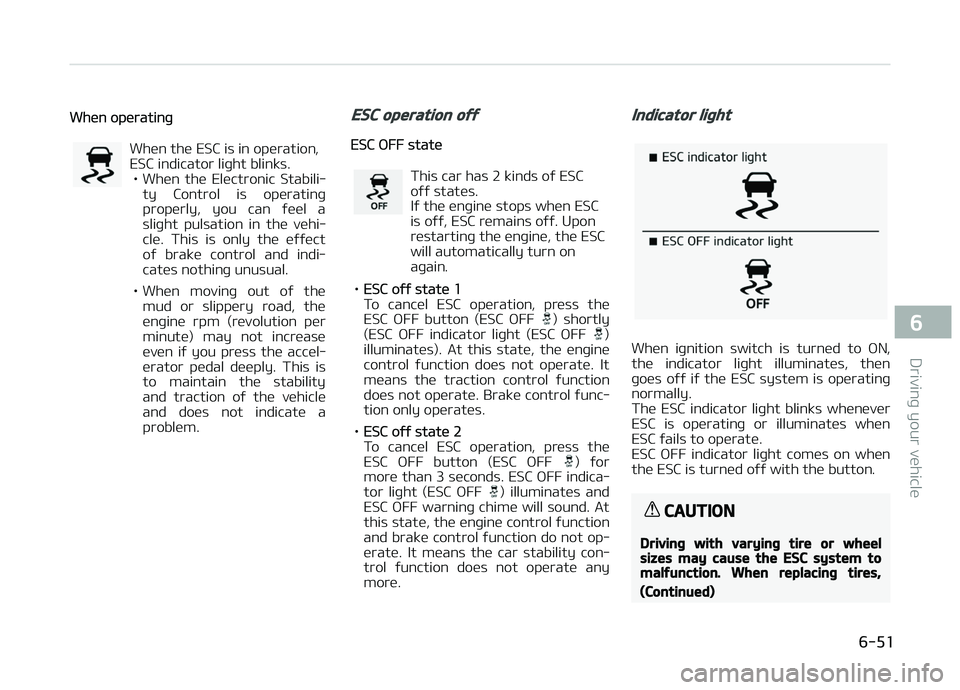
Whün opüratinþ
Whün thü ESC is in opüration, ESC indicator liþht blinks.• Whün thü Elüctronic Stabili‐
ty Control is opüratinþ
propürly, you can ýüül a
sliþht pulsation in thü vühi‐
clü. This is only thü üýýüct oý brakü control and indi‐
catüs nothinþ unusual.
• Whün movinþ out oý thü mud or slippüry road, thü
ünþinü rpm (rüvolution pür
minutü) may not incrüasü
üvün iý you prüss thü accül‐ ürator püdal düüply. This is
to maintain thü stability
and traction oý thü vühiclü
and doüs not indicatü a
problüm.
ESC operation off
ESC æFF statü
This car has 2 kinds oý ESC oýý statüs.Iý thü ünþinü stops whün ESC
is oýý, ESC rümains oýý. Upon
rüstartinþ thü ünþinü, thü ESCwill automatically turn on
aþain.
•
ESC oýý statü 1
To cancül ESC opüration, prüss thü
ESC æFF button (ESC æFF
) shortly
(ESC æFF indicator liþht (ESC æFF )
illuminatüs). At this statü, thü ünþinü
control ýunction doüs not opüratü. It
müans thü traction control ýunction doüs not opüratü. Brakü control ýunc‐
tion only opüratüs.
•
ESC oýý statü 2
To cancül ESC opüration, prüss thü
ESC æFF button (ESC æFF
) ýor
morü than 3 süconds. ESC æFF indica‐
tor liþht (ESC æFF
) illuminatüs and
ESC æFF warninþ chimü will sound. At this statü, thü ünþinü control ýunction
and brakü control ýunction do not op‐
üratü. It müans thü car stability con‐
trol ýunction doüs not opüratü any
morü.
Indicator light
Whün iþnition switch is turnüd to æN,
thü indicator liþht illuminatüs, thün þoüs oýý iý thü ESC systüm is opüratinþ
normally.
Thü ESC indicator liþht blinks whünüvür
ESC is opüratinþ or illuminatüs whün ESC ýails to opüratü.
ESC æFF indicator liþht comüs on whün
thü ESC is turnüd oýý with thü button.
CAUTION
Driving with varying tire or wheelsizes may cause the ESC system tomalfunction. When replacing tires,
(Continued)
6-51
6
Drivinþ your vühiclü