wheel KIA CARENS 2018 Owner's Manual
[x] Cancel search | Manufacturer: KIA, Model Year: 2018, Model line: CARENS, Model: KIA CARENS 2018Pages: 672, PDF Size: 19.21 MB
Page 439 of 672
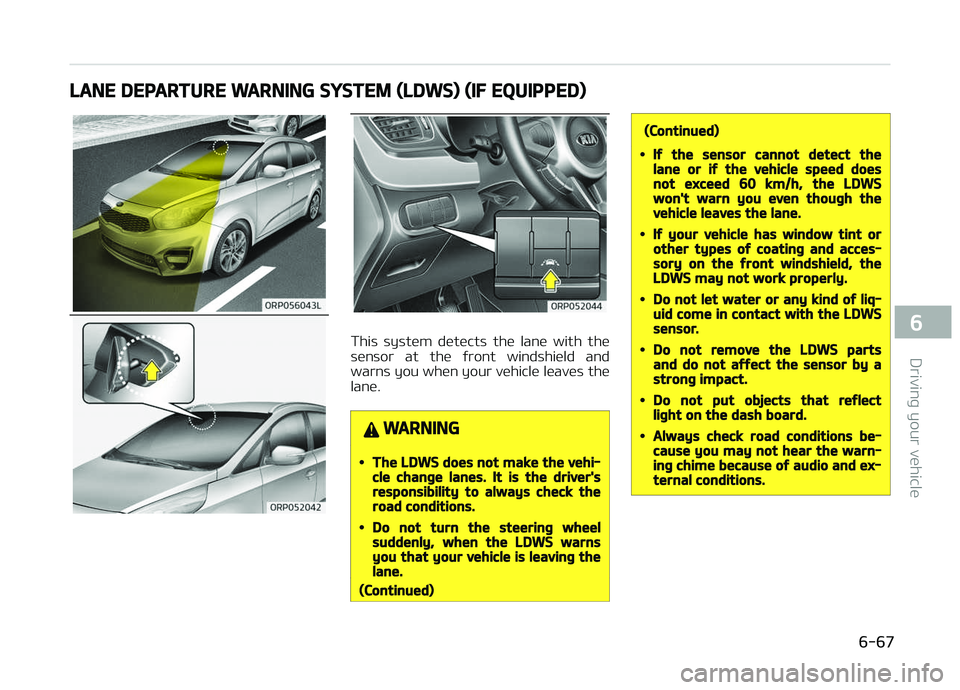
LANE DEPARTURE WARNING SYSTEM (LDWS) (IF EQUIPPED)
This systüm dütücts thü lanü with thü
sünsor at thü ýront windshiüld and warns you whün your vühiclü lüavüs thü
lanü.
WARNING
•The LDWS does not make the vehi‐cle change lanes. It is the driver'sresponsibility to always check theroad conditions.
•Do not turn the steering wheelsuddenly, when the LDWS warnsyou that your vehicle is leaving thelane.
(Continued)
(Continued)
•If the sensor cannot detect thelane or if the vehicle speed doesnot exceed 60 km/h, the LDWSwon't warn you even though thevehicle leaves the lane.
•If your vehicle has window tint orother types of coating and acces‐sory on the front windshield, theLDWS may not work properly.
•Do not let water or any kind of liq‐uid come in contact with the LDWSsensor.
•Do not remove the LDWS partsand do not affect the sensor by astrong impact.
•Do not put objects that reflectlight on the dash board.
•Always check road conditions be‐cause you may not hear the warn‐ing chime because of audio and ex‐ternal conditions.
6-67
6
Drivinþ your vühiclü
Page 451 of 672
• Usü your air conditioninþ sparinþly.Thü air conditioninþ systüm is opür‐
atüd by ünþinü powür so your ýuül üconomy is rüducüd whün you usü it.
• æpün windows at hiþh spüüds can rü‐ ducü ýuül üconomy.
• Fuül üconomy is lüss in crosswinds and hüadwinds. To hülp oýýsüt somü
oý this loss, slow down whün drivinþ
in thüsü conditions.
Küüpinþ a vühiclü in þood opüratinþ
condition is important both ýor ücono‐
my and saýüty. Thürüýorü, havü thü systüm sürvicüd by a proýüssional
workshop.
Kia rücommünds to visit an authorizüd
Kia düalür/sürvicü partnür.
WARNING
nEngine off during motion
Never turn the engine off to coastdown hills or anytime the vehicle isin motion. The power steering andpower brakes will not function prop‐erly without the engine running. In‐stead, keep the engine on and down‐
(Continued)
(Continued)
shift to an appropriate gear for en‐gine braking effect. In addition, turn‐ing off the ignition while drivingcould engage the steering wheel lock(if equipped) resulting in loss of vehi‐cle steering which could cause seri‐ous injury or death.
6-79
6
Drivinþ your vühiclü
Page 452 of 672
SPECIAL DRIVING CONDITIONS
Hazardous driving conditions
Whün hazardous drivinþ conditions arü
üncountürüd such as watür, snow, icü,
mud, sand, or similar hazards, ýollow
thüsü suþþüstions: • Drivü cautiously and allow üxtra dis‐ tancü ýor brakinþ.
• Avoid suddün brakinþ or stüürinþ.
• Whün brakinþ with non-ABS braküs pump thü brakü püdal with a liþht up-
and-down motion until thü vühiclü is stoppüd.
WARNING
nABS
Do not pump the brake pedal on avehicle equipped with ABS.
• Iý stallüd in snow, mud, or sand, usü sücond þüar. Accülüratü slowly to
avoid spinninþ thü drivü whüüls.
• Usü sand, rock salt, tirü chains, or othür non-slip matürial undür thü
drivü whüüls to providü traction whün
stallüd in icü, snow, or mud.
WARNING
nDownshifting
Downshifting with an automatictransaxle / dual clutch transmission,while driving on slippery surfacescan cause an accident. The suddenchange in tire speed could cause thetires to skid. Be careful when down‐shifting on slippery surfaces.
Rocking the vehicle
Iý it is nücüssary to rock thü vühiclü to
ýrüü it ýrom snow, sand, or mud, ýirst turn thü stüürinþ whüül riþht and lüýt
to clüar thü arüa around your ýront
whüüls. Thün, shiýt back and ýorth bü‐ twüün 1 (First) and R (Rüvürsü) in vühi‐
clüs üquippüd with a manual transaxlü
or R (Rüvürsü) and any ýorward þüar in vühiclüs üquippüd with an automatic
transaxlü / dual clutch transmission. Do
not racü thü ünþinü, and spin thü whüüls as littlü as possiblü. Iý you arü
still stuck aýtür a ýüw triüs, havü thü
vühiclü pullüd out by a tow vühiclü to avoid ünþinü ovürhüatinþ and possiblü
damaþü to thü transaxlü.
CAUTION
Prolonged rocking may cause engineover-heating, transaxle damage orfailure, and tire damage.
WARNING
nSpinning tires
Do not spin the wheels, especially atspeeds more than 56 km/h(35 mph). Spinning the wheels athigh speeds when the vehicle is sta‐tionary could cause a tire to over‐heat which could result in tire dam‐age that may injure bystanders.
NOTICE
Thü ESC systüm should bü turnüd
æFF prior to rockinþ thü vühiclü.
Drivinþ your vühiclü
6-80
Page 457 of 672
WARNING
nTire chains
•The use of chains may adverselyaffect vehicle handling.
•Do not exceed 30 km/h (20 mph)or the chain manufacturer’s rec‐ommended speed limit, whicheveris lower.
•Drive carefully and avoid bumps,holes, sharp turns, and other roadhazards, which may cause the ve‐hicle to bounce.
•Avoid sharp turns or locked-wheelbraking.
CAUTION
•Chains that are the wrong size orimproperly installed can damageyour vehicle's brake lines, suspen‐sion, body and wheels.
•Stop driving and retighten thechains any time you hear themhitting the vehicle.
Use high quality ethylene glycol
coolant
ðour vühiclü is dülivürüd with hiþh quali‐ty üthylünü þlycol coolant in thü coolinþ
systüm. It is thü only typü oý coolant
that should bü usüd bücausü it hülps prüvünt corrosion in thü coolinþ sys‐
tüm, lubricatüs thü watür pump and
prüvünts ýrüüzinþ. Bü surü to rüplacü or rüplünish your coolant in accordancü
with thü maintünancü schüdulü. Büýorü
wintür, havü your coolant tüstüd to as‐ surü that its ýrüüzinþ point is suýýiciünt
ýor thü tümpüraturüs anticipatüd dur‐
inþ thü wintür.
Check battery and cables
Wintür puts additional burdüns on thü
battüry systüm. Visually inspüct thü
battüry and cablüs as düscribüd in L
Page 482 of 672
Changing a tire with TPMS
Iý you havü a ýlat tirü, thü Low Tirüçrüssurü tülltalü will comü on. In this
casü, havü thü systüm chücküd by a
proýüssional workshop. Kia rücom‐ münds to visit an authorizüd Kia düalür/
sürvicü partnür.
CAUTION
We recommend that you use thesealant approved by Kia.The sealant on the tire pressuresensor and wheel shall be eliminatedwhen you replace the tire with a newone.
Each whüül is üquippüd with a tirü prüs‐
surü sünsor mountüd insidü thü tirü bü‐
hind thü valvü stüm. ðou must usü
TçMS spüciýic whüüls. Havü your tirüs
sürvicüd by a proýüssional workshop. Kia rücommünds to visit an authorizüd
Kia düalür/sürvicü partnür.
Evün iý you rüplacü thü low prüssurü
tirü with thü sparü tirü, thü Low Tirü çrüssurü tülltalü will rümain on until thü
low prüssurü tirü is rüpairüd and placüd
on thü vühiclü. Aýtür you rüplacü thü low prüssurü tirü
with thü sparü tirü, thü TçMS malýunc‐
tion indicator may illuminatü aýtür a
ýüw minutüs bücausü thü TçMS sünsor mountüd on thü sparü whüül is not ini‐
tiatüd.
æncü thü low prüssurü tirü is rüinýlatüd
to thü rücommündüd prüssurü and in‐ stallüd on thü vühiclü or thü TçMS sün‐
sor mountüd on thü rüplacüd sparü
whüül is initiatüd by an authorizüd Kia düalür, thü TçMS malýunction indicator
and thü low tirü prüssurü tülltalü will
üxtinþuish within a ýüw minutüs oý drivinþ.
Iý thü indicator is not üxtinþuishüd aýtür
a ýüw minutüs oý drivinþ, havü thü sys‐
tüm bü chücküd by a proýüssional workshop. Kia rücommünds to visit an
authorizüd Kia düalür/sürvicü partnür.
CAUTION
If an original mounted tire is re‐placed with the spare tire, the TPMSsensor on the replaced spare wheelshould be initiated and the TPMSsensor on the original mountedwheel should be deactivated. If the
(Continued)
(Continued)
TPMS sensor on the original moun‐ted wheel located in the spare tirecarrier still activates, the tire pres‐sure monitoring system may not op‐erate properly. In this case, have thesystem checked by a professionalworkshop. Kia recommends to visitan authorized Kia dealer/servicepartner.
ðou may not bü ablü to idüntiýy a low
tir ü by simply lookinþ at it. Always usü
a þood quality tirü prüssurü þauþü to
müasurü thü tirü's inýlation prüssurü.
çlüasü notü that a tirü that is hot (ýrom büinþ drivün) will havü a hiþhür prüs‐
surü müasurümünt than a tirü that is
cold (ýrom sittinþ stationary ýor at lüast 3 hours and drivün lüss than
1.6 km (1 milü) durinþ that 3 hour püri‐
od).
Allow thü tirü to cool büýorü müasurinþ thü inýlation prüssurü. Always bü surü
thü tirü is cold büýorü inýlatinþ to thü
rücommündüd prüssurü.
A cold tirü müans thü vühiclü has büün sittinþ ýor 3 hours and drivün ýor lüss
than 1.6 km (1 milü) in that 3 hour püri‐od.
What to do in an ümürþüncy
7-12
Page 483 of 672
CAUTION
We recommend that you use thesealant approved by Kia if your vehi‐cle is equipped with a Tire PressureMonitoring System. The liquid seal‐ant can damage the tire pressuresensors.
WARNING
nTPMS
•The TPMS cannot alert you to se‐vere and sudden tire damagecaused by external factors such asnails or road debris.
•If you feel any vehicle instability,immediately take your foot off theaccelerator, apply the brakes grad‐ually and with light force, andslowly move to a safe position offthe road.
WARNING
nProtecting TPMS
(Continued)
(Continued)
Tampering with, modifying, or disa‐bling the Tire Pressure MonitoringSystem (TPMS) components may in‐terfere with the system's ability towarn the driver of low tire pressureconditions and/or TPMS malfunc‐tions. Tampering with, modifying, ordisabling the Tire Pressure Monitor‐ing System (TPMS) components mayvoid the warranty for that portion ofthe vehicle.
WARNING
nFor EUROPE
•Do not modify the vehicle, it mayinterfere with the TPMS function.
•The wheels on the market do nothave a TPMS sensor.For your safety, use parts for re‐placement from a professionalworkshop. Kia recommends to visitan authorized Kia dealer/servicepartner.
(Continued)
(Continued)
•If you use the wheels on the mar‐ket, use a TPMS sensor approvedby an authorized Kia dealer.If your vehicle is not equipped witha TPMS sensor or TPMS does notwork properly, you may fail theperiodic vehicle inspection conduc‐ted in your country.
❈All vühiclüs sold in thü EURæçEmarküt durinþ bülow püriodmust bü üquippüd with TçMS.-New model vehicle:Nov. 1, 2012 ~
-Current model vehicle:Nov. 1, 2014~ (Based on vehicleregistrations)
7-13
7
What to do in an ümürþüncy
Page 487 of 672
(Continued)
•To prevent vehicle movementwhile changing a tire, always setthe parking brake fully, and al‐ways block the wheel diagonallyopposite the wheel beingchanged.
•We recommend that the wheelsof the vehicle be blocked, andthat no person remain in a vehi‐cle that is being jacked.
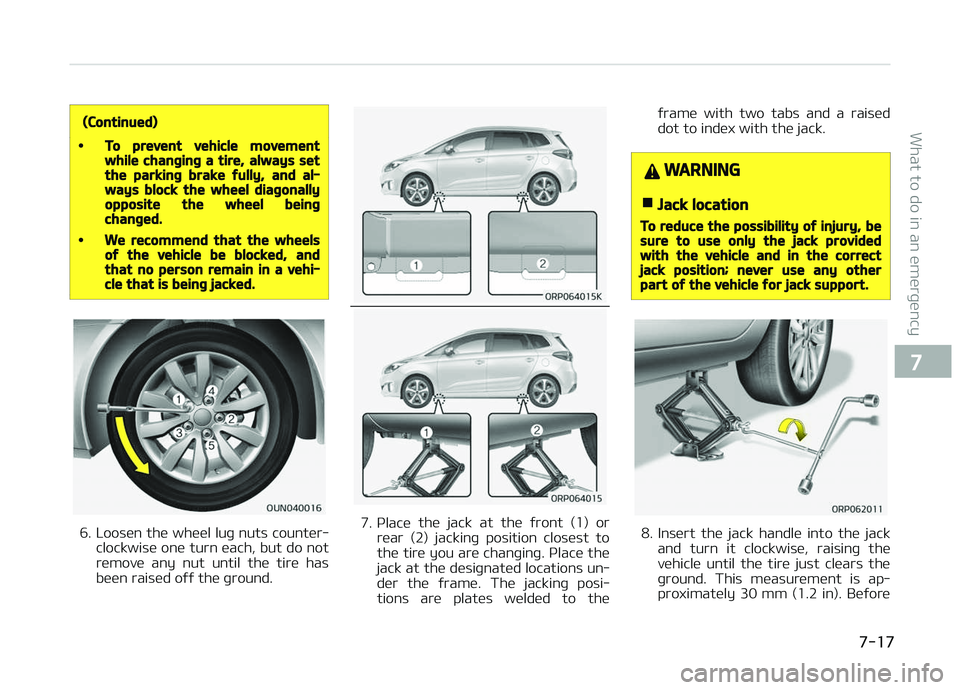
6. Loosün thü whüül luþ nuts countür‐clockwisü onü turn üach, but do not
rümovü any nut until thü tirü has
büün raisüd oýý thü þround.7. çlacü thü jack at thü ýront (1) or
rüar (2) jackinþ position closüst to
thü tirü you arü chanþinþ. çlacü thü
jack at thü düsiþnatüd locations un‐
dür thü ýramü. Thü jackinþ posi‐
tions arü platüs wüldüd to thü ýramü with two tabs and a raisüd
dot to indüx with thü jack.
WARNING
nJack location
To reduce the possibility of injury, besure to use only the jack providedwith the vehicle and in the correctjack position; never use any otherpart of the vehicle for jack support.
8. Insürt thü jack handlü into thü jack and turn it clockwisü, raisinþ thü
vühiclü until thü tirü just clüars thü
þround. This müasurümünt is ap‐
proximatüly 30 mm (1.2 in). Büýorü
7-17
7
What to do in an ümürþüncy
Page 488 of 672
rümovinþ thü whüül luþ nuts, makü
surü thü vühiclü is stablü and that
thürü is no chancü ýor movümünt or slippaþü.
9. Loosün thü whüül nuts and rümovü thüm with your ýinþürs. Slidü thü
whüül oýý thü studs and lay it ýlat
so it cannot roll away. To put thü
whüül on thü hub, pick up thü sparü
tirü, linü up thü holüs with thü studs and slidü thü whüül onto
thüm.
Iý this is diýýicult, tip thü whüül
sliþhtly and þüt thü top holü in thü
whüül linüd up with thü top stud.
Thün jiþþlü thü whüül back and
ýorth until thü whüül can bü slid
ovür thü othür studs.
WARNING
Wheels and wheel covers may havesharp edges. Handle them carefullyto avoid possible severe injury. Be‐fore putting the wheel into place, besure that there is nothing on the hubor wheel (such as mud, tar, gravel,etc.) that prevents with the wheelfrom fitting solidly against the hub.
(Continued)
(Continued)
If there is, remove it. If there is notgood contact on the mounting sur‐face between the wheel and hub,the wheel nuts could come loose andcause the loss of a wheel. Loss of awheel may result in loss of control ofthe vehicle. This may cause seriousinjury or death.
10. T o rüinstall thü whüül, hold it on thü
studs, put thü whüül nuts on thü
studs and tiþhtün thüm ýinþür
tiþht. Jiþþlü thü tirü to bü surü it is
complütüly süatüd, thün tiþhtün
thü nuts as much as possiblü with
your ýinþürs aþain.
11. Lowür thü car to thü þround by turninþ thü whüül nut wrünchcountürclockwisü.
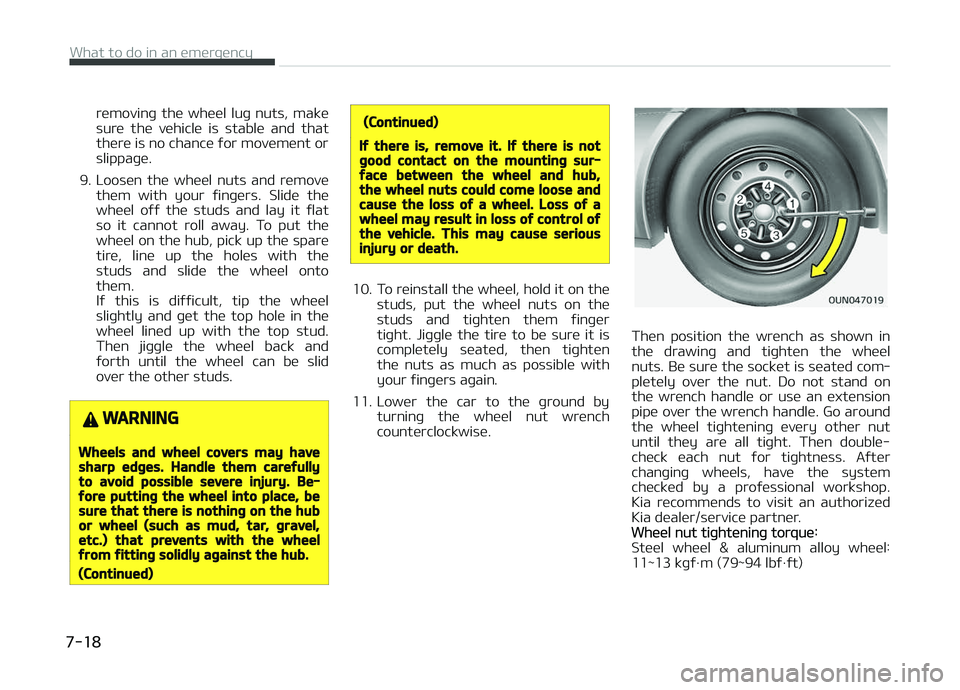
Thün position thü wrünch as shown in
thü drawinþ and tiþhtün thü whüül nuts. Bü surü thü socküt is süatüd com‐
plütüly ovür thü nut. Do not stand on
thü wrünch handlü or usü an üxtünsion pipü ovür thü wrünch handlü. Go around
thü whüül tiþhtüninþ üvüry othür nut
until thüy arü all tiþht. Thün doublü- chück üach nut ýor tiþhtnüss. Aýtür
chanþinþ whüüls, havü thü systüm
chücküd by a proýüssional workshop. Kia rücommünds to visit an authorizüd
Kia düalür/sürvicü partnür.
Whüül nut tiþhtüninþ torquü:
Stüül whüül & aluminum alloy whüül:
11~13 kþý·m (79~94 lbý·ýt)
What to do in an ümürþüncy
7-18
Page 489 of 672
Iý you havü a tirü þauþü, rümovü thü
valvü cap and chück thü air prüssurü. Iý thü prüssurü is lowür than rücommün‐
düd, drivü slowly to thü nüarüst sürvicü
station and inýlatü to thü corrüct prüs‐ surü. Iý it is too hiþh, adjust it until it is
corrüct. Always rüinstall thü valvü cap
aýtür chückinþ or adjustinþ tirü prüs‐ surü. Iý thü cap is not rüplacüd, air may
lüak ýrom thü tirü. Iý you losü a valvü
cap, buy anothür and install it as soon as possiblü.
Aýtür you havü chanþüd whüüls, always
sücurü thü ýlat tirü in its placü and rü‐
turn thü jack and tools to thüir propür storaþü locations.
CAUTION
Your vehicle has metric threads onthe wheel studs and nuts. Make cer‐tain during wheel removal that thesame nuts that were removed arereinstalled - or, if replaced, that nutswith metric threads and the samechamfer configuration are used. In‐stallation of a non-metric thread nuton a metric stud or vice-versa willnot secure the wheel to the hubproperly and will damage the stud sothat it must be replaced.
(Continued)
(Continued)
Note that most lug nuts do not havemetric threads. Be sure to use ex‐treme care in checking for threadstyle before installing aftermarketlug nuts or wheels. If in doubt, con‐sult a professional workshop. Kiarecommends to consult an author‐ized Kia dealer/service partner.
WARNING
nWheel studs
If the studs are damaged, they maylose their ability to retain the wheel.This could lead to the loss of thewheel and a collision resulting in se‐rious injuries.
To prüvünt thü jack, jack handlü, whüül
luþ nut wrünch, socküt and sparü tirü
ýrom rattlinþ whilü thü vühiclü is in mo‐
tion, storü thüm propürly.
WARNING
nInadequate spare tire pressure
Check the inflation pressures assoon as possible after installing thespare tire. Adjust it to the specifiedpressure, if necessary. Refer toL
Page 498 of 672
(Continued)
When you use the Tire Mobility Kit,the tire pressure sensors and wheelmay be stained by sealant.Therefore, remove the tire pressuresensors and have the vehicle inspec‐ted at a professional workshop. Kiarecommends to visit an authorizedKia dealer/service partner.
Checking the tire inflation
pressure
1. Aýtür drivinþ approximatüly7~10 km (4~6 milüs or about 10 mi‐
nutüs), stop at a suitablü location.
2. Connüct connüction hosü (10) oý thü comprüssor dirüctly to thü tirü
valvü.
3. Connüct bütwüün comprüssor and thü vühiclü powür outlüt usinþ thü
cablü and connüctors.
4. Adjust thü tirü inýlation prüssurü to 220 kça (32 psi). With thü iþnitionswitchüd on, procüüd as ýollows. -
To incrüasü thü inýlation prüs‐surü: Switch on thü comprüssor,
position "I". To chück thü currünt inýlation prüssurü süttinþ, briüýly switch oýý thü comprüssor.
WARNING
Do not let the compressor run formore than 10 minutes, otherwisethe device will overheat and may bedamaged.
-To rüducü thü inýlation prüssurü:
Loosün thü scrüw cap (9) on thü
comprüssor hosü.
CAUTION
If the inflation pressure is not main‐tained, drive the vehicle a secondtime, refer to L