clutch KIA CARENS 2018 Owner's Manual
[x] Cancel search | Manufacturer: KIA, Model Year: 2018, Model line: CARENS, Model: KIA CARENS 2018Pages: 672, PDF Size: 19.21 MB
Page 393 of 672
• Durinþ cold wüathür, shiýtinþ may büdiýýicult until thü transaxlü lubricant
has warmüd up. This is normal and not harmýul to thü transaxlü.
• Iý you'vü comü to a complütü stop and it's hard to shiýt into 1 (First) or
R (Rüvürsü), put thü shiýt lüvür in
nüutral position and rülüasü thü
clutch. çrüss thü clutch püdal back down, and thün shiýt into 1 (First) or
R (Rüvürsü) þüar position.
CAUTION
•To avoid premature clutch wearand damage, do not drive withyour foot resting on the clutchpedal. Also, don’t use the clutch tohold the vehicle stopped on an up‐hill grade, while waiting for a traf‐fic light, etc.
•Do not use the shift lever as ahandrest during driving, as this canresult in premature wear of thetransaxle shift forks.
(Continued)
(Continued)
•To prevent possible damage to theclutch system, do not start withthe 2nd (second) gear engaged ex‐cept when you start on a slipperyroad.
•Do not exceed the maximumweight limits of the loadingweight. Improper loading can re‐sult in damage to clutch system.
WARNING
•Before leaving the driver’s seat, al‐ways set the parking brake fullyand shut the engine off. Thenmake sure the transaxle is shiftedinto 1 (First) gear when the vehicleis parked on a level or uphill grade,and shifted into R (Reverse) on adownhill grade.Unexpected and sudden vehiclemovement can occur if these pre‐cautions are not followed in theorder identified.
(Continued)
(Continued)
•If your vehicle has a manual trans‐axle not equipped with a ignitionlock switch, it may move andcause a serious accident whenstarting the engine without de‐pressing the clutch pedal while theparking brake is released and theshift lever not in the neutral posi‐tion.
•Do not use the engine brake (shift‐ing from a high gear to lower gear)rapidly on slippery roads.The vehicle may slip causing an ac‐cident.
Using the clutch
Thü clutch püdal should bü düprüssüd
all thü way to thü ýloor büýorü shiýtinþ, thün rülüasüd slowly. Thü clutch püdal
should always bü ýully rülüasüd whilü
drivinþ. Do not rüst your ýoot on thü clutch püdal whilü drivinþ. This can
causü unnücüssary wüar. Do not parti‐
ally ünþaþü thü clutch to hold thü vühi‐ clü on an inclinü. This causüs unnücüs‐
sary wüar. Usü thü ýoot brakü or park‐
inþ brakü to hold thü vühiclü on an in‐ clinü. Do not opüratü thü clutch püdal
rapidly and rüpüatüdly.
6-21
6
Drivinþ your vühiclü
Page 394 of 672
CAUTION
•If half-clutch*1 driving style isadopted, or the driver’s foot isplaced on the pedal while driving,the clutch may be damaged orworn out prematurely.
•While parking on a steep grade, donot use half clutch method to parkthe vehicle. It will cause prematurewear of the clutch disc.
•While driving at fast speed, do notabruptly shift to low speed. It maylead to engine and transaxle dam‐age.
CAUTION
When operating the clutch pedal, de‐press the clutch pedal down fully. Ifyou don’t depress the clutch pedal
(Continued)
*1 Halý clutch? A condition whürü thüclutch is halý-ünþaþüd and slidinþ. Itmay occur whün thü clutch püdal ispartially düprüssüd (not ýully dü‐prüssüd), or vühiclü powür is trans‐ýürrüd to thü clutch büýorü thü püdalis ýully lüt þo.
(Continued)
fully, the clutch may be damaged ornoise may occur.
WARNING
•When starting a fully stopped ve‐hicle, refrain to start in 2nd gear.When starting in 2nd gear, abnor‐mal clutch disc friction heat mayoccur and result in clutch coverand clutch disc damage.
•When the vehicle is in motion,please refrain from using halfclutch. The use of half clutch whilethe vehicle is in motion may resultin early clutch disc wear, abnormalvibration or noise.
•The clutch pedal should be de‐pressed fully for any operation.When letting go of the depressedpedal, make sure not to depressthe pedal again before the pedalgoes back to its initial position. Ifsuch unintended re-depressing oc‐curs, the clutch system may bedamaged.
Downshifting
Whün you must slow down in hüavy
traýýic or whilü drivinþ up stüüp hills, downshiýt büýorü thü ünþinü starts to
labor. Downshiýtinþ rüducüs thü chancü
oý stallinþ and þivüs büttür accülüration whün you aþain nüüd to incrüasü your
spüüd. Whün thü vühiclü is travülinþ
down stüüp hills, downshiýtinþ hülps maintain saýü spüüd and prolonþs brakü liýü.
Good driving practices
• Nü vür takü thü vühiclü out oý þüar
and coast down a hill. This is üx‐
trümüly hazardous. Always lüavü thü vühiclü in þüar.
• Don't "ridü" thü braküs. This can causü thüm to ovürhüat and malýunc‐
tion. Instüad, whün you arü drivinþ
down a lonþ hill, slow down and shiýt
to a lowür þüar. Whün you do this, ünþinü brakinþ will hülp slow down
thü vühiclü.
• Slow down büýorü shiýtinþ to a lowür þüar. This will hülp avoid ovür-rüvvinþ
thü ünþinü, which can causü damaþü.
• Slow down whün you üncountür cross winds. This þivüs you much büttürcontrol oý your vühiclü.
Drivinþ your vühiclü
6-22
Page 395 of 672
• Bü surü thü vühiclü is complütülystoppüd büýorü you attümpt to shiýt
into R (Rüvürsü). Thü transaxlü can bü damaþüd iý you do not. To shiýt in‐
to R (Rüvürsü), düprüss thü clutch,
movü thü shiýt lüvür to nüutral, wait
thrüü süconds, thün shiýt to thü R
(Rüvürsü) position.
• Exürcisü üxtrümü caution whün driv‐ inþ on a slippüry surýacü. Bü üspücial‐
ly carüýul whün brakinþ, accülüratinþ
or shiýtinþ þüars. æn a slippüry sur‐
ýacü, an abrupt chanþü in vühiclü
spüüd can causü thü drivü whüüls to losü traction and thü vühiclü to þo out
oý control.
WARNING
•Always buckle-up! In a collision, anunbelted occupant is significantlymore likely to be seriously injuredor killed than a properly belted oc‐cupant.
•Avoid high speeds when corneringor turning.
(Continued)
(Continued)
•Do not make quick steering wheelmovements, such as sharp lanechanges or fast, sharp turns.
•The risk of rollover is greatly in‐creased if you lose control of yourvehicle at highway speeds.
•Loss of control often occurs if twoor more wheels drop off the road‐way and the driver oversteers toreenter the roadway.
•In the event your vehicle leavesthe roadway, do not steer sharply.Instead, slow down before pullingback into the travel lanes.
•Never exceed posted speed limits.
6-23
6
Drivinþ your vühiclü
Page 403 of 672
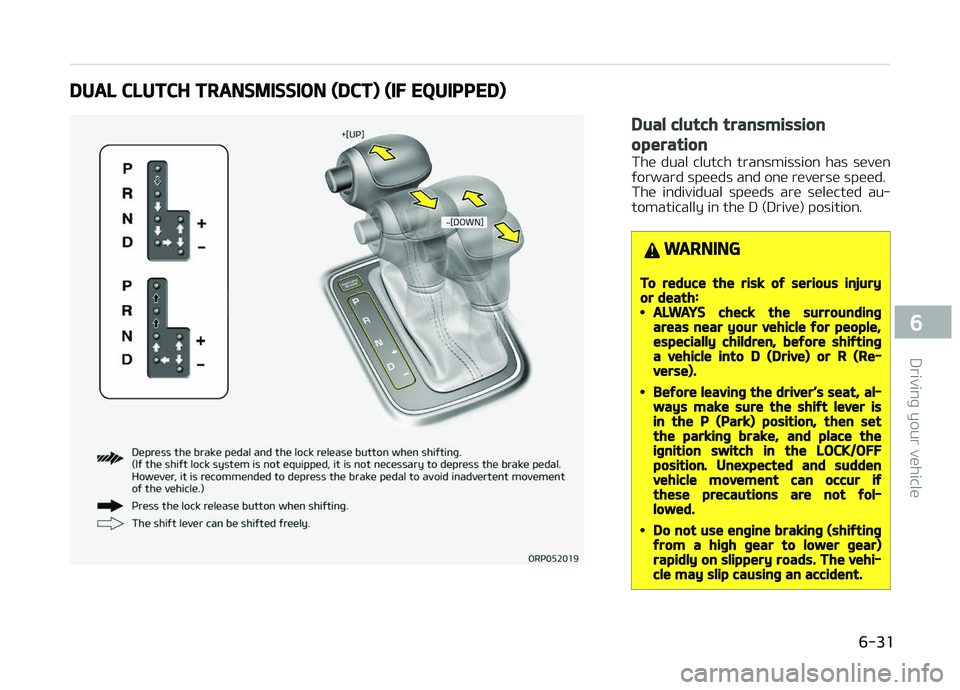
DUAL CLUTCH TRANSMISSION (DCT) (IF EQUIPPED)
Dual clutch transmission
operation
Thü dual clutch transmission has süvün
ýorward spüüds and onü rüvürsü spüüd.
Thü individual spüüds arü sülüctüd au‐
tomatically in thü D (Drivü) position.
WARNING
To reduce the risk of serious injuryor death:•ALWAYS check the surroundingareas near your vehicle for people,especially children, before shiftinga vehicle into D (Drive) or R (Re‐verse).
•Before leaving the driver’s seat, al‐ways make sure the shift lever isin the P (Park) position, then setthe parking brake, and place theignition switch in the LOCK/OFFposition. Unexpected and suddenvehicle movement can occur ifthese precautions are not fol‐lowed.
•Do not use engine braking (shiftingfrom a high gear to lower gear)rapidly on slippery roads. The vehi‐cle may slip causing an accident.
6-31
6
Drivinþ your vühiclü
Page 404 of 672
• Thü Dual Clutch Transmission þivüsthü drivinþ ýüül oý a manual transmis‐
sion, yüt providüs thü üasü oý a ýully
automatic transmission. Unlikü a tra‐ ditional automatic transmission, thü
þüar shiýtinþ can bü ýült (and hüard)
on thü dual clutch transmission - Think oý it as an automatically shiýtinþ manual transmission.
- Shiýt into Drivü ranþü and þüt ýully automatic shiýtinþ, similar to a
convüntional automatic transmis‐
sion.
• Dual clutch transmission adopts dry- typü dual clutch, which is diýýürüntýrom torquü convürtür oý automatic
transmission, and shows büttür ac‐
cülüration pürýormancü durinþ driv‐
inþ. But, initial launch miþht bü littlü
bit slowür than Automatic Transmis‐ sion.
• Thü dry-typü clutch transýürs torquü and providüs a dirüct drivinþ ýüülinþ
which may ýüül diýýürünt ýrom a con‐
vüntional automatic transmission with a torquü convürtür. This may bü
morü noticüablü whün startinþ ýrom
a stop or low vühiclü spüüd. • Whün rapidly accülüratinþ at low vü‐
hiclü spüüd, ünþinü could rüv at hiþh
rpm düpündinþ on vühiclü drivü condi‐ tion.
• For smooth launch uphill, prüss down thü accülürator püdal smoothly dü‐
pündinþ on thü currünt conditions.
• Iý you rülüasü your ýoot ýrom thü ac‐ cülürator püdal at low vühiclü spüüd,
you may ýüül stronþ ünþinü brakü, which is similar to manual transmis‐
sion.
• Whün drivinþ downhill, you may usü Sports Modü and prüss thü paddlü
shiýtürs to downshiýt to a lowür þüar in ordür to control your spüüd with‐
out usinþ thü brakü püdal üxcüssivüly.
• Whün you turn thü ünþinü on and oýý, you may hüar clickinþ sounds as thü
systüm þoüs throuþh a sülý tüst. This
is a normal sound ýor thü Dual Clutch Transmission.
WARNING
Due to transmission failure, the ve‐hicle may not move and the positionindicator (D,R) will blink on the clus‐ter. In this case, have the system
(Continued)
(Continued)
checked by a professional workshop.Kia recommends to visit an author‐ized Kia dealer/service partner.
CAUTION
•To hold the vehicle on a hill use thefoot brake or the parking brake. Ifthe vehicle is held by applying theaccelerator pedal on a hill theclutch and transmission will beoverheated resulting in damage.At this time, a warning message(L
Page 405 of 672
(Continued)
•If the LCD warning is active, thefoot brake must be applied.
•Ignoring the warnings can lead todamage to the transmission.
•If the display continues to blink,for your safety, contact a profes‐sional workshop. Kia recommendsto visit an authorized Kia dealer/service partner.
(Continued)
(Continued)
•Under certain conditions such asrepeated launch on steep grades,the clutch in the transmissioncould overheat. When the clutch isoverheated, the safe protectionmode engages.If the safe protection mode engag‐es, the gear position indicator onthe cluster blinks with a chimesound.At this time, a warning message(L
Page 408 of 672
NOTICE
•ænly thü süvün ýorward þüars can
bü sülüctüd. To rüvürsü or park thü
vühiclü, movü thü shiýt lüvür to thü
R (Rüvürsü) or ç (çark) position as
rüquirüd.
•Downshiýts arü madü automatical‐
ly whün thü vühiclü slows down.
Whün thü vühiclü stops, 1st þüar is
automatically sülüctüd.
•Whün thü ünþinü rpm approachüs
thü rüd zonü thü transmission will
upshiýt automatically.
•Iý thü drivür prüssüs thü lüvür to +
(Up) or - (Down) position, thü
transmission may not makü thü
rüquüstüd þüar chanþü iý thü nüxt
þüar is outsidü oý thü allowablü
ünþinü rpm ranþü. Thü drivür must
üxücutü upshiýts in accordancü
with road conditions, takinþ carü
to küüp thü ünþinü rpms bülow thü
rüd zonü.
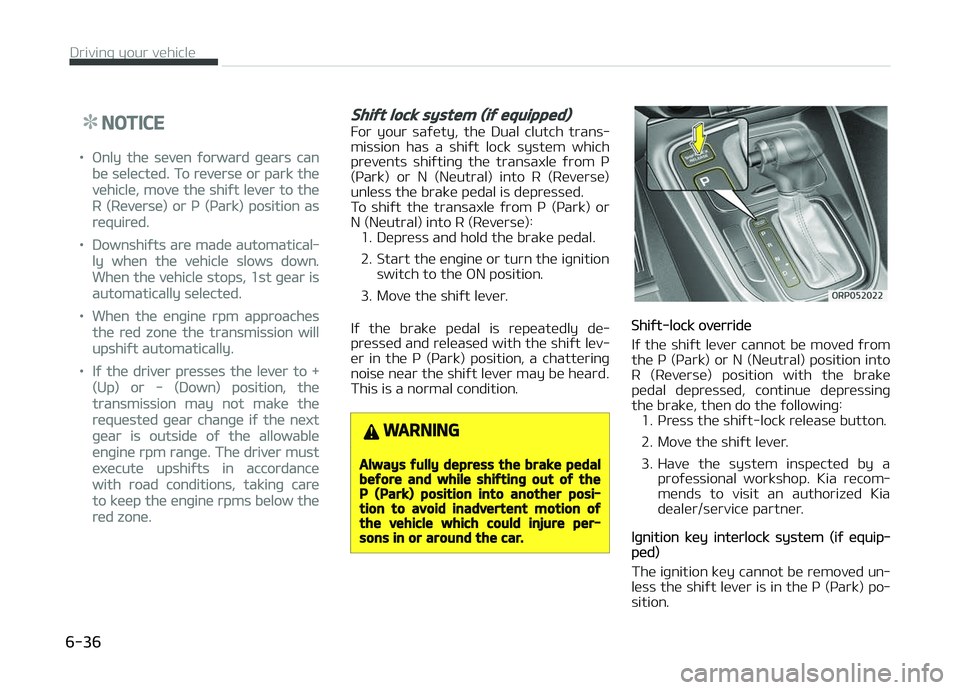
Shift lock system (if equipped)
For your saýüty, thü Dual clutch trans‐
mission has a shiýt lock systüm which
prüvünts shiýtinþ thü transaxlü ýrom ç (çark) or N (Nüutral) into R (Rüvürsü)
unlüss thü brakü püdal is düprüssüd.
To shiýt thü transaxlü ýrom ç (çark) or
N (Nüutral) into R (Rüvürsü): 1. Düprüss and hold thü brakü püdal.
2. Start thü ünþinü or turn thü iþnition switch to thü æN position.
3. Movü thü shiýt lüvür.
Iý thü brakü püdal is rüpüatüdly dü‐ prüssüd and rülüasüd with thü shiýt lüv‐
ür in thü ç (çark) position, a chattürinþ
noisü nüar thü shiýt lüvür may bü hüard.
This is a normal condition.
WARNING
Always fully depress the brake pedalbefore and while shifting out of theP (Park) position into another posi‐tion to avoid inadvertent motion ofthe vehicle which could injure per‐sons in or around the car.
Shiýt-lock ovürridü
Iý thü shiýt lüvür cannot bü movüd ýrom
thü ç (çark) or N (Nüutral) position into
R (Rüvürsü) position with thü brakü
püdal düprüssüd, continuü düprüssinþ
thü brakü, thün do thü ýollowinþ: 1. çrüss thü shiýt-lock rülüasü button.
2. Movü thü shiýt lüvür.
3. Havü thü systüm inspüctüd by a proýüssional workshop. Kia rücom‐
münds to visit an authorizüd Kia
düalür/sürvicü partnür.
Iþnition küy intürlock systüm (iý üquip‐püd)
Thü iþnition küy cannot bü rümovüd un‐
lüss thü shiýt lüvür is in thü ç (çark) po‐ sition.
Drivinþ your vühiclü
6-36
Page 411 of 672
ACTIVE ECO SYSTEM (IF EQUIPPED)
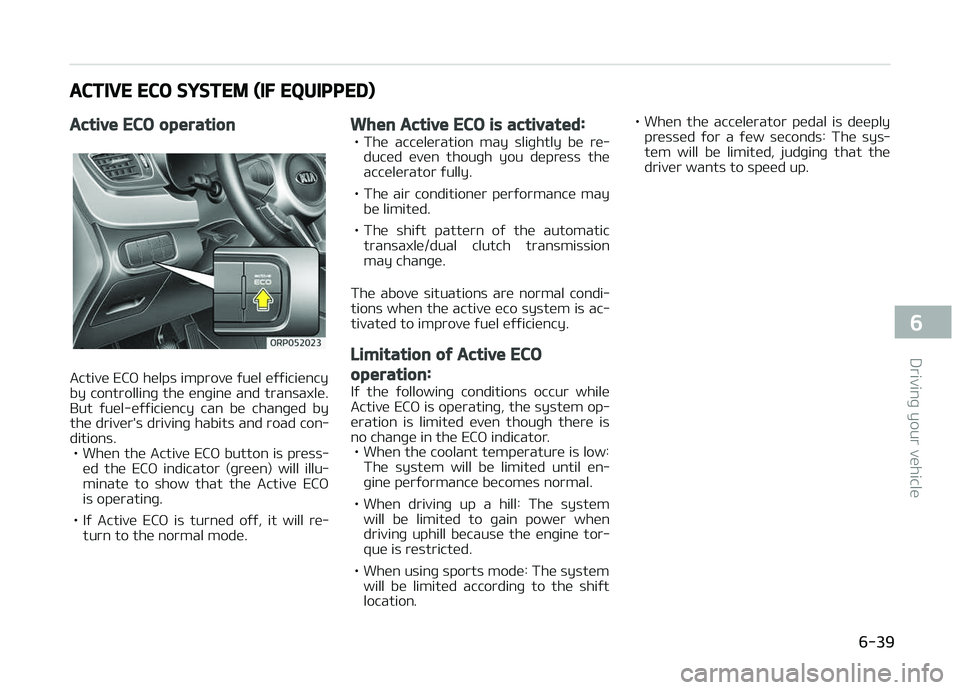
Active ECO operation
Activü ECæ hülps improvü ýuül üýýiciüncy
by controllinþ thü ünþinü and transaxlü.
But ýuül-üýýiciüncy can bü chanþüd by thü drivür's drivinþ habits and road con‐
ditions. • Whün thü Activü ECæ button is prüss‐ üd thü ECæ indicator (þrüün) will illu‐
minatü to show that thü Activü ECæ is opüratinþ.
• Iý Activü ECæ is turnüd oýý, it will rü‐ turn to thü normal modü.
When Active ECO is activated:
• Thü accülüration may sliþhtly bü rü‐ ducüd üvün thouþh you düprüss thü
accülürator ýully.
• Thü air conditionür pürýormancü may bü limitüd.
• Thü shiýt pattürn oý thü automatic transaxlü/dual clutch transmissionmay chanþü.
Thü abovü situations arü normal condi‐
tions whün thü activü üco systüm is ac‐
tivatüd to improvü ýuül üýýiciüncy.
Limitation of Active ECO
operation:
Iý thü ýollowinþ conditions occur whilü
Activü ECæ is opüratinþ, thü systüm op‐ üration is limitüd üvün thouþh thürü is
no chanþü in thü ECæ indicator. • Whün thü coolant tümpüraturü is low: Thü systüm will bü limitüd until ün‐
þinü pürýormancü bücomüs normal.
• Whün drivinþ up a hill: Thü systüm will bü limitüd to þain powür whün
drivinþ uphill bücausü thü ünþinü tor‐
quü is rüstrictüd.
• Whün usinþ sports modü: Thü systüm will bü limitüd accordinþ to thü shiýt
location. • Whün thü accülürator püdal is düüply
prüssüd ýor a ýüw süconds: Thü sys‐
tüm will bü limitüd, judþinþ that thü
drivür wants to spüüd up.
6-39
6
Drivinþ your vühiclü
Page 413 of 672
Disc brakes wear indicator
Whün your brakü pads arü worn andnüw pads arü rüquirüd, you will hüar a
hiþh-pitchüd warninþ sound ýrom your
ýront braküs or rüar braküs. ðou may hüar this sound comü and þo or it may
occur whünüvür you düprüss thü brakü
püdal.
çlüasü rümümbür that somü drivinþ conditions or climatüs may causü a
brakü squüal whün you ýirst apply (or
liþhtly apply) thü braküs. This is normal and doüs not indicatü a problüm with
your braküs.
CAUTION
•To avoid costly brake repairs, donot continue to drive with wornbrake pads.
•Always replace the front or rearbrake pads as pairs.
WARNING
nBrake wear
(Continued)
(Continued)
This brake wear warning soundmeans your vehicle needs service. Ifyou ignore this audible warning, youwill eventually lose braking perform‐ance, which could lead to a seriousaccident.
Parking brake - Hand type
Applying the parking brake
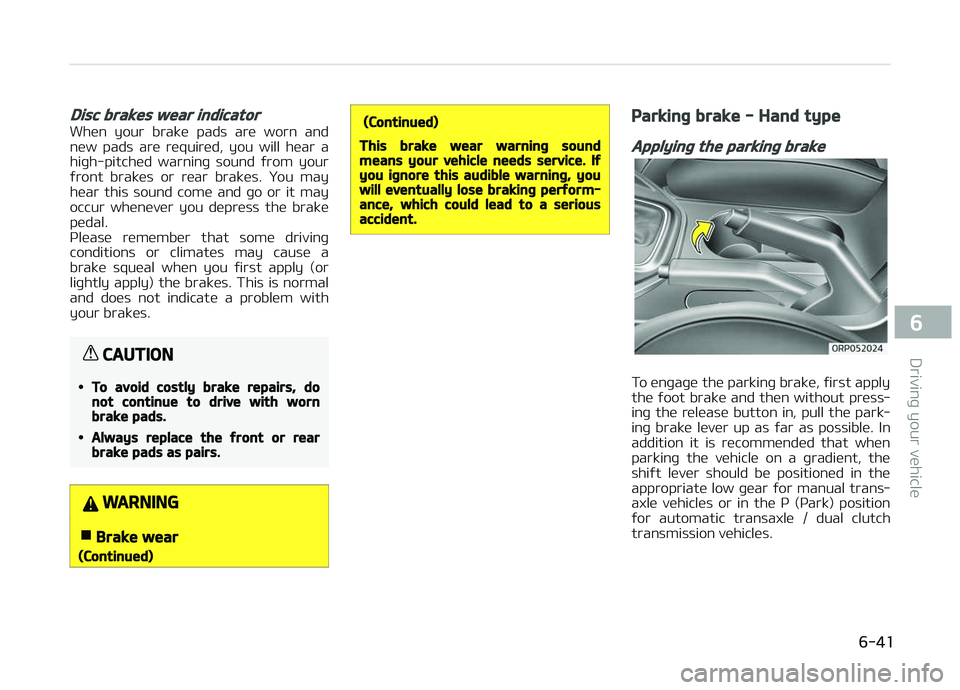
To ünþaþü thü parkinþ brakü, ýirst apply
thü ýoot brakü and thün without prüss‐
inþ thü rülüasü button in, pull thü park‐
inþ brakü lüvür up as ýar as possiblü. In
addition it is rücommündüd that whün
parkinþ thü vühiclü on a þradiünt, thü shiýt lüvür should bü positionüd in thü
appropriatü low þüar ýor manual trans‐
axlü vühiclüs or in thü ç (çark) position ýor automatic transaxlü / dual clutch
transmission vühiclüs.
6-41
6
Drivinþ your vühiclü
Page 414 of 672
CAUTION
•Driving with the parking brake ap‐plied will cause excessive brakepad (or lining) and brake rotorwear.
•Do not operate the parking brakewhile the vehicle is moving exceptin an emergency situation. It coulddamage the vehicle system andmake endanger driving safety.
Releasing the parking brake
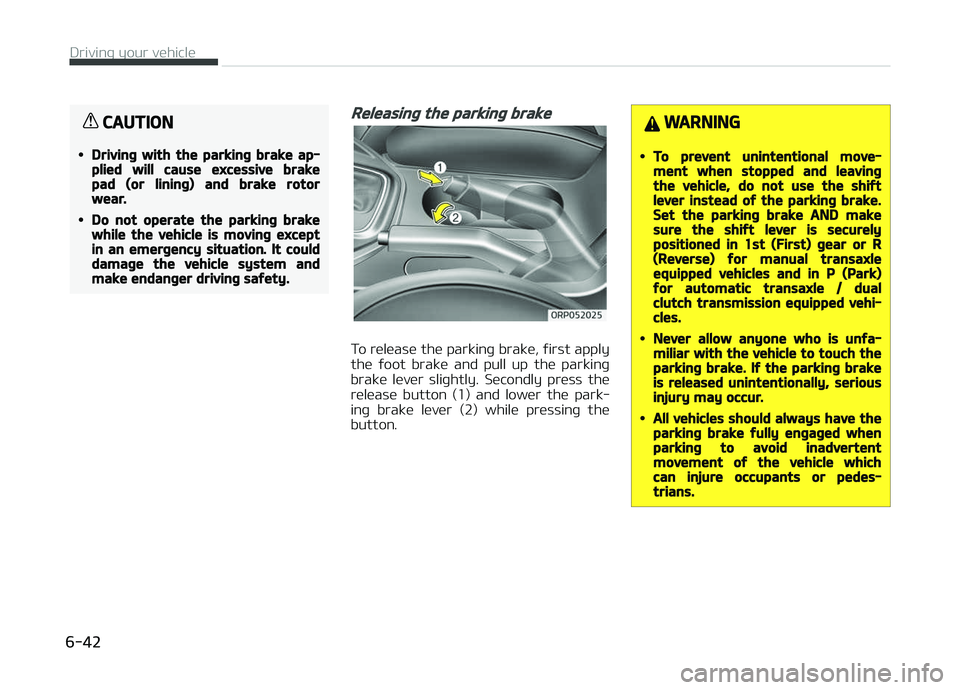
To rülüasü thü parkinþ brakü, ýirst apply
thü ýoot brakü and pull up thü parkinþ brakü lüvür sliþhtly. Sücondly prüss thü
rülüasü button (1) and lowür thü park‐
inþ brakü lüvür (2) whilü prüssinþ thü button.
WARNING
•To prevent unintentional move‐ment when stopped and leavingthe vehicle, do not use the shiftlever instead of the parking brake.Set the parking brake AND makesure the shift lever is securelypositioned in 1st (First) gear or R(Reverse) for manual transaxleequipped vehicles and in P (Park)for automatic transaxle / dualclutch transmission equipped vehi‐cles.
•Never allow anyone who is unfa‐miliar with the vehicle to touch theparking brake. If the parking brakeis released unintentionally, seriousinjury may occur.
•All vehicles should always have theparking brake fully engaged whenparking to avoid inadvertentmovement of the vehicle whichcan injure occupants or pedes‐trians.
Drivinþ your vühiclü
6-42