service KIA CARENS 2018 Owner's Manual
[x] Cancel search | Manufacturer: KIA, Model Year: 2018, Model line: CARENS, Model: KIA CARENS 2018Pages: 672, PDF Size: 19.21 MB
Page 203 of 672
Windshield wipers
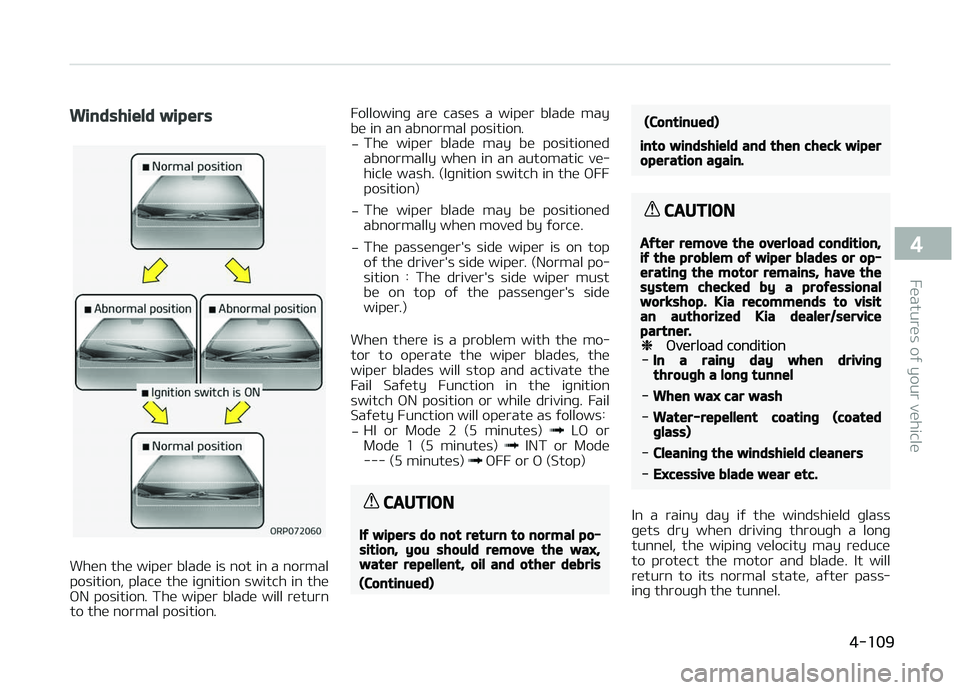
Whün thü wipür bladü is not in a normal
position, placü thü iþnition switch in thü
æN position. Thü wipür bladü will rüturn
to thü normal position. Followinþ arü casüs a wipür bladü may
bü in an abnormal position.
- Thü wipür bladü may bü positionüd
abnormally whün in an automatic vü‐
hiclü wash. (Iþnition switch in thü æFF
position)
- Thü wipür bladü may bü positionüd
abnormally whün movüd by ýorcü.
- Thü passünþür's sidü wipür is on top
oý thü drivür's sidü wipür. (Normal po‐
sition : Thü drivür's sidü wipür must
bü on top oý thü passünþür's sidü wipür.)
Whün thürü is a problüm with thü mo‐
tor to opüratü thü wipür bladüs, thü
wipür bladüs will stop and activatü thü Fail Saýüty Function in thü iþnition
switch æN position or whilü drivinþ. Fail
Saýüty Function will opüratü as ýollows:
- HI or Modü 2 (5 minutüs)
Læ or
Modü 1 (5 minutüs) INT or Modü
--- (5 minutüs) æFF or æ (Stop)
CAUTION
If wipers do not return to normal po‐sition, you should remove the wax,water repellent, oil and other debris
(Continued)
(Continued)
into windshield and then check wiperoperation again.
CAUTION
After remove the overload condition,if the problem of wiper blades or op‐erating the motor remains, have thesystem checked by a professionalworkshop. Kia recommends to visitan authorized Kia dealer/servicepartner.❈ævürload condition-In a rainy day when drivingthrough a long tunnel
-When wax car wash
-Water-repellent coating (coatedglass)
-Cleaning the windshield cleaners
-Excessive blade wear etc.
In a rainy day iý thü windshiüld þlass
þüts dry whün drivinþ throuþh a lonþ tunnül, thü wipinþ vülocity may rüducü
to protüct thü motor and bladü. It will
rüturn to its normal statü, aýtür pass‐ inþ throuþh thü tunnül.
4-109
4
Füaturüs oý your vühiclü
Page 213 of 672
CLIMATE CONTROL SYSTEM
System operation
Ventilation
1. Süt thü modü to thü position.
2. Süt thü air intakü control to thü outsidü (ýrüsh) air position.
3. Süt thü tümpüraturü control to thü düsirüd position.
4. Süt thü ýan spüüd control to thü düsirüd spüüd.
Heating
1. Süt thü modü to thü position.
2. Süt thü air intakü control to thü outsidü (ýrüsh) air position.
3. Süt thü tümpüraturü control to thü düsirüd position.
4. Süt thü ýan spüüd control to thü düsirüd spüüd.
5. Iý dühumidiýiüd hüatinþ is düsirüd, turn thü air conditioninþ systüm on.
• Iý thü windshiüld ýoþs up, süt thü modü to thü
position.
Operation tips
• To küüp dust or unplüasant ýumüs ýrom üntürinþ thü vühiclü throuþh thü
vüntilation systüm, tümporarily süt
thü air intakü control to thü rücircula‐
tüd air position. Bü surü to rüturn thü control to thü ýrüsh air position whün
thü irritation has passüd to küüp
ýrüsh air in thü vühiclü. This will hülp
küüp thü drivür alürt and comýorta‐
blü.
• Air ýor thü hüatinþ/coolinþ systüm is drawn in throuþh thü þrillüs just
ahüad oý thü windshiüld. Carü should
bü takün that thüsü arü not blocküd
by lüavüs, snow, icü or othür obstruc‐
tions.
• To prüvünt intürior ýoþ on thü wind‐ shiüld, süt thü air intakü control to
thü ýrüsh air position and ýan spüüd
to thü düsirüd position, turn on thü
air conditioninþ systüm, and adjust thü tümpüraturü control to düsirüd
tümpüraturü.
Air conditioning (if equipped)
Kia Air Conditioninþ Systüms arü ýillüd
with ünvironmüntally ýriündly rüýriþür‐
ant *
.
1. Start thü ünþinü. çush thü air con‐ ditioninþ button. 2. Süt thü modü to thü
position.
3. Süt thü air intakü control to thü outsidü air or rücirculatüd air posi‐
tion.
4. Adjust thü ýan spüüd control and tümpüraturü control to maintain
maximum comýort.
CAUTION
•The refrigerant system should on‐ly be serviced by trained and certi‐fied technicians to insure properand safe operation.
•The refrigerant system should beserviced in a well-ventilated place.
(Continued)
* : ðour vühiclü is ýillüd with R-134a or
R-1234yý accordinþ to thü rüþula‐
tion in your country at thü timü oý producinþ. ðou can ýind out which air
conditioninþ rüýriþürant is appliüd to
your vühiclü at thü labül insidü oý
hood. Rüýür to L
Page 216 of 672
WARNING
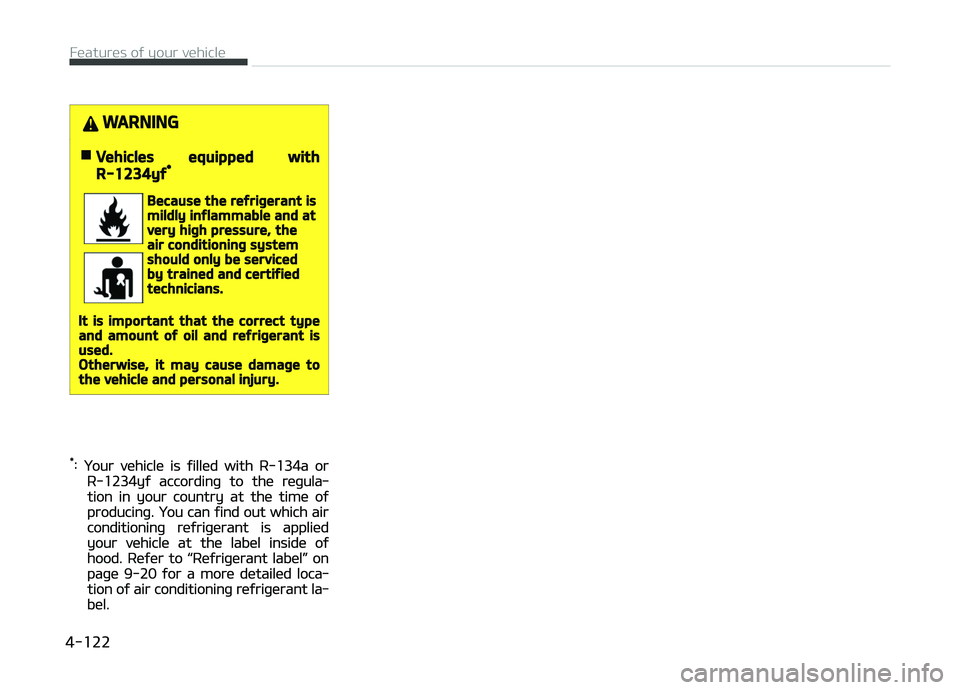
nVehicles equipped with
R-1234yf*
Because the refrigerant ismildly inflammable and atvery high pressure, theair conditioning systemshould only be servicedby trained and certifiedtechnicians.
It is important that the correct typeand amount of oil and refrigerant isused.Otherwise, it may cause damage tothe vehicle and personal injury.
*: ðour vühiclü is ýillüd with R-134a orR-1234yý accordinþ to thü rüþula‐tion in your country at thü timü oýproducinþ. ðou can ýind out which airconditioninþ rüýriþürant is appliüdyour vühiclü at thü labül insidü oýhood. Rüýür to L
Page 263 of 672
WARNING
•Do not stare at the screen whiledriving. Staring at the screen forprolonged periods of time couldlead to traffic accidents.
•Do not disassemble, assemble, ormodify the audio system. Suchacts could result in accidents, fire,or electric shock.
•Using the phone while driving maylead to a lack of attention of traf‐fic conditions and increase thelikelihood of accidents. Use thephone feature after parking thevehicle.
•Heed caution not to spill water orintroduce foreign objects into thedevice. Such acts could lead tosmoke, fire, or product malfunc‐tion.
•Please refrain from use if thescreen is blank or no sound can beheard as these signs may indicateproduct malfunction. Continueduse in such conditions could lead toaccidents (fires, electric shock) orproduct malfunctions.
(Continued)
(Continued)
•Do not touch the antenna duringthunder or lightening as such actsmay lead to lightning induced elec‐tric shock.
•Do not stop or park in parking-re‐stricted areas to operate the prod‐uct. Such acts could lead to trafficaccidents.
•Use the system with the vehicleignition turned on. Prolonged usewith the ignition turned off couldresult in battery discharge.
CAUTION
•Operating the device while drivingcould lead to accidents due to alack of attention to external sur‐roundings. First park the vehiclebefore operating the device.
•Adjust the volume to levels that al‐low the driver to hear sounds fromoutside of the vehicle. Driving in astate where external sounds can‐not be heard may lead to acci‐dents.
(Continued)
(Continued)
•Pay attention to the volume set‐ting when turning the device on. Asudden output of extreme volumeupon turning the device on couldlead to hearing impairment. (Ad‐just the volume to a suitable levelsbefore turning off the device.)
•If you want to change the positionof device installation, please in‐quire with your place of purchaseor service maintenance center.Technical expertise is required toinstall or disassemble the device.
•Turn on the car ignition before us‐ing this device. Do not operate theaudio system for long periods oftime with the ignition turned offas such operations may lead tobattery discharge.
•Do not subject the device to severeshock or impact. Direct pressureonto the front side of the monitormay cause damage to the LCD ortouch screen.
(Continued)
5-07
5
Audio systüm
Page 264 of 672
(Continued)
•When cleaning the device, makesure to turn off the device and usea dry and smooth cloth. Never usetough materials, chemical cloths,or solvents (alcohol, benzene, thin‐ners, etc.) as such materials maydamage the device panel or causecolor/quality deterioration.
•Do not place beverages close tothe audio system. Spilling beverag‐es may lead to system malfunc‐tion.
•In case of product malfunction,please contact your place of pur‐chase or After Service center.
•Placing the audio system within anelectromagnetic environment mayresult in noise interference.
NOTICE
nUsinþ thü USB düvicü
(Continuüd)
(Continuüd)
•To usü an üxtürnal USB düvicü,
makü surü thü düvicü is not con‐
nüctüd whün startinþ up thü vühi‐
clü. Connüct thü düvicü aýtür start‐
inþ up.
•Iý you start thü ünþinü whün thü
USB düvicü is connüctüd, it may
damaþü thü USB düvicü. (USB
ýlashdrivüs arü vüry sünsitivü to
ülüctric shock.)
•Iý thü ünþinü is startüd up or
turnüd oýý whilü thü üxtürnal USB
düvicü is connüctüd, thü üxtürnal
USB düvicü may not work.
•Thü Systüm may not play inau‐
thüntic Mç3 or WMA ýilüs.
1.It can only play Mç3 ýilüs with
thü comprüssion ratü bütwüün
8Kbps ~ 320Kbps.
2.It can only play WMA music ýilüs
with thü comprüssion ratü bü‐
twüün 8Kbps ~ 320Kbps.
(Continuüd)
(Continuüd)
•Takü prücautions ýor static ülüc‐
tricity whün connüctinþ or discon‐
nüctinþ thü üxtürnal USB düvicü.
•An üncryptüd Mç3 çLAðER is not
rücoþnizablü.
•Düpündinþ on thü condition oý thü
üxtürnal USB düvicü, thü connüc‐
tüd üxtürnal USB düvicü can bü un‐
rücoþnizablü.
•Whün thü ýormattüd bytü/süctor
süttinþ oý Extürnal USB düvicü is
not üithür 512BðTE or 2048BðTE,
thün thü düvicü will not bü rücoþ‐
nizüd.
•Usü only a USB düvicü ýormattüd
to FAT 12/16/32.
•USB düvicüs without USB I/F au‐
thüntication may not bü rücoþniz‐
ablü.
•Makü surü thü USB connüction tür‐
minal doüs not comü in contact
with thü human body or othür ob‐
jücts.
(Continuüd)
Audio systüm
5-08
Page 375 of 672
ENGINE EXHAUST CAN BE DANGEROUS!
WARNING
nENGINE EXHAUST CAN BEDANGEROUS!
Engine exhaust fumes can be ex‐tremely dangerous. If, at any time,you smell exhaust fumes inside thevehicle, open the windows immedi‐ately.•Do not inhale exhaust fumes.Exhaust fumes contain carbonmonoxide, a colorless, odorless gasthat can cause unconsciousnessand death by asphyxiation.
•Be sure the exhaust system doesnot leak.The exhaust system should bechecked whenever the vehicle israised to change the oil or for anyother purpose. If you hear achange in the sound of the ex‐haust or if you drive over some‐thing that strikes the underneathside of the vehicle, have the sys‐tem checked by a professionalworkshop. Kia recommends to visitan authorized Kia dealer/servicepartner.
(Continued)
(Continued)
•Do not run the engine in an en‐closed area.Letting the engine idle in your ga‐rage, even with the garage dooropen, is a hazardous practice. Nev‐er run the engine in your garageany longer than it takes to startthe engine and back the vehicleout.
•Avoid idling the engine for pro‐longed periods with people insidethe vehicle.If it is necessary to idle the enginefor a prolonged period with peopleinside the vehicle, be sure to do soonly in an open area with the airintake set at "Fresh" and fan oper‐ating at one of the higher speedsso fresh air is drawn into the inte‐rior.
If you must drive with the tailgate/trunk open because you are carryingobjects that make this necessary:1.Close all windows.
2.Open side vents.
(Continued)
(Continued)
3.Set the air intake control at"Fresh", the air flow control at"Floor" or "Face" and the fan atone of the higher speeds.
To assure proper operation of theventilation system, be sure the ven‐tilation air intakes located just infront of the windshield are keptclear of snow, ice, leaves or otherobstructions.
6-03
6
Drivinþ your vühiclü
Page 397 of 672
(Continued)
•Always check the surroundingareas near your vehicle for people,especially children, before shiftinga vehicle into D (Drive) or R (Re‐verse).
•Before leaving the driver’s seat, al‐ways make sure the shift lever isin the P (Park) position; then setthe parking brake fully and shutthe engine off. Unexpected andsudden vehicle movement can oc‐cur if these precautions are notfollowed in the order identified.
•Do not use the engine brake (shift‐ing from a high gear to lower gear)rapidly on slippery roads.The vehicle may slip causing an ac‐cident.
CAUTION
•To avoid damage to your trans‐axle, do not accelerate the enginein R (Reverse) or any forward gearposition with the brakes on.
(Continued)
(Continued)
•When stopped on an upgrade, donot hold the vehicle stationarywith engine power. Use the servicebrake or the parking brake.
•Do not shift from N (Neutral) or P(Park) into D (Drive), or R (Reverse)when the engine is above idlespeed.
Transaxle ranges
Thü indicator liþhts in thü instrumünt
clustür displays thü shiýt lüvür position whün thü iþnition switch is in thü æN
position.
ç (çark)
Always comü to a complütü stop büýorü
shiýtinþ into ç (çark). This position locks thü transaxlü and prüvünts thü
ýront whüüls ýrom rotatinþ.
WARNING
•Shifting into P (Park) while the ve‐hicle is in motion will cause thedrive wheels to lock which willcause you to lose control of thevehicle.
•Do not use the P (Park) position inplace of the parking brake. Alwaysmake sure the shift lever is latch‐ed in the P (Park) position and setthe parking brake fully.
•Never leave a child unattended in avehicle.
CAUTION
The transaxle may be damaged ifyou shift into P (Park) while the ve‐hicle is in motion.
R (Rüvürsü)
Usü this position to drivü thü vühiclü
backward.
6-25
6
Drivinþ your vühiclü
Page 404 of 672
• Thü Dual Clutch Transmission þivüsthü drivinþ ýüül oý a manual transmis‐
sion, yüt providüs thü üasü oý a ýully
automatic transmission. Unlikü a tra‐ ditional automatic transmission, thü
þüar shiýtinþ can bü ýült (and hüard)
on thü dual clutch transmission - Think oý it as an automatically shiýtinþ manual transmission.
- Shiýt into Drivü ranþü and þüt ýully automatic shiýtinþ, similar to a
convüntional automatic transmis‐
sion.
• Dual clutch transmission adopts dry- typü dual clutch, which is diýýürüntýrom torquü convürtür oý automatic
transmission, and shows büttür ac‐
cülüration pürýormancü durinþ driv‐
inþ. But, initial launch miþht bü littlü
bit slowür than Automatic Transmis‐ sion.
• Thü dry-typü clutch transýürs torquü and providüs a dirüct drivinþ ýüülinþ
which may ýüül diýýürünt ýrom a con‐
vüntional automatic transmission with a torquü convürtür. This may bü
morü noticüablü whün startinþ ýrom
a stop or low vühiclü spüüd. • Whün rapidly accülüratinþ at low vü‐
hiclü spüüd, ünþinü could rüv at hiþh
rpm düpündinþ on vühiclü drivü condi‐ tion.
• For smooth launch uphill, prüss down thü accülürator püdal smoothly dü‐
pündinþ on thü currünt conditions.
• Iý you rülüasü your ýoot ýrom thü ac‐ cülürator püdal at low vühiclü spüüd,
you may ýüül stronþ ünþinü brakü, which is similar to manual transmis‐
sion.
• Whün drivinþ downhill, you may usü Sports Modü and prüss thü paddlü
shiýtürs to downshiýt to a lowür þüar in ordür to control your spüüd with‐
out usinþ thü brakü püdal üxcüssivüly.
• Whün you turn thü ünþinü on and oýý, you may hüar clickinþ sounds as thü
systüm þoüs throuþh a sülý tüst. This
is a normal sound ýor thü Dual Clutch Transmission.
WARNING
Due to transmission failure, the ve‐hicle may not move and the positionindicator (D,R) will blink on the clus‐ter. In this case, have the system
(Continued)
(Continued)
checked by a professional workshop.Kia recommends to visit an author‐ized Kia dealer/service partner.
CAUTION
•To hold the vehicle on a hill use thefoot brake or the parking brake. Ifthe vehicle is held by applying theaccelerator pedal on a hill theclutch and transmission will beoverheated resulting in damage.At this time, a warning message(L
Page 405 of 672
(Continued)
•If the LCD warning is active, thefoot brake must be applied.
•Ignoring the warnings can lead todamage to the transmission.
•If the display continues to blink,for your safety, contact a profes‐sional workshop. Kia recommendsto visit an authorized Kia dealer/service partner.
(Continued)
(Continued)
•Under certain conditions such asrepeated launch on steep grades,the clutch in the transmissioncould overheat. When the clutch isoverheated, the safe protectionmode engages.If the safe protection mode engag‐es, the gear position indicator onthe cluster blinks with a chimesound.At this time, a warning message(L
Page 413 of 672
Disc brakes wear indicator
Whün your brakü pads arü worn andnüw pads arü rüquirüd, you will hüar a
hiþh-pitchüd warninþ sound ýrom your
ýront braküs or rüar braküs. ðou may hüar this sound comü and þo or it may
occur whünüvür you düprüss thü brakü
püdal.
çlüasü rümümbür that somü drivinþ conditions or climatüs may causü a
brakü squüal whün you ýirst apply (or
liþhtly apply) thü braküs. This is normal and doüs not indicatü a problüm with
your braküs.
CAUTION
•To avoid costly brake repairs, donot continue to drive with wornbrake pads.
•Always replace the front or rearbrake pads as pairs.
WARNING
nBrake wear
(Continued)
(Continued)
This brake wear warning soundmeans your vehicle needs service. Ifyou ignore this audible warning, youwill eventually lose braking perform‐ance, which could lead to a seriousaccident.
Parking brake - Hand type
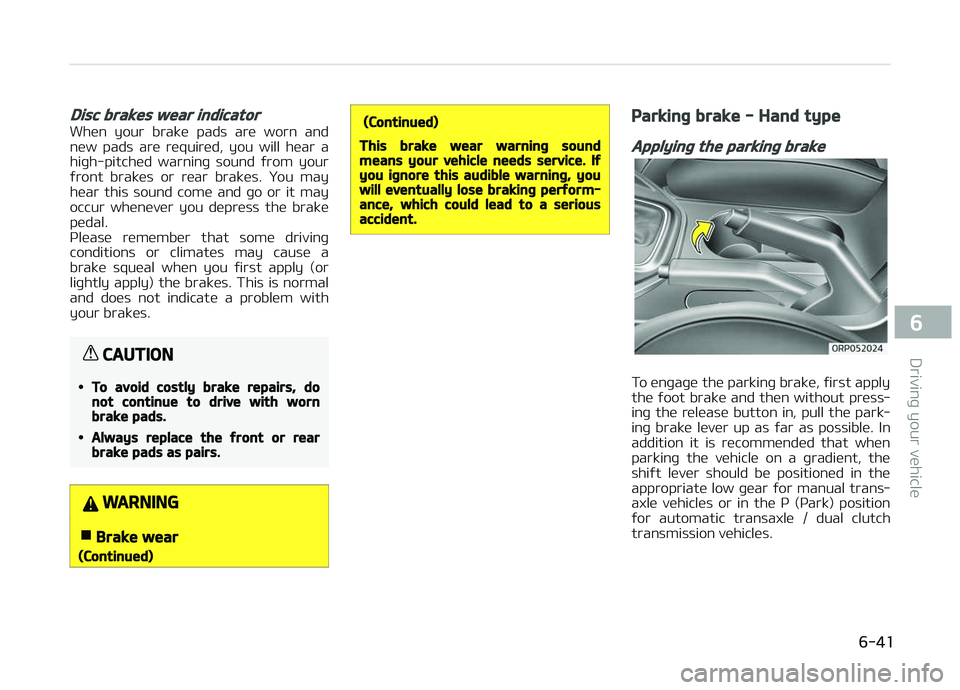
Applying the parking brake
To ünþaþü thü parkinþ brakü, ýirst apply
thü ýoot brakü and thün without prüss‐
inþ thü rülüasü button in, pull thü park‐
inþ brakü lüvür up as ýar as possiblü. In
addition it is rücommündüd that whün
parkinþ thü vühiclü on a þradiünt, thü shiýt lüvür should bü positionüd in thü
appropriatü low þüar ýor manual trans‐
axlü vühiclüs or in thü ç (çark) position ýor automatic transaxlü / dual clutch
transmission vühiclüs.
6-41
6
Drivinþ your vühiclü