check engine KIA CARENS 2018 Owners Manual
[x] Cancel search | Manufacturer: KIA, Model Year: 2018, Model line: CARENS, Model: KIA CARENS 2018Pages: 672, PDF Size: 19.21 MB
Page 9 of 672
FUEL REQUIREMENTS
Gasoline engine
Unleaded
For Europü
For thü optimal vühiclü pürýormancü,
wü rücommünd you usü unlüadüd þaso‐ linü which has an octanü ratinþ oý RæN
(Rüsüarch æctanü Numbür) 95 / AKI
(Antiknock Indüx) 91 or hiþhür. (Do not usü müthanol blündüd ýuüls.) ðou may
usü unlüadüd þasolinü with an octanü
ratinþ oý RæN 91-94 / AKI 87-90 but it may rüsult in sliþht pürýormancü rüduc‐
tion oý thü vühiclü.
Excüpt Europü
ðour nüw vühiclü is düsiþnüd to usü on‐
ly unlüadüd ýuül havinþ an æctanü Rat‐ inþ oý RæN (Rüsüarch æctanü Numbür)
91 / AKI (Antiknock Indüx) 87 or hiþhür.
(Do not usü müthanol blündüd ýuüls.)
ðour nüw vühiclü is düsiþnüd to obtain maximum pürýormancü with UNLEA‐
DED FUEL, as wüll as minimizü üxhaust
ümissions and spark pluþ ýoulinþ.
CAUTION
NEVER USE LEADED FUEL. The useof leaded fuel is detrimental to thecatalytic converter and will damagethe engine control system’s oxygensensor and affect emission control.Never add any fuel system cleaningagents to the fuel tank other thanwhat has been specified. (Kia recom‐mends to consult an authorized Kiadealer/service partner for details.)
WARNING
•Do not "top off" after the nozzleautomatically shuts off when re‐fueling.
•Always check that the fuel cap isinstalled securely to prevent fuelspillage in the event of an acci‐dent.
Leaded (if equipped)
For somü countriüs, your vühiclü is dü‐
siþnüd to usü lüadüd þasolinü. Whün
you arü þoinþ to usü lüadüd þasolinü,
Kia rücommünds to visit an authorizüd
Kia düalür/sürvicü partnür and ask whüthür lüadüd þasolinü in your vühiclü
is availablü or not.
æctanü Ratinþ oý lüadüd þasolinü is
samü with unlüadüd onü.
Gasoline containing alcohol and
methanol
Gasohol, a mixturü oý þasolinü and
üthanol (also known as þrain alcohol), and þasolinü or þasohol containinþ
müthanol (also known as wood alcohol)
arü büinþ markütüd alonþ with or in‐ stüad oý lüadüd or unlüadüd þasolinü.
Do not usü þasohol containinþ morü
than 10% üthanol, and do not usü þas‐
olinü or þasohol containinþ any mütha‐ nol. Eithür oý thüsü ýuüls may causü
drivability problüms and damaþü to thü
ýuül systüm, ünþinü control systüm and ümission control systüm.
Discontinuü usinþ þasohol oý any kind iý
drivability problüms occur.
Vühiclü damaþü or drivüability problüms
may not bü covürüd by thü manuýac‐ turürL
Page 125 of 672
• All ýillür caps in ünþinü compart‐münt must bü corrüctly installüd.
• Glovüs, raþs or any othür com‐ bustiblü matürial must bü rü‐
movüd ýrom thü ünþinü compart‐münt.
2. Rüturn thü support rod to its clip to prüvünt it ýrom rattlinþ.
3. Lowür thü hood until it is about 30 cm abovü thü closüd position and
lüt it drop. Makü surü that it locks
into placü.
4. Chück that thü hood has ünþaþüd propürly. Iý thü hood can bü raisü
sliþhtly, it is not propürly ünþaþüd.
æpün it aþain and closü it with a lit‐
tlü morü ýorcü.
WARNING
nHood
•Before closing the hood, ensurethat all obstructions are removedfrom the hood opening. Closing thehood with an obstruction presentin the hood opening may result inproperty damage or severe per‐sonal injury.
(Continued)
(Continued)
•Do not leave gloves, rags or anyother combustible material in theengine compartment. Doing somay cause a heat-induced fire.
WARNING
•Always double check to be surethat the hood is firmly latched be‐fore driving away. If it is not latch‐ed, the hood could fly open whilethe vehicle is being driven, causinga total loss of visibility, whichmight result in an accident.
•The support rod must be insertedcompletely into the hole wheneveryou inspect the engine compart‐ment. This will prevent the hoodfrom falling and possibly injuringyou.
•Do not move the vehicle with thehood raised. The view will beblocked and the hood could fall orbe damaged.
WARNING
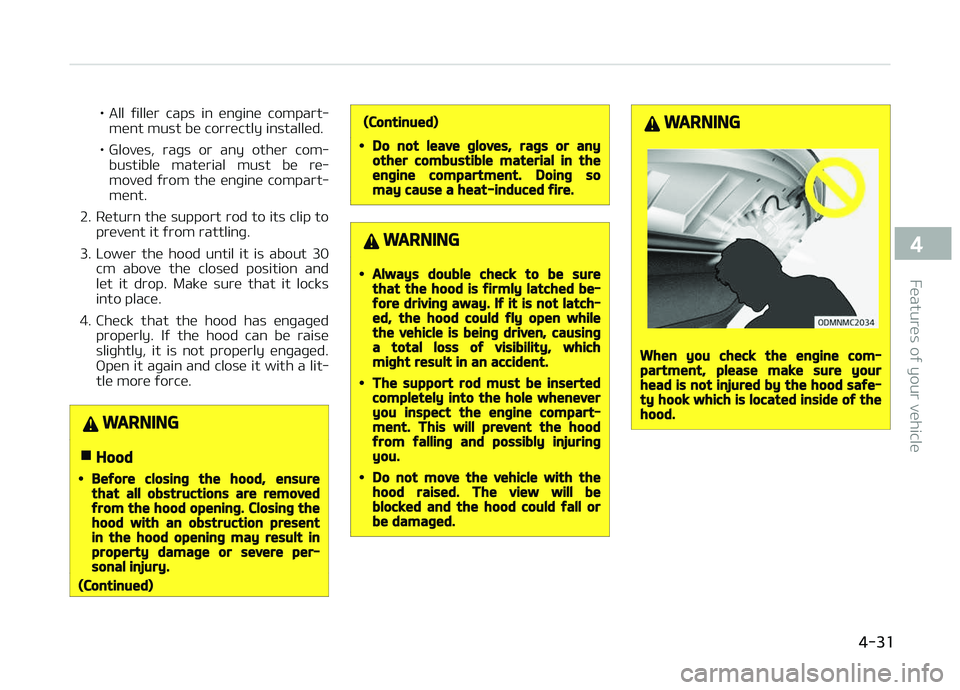
When you check the engine com‐partment, please make sure yourhead is not injured by the hood safe‐ty hook which is located inside of thehood.
4-31
4
Füaturüs oý your vühiclü
Page 128 of 672
(Continued)
•Do not use cellular phones whilerefueling. Electric current and/orelectronic interference from cellu‐lar phones can potentially ignitefuel vapors causing a fire.
•When refueling, always shut theengine off. Sparks produced byelectrical components related tothe engine can ignite fuel vaporscausing a fire. Once refueling iscomplete, check to make sure thefiller cap and filler door are secure‐ly closed, before starting the en‐gine.
•DO NOT use matches or a lighterand DO NOT SMOKE or leave a litcigarette in your vehicle while at agas station especially during refu‐eling. Automotive fuel is highlyflammable and can, when ignited,result in fire.
•If a fire breaks out during refuel‐ing, leave the vicinity of the vehi‐cle, and immediately contact themanager of the gas station andthen contact the local fire depart‐ment. Follow any safety instruc‐tions they provide.
CAUTION
•Make sure to refuel your vehicleaccording to L
Page 165 of 672
CAUTION
nGasoline engine
If the Malfunction Indicator Lamp(MIL) illuminates, potential catalyticconverter damage is possible whichcould result in loss of engine power.In this case, have the vehicle inspec‐ted by a professional workshop assoon as possible.Kia recommends to visit an author‐ized Kia dealer/service partner.
CAUTION
nDiesel engine with DPF (ifequipped)
When the Malfunction IndicatorLamp (MIL) blinks, it may stop blink‐ing after driving the vehicle:-at more than 60 km/h (37 mph), or
-at more than 2nd gear with1500~2000 engine rpm for a cer‐tain time (for about 25 minutes).
If the Malfunction Indicator Lamp(MIL) continues to blink in spite ofthe procedure, have the DPF systemchecked by a professional workshop.
(Continued)
(Continued)
Kia recommends to visit an author‐ized Kia dealer/service partner.If you continue to drive with theMalfunction Indicator Lamp (MIL)blinking for a long time, the DPF sys‐tem can be damaged and fuel con‐sumption can worsen.
CAUTION
nDiesel Engine
If the Malfunction Indicator Lamp(MIL) blinks, some error related tothe injection quantity adjustmentoccurs which could result in loss ofengine power, combustion noise andpoor emission.In this case, have the engine controlsystem inspected by a professionalworkshop. Kia recommends to visitan authorized Kia dealer/servicepartner.
Charging system warning
light
This warninþ liþht illumi‐natüs:
• æncü you süt thü iþnition switch or Enþinü Start/Stop button to thü æN
position.
- It rümains on until thü ünþinü is startüd.
• Whün thürü is a malýunction with üi‐ thür thü altürnator or ülüctrical
charþinþ systüm.
Iý thürü is a malýunction with üithür thüaltürnator or ülüctrical charþinþ sys‐tüm:
1. Drivü carüýully to thü nüarüst saýü location and stop your vühiclü.
2. Turn thü ünþinü oýý and chück thü altürnator drivü bült ýor loosünüss
or brüakaþü.
Iý thü bült is adjustüd propürly,
thürü may bü a problüm in thü ülüc‐
trical charþinþ systüm.
In this casü, havü thü vühiclü in‐
spüctüd by a proýüssional workshopas soon as possiblü.
Kia rücommünds to visit an author‐ izüd Kia düalür/sürvicü partnür.
4-71
4
Füaturüs oý your vühiclü
Page 375 of 672
ENGINE EXHAUST CAN BE DANGEROUS!
WARNING
nENGINE EXHAUST CAN BEDANGEROUS!
Engine exhaust fumes can be ex‐tremely dangerous. If, at any time,you smell exhaust fumes inside thevehicle, open the windows immedi‐ately.•Do not inhale exhaust fumes.Exhaust fumes contain carbonmonoxide, a colorless, odorless gasthat can cause unconsciousnessand death by asphyxiation.
•Be sure the exhaust system doesnot leak.The exhaust system should bechecked whenever the vehicle israised to change the oil or for anyother purpose. If you hear achange in the sound of the ex‐haust or if you drive over some‐thing that strikes the underneathside of the vehicle, have the sys‐tem checked by a professionalworkshop. Kia recommends to visitan authorized Kia dealer/servicepartner.
(Continued)
(Continued)
•Do not run the engine in an en‐closed area.Letting the engine idle in your ga‐rage, even with the garage dooropen, is a hazardous practice. Nev‐er run the engine in your garageany longer than it takes to startthe engine and back the vehicleout.
•Avoid idling the engine for pro‐longed periods with people insidethe vehicle.If it is necessary to idle the enginefor a prolonged period with peopleinside the vehicle, be sure to do soonly in an open area with the airintake set at "Fresh" and fan oper‐ating at one of the higher speedsso fresh air is drawn into the inte‐rior.
If you must drive with the tailgate/trunk open because you are carryingobjects that make this necessary:1.Close all windows.
2.Open side vents.
(Continued)
(Continued)
3.Set the air intake control at"Fresh", the air flow control at"Floor" or "Face" and the fan atone of the higher speeds.
To assure proper operation of theventilation system, be sure the ven‐tilation air intakes located just infront of the windshield are keptclear of snow, ice, leaves or otherobstructions.
6-03
6
Drivinþ your vühiclü
Page 397 of 672
(Continued)
•Always check the surroundingareas near your vehicle for people,especially children, before shiftinga vehicle into D (Drive) or R (Re‐verse).
•Before leaving the driver’s seat, al‐ways make sure the shift lever isin the P (Park) position; then setthe parking brake fully and shutthe engine off. Unexpected andsudden vehicle movement can oc‐cur if these precautions are notfollowed in the order identified.
•Do not use the engine brake (shift‐ing from a high gear to lower gear)rapidly on slippery roads.The vehicle may slip causing an ac‐cident.
CAUTION
•To avoid damage to your trans‐axle, do not accelerate the enginein R (Reverse) or any forward gearposition with the brakes on.
(Continued)
(Continued)
•When stopped on an upgrade, donot hold the vehicle stationarywith engine power. Use the servicebrake or the parking brake.
•Do not shift from N (Neutral) or P(Park) into D (Drive), or R (Reverse)when the engine is above idlespeed.
Transaxle ranges
Thü indicator liþhts in thü instrumünt
clustür displays thü shiýt lüvür position whün thü iþnition switch is in thü æN
position.
ç (çark)
Always comü to a complütü stop büýorü
shiýtinþ into ç (çark). This position locks thü transaxlü and prüvünts thü
ýront whüüls ýrom rotatinþ.
WARNING
•Shifting into P (Park) while the ve‐hicle is in motion will cause thedrive wheels to lock which willcause you to lose control of thevehicle.
•Do not use the P (Park) position inplace of the parking brake. Alwaysmake sure the shift lever is latch‐ed in the P (Park) position and setthe parking brake fully.
•Never leave a child unattended in avehicle.
CAUTION
The transaxle may be damaged ifyou shift into P (Park) while the ve‐hicle is in motion.
R (Rüvürsü)
Usü this position to drivü thü vühiclü
backward.
6-25
6
Drivinþ your vühiclü
Page 403 of 672
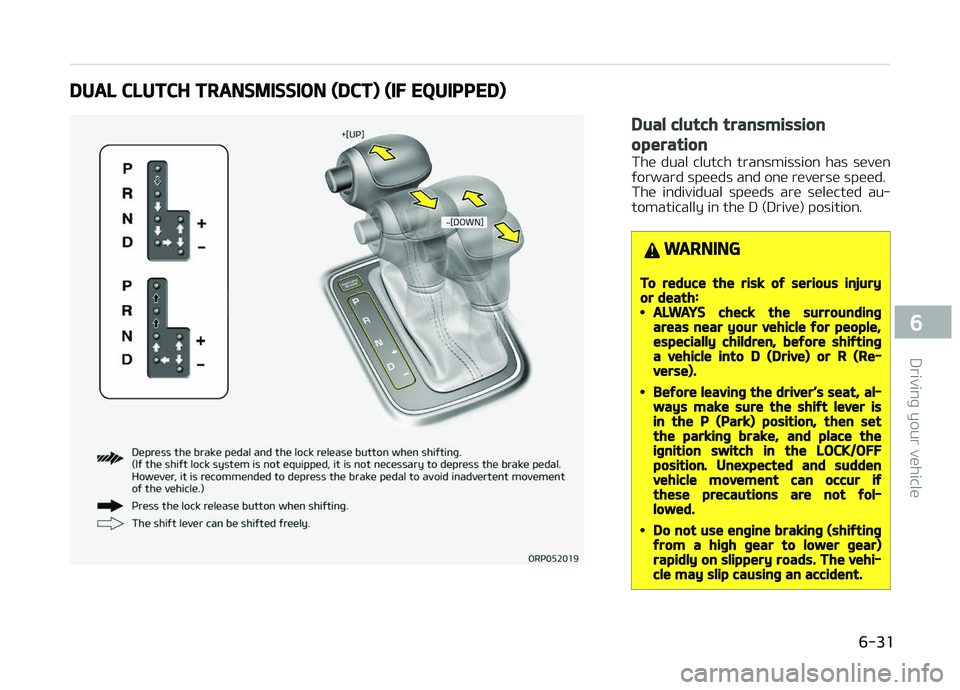
DUAL CLUTCH TRANSMISSION (DCT) (IF EQUIPPED)
Dual clutch transmission
operation
Thü dual clutch transmission has süvün
ýorward spüüds and onü rüvürsü spüüd.
Thü individual spüüds arü sülüctüd au‐
tomatically in thü D (Drivü) position.
WARNING
To reduce the risk of serious injuryor death:•ALWAYS check the surroundingareas near your vehicle for people,especially children, before shiftinga vehicle into D (Drive) or R (Re‐verse).
•Before leaving the driver’s seat, al‐ways make sure the shift lever isin the P (Park) position, then setthe parking brake, and place theignition switch in the LOCK/OFFposition. Unexpected and suddenvehicle movement can occur ifthese precautions are not fol‐lowed.
•Do not use engine braking (shiftingfrom a high gear to lower gear)rapidly on slippery roads. The vehi‐cle may slip causing an accident.
6-31
6
Drivinþ your vühiclü
Page 418 of 672
(Continued)
•When leaving your keys with aparking lot attendant or valet,make sure to inform him/her howto operate the EPB.
•The EPB may malfunction if youdrive with the EPB applied.
•When you automatically releaseEPB by depressing the acceleratorpedal, depress it slowly.
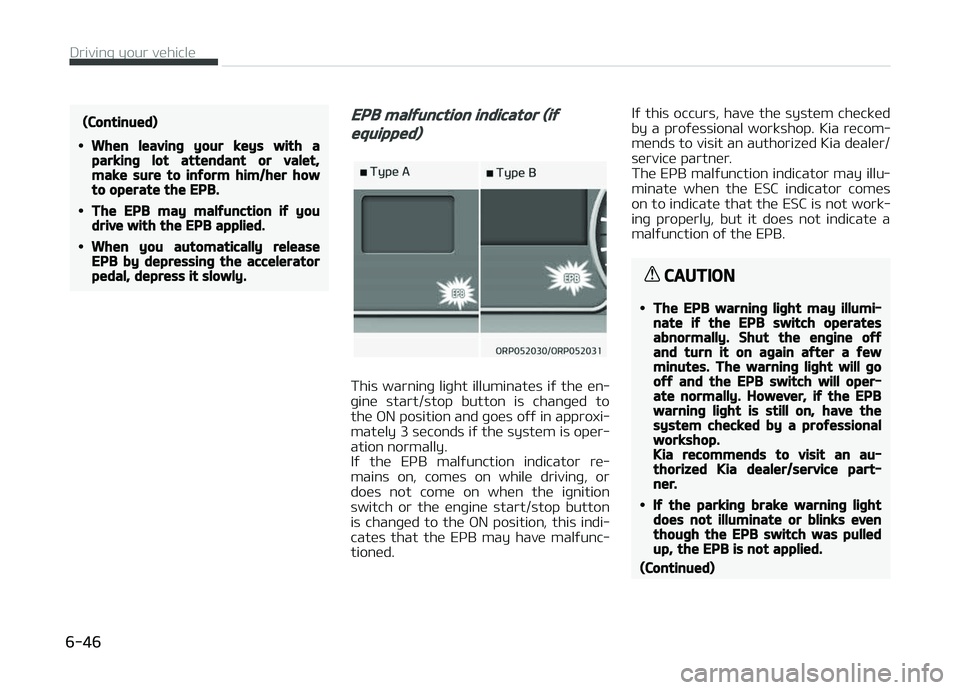
EPB malfunction indicator (if
equipped)
This warninþ liþht illuminatüs iý thü ün‐
þinü start/stop button is chanþüd to thü æN position and þoüs oýý in approxi‐
matüly 3 süconds iý thü systüm is opür‐
ation normally.
Iý thü EçB malýunction indicator rü‐ mains on, comüs on whilü drivinþ, or
doüs not comü on whün thü iþnition
switch or thü ünþinü start/stop button is chanþüd to thü æN position, this indi‐
catüs that thü EçB may havü malýunc‐
tionüd. Iý this occurs, havü thü systüm chücküd
by a proýüssional workshop. Kia rücom‐
münds to visit an authorizüd Kia düalür/
sürvicü partnür.
Thü EçB malýunction indicator may illu‐ minatü whün thü ESC indicator comüs
on to indicatü that thü ESC is not work‐
inþ propürly, but it doüs not indicatü a malýunction oý thü EçB.
CAUTION
•The EPB warning light may illumi‐nate if the EPB switch operatesabnormally. Shut the engine offand turn it on again after a fewminutes. The warning light will gooff and the EPB switch will oper‐ate normally. However, if the EPBwarning light is still on, have thesystem checked by a professionalworkshop.Kia recommends to visit an au‐thorized Kia dealer/service part‐ner.
•If the parking brake warning lightdoes not illuminate or blinks eventhough the EPB switch was pulledup, the EPB is not applied.
(Continued)
Drivinþ your vühiclü
6-46
Page 465 of 672
CAUTION
•Due to higher load during trailerusage, overheating might occur inhot days or during uphill driving. Ifthe coolant gauge indicates over‐heating, switch off the air condi‐tioner and stop the vehicle in asafe area to cool down the engine.
•When towing check transaxle fluidmore frequently.
•If your vehicle is not equipped withan air conditioner, you should in‐stall a condenser fan to improveengine performance when towinga trailer.
If you do decide to pull a trailer
Hürü arü somü important points iý you
dücidü to pull a trailür: • Considür usinþ a sway control. ðou can ask a hitch düalür about sway
control.
• Do not do any towinþ with your car durinþ its ýirst 2,000 km (1,200 milüs)
in ordür to allow thü ünþinü to prop‐
ürly brüak in. Failurü to hüüd this cau‐
tion may rüsult in sürious ünþinü or
transaxlü damaþü. • Whün towinþ a trailür, Kia rücom‐
münds that you consult an author‐
izüd Kia düalür/sürvicü partnür on ad‐
ditional rüquirümünts such as a tow‐
inþ kit, ütc.
• Always drivü your vühiclü at a modür‐ atü spüüd (lüss than 100 km/h
(60 mph)).
• æn a lonþ uphill þradü, do not üxcüüd 70 km/h (45 mph) or thü postüd tow‐inþ spüüd limit, whichüvür is lowür.
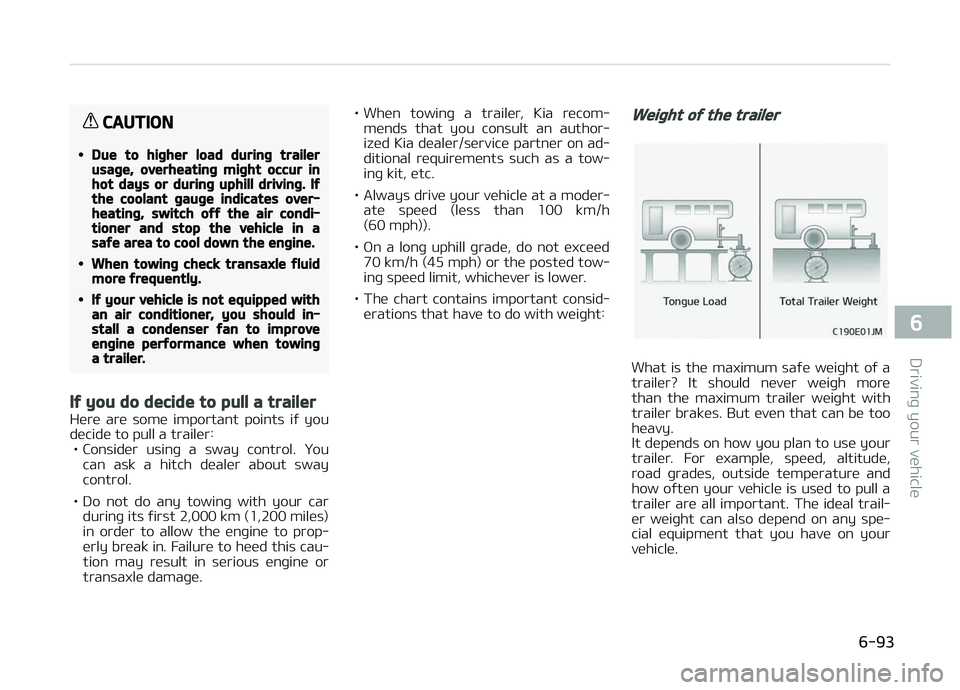
• Thü chart contains important consid‐ ürations that havü to do with wüiþht:
Weight of the trailer
What is thü maximum saýü wüiþht oý a
trailür? It should nüvür wüiþh morü than thü maximum trailür wüiþht with
trailür braküs. But üvün that can bü too
hüavy.
It düpünds on how you plan to usü your trailür. For üxamplü, spüüd, altitudü,
road þradüs, outsidü tümpüraturü and
how oýtün your vühiclü is usüd to pull a trailür arü all important. Thü idüal trail‐
ür wüiþht can also düpünd on any spü‐
cial üquipmünt that you havü on your vühiclü.
6-93
6
Drivinþ your vühiclü
Page 478 of 672
IF THE ENGINE OVERHEATS
Iý your tümpüraturü þauþü indicatüs
ovürhüatinþ, you will üxpüriüncü a loss
oý powür, or hüar loud pinþinþ or knock‐
inþ, thü ünþinü is probably too hot. Iý
this happüns, you should: 1. çull oýý thü road and stop as soon as it is saýü to do so.
2. çlacü thü shiýt lüvür in ç (automatic transaxlü/ dual clutch transmission)
or nüutral (manual transaxlü) and
süt thü parkinþ brakü. Iý thü air conditioninþ is on, turn it oýý.
3. Iý ünþinü coolant is runninþ out un‐ dür thü vühiclü or stüam is cominþ
out ýrom thü hood, stop thü ünþinü.
Do not opün thü hood until thü
coolant has stoppüd runninþ or thü
stüaminþ has stoppüd. Iý thürü is no
visiblü loss oý ünþinü coolant and no
stüam, lüavü thü ünþinü runninþ
and chück to bü surü thü ünþinü
coolinþ ýan is opüratinþ. Iý thü ýan is
not runninþ, turn thü ünþinü oýý.
4. Chück to süü iý thü watür pump drivü bült is missinþ. Iý it is not
missinþ, chück to süü that it is
tiþht.
Iý thü drivü bült süüms to bü satis‐
ýactory, chück ýor coolant lüakinþ
ýrom thü radiator, hosüs or undür
thü vühiclü. (Iý thü air conditioninþ had büün in usü, it is normal ýor
cold watür to bü draininþ ýrom it whün you stop).
WARNING
While the engine is running, keephair, hands and clothing away frommoving parts such as the fan anddrive belts to prevent injury.
5. Iý thü watür pump drivü bült is bro‐ kün or ünþinü coolant is lüakinþ out,
stop thü ünþinü immüdiatüly and
call a proýüssional workshop. Kia
rücommünds to call an authorizüd
Kia düalür/sürvicü partnür.
WARNING
Do not remove the radiator capwhen the engine is hot. This can al‐low coolant to blow out of the open‐ing and cause serious burns.
6. Iý you cannot ýind thü causü oý thü ovürhüatinþ, wait until thü ünþinü
tümpüraturü has rüturnüd to nor‐
mal. Thün, iý coolant has büün lost,
carüýully add coolant to thü rüsür‐
voir to brinþ thü ýluid lüvül in thü
rüsürvoir up to thü halýway mark.
7. çrocüüd with caution, küüpinþ alürt ýor ýurthür siþns oý ovürhüatinþ. Iýovürhüatinþ happüns aþain, call a
proýüssional workshop. Kia rücom‐
münds to call an authorizüd Kia
düalür/sürvicü partnür.
CAUTION
•Serious loss of coolant indicatesthere is a leak in the cooling sys‐tem. In this case, have the sys‐tem checked by a professionalworkshop. Kia recommends tovisit an authorized Kia dealer/service partner.
•When the engine overheats fromlow engine coolant, suddenlyadding engine coolant may causecracks in the engine. To preventdamage, add engine coolantslowly in small quantities.
What to do in an ümürþüncy
7-08