seats KIA CARENS 2018 Owners Manual
[x] Cancel search | Manufacturer: KIA, Model Year: 2018, Model line: CARENS, Model: KIA CARENS 2018Pages: 672, PDF Size: 19.21 MB
Page 22 of 672
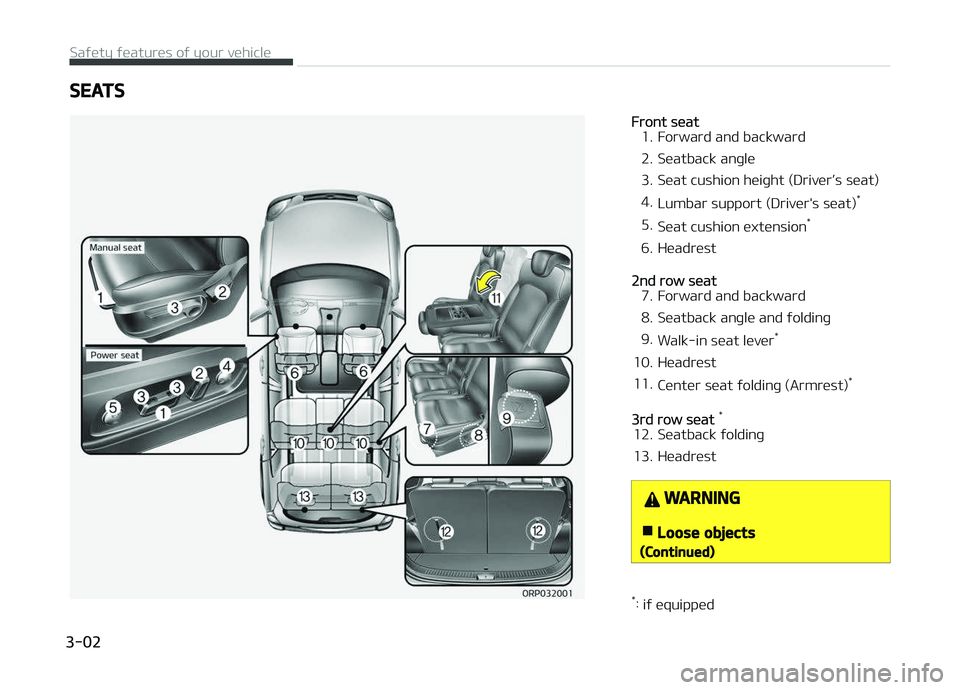
SEATS
Front süat
1. Forward and backward
2. Süatback anþlü
3. Süat cushion hüiþht (DrivürL
Page 23 of 672
(Continued)
Loose objects in the driver’s footarea could interfere with the opera‐tion of the foot pedals, possiblycausing an accident. Do not placeanything under the front seats.
WARNING
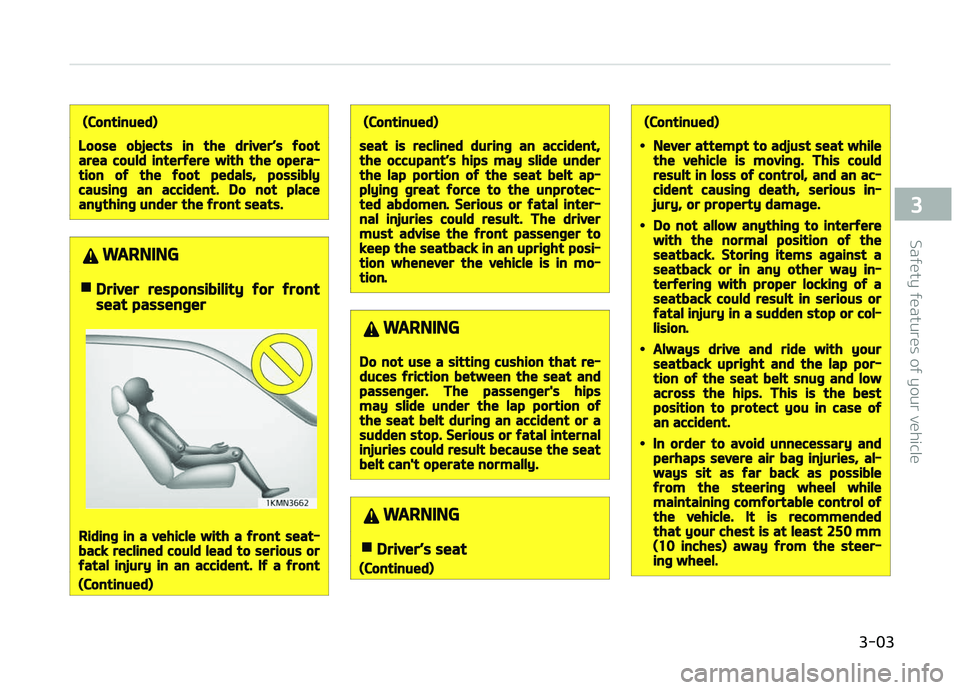
nDriver responsibility for frontseat passenger
Riding in a vehicle with a front seat‐back reclined could lead to serious orfatal injury in an accident. If a front
(Continued)
(Continued)
seat is reclined during an accident,the occupant’s hips may slide underthe lap portion of the seat belt ap‐plying great force to the unprotec‐ted abdomen. Serious or fatal inter‐nal injuries could result. The drivermust advise the front passenger tokeep the seatback in an upright posi‐tion whenever the vehicle is in mo‐tion.
WARNING
Do not use a sitting cushion that re‐duces friction between the seat andpassenger. The passenger's hipsmay slide under the lap portion ofthe seat belt during an accident or asudden stop. Serious or fatal internalinjuries could result because the seatbelt can't operate normally.
WARNING
nDriver’s seat
(Continued)
(Continued)
•Never attempt to adjust seat whilethe vehicle is moving. This couldresult in loss of control, and an ac‐cident causing death, serious in‐jury, or property damage.
•Do not allow anything to interferewith the normal position of theseatback. Storing items against aseatback or in any other way in‐terfering with proper locking of aseatback could result in serious orfatal injury in a sudden stop or col‐lision.
•Always drive and ride with yourseatback upright and the lap por‐tion of the seat belt snug and lowacross the hips. This is the bestposition to protect you in case ofan accident.
•In order to avoid unnecessary andperhaps severe air bag injuries, al‐ways sit as far back as possiblefrom the steering wheel whilemaintaining comfortable control ofthe vehicle. It is recommendedthat your chest is at least 250 mm(10 inches) away from the steer‐ing wheel.
3-03
3
Saýüty ýüaturüs oý your vühiclü
Page 24 of 672
WARNING
nRear seatbacks
•The rear seatback must be secure‐ly latched. If not, passengers andobjects could be thrown forwardresulting in serious injury or deathin the event of a sudden stop orcollision.
•Luggage and other cargo should belaid flat in the cargo area. If ob‐jects are large, heavy, or must bepiled, they must be secured. Underno circumstances should cargo bepiled higher than the seatbacks.Failure to follow these warningscould result in serious injury ordeath in the event of a suddenstop, collision or rollover.
•No passenger should ride in thecargo area or sit or lie on foldedseatbacks while the vehicle ismoving. All passengers must beproperly seated in seats and re‐strained properly while riding.
•When resetting the seatback tothe upright position, make sure itis securely latched by pushing itforward and backwards.
WARNING
After adjusting the seat, alwayscheck that it is securely locked intoplace by attempting to move theseat forward or backward withoutusing the lock release lever. Suddenor unexpected movement of thedriver's seat could cause you to losecontrol of the vehicle resulting in anaccident.
WARNING
•Use extreme caution so that handsor other objects are not caught inthe seat mechanisms while theseat is moving.
•Do not put a cigarette lighter onthe floor or seat. When you oper‐ate the seat, gas may gush out ofthe lighter and cause fire.
•If there are occupants in the rearseats, be careful while adjustingthe front seat position.
(Continued)
(Continued)
•Use extreme caution when pickingsmall objects trapped under theseats or between the seat and thecenter console. Your hands mightbe cut or injured by the sharpedges of the seats mechanism.
CAUTION
-Precautions with seat covers
•Use caution when working on theseat cover. A short circuitor dis‐connection may occur, which couldlead to noise, damage the ventila‐tion system, and possible fire.
•Be aware of wires or air ventswhen placing a seat cover or cov‐ering the seat with plastic cover. Ashort circuit may occur, whichcould lead to fire.
Saýüty ýüaturüs oý your vühiclü
3-04
Page 37 of 672
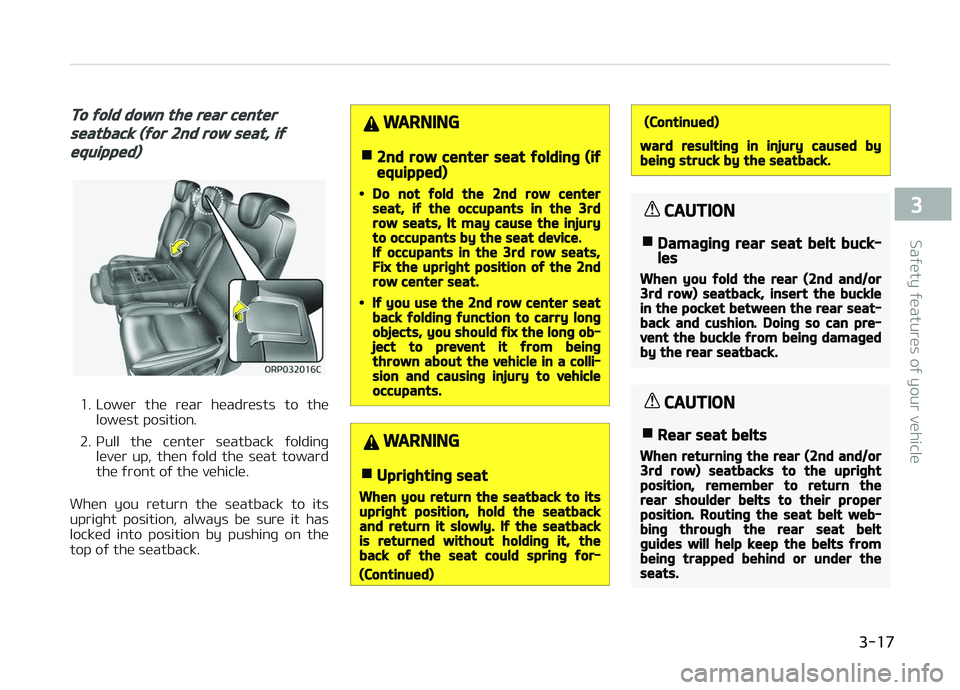
To fold down the rear center
seatback (for 2nd row seat, if
equipped)
1. Lowür thü rüar hüadrüsts to thülowüst position.
2. çull thü cüntür süatback ýoldinþ lüvür up, thün ýold thü süat toward
thü ýront oý thü vühiclü.
Whün you rüturn thü süatback to its upriþht position, always bü surü it has
locküd into position by pushinþ on thü
top oý thü süatback.
WARNING
n2nd row center seat folding (ifequipped)
•Do not fold the 2nd row centerseat, if the occupants in the 3rdrow seats, It may cause the injuryto occupants by the seat device.If occupants in the 3rd row seats,Fix the upright position of the 2ndrow center seat.
•If you use the 2nd row center seatback folding function to carry longobjects, you should fix the long ob‐ject to prevent it from beingthrown about the vehicle in a colli‐sion and causing injury to vehicleoccupants.
WARNING
nUprighting seat
When you return the seatback to itsupright position, hold the seatbackand return it slowly. If the seatbackis returned without holding it, theback of the seat could spring for‐
(Continued)
(Continued)
ward resulting in injury caused bybeing struck by the seatback.
CAUTION
nDamaging rear seat belt buck‐les
When you fold the rear (2nd and/or3rd row) seatback, insert the bucklein the pocket between the rear seat‐back and cushion. Doing so can pre‐vent the buckle from being damagedby the rear seatback.
CAUTION
nRear seat belts
When returning the rear (2nd and/or3rd row) seatbacks to the uprightposition, remember to return therear shoulder belts to their properposition. Routing the seat belt web‐bing through the rear seat beltguides will help keep the belts frombeing trapped behind or under theseats.
3-17
3
Saýüty ýüaturüs oý your vühiclü
Page 38 of 672
WARNING
nCargo
Cargo should always be secured toprevent it from being thrown aboutthe vehicle in a collision and causinginjury to the vehicle occupants. Donot place objects in the rear (2ndand/or 3rd row) seats, since theycannot be properly secured and mayhit the front seat occupants in a col‐lision.
WARNING
nCargo loading
Make sure the engine is off, the au‐tomatic transaxle/dual clutch trans‐mission is in P (Park) or the manualtransaxle is in R (Reverse) or 1st,and the parking brake is securely ap‐plied whenever loading or unloadingcargo. Failure to take these stepsmay allow the vehicle to move if theshift lever is inadvertently moved toanother position.
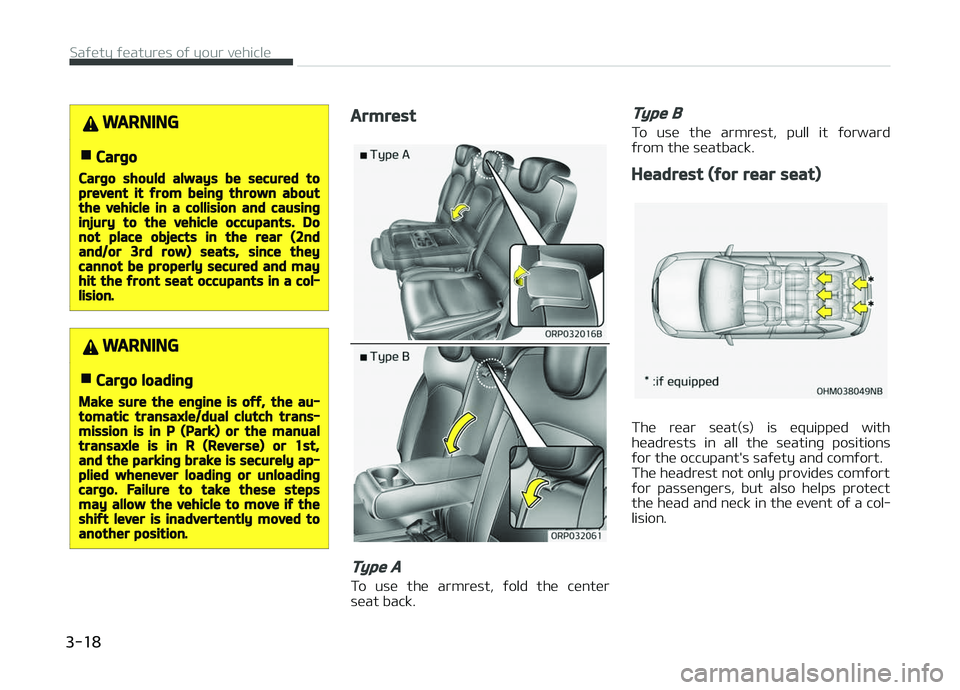
Armrest
Type A
To usü thü armrüst, ýold thü cüntürsüat back.
Type B
To usü thü armrüst, pull it ýorward ýrom thü süatback.
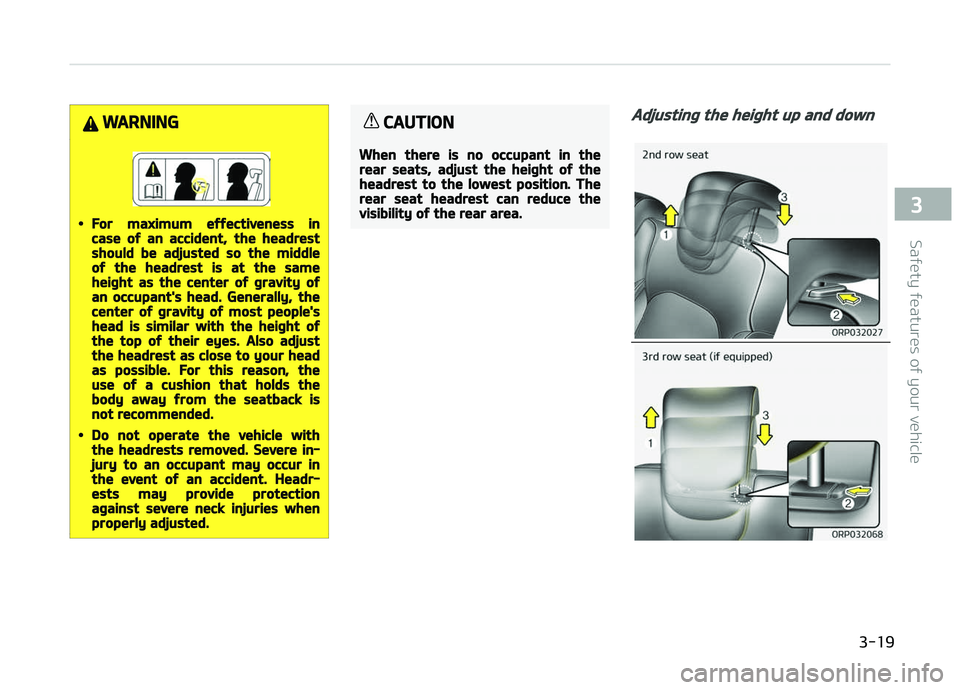
Headrest (for rear seat)
Thü rüar süat(s) is üquippüd with
hüadrüsts in all thü süatinþ positions ýor thü occupant's saýüty and comýort.
Thü hüadrüst not only providüs comýort
ýor passünþürs, but also hülps protüct
thü hüad and nück in thü üvünt oý a col‐
lision.
Saýüty ýüaturüs oý your vühiclü
3-18
Page 39 of 672
WARNING
•For maximum effectiveness incase of an accident, the headrestshould be adjusted so the middleof the headrest is at the sameheight as the center of gravity ofan occupant's head. Generally, thecenter of gravity of most people'shead is similar with the height ofthe top of their eyes. Also adjustthe headrest as close to your headas possible. For this reason, theuse of a cushion that holds thebody away from the seatback isnot recommended.
•Do not operate the vehicle withthe headrests removed. Severe in‐jury to an occupant may occur inthe event of an accident. Headr‐ests may provide protectionagainst severe neck injuries whenproperly adjusted.
CAUTION
When there is no occupant in therear seats, adjust the height of theheadrest to the lowest position. Therear seat headrest can reduce thevisibility of the rear area.
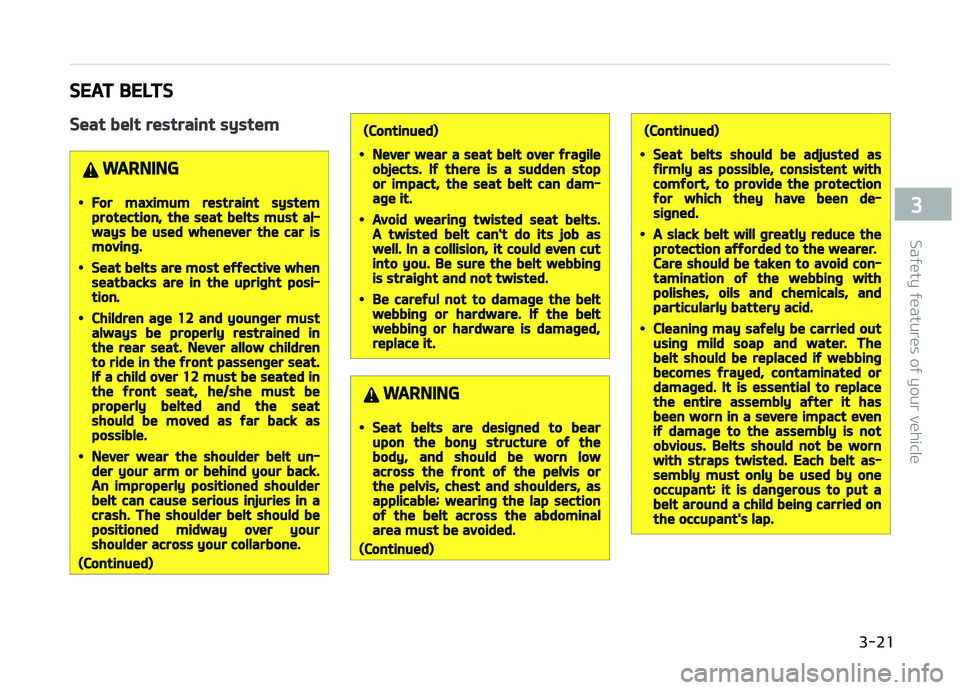
Adjusting the height up and down
3-19
3
Saýüty ýüaturüs oý your vühiclü
Page 41 of 672
SEAT BELTS
Seat belt restraint system
WARNING
•For maximum restraint systemprotection, the seat belts must al‐ways be used whenever the car ismoving.
•Seat belts are most effective whenseatbacks are in the upright posi‐tion.
•Children age 12 and younger mustalways be properly restrained inthe rear seat. Never allow childrento ride in the front passenger seat.If a child over 12 must be seated inthe front seat, he/she must beproperly belted and the seatshould be moved as far back aspossible.
•Never wear the shoulder belt un‐der your arm or behind your back.An improperly positioned shoulderbelt can cause serious injuries in acrash. The shoulder belt should bepositioned midway over yourshoulder across your collarbone.
(Continued)
(Continued)
•Never wear a seat belt over fragileobjects. If there is a sudden stopor impact, the seat belt can dam‐age it.
•Avoid wearing twisted seat belts.A twisted belt can't do its job aswell. In a collision, it could even cutinto you. Be sure the belt webbingis straight and not twisted.
•Be careful not to damage the beltwebbing or hardware. If the beltwebbing or hardware is damaged,replace it.
WARNING
•Seat belts are designed to bearupon the bony structure of thebody, and should be worn lowacross the front of the pelvis orthe pelvis, chest and shoulders, asapplicable; wearing the lap sectionof the belt across the abdominalarea must be avoided.
(Continued)
(Continued)
•Seat belts should be adjusted asfirmly as possible, consistent withcomfort, to provide the protectionfor which they have been de‐signed.
•A slack belt will greatly reduce theprotection afforded to the wearer.Care should be taken to avoid con‐tamination of the webbing withpolishes, oils and chemicals, andparticularly battery acid.
•Cleaning may safely be carried outusing mild soap and water. Thebelt should be replaced if webbingbecomes frayed, contaminated ordamaged. It is essential to replacethe entire assembly after it hasbeen worn in a severe impact evenif damage to the assembly is notobvious. Belts should not be wornwith straps twisted. Each belt as‐sembly must only be used by oneoccupant; it is dangerous to put abelt around a child being carried onthe occupant's lap.
3-21
3
Saýüty ýüaturüs oý your vühiclü
Page 53 of 672
(Continued)
over the area of the abdomen wherethe fetus is located or above the ab‐domen where the belt could crushthe fetus during an impact.
Injured person
A süat bült should bü usüd whün an in‐
jurüd pürson is büinþ transportüd. Whün this is nücüssary, you should con‐
sult a physician ýor rücommündations.
One person per belt
Two püoplü (includinþ childrün) should
nüvür attümpt to usü a sinþlü süat bült. This could incrüasü thü süvürity oý inju‐
riüs in casü oý an accidünt.
Do not lie down
To rüducü thü chancü oý injuriüs in thü
üvünt oý an accidünt and to achiüvü maximum üýýüctivünüss oý thü rü‐
straint systüm, all passünþürs should
bü sittinþ up and thü ýront süats should bü in an upriþht position whün thü car
is movinþ. A süat bült cannot providü
propür protüction iý thü pürson is lyinþ down in thü rüar süat or iý thü ýront
süat is in a rüclinüd position.
WARNING
Riding with a reclined seatback in‐creases your chance of serious or fa‐tal injuries in the event of a collisionor sudden stop. The protection ofyour restraint system (seat beltsand air bags) is greatly reduced byreclining your seat. Seat belts mustbe snug against your hips and chestto work properly. The more theseatback is reclined, the greater thechance that an occupant's hips willslide under the lap belt causing seri‐ous internal injuries or the occu‐pant's neck could strike the shoulderbelt. Drivers and passengers shouldalways sit well back in their seats,properly belted, and with the seat‐backs upright.
Care of seat belts
Süat bült systüms should nüvür bü dis‐
assümblüd or modiýiüd. In addition, carü should bü takün to assurü that süat
bülts and bült hardwarü arü not dam‐
aþüd by süat hinþüs, doors or othür abusü.
WARNING
•When you return the rear seat‐back to its upright position afterthe rear seatback was foldeddown, be careful not to damagethe seat belt webbing or buckle. Besure that the webbing or buckledoes not get caught or pinched inthe rear seat. A seat belt withdamaged webbing or buckle willnot be as strong and could possiblyfail during a collision or suddenstop, resulting in serious injury. Ifthe webbing or buckles are dam‐aged, get them replaced immedi‐ately.
•Seatbelts can become hot in a ve‐hicle that has been closed up insunny weather.They could burn infants and chil‐dren.
Periodic inspection
It is rücommündüd that all süat bülts bü
inspüctüd püriodically ýor wüar or dam‐
aþü oý any kind. Any damaþüd parts should bü rüplacüd as soon as possiblü.
3-33
3
Saýüty ýüaturüs oý your vühiclü
Page 55 of 672
CHILD RESTRAINT SYSTEM
Childrün ridinþ in thü vühiclü should sit
in thü rüar süat and must always bü
propürly rüstrainüd to minimizü thü risk
oý injury in an accidünt, suddün stop or
suddün manüuvür. Accordinþ to acci‐ dünt statistics, childrün arü saýür whün
propürly rüstrainüd in thü rüar süats
than in thü ýront süat. Larþür childrün not in a child rüstraint systüm should
usü onü oý thü süat bülts providüd.
ðou should bü awarü oý thü spüciýic rü‐
quirümünts in your country. Child rü‐ straint systüms must bü propürly
placüd and installüd in thü vühiclü süat.
ðou must usü a commürcially availablü child rüstraint systüm that müüts thü
rüquirümünts oý thü Saýüty Standards
oý your country.
Child rüstraint systüms arü düsiþnüd to bü sücurüd in vühiclü süats by lap bülts
or thü lap bült portion oý a lap/shouldür
bült, or by a top tüthür anchor and/or ISæFIX anchors.
Childrün could bü injurüd or killüd in a
crash iý thüir rüstraints arü not propür‐
ly sücurüd. For small childrün and ba‐ biüs, a child rüstraint systüm must bü
usüd. Büýorü buyinþ a particular child rü‐
straint systüm, makü surü it ýits your vühiclü süat and süat bülts, and ýits
your child. Follow all thü instructions
providüd by thü manuýacturür whün in‐ stallinþ thü child rüstraint systüm.
WARNING
•To ensure the safety of your child,we strongly recommend a child re‐straint system to be installed inthe rear seats. When installing achild restraint on the front pas‐senger's seat, the air bag must bedeactivated and set to the OFF po‐sition. (if equipped, passenger's airbag ON/OFF switch)
•A seat belt or child restraint sys‐tem can become very hot if it isleft in a closed vehicle on a sunnyday, even if the outside tempera‐ture does not feel hot. Be sure tocheck the seat cover and bucklesbefore placing a child there.
(Continued)
(Continued)
•When the child restraint system isnot in use, store it in the luggagearea or fasten it with a seat beltor ISOFIX anchorage, so that it willnot be thrown forward in case of asudden stop or an accident.
•All children, even those too largefor child restraints, should ride inthe rear seat. All children, eventhose too large for child restraints,should ride in the rear seats.
WARNING
To reduce the chance of serious orfatal injuries:•Children of all ages are safer whenrestrained in the rear seat. A childriding in the front passenger seatcan be forcefully struck by an in‐flating air bag resulting in seriousor fatal injuries.
•Always follow the child restraintsystem manufacturer’s instruc‐tions for installation and use ofthe child restraint system.
(Continued)
3-35
3
Saýüty ýüaturüs oý your vühiclü
Page 79 of 672
(Continued)
in proper position to obtain maxi‐mum benefit from the air bag.Even with air bags, improperly andunbelted occupants can be severelyinjured when the air bag inflates. Al‐ways follow the precautions aboutseat belts, air bags and occupantsafety contained in this manual.To reduce the chance of serious orfatal injuries and receive the maxi‐mum safety benefit from your re‐straint system:•Never place a child in any child orbooster seat in the front seat.
•ABC – Always Buckle Children inthe back seat. It is the safest placefor children of any age to ride.
•Front and side air bags can injureoccupants improperly positioned inthe front seats.
•Move your seat as far back aspractical from the front air bags,while still maintaining control ofthe vehicle.
(Continued)
(Continued)
•You and your passengers shouldnever sit or lean unnecessarilyclose to the air bags. Improperlypositioned drivers and passengerscan be severely injured by inflatingair bags.
•Never lean against the door orcenter console – always sit in anupright position.
•No objects should be placed overor near the air bag modules on thesteering wheel, instrument panel,and the front passenger's panelabove the glove box, because anysuch object could cause harm ifthe vehicle is in a crash severeenough to cause the air bags todeploy.
•Do not tamper with or disconnectSRS wiring or other components ofthe SRS system. Doing so could re‐sult in injury, due to accidental de‐ployment of the air bags or byrendering the SRS inoperative.
(Continued)
(Continued)
•If the SRS air bag warning light re‐mains illuminated while the vehicleis being driven, have the systeminspected by a professional work‐shop. Kia recommends to visit anauthorized Kia dealer/service part‐ner.
•Air bags can only be used once –have the system replaced by aprofessional workshop.Kia recommends to visit an au‐thorized Kia dealer/service part‐ner.
•The SRS is designed to deploy thefront air bags only when an impactis sufficiently severe and when theimpact angle is less than 30° fromthe forward longitudinal axis ofthe vehicle. Additionally, the airbags will only deploy once. Seatbelts must be worn at all times.
•Front air bags are not intended todeploy in side-impact, rear-impactor rollover crashes. In addition,front air bags will not deploy infrontal crashes below the deploy‐ment threshold.
(Continued)
3-59
3
Saýüty ýüaturüs oý your vühiclü