automatic transmission KIA CARENS RHD 2017 Owner's Manual
[x] Cancel search | Manufacturer: KIA, Model Year: 2017, Model line: CARENS RHD, Model: KIA CARENS RHD 2017Pages: 723, PDF Size: 40.8 MB
Page 482 of 723
647
Driving your vehicle
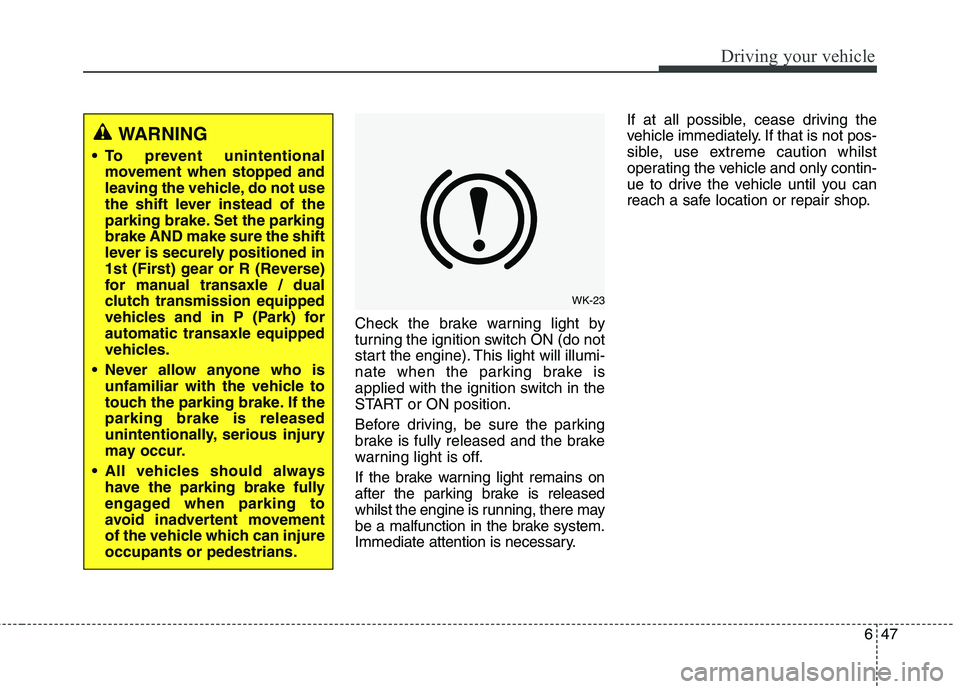
Check the brake warning light by
turning the ignition switch ON (do not
start the engine). This light will illumi-
nate when the parking brake is
applied with the ignition switch in the
START or ON position.
Before driving, be sure the parking
brake is fully released and the brake
warning light is off.
If the brake warning light remains on
after the parking brake is released
whilst the engine is running, there may
be a malfunction in the brake system.
Immediate attention is necessary.If at all possible, cease driving the
vehicle immediately. If that is not pos-
sible, use extreme caution whilst
operating the vehicle and only contin-
ue to drive the vehicle until you can
reach a safe location or repair shop.
WARNING
To prevent unintentional movement when stopped and
leaving the vehicle, do not use
the shift lever instead of the
parking brake. Set the parkingbrake AND make sure the shift
lever is securely positioned in
1st (First) gear or R (Reverse)
for manual transaxle / dual
clutch transmission equipped
vehicles and in P (Park) forautomatic transaxle equipped
vehicles.
Never allow anyone who is unfamiliar with the vehicle to
touch the parking brake. If theparking brake is released
unintentionally, serious injury
may occur.
All vehicles should always have the parking brake fully
engaged when parking to
avoid inadvertent movement
of the vehicle which can injureoccupants or pedestrians.
WK-23
Page 498 of 723
663
Driving your vehicle
Check to be sure the parking brakeis not engaged and that the park-
ing brake indicator light is out
before driving away.
Driving through water may get the brakes wet. They can also get wet
when the vehicle is washed. Wet
brakes can be dangerous! Your
vehicle will not stop as quickly if the
brakes are wet. Wet brakes may
cause the vehicle to pull to one
side.
To dry the brakes, apply the brakes
lightly until the braking action
returns to normal, taking care to
keep the vehicle under control at
all times. If the braking action does
not return to normal, stop as soon
as it is safe to do so and we rec-
ommend that you call an autho-
rised Kia dealer.
Do not coast down hills with the vehicle out of gear. This is extreme-
ly hazardous. Keep the vehicle in
gear at all times, use the brakes to
slow down, then shift to a lower
gear so that engine braking will
help you maintain a safe speed. Do not "ride" the brake pedal.
Resting your foot on the brake
pedal whilst driving can be danger-ous because it can result in the
brakes overheating and losing their
effectiveness. It also increases the
wear of the brake components.
If a tyre goes flat whilst you are driving, apply the brakes gently and
keep the vehicle pointed straight
ahead whilst you slow down. When
you are moving slowly enough for it
to be safe to do so, pull off the road
and stop in a safe place.
If your vehicle is equipped with an automatic transaxle / dual clutch
transmission, do not let your vehi-
cle creep forward. To avoid creep-
ing forward, keep your foot firmly
on the brake pedal when the vehi-cle is stopped.
Be cautious when parking on a hill. Firmly engage the parking brake
and place the shift lever in P (auto-
matic transaxle / dual clutch trans-
mission) or in first or reverse gear
(manual transaxle). If your vehicle
is facing downhill, turn the front
wheels into the kerb to help keep
the vehicle from rolling. If your vehicle is facing uphill, turn
the front wheels away from the
kerb to help keep the vehicle from
rolling. If there is no kerb or if it is
required by other conditions to
keep the vehicle from rolling, block
the wheels.
Under some conditions your park- ing brake can freeze in the
engaged position. This is most like-ly to happen when there is an accu-
mulation of snow or ice around or
near the rear brakes or if the brakes
are wet. If there is a risk that the
parking brake may freeze, apply it
only temporarily whilst you put the
shift lever in P (automatic transaxle
/ dual clutch transmission) or in first
or reverse gear (manual transaxle)
and block the rear wheels so the
vehicle cannot roll. Then release
the parking brake.
Do not hold the vehicle on the upgrade with the accelerator
pedal. This can cause the transaxle
to overheat. Always use the brake
pedal or parking brake.
Page 502 of 723
667
Driving your vehicle
To temporarily accelerate with
the cruise control on:
If you want to speed up temporarily
when the cruise control is on,
depress the accelerator pedal.
Increased speed will not interfere
with cruise control operation orchange the set speed.
To return to the set speed, take your
foot off the accelerator pedal.To cancel cruise control, do
one of the following:
Depress the brake pedal.
Depress the clutch pedal if
equipped with a manual transaxle.
Shift into N (Neutral) if equipped with an automatic transaxle / dual
clutch transmission.
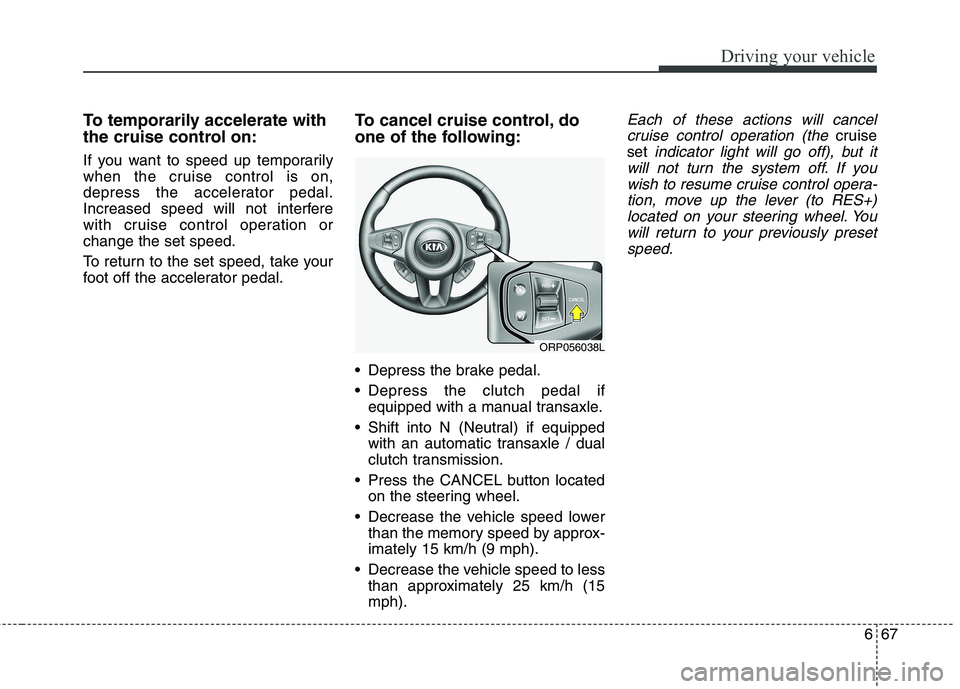
Press the CANCEL button located on the steering wheel.
Decrease the vehicle speed lower than the memory speed by approx-imately 15 km/h (9 mph).
Decrease the vehicle speed to less than approximately 25 km/h (15mph).Each of these actions will cancel
cruise control operation (the
cruise
set
indicator light will go off), but it
will not turn the system off. If you wish to resume cruise control opera-tion, move up the lever (to RES+)located on your steering wheel. You will return to your previously presetspeed.
ORP056038L
Page 527 of 723
Driving your vehicle
92
6
Hazardous driving conditions
When hazardous driving conditions
are encountered such as water,
snow, ice, mud, sand, or similar haz-
ards, follow these suggestions:
Drive cautiously and allow extra
distance for braking.
Avoid sudden braking or steering.
When braking with non-ABS brakes pump the brake pedal with
a light up-and-down motion until
the vehicle is stopped.
If stalled in snow, mud, or sand, use second gear. Accelerate slowly to
avoid spinning the drive wheels.
Use sand, rock salt, tyre chains, or other non-slip material under the
drive wheels to provide traction
when stalled in ice, snow, or mud. Rocking the vehicle
If it is necessary to rock the vehicle to
free it from snow, sand, or mud, first
turn the steering wheel right and left
to clear the area around your front
wheels. Then, shift back and forth
between 1 (First) and R (Reverse) in
vehicles equipped with a manual
transaxle or R (Reverse) and any for-
ward gear in vehicles equipped with
an automatic transaxle / dual clutch
transmission. Do not race the engine,and spin the wheels as little as possi-
ble. If you are still stuck after a few
tries, have the vehicle pulled out by a
tow vehicle to avoid engine overheat-
ing and possible damage to the
transaxle.
SPECIAL DRIVING CONDITIONS WARNING
- Downshifting
Downshifting with an automatic
transaxle / dual clutch transmis-
sion, whilst driving on slipperysurfaces can cause an accident.
The sudden change in tyrespeed could cause the tyres to
skid. Be careful when down-
shifting on slippery surfaces.
WARNING - ABS
Do not pump the brake pedal on
a vehicle equipped with ABS.
CAUTION
Prolonged rocking may cause engine over-heating, transaxledamage or failure, and tyre dam- age.
Page 534 of 723
699
Driving your vehicle
To keep locks from freezing
To keep the locks from freezing,
squirt an approved de-icer fluid or
glycerine into the key opening. If a
lock is covered with ice, squirt it with
an approved de-icing fluid to remove
the ice. If the lock is frozen internally,
you may be able to thaw it out by
using a heated key. Handle the heat-
ed key with care to avoid injury.
Use approved window washer
anti-freeze in system
To keep the water in the window
washer system from freezing, add an
approved window washer anti-freeze
solution in accordance with instruc-
tions on the container. Window wash-
er anti-freeze is available from an
authorised Kia dealer and most auto
parts outlets. Do not use engine
coolant or other types of anti-freeze
as these may damage the paint finish.Don't let your parking brake
freeze
Under some conditions your parking
brake can freeze in the engaged
position. This is most likely to hap-
pen when there is an accumulation
of snow or ice around or near the
rear brakes or if the brakes are wet.
If there is a risk the parking brake
may freeze, apply it only temporarily
whilst you put the shift lever in P
(automatic transaxle / dual clutch
transmission) or in first or reverse
gear (manual transaxle) and block
the rear wheels so the vehicle cannot
roll. Then release the parking brake.
Don't let ice and snow accu-
mulate underneath
Under some conditions, snow and
ice can build up under the fenders
and interfere with the steering. When
driving in severe winter conditions
where this may happen, you should
periodically check underneath the
vehicle to be sure the movement of
the front wheels and the steering
components is not obstructed.Carry emergency equipment
Depending on the severity of the
weather, you should carry appropri-
ate emergency equipment. Some of
the items you may want to carry
include tyre chains, tow straps or
chains, flashlight, emergency flares,
sand, shovel, jumper cables, window
scraper, gloves, ground cloth, cover-
alls, blanket, etc.
Page 541 of 723
Driving your vehicle
106
6
Parking on hills
Generally, if you have a trailer
attached to your vehicle, you should
not park your vehicle on a hill. People
can be seriously or fatally injured,
and both your vehicle and the trailer
can be damaged if unexpectedly roll
down hill. However, if you ever have to park your
trailer on a hill, here is how to do it:
1. Pull the vehicle into the parking
space. Turn the steering wheel in
the direction of the kerb (left if head-
ed down hill, right if headed up hill).
2. If the vehicle has a manual transaxle, place the car in neutral.
If the vehicle has an automatic
transaxle / dual clutch transmis-
sion, place the car in P (Park).
3. Set the parking brake and shut off the vehicle.
4. Place chocks under the trailer wheels on the down hill side of the
wheels.
5. Start the vehicle, hold the brakes, shift to neutral, release the parking
brake and slowly release the
brakes until the trailer chocksabsorb the load.
6. Reapply the brakes, reapply the parking brake and shift the vehicle
to R (Reverse) for manual transaxle
or P (Park) for automatic transaxle /
dual clutch transmission.
7. Shut off the vehicle and release the vehicle brakes but leave the
parking brake set.
WARNING - Parking on
a hill
Parking your vehicle on a hill
with a trailer attached could
cause serious injury or death,
should the trailer break loose.
WARNING - Parking
brake
It can be dangerous to get out
of your vehicle if the parking
brake is not firmly set.
If you have left the engine run-
ning, the vehicle can move sud-
denly. You or others could be
seriously or fatally injured.
Page 542 of 723
6107
Driving your vehicle
When you are ready to leave after
parking on a hill
1.With the manual transaxle inNeutral or automatic transaxle /
dual clutch transmission in P
(Park), apply your brakes and hold
the brake pedal down whilst you:
and
2.Slowly remove your foot from the brake pedal.
3.Drive slowly until the trailer is clear of the chocks.
4.Stop and have someone pick up and store the chocks. Maintenance when trailer tow- ing
Your vehicle will need service more
often when you regularly pull a trail-
er. Important items to pay particularattention to include engine oil,
transaxle fluid, axle lubricant and
cooling system fluid. Brake condition
is another important item to frequent-
ly check. Each item is covered in this
manual, and the Index will help you
find them quickly. If you’re trailering, it
is a good idea to review these sec-
tions before you start your trip.
Do not forget to also maintain your
trailer and hitch. Follow the mainte-nance schedule that accompanied
your trailer and check it periodically.
Preferably, conduct the check at the
start of each day’s driving. Most
importantly, all hitch nuts and boltsshould be tight.CAUTION
Due to higher load during
trailer usage, overheatingmight occur in hot days or during uphill driving. If thecoolant gauge indicates over-heating, switch off the air con- ditioner and stop the vehiclein a safe area to cool down theengine.
When towing check transaxle fluid more frequently.
If your vehicle is not equipped with an air conditioner, youshould install a condenser fanto improve engine perform-ance when towing a trailer.
Page 543 of 723
Driving your vehicle
108
6
If you do decide to pull a trailer
Here are some important points if
you decide to pull a trailer:
Consider using a sway control. You
can ask a hitch dealer about sway control.
Do not do any towing with your car during its first 2,000 km (1,200
miles) in order to allow the engine
to properly break in. Failure to heed
this caution may result in serious
engine or transaxle damage.
When towing a trailer, we recom- mend that you consult an authorisedKia dealer on additional require-
ments such as a towing kit, etc.
Always drive your vehicle at a mod- erate speed (less than 100 km/h(60 mph)).
On a long uphill grade, do not exceed 70 km/h (45 mph) or the
posted towing speed limit,
whichever is lower.
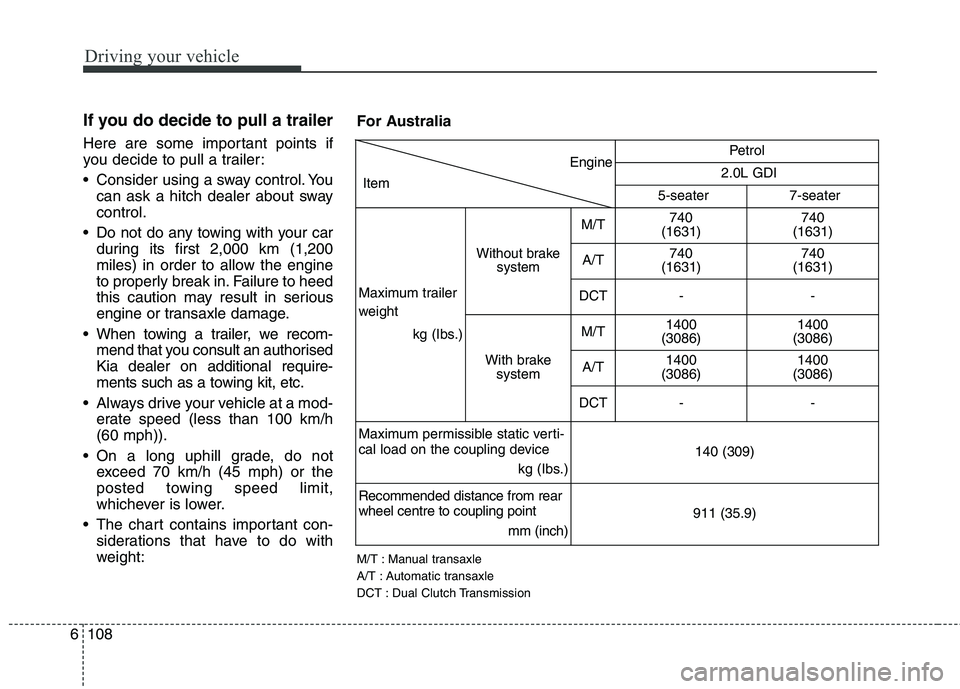
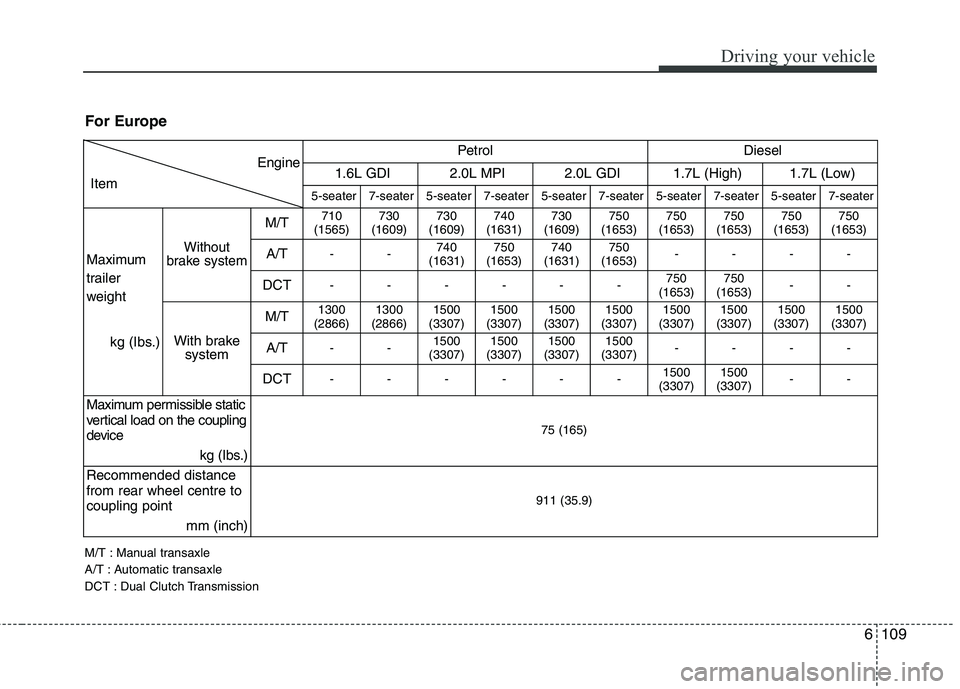
The chart contains important con- siderations that have to do with
weight:
Engine
ItemPetrol
2.0L GDI
5-seater 7-seater
Maximum trailer
weight kg (Ibs.)
Without brakesystem
M/T740
(1631) 740
(1631)
A/T740
(1631) 740
(1631)
DCT--
With brake system
M/T1400
(3086) 1400
(3086)
A/T1400
(3086) 1400
(3086)
DCT--
Maximum permissible static verti-
cal load on the coupling device kg (Ibs.)
140 (309)
Recommended distance from rear wheel centre to coupling point mm (inch)
911 (35.9)
For Australia
M/T : Manual transaxle
A/T : Automatic transaxle
DCT : Dual Clutch Transmission
Page 544 of 723
6109
Driving your vehicle
For Europe
M/T : Manual transaxle
A/T : Automatic transaxle
DCT : Dual Clutch Transmission
Engine
ItemPetrol Diesel
1.6L GDI2.0L MPI 2.0L GDI 1.7L (High) 1.7L (Low)
5-seater7-seater5-seater 7-seater 5-seater7-seater 5-seater 7-seater 5-seater 7-seater
Maximum
trailer
weight kg (Ibs.)
Without
brake system
M/T710
(1565)730
(1609)730
(1609) 740
(1631) 730
(1609)750
(1653) 750
(1653) 750
(1653) 750
(1653) 750
(1653)
A/T--740
(1631) 750
(1653) 740
(1631)750
(1653) ----
DCT------750
(1653) 750
(1653) --
With brake system
M/T1300
(2866)1300
(2866)1500
(3307) 1500
(3307) 1500
(3307)1500
(3307) 1500
(3307) 1500
(3307) 1500
(3307) 1500
(3307)
A/T--1500
(3307) 1500
(3307) 1500
(3307)1500
(3307) ----
DCT------1500
(3307) 1500
(3307) --
Maximum permissible static
vertical load on the coupling
device kg (Ibs.)
75 (165)
Recommended distance from rear wheel centre tocoupling point mm (inch)
911 (35.9)
Page 545 of 723
Driving your vehicle
110
6
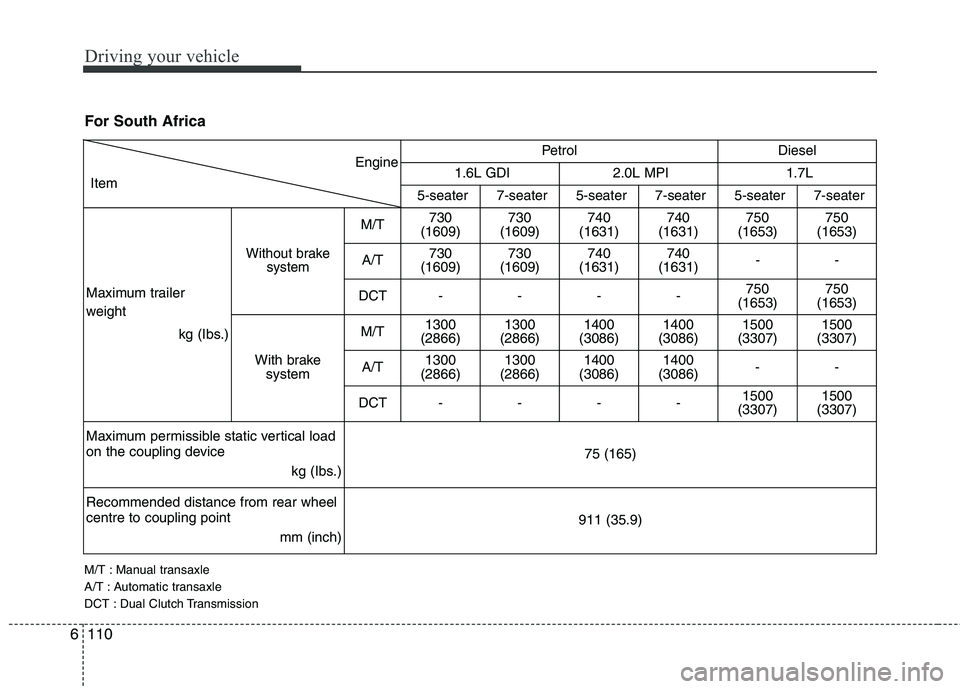
Engine
ItemPetrol Diesel
1.6L GDI2.0L MPI 1.7L
5-seater7-seater5-seater 7-seater 5-seater 7-seater
Maximum trailer
weight kg (Ibs.)
Without brake system
M/T730
(1609)730
(1609)740
(1631) 740
(1631) 750
(1653) 750
(1653)
A/T730
(1609)730
(1609)740
(1631) 740
(1631) --
DCT---- 750
(1653) 750
(1653)
With brake system
M/T1300
(2866)1300
(2866)1400
(3086) 1400
(3086) 1500
(3307) 1500
(3307)
A/T1300
(2866)1300
(2866)1400
(3086) 1400
(3086) --
DCT---- 1500
(3307) 1500
(3307)
Maximum permissible static vertical load
on the coupling device kg (Ibs.)
75 (165)
Recommended distance from rear wheel centre to coupling point mm (inch)
911 (35.9)
For South Africa
M/T : Manual transaxle
A/T : Automatic transaxle
DCT : Dual Clutch Transmission