automatic transmission KIA CARENS RHD 2017 User Guide
[x] Cancel search | Manufacturer: KIA, Model Year: 2017, Model line: CARENS RHD, Model: KIA CARENS RHD 2017Pages: 723, PDF Size: 40.8 MB
Page 449 of 723
Driving your vehicle
14
6
Starting the petrol engine
1.Carry the smart key or leave it
inside the vehicle.
2.Make sure the parking brake is firmly applied.
3. Manual Transaxle - Depress the
clutch pedal fully and shift the
transaxle into Neutral. Keep the
clutch pedal and brake pedal
depressed whilst starting the
engine.
Automatic transaxle / Dual clutch transmission - Place the
transaxle shift lever in P (Park).
Depress the brake pedal fully.
You can also start the engine when
the shift lever is in the N (Neutral)position.
4.Press the engine start/stop button.
It should be started without depress-
ing the accelerator. Manual Transaxle
To start the vehicle, keep the clutch
pedal and brake pedal depressed,
and make sure the engine RPM is
within normal range (under 1000
rpm). After checking, shift the
transaxle shift lever to the desiredposition.
Unlock the parking brake, and take
your foot off the clutch pedal. Then,
lightly depress the accelerator
pedal and slowly start the vehicle.
5. Do not wait for the engine to warm up whilst the vehicle remains sta-
tionary.
Start driving at moderate engine
speeds. (Steep accelerating and
decelerating should be avoided.)
Starting the diesel engine
To start the diesel engine when the engine is cold, it has to be pre-heat-
ed before starting the engine and
then have to be warmed up before
starting to drive.
1.Make sure the parking brake is applied.
2. Manual Transaxle - Depress the
clutch pedal fully and shift the
transaxle into Neutral. Keep the
clutch pedal and brake pedaldepressed whilst pressing the
engine start/stop button to the
START position.
Dual clutch transmission - Place
the transaxle shift lever in P (Park).
Depress the brake pedal fully.
You can also start the engine when
the shift lever is in the N (Neutral)position.
Page 452 of 723

617
Driving your vehicle
Your vehicle may be equipped with the ISG system, which reduces fuel
consumption by automatically shut-
ting down the engine, when the vehi-
cle is at a standstill. (For example :
red light, stop sign and traffic jam)
The engine starts automatically as
soon as the starting conditions aremet.
The ISG system is ON whenever the
engine is running.
✽✽NOTICE
When the engine automatically
starts by the ISG system, some
warning lights (ABS, ESC, ESC
OFF, EPS or Parking brake warn-
ing light) may turn on for a few sec-
onds.
This happens because of low battery
voltage. It does not mean the system
has malfunctioned.
Auto stop
To stop the engine in idle stop mode
With manual transaxle
1.Decrease the vehicle speed to less than 5 km/h (3 mph).
2.Shift into N (Neutral) position.
3.Release the clutch pedal. With dual clutch transmission
1. Decrease the vehicle speed to 0
km/h.
2. Shift into D (Drive) or N (Neutral) position.
3. Press the brake pedal.
The engine will stop and the green
AUTO STOP( ) indicator on the
instrument cluster will illuminate.
✽✽ NOTICE
You must reach a speed of at least 10
km/h (6 mph) since last idle stop.
ISG (IDLE STOP AND GO) SYSTEM (IF EQUIPPED)
ORP052004
Page 453 of 723
Driving your vehicle
18
6
✽✽
NOTICE
If you unfasten the seatbelt or open
the driver's door (or engine bonnet)
in auto stop mode, the following will
happen:
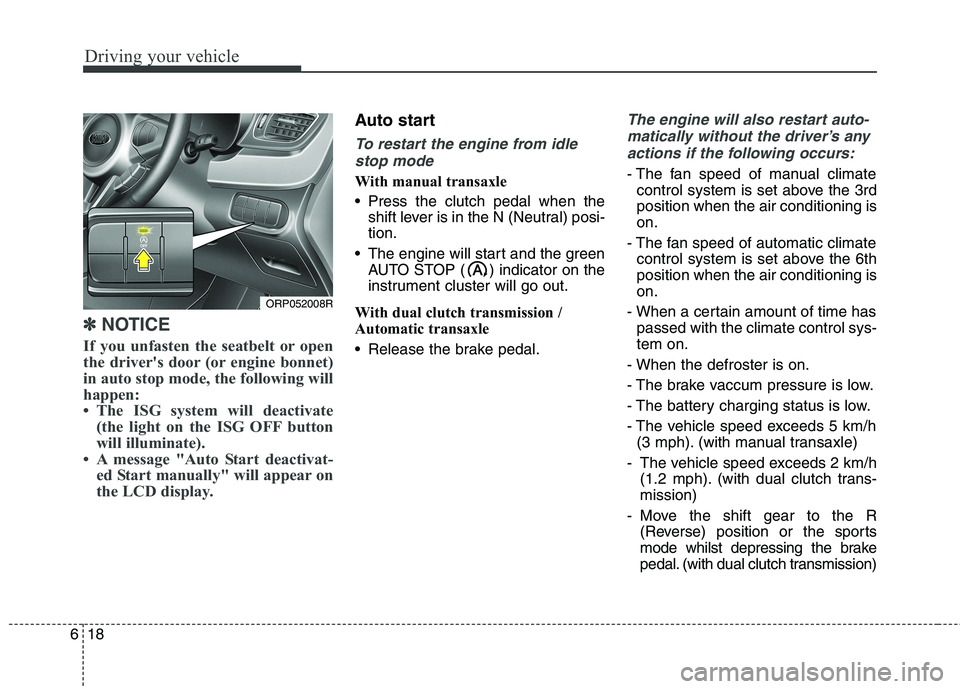
The ISG system will deactivate (the light on the ISG OFF button
will illuminate).
A message "Auto Start deactivat- ed Start manually" will appear on
the LCD display.
Auto start
To restart the engine from idle
stop mode
With manual transaxle
Press the clutch pedal when the shift lever is in the N (Neutral) posi- tion.
The engine will start and the green AUTO STOP ( ) indicator on the
instrument cluster will go out.
With dual clutch transmission /
Automatic transaxle
Release the brake pedal.
The engine will also restart auto- matically without the driver’s any actions if the following occurs:
- The fan speed of manual climate control system is set above the 3rd position when the air conditioning ison.
- The fan speed of automatic climate control system is set above the 6thposition when the air conditioning ison.
- When a certain amount of time has passed with the climate control sys-tem on.
- When the defroster is on.
- The brake vaccum pressure is low.
- The battery charging status is low.
- The vehicle speed exceeds 5 km/h (3 mph). (with manual transaxle)
- The vehicle speed exceeds 2 km/h (1.2 mph). (with dual clutch trans- mission)
- Move the shift gear to the R (Reverse) position or the sports
mode whilst depressing the brake
pedal. (with dual clutch transmission)
ORP052008R
Page 469 of 723
Driving your vehicle
34
6
Dual clutch transmission oper- ation
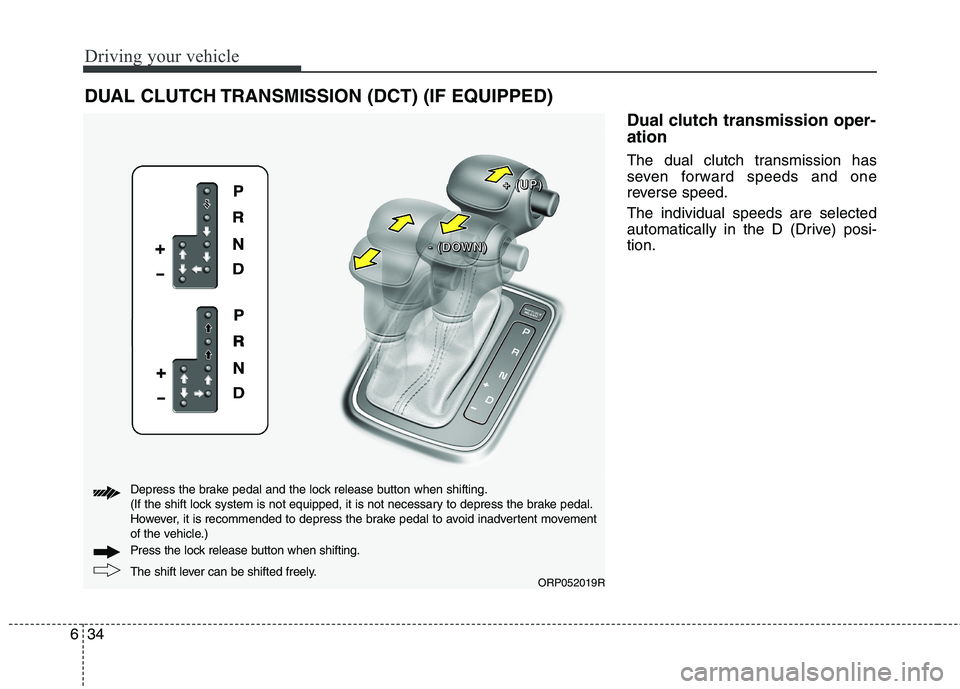
The dual clutch transmission has
seven forward speeds and one
reverse speed. The individual speeds are selected
automatically in the D (Drive) posi-tion.
DUAL CLUTCH TRANSMISSION (DCT) (IF EQUIPPED)
ORP052019R
+
+++ ((((UUUUPPPP))))
---- ((((DDDDOOOOWWWWNNNN))))
The shift lever can be shifted freely.
Press the lock release button when shifting.
Depress the brake pedal and the lock release button when shifting.
(If the shift lock system is not equipped, it is not necessary to depress the brake pedal.
However, it is recommended to depress the brake pedal to avoid inadvertent movement
of the vehicle.)
Page 470 of 723
635
Driving your vehicle
The Dual Clutch Transmissiongives the driving feel of a manual
transmission, yet provides the
ease of a fully automatic transmis-
sion. Unlike a traditional automatic
transmission, the gear shifting can
be felt (and heard) on the dual
clutch transmission
- Think of it as an automaticallyshifting manual transmission.
- Shift into Drive range and get fully automatic shifting, similar to a
conventional automatic transmis-sion.
Dual clutch transmission adopts dry-type dual clutch, which is dif-
ferent from torque converter of
automatic transmission, and
shows better acceleration perform-
ance during driving. But, initial
launch might be little bit slower
than Automatic Transmission.
The dry-type clutch transfers torque and provides a direct driving feeling
which may feel different from a con-
ventional automatic transmission
with a torque converter. This may be
more noticeable when starting from
a stop or low vehicle speed. When rapidly accelerating at low
vehicle speed, engine could rev at
high rpm depending on vehicle
drive condition.
For smooth launch uphill, press down the accelerator pedalsmoothly depending on the current
conditions.
If you release your foot from the accelerator pedal at low vehicle
speed, you may feel strong engine
brake, which is similar to manual
transmission.
When driving downhill, you may use Sports Mode and press the
paddle shifters to downshift to a
lower gear in order to control your
speed without using the brake
pedal excessively.
When you turn the engine on and off, you may hear clicking soundsas the system goes through a self
test. This is a normal sound for the
Dual Clutch Transmission.
WARNING
To reduce the risk of serious
injury or death:
ALWAYS check the surround- ing areas near your vehicle for
people, especially children,
before shifting a vehicle into
D (Drive) or R (Reverse).
Before leaving the driver’s seat, always make sure the
shift lever is in the P (Park)
position, then set the parking
brake, and place the ignition
switch in the LOCK/OFF posi-
tion. Unexpected and sudden
vehicle movement can occurif these precautions are not
followed.
Do not use engine braking (shifting from a high gear to
lower gear) rapidly on slip-
pery roads. The vehicle mayslip causing an accident.
Page 471 of 723
Driving your vehicle
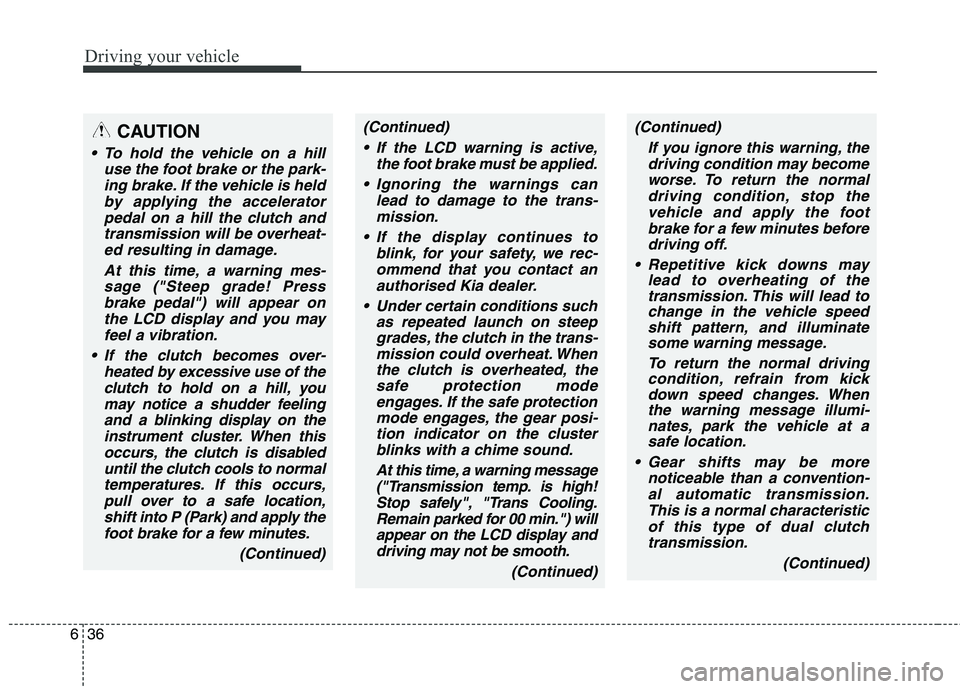
36
6
CAUTION
To hold the vehicle on a hill
use the foot brake or the park-ing brake. If the vehicle is heldby applying the acceleratorpedal on a hill the clutch and transmission will be overheat-ed resulting in damage.
At this time, a warning mes-sage ("Steep grade! Pressbrake pedal") will appear on the LCD display and you mayfeel a vibration.
If the clutch becomes over- heated by excessive use of theclutch to hold on a hill, you may notice a shudder feelingand a blinking display on theinstrument cluster. When this occurs, the clutch is disableduntil the clutch cools to normaltemperatures. If this occurs, pull over to a safe location,shift into P (Park) and apply thefoot brake for a few minutes.
(Continued)
(Continued)
If the LCD warning is active, the foot brake must be applied.
Ignoring the warnings can lead to damage to the trans-mission.
If the display continues to blink, for your safety, we rec-ommend that you contact anauthorised Kia dealer.
Under certain conditions such as repeated launch on steepgrades, the clutch in the trans-mission could overheat. When
the clutch is overheated, thesafe protection modeengages. If the safe protectionmode engages, the gear posi-tion indicator on the clusterblinks with a chime sound.
At this time, a warning message("Transmission temp. is high! Stop safely", "Trans Cooling.Remain parked for 00 min.") willappear on the LCD display anddriving may not be smooth.
(Continued)(Continued)If you ignore this warning, thedriving condition may becomeworse. To return the normal driving condition, stop thevehicle and apply the footbrake for a few minutes before driving off.
Repetitive kick downs may lead to overheating of thetransmission. This will lead tochange in the vehicle speed shift pattern, and illuminatesome warning message.
To return the normal drivingcondition, refrain from kickdown speed changes. Whenthe warning message illumi- nates, park the vehicle at asafe location.
Gear shifts may be more noticeable than a convention-al automatic transmission.This is a normal characteristic of this type of dual clutchtransmission.
(Continued)
Page 474 of 723

639
Driving your vehicle
D (Drive)
This is the normal driving position.
The transmission will automatically
shift through a seven-gear
sequence, providing the best fuel
economy and power.
For extra power when passing anoth-
er vehicle or driving uphill depress
the accelerator pedal further until
you feel the transmission downshift
to a lower gear.Sports mode
Whether the vehicle is stationary or
in motion, sports mode is selected by
pushing the shift lever from the D
(Drive) position into the manual gate.
To return to D (Drive) range opera-
tion, push the shift lever back into the
main gate.
In Sports Mode, moving the shift lever
backwards and forwards will allow you
to select the desired range of gears
for the current driving conditions.
+ (Up) : Push the lever forward onceto shift up one gear.
- (Down) : Pull the lever backwards once to shift down one
gear.
ORP052020R
Sports mode
+
+++ ((((UUUUPPPP))))
---- ((((DDDDOOOOWWWWNNNN))))
(Continued)
After the ignition switch has been turned off, the electronicparking brake cannot be dis- engaged.
For EPB (Electronic Parking Brake) equipped vehicles with[AUTO HOLD] function usedwhilst driving, if the ignition button has been turned [OFF],the electronic parking brakewill be engaged automatically.
Therefore, [AUTO HOLD] func-tion should be turned off before the ignition button isturned off.
Page 475 of 723
Driving your vehicle
40
6
✽✽
NOTICE
Only the seven forward gears can be selected. To reverse or park the
vehicle, move the shift lever to the
R (Reverse) or P (Park) position as
required.
Downshifts are made automatical- ly when the vehicle slows down.
When the vehicle stops, 1st gear is
automatically selected.
When the engine rpm approaches the red zone the transmission will
upshift automatically.
If the driver presses the lever to + (Up) or - (Down) position, the
transmission may not make the
requested gear change if the next
gear is outside of the allowable
engine rpm range. The driver
must execute upshifts in accor-
dance with road conditions, taking
care to keep the engine rpms
below the red zone.Shift lock system (if equipped)
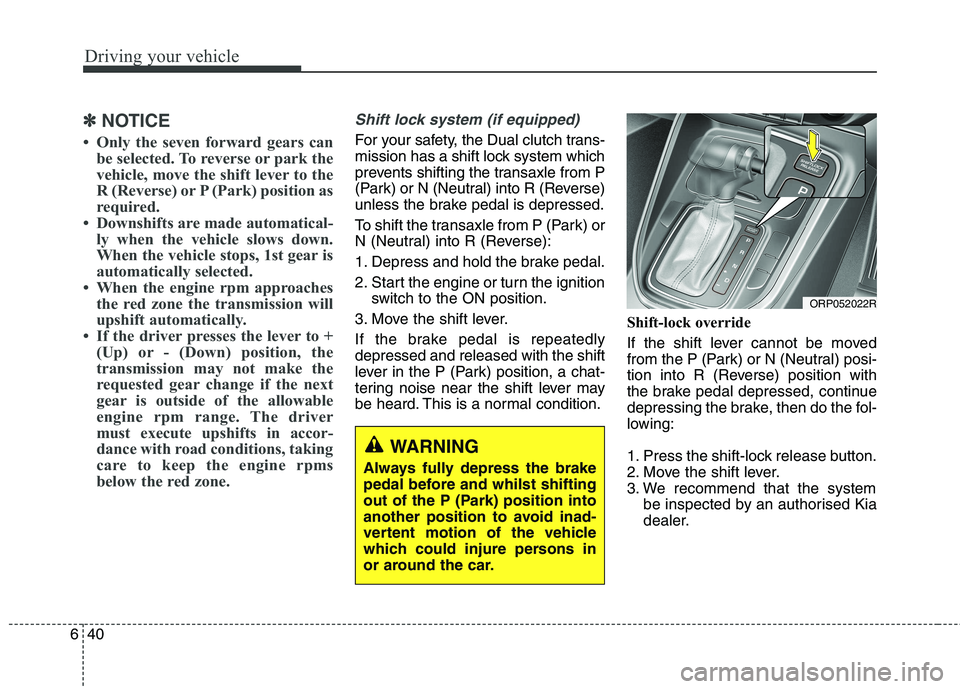
For your safety, the Dual clutch trans-
mission has a shift lock system which
prevents shifting the transaxle from P
(Park) or N (Neutral) into R (Reverse)
unless the brake pedal is depressed.
To shift the transaxle from P (Park) or
N (Neutral) into R (Reverse):
1. Depress and hold the brake pedal.
2. Start the engine or turn the ignition switch to the ON position.
3. Move the shift lever.
If the brake pedal is repeatedly depressed and released with the shift
lever in the P (Park) position, a chat-
tering noise near the shift lever may
be heard. This is a normal condition. Shift-lock override
If the shift lever cannot be moved
from the P (Park) or N (Neutral) posi-
tion into R (Reverse) position with
the brake pedal depressed, continue
depressing the brake, then do the fol-
lowing:
1. Press the shift-lock release button.
2. Move the shift lever.
3. We recommend that the system
be inspected by an authorised Kia
dealer.
ORP052022R
WARNING
Always fully depress the brake
pedal before and whilst shifting
out of the P (Park) position into
another position to avoid inad-
vertent motion of the vehicle
which could injure persons in
or around the car.
Page 478 of 723

643
Driving your vehicle
Active ECO operation
Active ECO helps improve fuel effi-
ciency by controlling the engine and
transaxle. But fuel-efficiency can be
changed by the driver's driving habits
and road conditions.
When the Active ECO button ispressed the ECO indicator (green)
will illuminate to show that the
Active ECO is operating.
If Active ECO is turned off, it will return to the normal mode. When Active ECO is activated:
The acceleration may slightly be
reduced eventhough you depress
the accelerator fully.
The air conditioner performance may be limited.
The shift pattern of the automatic transaxle/dual clutch transmission
may change.
The above situations are normal
conditions when the active eco sys-
tem is activated to improve fuel effi-
ciency. Limitation of Active ECO oper- ation:
If the following conditions occur
whilst Active ECO is operating, the
system operation is limited eventhough there is no change in the
ECO indicator.
When the coolant temperature is
low: The system will be limited until
engine performance becomes nor-mal.
When driving up a hill: The system will be limited to gain power when
driving uphill because the engine
torque is restricted.
When using sports mode: The sys- tem will be limited according to theshift location.
When the accelerator pedal is deeply pressed for a few seconds:The system will be limited, judging
that the driver wants to speed up.
ACTIVE ECO SYSTEM (IF EQUIPPED)
ORP056023R
Page 481 of 723

Driving your vehicle
46
6
Parking brake - Hand type
Applying the parking brake
To engage the parking brake, first
apply the foot brake and then without
pressing the release button in, pull
the parking brake lever up as far as
possible. In addition it is recommend-
ed that when parking the vehicle on
a gradient, the shift lever should be
positioned in the appropriate low
gear for manual transaxle vehicles or
in the P (Park) position for automatic
transaxle / dual clutch transmission
vehicles.
Releasing the parking brake
To release the parking brake, first
apply the foot brake and pull up the
parking brake lever slightly. Secondly
press the release button (1) and
lower the parking brake lever (2)
whilst pressing the button.
ORP052025R
ORP056024R
CAUTION
Driving with the parking brake
applied will cause excessivebrake pad (or lining) and brake rotor wear.
Do not operate the parking brake whilst the vehicle ismoving except in an emer-gency situation. It could dam- age the vehicle system andmake endanger driving safety.