automatic transmission KIA CARENS RHD 2017 Owner's Guide
[x] Cancel search | Manufacturer: KIA, Model Year: 2017, Model line: CARENS RHD, Model: KIA CARENS RHD 2017Pages: 723, PDF Size: 40.8 MB
Page 553 of 723
73
What to do in an emergency
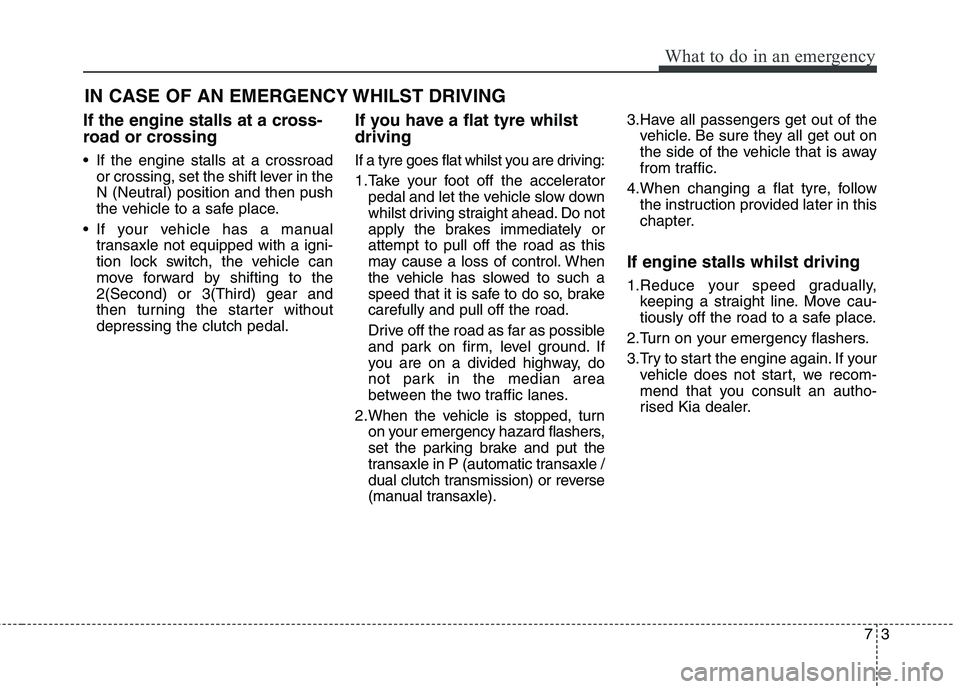
IN CASE OF AN EMERGENCY WHILST DRIVING
If the engine stalls at a cross-
road or crossing
If the engine stalls at a crossroad or crossing, set the shift lever in the
N (Neutral) position and then push
the vehicle to a safe place.
If your vehicle has a manual transaxle not equipped with a igni-
tion lock switch, the vehicle can
move forward by shifting to the2(Second) or 3(Third) gear and
then turning the starter withoutdepressing the clutch pedal. If you have a flat tyre whilst driving
If a tyre goes flat whilst you are driving:
1.Take your foot off the accelerator
pedal and let the vehicle slow down
whilst driving straight ahead. Do not
apply the brakes immediately orattempt to pull off the road as this
may cause a loss of control. When
the vehicle has slowed to such a
speed that it is safe to do so, brakecarefully and pull off the road.
Drive off the road as far as possible
and park on firm, level ground. If
you are on a divided highway, do
not park in the median area
between the two traffic lanes.
2.When the vehicle is stopped, turn on your emergency hazard flashers,
set the parking brake and put the
transaxle in P (automatic transaxle /
dual clutch transmission) or reverse
(manual transaxle). 3.Have all passengers get out of the
vehicle. Be sure they all get out on
the side of the vehicle that is away
from traffic.
4.When changing a flat tyre, follow the instruction provided later in this
chapter.
If engine stalls whilst driving
1.Reduce your speed gradually, keeping a straight line. Move cau-
tiously off the road to a safe place.
2.Turn on your emergency flashers.
3.Try to start the engine again. If your vehicle does not start, we recom-
mend that you consult an autho-
rised Kia dealer.
Page 557 of 723
77
What to do in an emergency
1.Make sure the booster battery is12-volt and that its negative termi-
nal is grounded.
2.If the booster battery is in another vehicle, do not allow the vehicles totouch.
3.Turn off all unnecessary electrical loads.
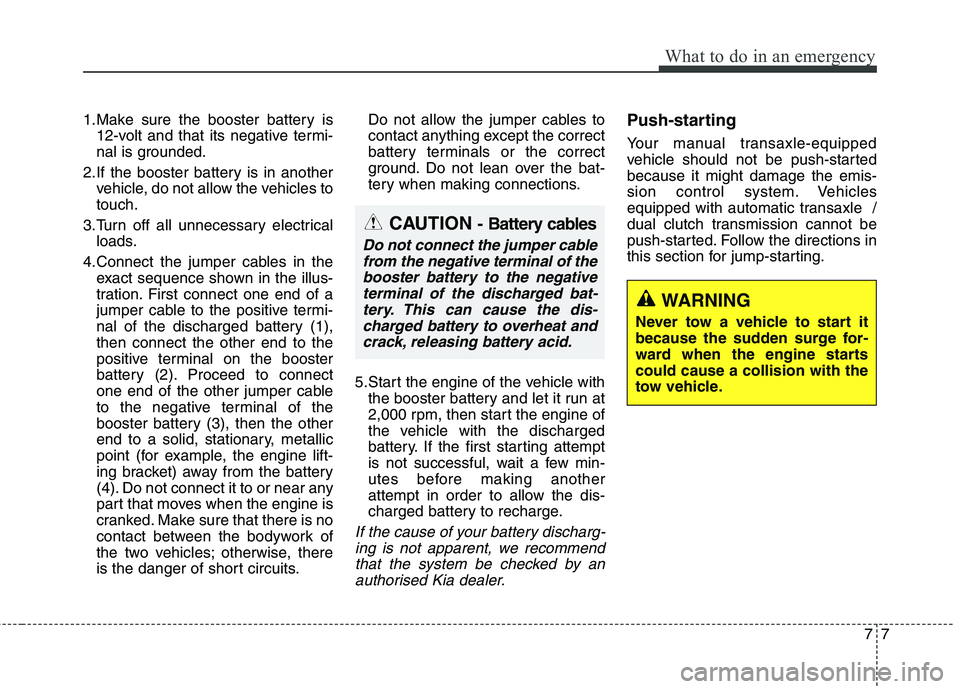
4.Connect the jumper cables in the exact sequence shown in the illus-
tration. First connect one end of a
jumper cable to the positive termi-
nal of the discharged battery (1),then connect the other end to the
positive terminal on the booster
battery (2). Proceed to connect
one end of the other jumper cable
to the negative terminal of the
booster battery (3), then the other
end to a solid, stationary, metallic
point (for example, the engine lift-
ing bracket) away from the battery
(4). Do not connect it to or near any
part that moves when the engine is
cranked. Make sure that there is no
contact between the bodywork of
the two vehicles; otherwise, there
is the danger of short circuits. Do not allow the jumper cables to
contact anything except the correct
battery terminals or the correct
ground. Do not lean over the bat-
tery when making connections.
5.Start the engine of the vehicle with the booster battery and let it run at
2,000 rpm, then start the engine of
the vehicle with the discharged
battery. If the first starting attempt
is not successful, wait a few min-
utes before making another
attempt in order to allow the dis-
charged battery to recharge.
If the cause of your battery discharg-
ing is not apparent, we recommendthat the system be checked by an authorised Kia dealer.
Push-starting
Your manual transaxle-equipped
vehicle should not be push-startedbecause it might damage the emis-
sion control system. Vehicles
equipped with automatic transaxle /
dual clutch transmission cannot be
push-started. Follow the directions in
this section for jump-starting.
CAUTION - Battery cables
Do not connect the jumper cable
from the negative terminal of thebooster battery to the negative terminal of the discharged bat-tery. This can cause the dis-charged battery to overheat and crack, releasing battery acid.
WARNING
Never tow a vehicle to start it
because the sudden surge for-
ward when the engine startscould cause a collision with the
tow vehicle.
Page 567 of 723
717
What to do in an emergency
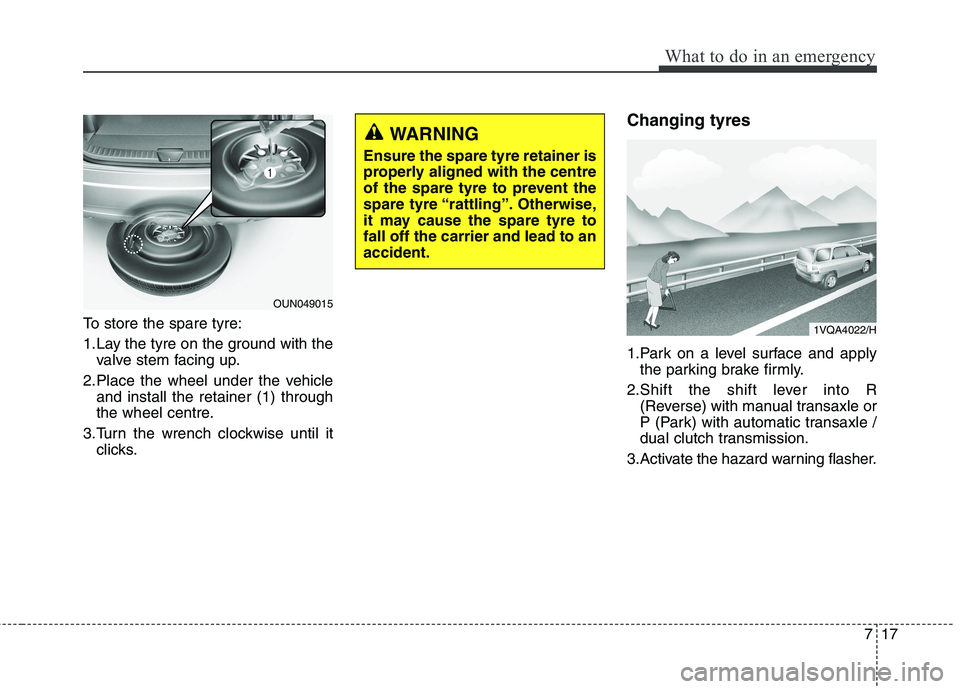
To store the spare tyre:
1.Lay the tyre on the ground with thevalve stem facing up.
2.Place the wheel under the vehicle and install the retainer (1) through
the wheel centre.
3.Turn the wrench clockwise until it clicks. Changing tyres
1.Park on a level surface and apply
the parking brake firmly.
2.Shift the shift lever into R (Reverse) with manual transaxle or
P (Park) with automatic transaxle /
dual clutch transmission.
3.Activate the hazard warning flasher.
OUN049015
WARNING
Ensure the spare tyre retainer is
properly aligned with the centre
of the spare tyre to prevent the
spare tyre “rattling”. Otherwise,
it may cause the spare tyre tofall off the carrier and lead to anaccident.
1VQA4022/H
Page 574 of 723
What to do in an emergency
24
7
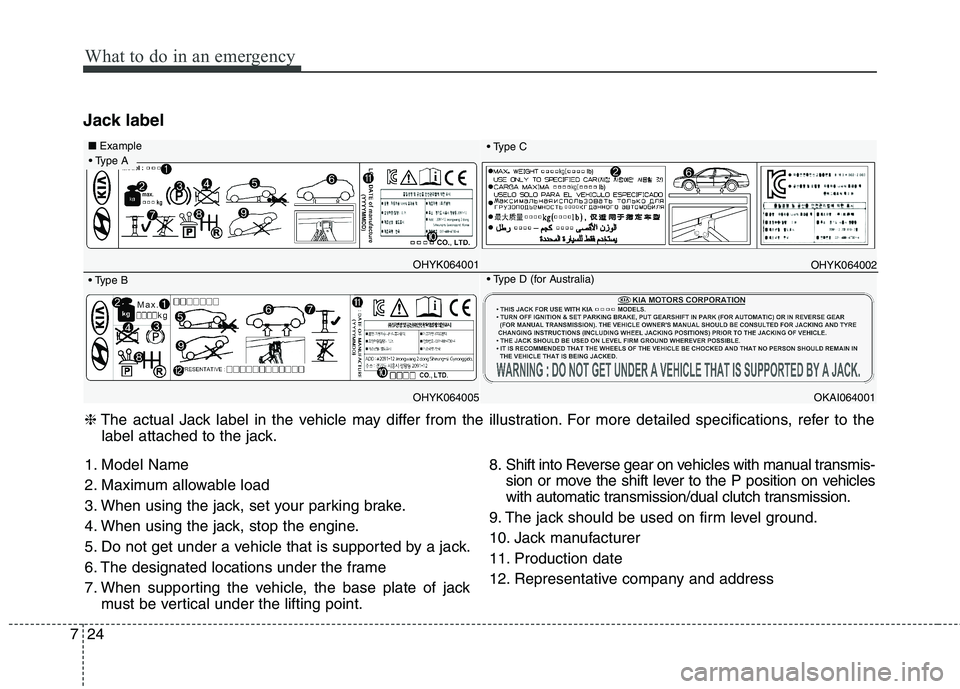
Jack label
❈ The actual Jack label in the vehicle may differ from the illustration. For more detailed specifications, refer to the
label attached to the jack.
OHYK064002
■ Example
OHYK064005
OHYK064001
OKAI064001
1. Model Name
2. Maximum allowable load
3. When using the jack, set your parking brake.
4. When using the jack, stop the engine.
5. Do not get under a vehicle that is supported by a jack.
6. The designated locations under the frame
7. When supporting the vehicle, the base plate of jack must be vertical under the lifting point. 8. Shift into Reverse gear on vehicles with manual transmis-
sion or move the shift lever to the P position on vehicles
with automatic transmission/dual clutch transmission.
9. The jack should be used on firm level ground.
10. Jack manufacturer
11. Production date
12. Representative company and address
Page 586 of 723
What to do in an emergency
36
7
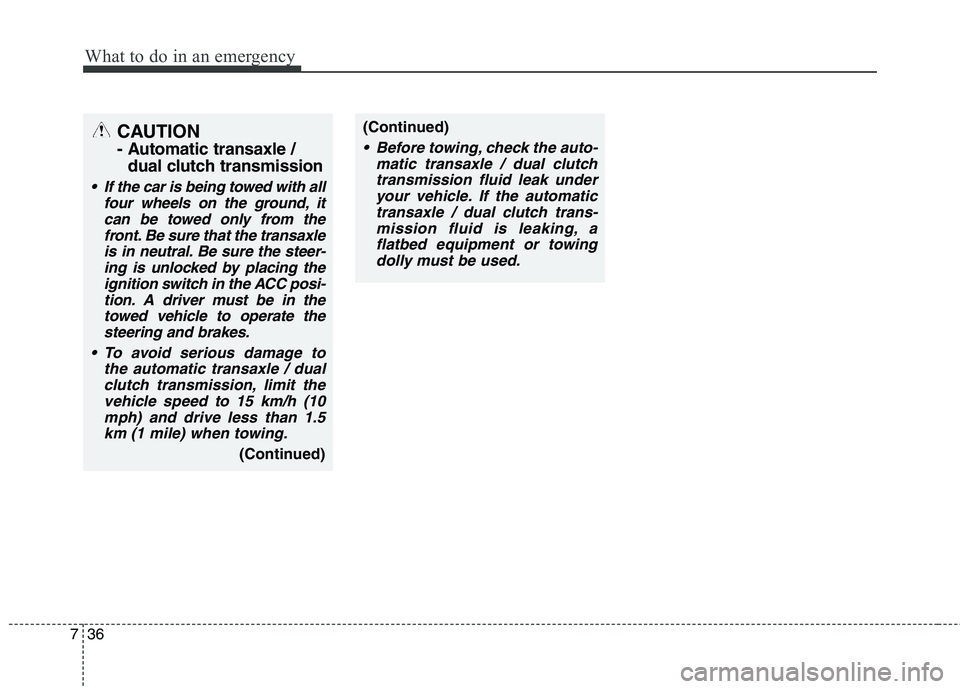
CAUTION
- Automatic transaxle /
dual clutch transmission
If the car is being towed with all four wheels on the ground, itcan be towed only from thefront. Be sure that the transaxleis in neutral. Be sure the steer- ing is unlocked by placing theignition switch in the ACC posi-tion. A driver must be in the towed vehicle to operate thesteering and brakes.
To avoid serious damage to the automatic transaxle / dualclutch transmission, limit the vehicle speed to 15 km/h (10mph) and drive less than 1.5km (1 mile) when towing.
(Continued)
(Continued)
Before towing, check the auto- matic transaxle / dual clutchtransmission fluid leak under your vehicle. If the automatictransaxle / dual clutch trans-mission fluid is leaking, a flatbed equipment or towingdolly must be used.
Page 597 of 723
Maintenance
10
8
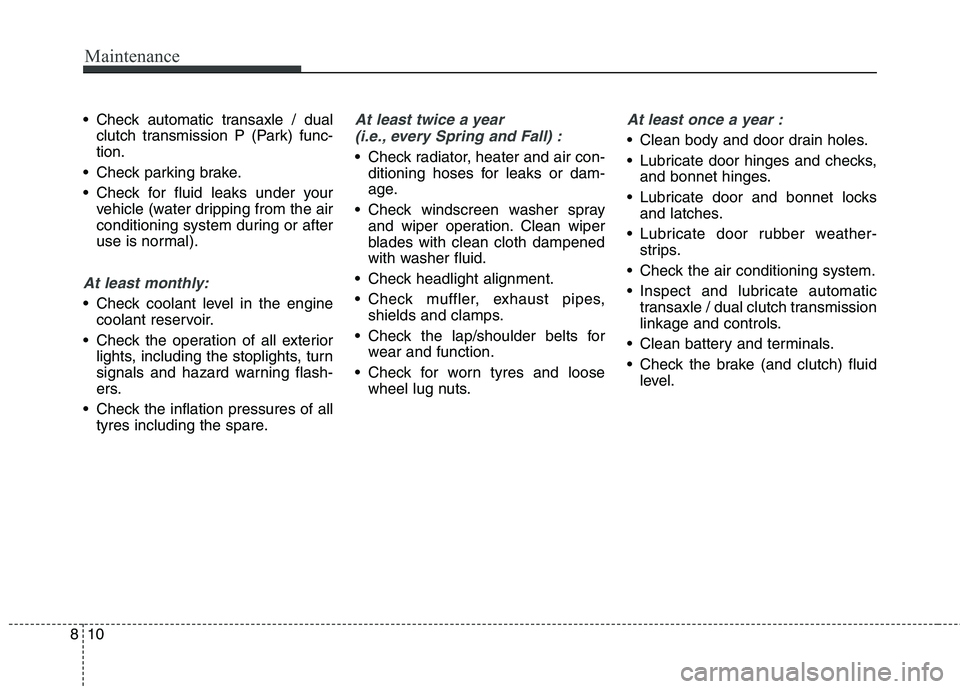
Check automatic transaxle / dual
clutch transmission P (Park) func- tion.
Check parking brake.
Check for fluid leaks under your vehicle (water dripping from the air
conditioning system during or after
use is normal).
At least monthly:
Check coolant level in the enginecoolant reservoir.
Check the operation of all exterior lights, including the stoplights, turn
signals and hazard warning flash-
ers.
Check the inflation pressures of all tyres including the spare.
At least twice a year
(i.e., every Spring and Fall) :
Check radiator, heater and air con- ditioning hoses for leaks or dam-
age.
Check windscreen washer spray and wiper operation. Clean wiper
blades with clean cloth dampened
with washer fluid.
Check headlight alignment.
Check muffler, exhaust pipes, shields and clamps.
Check the lap/shoulder belts for wear and function.
Check for worn tyres and loose wheel lug nuts.
At least once a year :
Clean body and door drain holes.
Lubricate door hinges and checks,and bonnet hinges.
Lubricate door and bonnet locks and latches.
Lubricate door rubber weather- strips.
Check the air conditioning system.
Inspect and lubricate automatic transaxle / dual clutch transmission
linkage and controls.
Clean battery and terminals.
Check the brake (and clutch) fluid level.
Page 601 of 723
Maintenance
14
8
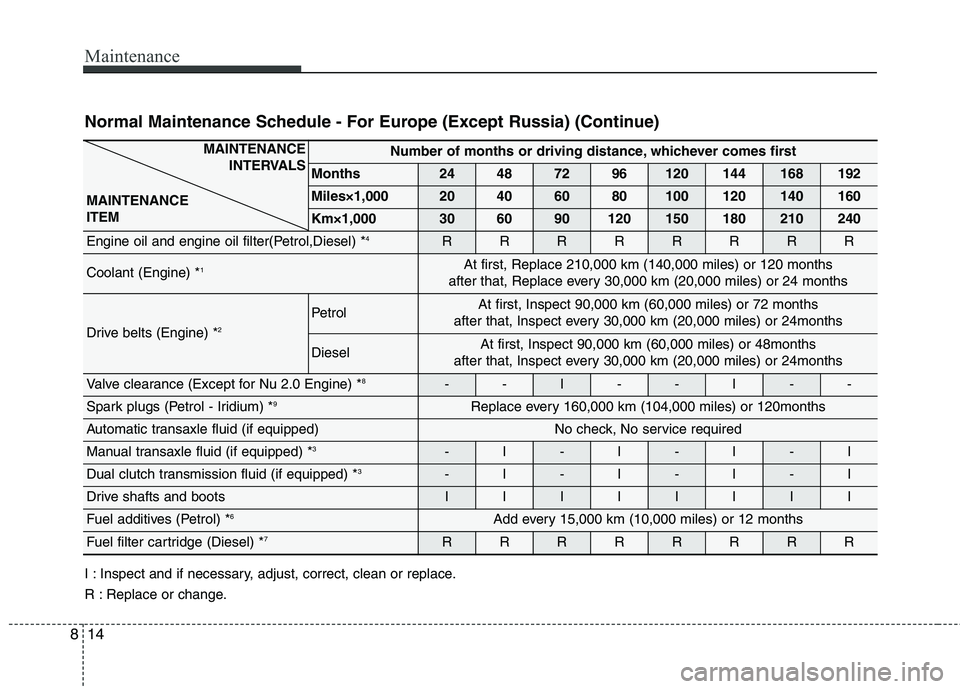
Normal Maintenance Schedule - For Europe (Except Russia) (Continue)
I : Inspect and if necessary, adjust, correct, clean or replace.
R : Replace or change.
MAINTENANCE
INTERVALS
MAINTENANCE ITEMNumber of months or driving distance, whichever comes first
Months24487296120144168192
Miles×1,00020406080100120140160
Km×1,000306090120150180210240
Engine oil and engine oil filter(Petrol,Diesel) * 4RRRRRRRR
Coolant (Engine) *1At first, Replace 210,000 km (140,000 miles) or 120 months
after that, Replace every 30,000 km (20,000 miles) or 24 months
Drive belts (Engine) * 2
PetrolAt first, Inspect 90,000 km (60,000 miles) or 72 months
after that, Inspect every 30,000 km (20,000 miles) or 24months
DieselAt first, Inspect 90,000 km (60,000 miles) or 48months
after that, Inspect every 30,000 km (20,000 miles) or 24months
Valve clearance (Except for Nu 2.0 Engine) * 8--I--I--
Spark plugs (Petrol - Iridium) *9Replace every 160,000 km (104,000 miles) or 120months
Automatic transaxle fluid (if equipped)No check, No service required
Manual transaxle fluid (if equipped) * 3-I-I-I-I
Dual clutch transmission fluid (if equipped) * 3-I-I-I-I
Drive shafts and bootsIIIIIIII
Fuel additives (Petrol) *6Add every 15,000 km (10,000 miles) or 12 months
Fuel filter cartridge (Diesel) * 7RRRRRRRR
Page 604 of 723
817
Maintenance
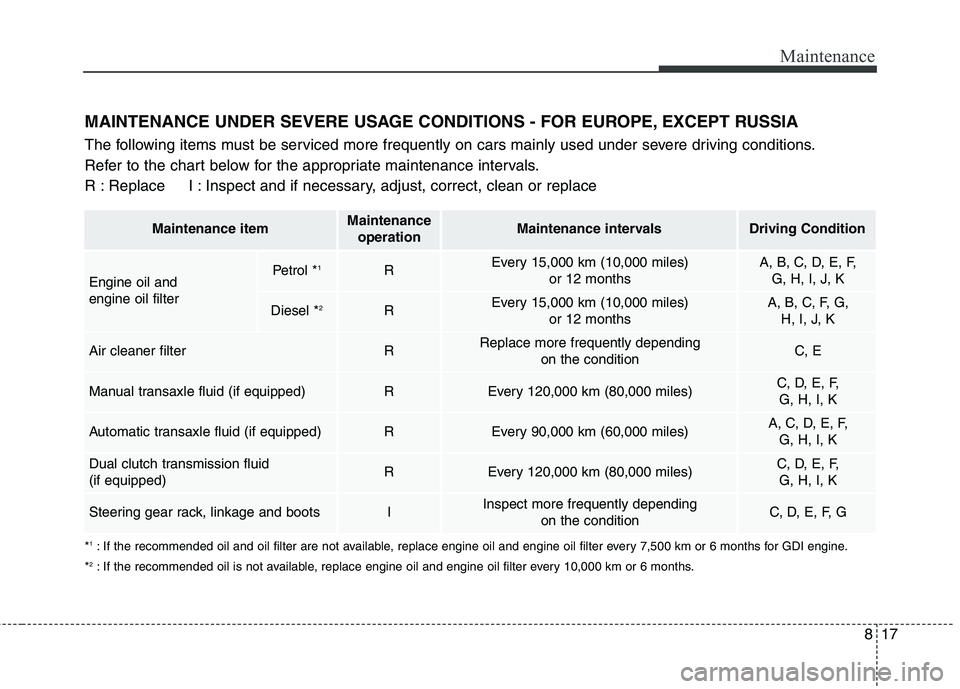
MAINTENANCE UNDER SEVERE USAGE CONDITIONS - FOR EUROPE, EXCEPT RUSSIA
The following items must be serviced more frequently on cars mainly used under severe driving conditions.
Refer to the chart below for the appropriate maintenance intervals.
R : Replace I : Inspect and if necessary, adjust, correct, clean or replace
Maintenance itemMaintenanceoperationMaintenance intervalsDriving Condition
Engine oil and engine oil filterREvery 15,000 km (10,000 miles) or 12 monthsA, B, C, D, E, F, G, H, I, J, K
REvery 15,000 km (10,000 miles) or 12 monthsA, B, C, F, G, H, I, J, K
Air cleaner filterRReplace more frequently depending on the conditionC, E
Manual transaxle fluid (if equipped)REvery 120,000 km (80,000 miles)C, D, E, F, G, H, I, K
Automatic transaxle fluid (if equipped)REvery 90,000 km (60,000 miles)A, C, D, E, F, G, H, I, K
Dual clutch transmission fluid (if equipped)REvery 120,000 km (80,000 miles)C, D, E, F, G, H, I, K
Steering gear rack, linkage and bootsIInspect more frequently depending on the conditionC, D, E, F, G
Petrol *1
Diesel * 2
* 1
: If the recommended oil and oil filter are not available, replace engine oil and engine oil filter every 7,500 km or 6 months for GDI engine.
* 2
: If the recommended oil is not available, replace engine oil and engine oil filter every 10,000 km or 6 months.
Page 610 of 723
823
Maintenance
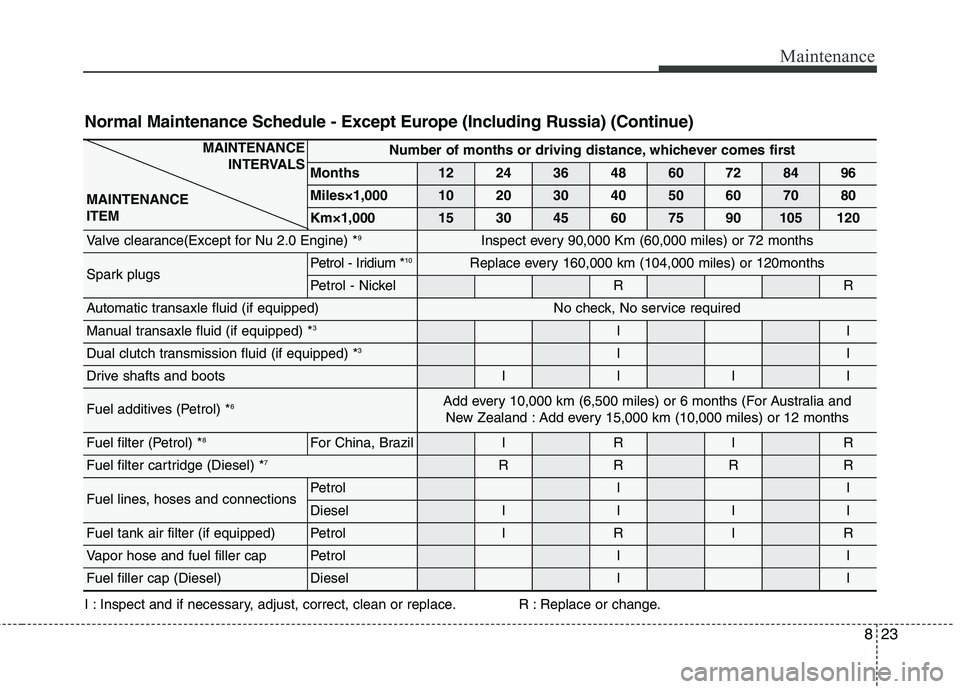
Normal Maintenance Schedule - Except Europe (Including Russia) (Continue)
MAINTENANCE INTERVALS
MAINTENANCE ITEMNumber of months or driving distance, whichever comes first
Months1224364860728496
Miles×1,0001020304050607080
Km×1,000153045607590105120
Valve clearance(Except for Nu 2.0 Engine) * 9Inspect every 90,000 Km (60,000 miles) or 72 months
Spark plugsPetrol - Iridium *10
Replace every 160,000 km (104,000 miles) or 120months
Petrol - NickelRR
Automatic transaxle fluid (if equipped)No check, No service required
Manual transaxle fluid (if equipped) * 3II
Dual clutch transmission fluid (if equipped) * 3II
Drive shafts and bootsIIII
Fuel additives (Petrol) *6Add every 10,000 km (6,500 miles) or 6 months (For Australia and
New Zealand : Add every 15,000 km (10,000 miles) or 12 months
Fuel filter (Petrol) * 8For China, BrazilIRIR
Fuel filter cartridge (Diesel) * 7RRRR
Fuel lines, hoses and connectionsPetrolII
DieselIIII
Fuel tank air filter (if equipped)PetrolIRIR
Vapor hose and fuel filler capPetrolII
Fuel filler cap (Diesel)DieselII
I : Inspect and if necessary, adjust, correct, clean or replace. R : Replace or change.
Page 613 of 723
Maintenance
26
8
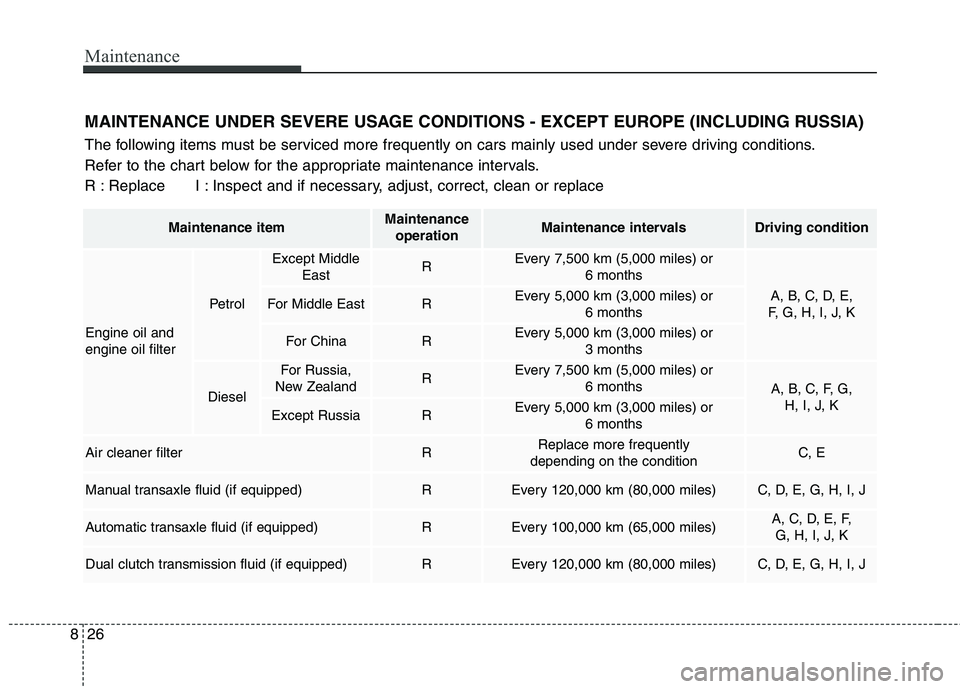
MAINTENANCE UNDER SEVERE USAGE CONDITIONS - EXCEPT EUROPE (INCLUDING RUSSIA)
The following items must be serviced more frequently on cars mainly used under severe driving conditions.
Refer to the chart below for the appropriate maintenance intervals.
R : Replace I : Inspect and if necessary, adjust, correct, clean or replace
Maintenance itemMaintenance
operationMaintenance intervalsDriving condition
Engine oil and engine oil filter
Petrol
Except Middle EastREvery 7,500 km (5,000 miles) or 6 months
A, B, C, D, E,
F, G, H, I, J, K For Middle EastREvery 5,000 km (3,000 miles) or 6 months
For ChinaREvery 5,000 km (3,000 miles) or 3 months
Diesel
For Russia,
New ZealandREvery 7,500 km (5,000 miles) or 6 months
A, B, C, F, G, H, I, J, K
Except RussiaREvery 5,000 km (3,000 miles) or 6 months
Air cleaner filterRReplace more frequently
depending on the conditionC, E
Manual transaxle fluid (if equipped)REvery 120,000 km (80,000 miles)C, D, E, G, H, I, J
Automatic transaxle fluid (if equipped)REvery 100,000 km (65,000 miles)A, C, D, E, F, G, H, I, J, K
Dual clutch transmission fluid (if equipped)REvery 120,000 km (80,000 miles)C, D, E, G, H, I, J