key battery KIA CARNIVAL 2007 User Guide
[x] Cancel search | Manufacturer: KIA, Model Year: 2007, Model line: CARNIVAL, Model: KIA CARNIVAL 2007Pages: 1575, PDF Size: 44.86 MB
Page 855 of 1575

2007 > 2.7L V6 GASOLINE >
REMOVAL
1.Disconnect the battery negative cable, and wait for at least three minutes before beginning work.
2. Remove the door scuff trim. (Refer to BD group)
3. Remove the center pillar trim. (Refer to BD group)
4. Remove the lower anchor bolt.
5. Remove the upper anchor bolt.
6. Loosen the Seat Belt Pretensioner mounting bolts and remove the Seat Belt Pretensioner.
7.Disconnect the Seat Belt Pretensioner connector.
INSTALLATION
1.Disconnect the negative ( - ) cable from battery and wait for at least three minutes.
2. Remove ignition key from the vehicle.
3. Connect the Seat Belt Pretensioner connector.
4. Install the Seat Belt Pretensioner (BPT) with bolts.
Tightening Torque (Seat Belt Anchor Bolt)
: 4.0 ~ 5.5 kgf.m (39.2 ~ 53.9 Nm, 28.9 ~ 39.8 lb.ft)
5. Install the upper and lower anchor bolts.
Tightening Torque (Seat Belt Anchor Bolt)
: 4.0 ~ 5.5 kgf.m (39.2 ~ 53.9 Nm, 28.9 ~ 39.8 lb.ft)
6. Install the center pillar trim and door scuff trim.
7. Reconnect the negative battery cable.
8. After installing the Seat Belt Pretensioner (BPT), confirm proper system operation:
a. Turn the ignition switch ON; the SRS indicator light should be turned on for about six seconds and then go off.
Page 859 of 1575

2007 > 2.7L V6 GASOLINE >
REMOVAL
1.Disconnect the battery negative cable, and wait for at least three minutes before beginning work.
2. Remove the front seat assembly. (Refer to BD group)
3. Loosen the Seat Belt Buckle Pretensioner mounting bolt and remove the Seat Belt Buckle Pretensioner.
INSTALLATION
1.Disconnect the battery negative cable and wait for at least three minutes.
2. Remove the ignition key from the vehicle.
3. Install the Seat Belt Buckle Pretensioner (BUPT) with the bolt.
Tightening torque
: 4.0 ~ 5.5 kgf.m (39.2 ~ 53.9 Nm, 28.9 ~ 39.8 lb.ft)
4. Install the front seat assembly.
a.Ensure that the harness is installed and routed properly to prevent damage to the wiring.
5. Reconnect the battery negative cable.
6. After installing the Seat Belt Buckle Pretensioner (BUPT), confirm proper system operation:
a. Turn the ignition switch ON; the SRS indicator light should be turned on for about six seconds and then go off.
Page 926 of 1575

18Voltage for hybrid ECU 1 A500 mA 60200
5,10,17,19 signal wheel speed sensor FL,
FR, RL,RR
6 mA
16 mA 250200 to
ground 1.5M to bat
16,9,6,8 Voltage supply for the active
wheel speed sensor FL,FR,
RL, RR 6 mA
16 mA 250200 to
ground 1.5M to bat
14,24 wheel speed sensor output
(FR, RL) 20 mA
10 mA 250200
11 Diagnostic wire K 6 mA3 mA 250200
22 ABS - warning lamp actuation 30 mA5 mA 250200
12 EBD- warning lamp actuation 30 mA5 mA 250200
20 brake light switch 10 mA5 mA 250200
15 CAN Low 30 mA20 mA 250200
26 CAN High 30 mA20 mA 250200
ABS HECU CONNECTOR Connector terminal SpecificationCondition
Number Description
1 Ground for recirculation pump Current range: Min.10A
Max.20~39A Always
4 Ground for solenoid valves and
ECU Current range: Min.2.5A
Max.5~15A Always
2 Voltage supply for pump motor
Battery voltageAlways
3 Voltage supply for solenoid valves
16 Voltage supply for the active
wheel speed sensor FL,FR, RL, RR Battery voltage
IG ON
9
6
8
5
signal wheel speed sensor FL, FR, RL,RR Voltage(High) : 0.89~1.26 V
Voltage (Low) : 0.44~0.63 V On driving
10
17
19
11
Diagnostic wire K Voltage (High)
≥ 0.8 * IG ON
Voltage (Low) ≤ 0.2 * IG ON On SCAN TOOL
communication
18 Voltage for hybrid ECU Battery voltageKEY ON/OFF
20 Brake light switch Voltage (High)
≥ 0.8 * IG ON
Voltage (Low) ≤ 0.3 * IG ON BRAKE ON/OFF
SENSOR OUTPUT ON SCAN TOOL(ABS) Description AbbreviationUnitRemarks
1 Vehicle speed sensor VEH. SPDKm/h
2 Battery voltage BATT. VOLV
3 FL Wheel speed sensor FL WHEELKm/h
Page 966 of 1575
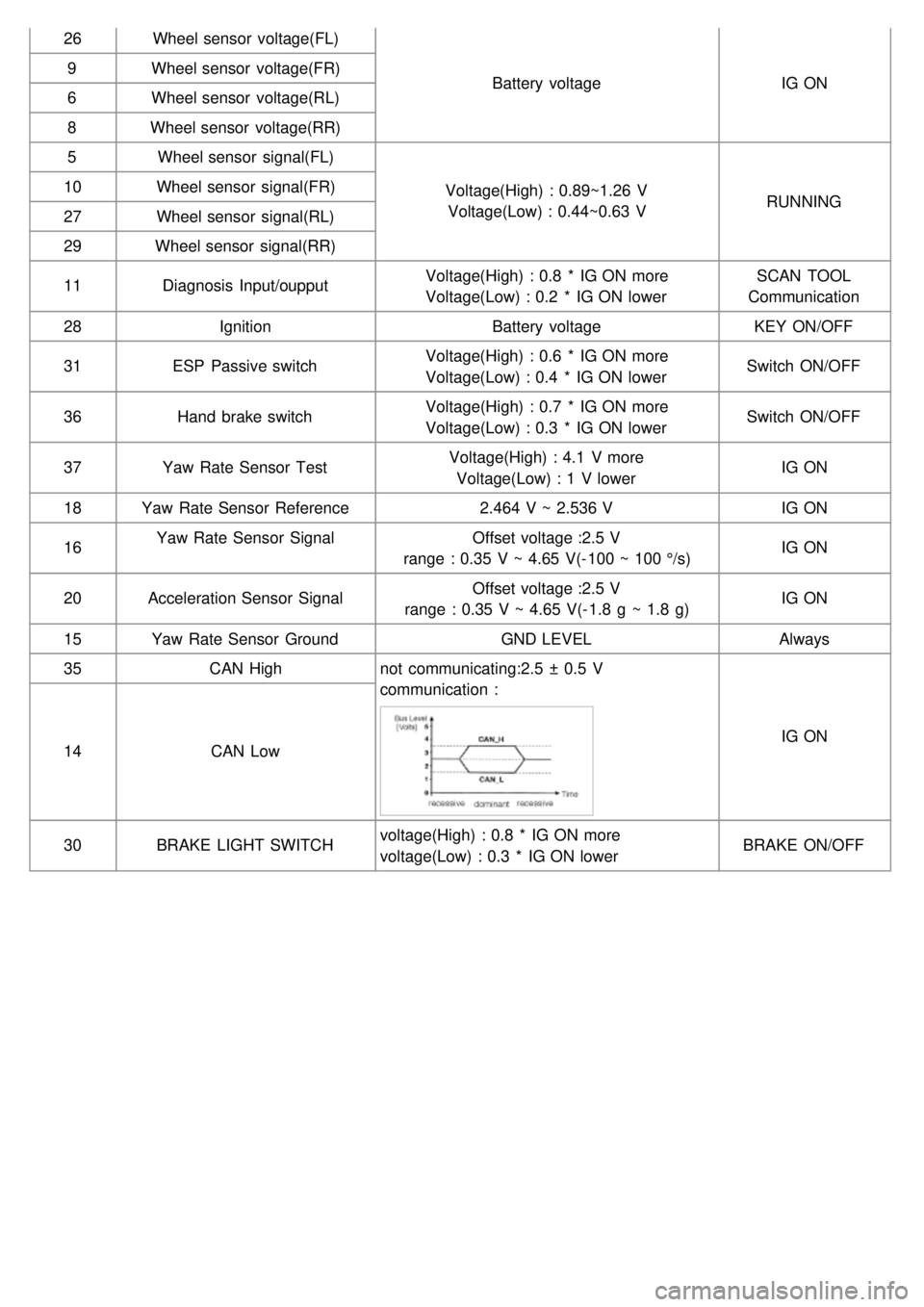
26Wheel sensor voltage(FL)
Battery voltageIG ON
9
Wheel sensor voltage(FR)
6 Wheel sensor voltage(RL)
8 Wheel sensor voltage(RR)
5 Wheel sensor signal(FL)
Voltage(High) : 0.89~1.26 VVoltage(Low) : 0.44~0.63 V RUNNING
10
Wheel sensor signal(FR)
27 Wheel sensor signal(RL)
29 Wheel sensor signal(RR)
11 Diagnosis Input/oupput Voltage(High) : 0.8 * IG ON more
Voltage(Low) : 0.2 * IG ON lower SCAN TOOL
Communication
28 Ignition Battery voltageKEY ON/OFF
31 ESP Passive switch Voltage(High) : 0.6 * IG ON more
Voltage(Low) : 0.4 * IG ON lower Switch ON/OFF
36 Hand brake switch Voltage(High) : 0.7 * IG ON more
Voltage(Low) : 0.3 * IG ON lower Switch ON/OFF
37 Yaw Rate Sensor Test Voltage(High) : 4.1 V more
Voltage(Low) : 1 V lower IG ON
18 Yaw Rate Sensor Reference 2.464 V ~ 2.536 VIG ON
16 Yaw Rate Sensor Signal
Offset voltage :2.5 V
range : 0.35 V ~ 4.65 V(- 100 ~ 100 °/s) IG ON
20 Acceleration Sensor Signal Offset voltage :2.5 V
range : 0.35 V ~ 4.65 V(- 1.8 g ~ 1.8 g) IG ON
15 Yaw Rate Sensor Ground GND LEVELAlways
35 CAN High not communicating:2.5 ± 0.5 V
communication :
IG ON
14 CAN Low
30 BRAKE LIGHT SWITCH voltage(High) : 0.8 * IG ON more
voltage(Low) : 0.3 * IG ON lower BRAKE ON/OFF
Page 1207 of 1575
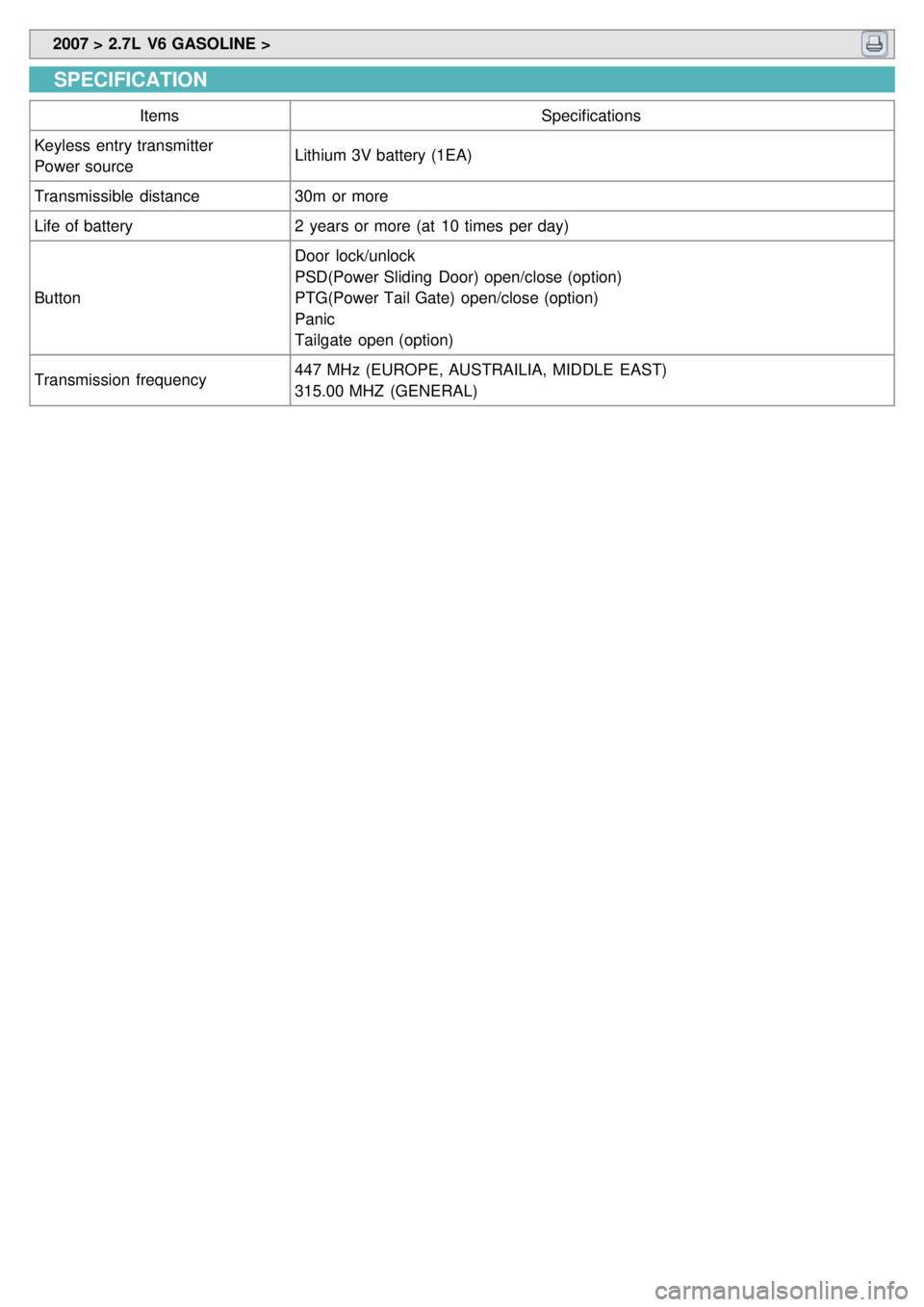
2007 > 2.7L V6 GASOLINE >
SPECIFICATION
Items Specifications
Keyless entry transmitter
Power source Lithium 3V battery (1EA)
Transmissible distance 30m or more
Life of battery 2 years or more (at 10 times per day)
Button Door lock/unlock
PSD(Power Sliding Door) open/close (option)
PTG(Power Tail Gate) open/close (option)
Panic
Tailgate open (option)
Transmission frequency 447 MHz (EUROPE, AUSTRAILIA, MIDDLE EAST)
315.00 MHZ (GENERAL)
Page 1217 of 1575
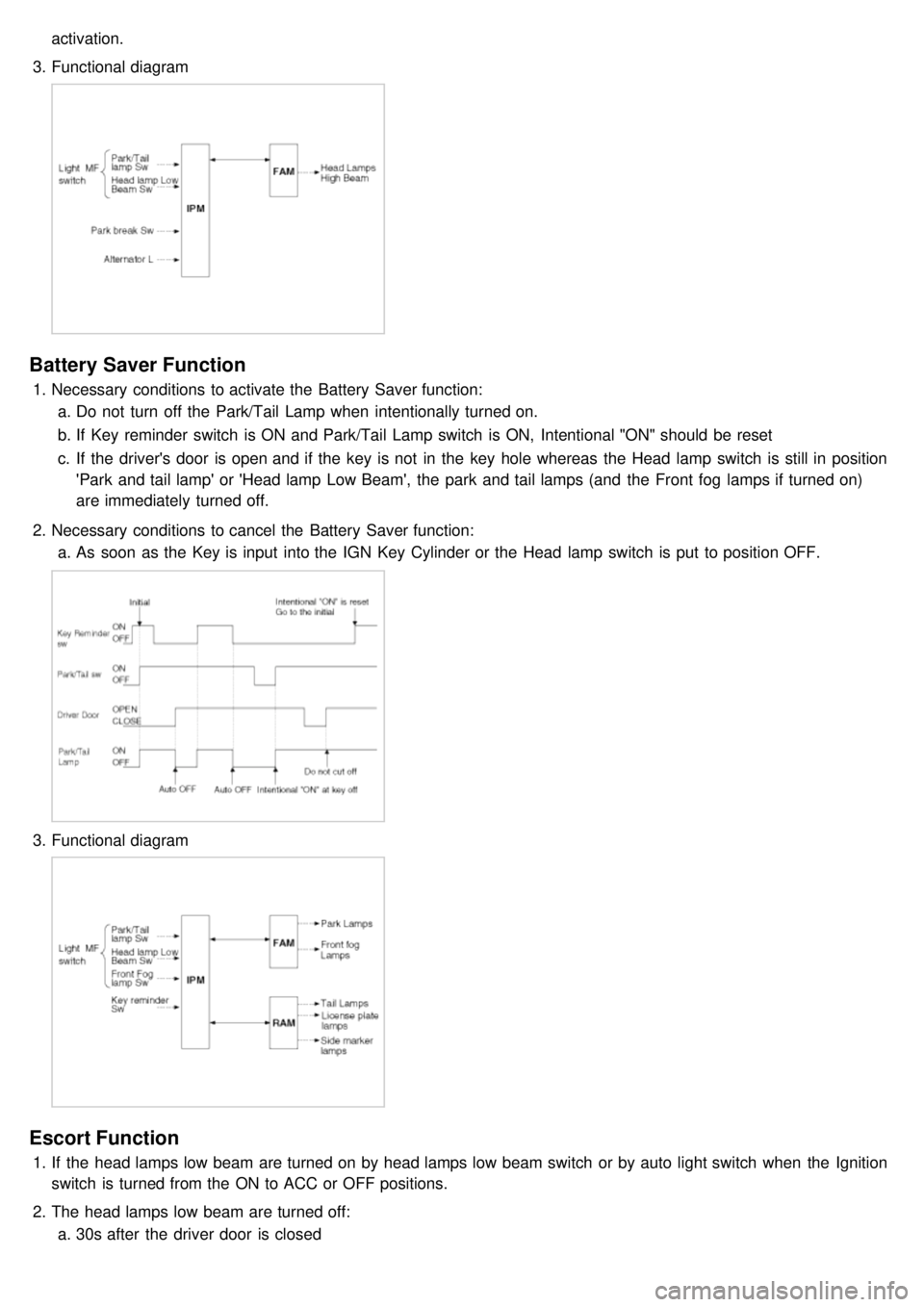
activation.
3. Functional diagram
Battery Saver Function
1.Necessary conditions to activate the Battery Saver function:
a. Do not turn off the Park/Tail Lamp when intentionally turned on.
b. If Key reminder switch is ON and Park/Tail Lamp switch is ON, Intentional "ON" should be reset
c. If the driver's door is open and if the key is not in the key hole whereas the Head lamp switch is still in position
'Park and tail lamp' or 'Head lamp Low Beam', the park and tail lamps (and the Front fog lamps if turned on)
are immediately turned off.
2. Necessary conditions to cancel the Battery Saver function:
a. As soon as the Key is input into the IGN Key Cylinder or the Head lamp switch is put to position OFF.
3.Functional diagram
Escort Function
1.If the head lamps low beam are turned on by head lamps low beam switch or by auto light switch when the Ignition
switch is turned from the ON to ACC or OFF positions.
2. The head lamps low beam are turned off:
a. 30s after the driver door is closed
Page 1218 of 1575
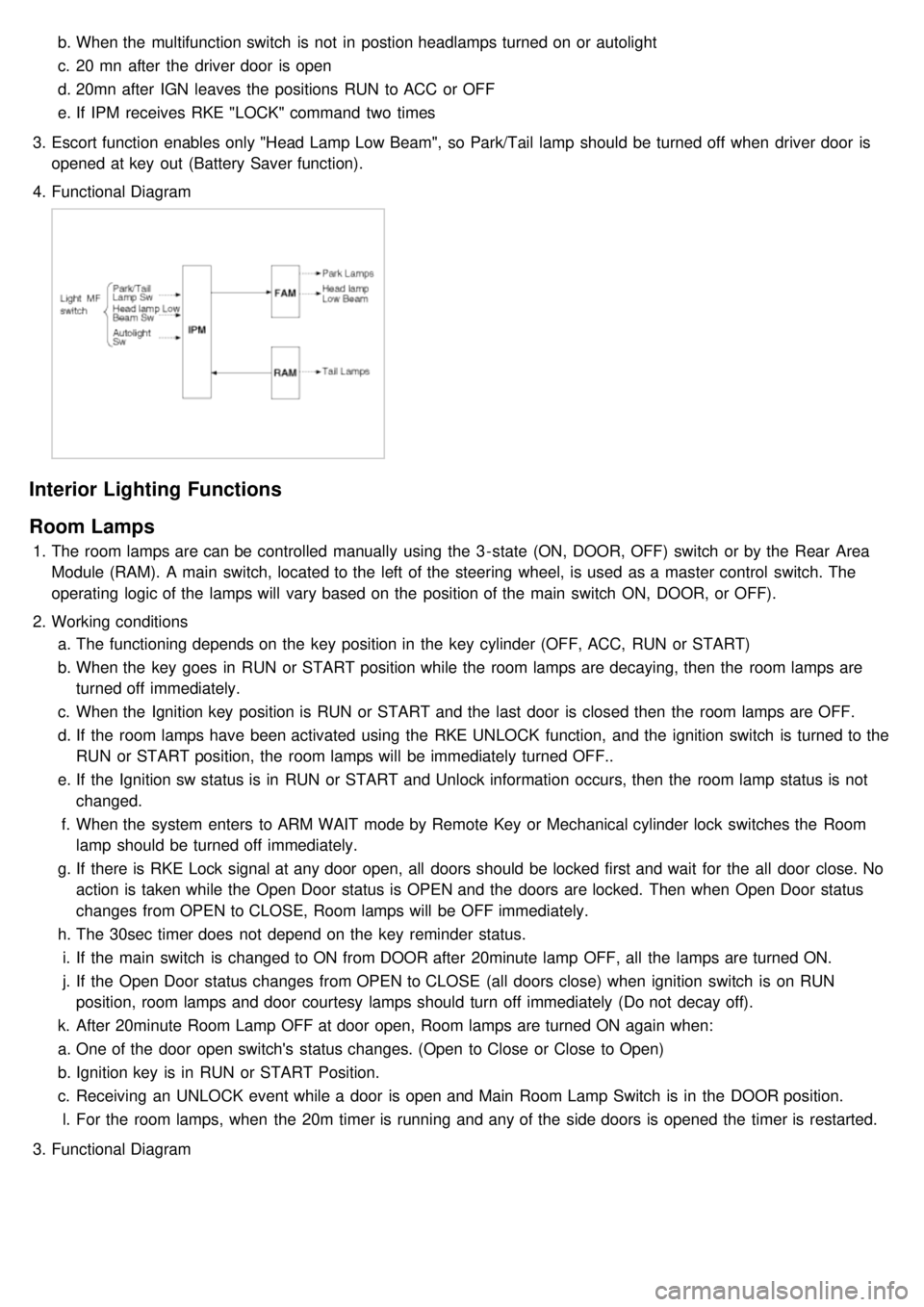
b.When the multifunction switch is not in postion headlamps turned on or autolight
c. 20 mn after the driver door is open
d. 20mn after IGN leaves the positions RUN to ACC or OFF
e. If IPM receives RKE "LOCK" command two times
3. Escort function enables only "Head Lamp Low Beam", so Park/Tail lamp should be turned off when driver door is
opened at key out (Battery Saver function).
4. Functional Diagram
Interior Lighting Functions
Room Lamps
1.The room lamps are can be controlled manually using the 3 - state (ON, DOOR, OFF) switch or by the Rear Area
Module (RAM). A main switch, located to the left of the steering wheel, is used as a master control switch. The
operating logic of the lamps will vary based on the position of the main switch ON, DOOR, or OFF).
2. Working conditions
a. The functioning depends on the key position in the key cylinder (OFF, ACC, RUN or START)
b. When the key goes in RUN or START position while the room lamps are decaying, then the room lamps are
turned off immediately.
c. When the Ignition key position is RUN or START and the last door is closed then the room lamps are OFF.
d. If the room lamps have been activated using the RKE UNLOCK function, and the ignition switch is turned to the
RUN or START position, the room lamps will be immediately turned OFF..
e. If the Ignition sw status is in RUN or START and Unlock information occurs, then the room lamp status is not
changed.
f. When the system enters to ARM WAIT mode by Remote Key or Mechanical cylinder lock switches the Room
lamp should be turned off immediately.
g. If there is RKE Lock signal at any door open, all doors should be locked first and wait for the all door close. No
action is taken while the Open Door status is OPEN and the doors are locked. Then when Open Door status
changes from OPEN to CLOSE, Room lamps will be OFF immediately.
h. The 30sec timer does not depend on the key reminder status.
i. If the main switch is changed to ON from DOOR after 20minute lamp OFF, all the lamps are turned ON.
j. If the Open Door status changes from OPEN to CLOSE (all doors close) when ignition switch is on RUN
position, room lamps and door courtesy lamps should turn off immediately (Do not decay off).
k. After 20minute Room Lamp OFF at door open, Room lamps are turned ON again when:
a. One of the door open switch's status changes. (Open to Close or Close to Open)
b. Ignition key is in RUN or START Position.
c. Receiving an UNLOCK event while a door is open and Main Room Lamp Switch is in the DOOR position.
l. For the room lamps, when the 20m timer is running and any of the side doors is opened the timer is restarted.
3. Functional Diagram
Page 1236 of 1575

Battery Removal
a.If the battery is removed with the system in the ARM state, the system will be placed into the ARM state upon
battery reconnect.
b. The ALARM state will be re- activated if the battery is disconnected, then reconnected, with the system in an
ALARM state.
c. If the battery is disconnected and reconnected with the system in AFTER ALARM state, the alarm will be re-
activated.
d. The system will enter DISARM mode if the battery is disconnected during the ALARM WAIT state.
Panic
a.If RKE PANIC signal is received, Siren output and hazard lamp operate for 27 seconds and the system return to
the previous state as soon as the PANIC function finishes.
b. The PANIC function will be stopped if any RKE signal is received during PANIC activation..
c. If Key reminder switch is ON during PANIC function is operating, PANIC is stopped immediately.
d. If the system goes to ALARM mode during PANIC function is operating, PANIC is stopped immediately and then
ALARM function should be activated.
e. During ALARM state;
If RKE PANIC signal is received, ALARM mode is maintained and PANIC function should be ignored. ALARM has
higher priority than PANIC function.
f. During AFTER_ALARM state;
If RKE PANIC signal is received, AFTR_ALARM mode is maintained and PANIC function should be activated.
Safe & Rescue Mode
The goal of those modes is to be able to cope with failures that may happen on some of the most critical
functionalities (for the driver security) of the system.
Safe Mode
The safe mode is entered in case of system problems such as:
a. Incoherent inputs on monitored signals. In this case, safe mode is the debouncing time before the inputs are
considered INVALID. Note that today, we have no way to detect if the rain/light sensor is in working operation or
not. It means that a driver action will be required in case of failure of this sensor;
b. Loss of the CAN frame containing the monitored signal:
c. Loss of the CAN network: CAN goes to BUS OFF state, safe mode is the time necessary for detecting the BUS
OFF state.
In all cases, the action in safe mode is to maintain the previous state of the system (for lighting and wiping). The list of
monitored signals is the same as in rescue mode
Exiting Safe Mode
The software safe mode is exited and the module goes back to the normal mode when: a. On IPM, hardware inputs return to a coherent state;
b. The lost CAN signal comes back while timeout has not elapsed;
c. The CAN network returns to a normal state without reaching BUS OFF state.
Software safe mode is also exited when the software rescue mode is entered (problem does not disappear).
Hardware safe mode is exited and the module goes back to normal mode if the internal problem disappears (watchdog
is properly triggered again). If the problem stays, hardware safe mode is exited to enter hardware rescue mode.
Rescue Modes
The rescue mode consists in activating some safety functions when IGN2 = ON: a. Switch on the low beams (FAM), park lamps (FAM), tail lamps (RAM) and cluster backlighting (IPM);
b. Unlock of all the doors when the rescue mode is entered with IGN2 = ON
c. Front wipers do not need to be turned on by software in rescue mode because wipers can be turned on by
manually setting the MF switch to low speed. The FAM software must keep the same state as before entering the
rescue mode.
d. When IGN2 = OFF, low beams, park/tail lamps and cluster backlighting are turned off.
Entering Rescue Modes
Page 1251 of 1575
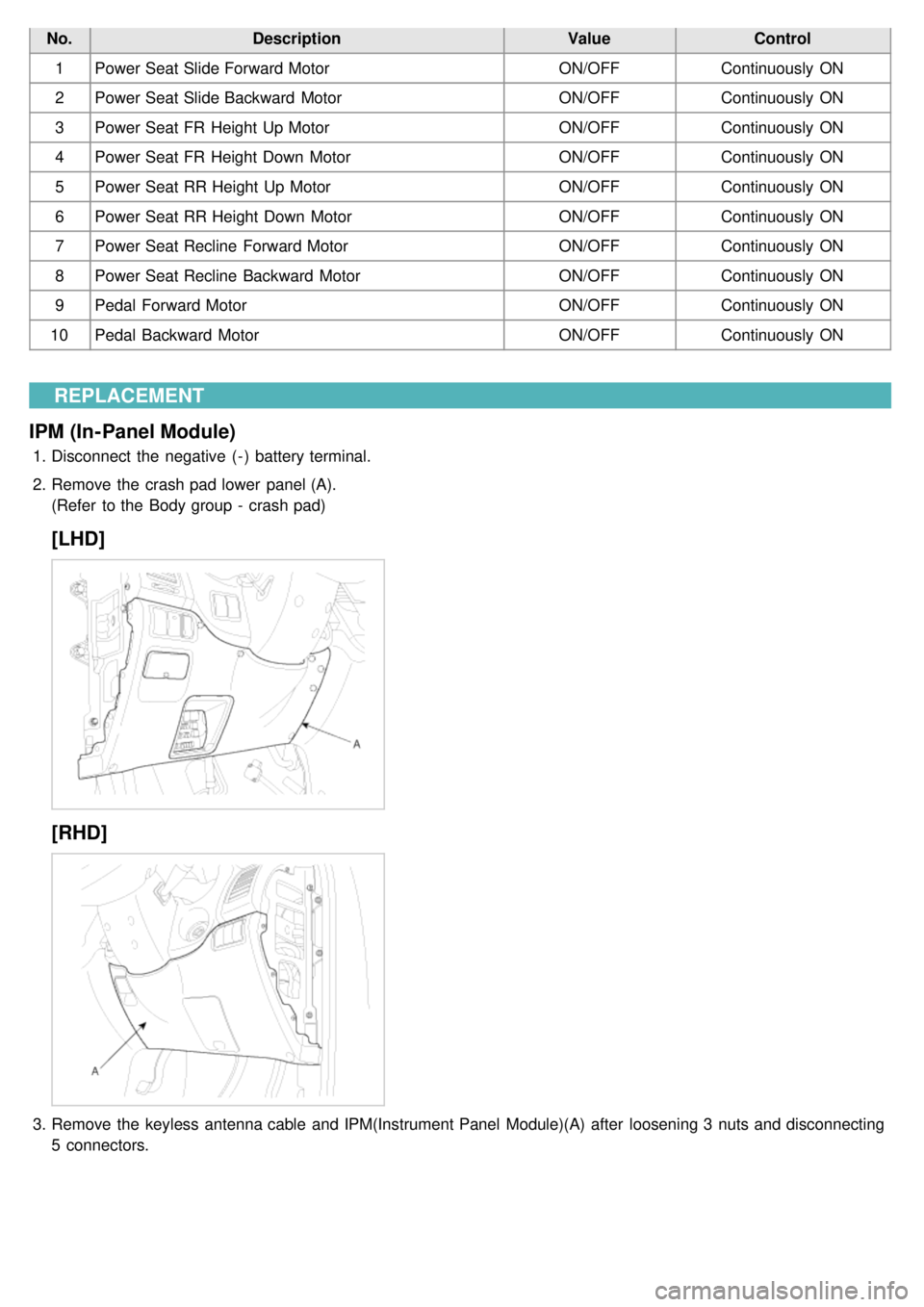
No.Description ValueControl
1 Power Seat Slide Forward Motor ON/OFFContinuously ON
2 Power Seat Slide Backward Motor ON/OFFContinuously ON
3 Power Seat FR Height Up Motor ON/OFFContinuously ON
4 Power Seat FR Height Down Motor ON/OFFContinuously ON
5 Power Seat RR Height Up Motor ON/OFFContinuously ON
6 Power Seat RR Height Down Motor ON/OFFContinuously ON
7 Power Seat Recline Forward Motor ON/OFFContinuously ON
8 Power Seat Recline Backward Motor ON/OFFContinuously ON
9 Pedal Forward Motor ON/OFFContinuously ON
10 Pedal Backward Motor ON/OFFContinuously ON
REPLACEMENT
IPM (In-Panel Module)
1. Disconnect the negative ( - ) battery terminal.
2. Remove the crash pad lower panel (A).
(Refer to the Body group - crash pad)
[LHD]
[RHD]
3.Remove the keyless antenna cable and IPM(Instrument Panel Module)(A) after loosening 3 nuts and disconnecting
5 connectors.
Page 1259 of 1575

2007 > 2.7L V6 GASOLINE >
DESCRIPTION
An optimal seat position set by a driver can be memorized in P/seat unit by memory SW and position SW, which
enables restoration of seat position set by the driver despite seat adjustments.
Furthermore, data is transmitted between P/seat and IPM, DDM, ADM, RAM, FAM, CLUSTER through CAN BUS.
Seat position presets cannot be recalled while driving. An emergency stop function is provided; additional functions are
described below.
1. It conducts manual operation of seat by CAN BUS data transmitted by DDM as well as that of adjustable pedal by
CAN BUS data transmitted by IPM received when operating SW manually.
2. Manual SW behavior when communication stops (back- up behavior)
a. Slide front/rear
b. Recline front/rear
c. Position control of slide motor is possible by manual SW even in case of congestion in CPU or removal of a
fuse for P/seat unit B.
3. 2 memory locations are provided for storing seat, outside mirror, and adjustable pedal presets.
4. The driver seat can be set to slide rearward when the ignition key is removed, and forward when the key is
inserted.
5. 2 additional presets for seat, mirror, and adjustable pedal position can be stored with the RKE transmitter.
OPERATION
MANUAL OPERATION
Manual operation of the driver seat and adjustable pedals is possible provided the transaxle is in 'P' range and the
vehicle speed is 0 MPH. Operation of the manual controls overrides any automatic operation commanded via CAN.
MEMORY OPERATION
1. Pressing the 'M' button on the control panel will place the system into memory storage mode and will result in a
single pulse from the output buzzer.
2. If one of the memory location buttons is pressed and held within 5 seconds of pressing the 'M' button, the output
buzzer will pulse twice to indicate successful storage of seat, mirror, and adjustable pedal positions.
3. The ignition switch must be in the RUN or START position, the vehicle speed must be 0 MPH, and the transaxle
must be in 'P' range to store memory presets.
4. Pressing the 'M' button while recalling a stored preset will halt the preset recall operation.
5. Memory will be cleared if battery is removed.
MEMORY REPLAY OPERATION
1.Pressing one of the memory location buttons will result in the driver seat, outside mirrors, and adjustable pedals
being positioned based on the stored preset data.
2. The ignition switch must be in the RUN position, the transaxle must be in 'P' range, the vehicle speed must be 0
MPH, and the manual functions must not be in operation to recall stored presets.
3. Others
a. Play operation not recorded in the position switch will not be conducted and there will be no buzzer output.
b. If other data is received during preset recall operation, the most recent preset recall signal will take
precedence.
c. If engine is started during preset recall operation, halt preset recall operation, and resume it toward target
position 100ms after Ignition switch is returned to "RUN". However, if the START state lasts over 5 sec., it will
not resume even after returning to RUN.
d. If preset recall order is received during engine start, preset recall operation is inhibited.
e. If input from manual switch for seat and adjust pedal occurs during preset recall operation of seat and adjust
pedal, halt all their preset recall operations.
f. If an error occurs during manual operation of seat and adjust pedal, delete Memory.