low oil pressure KIA CARNIVAL 2007 User Guide
[x] Cancel search | Manufacturer: KIA, Model Year: 2007, Model line: CARNIVAL, Model: KIA CARNIVAL 2007Pages: 1575, PDF Size: 44.86 MB
Page 360 of 1575
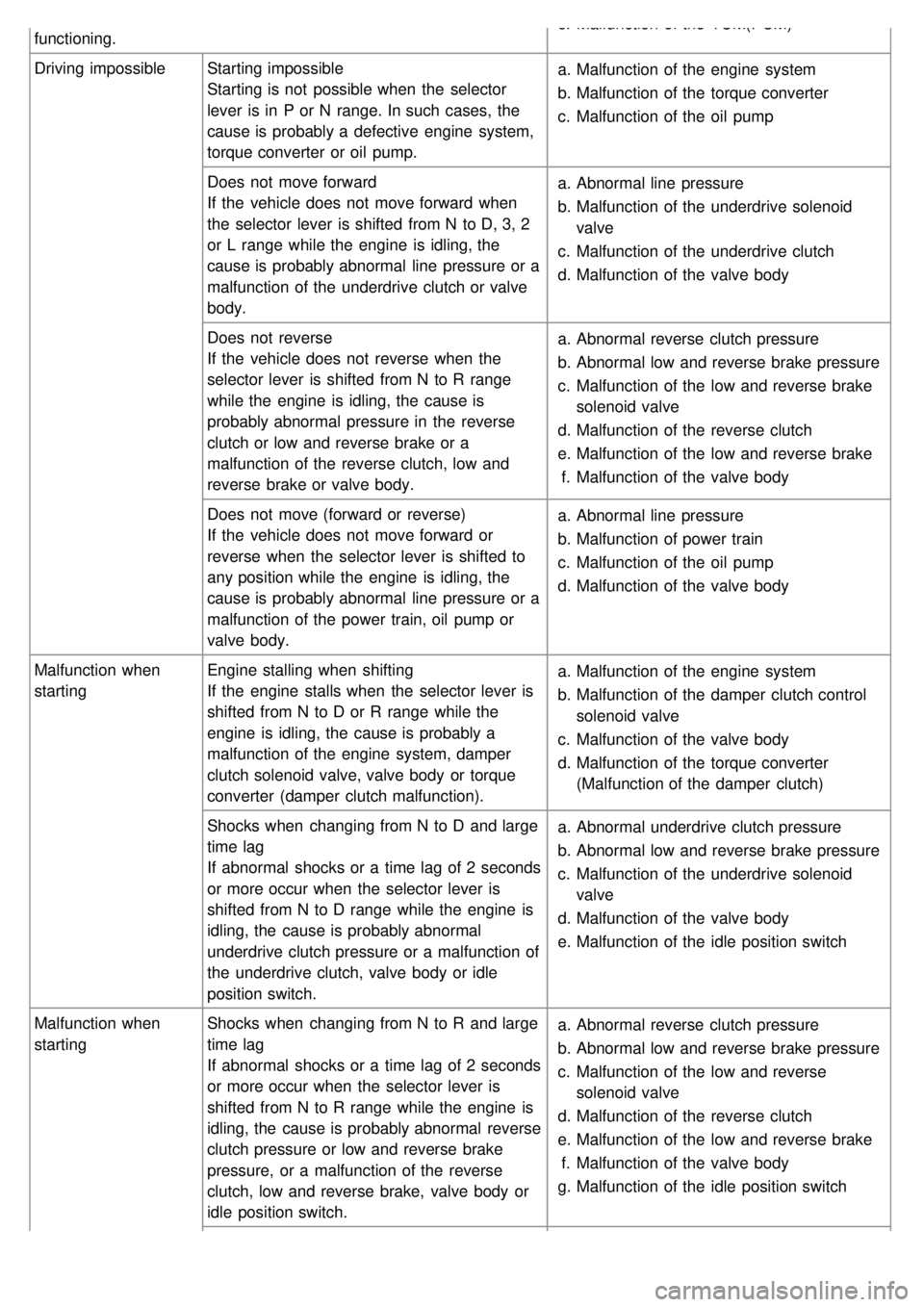
functioning.c.
Malfunction of the TCM(PCM)
Driving impossible Starting impossible
Starting is not possible when the selector
lever is in P or N range. In such cases, the
cause is probably a defective engine system,
torque converter or oil pump. a.
Malfunction of the engine system
b. Malfunction of the torque converter
c. Malfunction of the oil pump
Does not move forward
If the vehicle does not move forward when
the selector lever is shifted from N to D, 3, 2
or L range while the engine is idling, the
cause is probably abnormal line pressure or a
malfunction of the underdrive clutch or valve
body. a.
Abnormal line pressure
b. Malfunction of the underdrive solenoid
valve
c. Malfunction of the underdrive clutch
d. Malfunction of the valve body
Does not reverse
If the vehicle does not reverse when the
selector lever is shifted from N to R range
while the engine is idling, the cause is
probably abnormal pressure in the reverse
clutch or low and reverse brake or a
malfunction of the reverse clutch, low and
reverse brake or valve body. a.
Abnormal reverse clutch pressure
b. Abnormal low and reverse brake pressure
c. Malfunction of the low and reverse brake
solenoid valve
d. Malfunction of the reverse clutch
e. Malfunction of the low and reverse brake
f. Malfunction of the valve body
Does not move (forward or reverse)
If the vehicle does not move forward or
reverse when the selector lever is shifted to
any position while the engine is idling, the
cause is probably abnormal line pressure or a
malfunction of the power train, oil pump or
valve body. a.
Abnormal line pressure
b. Malfunction of power train
c. Malfunction of the oil pump
d. Malfunction of the valve body
Malfunction when
starting Engine stalling when shifting
If the engine stalls when the selector lever is
shifted from N to D or R range while the
engine is idling, the cause is probably a
malfunction of the engine system, damper
clutch solenoid valve, valve body or torque
converter (damper clutch malfunction). a.
Malfunction of the engine system
b. Malfunction of the damper clutch control
solenoid valve
c. Malfunction of the valve body
d. Malfunction of the torque converter
(Malfunction of the damper clutch)
Shocks when changing from N to D and large
time lag
If abnormal shocks or a time lag of 2 seconds
or more occur when the selector lever is
shifted from N to D range while the engine is
idling, the cause is probably abnormal
underdrive clutch pressure or a malfunction of
the underdrive clutch, valve body or idle
position switch. a.
Abnormal underdrive clutch pressure
b. Abnormal low and reverse brake pressure
c. Malfunction of the underdrive solenoid
valve
d. Malfunction of the valve body
e. Malfunction of the idle position switch
Malfunction when
starting Shocks when changing from N to R and large
time lag
If abnormal shocks or a time lag of 2 seconds
or more occur when the selector lever is
shifted from N to R range while the engine is
idling, the cause is probably abnormal reverse
clutch pressure or low and reverse brake
pressure, or a malfunction of the reverse
clutch, low and reverse brake, valve body or
idle position switch. a.
Abnormal reverse clutch pressure
b. Abnormal low and reverse brake pressure
c. Malfunction of the low and reverse
solenoid valve
d. Malfunction of the reverse clutch
e. Malfunction of the low and reverse brake
f. Malfunction of the valve body
g. Malfunction of the idle position switch
Page 366 of 1575
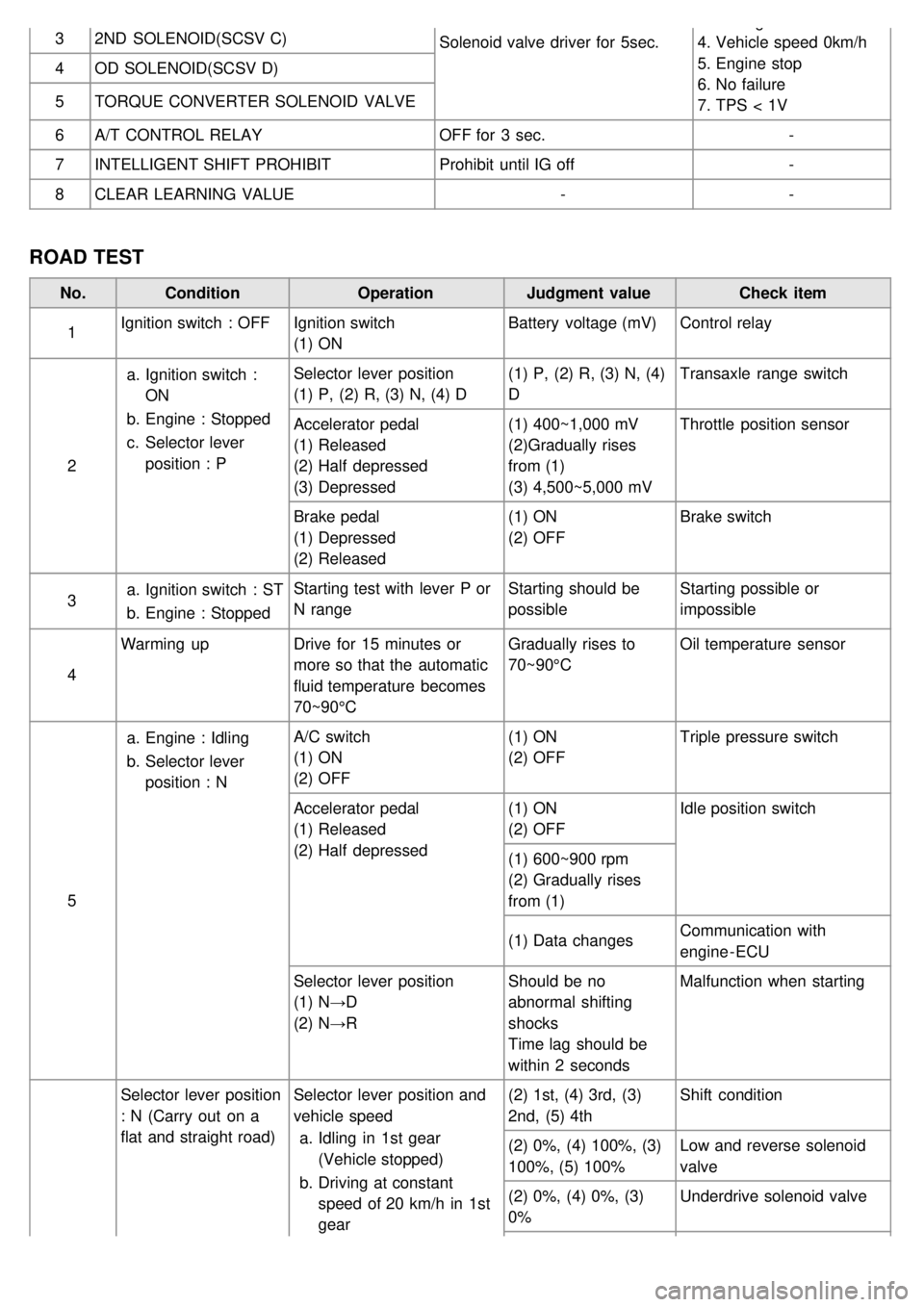
32ND SOLENOID(SCSV C)
Solenoid valve driver for 5sec.3. P range
4. Vehicle speed 0km/h
5. Engine stop
6. No failure
7. TPS < 1V
4
OD SOLENOID(SCSV D)
5 TORQUE CONVERTER SOLENOID VALVE
6 A/T CONTROL RELAY OFF for 3 sec. -
7 INTELLIGENT SHIFT PROHIBIT Prohibit until IG off -
8 CLEAR LEARNING VALUE --
ROAD TEST
No.Condition OperationJudgment value Check item
1 Ignition switch : OFF
Ignition switch
(1) ON Battery voltage (mV)
Control relay
2 a.
Ignition switch :
ON
b. Engine : Stopped
c. Selector lever
position : P Selector lever position
(1) P, (2) R, (3) N, (4) D
(1) P, (2) R, (3) N, (4)
DTransaxle range switch
Accelerator pedal
(1) Released
(2) Half depressed
(3) Depressed (1) 400~1,000 mV
(2)Gradually rises
from (1)
(3) 4,500~5,000 mVThrottle position sensor
Brake pedal
(1) Depressed
(2) Released (1) ON
(2) OFF
Brake switch
3 a.
Ignition switch : ST
b. Engine : Stopped Starting test with lever P or
N range
Starting should be
possibleStarting possible or
impossible
4 Warming up
Drive for 15 minutes or
more so that the automatic
fluid temperature becomes
70~90°C Gradually rises to
70~90°C
Oil temperature sensor
5 a.
Engine : Idling
b. Selector lever
position : N A/C switch
(1) ON
(2) OFF
(1) ON
(2) OFF
Triple pressure switch
Accelerator pedal
(1) Released
(2) Half depressed (1) ON
(2) OFF
Idle position switch
(1) 600~900 rpm
(2) Gradually rises
from (1)
(1) Data changes Communication with
engine - ECU
Selector lever position
(1) N→D
(2) N→R Should be no
abnormal shifting
shocks
Time lag should be
within 2 secondsMalfunction when starting
Selector lever position
: N (Carry out on a
flat and straight road) Selector lever position and
vehicle speed
a. Idling in 1st gear
(Vehicle stopped)
b. Driving at constant
speed of 20 km/h in 1st
gear (2) 1st, (4) 3rd, (3)
2nd, (5) 4th
Shift condition
(2) 0%, (4) 100%, (3)
100%, (5) 100% Low and reverse solenoid
valve
(2) 0%, (4) 0%, (3)
0% Underdrive solenoid valve
Page 368 of 1575
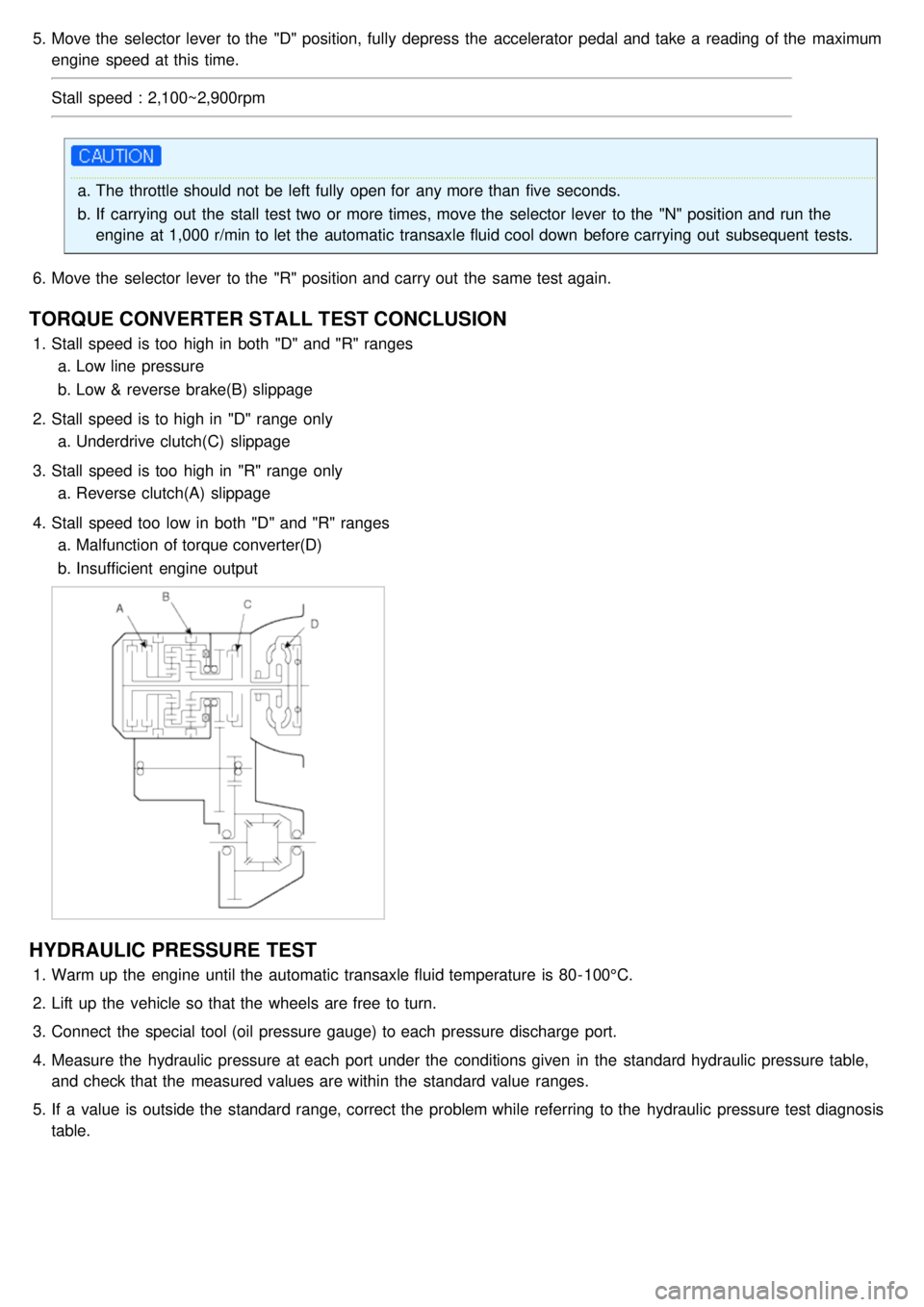
5.Move the selector lever to the "D" position, fully depress the accelerator pedal and take a reading of the maximum
engine speed at this time.
Stall speed : 2,100~2,900rpm
a.The throttle should not be left fully open for any more than five seconds.
b. If carrying out the stall test two or more times, move the selector lever to the "N" position and run the
engine at 1,000 r/min to let the automatic transaxle fluid cool down before carrying out subsequent tests.
6. Move the selector lever to the "R" position and carry out the same test again.
TORQUE CONVERTER STALL TEST CONCLUSION
1.Stall speed is too high in both "D" and "R" ranges
a. Low line pressure
b. Low & reverse brake(B) slippage
2. Stall speed is to high in "D" range only
a. Underdrive clutch(C) slippage
3. Stall speed is too high in "R" range only
a. Reverse clutch(A) slippage
4. Stall speed too low in both "D" and "R" ranges
a. Malfunction of torque converter(D)
b. Insufficient engine output
HYDRAULIC PRESSURE TEST
1.Warm up the engine until the automatic transaxle fluid temperature is 80- 100°C.
2. Lift up the vehicle so that the wheels are free to turn.
3. Connect the special tool (oil pressure gauge) to each pressure discharge port.
4. Measure the hydraulic pressure at each port under the conditions given in the standard hydraulic pressure table,
and check that the measured values are within the standard value ranges.
5. If a value is outside the standard range, correct the problem while referring to the hydraulic pressure test diagnosis
table.
Page 371 of 1575
![KIA CARNIVAL 2007 User Guide 2007 > 2.7L V6 GASOLINE >
SERVICE ADJUSTMENT PROCEDURE
Automatic transaxle fluid
INSPECTION 1. Drive the vehicle until the fluid reaches normal operating temperature [70~80°C].
2. Place the](/img/2/57045/w960_57045-370.png "KIA CARNIVAL 2007 User Guide 2007 > 2.7L V6 GASOLINE >
SERVICE ADJUSTMENT PROCEDURE
Automatic transaxle fluid
INSPECTION 1. Drive the vehicle until the fluid reaches normal operating temperature [70~80°C].
2. Place the")
2007 > 2.7L V6 GASOLINE >
SERVICE ADJUSTMENT PROCEDURE
Automatic transaxle fluid
INSPECTION 1. Drive the vehicle until the fluid reaches normal operating temperature [70~80°C].
2. Place the vehicle on a level surface.
3. Move the selector lever through all gear positions. This will fill the torque converter and the hudraulic system with
fluid and move the selector lever to the "N" (Neutral) or "P"(Park) position.
4. Before removing the oil level gauge, wipe all contaminants from around the oil level gauge. Then take out the oil
level gauge and check the condition of the fluid.
If the fluid smells as if it is burning, it means that the fluid has been contaminated by fine particles from the
bushes and friction materials, a transaxle overhaul may be necessary.
5. Check that the fluid level is at the HOT mark on the oil level gauge. If the fluid level is low, add automatic transaxle
fluid until the level reaches the "HOT" mark.
Auto transaxle fluid:
DIAMOND ATF SP - III, SK ATF SP - III
Quantity : 8.5ℓ (9.0 US qt, 7.5 lmp.qt)
Low fluid level can cause a variety of a abnormal conditions because it allows the pump to take in air along
with fluid. Air trapped in the hydraulic system forms bubbles, which are compressable. Therefore, pressures
will be erratic, causing delayed shifting ,slipping clutches and brakes, etc. Improper filling can also raise fluid
level too high. When the transaxle has too much fluid, gears churn up foam and acuise the same conditions
which occur with low fluid level, resulting in accelerated deterioration of automatic transaxle fluid. In either
case, air bubbles can cause overheating, and fluid oxidation, which can interfere with normal valve, clutch, and
brake operation. Foaming can also result in fluid escaping from the transaxle vent where it may be mistaken
for a leak.
6. Insert the oil level gauge(A) securely.
When new, automatic transmission fluid should be red. The red dye is added so the assembly plant can
identify it as transmission fluid and distinguish it from engine oil or antifreeze. The red dye, which is not an
indicator of fluid quality, is not permanent. As the vehicle is driven the transmission fluid will begin to look
darker. The color may eventually appear light brown.
Page 384 of 1575

19.Remove the under cover (A).
20.Drain the transaxle fluid.
21. Drain power steering fluid through the return tube(A). (see ST group)
22.Disconnect the power steering pressure tube (A) from the power steering oil pump.
23.Disconnect the lower arm, the tie rod end ball joint, the stabilizer bar link from the front knuckle. (see SS group)
24. Remove the roll stopper mounting bolts.
25. Remove the mounting bolts from the sub frame by supporting the sub frame with a jack. (see SS group)
26. Remove drive shaft from transaxle. (see DS group).
27. Install a jack for supporting the transaxle assembly.
28. Remove the drive plate bolts (A) and the transaxle lower mounting bolts (B- 4EA).
Page 430 of 1575

17.Disconnect the power steering pressure hose (A) from the power steering oil pump. (see ST group)
18.Drain the tranaxle fluid through the drain plug.
19. Remove the hanger(A).
20.Disconnect the lower arm, the tie rod end ball joint, the stabilizer bar link from the front knuckle. (see SS group)
21. Remove the roll stopper mounting bolt(A).
22.Remove the power steering return tube mounting bolt(A)
Page 437 of 1575
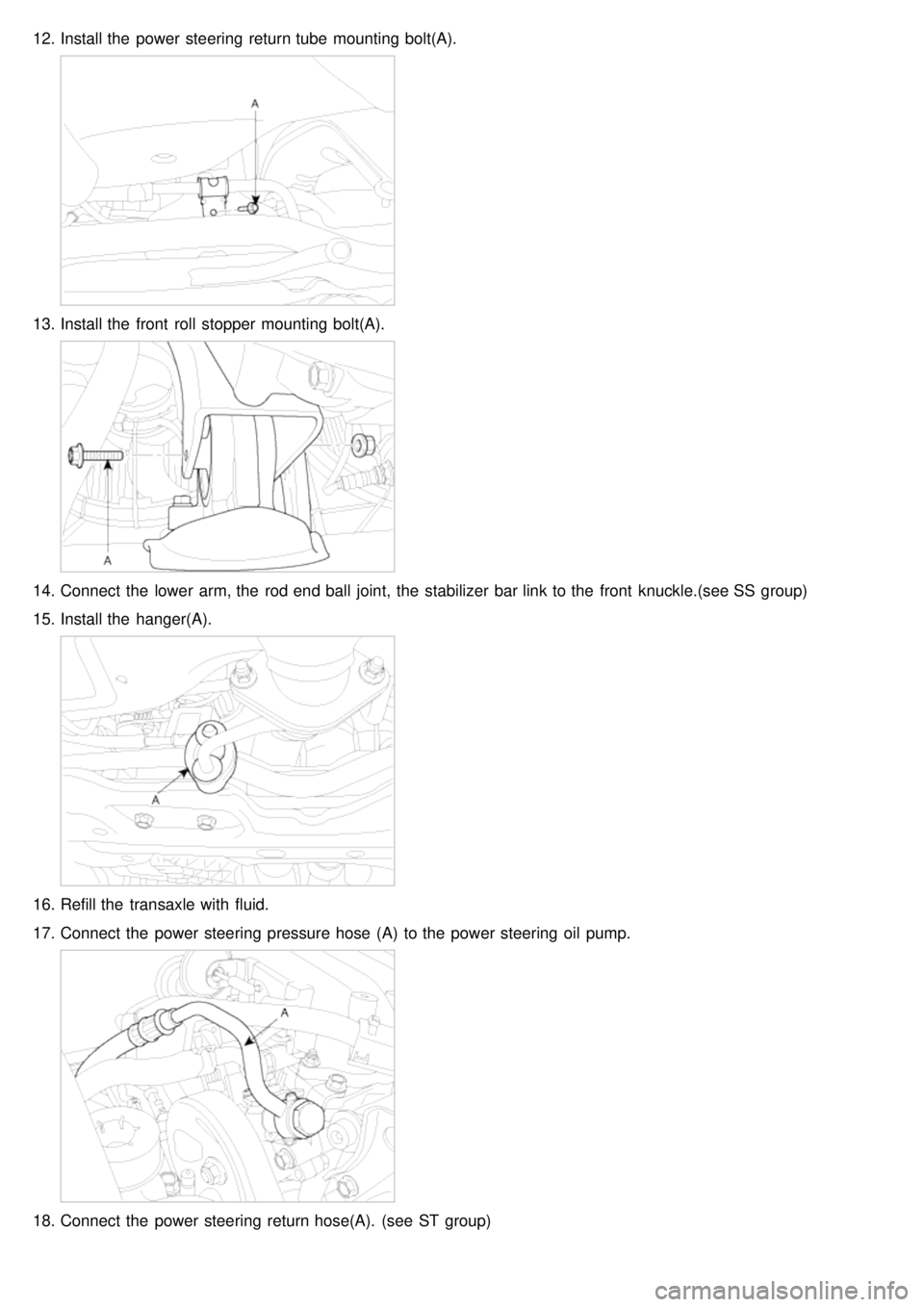
12.Install the power steering return tube mounting bolt(A).
13.Install the front roll stopper mounting bolt(A).
14.Connect the lower arm, the rod end ball joint, the stabilizer bar link to the front knuckle.(see SS group)
15. Install the hanger(A).
16.Refill the transaxle with fluid.
17. Connect the power steering pressure hose (A) to the power steering oil pump.
18.Connect the power steering return hose(A). (see ST group)
Page 581 of 1575

2007 > 2.7L V6 GASOLINE >
TROUBLESHOOTING
Symptom Probable cause Remedy
Excessive play in
steering Loose yoke plug
Retighten
Loose steering gear mounting bolts Retighten
Loose or worn tie rod end Retighten or replace as necessary
Steering wheel
operation is not
smooth (Insufficient
power assist) V- belt slippage
Readjust
Damaged V- belt Replace
Low fluid level Replenish
Air in the fluid Bleed air
Twisted or damaged hoses Correct the routing or replace
Insufficient oil pump pressure Repair or replace the oil pump
Sticky flow control valve Replace
Excessive internal oil pump leakage Replace the damaged parts
Excessive oil leaks from rack and pinion in
gear box Replace the damaged parts
Distorted or damaged gear box or valve body
seals Replace
Steering wheel does
not return properly Excessive turning resistance of tierod end
Replace
Yoke plug excessively tight Adjust
Tie rod and/or ball joint cannot turn smoothly Replace
Loose mounting of gear box mounting bracket
Worn steering shaft joint and/or Retighten
Worn steering shaft joint and/or body
grommet Correct or replace
Distorted rack Replace
Damaged pinion bearing Replace
Twisted or damaged hoses Reposition or replace
Damaged oil pressure control valve Replace
Damaged oil pump input shaft bearing Replace
Noise Hissing Noise in Steering Gear
There is some noise with all power steering systems. One of the most common is a hissing
sound when the steering wheel is turned and the car is not moving. This noise will be most
evident when turning the wheel while the brakes are being applied. There is no relationship
between this noise and steering performance. Do not replace the valve unless the "hissing"
noise becomes extreme. A replaced valve will also make a slight noise, and is not always a
solution for the condition.
Rattling or chucking
noise in the rack and
pinion Interference with hoses from vehicle body
Reposition
Loose gear box bracket Retighten
Loose tie rod end and/or ball joint Retighten
Worn tie rod and/or ball joint Replace
Noise in the oil pump Low fluid level Replenish
Air in the fluid Bleed air
Loose pump mounting bolts Retighten
Page 585 of 1575
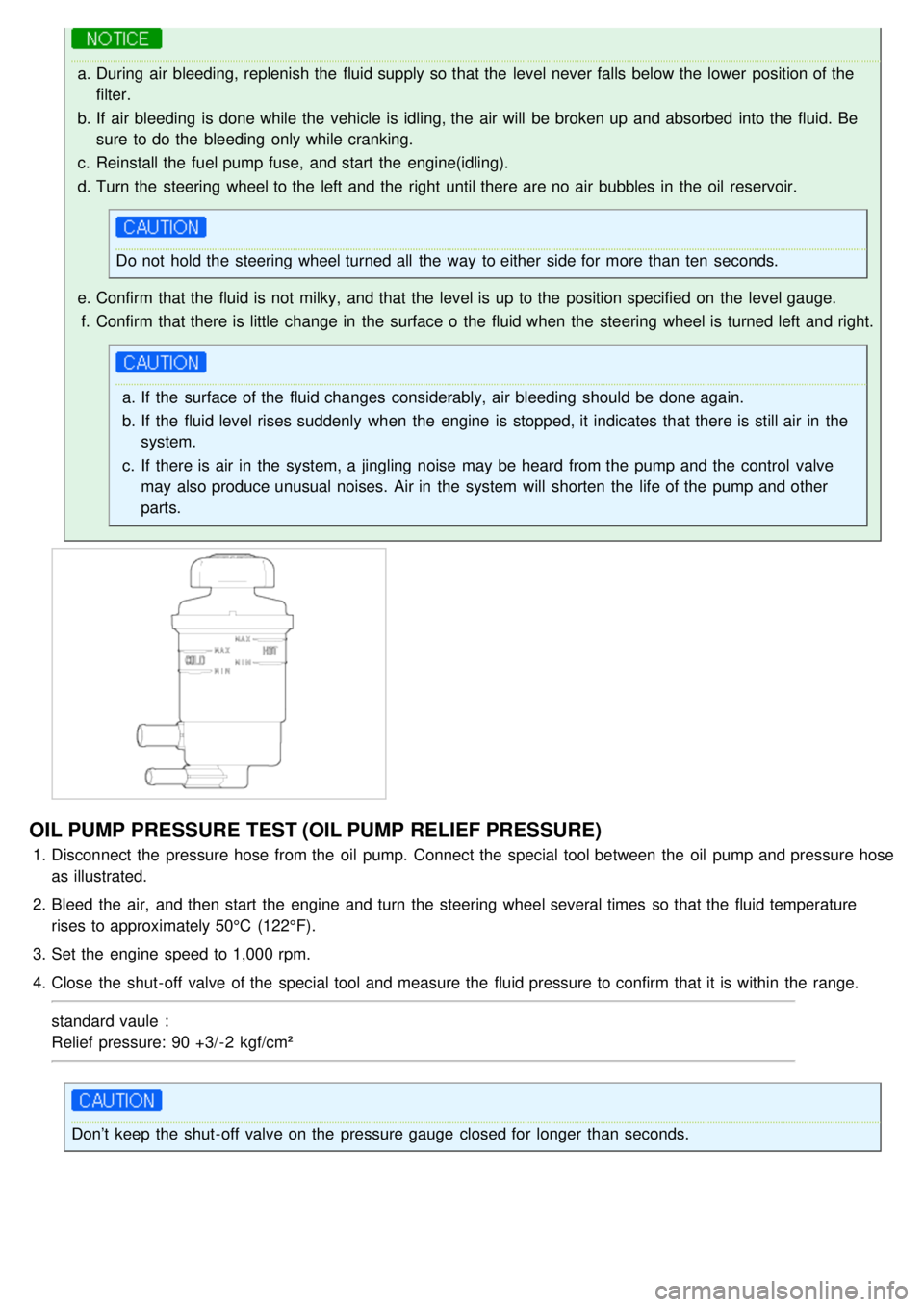
a.During air bleeding, replenish the fluid supply so that the level never falls below the lower position of the
filter.
b. If air bleeding is done while the vehicle is idling, the air will be broken up and absorbed into the fluid. Be
sure to do the bleeding only while cranking.
c. Reinstall the fuel pump fuse, and start the engine(idling).
d. Turn the steering wheel to the left and the right until there are no air bubbles in the oil reservoir.
Do not hold the steering wheel turned all the way to either side for more than ten seconds.
e. Confirm that the fluid is not milky, and that the level is up to the position specified on the level gauge.
f. Confirm that there is little change in the surface o the fluid when the steering wheel is turned left and right.
a. If the surface of the fluid changes considerably, air bleeding should be done again.
b. If the fluid level rises suddenly when the engine is stopped, it indicates that there is still air in the
system.
c. If there is air in the system, a jingling noise may be heard from the pump and the control valve
may also produce unusual noises. Air in the system will shorten the life of the pump and other
parts.
OIL PUMP PRESSURE TEST (OIL PUMP RELIEF PRESSURE)
1.Disconnect the pressure hose from the oil pump. Connect the special tool between the oil pump and pressure hose
as illustrated.
2. Bleed the air, and then start the engine and turn the steering wheel several times so that the fluid temperature
rises to approximately 50°C (122°F).
3. Set the engine speed to 1,000 rpm.
4. Close the shut- off valve of the special tool and measure the fluid pressure to confirm that it is within the range.
standard vaule :
Relief pressure: 90 +3/- 2 kgf/cm²
Don’t keep the shut- off valve on the pressure gauge closed for longer than seconds.
Page 587 of 1575

2007 > 2.7L V6 GASOLINE >
SPECIFICATIONS
Items Specifications
Steering column/ shaft Type
Tilt
Tilt stroke +7°/ - 11.7°
Steering gear Type
Rack & pinion
Rack stroke VRS On
148 mm (5.827 in)
VRS Off 156 mm (6.142 in)
Power steering pump Type
Vane
Diesel Relief pressure
90 kgf/cm²
Discharge 9.6 cc/rev
Gasoline Relief pressure
90 kgf/cm²
Discharge 10.5 cc/rev
SERVICE STANDARD
Items Specifications
Steering wheel free play 30 mm (1.12 in)
Steering angle VRS on
Inner
38.64°
Outer 31.78°
VRS off Inner
41.91°
Outer 33.54°
TIGHTENING TORQUE
Items NmKgf.m Lb- ft
Steering wheel lock nut 40 ~ 504.0 ~ 5.0 29 ~ 36
Steering column mounting bolts and nut 13 ~ 181.3 ~ 1.89.4 ~ 13.0
Bolt connecting steering column to universal
joint 15 ~ 20
1.5 ~ 2.010.8 ~ 14.5
Bolt connecting universal joint to steering gear 13 ~ 181.3 ~ 1.89.4 ~ 13.0
Steering column mounting bolts and nut 13 ~ 181.3 ~ 1.89.4 ~ 13.0
Tie rod end castle nut 35 ~ 453.5 ~ 4.5 25 ~ 33
Front lower arm ball joint assembly bolts 90 ~ 1209.0 ~ 12.0 65 ~ 87
Stabilizer link to strut assembly nut 100 ~ 12010.0 ~ 12.0 72 ~ 87
Rear roll stopper to sub- frame bolts 50 ~ 605.0 ~ 6.0 36 ~ 43
Pressure tube to valve body housing nut 12 ~ 181.2 ~ 1.8 9 ~ 13
Pressure tube to oil pump eye bolt 65 ~ 756.5 ~ 7.5 47 ~ 54
Return tube to valve body housing nut 12 ~ 181.2 ~ 1.8 9 ~ 13
Power steering gear box to sub- frame bots 90 ~ 1109.0 ~ 11.0 65 ~ 80
LUBRICANT
Item Lubricant Quantity
Power steering fluid PSF - 31.1 L