steering wheel KIA CARNIVAL 2007 User Guide
[x] Cancel search | Manufacturer: KIA, Model Year: 2007, Model line: CARNIVAL, Model: KIA CARNIVAL 2007Pages: 1575, PDF Size: 44.86 MB
Page 497 of 1575

Check the vehicle alignmnt.
● Is the alignment within specification ?
→ YES
Go to
→ NO
Adjust the alignment as necessary.
See page SS - 69 (wheel alignment).
BRAKE DRAG DIAGNOSIS Apply the brakes while driving.
● Does drift or pull occur when the brakes are applied ?
→ YES
See BR group - specification.
→ NO
If the steering wheel is in the center, the vehicle is OK.
If the steering wheel is off- center, Go to Detailed Test F.
DETAILED TEST F : STEERING WHEEL OFF- CENTER CONDITIONS DETAILS/RESULTS/ACTIONS
CHECK THE CLEAR VISION Place the vehicle on an alignment rack.
● Is the clear vision within specification ?
→ YES
Go to F2.
→ NO
Adjust the clear vision to specification.
INSPECT THE STEERING COMPONENTS
a.Raise and support the vehicle.
b. Inspect the steering components for excessive wear or damage.
See ST group - specification.
● Are the steering components excessively worn or damaged ?
→ YES
Repair or Install new components as necessary.
→ NO
If it tracks correctly, vehicle is OK.
If it tracks incorrectly, Go to Detailed Test
DETAILED TEST G : TRACKS INCORRECTLY CONDITIONS DETAILS/RESULTS/ACTIONS
CHECK THE CASTER Place the vehicle on an alignment rack.
● Is the caster within specification ?
→ YES
Go to G2.
Page 501 of 1575

a.Substitute a known good set of wheels and tires.
b. Perform a road test.
c. If the vehicle still exhibits a shake or vibration, note the vehicle speed
and/or engine rpm which it occurs.
● Is the vibration felt ?
→ YES
Engine/transmission imbalance.
See the specification of TR group, EM group, FL group and EC group.
→ NO
Install the original tire/wheel assemblies one by one, Road testing at
each step until the damaged tire(s)/wheel(s) as necessary. Test the
system for normal operation.
Wheel /tire noise, vibration and harshness concerns are directly related to vehicle speed and are not generally affected
by acceleration, coasting or decelerating. Also, out - of- balance wheel and tires can vibrate at more than one speed. A
vibration that is affected by the engine rpm, or is eliminated by placing the transmission in Neutral is not related to the
tire and wheel. As a general rule, tire and wheel vibrations felt in the steering wheel are related to the front tire and
wheel assemblies. Vibrations felt in the seat or floor are related to the rear tire and wheel assemblies. This can initially
isolate a concern to the front or rear.
Careful attention must be paid to the tire and wheels. There are several symptoms that can be caused by damaged or
worn tire and wheels. Perform a careful visual inspection of the tires and wheel assemblies. Spin the tires slowly and
watch for signs of lateral or radial runout. Refer to the tire wear chart to determine the tire wear conditions and actions WHEEL AND TIRE DIAGNOSIS
Rapid wear at the center Rapid wear at both shoulders Wear at one shoulder
a.Center - tread down to fabric due to
excessive over inflated tires
b. Lack of rotation
c. Excessive toe on drive wheels
d. Heavy acceleration on drive a.
Under- inflated tires
b. Worn suspension components
c. Excessive cornering speeds
d. Lack of rotation a.
Toe adjustment out of specification
b. Camber out of specification
c. Damaged strut
d. Damaged lower arm
Partial wear Feathered edge Wear pattern
a.Caused by irregular burrs on
brake drums a.
Toe adjustment out of
specification
b. Damaged or worn tie rods
c. Damaged knuckle a.
Excessive toe on non- drive
wheels
b. Lack of rotation
Page 523 of 1575

2007 > 2.7L V6 GASOLINE >
REMOVAL
1.Remove the connecting bolt (A) between the steering universal joint assembly (B) and the pinion assembly.
2.Loosen the wheel nuts slightly. Raise the front of the vehicle, and make sure it is securely supported.
3. Remove the front wheel and tire (A) from front hub (B).
Be careful not to damage the hub bolts (C) when removing the front wheel and tire (A).
4. Remove the front stabilizer link (A) nut (B) from the strut assembly.
5.After removing both sides of the tie rod end (A) self - locking nuts (B) and cotterpin (C), remove the ball joint by
using the special tool(09568- 4A000).
Page 528 of 1575

specification.
Tightening torque Nm (kgf.m, lb - ft) :
65 ~ 80 (6 ~ 8, 43.4 ~ 57.8)
9.Install the front stabilizer link (A) nut (B) to the strut assembly.
Tightening torque Nm (kgf.m, lb - ft) :
100 ~ 120 (10 ~ 12, 72.3 ~ 86.8)
10. Install the wheel and the tire (A) to the front hub (B).
Tightening torque Nm (kgf.m, lb - ft) :
90 ~ 110 (9 ~ 11, 65.1 ~ 79.5)
Be careful not to damage the hub bolts(C) when installing the front wheel and tire(A).
11. Install the connecting bolt (A) between the steering universal joint assembly (B) and the pinion assembly.
Page 529 of 1575

Tightening torque Nm (kgf.m, lb - ft) :
13 ~ 18 (1.3 ~ 1.8, 9.4 ~ 13.0)
After installation, if neccessary, adjust the alignment of the steering wheel and front tires
INSPECTION
1.Check the bushing for wear and deterioration.
2. Check the stabilizer bar for bending or breakage.
3. Check the ball joint for rotating torque.
(1) If there is a crack in the dust cover, replace it and add grease.
(2) Move the stabilizer link ball joint stud several times in a circular motion.
(3) Mount the self - locking nut on the ball joint, and then measure the ball joint rotating torque.
Standard value :
0.5 ~ 2.5 Nm (5 ~ 25 kgf., 0.36 ~ 1.81 lb - ft)
Measure torque using the special tool(09532- 11600) and torque wrench at the range of 0.5 - 2 rpm after
moving the ball joint stud 10 times at room temperature.
(4)If the rotating torque exceeds the upper limit of standard value, replace the upper arm assembly.
(5) Even if the rotating torque is below the lower limit of the standard value, the ball joint may be reused unless it
has drag and excessive play.
Page 569 of 1575
![KIA CARNIVAL 2007 User Guide 2007 > 2.7L V6 GASOLINE >
TIRE WEAR
1.Measure the tread depth of the tires.
Tread depth [limit] : 1.6 mm (0.063 in)
2. If the remaining tread(A) depth is less than the limit, replace the](/img/2/57045/w960_57045-568.png "KIA CARNIVAL 2007 User Guide 2007 > 2.7L V6 GASOLINE >
TIRE WEAR
1.Measure the tread depth of the tires.
Tread depth [limit] : 1.6 mm (0.063 in)
2. If the remaining tread(A) depth is less than the limit, replace the")
2007 > 2.7L V6 GASOLINE >
TIRE WEAR
1.Measure the tread depth of the tires.
Tread depth [limit] : 1.6 mm (0.063 in)
2. If the remaining tread(A) depth is less than the limit, replace the tire.
When the tread depth of the tires is less than 1.6 mm (0.063 in), the wear indicators(B) will appear.
TIRE ROTATION
Rotate the tires in the pattern illustrated.
CHECKING FOR PULL AND WANDER
If the steering pulls to one side, rotate the tires according to the following wheel rotation procedure.
1. Rotate the front right and front left tires, and perform a road test in order to confirm vehicle stability.
Page 570 of 1575

2.If the steering pulls to the opposite side, rotate the front and rear tires, and perform a road test again.
3.If the steering continues to pull to one side, rotate the front right and left tires again, and perform a road test.
4.If the steering continues to pull to the opposite side, replace the front wheels with new ones.
Page 572 of 1575
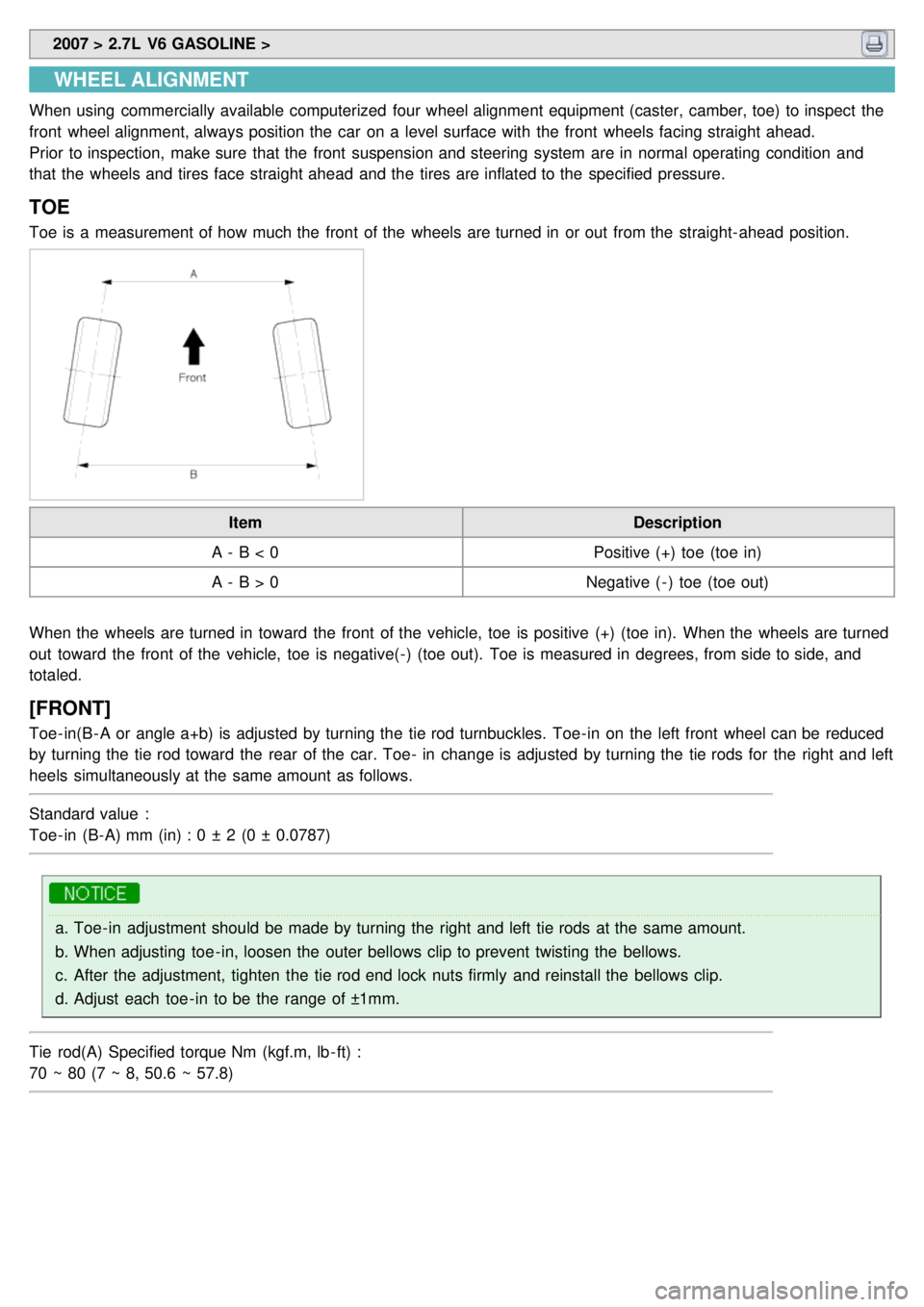
2007 > 2.7L V6 GASOLINE >
WHEEL ALIGNMENT
When using commercially available computerized four wheel alignment equipment (caster, camber, toe) to inspect the
front wheel alignment, always position the car on a level surface with the front wheels facing straight ahead.
Prior to inspection, make sure that the front suspension and steering system are in normal operating condition and
that the wheels and tires face straight ahead and the tires are inflated to the specified pressure.
TOE
Toe is a measurement of how much the front of the wheels are turned in or out from the straight- ahead position.
Item Description
A - B < 0 Positive (+) toe (toe in)
A - B > 0 Negative ( - ) toe (toe out)
When the wheels are turned in toward the front of the vehicle, toe is positive (+) (toe in). When the wheels are turned
out toward the front of the vehicle, toe is negative(- ) (toe out). Toe is measured in degrees, from side to side, and
totaled.
[FRONT]
Toe- in(B - A or angle a+b) is adjusted by turning the tie rod turnbuckles. Toe- in on the left front wheel can be reduced
by turning the tie rod toward the rear of the car. Toe- in change is adjusted by turning the tie rods for the right and left
heels simultaneously at the same amount as follows.
Standard value :
Toe- in (B- A) mm (in) : 0 ± 2 (0 ± 0.0787)
a. Toe- in adjustment should be made by turning the right and left tie rods at the same amount.
b. When adjusting toe - in, loosen the outer bellows clip to prevent twisting the bellows.
c. After the adjustment, tighten the tie rod end lock nuts firmly and reinstall the bellows clip.
d. Adjust each toe - in to be the range of ±1mm.
Tie rod(A) Specified torque Nm (kgf.m, lb - ft) :
70 ~ 80 (7 ~ 8, 50.6 ~ 57.8)
Page 579 of 1575

2007 > 2.7L V6 GASOLINE >
SPECIAL TOOLS
Tool (Number and Name) IllustrationUse
09222 - 32100
Valve stem oil seal installer
Installation of the oil pump oil seal
09555 - 21000
Bar
Removal and installation of the oil
seal
(Use with 09573 - 33100, 09573 -
33000,09573- 21000)
09561 - 11001
Steering wheel puller
Removal of steering wheel
09568 - 4A000
Tie rod end puller
Separation of the tie rod end bail
joint
09572 - 21000
Oil pressure gauge
Measurement of the oil pressure
(Use with 09572 - 22100, 09572 -
21200)
09572 - 21200
Oil pressure gauge adapter
Measurement of the oil pressure
(Use with 09572 - 21000, 09572 -
22100)
09572 - 22100 Measurement of the oil pressure
Page 581 of 1575

2007 > 2.7L V6 GASOLINE >
TROUBLESHOOTING
Symptom Probable cause Remedy
Excessive play in
steering Loose yoke plug
Retighten
Loose steering gear mounting bolts Retighten
Loose or worn tie rod end Retighten or replace as necessary
Steering wheel
operation is not
smooth (Insufficient
power assist) V- belt slippage
Readjust
Damaged V- belt Replace
Low fluid level Replenish
Air in the fluid Bleed air
Twisted or damaged hoses Correct the routing or replace
Insufficient oil pump pressure Repair or replace the oil pump
Sticky flow control valve Replace
Excessive internal oil pump leakage Replace the damaged parts
Excessive oil leaks from rack and pinion in
gear box Replace the damaged parts
Distorted or damaged gear box or valve body
seals Replace
Steering wheel does
not return properly Excessive turning resistance of tierod end
Replace
Yoke plug excessively tight Adjust
Tie rod and/or ball joint cannot turn smoothly Replace
Loose mounting of gear box mounting bracket
Worn steering shaft joint and/or Retighten
Worn steering shaft joint and/or body
grommet Correct or replace
Distorted rack Replace
Damaged pinion bearing Replace
Twisted or damaged hoses Reposition or replace
Damaged oil pressure control valve Replace
Damaged oil pump input shaft bearing Replace
Noise Hissing Noise in Steering Gear
There is some noise with all power steering systems. One of the most common is a hissing
sound when the steering wheel is turned and the car is not moving. This noise will be most
evident when turning the wheel while the brakes are being applied. There is no relationship
between this noise and steering performance. Do not replace the valve unless the "hissing"
noise becomes extreme. A replaced valve will also make a slight noise, and is not always a
solution for the condition.
Rattling or chucking
noise in the rack and
pinion Interference with hoses from vehicle body
Reposition
Loose gear box bracket Retighten
Loose tie rod end and/or ball joint Retighten
Worn tie rod and/or ball joint Replace
Noise in the oil pump Low fluid level Replenish
Air in the fluid Bleed air
Loose pump mounting bolts Retighten