transmission KIA CARNIVAL 2007 User Guide
[x] Cancel search | Manufacturer: KIA, Model Year: 2007, Model line: CARNIVAL, Model: KIA CARNIVAL 2007Pages: 1575, PDF Size: 44.86 MB
Page 371 of 1575
![KIA CARNIVAL 2007 User Guide 2007 > 2.7L V6 GASOLINE >
SERVICE ADJUSTMENT PROCEDURE
Automatic transaxle fluid
INSPECTION 1. Drive the vehicle until the fluid reaches normal operating temperature [70~80°C].
2. Place the](/img/2/57045/w960_57045-370.png "KIA CARNIVAL 2007 User Guide 2007 > 2.7L V6 GASOLINE >
SERVICE ADJUSTMENT PROCEDURE
Automatic transaxle fluid
INSPECTION 1. Drive the vehicle until the fluid reaches normal operating temperature [70~80°C].
2. Place the")
2007 > 2.7L V6 GASOLINE >
SERVICE ADJUSTMENT PROCEDURE
Automatic transaxle fluid
INSPECTION 1. Drive the vehicle until the fluid reaches normal operating temperature [70~80°C].
2. Place the vehicle on a level surface.
3. Move the selector lever through all gear positions. This will fill the torque converter and the hudraulic system with
fluid and move the selector lever to the "N" (Neutral) or "P"(Park) position.
4. Before removing the oil level gauge, wipe all contaminants from around the oil level gauge. Then take out the oil
level gauge and check the condition of the fluid.
If the fluid smells as if it is burning, it means that the fluid has been contaminated by fine particles from the
bushes and friction materials, a transaxle overhaul may be necessary.
5. Check that the fluid level is at the HOT mark on the oil level gauge. If the fluid level is low, add automatic transaxle
fluid until the level reaches the "HOT" mark.
Auto transaxle fluid:
DIAMOND ATF SP - III, SK ATF SP - III
Quantity : 8.5ℓ (9.0 US qt, 7.5 lmp.qt)
Low fluid level can cause a variety of a abnormal conditions because it allows the pump to take in air along
with fluid. Air trapped in the hydraulic system forms bubbles, which are compressable. Therefore, pressures
will be erratic, causing delayed shifting ,slipping clutches and brakes, etc. Improper filling can also raise fluid
level too high. When the transaxle has too much fluid, gears churn up foam and acuise the same conditions
which occur with low fluid level, resulting in accelerated deterioration of automatic transaxle fluid. In either
case, air bubbles can cause overheating, and fluid oxidation, which can interfere with normal valve, clutch, and
brake operation. Foaming can also result in fluid escaping from the transaxle vent where it may be mistaken
for a leak.
6. Insert the oil level gauge(A) securely.
When new, automatic transmission fluid should be red. The red dye is added so the assembly plant can
identify it as transmission fluid and distinguish it from engine oil or antifreeze. The red dye, which is not an
indicator of fluid quality, is not permanent. As the vehicle is driven the transmission fluid will begin to look
darker. The color may eventually appear light brown.
Page 372 of 1575
REPLACEMENT
If you have a fluid changer, use this changer to replace the fluid. If you do not, replace it using the following
procedure.1. Disconnect the hose which connects the transmission and the oil cooler which is within the radiator only in 2.4L
engine(3.3L- the oil cooler is separated).
2. Start the engine and let the fluid drain out.
Running conditions : "N" range with engine idling.
The engine should be stopped within one minute after it is started. If the fluid has all drained out before then,
the engine should be stopped at that point.
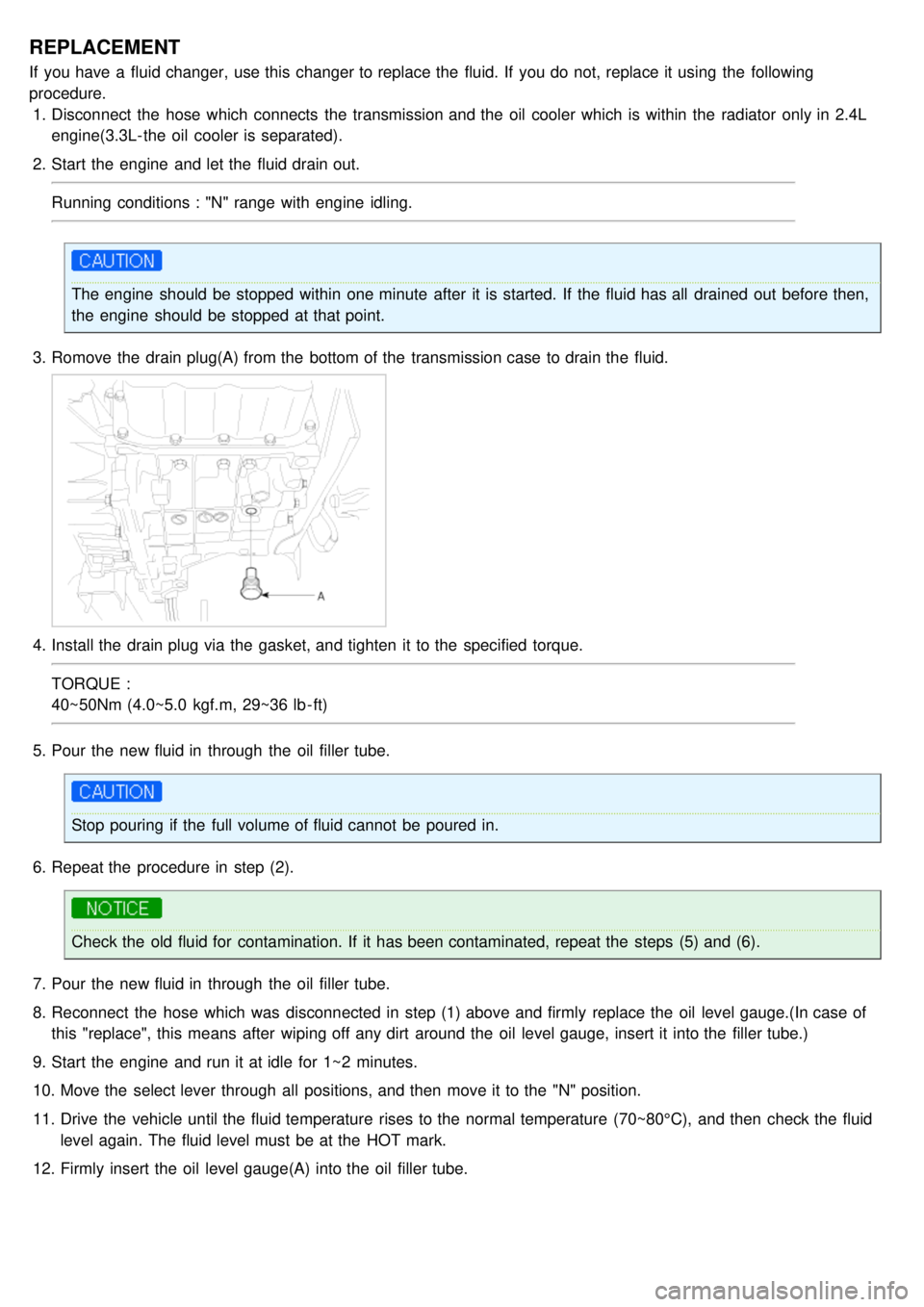
3. Romove the drain plug(A) from the bottom of the transmission case to drain the fluid.
4.Install the drain plug via the gasket, and tighten it to the specified torque.
TORQUE :
40~50Nm (4.0~5.0 kgf.m, 29~36 lb - ft)
5. Pour the new fluid in through the oil filler tube.
Stop pouring if the full volume of fluid cannot be poured in.
6. Repeat the procedure in step (2).
Check the old fluid for contamination. If it has been contaminated, repeat the steps (5) and (6).
7. Pour the new fluid in through the oil filler tube.
8. Reconnect the hose which was disconnected in step (1) above and firmly replace the oil level gauge.(In case of
this "replace", this means after wiping off any dirt around the oil level gauge, insert it into the filler tube.)
9. Start the engine and run it at idle for 1~2 minutes.
10. Move the select lever through all positions, and then move it to the "N" position.
11. Drive the vehicle until the fluid temperature rises to the normal temperature (70~80°C), and then check the fluid
level again. The fluid level must be at the HOT mark.
12. Firmly insert the oil level gauge(A) into the oil filler tube.
Page 417 of 1575
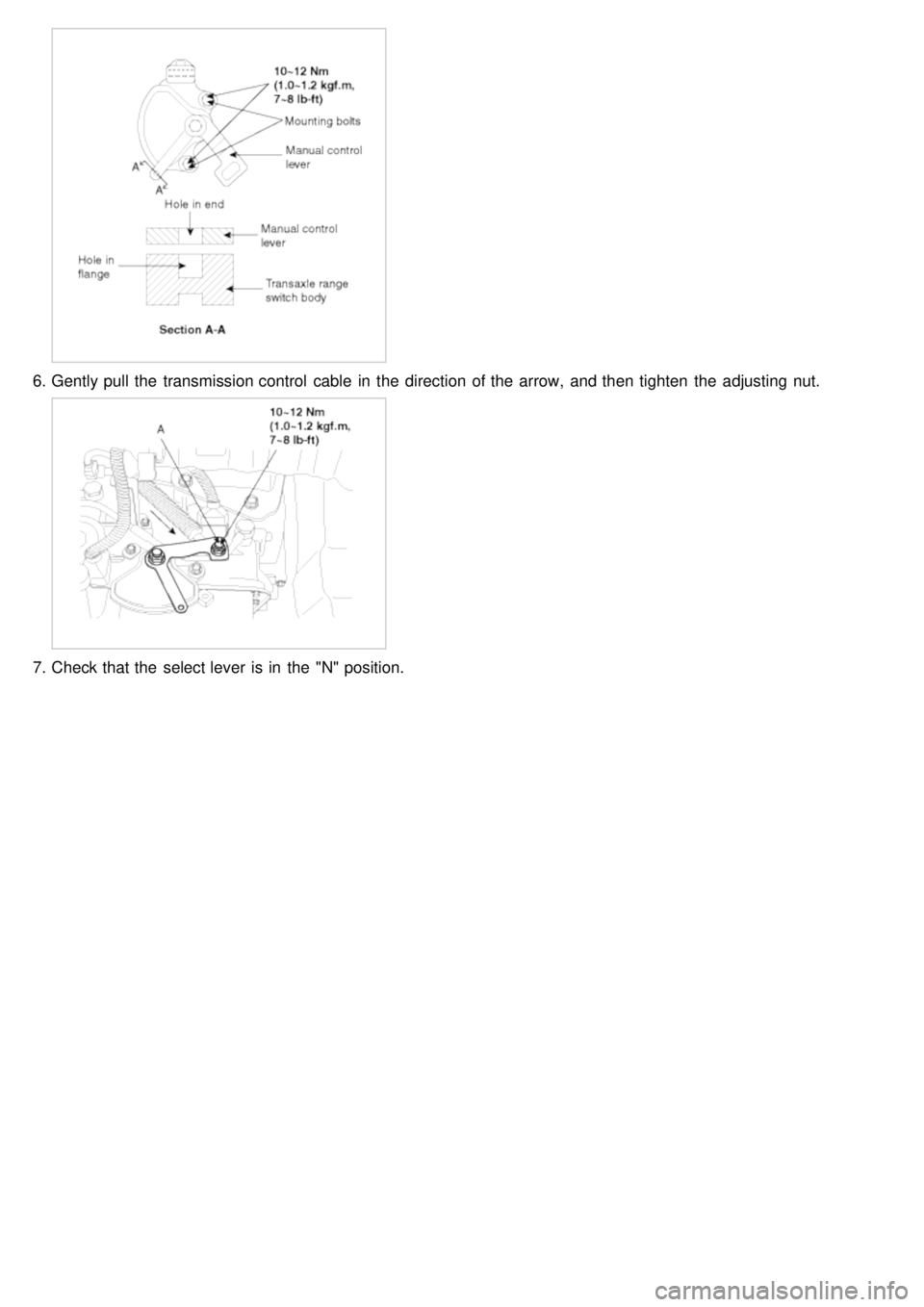
6.Gently pull the transmission control cable in the direction of the arrow, and then tighten the adjusting nut.
7.Check that the select lever is in the "N" position.
Page 424 of 1575

2007 > 2.7L V6 GASOLINE >
SERVICE ADJUSTMENT PROCEDURE
Transmission oil inspection and replacement
1. After parking the vehicle on a plain, stop the engine.
2. After removing the oil filler plug and washer, inspect the manual transaxle fluid condition and quantity.
3. If the manual transaxle fluid is contaminated, drain it out by removing the oil drain plug.
4. Tighten the new oil drain plug and feed manual transaxle fluid to a proper level.
TORQUE:
29.4~34.4 Nm(3.0~3.5kgf.m, 21.7~25.3lb - ft)
Oil type: SAE75W/85
Oil quantity:
1.9 liter(2.0077 US qt, 1.6718 lmp qt)
5. Retighten the oil filler plug with a new washer.
TORQUE:
29.4~34.4 Nm(3.0~3.5kgf.m, 21.7~25.3lb - ft)
Back up lamp switch inspection
1.Disconnect the back up lamp switch connector(B).
2.Inspect the continuity of the switch. When the shift lever is located in reverse range, it should be applied an electric
current.
3. Replace the back up lamp switch, if necessary.
TORQUE:
29.4~34.4 Nm(3.0~3.5kgf.m, 21.7~25.3lb - ft)
Page 501 of 1575

a.Substitute a known good set of wheels and tires.
b. Perform a road test.
c. If the vehicle still exhibits a shake or vibration, note the vehicle speed
and/or engine rpm which it occurs.
● Is the vibration felt ?
→ YES
Engine/transmission imbalance.
See the specification of TR group, EM group, FL group and EC group.
→ NO
Install the original tire/wheel assemblies one by one, Road testing at
each step until the damaged tire(s)/wheel(s) as necessary. Test the
system for normal operation.
Wheel /tire noise, vibration and harshness concerns are directly related to vehicle speed and are not generally affected
by acceleration, coasting or decelerating. Also, out - of- balance wheel and tires can vibrate at more than one speed. A
vibration that is affected by the engine rpm, or is eliminated by placing the transmission in Neutral is not related to the
tire and wheel. As a general rule, tire and wheel vibrations felt in the steering wheel are related to the front tire and
wheel assemblies. Vibrations felt in the seat or floor are related to the rear tire and wheel assemblies. This can initially
isolate a concern to the front or rear.
Careful attention must be paid to the tire and wheels. There are several symptoms that can be caused by damaged or
worn tire and wheels. Perform a careful visual inspection of the tires and wheel assemblies. Spin the tires slowly and
watch for signs of lateral or radial runout. Refer to the tire wear chart to determine the tire wear conditions and actions WHEEL AND TIRE DIAGNOSIS
Rapid wear at the center Rapid wear at both shoulders Wear at one shoulder
a.Center - tread down to fabric due to
excessive over inflated tires
b. Lack of rotation
c. Excessive toe on drive wheels
d. Heavy acceleration on drive a.
Under- inflated tires
b. Worn suspension components
c. Excessive cornering speeds
d. Lack of rotation a.
Toe adjustment out of specification
b. Camber out of specification
c. Damaged strut
d. Damaged lower arm
Partial wear Feathered edge Wear pattern
a.Caused by irregular burrs on
brake drums a.
Toe adjustment out of
specification
b. Damaged or worn tie rods
c. Damaged knuckle a.
Excessive toe on non- drive
wheels
b. Lack of rotation
Page 1207 of 1575
2007 > 2.7L V6 GASOLINE >
SPECIFICATION
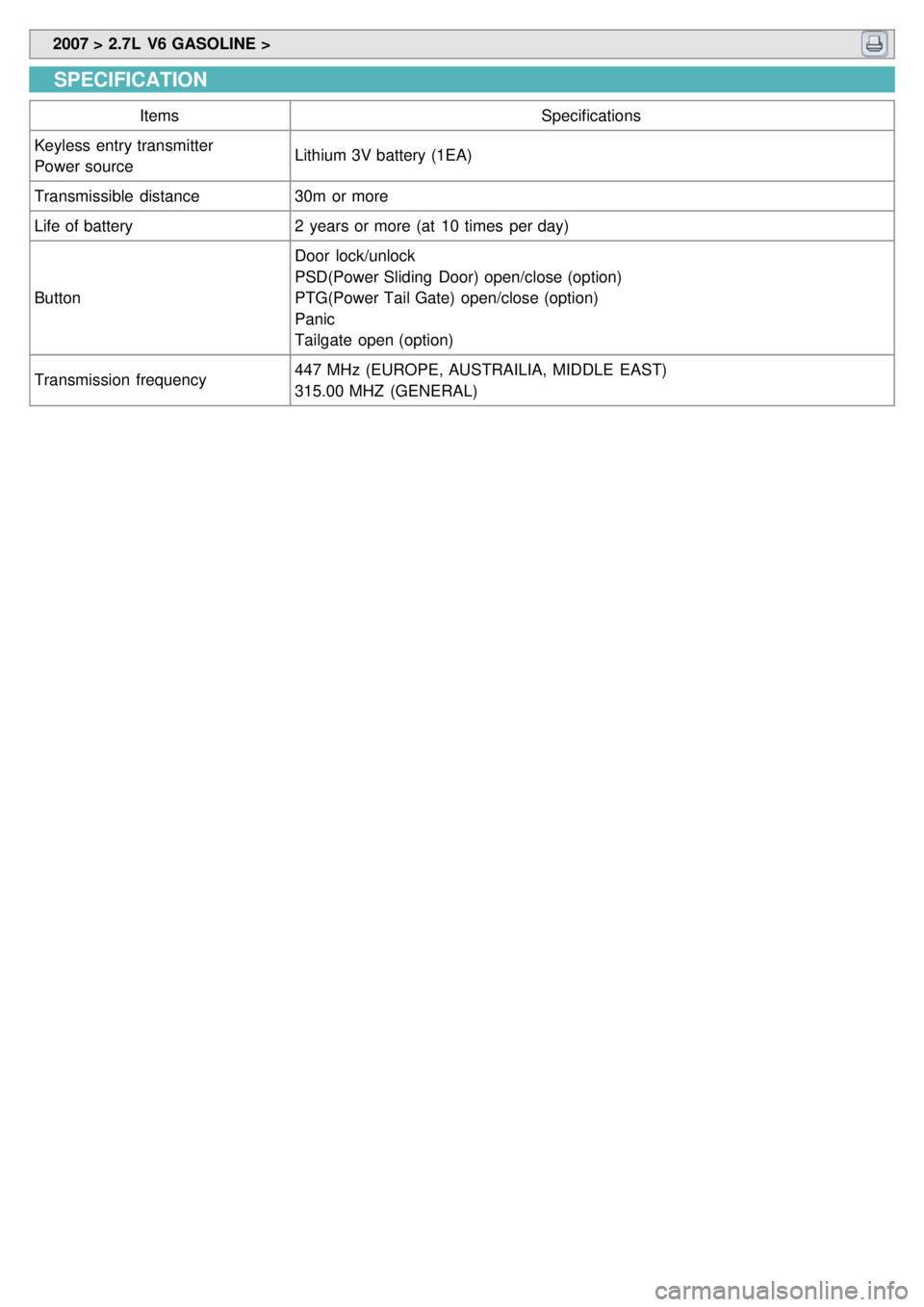
Items Specifications
Keyless entry transmitter
Power source Lithium 3V battery (1EA)
Transmissible distance 30m or more
Life of battery 2 years or more (at 10 times per day)
Button Door lock/unlock
PSD(Power Sliding Door) open/close (option)
PTG(Power Tail Gate) open/close (option)
Panic
Tailgate open (option)
Transmission frequency 447 MHz (EUROPE, AUSTRAILIA, MIDDLE EAST)
315.00 MHZ (GENERAL)
Page 1504 of 1575

SMARTRA unit
The SMARTRA carries out communication with the built- in transponder in the ignition key. This wireless
communication runs on RF (Radio frequency of 125 kHz). The SMARTRA is mounted behind of the crush pad under
panel close to the antenna coil for RF transmission and receiving.
The RF signal from the transponder, received by the antenna coil, is converted into messages for serial
communication by the SMARTRA device. And, the received messages from the PCM(ECM) are converted into an RF
signal, which is transmitted to the transponder by the antenna.
The SMARTRA does not carry out the validity check of the transponder or the calculation of encryption algorithm. This
device is only an advanced interface, which converts the RF data flow of the transponder into serial communication to
the PCM(ECM) and vice versa.
TRANSPONDER (Built-in keys)
The transponder has an advanced encryption algorithm. During the key teaching procedure, the transponder will be
programmed with vehicle specific data. The vehicle specific data are written into the transponder memory. The write
procedure is once only; therefore, the contents of the transponder can never be modified or changed.
Antenna coil
The antenna coil (A) has the following functions.a. The antenna coil supplies energy to the transponder.
b. The antenna coil receives signal from the transponder.
Page 1538 of 1575

(3)If a vehicle stays under extremely hot or cold environment, the detection range may be reduced. It will be
restored at the normal temperature.
(4) When heavy cargo is loaded in rear cargo area, it changes the vehicle balance, which reduces the detection
range.
(5) When other vehicle's horn, motor cycle engine noise, or other ultra - sonic wave sources are near.
(6) Under heavy rain.
(7) When reversing towards a vertical wall and the gap between the vehicle and the wall is 15cm. (Alarm may
sound despite the absence of a barrier)
(8) If radio antenna is installed at the rear.
(9) If the vehicle rear wiring is re- routed or electrical component is added at the rear part.
(10) Vehicle balance is changed due to the replacement of the rear spring.
(11) The unit will operate normally when the vehicle speed is 5km/h or less.
Above this speed, the unit may not operate normally
8. Check the rear bumper for installation condition and deformation. If installed improperly or the sensor orientation is
deviated, it may cause malfunction.
9. Be careful not to apply shock during sensor installation on the transmission or reception unit.
10. When adding electrical devices or modifying harness at the rear body of the vehicle, ensure not to change the
transmission and reception unit wiring.
Tagging the transmission side and reception side, it may cause malfunction.
11. High power radio transmitter (above 10W) may cause malfunction. Do not install it on the vehicle.
12. Be careful that excessive heat or sharp objects shall not touch ultrasonic sensor surface.
Do not cover the sensor opening or press the sensor.
Page 1566 of 1575

2007 > 2.7L V6 GASOLINE >
REPLACEMENT
1.Remove a transaxle assembly (refer to 'MT'- group).
2. Remove the clutch cover bolts. Not to be bent or twisted, loosen them in diagonal directions.
3.Remove the clutch cover and disc.
4. Using the SST(09411- 43000), install a clutch disc and cover.
a. Replace a clutch cover and disc as a set.
* Possible problems when not following the caution
a. When replacing only a disc, slip problem can occur because of the initial clamp load loss by the adjusting
ring's unusual work.
b. When replacing only a disc, it can be difficult to cut power because the thickness of the disc cannot be
permitted.
b. Apply grease on a disc spline part and transmission input shaft spline part as required.
* Possible problems when not following
a. When not applying: Excessively wear of splines and bad clutch operation
b. When excessively applying: Scattered grease by centrifugal force conteminates the clutch disc. Loss of friction
force can cause a slip
c. The 'T/M SIDE' marked surface should face the transaxle.
→ If the surface face the opposite side, there can be an interference between a disc and a flywheel surface.
Page 1567 of 1575

5.Tighten the clutch cover.
TORQUE:
24.5~35.3Nm (250~360kgf.cm, 18.1~26.0lb - ft) (6EA)
When installing the clutch cover, tighten the bolts in diagonal directions not to be bent or twisted.
* Possible problems when not following
a. When tightening the bolt completely at a time: the clutch cover can be twisted and vibration can occur.
b. On vehicles with self adjusting clutches, it is necessary to follow this caution.
c. Not following tightening torque: There can be bad torque transmission in clutch and relaxation possibility of
bolts.
INSPECTION
1.Inspect diaphragm spring wear which is in contact with a concentric slave cylinder bearing.