oil type KIA CARNIVAL 2007 Owner's Manual
[x] Cancel search | Manufacturer: KIA, Model Year: 2007, Model line: CARNIVAL, Model: KIA CARNIVAL 2007Pages: 1575, PDF Size: 44.86 MB
Page 584 of 1575

CHECKING POWER STEERING BELT TENSION
Refer to EM group(Timing system).
CHECKING POWER STEERING FLUID LEVEL
1.Position the vehicle on a level surface.
2. Start the engine. With the vehicle kept stationary, turn the steering wheel several times continuously to raise the
fluid temperature to 50- 60°C (122 - 140°F).
3. With the engine at idle, turn the steering wheel fully clockwise and counter- clockwise several times.
4. Make sure that there is no foaming or cloudiness in the reservoir fluid.
5. Stop the engine and check for any difference in fluid level between a stationary and a running engine.
a.If the fluid level varies 5 mm (0.2 in) or more, bleed the system again.
b. If the fluid level suddenly rises after stopping the engine, further bleeding is required.
c. Incomplete bleeding will produce a chattering sound in the pump and noise in the flow control valve, and
lead to decreased durability of the pump.
REPLACING POWER STEERING FLUID
1.Jack up the front wheels and support them with jackstands.
2. Disconnect the return hose from the oil reservoir and plug the oil reservoir.
3. Connect a vinyl hose to the disconnected return hose, and drain the oil into a container.
4. Remove the fuel pump fuse, then start the engine and wait for the engine to stall. Next, while operating the starting
motor intermittently, turn the steering wheel all the way to the left and then to the right several times to drain the
fluid.
5. Connect the return hoses, then fill the oil reservoir with the specified fluid.
6. Reinstall the fuel pump fuse.
7. Start the engine. Check for oil leakage.
8. Stop the engine.
9. Bleed the system.
Power steering fluid type : PSF - 3
Total quantity : Approx 1.1 liter
AIR BLEEDING
1.Remove the fuel pump fuse, then start the engine and wait for the engine to stall. Next, while operating the starting
motor intermittently (for 15 ~ 20 seconds), turn the steering wheel all the way to the left and then to the right five or
six times.
Page 587 of 1575

2007 > 2.7L V6 GASOLINE >
SPECIFICATIONS
Items Specifications
Steering column/ shaft Type
Tilt
Tilt stroke +7°/ - 11.7°
Steering gear Type
Rack & pinion
Rack stroke VRS On
148 mm (5.827 in)
VRS Off 156 mm (6.142 in)
Power steering pump Type
Vane
Diesel Relief pressure
90 kgf/cm²
Discharge 9.6 cc/rev
Gasoline Relief pressure
90 kgf/cm²
Discharge 10.5 cc/rev
SERVICE STANDARD
Items Specifications
Steering wheel free play 30 mm (1.12 in)
Steering angle VRS on
Inner
38.64°
Outer 31.78°
VRS off Inner
41.91°
Outer 33.54°
TIGHTENING TORQUE
Items NmKgf.m Lb- ft
Steering wheel lock nut 40 ~ 504.0 ~ 5.0 29 ~ 36
Steering column mounting bolts and nut 13 ~ 181.3 ~ 1.89.4 ~ 13.0
Bolt connecting steering column to universal
joint 15 ~ 20
1.5 ~ 2.010.8 ~ 14.5
Bolt connecting universal joint to steering gear 13 ~ 181.3 ~ 1.89.4 ~ 13.0
Steering column mounting bolts and nut 13 ~ 181.3 ~ 1.89.4 ~ 13.0
Tie rod end castle nut 35 ~ 453.5 ~ 4.5 25 ~ 33
Front lower arm ball joint assembly bolts 90 ~ 1209.0 ~ 12.0 65 ~ 87
Stabilizer link to strut assembly nut 100 ~ 12010.0 ~ 12.0 72 ~ 87
Rear roll stopper to sub- frame bolts 50 ~ 605.0 ~ 6.0 36 ~ 43
Pressure tube to valve body housing nut 12 ~ 181.2 ~ 1.8 9 ~ 13
Pressure tube to oil pump eye bolt 65 ~ 756.5 ~ 7.5 47 ~ 54
Return tube to valve body housing nut 12 ~ 181.2 ~ 1.8 9 ~ 13
Power steering gear box to sub- frame bots 90 ~ 1109.0 ~ 11.0 65 ~ 80
LUBRICANT
Item Lubricant Quantity
Power steering fluid PSF - 31.1 L
Page 647 of 1575
2007 > 2.7L V6 GASOLINE >
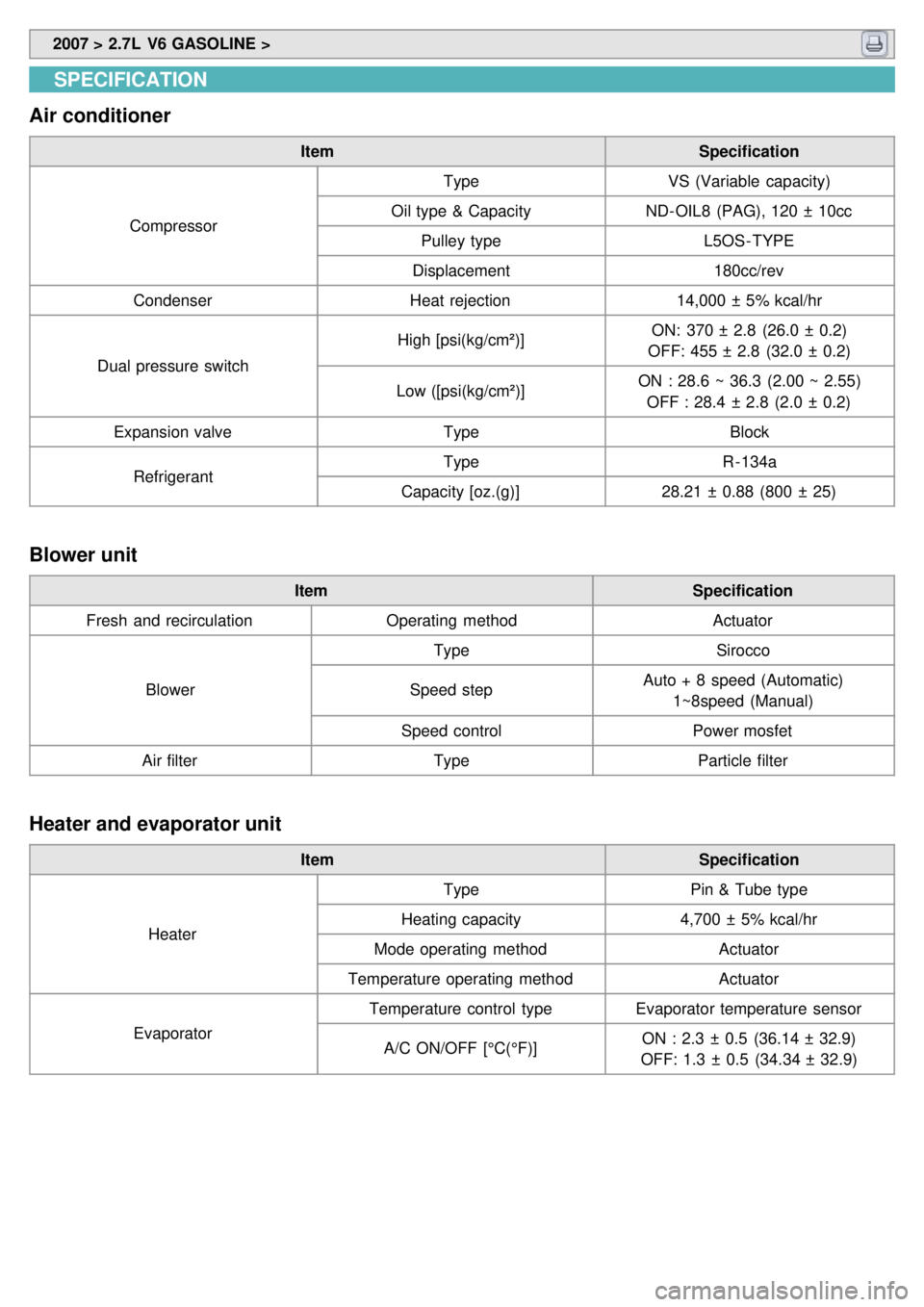
SPECIFICATION
Air conditioner
Item Specification
Compressor Type
VS (Variable capacity)
Oil type & Capacity ND- OIL8 (PAG), 120 ± 10cc
Pulley type L5OS - TYPE
Displacement 180cc/rev
Condenser Heat rejection14,000 ± 5% kcal/hr
Dual pressure switch High [psi(kg/cm²)]
ON: 370 ± 2.8 (26.0 ± 0.2)
OFF: 455 ± 2.8 (32.0 ± 0.2)
Low ([psi(kg/cm²)] ON : 28.6 ~ 36.3 (2.00 ~ 2.55)
OFF : 28.4 ± 2.8 (2.0 ± 0.2)
Expansion valve TypeBlock
Refrigerant Type
R- 134a
Capacity [oz.(g)] 28.21 ± 0.88 (800 ± 25)
Blower unit
Item Specification
Fresh and recirculation Operating method Actuator
Blower Type
Sirocco
Speed step Auto + 8 speed (Automatic)
1~8speed (Manual)
Speed control Power mosfet
Air filter TypeParticle filter
Heater and evaporator unit
Item Specification
Heater Type
Pin & Tube type
Heating capacity 4,700 ± 5% kcal/hr
Mode operating method Actuator
Temperature operating method Actuator
Evaporator Temperature control type
Evaporator temperature sensor
A/C ON/OFF [°C(°F)] ON : 2.3 ± 0.5 (36.14 ± 32.9)
OFF: 1.3 ± 0.5 (34.34 ± 32.9)
Page 866 of 1575

TIGHTENING TORQUE
ItemsNmkgf.m lb - ft
Master cylinder to booster mounting nut 8 ~ 120.8 ~ 1.2 5.8 ~ 8.7
Brake booster mounting nut 13 ~ 161.3 ~ 1.6 9.4 ~ 11.6
Bleeder screw 7 ~ 130.7 ~ 1.3 5.06 ~ 9.4
Brake tube nut, brake hose 13 ~ 171.3 ~ 1.7 9.4 ~ 12.3
Caliper guide rod bolt (Front) 22 ~ 322.2 ~ 3.215.9 ~ 23.1
Caliper guide rod bolt (Rear) 22 ~ 322.2 ~ 3.215.9 ~ 23.1
Caliper assembly to knuckle (Front) 85 ~ 1008.5 ~ 1061.5 ~ 72.3
Caliper assembly to knuckle (Rear) 50 ~ 605.0 ~ 6.036.2 ~ 43.4
Brake hose to front caliper 25 ~ 302.5 ~ 3.018.1 ~ 21.7
Brake pedal assembly bracket mounting nut 10 ~ 151.0 ~ 1.5 7.2 ~ 10.8
Brake pedal mounting nut 13 ~ 161.3 ~ 1.6 9.4 ~ 11.6
Stop lamp switch mounting nut 8 ~ 100.8 ~ 1.0 5.8 ~ 7.23
Active wheel speed sensor mounting bolt on
the brake plate 7 ~ 10
0.7 ~ 1.0 5.1 ~ 7.2
HECU mounting bracket bolt 17 ~ 261.7 ~ 2.612.3 ~ 18.8
HECU mounting nut 6 ~ 100.6 ~ 1.0 4.3 ~ 7.2
Yaw rate & lateral acceleration sensor bolt 5 ~ 80.5 ~ 0.8 3.62 ~ 5.8
SPECIFICATION (ABS)
Part ItemStandard valueRemark
HECU(Hydraulic and
Electronic Control
Unit) System
4 channel 4 sensor
(Solenoid)
·ABS system:ABS &
EBD control
Type
Motor, valve relay
intergrated type
Operating voltage 8 V ~ 16 V(DC)
Operating temperature - 40 ~ 120 °C
( - 40 ~ 248 °F)
Warning lamp Operating voltage
12 V·ABS W/L:ABS failure
·Brake W/L:Parking,
brake oil, EBD failure
Current consumption 80 mA
Acitve wheel speed
sensor Supply voltage
DC 4.5 ~ 2.0 V
Operating temperature - 40 ~ 150 °C
Output current low 5.9 ~ 8.4 mATyp.7 mA
Output current High 11.8 ~ 16.8 mATyp.14 mA
Frequency range 1 ~ 2500 HZ
Air gap Front
0.15 ~ 1.5 mm Typ.0.7 mm
Rear 0.2 ~ 1.2 mm Typ.0.7 mm
Tone wheel 48 teeth
Output duty 30~70 %
SPECIFICATION(ESP)
Page 1310 of 1575

4.Connect the oil pressure switch wire harness.
5. Turn the ignition switch ON. Check that the warning lamp lights up. If the warning lamp doesn't light, test the wire
harness.
BRAKE FLUID LEVEL WARNING SWITCH
1.Remove the connector (A) from the switch located at the brake fluid reservoir (B).
2. Verify that continuity exists between switch terminals 1 and 2 while pressing the switch (float) down with a rod.
BRAKE FLUID LEVEL WARNING LAMP
1.Ignition "ON"
2. Release the parking brake.
3. Remove the connector from the brake fluid level warning switch.
4. Ground the connector at the harness side.
5. Verify that the warning lamp lights.
PARKING BRAKE SWITCH
The parking brake switch is a push type. It is located at the side of the parking brake pedal.
1. Check that there is continuity between the terminal and switch body with the switch (A) ON.
Page 1503 of 1575
2007 > 2.7L V6 GASOLINE >
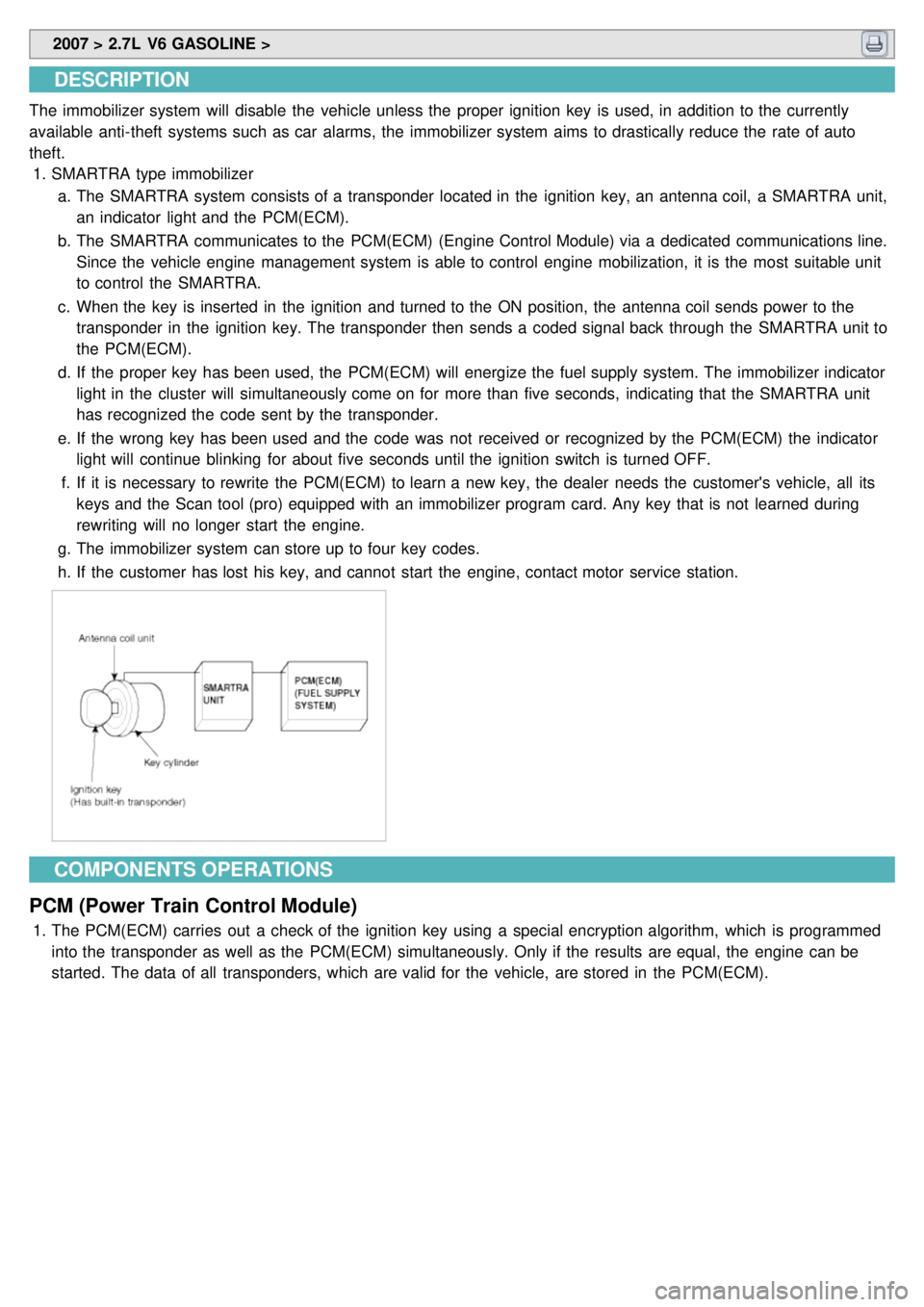
DESCRIPTION
The immobilizer system will disable the vehicle unless the proper ignition key is used, in addition to the currently
available anti- theft systems such as car alarms, the immobilizer system aims to drastically reduce the rate of auto
theft.
1. SMARTRA type immobilizer
a. The SMARTRA system consists of a transponder located in the ignition key, an antenna coil, a SMARTRA unit,
an indicator light and the PCM(ECM).
b. The SMARTRA communicates to the PCM(ECM) (Engine Control Module) via a dedicated communications line.
Since the vehicle engine management system is able to control engine mobilization, it is the most suitable unit
to control the SMARTRA.
c. When the key is inserted in the ignition and turned to the ON position, the antenna coil sends power to the
transponder in the ignition key. The transponder then sends a coded signal back through the SMARTRA unit to
the PCM(ECM).
d. If the proper key has been used, the PCM(ECM) will energize the fuel supply system. The immobilizer indicator
light in the cluster will simultaneously come on for more than five seconds, indicating that the SMARTRA unit
has recognized the code sent by the transponder.
e. If the wrong key has been used and the code was not received or recognized by the PCM(ECM) the indicator
light will continue blinking for about five seconds until the ignition switch is turned OFF.
f. If it is necessary to rewrite the PCM(ECM) to learn a new key, the dealer needs the customer's vehicle, all its
keys and the Scan tool (pro) equipped with an immobilizer program card. Any key that is not learned during
rewriting will no longer start the engine.
g. The immobilizer system can store up to four key codes.
h. If the customer has lost his key, and cannot start the engine, contact motor service station.
COMPONENTS OPERATIONS
PCM (Power Train Control Module)
1. The PCM(ECM) carries out a check of the ignition key using a special encryption algorithm, which is programmed
into the transponder as well as the PCM(ECM) simultaneously. Only if the results are equal, the engine can be
started. The data of all transponders, which are valid for the vehicle, are stored in the PCM(ECM).
Page 1506 of 1575
2007 > 2.7L V6 GASOLINE >
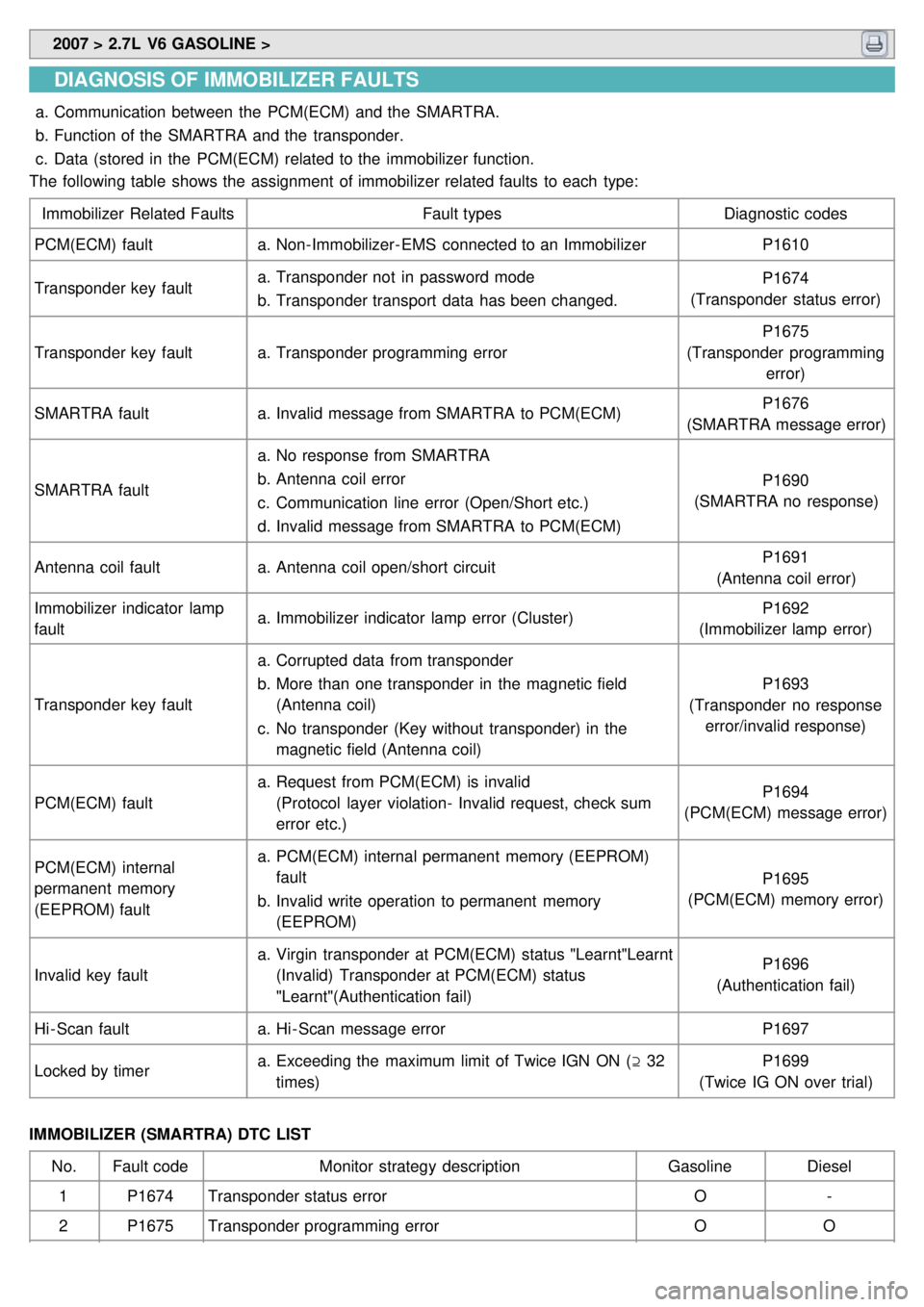
DIAGNOSIS OF IMMOBILIZER FAULTS
a.Communication between the PCM(ECM) and the SMARTRA.
b. Function of the SMARTRA and the transponder.
c. Data (stored in the PCM(ECM) related to the immobilizer function.
The following table shows the assignment of immobilizer related faults to each type:
Immobilizer Related Faults Fault typesDiagnostic codes
PCM(ECM) fault a.Non- Immobilizer- EMS connected to an Immobilizer P1610
Transponder key fault a.
Transponder not in password mode
b. Transponder transport data has been changed. P1674
(Transponder status error)
Transponder key fault a.Transponder programming error P1675
(Transponder programming error)
SMARTRA fault a.Invalid message from SMARTRA to PCM(ECM) P1676
(SMARTRA message error)
SMARTRA fault a.
No response from SMARTRA
b. Antenna coil error
c. Communication line error (Open/Short etc.)
d. Invalid message from SMARTRA to PCM(ECM) P1690
(SMARTRA no response)
Antenna coil fault a.Antenna coil open/short circuit P1691
(Antenna coil error)
Immobilizer indicator lamp
fault a.
Immobilizer indicator lamp error (Cluster) P1692
(Immobilizer lamp error)
Transponder key fault a.
Corrupted data from transponder
b. More than one transponder in the magnetic field
(Antenna coil)
c. No transponder (Key without transponder) in the
magnetic field (Antenna coil) P1693
(Transponder no response error/invalid response)
PCM(ECM) fault a.
Request from PCM(ECM) is invalid
(Protocol layer violation- Invalid request, check sum
error etc.) P1694
(PCM(ECM) message error)
PCM(ECM) internal
permanent memory
(EEPROM) fault a.
PCM(ECM) internal permanent memory (EEPROM)
fault
b. Invalid write operation to permanent memory
(EEPROM) P1695
(PCM(ECM) memory error)
Invalid key fault a.
Virgin transponder at PCM(ECM) status "Learnt"Learnt
(Invalid) Transponder at PCM(ECM) status
"Learnt"(Authentication fail) P1696
(Authentication fail)
Hi - Scan fault a.Hi - Scan message error P1697
Locked by timer a.
Exceeding the maximum limit of Twice IGN ON ( ⊇ 32
times) P1699
(Twice IG ON over trial)
IMMOBILIZER (SMARTRA) DTC LIST No. Fault code Monitor strategy description GasolineDiesel
1 P1674 Transponder status error O-
2 P1675 Transponder programming error OO