wheel KIA CARNIVAL 2007 Repair Manual
[x] Cancel search | Manufacturer: KIA, Model Year: 2007, Model line: CARNIVAL, Model: KIA CARNIVAL 2007Pages: 1575, PDF Size: 44.86 MB
Page 563 of 1575

2007 > 2.7L V6 GASOLINE >
REMOVAL
1.Loosen the wheel nuts slightly.
Raise the rear of the vehicle, and make sure it is securely supported.
2. Remove the rear wheel and tire (A) from rear hub (B).
Be careful not to damage the hub bolts (C) when removing the rear wheel and tire (A).
3. Remove the left/right nuts (C) of the rear stabilizer links (B) from the trailing arm (A).
4.Remove the left/right mounting nuts (B) of the rear stabilizer bar brackets (A).
5.Remove the rear stabilizer link (A) nut (B) from the stabilizer bar assembly.
Page 565 of 1575
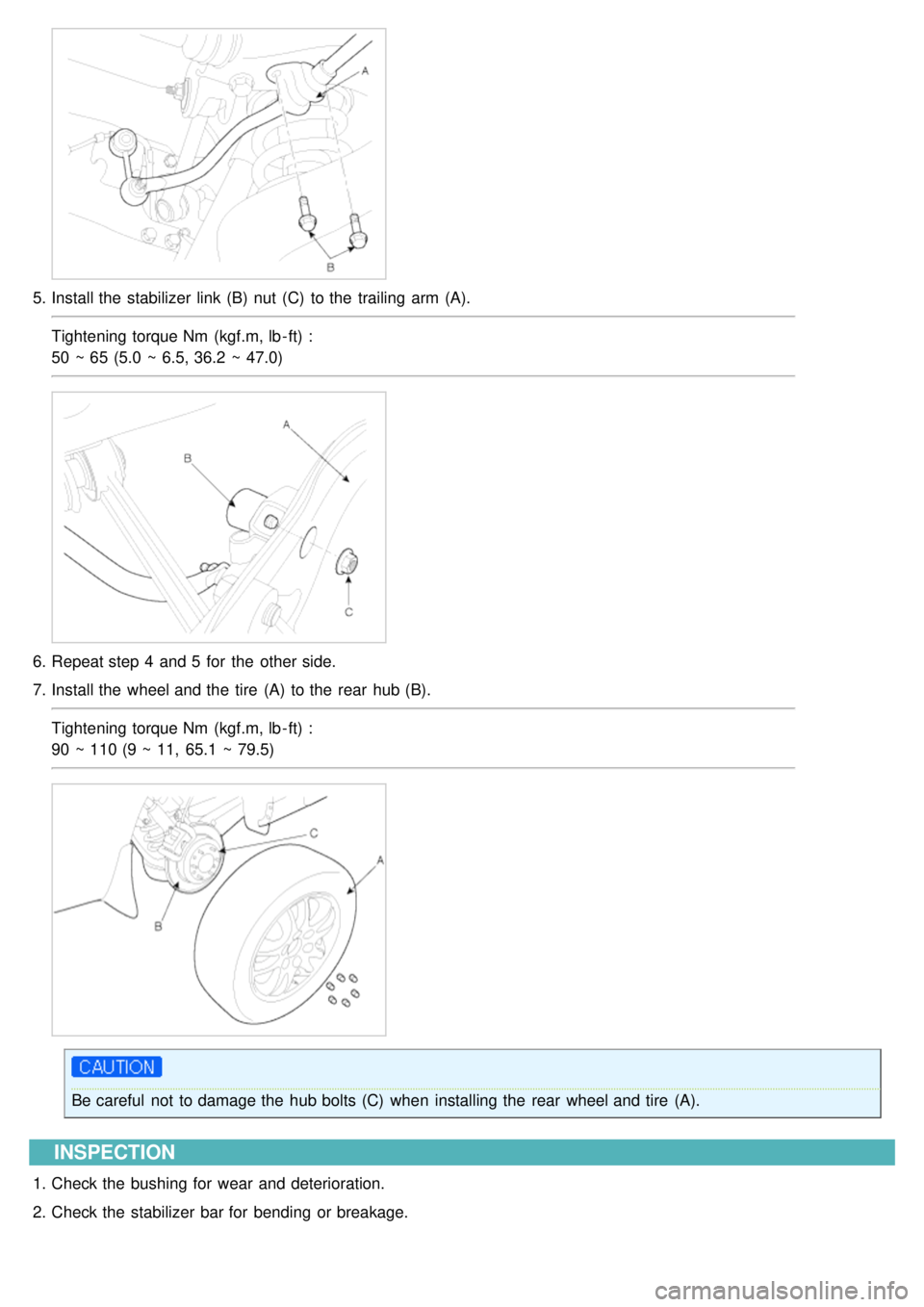
5.Install the stabilizer link (B) nut (C) to the trailing arm (A).
Tightening torque Nm (kgf.m, lb - ft) :
50 ~ 65 (5.0 ~ 6.5, 36.2 ~ 47.0)
6.Repeat step 4 and 5 for the other side.
7. Install the wheel and the tire (A) to the rear hub (B).
Tightening torque Nm (kgf.m, lb - ft) :
90 ~ 110 (9 ~ 11, 65.1 ~ 79.5)
Be careful not to damage the hub bolts (C) when installing the rear wheel and tire (A).
INSPECTION
1.Check the bushing for wear and deterioration.
2. Check the stabilizer bar for bending or breakage.
Page 567 of 1575

Tires / Wheels
Page 569 of 1575
![KIA CARNIVAL 2007 Repair Manual 2007 > 2.7L V6 GASOLINE >
TIRE WEAR
1.Measure the tread depth of the tires.
Tread depth [limit] : 1.6 mm (0.063 in)
2. If the remaining tread(A) depth is less than the limit, replace the](/img/2/57045/w960_57045-568.png "KIA CARNIVAL 2007 Repair Manual 2007 > 2.7L V6 GASOLINE >
TIRE WEAR
1.Measure the tread depth of the tires.
Tread depth [limit] : 1.6 mm (0.063 in)
2. If the remaining tread(A) depth is less than the limit, replace the")
2007 > 2.7L V6 GASOLINE >
TIRE WEAR
1.Measure the tread depth of the tires.
Tread depth [limit] : 1.6 mm (0.063 in)
2. If the remaining tread(A) depth is less than the limit, replace the tire.
When the tread depth of the tires is less than 1.6 mm (0.063 in), the wear indicators(B) will appear.
TIRE ROTATION
Rotate the tires in the pattern illustrated.
CHECKING FOR PULL AND WANDER
If the steering pulls to one side, rotate the tires according to the following wheel rotation procedure.
1. Rotate the front right and front left tires, and perform a road test in order to confirm vehicle stability.
Page 570 of 1575

2.If the steering pulls to the opposite side, rotate the front and rear tires, and perform a road test again.
3.If the steering continues to pull to one side, rotate the front right and left tires again, and perform a road test.
4.If the steering continues to pull to the opposite side, replace the front wheels with new ones.
Page 571 of 1575

Wheel
Page 572 of 1575
2007 > 2.7L V6 GASOLINE >
WHEEL ALIGNMENT
When using commercially available computerized four wheel alignment equipment (caster, camber, toe) to inspect the
front wheel alignment, always position the car on a level surface with the front wheels facing straight ahead.
Prior to inspection, make sure that the front suspension and steering system are in normal operating condition and
that the wheels and tires face straight ahead and the tires are inflated to the specified pressure.
TOE
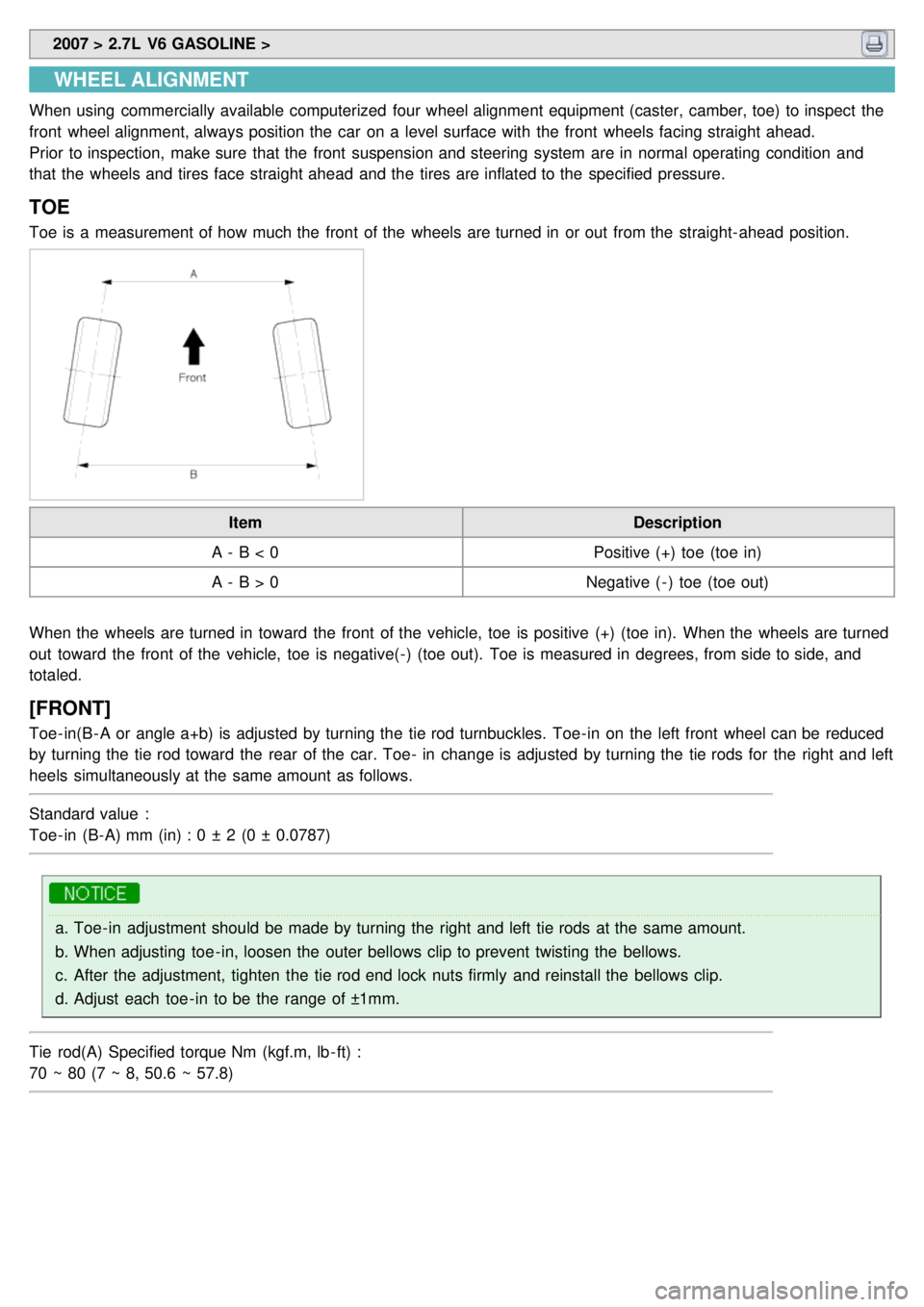
Toe is a measurement of how much the front of the wheels are turned in or out from the straight- ahead position.
Item Description
A - B < 0 Positive (+) toe (toe in)
A - B > 0 Negative ( - ) toe (toe out)
When the wheels are turned in toward the front of the vehicle, toe is positive (+) (toe in). When the wheels are turned
out toward the front of the vehicle, toe is negative(- ) (toe out). Toe is measured in degrees, from side to side, and
totaled.
[FRONT]
Toe- in(B - A or angle a+b) is adjusted by turning the tie rod turnbuckles. Toe- in on the left front wheel can be reduced
by turning the tie rod toward the rear of the car. Toe- in change is adjusted by turning the tie rods for the right and left
heels simultaneously at the same amount as follows.
Standard value :
Toe- in (B- A) mm (in) : 0 ± 2 (0 ± 0.0787)
a. Toe- in adjustment should be made by turning the right and left tie rods at the same amount.
b. When adjusting toe - in, loosen the outer bellows clip to prevent twisting the bellows.
c. After the adjustment, tighten the tie rod end lock nuts firmly and reinstall the bellows clip.
d. Adjust each toe - in to be the range of ±1mm.
Tie rod(A) Specified torque Nm (kgf.m, lb - ft) :
70 ~ 80 (7 ~ 8, 50.6 ~ 57.8)
Page 573 of 1575
![KIA CARNIVAL 2007 Repair Manual [REAR]
Standard value :
Toe- in (B- A) mm (in) : 2.6 ± 2 (0.1024 ± 0.0787)
Adjust the toe - in by turning the cambolt of the assist arm.
Left cambolt : Clockwise → toe - in
Right camb](/img/2/57045/w960_57045-572.png "KIA CARNIVAL 2007 Repair Manual [REAR]
Standard value :
Toe- in (B- A) mm (in) : 2.6 ± 2 (0.1024 ± 0.0787)
Adjust the toe - in by turning the cambolt of the assist arm.
Left cambolt : Clockwise → toe - in
Right camb")
[REAR]
Standard value :
Toe- in (B- A) mm (in) : 2.6 ± 2 (0.1024 ± 0.0787)
Adjust the toe - in by turning the cambolt of the assist arm.
Left cambolt : Clockwise → toe - in
Right cambolt : Clockwise → toe - out
The variation of toe by a rotation of the cambolt :
About 3.2 mm (0.126 in)
a. Each toe should be within ±1 mm (± 0.039 in).
If the difference between right and left is not within +2mm (0.079 in), repeat adjustment.
b. After adjusting the cambolt, tighten the nut to the specified torque.
Specified torque
90 ~ 120 Nm (9 ~ 12 kgf.m, 65.1 ~ 86.8 lb - ft)
CAMBER
[FRONT]
Camber is the inward or outward tilting of the wheels at the top.
Page 574 of 1575

ItemDescription
A Positive camber angle
B True vertical
When the wheel tilts out at the top, then the camber is positive (+).
When the wheel tilts in at the top, then the camber is negative(- ).
Standard value : 0° ± 30´
Difference between right and left angle is within 0° 30´
Camber is pre- set at the factory and doesn't need to be adjusted. If the camber is not within the standard value,
replace the bent or damaged parts.
[REAR]
Standard value : - 6´ ± 30´
Difference between right and left angle is within 0° 30´
Adjust the camber by turning the cambolt of the rear upper arm.
Left cambolt : Clockwise → camber(- )
Right cambolt : Clockwise →camber(+)
The variation of camber by a rotation of the cambolt :
About 0°8´35´´
CASTER
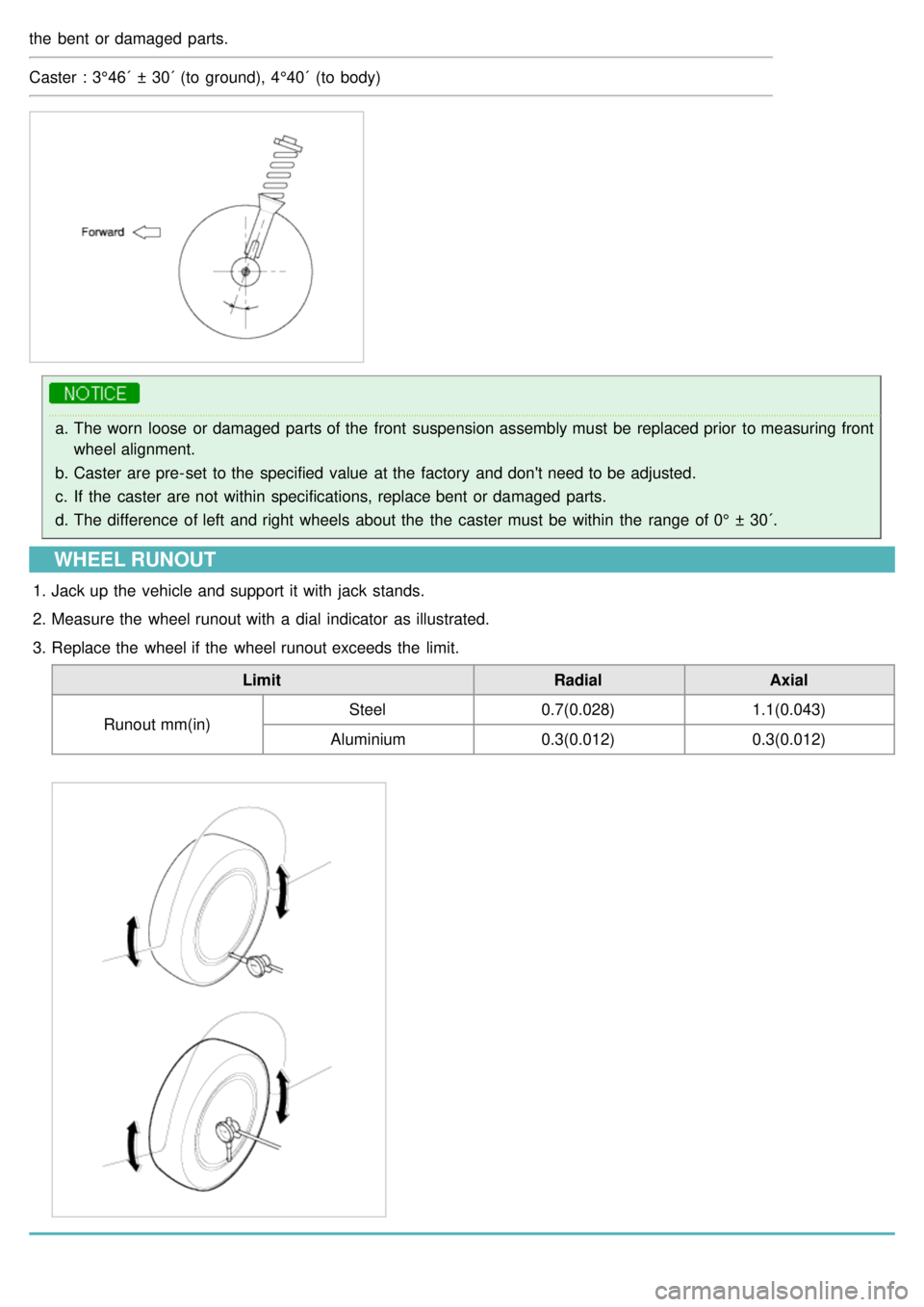
Caster is the tilting of the strut axis either forward or backward from vertical. A backward tilt is positive (+) and a
forward tilt is negative ( - ).
Caster is pre- set at the factory and doesn't need to be adjusted. If the caster is not within the standard value, replace
the bent or damaged parts.
Page 575 of 1575
the bent or damaged parts.
Caster : 3°46´ ± 30´ (to ground), 4°40´ (to body)
a.The worn loose or damaged parts of the front suspension assembly must be replaced prior to measuring front
wheel alignment.
b. Caster are pre- set to the specified value at the factory and don't need to be adjusted.
c. If the caster are not within specifications, replace bent or damaged parts.
d. The difference of left and right wheels about the the caster must be within the range of 0° ± 30´.
WHEEL RUNOUT
1.Jack up the vehicle and support it with jack stands.
2. Measure the wheel runout with a dial indicator as illustrated.
3. Replace the wheel if the wheel runout exceeds the limit.
Limit RadialAxial
Runout mm(in) Steel
0.7(0.028) 1.1(0.043)
Aluminium 0.3(0.012)0.3(0.012)