wheel KIA CARNIVAL 2007 Owner's Manual
[x] Cancel search | Manufacturer: KIA, Model Year: 2007, Model line: CARNIVAL, Model: KIA CARNIVAL 2007Pages: 1575, PDF Size: 44.86 MB
Page 452 of 1575
2007 > 2.7L V6 GASOLINE >
REMOVAL
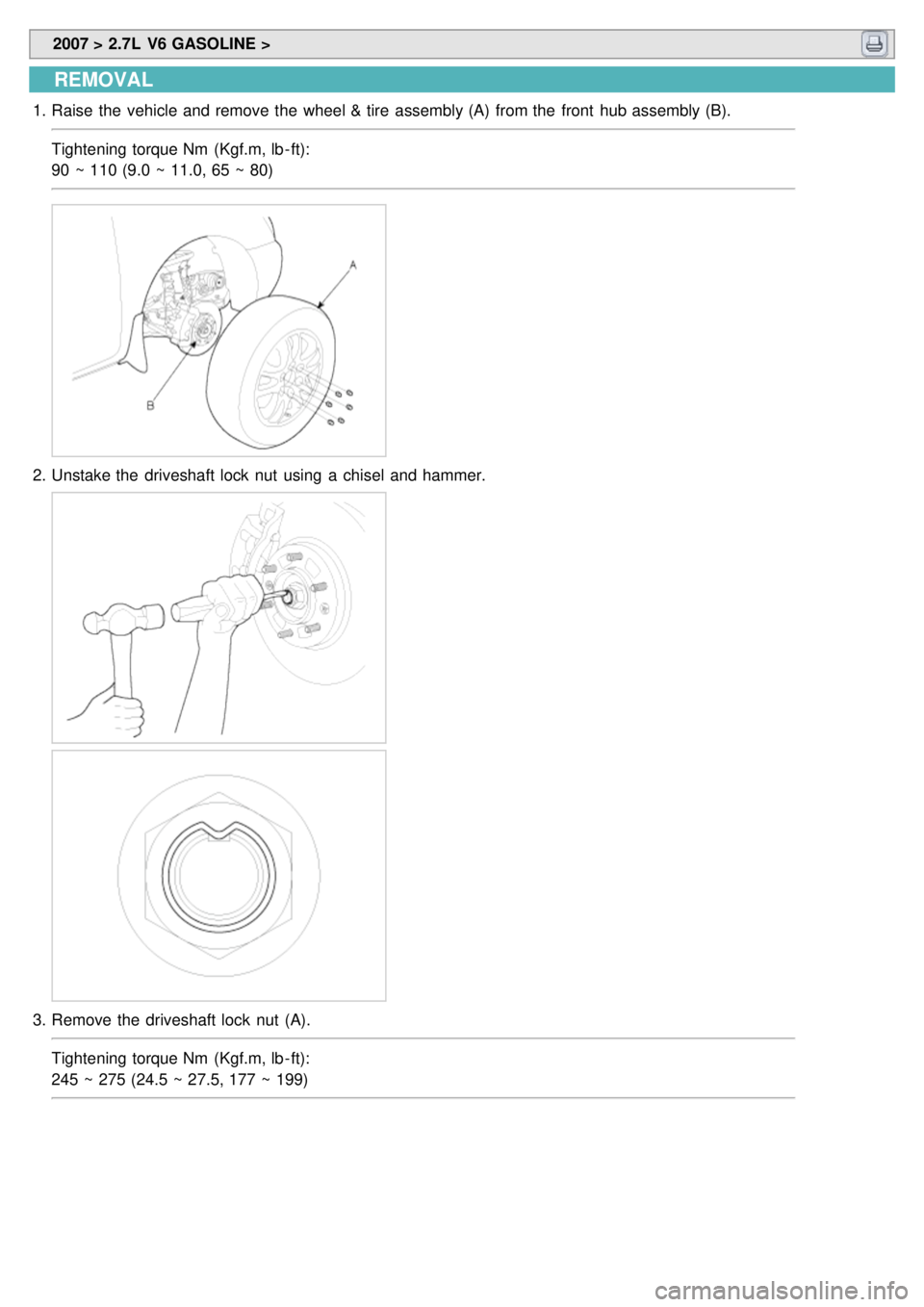
1.Raise the vehicle and remove the wheel & tire assembly (A) from the front hub assembly (B).
Tightening torque Nm (Kgf.m, lb - ft):
90 ~ 110 (9.0 ~ 11.0, 65 ~ 80)
2.Unstake the driveshaft lock nut using a chisel and hammer.
3.Remove the driveshaft lock nut (A).
Tightening torque Nm (Kgf.m, lb - ft):
245 ~ 275 (24.5 ~ 27.5, 177 ~ 199)
Page 462 of 1575
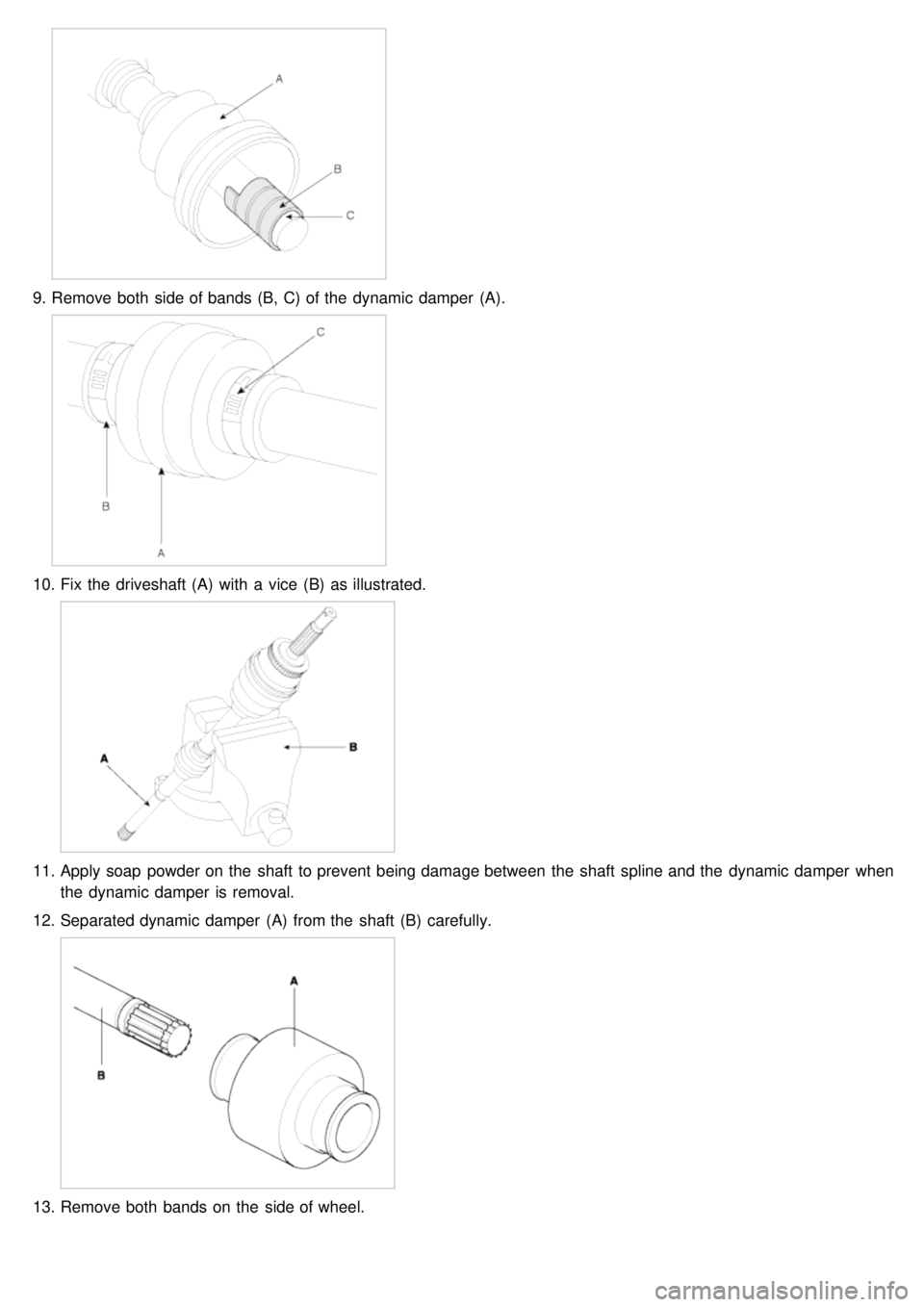
9.Remove both side of bands (B, C) of the dynamic damper (A).
10. Fix the driveshaft (A) with a vice (B) as illustrated.
11.Apply soap powder on the shaft to prevent being damage between the shaft spline and the dynamic damper when
the dynamic damper is removal.
12. Separated dynamic damper (A) from the shaft (B) carefully.
13.Remove both bands on the side of wheel.
Page 463 of 1575

14.Pull out the joint(BJ) boot on the side of wheel into the transaxle direction.
Be careful not to damage the boot.
REASSEMBLY
1.Wrap tape around the drive shaft splines (UTJ side) to prevent damage to the boots.
2. Apply grease to the joint(BJ) boot on the side of wheel and install the boots.
3. Install the bands to both boots.
4.Using clamp, secure the boot bands.
Clearance (A) : 2.0 mm (0.079 in.) or less
5.To install the dynamic damper, keep the BJ shaft in a straight line and secure the dynamic damper with the
dynamic damper bands.
6. Install the UTJ boot bands and UTJ boot.
7. Using the alignment marks (D) made during disassembly as a guide, install the spider assembly (A) and snap ring
(B) on the driveshaft splines (C).
Page 469 of 1575

2007 > 2.7L V6 GASOLINE >
REMOVAL
1.Raise the vehicle and remove the wheel & tire assembly (A) from the front hub assembly (B).
Tightening torque Nm (Kgf.m, lb - ft):
90 ~ 110 (9.0 ~ 11.0, 65 ~ 80)
2.Remove the wheel speed sensor & wire (A) by loosening the bolts.
3.Disconnect the brake hose (A) from the strut assembly.
4.Unstake the driveshaft lock nut using a chisel and hammer.
Page 474 of 1575
INSPECTION
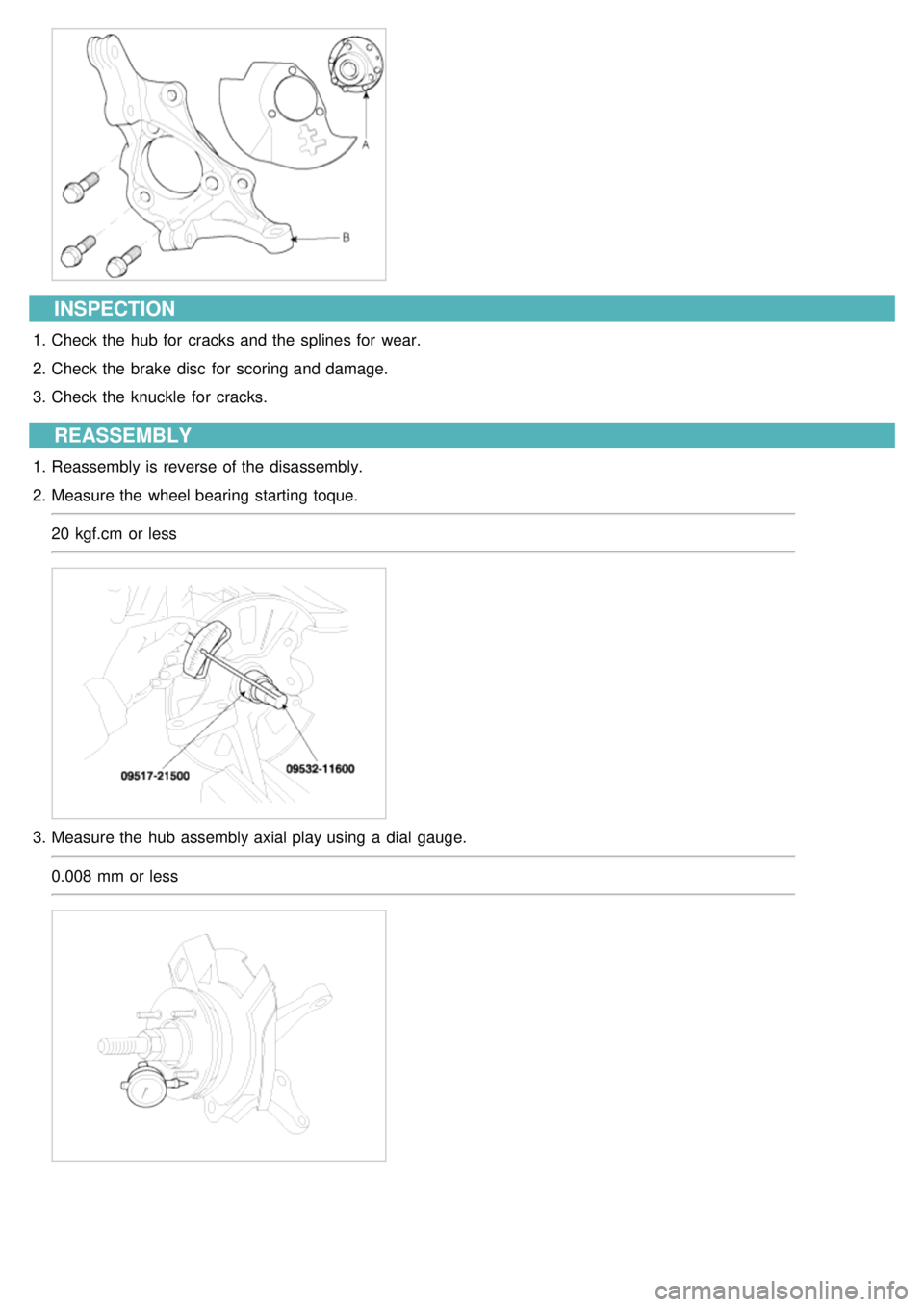
1.Check the hub for cracks and the splines for wear.
2. Check the brake disc for scoring and damage.
3. Check the knuckle for cracks.
REASSEMBLY
1.Reassembly is reverse of the disassembly.
2. Measure the wheel bearing starting toque.
20 kgf.cm or less
3.Measure the hub assembly axial play using a dial gauge.
0.008 mm or less
Page 477 of 1575

2007 > 2.7L V6 GASOLINE >
REMOVAL
1.Release the parking brake.
2. Remove the wheel & tire assembly.
Tightening torque Nm (kgf.m, lb - ft):
90 ~ 110 (9.0 ~ 11.0, 65 ~ 80)
3.Support lower part of the lower arm (A) using a jack and remove the bolt & nut (B).
Tightening torque Nm (kgf.m, lb - ft):
160 ~ 180 (16.0 ~ 18.0, 116 ~ 130)
4.Remove the coil spring (A) and upper pad.
5.Remove the wheel speed sensor (A).
Page 488 of 1575

accelerating around a cornerSee DS group - driveshaft.
Front suspension noise - A squeak,
creak, or rattle noise - occurs mostly
over bumps or rough roads Steering components
Loose or bent front struts or shock
absorbers
Damaged spring or spring mounts
Damaged or worn arm bushings
Worn or damaged stabilizer bar
bushing or linksGo to detailed test A.
Groaning or grinding - noise from the
front strut, occurs when driving on
bumpy roads or turning the vehicle Uneven seating surface between the
insulator and panel by the burrs
around the strut insulator mounting
bolts and the insulator boltes
mounting holesRepair or install a new parts as
necessary.
Rear suspension noise - a squeak,
creak or rattle noise - occurs mostly
over bumps or rough roads Loose or bent rear shock absorbers
Damaged spring or spring mounts
Damaged or worn control arm
bushingsGo to detailed test B.
Shudder - occurs during acceleration
from a slow speed or stop Rear axle assembly mis - positioned
Damaged or worn front suspension
componentsCheck the axle mounts and rear
suspension for damage or wear.
Repair as necessary.
Check for a loose stabilizer bar,
damaged or loose strut/strut bushings
or loose or worn ball joints. Inspect
the steering linkage for wear or
damage. Repair or Install new
components as necessary.
Shimmy - most noticeable on
coast/deceleration - also hard steering
condition Excessive positive caster
Check the caster alignment angle.
Correct as necessary.
Tire noise - hum/moan at constant
speeds Abnormal wear patterns
Spin the tire and Check for tire wear.
Install a new tire as necessary.
Inspect for damaged/worn suspension
components. Perform wheel
alignment.
Tire noise - noise tone lowers as the
vehicle speed is lowered Out- of- balance tire
Balance the tire and road test. Install
a new tire as necessary.
Tire noise - ticking noise, change with
speed Nail puncture or stone in tire tread
Inspect the tire. Repair or replace as
necessary.
Wheel and tire - vibration and noise
concern is directly related to vehicle
speed and is not affected by
acceleration, coasting or decelerating Damaged or worn tire
Go to detailed test C.
Tire wobble or shudder - occurs at
lower speeds Damaged wheel bearings
Spin the tire and check for abnormal
wheel bearing play or roughness.
Adjust or Install new wheel bearings
as necessary.
See DS group - front/rear axle.
Damaged wheel Inspect the wheel for damage. Install
a new wheel as necessary.
Damaged or worn suspension
components Inspect the suspension components
for wear or damage. Repair as
necessary.
Page 489 of 1575
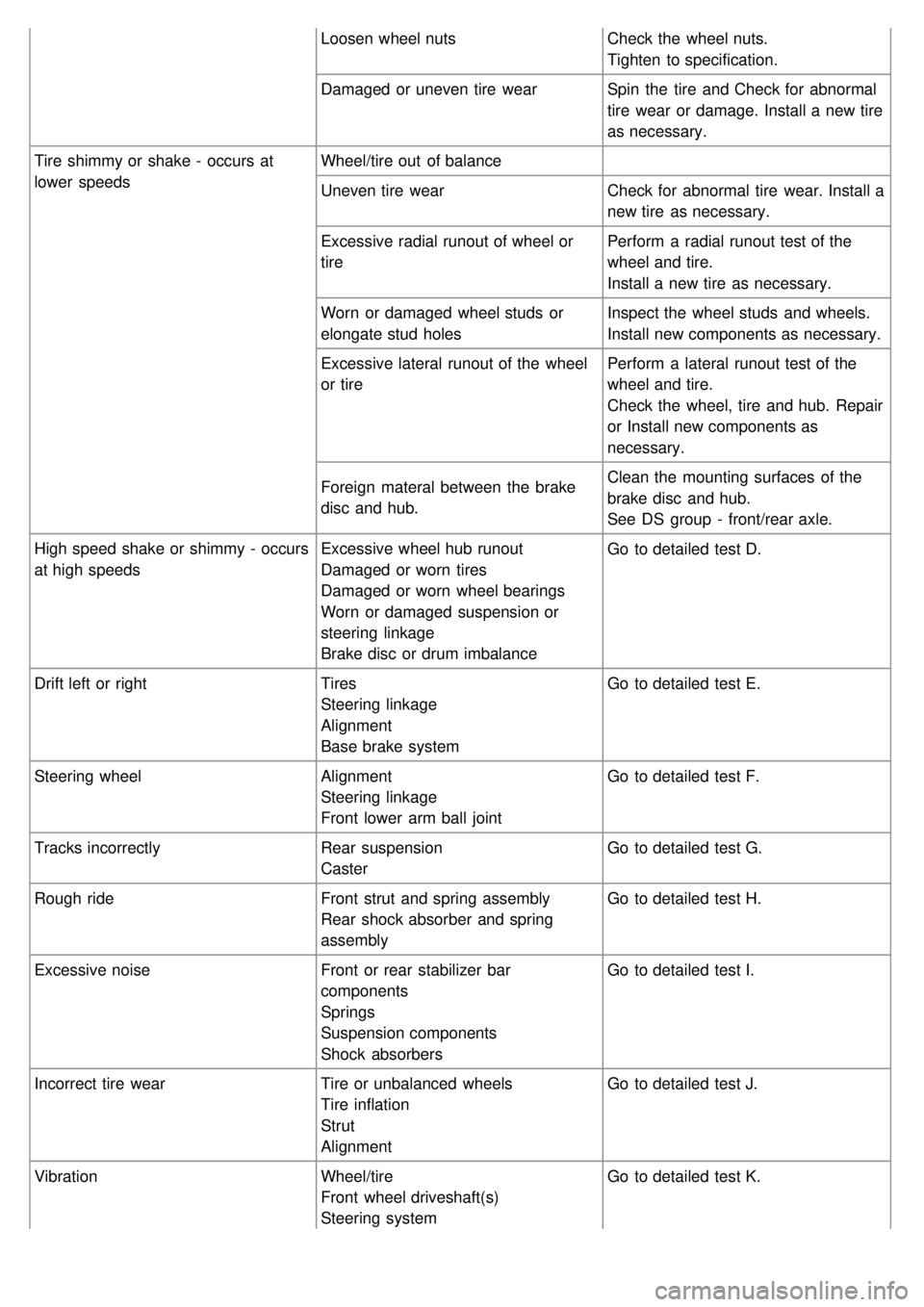
Loosen wheel nutsCheck the wheel nuts.
Tighten to specification.
Damaged or uneven tire wear Spin the tire and Check for abnormal
tire wear or damage. Install a new tire
as necessary.
Tire shimmy or shake - occurs at
lower speeds Wheel/tire out of balance
Uneven tire wear
Check for abnormal tire wear. Install a
new tire as necessary.
Excessive radial runout of wheel or
tire Perform a radial runout test of the
wheel and tire.
Install a new tire as necessary.
Worn or damaged wheel studs or
elongate stud holes Inspect the wheel studs and wheels.
Install new components as necessary.
Excessive lateral runout of the wheel
or tire Perform a lateral runout test of the
wheel and tire.
Check the wheel, tire and hub. Repair
or Install new components as
necessary.
Foreign materal between the brake
disc and hub. Clean the mounting surfaces of the
brake disc and hub.
See DS group - front/rear axle.
High speed shake or shimmy - occurs
at high speeds Excessive wheel hub runout
Damaged or worn tires
Damaged or worn wheel bearings
Worn or damaged suspension or
steering linkage
Brake disc or drum imbalanceGo to detailed test D.
Drift left or right Tires
Steering linkage
Alignment
Base brake systemGo to detailed test E.
Steering wheel Alignment
Steering linkage
Front lower arm ball jointGo to detailed test F.
Tracks incorrectly Rear suspension
CasterGo to detailed test G.
Rough ride Front strut and spring assembly
Rear shock absorber and spring
assemblyGo to detailed test H.
Excessive noise Front or rear stabilizer bar
components
Springs
Suspension components
Shock absorbersGo to detailed test I.
Incorrect tire wear Tire or unbalanced wheels
Tire inflation
Strut
AlignmentGo to detailed test J.
Vibration Wheel/tire
Front wheel driveshaft(s)
Steering system
Strut and spring assemblyGo to detailed test K.
Page 490 of 1575
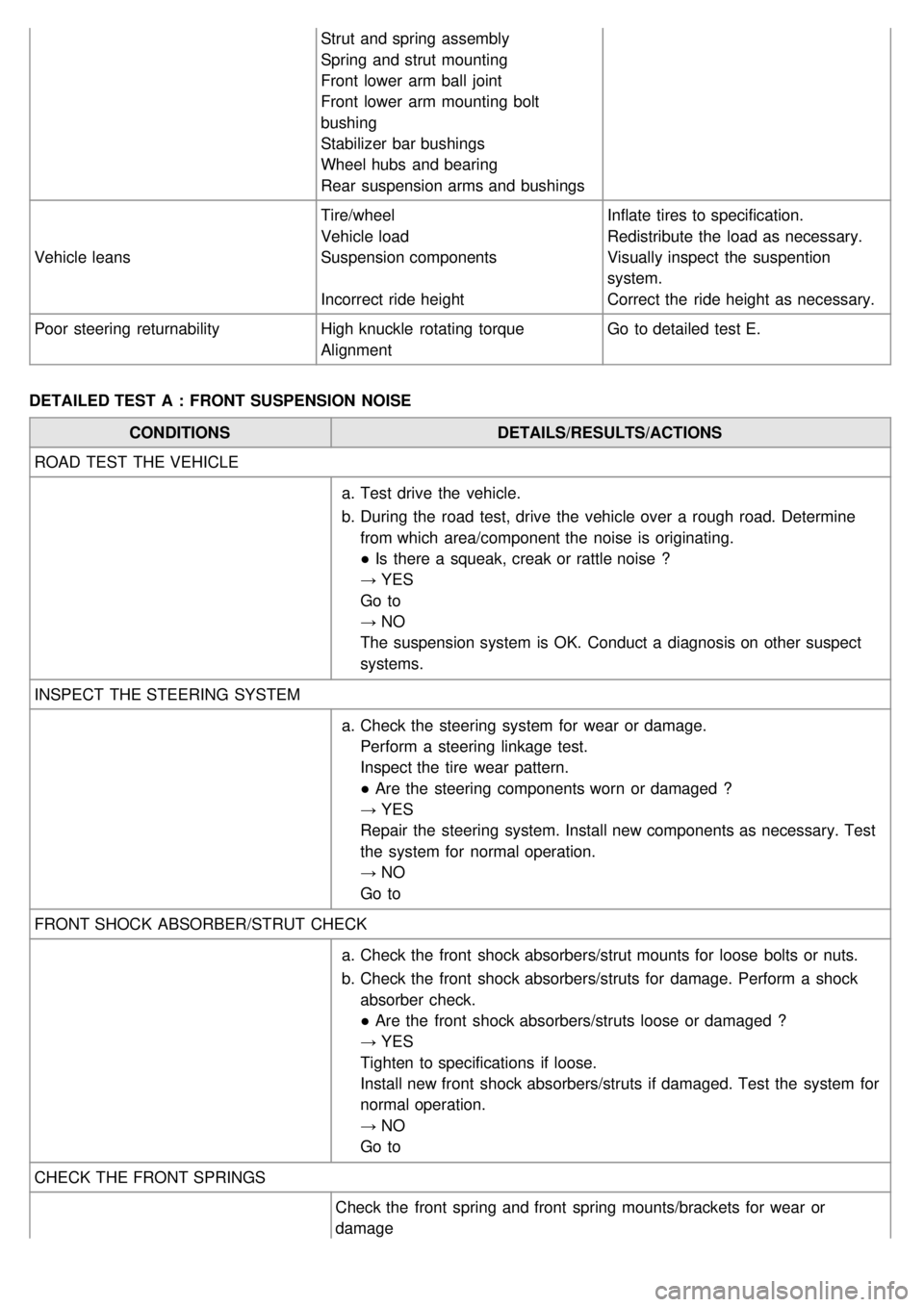
Strut and spring assembly
Spring and strut mounting
Front lower arm ball joint
Front lower arm mounting bolt
bushing
Stabilizer bar bushings
Wheel hubs and bearing
Rear suspension arms and bushings
Vehicle leans Tire/wheel
Vehicle load
Suspension components
Incorrect ride heightInflate tires to specification.
Redistribute the load as necessary.
Visually inspect the suspention
system.
Correct the ride height as necessary.
Poor steering returnability High knuckle rotating torque
AlignmentGo to detailed test E.
DETAILED TEST A : FRONT SUSPENSION NOISE CONDITIONS DETAILS/RESULTS/ACTIONS
ROAD TEST THE VEHICLE
a.Test drive the vehicle.
b. During the road test, drive the vehicle over a rough road. Determine
from which area/component the noise is originating.
● Is there a squeak, creak or rattle noise ?
→ YES
Go to
→ NO
The suspension system is OK. Conduct a diagnosis on other suspect
systems.
INSPECT THE STEERING SYSTEM a.Check the steering system for wear or damage.
Perform a steering linkage test.
Inspect the tire wear pattern.
● Are the steering components worn or damaged ?
→ YES
Repair the steering system. Install new components as necessary. Test
the system for normal operation.
→ NO
Go to
FRONT SHOCK ABSORBER/STRUT CHECK a.Check the front shock absorbers/strut mounts for loose bolts or nuts.
b. Check the front shock absorbers/struts for damage. Perform a shock
absorber check.
● Are the front shock absorbers/struts loose or damaged ?
→ YES
Tighten to specifications if loose.
Install new front shock absorbers/struts if damaged. Test the system for
normal operation.
→ NO
Go to
CHECK THE FRONT SPRINGS Check the front spring and front spring mounts/brackets for wear or
damage
Page 492 of 1575
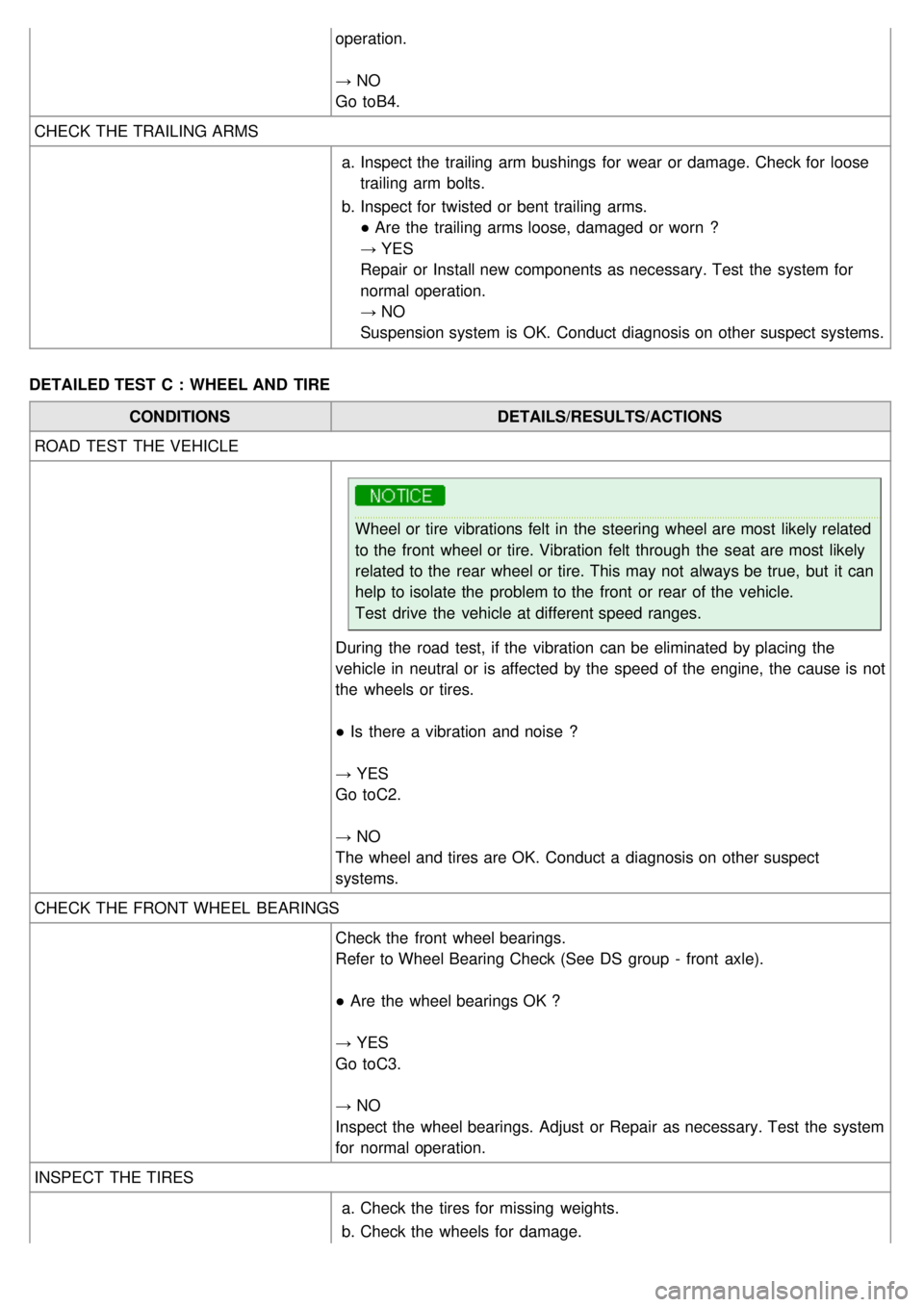
operation.
→ NO
Go toB4.
CHECK THE TRAILING ARMS
a.Inspect the trailing arm bushings for wear or damage. Check for loose
trailing arm bolts.
b. Inspect for twisted or bent trailing arms.
● Are the trailing arms loose, damaged or worn ?
→ YES
Repair or Install new components as necessary. Test the system for
normal operation.
→ NO
Suspension system is OK. Conduct diagnosis on other suspect systems.
DETAILED TEST C : WHEEL AND TIRE CONDITIONS DETAILS/RESULTS/ACTIONS
ROAD TEST THE VEHICLE
Wheel or tire vibrations felt in the steering wheel are most likely related
to the front wheel or tire. Vibration felt through the seat are most likely
related to the rear wheel or tire. This may not always be true, but it can
help to isolate the problem to the front or rear of the vehicle.
Test drive the vehicle at different speed ranges.
During the road test, if the vibration can be eliminated by placing the
vehicle in neutral or is affected by the speed of the engine, the cause is not
the wheels or tires.
● Is there a vibration and noise ?
→ YES
Go to C2.
→ NO
The wheel and tires are OK. Conduct a diagnosis on other suspect
systems.
CHECK THE FRONT WHEEL BEARINGS Check the front wheel bearings.
Refer to Wheel Bearing Check (See DS group - front axle).
● Are the wheel bearings OK ?
→ YES
Go to C3.
→ NO
Inspect the wheel bearings. Adjust or Repair as necessary. Test the system
for normal operation.
INSPECT THE TIRES
a.Check the tires for missing weights.
b. Check the wheels for damage.