service KIA CEED 2014 Owners Manual
[x] Cancel search | Manufacturer: KIA, Model Year: 2014, Model line: CEED, Model: KIA CEED 2014Pages: 1206, PDF Size: 50.15 MB
Page 1093 of 1206
Maintenance
32
7
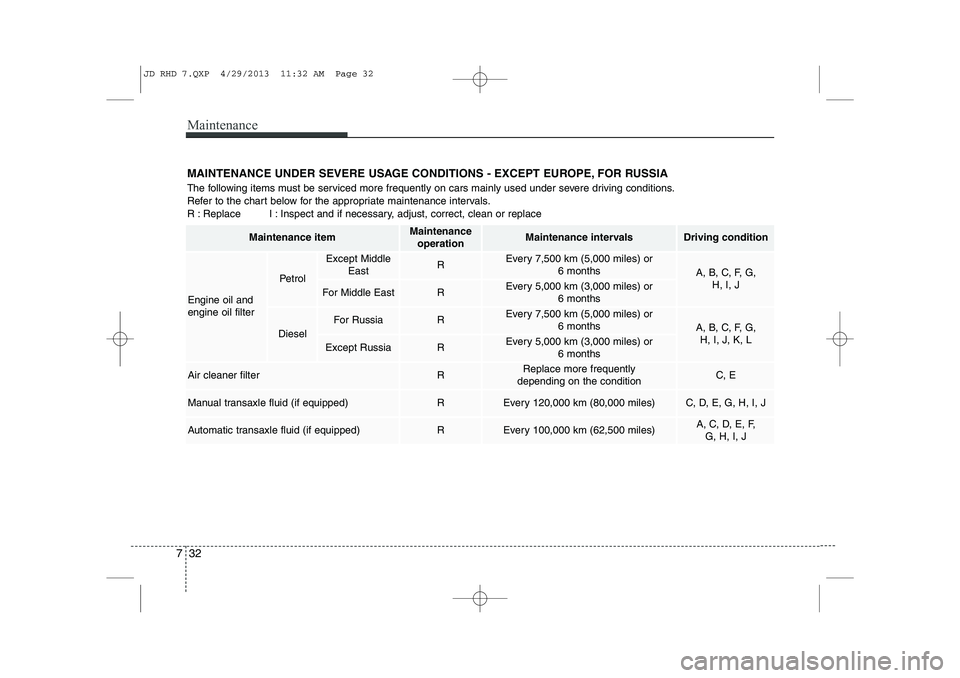
MAINTENANCE UNDER SEVERE USAGE CONDITIONS - EXCEPT EUROPE, FOR RUSSIA
The following items must be serviced more frequently on cars mainly used under severe driving conditions.
Refer to the chart below for the appropriate maintenance intervals.
R : Replace I : Inspect and if necessary, adjust, correct, clean or replace
Maintenance itemMaintenance
operationMaintenance intervalsDriving condition
Engine oil and engine oil filter
Petrol
Except Middle EastREvery 7,500 km (5,000 miles) or 6 months
A, B, C, F, G, H, I, J
For Middle EastREvery 5,000 km (3,000 miles) or 6 months
Diesel
For RussiaREvery 7,500 km (5,000 miles) or 6 months
A, B, C, F, G, H, I, J, K, L
Except RussiaREvery 5,000 km (3,000 miles) or 6 months
Air cleaner filterRReplace more frequently
depending on the conditionC, E
Manual transaxle fluid (if equipped)REvery 120,000 km (80,000 miles)C, D, E, G, H, I, J
Automatic transaxle fluid (if equipped)REvery 100,000 km (62,500 miles)A, C, D, E, F, G, H, I, J
JD RHD 7.QXP 4/29/2013 11:32 AM Page 32
Page 1096 of 1206
735
Maintenance
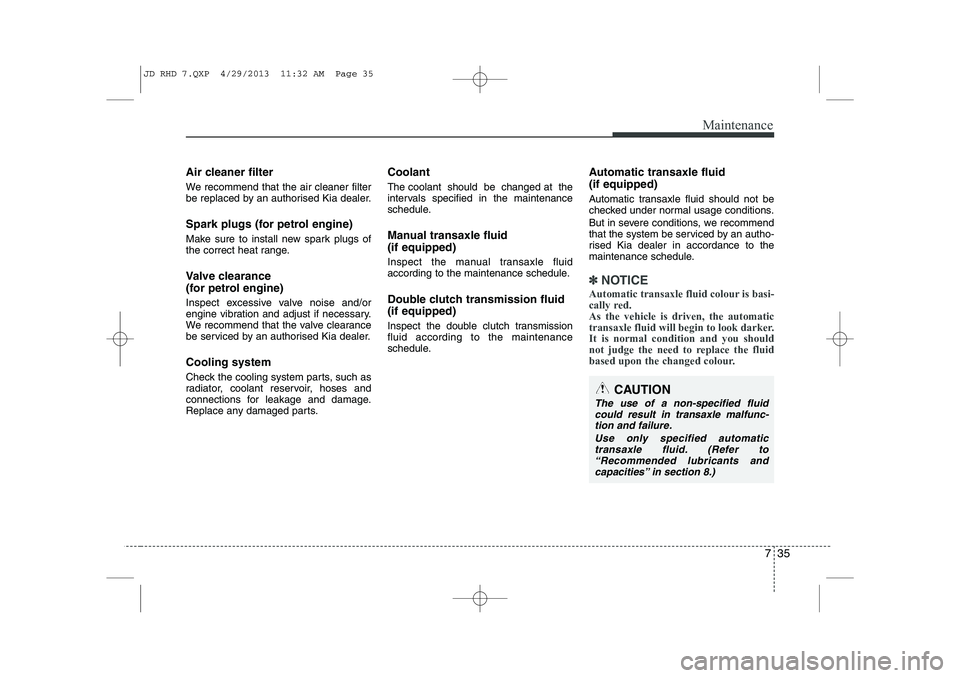
Air cleaner filter
We recommend that the air cleaner filter
be replaced by an authorised Kia dealer.
Spark plugs (for petrol engine)
Make sure to install new spark plugs of
the correct heat range.
Valve clearance
(for petrol engine)
Inspect excessive valve noise and/or
engine vibration and adjust if necessary.
We recommend that the valve clearance
be serviced by an authorised Kia dealer. Cooling system
Check the cooling system parts, such as
radiator, coolant reservoir, hoses and
connections for leakage and damage.
Replace any damaged parts.Coolant The coolant should be changed at the
intervals specified in the maintenance
schedule.
Manual transaxle fluid (if equipped)
Inspect the manual transaxle fluid
according to the maintenance schedule.
Double clutch transmission fluid (if equipped)
Inspect the double clutch transmission fluid according to the maintenance
schedule.
Automatic transaxle fluid (if equipped)
Automatic transaxle fluid should not be
checked under normal usage conditions.
But in severe conditions, we recommend
that the system be serviced by an autho-
rised Kia dealer in accordance to the
maintenance schedule.
✽✽
NOTICE
Automatic transaxle fluid colour is basi-
cally red. As the vehicle is driven, the automatic
transaxle fluid will begin to look darker.It is normal condition and you should
not judge the need to replace the fluid
based upon the changed colour.
CAUTION
The use of a non-specified fluid could result in transaxle malfunc-
tion and failure.
Use only specified automatictransaxle fluid. (Refer to“Recommended lubricants andcapacities” in section 8.)
JD RHD 7.QXP 4/29/2013 11:32 AM Page 35
Page 1104 of 1206
743
Maintenance
WASHER FLUID
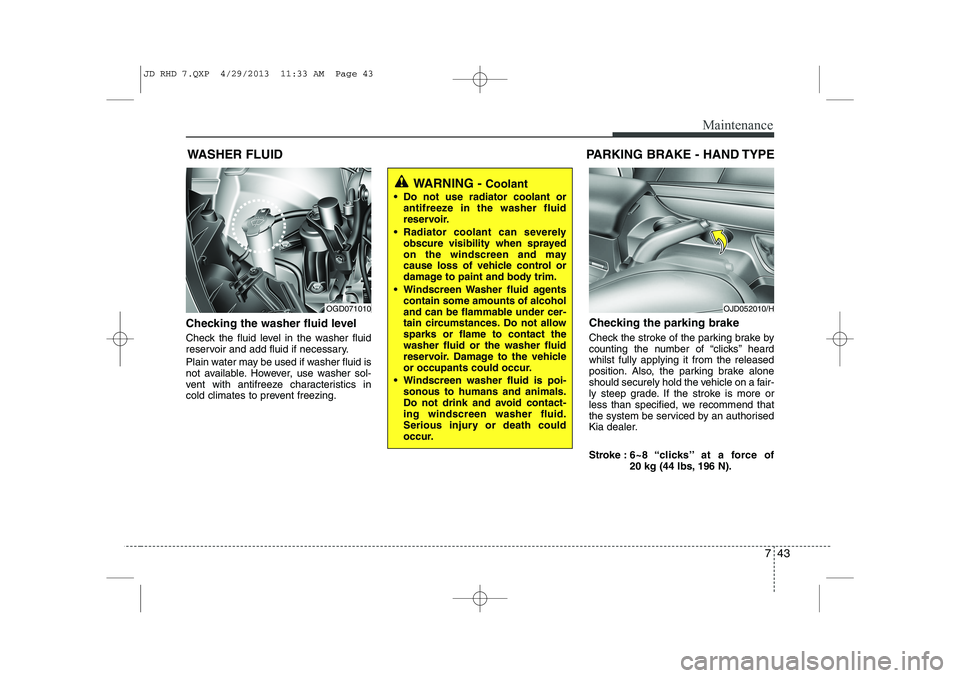
Checking the washer fluid level
Check the fluid level in the washer fluid
reservoir and add fluid if necessary.
Plain water may be used if washer fluid is
not available. However, use washer sol-
vent with antifreeze characteristics in
cold climates to prevent freezing. Checking the parking brake
Check the stroke of the parking brake by
counting the number of “clicks’’ heardwhilst fully applying it from the released
position. Also, the parking brake alone
should securely hold the vehicle on a fair-
ly steep grade. If the stroke is more or
less than specified, we recommend that
the system be serviced by an authorised
Kia dealer.
Stroke :
6~8 “clicks’’ at a force of
20 kg (44 lbs, 196 N).
OGD071010
WARNING - Coolant
Do not use radiator coolant or antifreeze in the washer fluid
reservoir.
Radiator coolant can severely obscure visibility when sprayed
on the windscreen and may
cause loss of vehicle control or
damage to paint and body trim.
Windscreen Washer fluid agents contain some amounts of alcohol
and can be flammable under cer-
tain circumstances. Do not allowsparks or flame to contact thewasher fluid or the washer fluid
reservoir. Damage to the vehicle
or occupants could occur.
Windscreen washer fluid is poi- sonous to humans and animals.
Do not drink and avoid contact-ing windscreen washer fluid.
Serious injury or death could
occur.
PARKING BRAKE - HAND TYPE
OJD052010/H
JD RHD 7.QXP 4/29/2013 11:33 AM Page 43
Page 1105 of 1206
Maintenance
44
7
FUEL FILTER (FOR DIESEL)
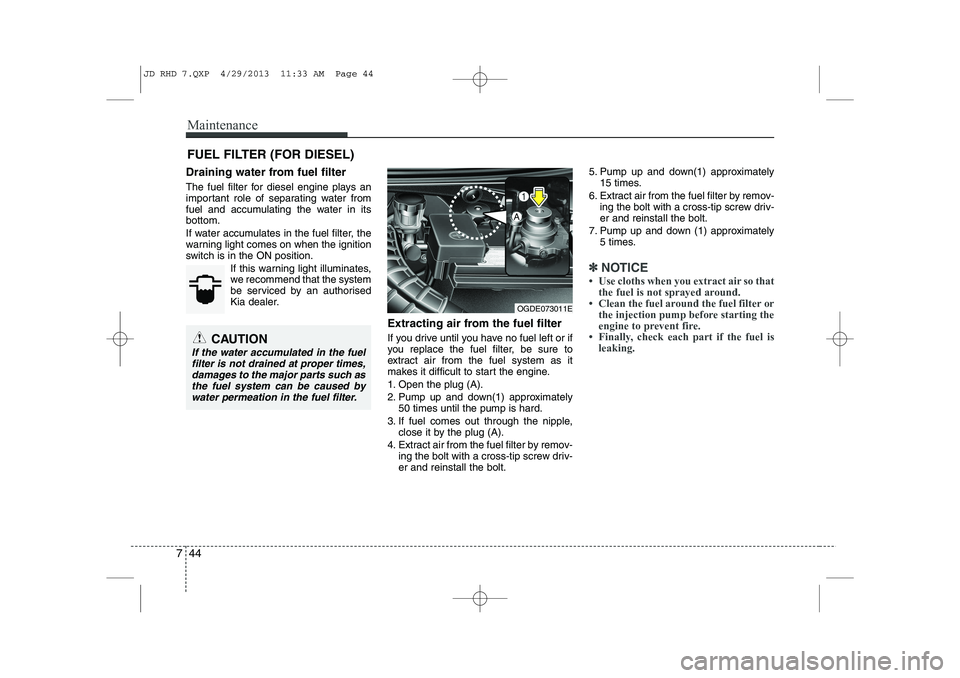
Draining water from fuel filter
The fuel filter for diesel engine plays an
important role of separating water from
fuel and accumulating the water in itsbottom.
If water accumulates in the fuel filter, the
warning light comes on when the ignition
switch is in the ON position. If this warning light illuminates,
we recommend that the system
be serviced by an authorised
Kia dealer.
Extracting air from the fuel filter
If you drive until you have no fuel left or if
you replace the fuel filter, be sure to
extract air from the fuel system as it
makes it difficult to start the engine.
1. Open the plug (A).
2. Pump up and down(1) approximately50 times until the pump is hard.
3. If fuel comes out through the nipple, close it by the plug (A).
4. Extract air from the fuel filter by remov- ing the bolt with a cross-tip screw driv- er and reinstall the bolt. 5. Pump up and down(1) approximately
15 times.
6. Extract air from the fuel filter by remov- ing the bolt with a cross-tip screw driv-er and reinstall the bolt.
7. Pump up and down (1) approximately 5 times.
✽✽ NOTICE
Page 1113 of 1206
Maintenance
52
7
BATTERY
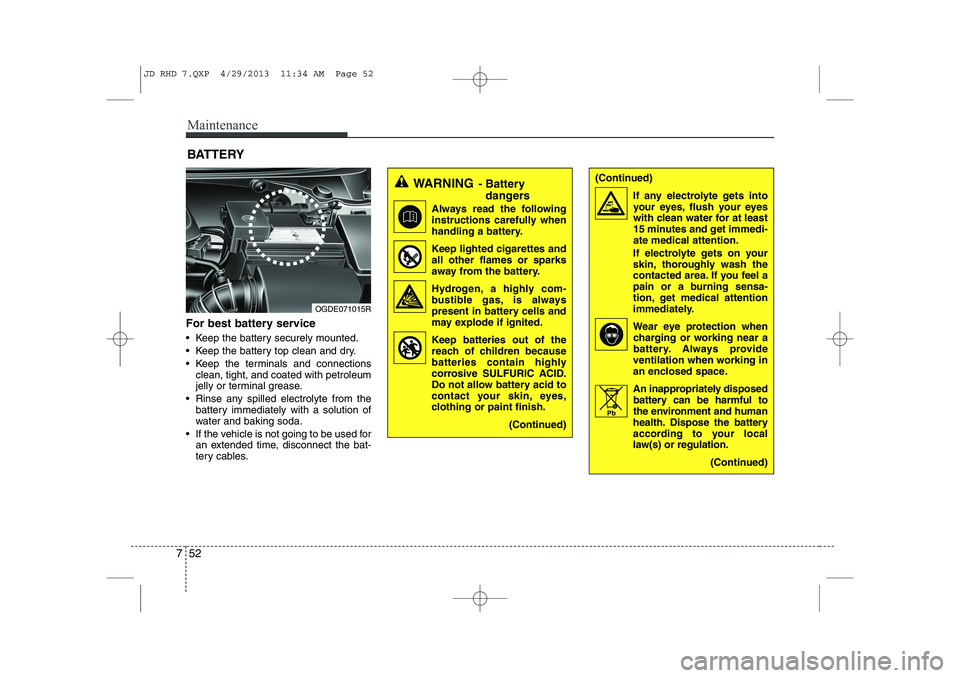
For best battery service
Keep the battery securely mounted.
Keep the battery top clean and dry.
Keep the terminals and connections clean, tight, and coated with petroleum
jelly or terminal grease.
Rinse any spilled electrolyte from the battery immediately with a solution of
water and baking soda.
If the vehicle is not going to be used for an extended time, disconnect the bat-
tery cables.
WARNING - Battery
dangers
Always read the following
instructions carefully when
handling a battery.
Keep lighted cigarettes and all other flames or sparks
away from the battery.
Hydrogen, a highly com- bustible gas, is always
present in battery cells and
may explode if ignited.
Keep batteries out of the reach of children because
batteries contain highly
corrosive SULFURIC ACID.
Do not allow battery acid to
contact your skin, eyes,
clothing or paint finish.
(Continued)
OGDE071015R
(Continued)If any electrolyte gets intoyour eyes, flush your eyes
with clean water for at least
15 minutes and get immedi-ate medical attention.
If electrolyte gets on your
skin, thoroughly wash the
contacted area. If you feel a
pain or a burning sensa-
tion, get medical attention
immediately.
Wear eye protection when charging or working near a
battery. Always provide
ventilation when working in
an enclosed space.
An inappropriately disposed battery can be harmful to
the environment and human
health. Dispose the battery
according to your local
law(s) or regulation.
(Continued)
Pb
JD RHD 7.QXP 4/29/2013 11:34 AM Page 52
Page 1124 of 1206
763
Maintenance
4. Tyre ply composition and material
The number of layers or plies of rub-
ber-coated fabric are in the tyre. Tyre
manufacturers also must indicate the
materials in the tyre, which include
steel, nylon, polyester, and others.
The letter "R" means radial ply con-
struction; the letter "D" means diago-
nal or bias ply construction; and theletter "B" means belted-bias ply con-
struction.
5. Maximum permissible inflationpressure
This number is the greatest amount of air pressure that should be put in
the tyre. Do not exceed the maximum
permissible inflation pressure. Refer
to the Tyre and Loading Information
label for recommended inflation
pressure.
6. Maximum load rating
This number indicates the maximum
load in kilograms and pounds that
can be carried by the tyre. When
replacing the tyres on the vehicle,
always use a tyre that has the same
load rating as the factory installed
tyre.
7. Uniform tyre quality grading
Quality grades can be found where
applicable on the tyre sidewall
between tread shoulder and maxi-
mum section width.
For example:
TREADWEAR 200
TRACTION AA
TEMPERATURE A
Tread wear
The tread wear grade is a compara-
tive rating based on the wear rate ofthe tyre when tested under controlled
conditions on a specified govern-
ment test course. For example, a tyre
graded 150 would wear one-and-a-
half times (1½) as well on the gov-
ernment course as a tyre graded100.
The relative performance of tyres depends upon the actual conditions
of their use, however, and may
depart significantly from the norm
because of variations in driving
habits, service practices and differ-
ences in road characteristics and cli-
mate.WARNING - Tyre age
Tyres degrade over time, even
when they are not being used.
Regardless of the remaining
tread, it is recommended that
tyres generally be replaced
after six (6) years of normal
service. Heat caused by hot cli-mates or frequent high loadingconditions can accelerate the
aging process. Failure to follow
this Warning can result in sud-
den tyre failure, which could
lead to a loss of control and an
accident involving serious
injury or death.
JD RHD 7.QXP 4/29/2013 11:34 AM Page 63
Page 1166 of 1206

7 105
Maintenance
Stop and tail light or tail light (LED type)
If the light does not operate, we recom-
mend that the system be checked by an
authorised Kia dealer.
Inside light (5 Door and Wagon)
1. Turn off the engine.
2. Open the tailgate.
3. Remove the service cover using a flat-blade screwdriver. ❈
These below steps (4~6) only for the 5 Door
vehicle.
4. Loosen the retaining nuts.
5. Disconnect the power connector.
6. Remove the rear combination light assembly from the body of the vehicle.
OJD072047OJD072048
JD RHD 7.QXP 4/29/2013 11:37 AM Page 105
Page 1167 of 1206
Maintenance
106
7
❈ Rear fog light is located only on the driver’s
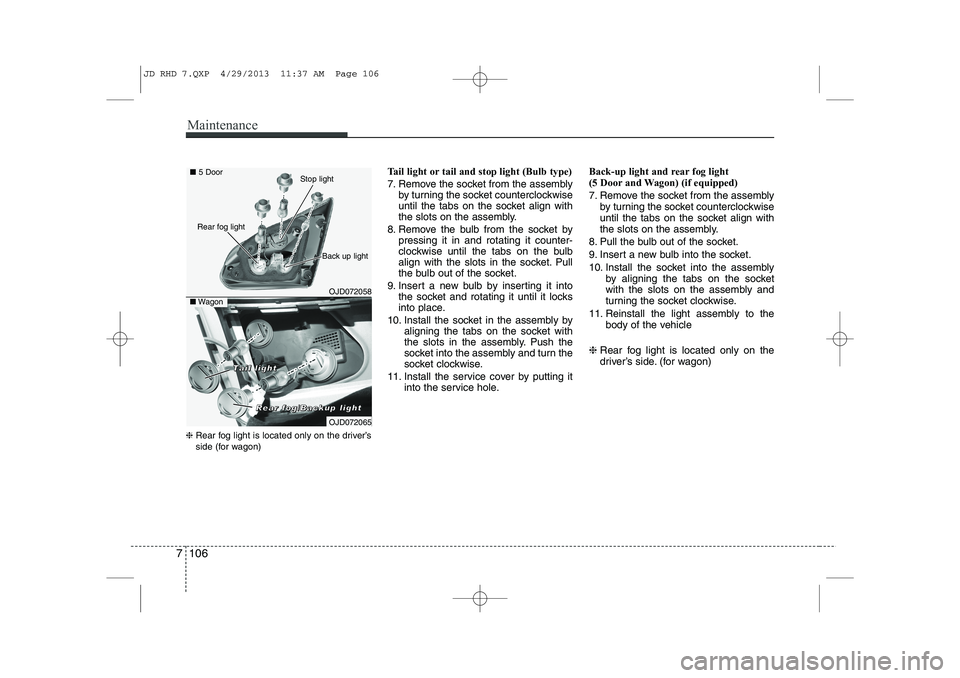
side (for wagon) Tail light or tail and stop light (Bulb type)
7. Remove the socket from the assembly
by turning the socket counterclockwise
until the tabs on the socket align with
the slots on the assembly.
8. Remove the bulb from the socket by pressing it in and rotating it counter-
clockwise until the tabs on the bulb
align with the slots in the socket. Pull
the bulb out of the socket.
9. Insert a new bulb by inserting it into the socket and rotating it until it locks
into place.
10. Install the socket in the assembly by aligning the tabs on the socket with
the slots in the assembly. Push the
socket into the assembly and turn the
socket clockwise.
11. Install the service cover by putting it into the service hole. Back-up light and rear fog light
(5 Door and Wagon) (if equipped)
7. Remove the socket from the assembly
by turning the socket counterclockwise
until the tabs on the socket align with
the slots on the assembly.
8. Pull the bulb out of the socket.
9. Insert a new bulb into the socket.
10. Install the socket into the assembly by aligning the tabs on the socket
with the slots on the assembly and
turning the socket clockwise.
11. Reinstall the light assembly to the body of the vehicle
❈ Rear fog light is located only on the
driver’s side. (for wagon)
OJD072058
■5 Door
■Wagon
Rear fog light
Back up light
Stop light
OJD072065
RRRReeeeaaaarrrr ffffoooogggg////BBBBaaaacccckkkkuuuupppp lllliiiigggghhhhtttt
TTTTaaaaiiiillll lllliiiigggghhhhtttt
JD RHD 7.QXP 4/29/2013 11:37 AM Page 106
Page 1177 of 1206
Maintenance
116
7
EMISSION CONTROL SYSTEM
The emission control system of your
vehicle is covered by a written limited
warranty. Please see the warranty infor-
mation contained in the Service Passport
in your vehicle.
Your vehicle is equipped with an emis- sion control system to meet all emission
regulations. There are three emission control sys-
tems which are as follows.
(1) Crankcase emission control system
(2) Evaporative emission control system(3) Exhaust emission control system In order to assure the proper function of
the emission control systems, it is rec-
ommended that you have your car
inspected and maintained by an autho-
rised Kia dealer in accordance with the
maintenance schedule. Caution for the Inspection and
Maintenance Test (With Electronic
Stability Control (ESC) system)
To prevent the vehicle from misfir-
ing during dynamometer testing,
turn the Electronic Stability Control
(ESC) system off by pressing the
ESC switch.
After dynamometer testing is com- pleted, turn the ESC system back on
by pressing the ESC switch again.
1. Crankcase emission control system
The positive crankcase ventilation sys-
tem is employed to prevent air pollution
caused by blow-by gases being emitted
from the crankcase. This system supplies
fresh filtered air to the crankcase through
the air intake hose. Inside the crankcase,
the fresh air mixes with blow-by gases,
which then pass through the PCV valveinto the induction system. 2. Evaporative emission control
System
The Evaporative Emission Control
System is designed to prevent fuel
vapours from escaping into the atmos-
phere.
Canister
Fuel vapours generated inside the fuel tank are absorbed and stored in the
onboard canister. When the engine is
running, the fuel vapours absorbed in the
canister are drawn into the surge tank
through the purge control solenoid valve.
Purge Control Solenoid Valve (PCSV)
The purge control solenoid valve is con-
trolled by the Engine Control Module
(ECM); when the engine coolant temper-
ature is low during idling, the PCSV clos-
es so that evaporated fuel is not taken
into the engine. After the engine warms-
up during ordinary driving, the PCSV
opens to introduce evaporated fuel to the
engine.
JD RHD 7.QXP 4/29/2013 11:38 AM Page 116
Page 1188 of 1206
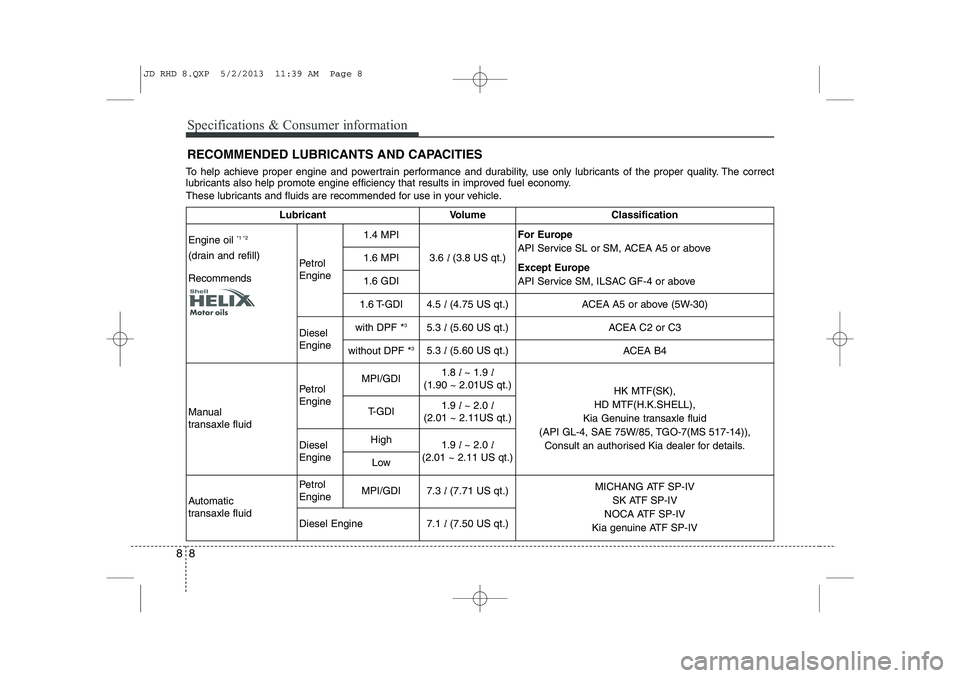
Specifications & Consumer information
8
8
To help achieve proper engine and powertrain performance and durability, use only lubricants of the proper quality. The correct
lubricants also help promote engine efficiency that results in improved fuel economy.
These lubricants and fluids are recommended for use in your vehicle. RECOMMENDED LUBRICANTS AND CAPACITIES
Lubricant Volume Classification
Engine oil *1 *2
(drain and refill) Recommends Petrol Engine1.4 MPI
3.6 l(3.8 US qt.) For Europe
API Service SL or SM, ACEA A5 or above
Except Europe
API Service SM, ILSAC GF-4 or above
1.6 MPI 1.6 GDI
1.6 T-GDI 4.5
l(4.75 US qt.)
ACEA A5 or above (5W-30)
Diesel Engine with DPF *
3
5.3 l(5.60 US qt.)
ACEA C2 or C3
without DPF * 3
5.3 l(5.60 US qt.)
ACEA B4
Manual
transaxle fluid PetrolEngine
MPI/GDI
1.8
l ~ 1.9 l
(1.90 ~ 2.01US qt.) HK MTF(SK),
HD MTF(H.K.SHELL),
Kia Genuine transaxle fluid
(API GL-4, SAE 75W/85, TGO-7(MS 517-14)), Consult an authorised Kia dealer for details.
T-GDI
1.9
l ~ 2.0 l
(2.01 ~ 2.11US qt.)
DieselEngine High
1.9 l ~ 2.0 l
(2.01 ~ 2.11 US qt.)
Low
Automatic
transaxle fluid PetrolEngine
MPI/GDI
7.3
l(7.71 US qt.) MICHANG ATF SP-IV
SK ATF SP-IV
NOCA ATF SP-IV
Kia genuine ATF SP-IV
Diesel Engine7.1 l(7.50 US qt.)
JD RHD 8.QXP 5/2/2013 11:39 AM Page 8