power steering KIA CEED 2015 Owner's Manual
[x] Cancel search | Manufacturer: KIA, Model Year: 2015, Model line: CEED, Model: KIA CEED 2015Pages: 1210, PDF Size: 35.92 MB
Page 602 of 1210
I11
Index
Seatback pocket . . . . . . . . . . . . . . . . . . . . . . . . . . . . . 3-13
Seats . . . . . . . . . . . . . . . . . . . . . . . . . . . . . . . . . . . . . . . . 3-2
Armrest . . . . . . . . . . . . . . . . . . . . . . . . . . . . . . . . . . . 3-15
Driver position memory system . . . . . . . . . . . . . . . . 3-8
Folding the rear seat. . . . . . . . . . . . . . . . . . . . . . . . . 3-16
Front seat adjustment . . . . . . . . . . . . . . . . . . . . . . . . 3-4
Headrest(front) . . . . . . . . . . . . . . . . . . . . . . . . . . . . . . 3-9
Headrest(rear) . . . . . . . . . . . . . . . . . . . . . . . . . . . . . . 3-14
Lumbar support (Automatic Seat) . . . . . . . . . . . . . . 3-7
Lumbar support (Manual seat). . . . . . . . . . . . . . . . . 3-5
Rear seat . . . . . . . . . . . . . . . . . . . . . . . . . . . . . . . . . . 3-14
Rear seat entry . . . . . . . . . . . . . . . . . . . . . . . . . . . . . 3-13
Seat warmer(front) . . . . . . . . . . . . . . . . . . . . . . . . . . 3-12
Seatback pocket . . . . . . . . . . . . . . . . . . . . . . . . . . . . 3-13
Service mode (Normal vision) . . . . . . . . . . . . . . . . . . 4-55
Service mode (Super vision). . . . . . . . . . . . . . . . . . . . 4-70
Shift lock system . . . . . . . . . . . . . . . . . . . . . . . . . . . . . 5-29
Shopping bag holder. . . . . . . . . . . . . . . . . . . . . . . . . 4-168
Side impact air bag . . . . . . . . . . . . . . . . . . . . . . . . . . . 3-55
Sliding armrest . . . . . . . . . . . . . . . . . . . . . . . . . . . . . 4-152
Smart key . . . . . . . . . . . . . . . . . . . . . . . . . . . . . . . . . . . 4-11
Smart parking assist system (SPAS) . . . . . . . . . . . . 4-100
Smooth cornering . . . . . . . . . . . . . . . . . . . . . . . . . . . . 5-65
Snow tires . . . . . . . . . . . . . . . . . . . . . . . . . . . . . . . . . . 5-67
Spare tire
Compact spare tire . . . . . . . . . . . . . . . . . . . . . . . . . . 6-15 Compact spare tire replacement . . . . . . . . . . . . . . . 7-60
Removing and storing the spare tire . . . . . . . . . . . 6-10
SPAS . . . . . . . . . . . . . . . . . . . . . . . . . . . . . . . . . . . . . . 4-100
Special driving conditions . . . . . . . . . . . . . . . . . . . . . 5-64 Driving at night. . . . . . . . . . . . . . . . . . . . . . . . . . . . . 5-65
Driving in flooded areas. . . . . . . . . . . . . . . . . . . . . . 5-66
Driving in the rain . . . . . . . . . . . . . . . . . . . . . . . . . . 5-65
Driving off-road . . . . . . . . . . . . . . . . . . . . . . . . . . . . 5-66
Hazardous driving conditions . . . . . . . . . . . . . . . . . 5-64
Highway driving . . . . . . . . . . . . . . . . . . . . . . . . . . . . 5-66
Rocking the vehicle. . . . . . . . . . . . . . . . . . . . . . . . . . 5-64
Smooth cornering . . . . . . . . . . . . . . . . . . . . . . . . . . . 5-65
Speed limit control system . . . . . . . . . . . . . . . . . . . . . 5-56
Speed limiter indicator (Normal vision) . . . . . . . . . . 4-51
Speed limiter indicator (Super vision) . . . . . . . . . . . 4-66
Speedometer (Normal vision) . . . . . . . . . . . . . . . . . . 4-47
Speedometer (Super vision) . . . . . . . . . . . . . . . . . . . . 4-62
Sports mode . . . . . . . . . . . . . . . . . . . . . . . . . . . . . . . . . 5-27
SRS components and functions . . . . . . . . . . . . . . . . . 3-47
Starting difficulties, see engine will not start . . . . . . . 6-4
Static bending light . . . . . . . . . . . . . . . . . . . . . . . . . . 4-112
Steering wheel . . . . . . . . . . . . . . . . . . . . . . . . . . . . . . . 4-37 Electric power steering . . . . . . . . . . . . . . . . . . . . . . 4-37
Flex steering wheel . . . . . . . . . . . . . . . . . . . . . . . . . . 4-40
Heated steering wheel . . . . . . . . . . . . . . . . . . . . . . . 4-38
Horn . . . . . . . . . . . . . . . . . . . . . . . . . . . . . . . . . . . . . . 4-39
JD eng Index.QXP 3/12/2015 3:06 PM Page 11
Page 616 of 1210
Your vehicle at a glance
4
2
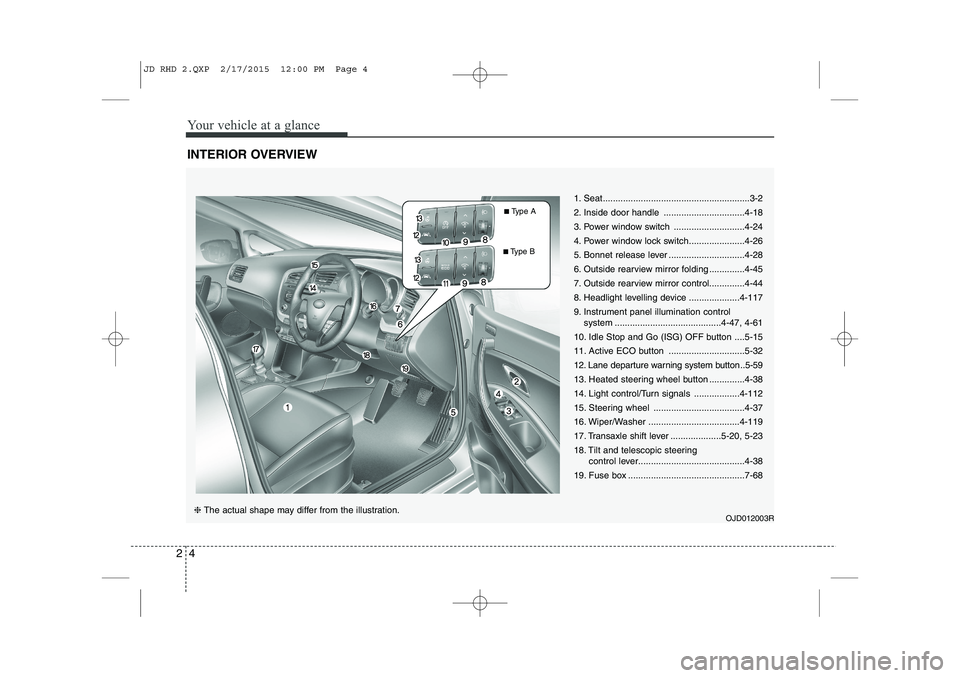
INTERIOR OVERVIEW
1. Seat..........................................................3-2
2. Inside door handle ................................4-18
3. Power window switch ............................4-24
4. Power window lock switch......................4-26
5. Bonnet release lever ..............................4-28
6. Outside rearview mirror folding ..............4-45
7. Outside rearview mirror control..............4-44
8. Headlight levelling device ....................4-117
9. Instrument panel illumination control
system ..........................................4-47, 4-61
10. Idle Stop and Go (ISG) OFF button ....5-15
11. Active ECO button ..............................5-32
12. Lane departure warning system button ..5-59
13. Heated steering wheel button ..............4-38
14. Light control/Turn signals ..................4-112
15. Steering wheel ....................................4-37
16. Wiper/Washer ....................................4-119
17. Transaxle shift lever ....................5-20, 5-23
18. Tilt and telescopic steering control lever..........................................4-38
19. Fuse box ..............................................7-68
OJD012003R
❈ The actual shape may differ from the illustration. ■
Type A
■ Type B
JD RHD 2.QXP 2/17/2015 12:00 PM Page 4
Page 617 of 1210
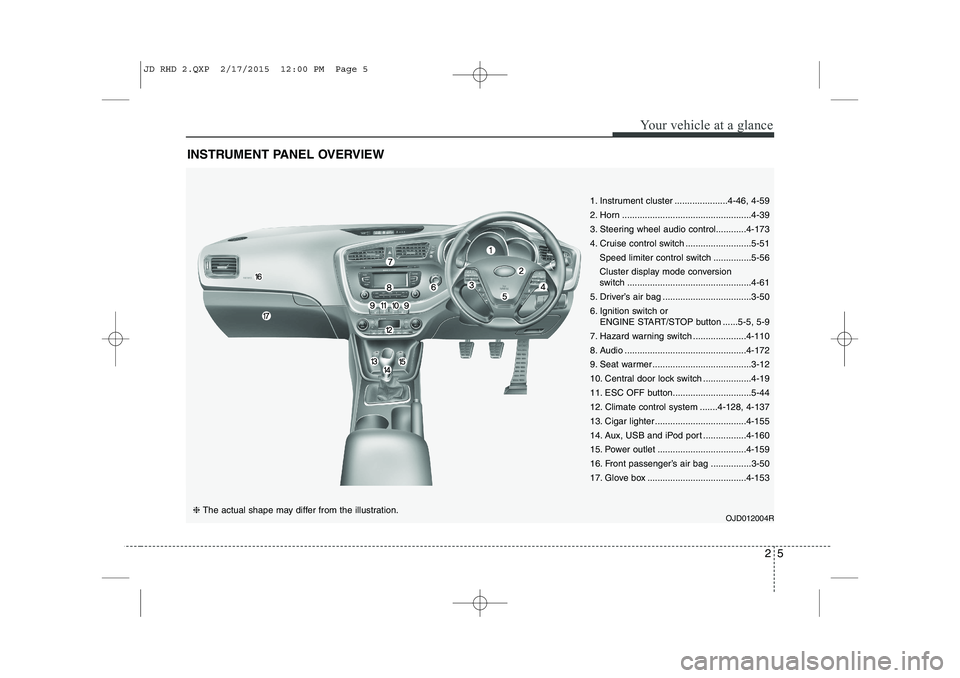
INSTRUMENT PANEL OVERVIEW
OJD012004R
25
Your vehicle at a glance
❈ The actual shape may differ from the illustration. 1. Instrument cluster .....................4-46, 4-59
2. Horn ...................................................4-39
3. Steering wheel audio control............4-173
4. Cruise control switch ..........................5-51
Speed limiter control switch ...............5-56
Cluster display mode conversion
switch .................................................4-61
5. Driver’s air bag ...................................3-50
6. Ignition switch or ENGINE START/STOP button ......5-5, 5-9
7. Hazard warning switch .....................4-110
8. Audio ................................................4-172
9. Seat warmer .......................................3-12
10. Central door lock switch ...................4-19
11. ESC OFF button...............................5-44
12. Climate control system .......4-128, 4-137
13. Cigar lighter ....................................4-155
14. Aux, USB and iPod port .................4-160
15. Power outlet ...................................4-159
16. Front passenger’s air bag ................3-50
17. Glove box .......................................4-153
JD RHD 2.QXP 2/17/2015 12:00 PM Page 5
Page 626 of 1210
Safety features of your vehicle
6
3
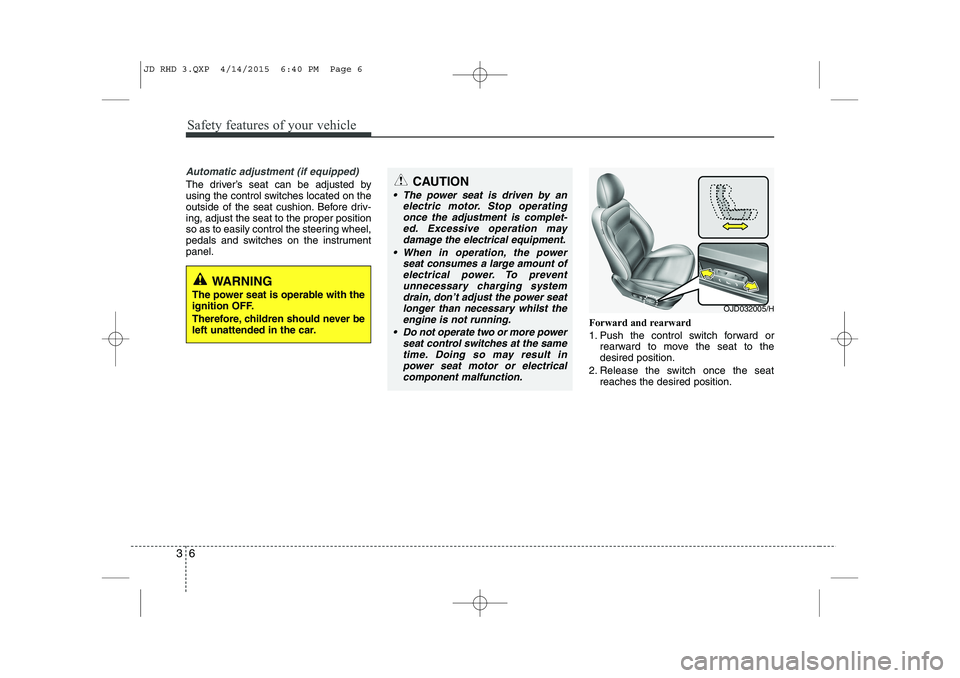
Automatic adjustment (if equipped)
The driver’s seat can be adjusted by
using the control switches located on the
outside of the seat cushion. Before driv-ing, adjust the seat to the proper position
so as to easily control the steering wheel,
pedals and switches on the instrumentpanel.
Forward and rearward
1. Push the control switch forward orrearward to move the seat to the desired position.
2. Release the switch once the seat reaches the desired position.
WARNING
The power seat is operable with the
ignition OFF.
Therefore, children should never be
left unattended in the car.
CAUTION
The power seat is driven by an electric motor. Stop operating
once the adjustment is complet- ed. Excessive operation maydamage the electrical equipment.
When in operation, the power seat consumes a large amount ofelectrical power. To preventunnecessary charging system drain, don’t adjust the power seat
longer than necessary whilst the engine is not running.
Do not operate two or more power seat control switches at the same
time. Doing so may result inpower seat motor or electrical component malfunction.
OJD032005/H
JD RHD 3.QXP 4/14/2015 6:40 PM Page 6
Page 686 of 1210
Features of your vehicle
Keys . . . . . . . . . . . . . . . . . . . . . . . . . . . . . . . . . . . . . 4-4• Record your key number . . . . . . . . . . . . . . . . . . . . . 4-4
• Key operations . . . . . . . . . . . . . . . . . . . . . . . . . . . . . . 4-4
• Immobiliser system . . . . . . . . . . . . . . . . . . . . . . . . . . 4-4
Remote keyless entry . . . . . . . . . . . . . . . . . . . . . . . 4-6 • Remote keyless entry system operations . . . . . . . . . 4-6
• Transmitter precautions . . . . . . . . . . . . . . . . . . . . . . 4-8
• Battery replacement . . . . . . . . . . . . . . . . . . . . . . . . . 4-9
Smart key . . . . . . . . . . . . . . . . . . . . . . . . . . . . . . . . 4-11 • Smart key function . . . . . . . . . . . . . . . . . . . . . . . . . . 4-11
• Smart key precautions. . . . . . . . . . . . . . . . . . . . . . . . 4-13
• Door lock/unlock in an emergency situation . . . . . . 4-13
Theft-alarm system . . . . . . . . . . . . . . . . . . . . . . . . 4-14 • Armed stage . . . . . . . . . . . . . . . . . . . . . . . . . . . . . . . . 4-14
• Theft-alarm stage . . . . . . . . . . . . . . . . . . . . . . . . . . . . 4-15
• Disarmed stage . . . . . . . . . . . . . . . . . . . . . . . . . . . . . . 4-16
Door locks . . . . . . . . . . . . . . . . . . . . . . . . . . . . . . . . 4-17 • From outside. . . . . . . . . . . . . . . . . . . . . . . . . . . . . . . . 4-17
• From inside . . . . . . . . . . . . . . . . . . . . . . . . . . . . . . . . . 4-18
• Deadlocks . . . . . . . . . . . . . . . . . . . . . . . . . . . . . . . . . . 4-20
• Door lock/unlock features . . . . . . . . . . . . . . . . . . . . . 4-20
• Child-protector rear door lock . . . . . . . . . . . . . . . . . 4-21
Tailgate . . . . . . . . . . . . . . . . . . . . . . . . . . . . . . . . . . 4-22 • Opening the tailgate. . . . . . . . . . . . . . . . . . . . . . . . . . 4-22
• Closing the tailgate . . . . . . . . . . . . . . . . . . . . . . . . . . 4-22
• Emergency tailgate safety release . . . . . . . . . . . . . . 4-23
Windows . . . . . . . . . . . . . . . . . . . . . . . . . . . . . . . . . 4-24 • Power windows. . . . . . . . . . . . . . . . . . . . . . . . . . . . . . 4-25
• Manual windows . . . . . . . . . . . . . . . . . . . . . . . . . . . . 4-27 Bonnet . . . . . . . . . . . . . . . . . . . . . . . . . . . . . . . . . . . 4-28
• Opening the bonnet . . . . . . . . . . . . . . . . . . . . . . . . . . 4-28
• Closing the bonnet . . . . . . . . . . . . . . . . . . . . . . . . . . . 4-29
Fuel filler lid . . . . . . . . . . . . . . . . . . . . . . . . . . . . . . 4-30 • Opening the fuel filler lid . . . . . . . . . . . . . . . . . . . . . 4-30
• Closing the fuel filler lid . . . . . . . . . . . . . . . . . . . . . . 4-30
Panorama sunroof . . . . . . . . . . . . . . . . . . . . . . . . . 4-33 • Sunroof open warning . . . . . . . . . . . . . . . . . . . . . . . . 4-33
• Sunshade . . . . . . . . . . . . . . . . . . . . . . . . . . . . . . . . . . . 4-34
• Sliding the sunroof . . . . . . . . . . . . . . . . . . . . . . . . . . . 4-34
• Tilting the sunroof . . . . . . . . . . . . . . . . . . . . . . . . . . . 4-34
• Closing the sunroof . . . . . . . . . . . . . . . . . . . . . . . . . . 4-35
• Resetting the sunroof . . . . . . . . . . . . . . . . . . . . . . . . . 4-36
Steering wheel . . . . . . . . . . . . . . . . . . . . . . . . . . . . 4-37 • Electronic power steering . . . . . . . . . . . . . . . . . . . . . 4-37
• Tilt & telescopic steering . . . . . . . . . . . . . . . . . . . . . . 4-38
• Heated steering wheel . . . . . . . . . . . . . . . . . . . . . . . . 4-38
• Horn . . . . . . . . . . . . . . . . . . . . . . . . . . . . . . . . . . . . . . 4-39
• Flex steering wheel. . . . . . . . . . . . . . . . . . . . . . . . . . . 4-40
Mirrors . . . . . . . . . . . . . . . . . . . . . . . . . . . . . . . . . . 4-42 • Inside rearview mirror . . . . . . . . . . . . . . . . . . . . . . . 4-42
• Outside rearview mirror . . . . . . . . . . . . . . . . . . . . . . 4-43
Instrument cluster (Normal vision) . . . . . . . . . . . 4-46 • Instrument panel illumination . . . . . . . . . . . . . . . . . 4-47
• Gauges . . . . . . . . . . . . . . . . . . . . . . . . . . . . . . . . . . . . . 4-47
• Manual transaxle shift indicator . . . . . . . . . . . . . . . 4-49
• Automatic transaxle shift position indicator . . . . . . 4-49
• Double clutch transmission shift indicator . . . . . . . 4-50
• Speed limiter indicator . . . . . . . . . . . . . . . . . . . . . . . 4-51
4
JD RHD 4a(~171).QXP 4/14/2015 6:55 PM Page 1
Page 722 of 1210
437
Features of your vehicle
Electronic power steering
Power steering uses the motor to assist
you in steering the vehicle. If the engine
is off or if the power steering system
becomes inoperative, the vehicle may
still be steered, but it will require
increased steering effort.
The electronic power steering is con-
trolled by the power steering control unit
which senses the steering wheel torque
and vehicle speed to command the
motor.
The steering effort becomes heavier as
the vehicle’s speed increases and
becomes lighter as the vehicle’s speed
decreases for better control of the steer- ing wheel.
Should you notice any change in the
effort required to steer during normal
vehicle operation, we recommend that
the system be checked by an authorised
Kia dealer.✽NOTICE
The following symptoms may occur dur-
ing normal vehicle operation:
• The EPS warning light does not illu- minate.
• The steering effort is high immediately
after turning the ignition switch on.
This happens as the system performs
the EPS system diagnostics. When the
diagnostics is completed, the steering
wheel will return to its normal condi-
tion.
• A click noise may be heard from the EPS relay after the ignition switch is
turned to the ON or LOCK/OFF posi-
tion.
• Motor noise may be heard when the
vehicle is at a stop or at a low driving
speed.
• The steering effort increases if the
steering wheel is rotated continuously
when the vehicle is not in motion.
However, after a few minutes, it will
return to its normal conditions. (Continued)(Continued)
• If an error is detected in the electric
power steering system, EPS will stop
assisting driver in steering the vehicle to
prevent accidents and the warning light
on the cluster will illuminate or blink.
We recommend that the system be
checked by an authorised Kia dealer as
soon as possible.
• When you operate the steering wheel in low temperature, abnormal noise could
occur. If temperature rises, the noise
will disappear. This is a normal condi-
tion.
• When the vehicle is stationary, if you turn the steering wheel all the way to
the left or right continuously, the
steering wheel becomes heavier from
the end. This is not a system malfunc-
tion but for your safety. As time pass-
es, the steering wheel returns to its
normal condition.
• When the charging system warning light comes on or the voltage is low
(When the alternator (or battery) does
not operate normally or it malfunc-
tions), the steering wheel may get
heavy and become difficult to control
operate abnormally.
STEERING WHEEL
JD RHD 4a(~171).QXP 4/14/2015 6:57 PM Page 37
Page 726 of 1210
441
Features of your vehicle
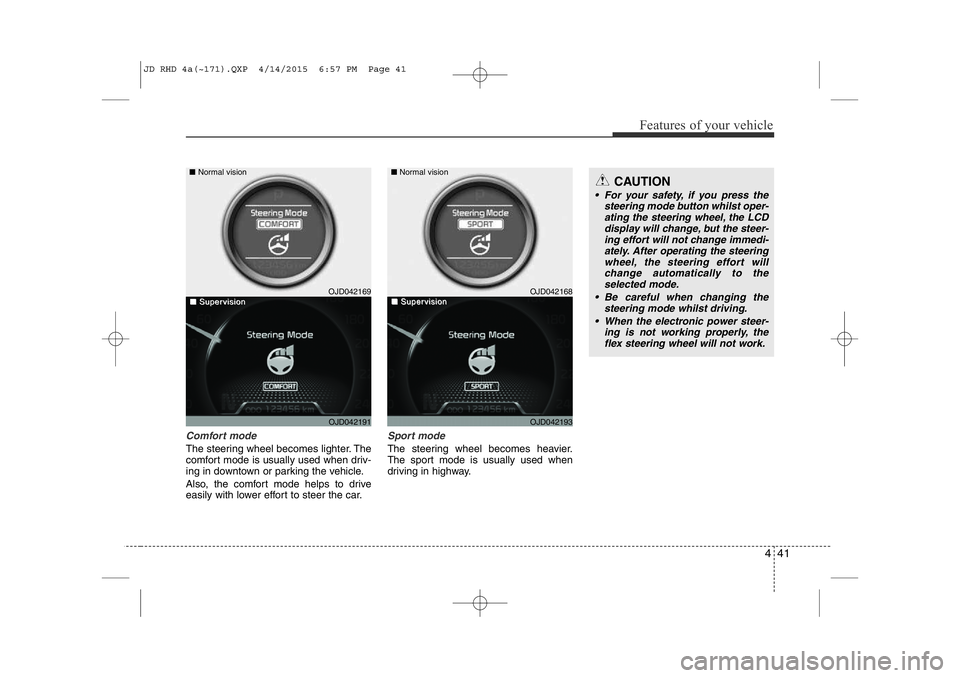
Comfort mode
The steering wheel becomes lighter. The
comfort mode is usually used when driv-
ing in downtown or parking the vehicle.
Also, the comfort mode helps to drive
easily with lower effort to steer the car.
Sport mode
The steering wheel becomes heavier.
The sport mode is usually used when
driving in highway.
CAUTION
• For your safety, if you press thesteering mode button whilst oper-ating the steering wheel, the LCD display will change, but the steer-ing effort will not change immedi-
ately. After operating the steeringwheel, the steering effort will change automatically to the
selected mode.
• Be careful when changing the steering mode whilst driving.
• When the electronic power steer- ing is not working properly, theflex steering wheel will not work.
OJD042169
OJD042191
■
Normal vision
■■SuperSupervisionvisionOJD042168
OJD042193
■ Normal vision
■■SuperSupervisionvision
JD RHD 4a(~171).QXP 4/14/2015 6:57 PM Page 41
Page 766 of 1210
481
Features of your vehicle
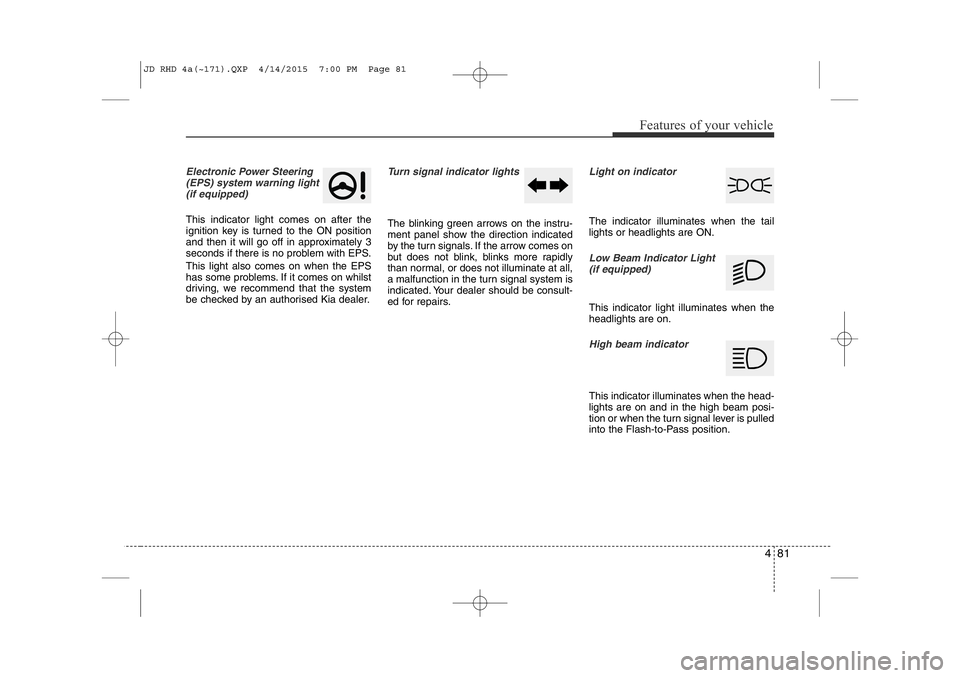
Electronic Power Steering(EPS) system warning light(if equipped)
This indicator light comes on after the
ignition key is turned to the ON position
and then it will go off in approximately 3
seconds if there is no problem with EPS. This light also comes on when the EPS
has some problems. If it comes on whilst
driving, we recommend that the system
be checked by an authorised Kia dealer.
Turn signal indicator lights
The blinking green arrows on the instru-
ment panel show the direction indicated
by the turn signals. If the arrow comes on
but does not blink, blinks more rapidly
than normal, or does not illuminate at all,
a malfunction in the turn signal system is
indicated. Your dealer should be consult-
ed for repairs.
Light on indicator
The indicator illuminates when the tail lights or headlights are ON.
Low Beam Indicator Light(if equipped)
This indicator light illuminates when the headlights are on.
High beam indicator
This indicator illuminates when the head- lights are on and in the high beam posi-
tion or when the turn signal lever is pulled
into the Flash-to-Pass position.
JD RHD 4a(~171).QXP 4/14/2015 7:00 PM Page 81
Page 959 of 1210
59
Driving your vehicle
ENGINE START/STOP BUTTON (IF EQUIPPED)
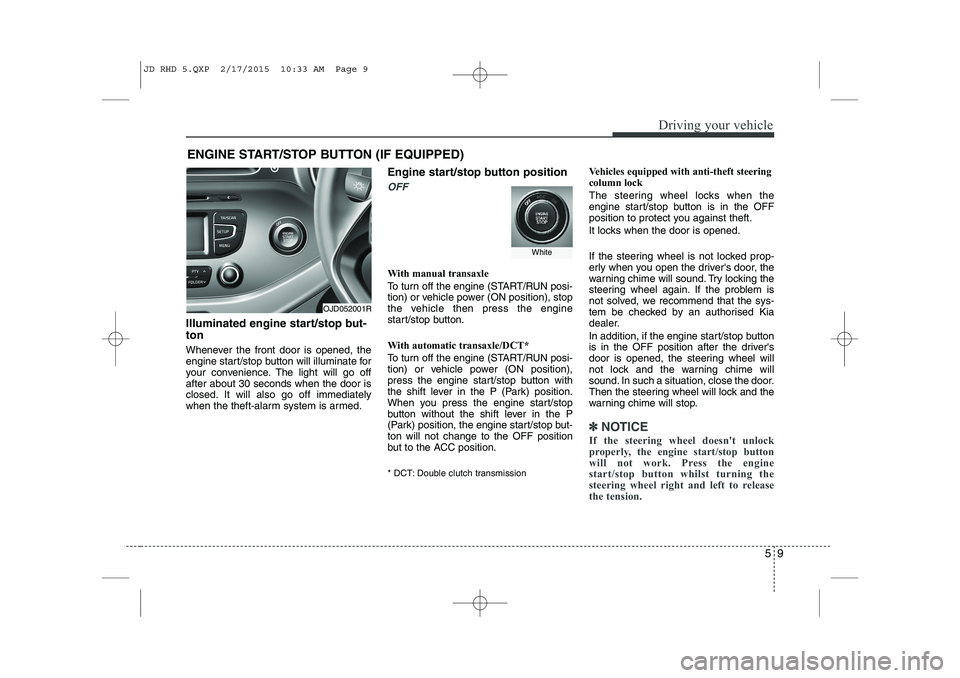
Illuminated engine start/stop but- ton
Whenever the front door is opened, the
engine start/stop button will illuminate for
your convenience. The light will go offafter about 30 seconds when the door is
closed. It will also go off immediately
when the theft-alarm system is armed. Engine start/stop button position
OFF
With manual transaxle
To turn off the engine (START/RUN posi-
tion) or vehicle power (ON position), stop
the vehicle then press the engine
start/stop button.
With automatic transaxle/DCT*
To turn off the engine (START/RUN posi-
tion) or vehicle power (ON position),
press the engine start/stop button with
the shift lever in the P (Park) position.
When you press the engine start/stop
button without the shift lever in the P
(Park) position, the engine start/stop but-ton will not change to the OFF position
but to the ACC position.
* DCT: Double clutch transmissionVehicles equipped with anti-theft steering
column lock
The steering wheel locks when the
engine start/stop button is in the OFF
position to protect you against theft.
It locks when the door is opened.
If the steering wheel is not locked prop-
erly when you open the driver's door, the
warning chime will sound. Try locking the
steering wheel again. If the problem is
not solved, we recommend that the sys-
tem be checked by an authorised Kia
dealer.
In addition, if the engine start/stop button
is in the OFF position after the driver's
door is opened, the steering wheel will
not lock and the warning chime will
sound. In such a situation, close the door.
Then the steering wheel will lock and the
warning chime will stop.
✽✽
NOTICE
If the steering wheel doesn't unlock
properly, the engine start/stop button
will not work. Press the engine
start/stop button whilst turning the
steering wheel right and left to release
the tension.
OJD052001R
White
JD RHD 5.QXP 2/17/2015 10:33 AM Page 9
Page 960 of 1210
Driving your vehicle
10
5
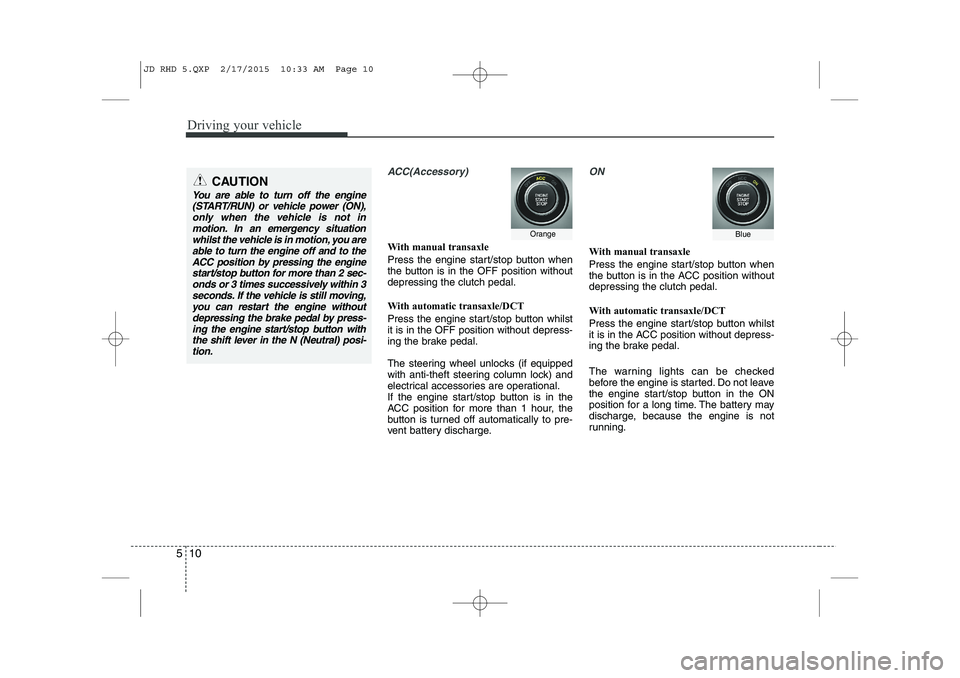
ACC(Accessory)
With manual transaxle
Press the engine start/stop button when
the button is in the OFF position withoutdepressing the clutch pedal.
With automatic transaxle/DCT
Press the engine start/stop button whilst it is in the OFF position without depress-
ing the brake pedal.
The steering wheel unlocks (if equipped
with anti-theft steering column lock) and
electrical accessories are operational.
If the engine start/stop button is in the
ACC position for more than 1 hour, the
button is turned off automatically to pre-
vent battery discharge.
ON
With manual transaxle
Press the engine start/stop button when
the button is in the ACC position withoutdepressing the clutch pedal.
With automatic transaxle/DCT
Press the engine start/stop button whilst
it is in the ACC position without depress-
ing the brake pedal.
The warning lights can be checked
before the engine is started. Do not leave
the engine start/stop button in the ON
position for a long time. The battery may
discharge, because the engine is not
running.
CAUTION
You are able to turn off the engine
(START/RUN) or vehicle power (ON),
only when the vehicle is not inmotion. In an emergency situation whilst the vehicle is in motion, you areable to turn the engine off and to the
ACC position by pressing the engine start/stop button for more than 2 sec-onds or 3 times successively within 3
seconds. If the vehicle is still moving,you can restart the engine without depressing the brake pedal by press-ing the engine start/stop button with
the shift lever in the N (Neutral) posi-tion.
OrangeBlue
JD RHD 5.QXP 2/17/2015 10:33 AM Page 10